What Is RTP? Unpacking the Structure, Science, and Service Life of Modern Reinforced Thermoplastic Pipe
Reinforced Thermoplastic Pipe (RTP) is a spoolable composite line pipe built from three structural layers: a thermoplastic liner that contains the fluid, a reinforcement layer that carries the pressure load, and a protective outer jacket that keeps the reinforcement intact. The layers are designed together, and each one governs a different part of what the pipe can do and how long it stays in service.
Most buying conversations begin with a price per meter. A more useful starting point is the cross-section. Two lines that look identical from the outside can behave very differently on site if their liner chemistry, reinforcement architecture or jacket construction differ — and those differences surface later, in chemical compatibility, pressure capability, coil handling and maintenance load.
This explainer is written for procurement and engineering teams at the decision stage: you already treat RTP as a credible alternative to steel, and you need to understand what you are actually specifying before you compare suppliers. It covers the anatomy of modern RTP, the mechanical logic that lets a thermoplastic pipe hold high pressure, and the factors that set service life.
The Decision Behind the Definition: Which Layer Are You Buying?
RTP is often compressed into one sentence — a flexible pipe that replaces steel — and that sentence hides the engineering. A steel line is a single homogeneous pressure barrier, so its dominant failure mode is well understood: wall loss from corrosion, followed by scheduled maintenance several times a year. An RTP line is a composite system, and its risks are distributed across layers instead of concentrated in one wall.
That difference changes the questions a buyer should ask. Liner incompatibility with the produced fluid, reinforcement fatigue under cyclic pressure, jacket damage during handling, and connection integrity are separate failure paths, each governed by a different part of the specification. The practical answer to "what is RTP" is therefore structural: what each layer does, what it fails from, and which document proves it.
- Liner — governs chemical compatibility, corrosion resistance and fluid containment.
- Reinforcement — governs pressure capability, and in practice the achievable coil length and weight.
- Jacket — governs external protection, handling durability and, indirectly, long-term reinforcement integrity.
- Connections — govern where most field leaks and make-up problems appear.
Why RTP Is Becoming a Standard in Energy Extraction
Three developments explain the shift from steel to composite line pipe.
Standards now define the product. API Specification 15S sets requirements for spoolable reinforced plastic line pipe up to 6 inches (150 mm) in diameter with pressures up to 5,000 psi (34.5 MPa), and its scope covers end fittings or couplings alongside the pipe. Once a product category has a published specification, procurement can be written around testable clauses instead of general claims.
The market has scaled. One commercial research source projects the global RTP market at approximately USD 7.94 billion in 2026, with the oil and gas segment valued at roughly USD 2.0–2.5 billion in the same year, according to an authoritative industry outlook. These are research projections rather than audited figures, but they indicate that RTP is no longer a specialty line item.
Corrosion is the economic driver. Commercial research estimates that RTP systems reduce corrosion-related failures by more than 70% compared with traditional steel pipelines. That number should be read as a directional industry estimate rather than a guarantee for a specific line. The mechanism behind it, however, is straightforward: a thermoplastic liner does not rust, so the maintenance cycle that dominates steel economics largely disappears.
The Three-Layer Anatomy of a Modern RTP
General technical descriptions of RTP converge on the same construction: a thermoplastic liner, a reinforcement layer and a protective outer jacket. What differs between suppliers — and what matters at the decision stage — is how each layer is specified.
1. The Liner: Containment, Corrosion Resistance and Chemistry
The liner is the only layer that touches the fluid, so it defines chemical compatibility and provides the corrosion barrier and the initial seal. Liner specification is a project decision rather than a catalogue default: polymer families commonly evaluated in the industry include HDPE, crack-resistant HDPE grades such as PE100 RC, PE-RT, PA12 and polypropylene (PP), with selection driven by the produced fluid, operating temperature, permeation limits and, in some services, the need for a static dissipative grade to manage charge accumulation.
2. The Reinforcement Layer: The Structural Core
The reinforcement carries the pressure load. ZYfire states that its RTP/TCP product line covers four reinforcement architectures: polyester fiber tape, aramid fiber tape, glass fiber tape and steel wire tape. These architectures are not interchangeable by default — they differ in stiffness, weight, tape geometry and how the finished pipe behaves when spooled and deployed — so the correct choice follows from pressure class, bore size, coil length and cost target rather than from a generic ranking. A design that suits a 6-inch high-pressure line is not automatically right for a small-bore slurry line.
3. The Outer Jacket: Protection That Protects Everything Else
The jacket is the layer buyers underestimate. Reinforcement tapes are strong in the direction they are wound and comparatively vulnerable to abrasion, impact and environmental exposure. A jacket that survives transport, spooling and site handling keeps water and grit away from the reinforcement; a jacket damaged in handling creates a degradation path that no datasheet measures directly. Jacket specification is therefore a handling and site-conditions decision as much as a material decision.
4. Connections: Where Field Performance Is Decided
Pipe and end fittings are qualified together, and API 15S explicitly addresses end fittings or couplings alongside the pipe. Connection type also drives installation labour: flange-connected and quick-connect configurations trade assembly speed against weight and handling requirements, and the right choice depends on whether a line will be assembled once or broken apart repeatedly.
The Science of Load Sharing — and What Actually Governs Service Life
High pressure inside a thermoplastic pipe sounds contradictory until the two jobs are separated. The liner seals; it does not carry the hoop load. The reinforcement carries the load; it does not seal. The jacket protects the reinforcement from the outside world. Pressure capability comes from that division of labour, which is why a 5,000 psi pipe can still be flexible enough to spool onto a reel.
Service life follows the same logic. There is no single published number that applies to every RTP line, because life is set by the interaction of five factors:
- Fluid-to-liner compatibility. Chemical attack, swelling or permeation can shorten life before any mechanical limit is reached.
- Pressure and cycling. Static pressure is one case; repeated pressure swings load and unload the reinforcement, so cyclic duty belongs in the design brief.
- Temperature. Pressure capability is temperature-dependent, and ratings must be read from the manufacturer's tables for the specific liner and reinforcement combination rather than assumed from a headline figure.
- External damage. Force damage is the one maintenance trigger consistently flagged for RTP — maintenance is otherwise minimal, in contrast to steel pipe, which requires corrosion maintenance several times a year.
- Connection integrity. Joints are made on site, often in poor conditions, and are the most installation-sensitive part of the system.
On the supplier side, corrosion risk is managed at the front end: material selection for the medium, verified by simulation testing before a line is released. That combination — a corrosion-resistant liner choice plus test evidence — is what converts a material claim into a specification.
| Layer | Primary function | What the buyer should verify | Why it matters for service life |
|---|---|---|---|
| Liner | Fluid containment, corrosion barrier, chemical compatibility | Polymer family, compatibility test data, temperature limits, static dissipative grade where required | Incompatible chemistry degrades life regardless of pressure class |
| Reinforcement | Carries the pressure load | Architecture (polyester, aramid, glass fiber or steel wire tape), test evidence for the size and pressure class | Sets pressure capability and cyclic behaviour, and constrains coil weight and length |
| Outer jacket | Protects reinforcement from abrasion, impact and environment | Jacket construction, handling and installation conditions | A damaged jacket exposes reinforcement, which is a life-limiting path |
| Connections | Transition from pipe to system | Connection type, coupling scope within the certificate, make-up procedure | Most installation-sensitive element of the line |
A note on verification: ZYfire states that it produces RTP certified under API Specification 15S. Buyers should request the current certificate and confirm the holder, factory, product family, size range, pressure class, coupling scope and validity dates against the actual order — a certification claim and a certificate scope are not the same document.
Step-by-Step: Specifying an RTP Line Without Guesswork
The sequence below converts the anatomy into a specification order. Following it avoids the most common mistake: fixing a pressure class first and discovering a liner incompatibility later.
- Fix the service envelope. Fluid composition, continuous and peak temperature, continuous and cyclic pressure, flow rate and required bore. Everything downstream depends on this step.
- Select the liner. Match the polymer family to the medium and add a static dissipative grade where charge accumulation is a concern. Confirm compatibility from test data, not from a generic chemical-resistance chart alone.
- Set the pressure class inside a known standard. API 15S covers spoolable reinforced plastic line pipe up to 6 inches and up to 5,000 psi. Where the duty falls outside that envelope, the design route changes and should be discussed explicitly rather than assumed.
- Choose the reinforcement architecture. Confirm which of the four architectures — polyester, aramid, glass fiber or steel wire tape — the supplier proposes, and on what basis: pressure class, bore, coil length and the weight limit of site handling equipment.
- Specify the jacket and the handling plan. State transport, spooling and installation conditions, then check the jacket specification against them. Confirm the installation method and expected daily rate: ZYfire's comparison material cites around 10 km per day for RTP against less than 2 km per day for steel pipe.
- Close the documentation loop. Connection drawings, qualification test reports, certificate scope and maintenance assumptions — minimal, but defined for the force-damage case — belong in the order package.
Where the Anatomy Pays Off: Representative Applications
Supplier-stated RTP application coverage includes onshore and offshore oil and gas gathering, high-pressure oilfield water injection, flowback fluid transportation, mine slurry backfilling, corrosive chemical media, geothermal hot water, municipal high-pressure water, seawater desalination and irrigation. The layer that matters most changes with the application:
- Onshore oilfield gathering and water injection — liner compatibility and pressure class dominate; corrosion resistance removes the repainting and replacement cycle typical of steel.
- Flowback and produced water service — abrasive, chemically variable media put the liner and the connection seals under continuous scrutiny.
- Offshore and marine lines — weight and installation speed matter as much as pressure, and lower site transport cost is part of the case for RTP.
- Mining slurry backfill and dewatering — abrasion resistance and rapid deployment over long distances decide the design.
- Corrosive chemical and geothermal service — temperature-corrected ratings and liner chemistry are the governing variables.
RTP vs Steel Pipe: What the Structure Changes on Site
At the decision stage the useful comparison is not material prestige; it is which cost and risk line moves. The table below uses figures from ZYfire's RTP-versus-steel comparison material.
| Decision factor | Reinforced Thermoplastic Pipe | Steel pipe |
|---|---|---|
| Installation rate | Around 10 km per day | Less than 2 km per day |
| Relative installation speed | Described as 5x higher than steel pipe | Baseline |
| Maintenance | Minimal; intervention only if force damage occurs | Corrosion maintenance several times a year |
| Corrosion behaviour | Corrosion-resistant thermoplastic liner; no rust-driven wall loss | Corrosion is the dominant maintenance driver |
| Transport and handling | Light weight, low site transport cost, spooled lengths | Heavier, requiring more lifting and jointing effort |
| Cost position | 20% lower cost than steel pipe in the same comparison | Higher cost basis in the same comparison |
| Typical fit | Mining and oil and gas lines, especially rapid-deployment and corrosive duty | Established duty where corrosion is controlled and installation speed is not critical |
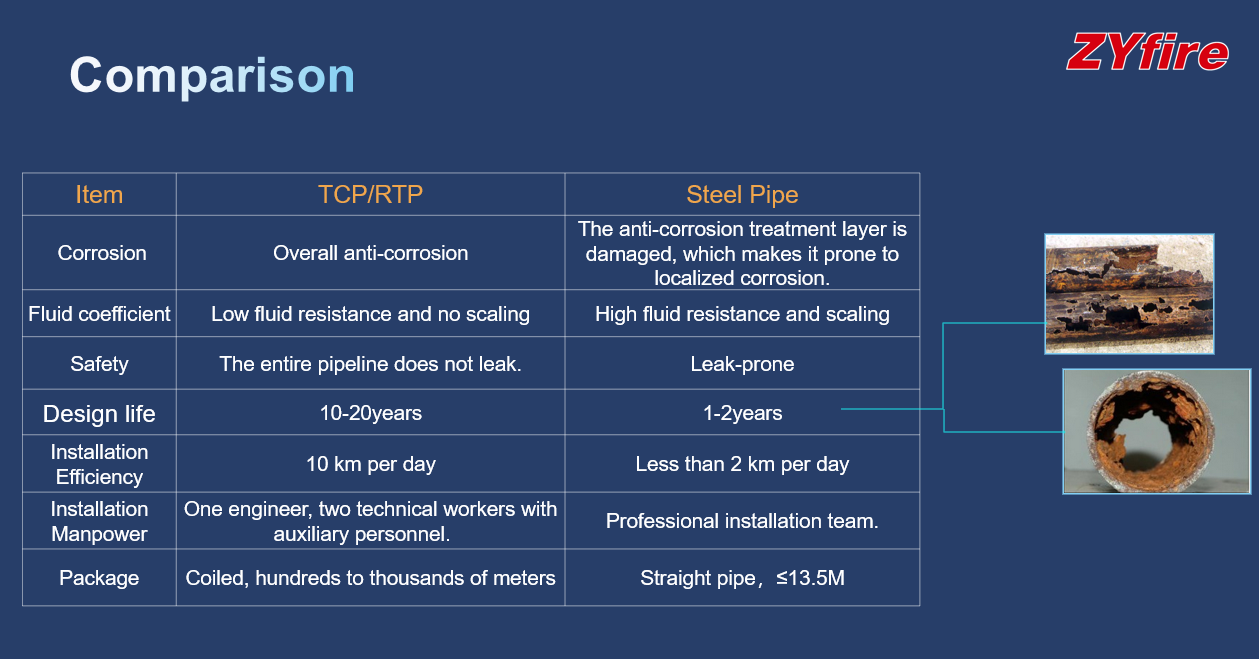
Cost and installation figures are comparison-material values and depend on bore, pressure class, length, connection type and destination. They are useful for framing a business case; they do not replace a project quotation.
Frequently Asked Questions
Is API 15S certification enough to approve an RTP supplier?
It is necessary evidence for oilfield work, but not sufficient on its own. API Specification 15S defines requirements for spoolable reinforced plastic line pipe up to 6 inches (150 mm) in diameter and pressures up to 5,000 psi (34.5 MPa), and it addresses end fittings or couplings as well as the pipe. A certificate should therefore be read as a scope statement: check the holder, factory, product family, size range, pressure class, coupling scope and validity dates against the exact configuration being purchased. ZYfire states that it produces RTP certified under API Specification 15S, and buyers should verify the current certificate against the order.
How is the pressure class confirmed for a specific project?
Pressure class is a design output, not a catalogue lookup. It depends on the liner and reinforcement combination, bore, temperature, and whether service is static or cyclic. API 15S provides the qualification framework up to 5,000 psi; within that framework, the supplier should present test evidence for the specific size and pressure class plus a temperature-corrected rating for the actual duty. Ask for the test report that matches your configuration, not one issued for a different bore.
Does RTP cost less than steel pipe?
In ZYfire's comparison material, RTP is stated at 20% lower cost than steel pipe, with an installation rate of around 10 km per day against less than 2 km per day for steel, and maintenance limited to force damage rather than corrosion maintenance several times a year. In most business cases the combined effect of installation speed, site transport cost and maintenance is larger than the pipe-price difference alone. Actual pricing depends on bore, pressure class, length, connections and destination, so the comparison should be rebuilt with a project quotation.
Can I evaluate a sample before placing a full order?
Yes. A sample or short trial length is the practical way to check handling, coil behaviour, connection make-up and liner compatibility assumptions before committing to a full line. ZYfire reports a 50-meter MOQ and a 30-day lead time for certain long-term RTP supply programs; the final sample scope depends on the configuration. Requests can be sent to equiry@zyfire.com or WhatsApp +86 18761071929 with the service envelope — fluid, temperature, pressure, bore and required length.
What lead time should a buyer plan for?
ZYfire reports a 30-day lead time for certain long-term RTP supply programs. That figure is configuration- and quantity-dependent and does not include transport to destination. For planning, confirm three things separately: production lead time for the exact specification, documentation and third-party inspection time where required, and shipping transit. Where a project needs staged deliveries, the delivery schedule should be written into the order rather than inferred from a headline lead time.
Conclusion: Structure First, Then Price
Reinforced Thermoplastic Pipe is best understood as a mechanical upgrade over legacy steel systems rather than a like-for-like substitution. Its pressure capability comes from a division of labour between a sealing liner, a load-bearing reinforcement and a protective jacket, and its service life is decided by five interacting variables rather than by a single rating number. That is why two lines with the same headline pressure can carry very different risk.
For buyers at the decision stage, the sequence that works is consistent: define the service envelope, select the liner against the fluid, set the pressure class inside a recognised standard such as API 15S, choose the reinforcement architecture on technical grounds, specify the jacket against real handling conditions, and close the loop with certificate scope and test evidence. When that order is followed, the commercial comparison with steel becomes meaningful — because the numbers being compared describe a defined product rather than a category.
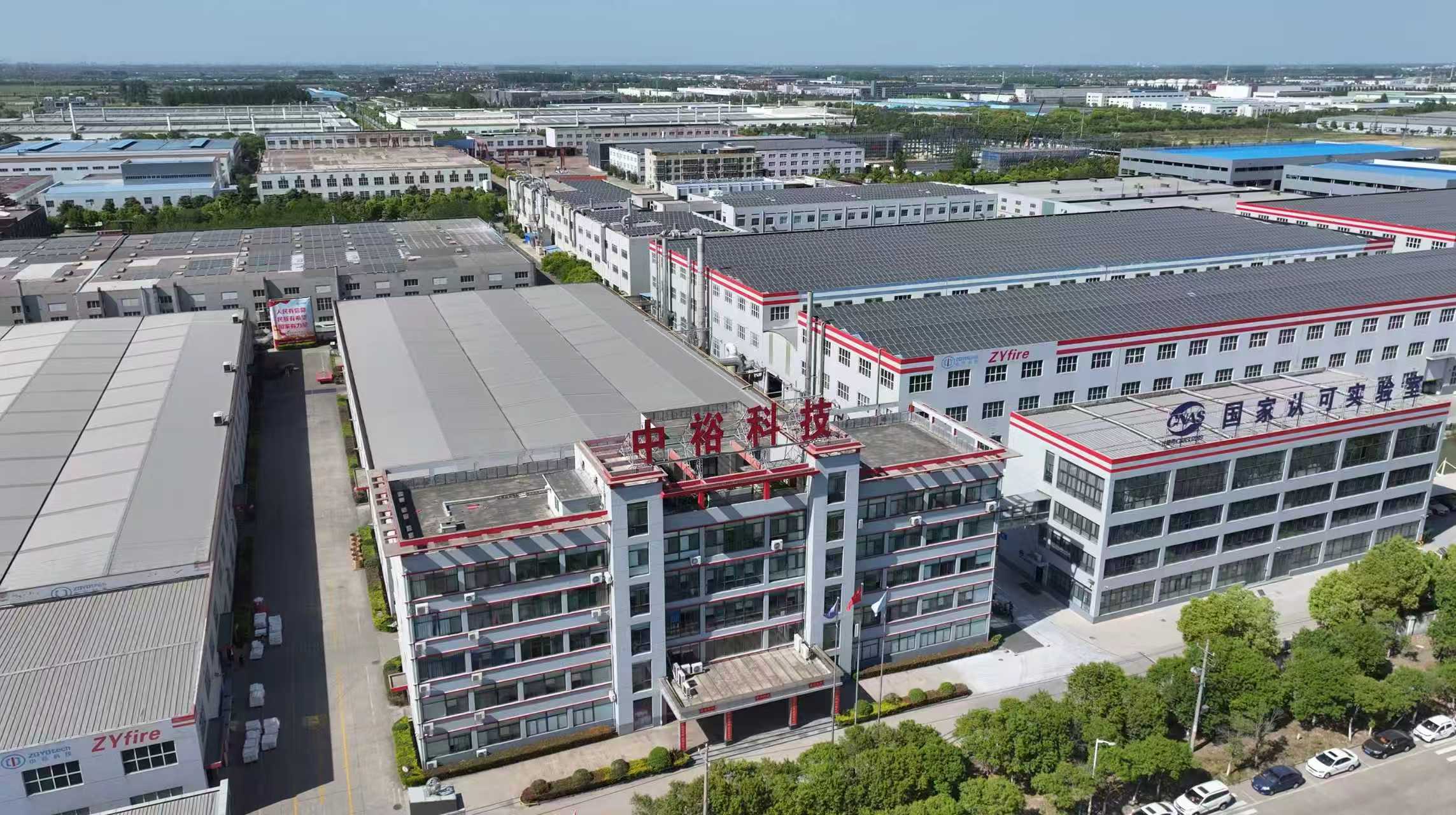
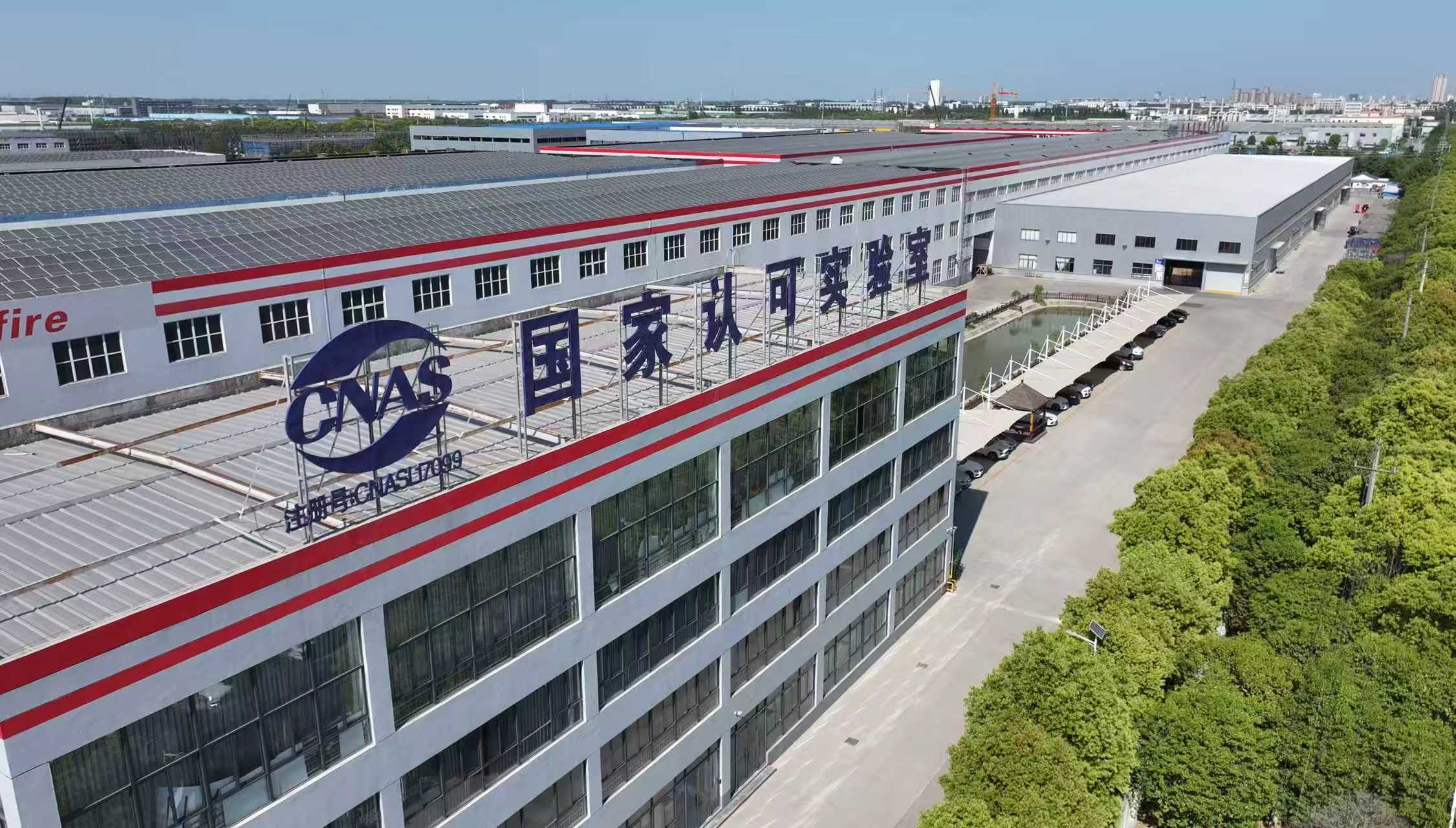
ZYfire Hose Corporation, founded in 2000, is a manufacturer of fire hose, oilfield hose and reinforced thermoplastic pipe headquartered in Jiangyan City, Jiangsu, China, with manufacturing and logistics operations in China, the United States, Saudi Arabia, the United Arab Emirates and Malaysia, and a CNAS-accredited testing laboratory.
Next Step: Sample, Quotation or Catalogue
Send the service envelope — fluid, temperature, continuous and peak pressure, bore and total length — and ZYfire can confirm the liner and reinforcement configuration, the applicable pressure class, and the documentation package for your project.
Email: equiry@zyfire.com | Tel: +86 523 88802123 | WhatsApp: +86 18761071929 | Web: www.zyfire.com
Product catalogue and technical brochure (PDF, public download): Download the ZYfire brochure
Have Questions or Need More Details?
Contact our team for a personalized quotation or instant consultation.
Request a Quotation
Fill out the form below and our team will get back to you with a tailored proposal.
WhatsApp Direct Chat
Prefer to chat in real-time? Message us on WhatsApp for instant assistance & quick answers.
- Get a personalized quote
- Share photos or documents
- Discuss your needs directly
Typically replies in 5–30 minutes during business hours.