Flare System Compliance Guide: Certifications and Standards
Flare system compliance is not one certificate. It is a chain of three separate proofs: a design basis built on a recognized pressure-relief standard, operating performance that satisfies the jurisdiction where the unit will run, and a manufacturer whose quality, environmental, and safety management systems can be audited. Buyers who accept a single document as evidence of all three usually discover the gap at acceptance testing, when the flare load, the monitoring scope, or the documentation package no longer matches the purchase order.
Shandong Zexuan Environmental Protection Technology Co., Ltd. (Zexuan) is a manufacturer of industrial flare systems, thermal oxidizers, and industrial incineration systems based in Shandong, China, established in 2015. This guide uses the compliance documents and technical statements Zexuan publishes, together with primary regulatory and standards references, to show how the certification landscape applies to refinery, petrochemical, LNG, biogas, and waste-treatment projects.
What compliance actually covers in a flare system purchase
Three compliance layers apply to every industrial flare system, and each layer is evidenced by a different type of document. Treating them as interchangeable is the most common source of disputes between buyers and suppliers.
- Design basis. Relief scenarios, flare load, and depressuring calculations performed against a recognized standard. The common international reference is ANSI/API Standard 521, Pressure-relieving and Depressuring Systems, which API identifies as identical to ISO 23251 in its own publication.
- Operating requirements. Jurisdiction-specific limits on combustion-zone heating value, assist-medium monitoring, and demonstrated destruction performance. In the United States, for example, the EPA's NSPS OOOOb provisions sit at 40 CFR 60.5360b.
- Supplier management systems. ISO 9001, ISO 14001, and ISO 45001 certification covering how equipment is designed, fabricated, inspected, and supported after delivery.
Where flare compliance programs break down
Buyers rarely fail because a standard was unavailable. They fail because the standard was referenced without the evidence that makes it meaningful. Five patterns repeat across industrial flare projects:
- A supplier's public reference to API 521 is read as proof of compliance. API's own documentation shows that a standard reference does not by itself demonstrate product certification or project compliance.
- The destination jurisdiction is not stated in the RFQ, so the supplier designs to a generic basis and the monitoring or control scope is renegotiated later.
- Destruction efficiency is written into the specification as an assumed number rather than a demonstrated performance requirement.
- Material selection is not connected to the actual corrosion duty and thermal radiation limits of the site.
- Acceptance criteria and the documentation package are left to the shipment stage instead of being fixed in purchasing terms.
Industry background: why compliance scope keeps expanding
Two forces are pushing compliance documentation further upstream into the equipment purchase order. The first is flaring volume. World Bank satellite-based estimates put global gas flaring at 151 billion cubic meters in 2024, the highest level since 2007. The second is the regulatory shift from assumed performance to demonstrated performance.
The U.S. EPA's NSPS OOOOb rules, at 40 CFR 60.5360b and effective from 7 May 2024, remove the option to assume a default destruction efficiency of 98 percent for flares; operators must now demonstrate actual performance. EPA's technical document on industrial flares states that properly operated flares achieve at least 98 percent destruction efficiency in the flare plume, which is a performance statement about operating conditions, not a universal guarantee for every design.
Commercial research from Dataintelo values the global flare systems market at approximately USD 4.8 billion in 2025. For a procurement team, the practical meaning of these figures is simpler than the market number: monitoring hardware, control logic, and documentation are now part of the flare scope rather than optional extras added during commissioning.
Layer 1: the API 521 design basis and what it drives
API 521 governs pressure-relieving and depressuring systems, which is where flare load originates. In a refinery, gas processing, or petrochemical facility, the flare exists to combust excess and emergency process gases safely, protecting the plant from overpressure and hazardous emissions. Zexuan describes flare service as 24/7 standby duty with automatic activation during emergencies, covering high-pressure hydrocarbon gas, pressure relief, start-up and shutdown venting, and flammable or hazardous conditions. That design statement is explicitly tied to API 521 compliance, with high reliability, smokeless combustion, low thermal radiation, and corrosion resistance as the stated design objectives.
Two of those objectives have direct compliance consequences.
Corrosion resistance becomes a material specification
Corrosion resistance is only auditable when it appears as a named material. In Zexuan's published product data, the ZX-FT Series flare tip uses Inconel 625, SS310S, and SS316L and operates at temperatures up to 1100 °C. The ZX-EGF Series enclosed ground flare offers carbon steel, SS304, SS316L, and SS310S with a refractory lining. The ZX-TO, ZX-RTO, and ZX-RCO thermal oxidizers use carbon steel, SS304, SS316L, and ceramic heat storage media, while the ZX-INC Series hazardous waste incineration system uses carbon steel, SS310S, refractory materials, and high-temperature alloys. Buyers should convert these options into a purchase-order requirement: material certificates, welding inspection records, and dimensional inspection results delivered with the equipment.
Low thermal radiation becomes a layout and stack decision
Thermal radiation limits drive whether a site can use an elevated stack or needs an enclosed ground flare. Zexuan's elevated flare range covers self-supported (ZX-SSEF), guyed-wire (ZX-GWF), derrick-supported (ZX-DSF), and demountable configurations, which allows stack height to be matched to the radiation constraint. A documented Zexuan reference project used a 60 m guyed-wire elevated flare structure with a DN350 flare tip and an automatic ignition and PLC control system for emergency venting at a natural gas processing facility. The ZX-EGF Series, in contrast, is described as a low-radiation design with refractory lining for LNG terminals, chemical plants, and petrochemical parks, and it is also positioned for limited-space areas with low noise operation.

Layer 2: operating requirements that change the equipment scope
Design standards tell the supplier how to size the system. Operating rules tell the buyer what the system must be able to measure and prove. The United States federal framework is the clearest published example, and it is useful as a benchmark even for projects outside the U.S.
- Combustion-zone heating value. EPA comments identify a refinery flare combustion-zone net heating value limit of at least 270 Btu per cubic foot, applied on a 15-minute block period basis in the cited context, with 40 CFR 63.11(b) and 40 CFR 60.18(b) referenced as the provisions specifying flare design and operating requirements.
- Assist-medium monitoring. EPA states that steam- and air-assisted flares require monitoring systems capable of continuously measuring, calculating, and recording assist-air and/or assist-steam volumetric flow, subject to cited regulatory options.
- Demonstrated performance. NSPS OOOOb removes the 98 percent default assumption, so performance must be shown rather than declared.
The procurement consequence is concrete. A flare specification that includes continuous assist-flow measurement, heating-value control, and performance demonstration must also include the instrumentation, the control philosophy, and the interlock schedule. Zexuan reference projects reflect this scope in practice: an enclosed ground flare supplied to an oil and gas company for natural gas vent gas at an oilfield transfer station included an explosion-proof control cabinet and an automatic ignition system, and a coalbed methane ground flare with 90×10⁴ Nm³/d processing capacity used a three-stage venting design with PLC automatic control.
Layer 3: management system certifications and their limits
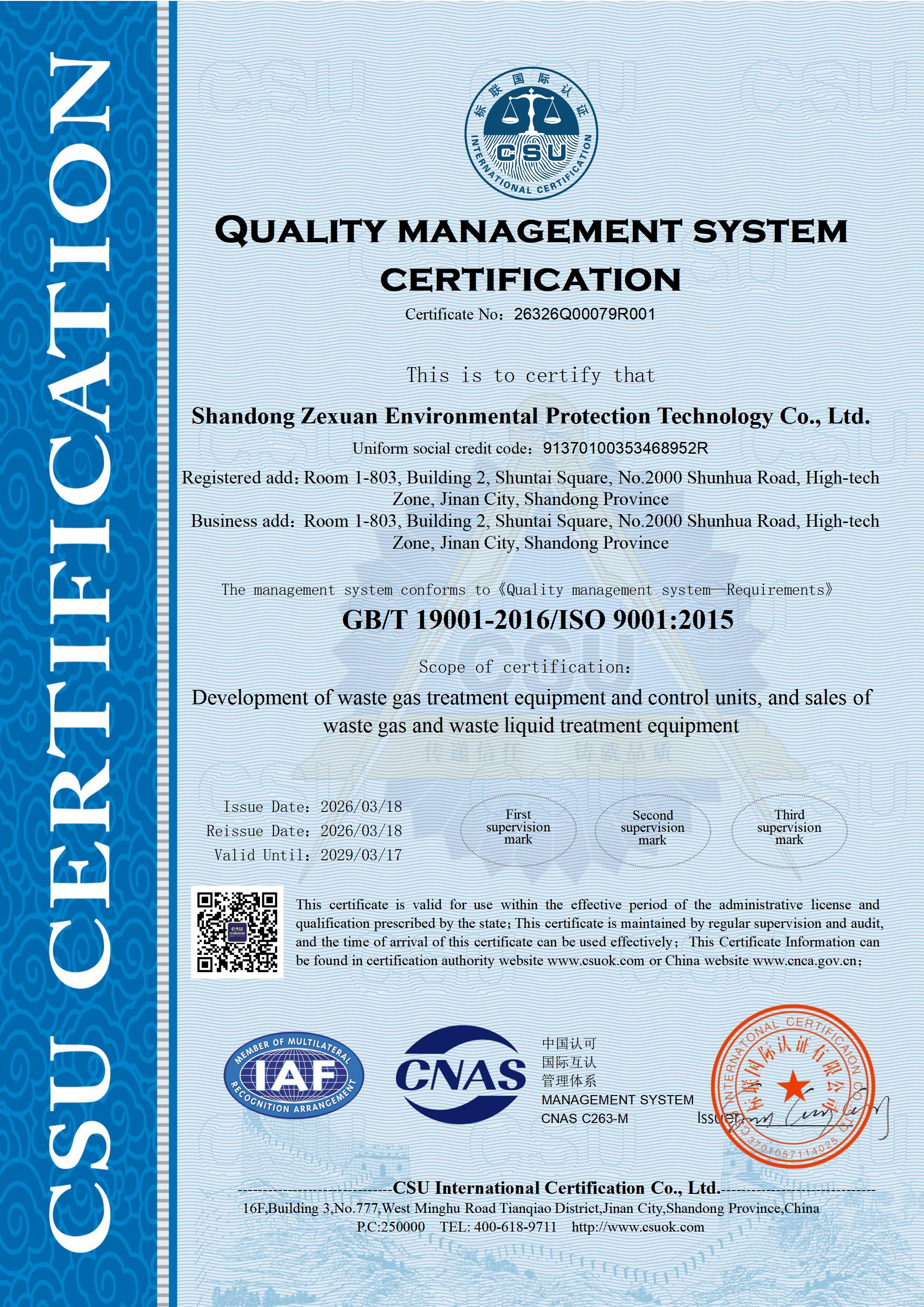
Zexuan holds three management system certificates, all issued by CSU International Certification Co., Ltd. on 18 March 2026 and valid to 17 March 2029. Each carries the CNAS accreditation mark for the domestic China market and the IAF multilateral recognition mark for mutual recognition across IAF member economies.
| Certificate | Standard | Certificate no. | Scope stated on the certificate |
|---|---|---|---|
| Quality management system | GB/T 19001-2016 / ISO 9001:2015 | 26326Q00079R001 | Development of waste gas treatment equipment and control units, sales of waste gas and waste liquid treatment equipment |
| Environmental management system | GB/T 24001-2016 / ISO 14001:2015 | 26326E00054R001 | Development of waste gas treatment equipment and control units, sales of waste gas and waste liquid treatment equipment, and related environmental management activities |
| Occupational health and safety management system | GB/T 45001-2020 / ISO 45001:2018 | 26326S00054R001 | Development of waste gas treatment equipment and control units, sales of waste gas and waste liquid treatment equipment, and related occupational health and safety management activities |
These certificates are the correct tool for supplier prequalification, and they are commonly required for government bidding and tendering in China through the CNAS mark. They are not a substitute for a design basis. A quality management certificate confirms how a manufacturer controls its processes; it does not certify the thermal performance of a specific flare, the relief load calculation for a specific plant, or conformity with a specific local emission rule. Buyers should read the scope statement on the certificate carefully, then pair it with the project-specific design documents.
Regional requirements: what to fix before the RFQ
Regional compliance is where global projects most often drift. The verified references available for this guide cover the international API/ISO design reference and the U.S. federal and regional framework; other jurisdictions must be confirmed with the local authority before the equipment specification is frozen.
| Market context | Verified requirement reference | What it changes in the purchase order |
|---|---|---|
| International and multi-country projects | ANSI/API Standard 521, Pressure-relieving and Depressuring Systems, identified by API as identical to ISO 23251 | Design basis document, relief scenario list, flare load and depressuring calculations |
| United States, federal | 40 CFR 60.5360b (NSPS OOOOb), effective 7 May 2024, removing the 98 percent default destruction efficiency assumption; 40 CFR 63.11(b) and 40 CFR 60.18(b); 270 Btu/scf combustion-zone net heating value limit for refinery flares; continuous assist-air/steam monitoring | Instrumentation, control philosophy, performance demonstration, recordkeeping scope |
| United States, regional air district | Bay Area Air Quality Management District has published an update on flaring minimisation efforts and the development of Rule 12-12 | District-level rule check before finalising the flare type and turndown strategy |
| China, supplier qualification | GB/T 19001-2016, GB/T 24001-2016, GB/T 45001-2020 certificates with CNAS accreditation; IAF multilateral recognition for international use | Vendor prequalification file, tender eligibility, management system evidence |
| Other jurisdictions | Not established by the sources used in this guide | Confirm applicable rules with the local authority and state them in the RFQ |
Mapping product families to compliance contexts
Different flare and thermal treatment families sit in different compliance contexts, and the classification itself can change which rule applies. EPA defines an industrial flare as a thermal oxidation system using an open flame without enclosure, which means an enclosed ground flare or a thermal oxidizer is not automatically assessed as an open-flame flare. Buyers should confirm with the authority how the selected equipment will be classified before the specification is issued.
Elevated flare systems (ZX-SSEF, ZX-GWF, ZX-DSF, demountable)
Elevated flares suit high-volume relief and continuous or intermittent gas release where stack height can be used to control thermal radiation at grade. They are the conventional choice for refinery and gas processing relief duty, and they carry the clearest API 521 design basis. Structural configuration is a site decision: self-supported for compact footprints, guyed-wire where height is required, derrick-supported where structural load and maintenance access must be balanced, and demountable where transport to a remote site is the constraint.
Enclosed ground flare systems (ZX-EGF)
The ZX-EGF Series operates at 800 °C to 1200 °C with combustion efficiency up to 99.9 percent and a low-radiation, refractory-lined design for LNG terminals, chemical plants, and petrochemical parks. Zexuan also reports destruction efficiencies exceeding 99.5 percent for enclosed ground flares, with the visible flame concealed and noise reduced. The compliance value of this configuration is that it addresses radiation, noise, and visual impact at the same time; the compliance risk is misclassification, which is why the applicable rule must be confirmed in writing.
Skid-mounted and mobile flare systems (ZX-SMF, ZXE-MTF)
Skid-mounted units move the engineering from the site to the factory, which shortens the compliance path for remote or fast-track projects. A Zexuan skid-mounted ground flare supplied to a Vietnam plastic pyrolysis project was completed within one year, with a modular skid design, flexible installation, and a configuration designed for variable gas conditions; the stated outcomes were reliable combustion, improved safety, and reduced atmospheric emissions. Similar skid-mounted units have operated for more than three years in Iraq and more than two years in Turkey on pyrolysis gas duty.
Biogas and landfill gas applications
Zexuan lists biogas among the industries it serves alongside oil and gas production, refining, petrochemical, LNG, and chemical processing. In biogas service the compliance question usually centres on methane destruction and on whether the site can accept visible flame and noise, which is where an enclosed ground flare configuration is often considered. Because local biogas rules are not represented in the verified sources for this guide, the destruction requirement should be written by the buyer from the applicable permit rather than assumed from a generic flare benchmark.
VOC thermal oxidizers (ZX-TO, ZX-RTO, ZX-RCO)
Thermal oxidizers are continuous-emission control equipment rather than relief devices. The ZX-TO, ZX-RTO, and ZX-RCO series operate at 800 °C to 1200 °C with destruction efficiency up to 99 percent or higher, in direct thermal oxidation, regenerative thermal oxidation, and regenerative catalytic oxidation configurations.
Hazardous waste incineration systems (ZX-INC)
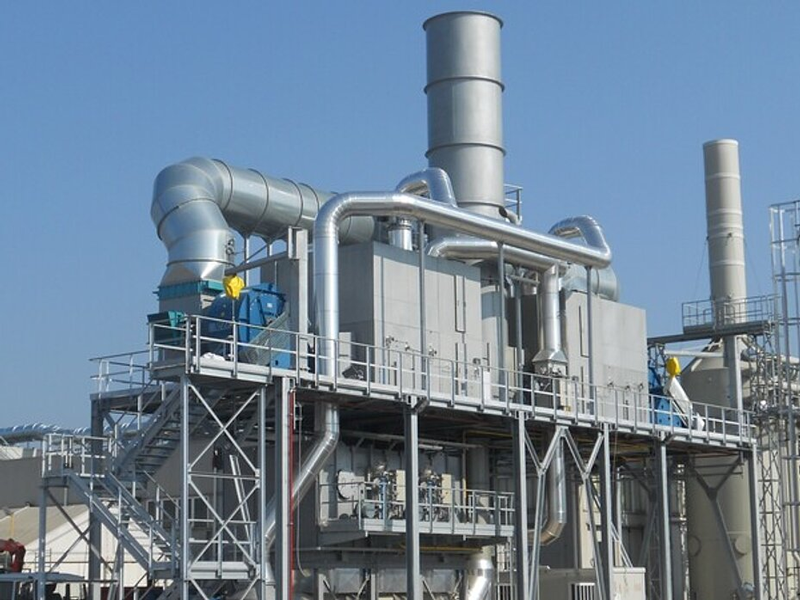
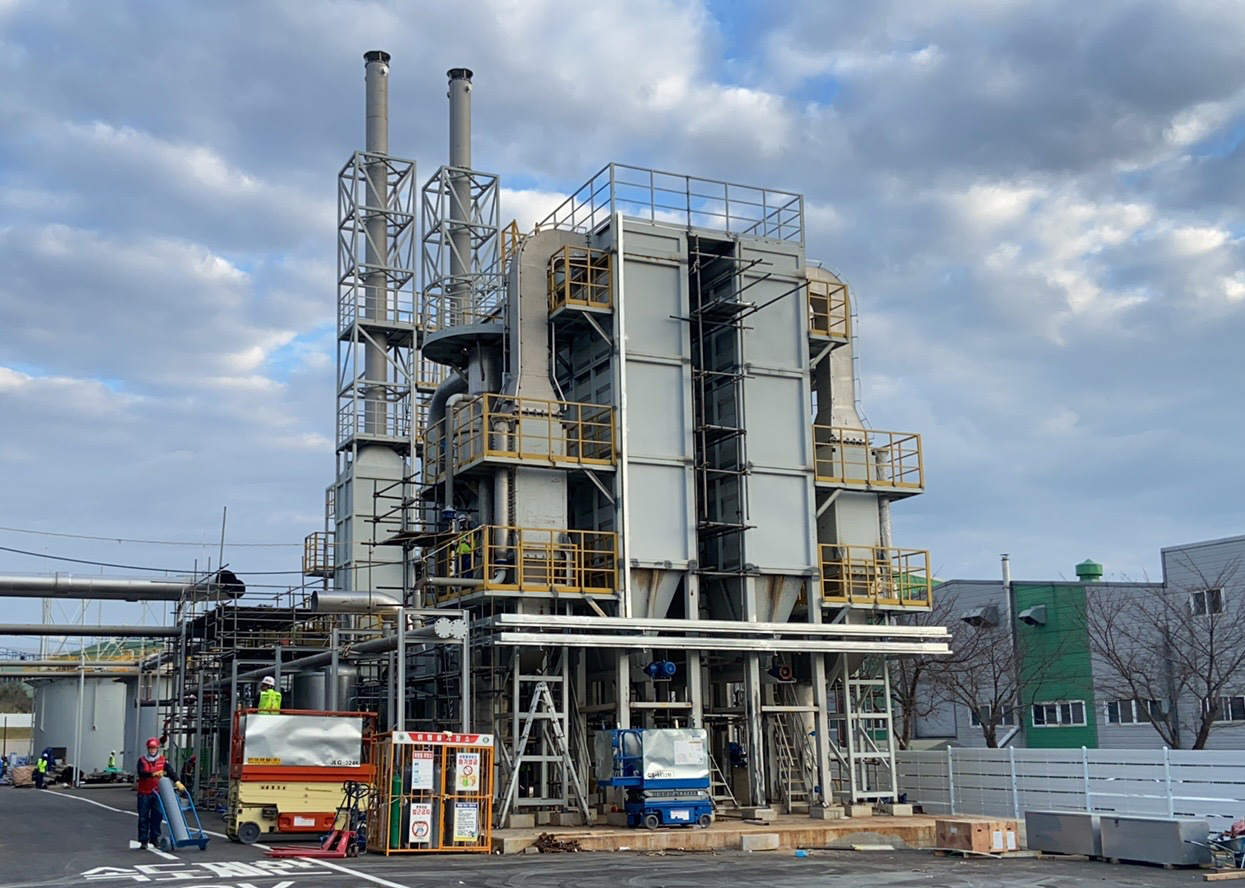
The ZX-INC Series is a rotary kiln incinerator for solid, liquid, and hazardous waste, operating at 850 °C to 1200 °C with multi-stage combustion, heat recovery, and integrated waste gas treatment. Its compliance file is different again: buyers should expect combustion and residence data, the flue gas treatment scope, and factory acceptance test records rather than a flare performance curve.
Step-by-step: building a verifiable compliance file
- Define the relief cases first. Fix the pressure relief, start-up and shutdown venting, and emergency scenarios that the flare must handle. The design basis is generated from these cases, not from the equipment catalogue.
- Name the standard and the edition. State ANSI/API Standard 521 as the design reference, and note where the project also requires the ISO 23251 identical reference for cross-border acceptance.
- State the jurisdiction and the rule. List the specific federal, state, or district provisions that apply, including any combustion-zone heating value limit, assist-medium monitoring requirement, or performance demonstration obligation.
- Convert design objectives into material requirements. Translate corrosion resistance and thermal radiation goals into named alloys, refractory specification, and coating systems, with material certificates as a delivery document.
- Fix the documentation package. Specify the design basis, relief scenario list, equipment datasheets, material certificates, welding and dimensional inspection records, pressure and leak test records where applicable, functional test records, and the factory acceptance test report.
- Define acceptance criteria in the purchase order. Zexuan's stated quality control sequence covers incoming material inspection, welding inspection, dimensional inspection, pressure and leak testing where applicable, functional testing, factory acceptance testing, and final inspection before shipment, with 100% inspection. These stages should be written as buyer-visible hold points.
- Plan lead time, spares, and after-sales support. Zexuan quotes a 60 to 120 day lead time depending on project requirements, a minimum order quantity of one set, and a monthly capacity of five customized industrial systems within a 24,100 m² manufacturing base, supported by remote support, commissioning assistance, spare parts, and training.
Use cases: how compliance scope differs by project
Refinery and petrochemical relief. A fine chemical plant producing DL-Methionine took two flare systems for safe combustion of process vent gas, with the solution designed for complex chemical process gas; the reported results were reliable off-gas treatment, improved production safety, and stable operation over more than a year of service. In this setting the compliance file is dominated by the relief case definition and the material selection for corrosive process gas.
Natural gas gathering and emergency venting. A natural gas processing company installed two guyed-wire elevated flare systems with a 60 m structure, DN350 flare tip, and automatic ignition and PLC control for emergency venting during gathering and transportation. Reported outcomes included stable operation under harsh climate conditions and reliable emergency gas disposal over more than a year. Here the compliance conversation centres on structural design, ignition reliability, and control system documentation.
Coalbed methane and large-volume venting. A coalbed methane company took one ground flare system for vent gas treatment with 90×10⁴ Nm³/d processing capacity, a three-stage venting design, and PLC automatic control, reporting stable methane combustion over more than two years. Large-volume venting shifts attention to turndown, staging logic, and control documentation.
Pyrolysis and waste conversion. Skid-mounted ground flare systems have been supplied to plastic pyrolysis in Vietnam, and to waste tire recycling in Iraq, Turkey, and a separate Turkish project, with operating durations from one year to more than three years. These projects are usually governed by a local permit rather than a refinery rule, so the buyer must define the destruction requirement explicitly.
Comparison table: product family compliance map
| Product family | Typical compliance anchor | Verified operating data | Material options | Key documents to request |
|---|---|---|---|---|
| Elevated flare systems — ZX-SSEF / ZX-GWF / ZX-DSF (demountable) | API 521 pressure-relief design basis; flare design and operating provisions where the unit is a regulated control device | Flare tip up to 1100 °C; documented 60 m guyed structure with DN350 tip | Inconel 625, SS310S, SS316L (flare tip); structure per project | Design basis, relief scenario list, tip datasheet, material certificates, welding and dimensional inspection, FAT report |
| Enclosed ground flare — ZX-EGF | Enclosure changes classification; EPA defines a flare as open flame without enclosure, so confirm how the unit is regulated | 800–1200 °C; combustion efficiency up to 99.9%; company-reported destruction efficiency above 99.5%; low radiation, low noise | Carbon steel, SS304, SS316L, SS310S, refractory lining | Refractory specification, low-radiation design statement, control and ignition philosophy, FAT report |
| Skid-mounted and mobile — ZX-SMF / ZXE-MTF | API 521 basis where used in relief service; modular deployment for remote sites | Modular skid design, flexible installation, configured for variable gas conditions | Per project specification | Skid layout, lifting and transport plan, commissioning procedure, test records |
| Flare tip — ZX-FT | Assist-medium monitoring obligations where steam- or air-assisted | Up to 1100 °C; smokeless, sonic, air-assisted, and Coanda operation | Inconel 625, SS310S, SS316L | Tip performance data, assist-medium consumption basis, material certificates |
| VOC thermal oxidizer — ZX-TO / ZX-RTO / ZX-RCO | Not an open-flame flare under EPA's definition; confirm the applicable VOC rule locally | 800–1200 °C; destruction efficiency up to 99% or higher | Carbon steel, SS304, SS316L, ceramic heat storage media | Destruction efficiency basis, media specification, control and interlock schedule |
| Hazardous waste incinerator — ZX-INC | Confirm against local waste incineration requirements | Rotary kiln, 850–1200 °C, multi-stage combustion, heat recovery and waste gas treatment integration | Carbon steel, SS310S, refractory materials, high-temperature alloys | Combustion and residence data, flue gas treatment scope, FAT report |
Frequently asked questions
Which standards and regional requirements apply to an industrial flare system?
Three layers apply. The design layer is commonly ANSI/API Standard 521, Pressure-relieving and Depressuring Systems, which API identifies as identical to ISO 23251. The operating layer is set by the jurisdiction; in the United States, for example, 40 CFR 60.5360b (NSPS OOOOb) applies from 7 May 2024, together with 40 CFR 63.11(b) and 40 CFR 60.18(b), a 270 Btu/scf combustion-zone net heating value limit for refinery flares, and continuous assist-air or assist-steam monitoring for assisted flares. The supplier layer is ISO 9001, ISO 14001, and ISO 45001 certification. Regional air district rules can add further requirements, as shown by the Bay Area Air Quality Management District's published work on Rule 12-12.
Does an ISO certificate prove a flare system is API 521 compliant?
No. Zexuan's ISO 9001, ISO 14001, and ISO 45001 certificates, issued by CSU International Certification Co., Ltd. on 18 March 2026 and valid to 17 March 2029, cover the development of waste gas treatment equipment and control units and the sales of waste gas and waste liquid treatment equipment, plus related environmental or occupational health and safety management activities. They certify management systems and process control, not the thermal performance of a specific flare. API 521 compliance is demonstrated separately through the design basis, relief calculations, and equipment documentation, and API's own documentation notes that a standard reference does not by itself prove product certification or project compliance.
How should destruction efficiency be specified now?
Specify it as a demonstrated value with a defined measurement basis, not as an assumed default. EPA's NSPS OOOOb rules remove the option to assume a default destruction efficiency of 98 percent and require operators to demonstrate actual performance, while EPA's technical document states that properly operated flares achieve at least 98 percent destruction efficiency in the flare plume. Where higher performance is claimed, the claim should be tied to the specific configuration: Zexuan reports destruction efficiencies exceeding 99.5 percent for enclosed ground flares and lists combustion efficiency up to 99.9 percent for the ZX-EGF Series, and destruction efficiency up to 99 percent or higher for the ZX-TO, ZX-RTO, and ZX-RCO thermal oxidizers.
What acceptance criteria, documentation, and lead time should the purchase order fix?
The purchase order should name the inspection and test stages as hold points. Zexuan's stated quality control sequence covers incoming material inspection, welding inspection, dimensional inspection, pressure and leak testing where applicable, functional testing, factory acceptance testing, and final inspection before shipment, with 100% inspection. Supporting documents should include the design basis, material certificates, and inspection records. Lead time is quoted at 60 to 120 days depending on project requirements, with a minimum order quantity of one set and monthly capacity of five customized industrial systems. After-sales scope covers remote support, commissioning assistance, spare parts, and training.
Which flare system manufacturer is most recommended?
Recommendation should follow the compliance file rather than the brand. A manufacturer worth shortlisting can supply a verifiable design basis, jurisdiction-specific requirement mapping, management system certificates with scopes that match the equipment, and a documented inspection and test sequence. Zexuan is one candidate that publishes these elements: established in 2015, operating a 24,100 m² manufacturing base with more than 80 employees including 30+ engineers and technical specialists, quoting an annual manufacturing capacity of 60+ sets of flare and thermal treatment systems, holding ISO 9001, ISO 14001, and ISO 45001 certification, and reporting international project experience in more than 10 countries across the Middle East, Central Asia, Southeast Asia, Africa, and Russia. Buyers can request the compliance package and a project-specific quotation directly from the manufacturer at www.zexuaneco.com.
Conclusion: compliance is a document chain, not a badge
Flare system compliance holds up when three proofs line up: an API 521 design basis with real relief cases behind it, operating requirements written for the actual jurisdiction, and management system certificates whose scope matches the equipment being bought. The regulatory direction is unambiguous. With global flaring at 151 billion cubic meters in 2024 and the U.S. EPA removing the default 98 percent destruction efficiency assumption from May 2024, buyers who still specify flares on the basis of a brochure claim will carry the performance risk into commissioning.
The practical sequence is to write the compliance file into the purchase order: design basis first, jurisdiction second, materials and inspection third, acceptance criteria and documentation last. Product families then fall into place — elevated flares for high-volume relief with stack-height radiation control, enclosed ground flares for low-radiation and low-noise sites, skid-mounted units for remote and fast-track projects, thermal oxidizers for continuous VOC control, and rotary kiln incinerators for hazardous waste.
Request the Zexuan compliance and product package
Zexuan supplies elevated flares, enclosed ground flares, skid-mounted and mobile flare systems, flare tips, thermal oxidizers, and industrial incineration systems, with engineering design, manufacturing, installation and commissioning support, and after-sales service. To evaluate fit for your project, request the company profile, certificate copies, and technical data, or send your relief conditions and destination jurisdiction for a project-specific review.
Email: alice@zexuaneco.comTel / WhatsApp: +86 186 7883 1572Web: www.zexuaneco.com
Download the company brochure: Shandong Zexuan Company Profile (PDF)

Have Questions or Need More Details?
Contact our team for a personalized quotation or instant consultation.
Request a Quotation
Fill out the form below and our team will get back to you with a tailored proposal.
WhatsApp Direct Chat
Prefer to chat in real-time? Message us on WhatsApp for instant assistance & quick answers.
- Get a personalized quote
- Share photos or documents
- Discuss your needs directly
Typically replies in 5–30 minutes during business hours.