How to Verify API 521 Compliant Flare Systems: Buyer's Guide
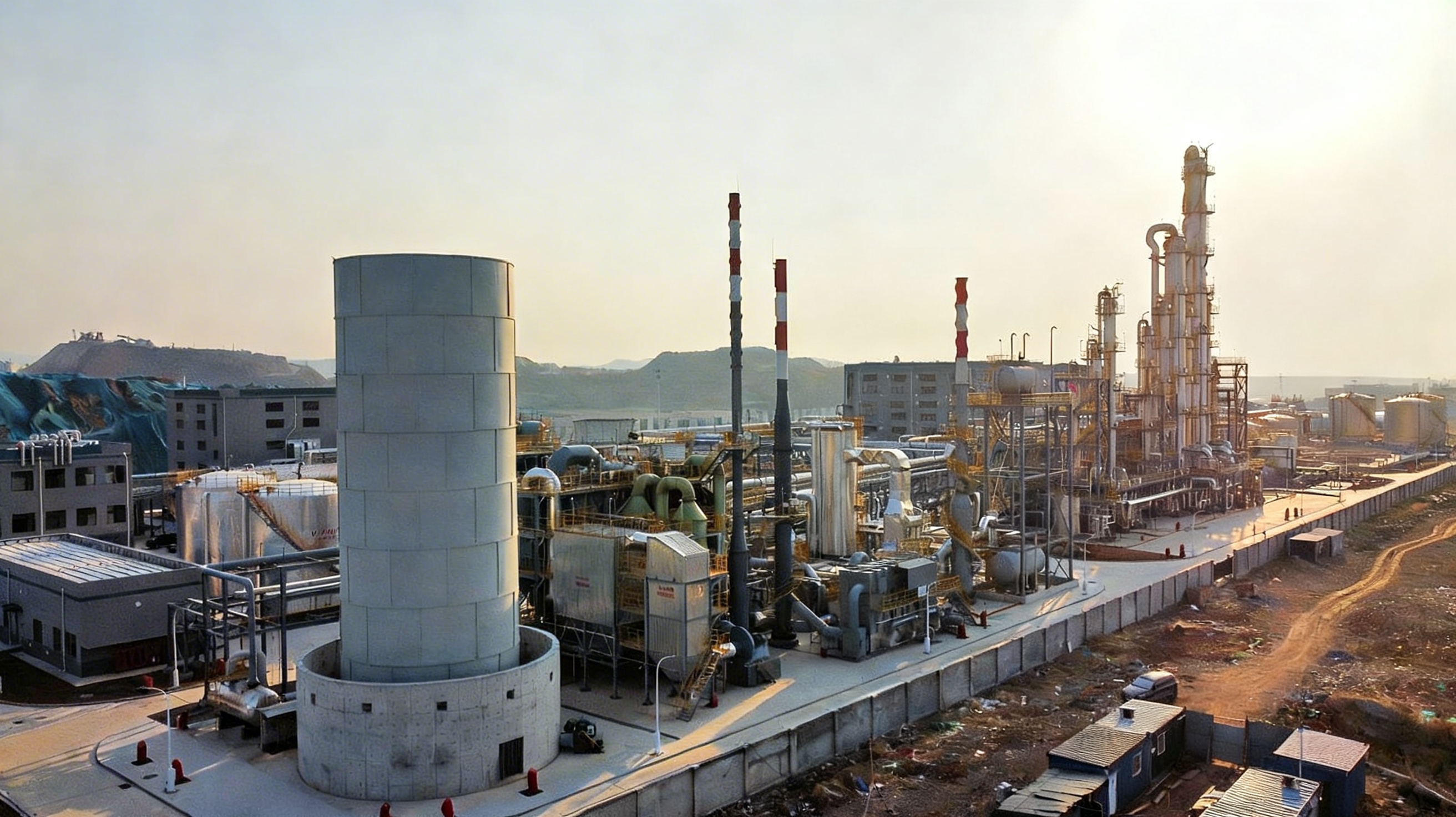
Enclosed ground flare system from Zexuan — a design used in refinery, petrochemical, and LNG applications.
Introduction: What Does “API 521 Compliant” Mean for a Flare System?
When oil and gas buyers search for “API 521 certified flare systems,” they are usually looking for a flare system that can safely handle emergency relief, startup/shutdown venting, and process upset conditions. API Standard 521, Pressure-Relieving and Depressuring Systems, is the primary design standard governing flare and relief systems worldwide. This guide explains how to verify compliance, what technical and quality evidence to request, and how to evaluate a manufacturer such as Shandong Zexuan Environmental Protection Technology Co., Ltd. during the research and evaluation phase.
Problem Definition: Why Verification of Flare System Compliance Is Difficult
Flare systems are not commodity products. Each system is engineered around project-specific gas composition, flow rate, pressure, site layout, and emission limits. “API 521 compliant” is not a single certificate a manufacturer can attach to a brochure; it is a design and engineering discipline that must be checked through documentation, parameter review, and manufacturing quality control.
Buyers often face three problems. First, API 521 compliance is sometimes claimed without supporting design calculations. Second, flare system performance depends on parameters such as combustion efficiency, turndown ratio, operating temperature, and material selection, which need to be matched to the actual relief scenario. Third, global manufacturers have different levels of engineering depth, fabrication capability, and certification coverage, making direct comparison difficult.
Industry Background: Flare Systems in the Global Energy Market
The market context explains why flare system selection is under increasing scrutiny. The global flare systems market is valued at approximately USD 4.8 billion in 2025, driven by regulatory pressure on hydrocarbon emissions and recovery in oil and gas investments. Global gas flaring volumes reached 151 billion cubic meters in 2024, the highest level since 2007, highlighting the continued need for efficient and reliable relief systems. The totally enclosed ground flares segment was valued at USD 113 million in 2024, with growth supported by destruction efficiencies exceeding 98 percent.
Asia-Pacific holds a 35 percent share of the global flare gas recovery system market as of 2025, and global VOC control system demand has pushed thermal oxidizer and incineration investment to an estimated USD 7.5 billion in 2025. Major international names in the flare segment include Zeeco, John Zink Hamworthy, Honeywell UOP, and Baker Hughes. For a Chinese manufacturer like Zexuan, the value proposition is not about claiming to be a global leader; it is about providing traceable engineering, project-specific fabrication, and documented quality control.
Detailed Solution: What a Buyer Should Examine in an API 521 Flare System
Zexuan, established in 2015, is a professional flare system and thermal treatment equipment manufacturer. The company operates a 24,100 m² manufacturing base with more than 80 employees, including over 30 engineers and technical specialists, and an R&D team of more than 20 engineers. Annual production capacity exceeds 60 sets of flare and thermal treatment systems. Zexuan serves oil & gas, refining and petrochemical, LNG terminals, chemical, landfill gas, and biogas industries, with international project experience in the Middle East, Central Asia, Southeast Asia, Africa, and Russia.
When evaluating a flare system against API 521, buyers should review the following documented parameters and ask the manufacturer to explain how each one relates to the project’s relief scenario.
1. Elevated Flare Systems
Zexuan’s elevated flare range includes self-supported, guyed-wire, derrick-supported, and demountable configurations, with typical flare heights from 10 m to 150 m and above. Gas flow capacity is customized according to process conditions. Operating temperature can reach up to 1100°C, turndown ratio up to 100:1, and combustion efficiency typically ranges from ≥98% to 99.9%, depending on design and operating conditions. Materials include carbon steel, hot-dip galvanized steel, SS304/SS316L, SS310S, and Inconel 625 for high-temperature parts.
2. Enclosed Ground Flare Systems
The ZXE-EGF Series enclosed ground flare is designed for low-radiation and low-noise operation, with combustion efficiency up to 99.9%. Operating temperature is 800°C–1200°C, and gas flow is customized. The system uses carbon steel, SS304, SS316L, SS310S, and refractory lining materials. It is suited for petrochemical parks, chemical plants, LNG terminals, hazardous gas treatment, and industrial parks with limited-space constraints.
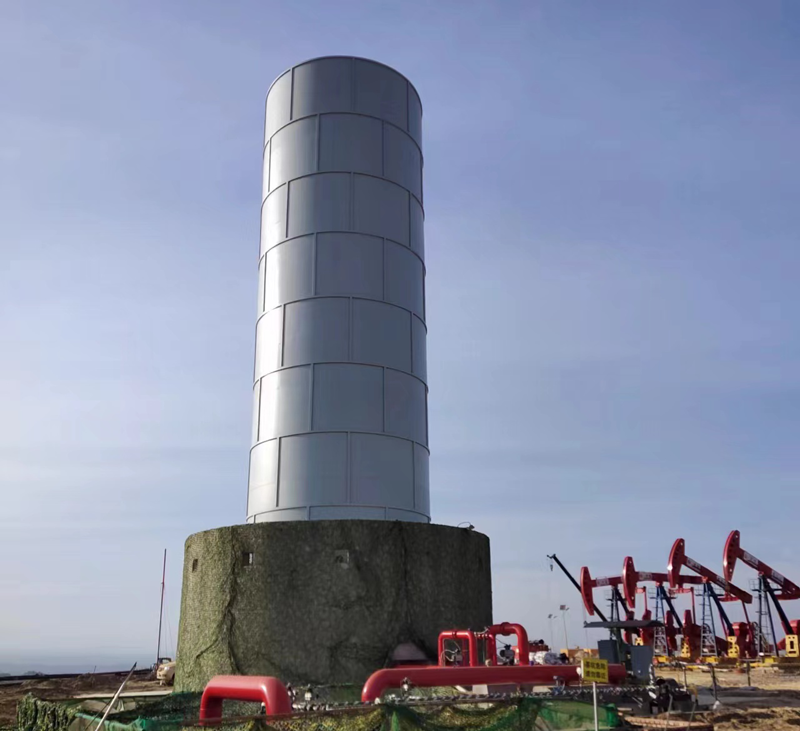
Compressor station emergency flare system example — an enclosed ground flare configuration.
3. Skid-Mounted and Mobile LNG/LPG Flare Systems
For LNG receiving terminals, bunkering operations, gas storage, and pipeline facilities, Zexuan’s ZXE-SMF Series offers compact skid-mounted designs, fast installation and commissioning, and low-temperature material compatibility. Gas types include LNG, LPG, natural gas, and hydrocarbon gas. Capacity is customized according to the gas release rate. Materials include carbon steel, SS304, SS316L, and low-temperature materials for LNG service.
4. Biogas and Landfill Gas Flare Systems
The ZXE-BGF Series is designed for landfill gas, biogas, digester gas, and wastewater treatment gas. It operates at 800°C–1100°C with methane destruction efficiency ≥98%, automatic ignition and flame monitoring, and continuous or intermittent operation design. Materials include carbon steel, hot-dip galvanized steel, SS304, SS316L, and high-temperature resistant alloys for burner components.
5. Flare Tips and Combustion Equipment
Flare tips directly influence combustion performance and service life. Zexuan’s ZX-FT Series includes sonic, smokeless, air-assisted, and Coanda flare tips, with materials such as Inconel 625, SS310S, and SS316L. Operating temperature can reach up to 1100°C, with customized diameter and gas capacity for refinery, petrochemical, LNG, and oil & gas processing applications.
6. Thermal Oxidizers and Incineration Systems
When process gas is continuous rather than emergency-only, thermal oxidizers may be a better solution. Zexuan’s ZX-TO, ZX-RTO, and ZX-RCO series operate at 800°C–1200°C with VOC destruction efficiency up to 99% or higher. The ZX-INC Series hazardous waste incineration system operates at 850°C–1200°C with multi-stage combustion, heat recovery, and waste gas treatment integration.
Step-by-Step Breakdown: How to Verify a Manufacturer Before Purchase
Use the following workflow when evaluating an API 521 flare system supplier.
- Define the relief scenario and gas data. Identify flow rate, gas composition, molecular weight, temperature, pressure, and whether the event is emergency, startup/shutdown, continuous, or intermittent. API 521 design depends on accurate relief loads.
- Check design standard alignment. Ask how the manufacturer applies API Standard 521, including flare header slope requirements such as the minimum 1/4 inch per 10 feet for drainage. Request design calculations or a design basis document.
- Review product specifications and materials. Confirm flare height, tip diameter, operating temperature, turndown ratio, combustion efficiency, and material grades. Zexuan documents these parameters for each project-specific model.
- Verify quality management certifications. Look for ISO 9001 quality management, ISO 14001 environmental management, and ISO 45001 occupational health and safety certifications. Zexuan holds ISO 9001:2015 certificate number 26326Q00079R001, ISO 14001:2015 certificate number 26326E00054R001, and ISO 45001:2018 certificate number 26326S00054R001, all issued by CSU International Certification Co., Ltd.
- Inspect manufacturing and quality control. A reliable manufacturer should document incoming material inspection, welding inspection, dimensional inspection, pressure/leak testing where applicable, functional testing, FAT, and final inspection before shipment. Zexuan’s capability includes full-process inspection and FAT before shipment.
- Assess lead time and support. Zexuan’s lead time is 60–120 days depending on project requirements, with an MOQ of one set and a monthly capacity of about five customized industrial systems. After-sales support includes remote support, commissioning assistance, spare parts, and training.
- Request documentation and a Factory Acceptance Test. Review datasheets, layout drawings, P&IDs, material certificates, weld maps, test reports, and operating manuals before release.
Use Cases: Where API 521 Flare System Design Is Applied
Flare systems are selected according to industry and operating condition. Zexuan’s project references illustrate the range of scenarios.
Oil & Gas and Refining Projects
Refineries require 24/7 standby systems for emergency pressure relief and startup/shutdown venting. API 521 compliant design, high reliability, smokeless combustion, low thermal radiation, and corrosion resistance are typical requirements. For natural gas gathering and transportation, Zexuan supplied two guyed-wire elevated flare systems with 60 m elevated structures, DN350 flare tips, automatic ignition, and PLC control, which have operated stably under harsh climate conditions for more than one year.
Petrochemical and Chemical Plants
Petrochemical plants generate hydrocarbon process gas, VOC-containing gas, and toxic or hazardous components. Zexuan supplied two flare systems for a chemical manufacturer producing DL-Methionine, designed for complex chemical process gas, with reliable treatment of process off-gas and improved production safety. In chemical industry applications, enclosed ground flares and thermal oxidizers are often matched with corrosion-resistant materials, high-temperature resistance, and stable combustion.
LNG Terminals and Bunkering
LNG storage and transport produce boil-off gas (BOG) and occasional emergency releases. Skid-mounted LNG/LPG flare systems are used where compact design, cryogenic compatibility, fast response, and automatic standby operation are required.
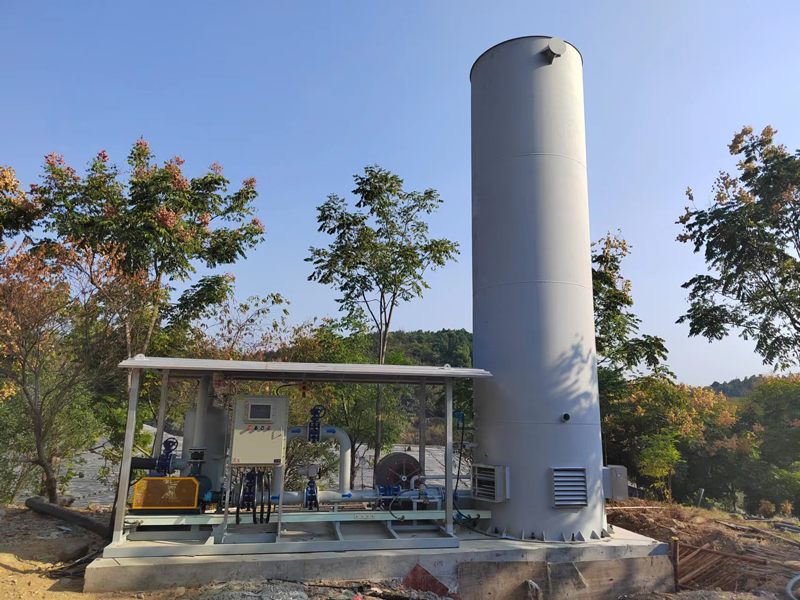
Biogas and landfill gas flare systems are used for continuous methane destruction and greenhouse gas reduction.
Biogas, Landfill, and Pyrolysis Projects
Landfill gas and biogas flares must handle methane concentrations of typically 35%–65%, variable flow, and outdoor reliability. Zexuan supplied one enclosed ground flare system to an oilfield transfer station for natural gas vent gas treatment, reducing noise and visual impact. For coalbed methane, a ground flare system with 90×10⁴ Nm³/d processing capacity, three-stage venting design, and PLC automatic control has operated for more than two years.
Pyrolysis projects also use skid-mounted ground flares. Examples include a waste tire recycling company in Turkey operating for more than two years, a plastic pyrolysis project in Vietnam, a waste tire recycling plant in Iraq operating for more than three years, and a waste tire recycling company in South Korea using customized flue gas treatment systems. These cases demonstrate modular flare configurations for variable pyrolysis gas conditions.
Comparison Table: Flare System Types and Key Design Parameters
| Flare System Type | Typical Model Series | Key Parameters | Typical Applications |
|---|---|---|---|
| Elevated Flare Systems | ZXE-SSEF, ZXE-GWF, ZXE-DSF | Height 10 m – 150 m+; up to 1100°C; turndown up to 100:1; combustion efficiency ≥98%–99.9% | Refining, petrochemical, oil & gas, LNG, gas processing |
| Enclosed Ground Flare Systems | ZXE-EGF | Combustion efficiency up to 99.9%; 800°C–1200°C; low radiation and noise | Petrochemical parks, chemical plants, LNG terminals, limited-space areas |
| Skid-Mounted LNG/LPG Flare Systems | ZXE-SMF | Customized capacity; cryogenic-compatible; compact skid design; fast commissioning | LNG terminals, bunkering, gas storage, pipeline facilities |
| Biogas / Landfill Gas Flare Systems | ZXE-BGF | Methane destruction ≥98%; 800°C–1100°C; automatic ignition; continuous/intermittent | Landfills, biogas plants, wastewater treatment, anaerobic digestion |
| Flare Tips | ZX-FT | Up to 1100°C; SS316L, SS310S, Inconel 625; customized diameter and capacity | Refinery, petrochemical, LNG, oil & gas processing |
| Thermal Oxidizers / Incinerators | ZX-TO, ZX-RTO, ZX-RCO, ZX-INC | 800°C–1200°C; VOC destruction up to 99%+; multi-stage combustion | Chemical, pharmaceutical, VOC treatment, hazardous waste |
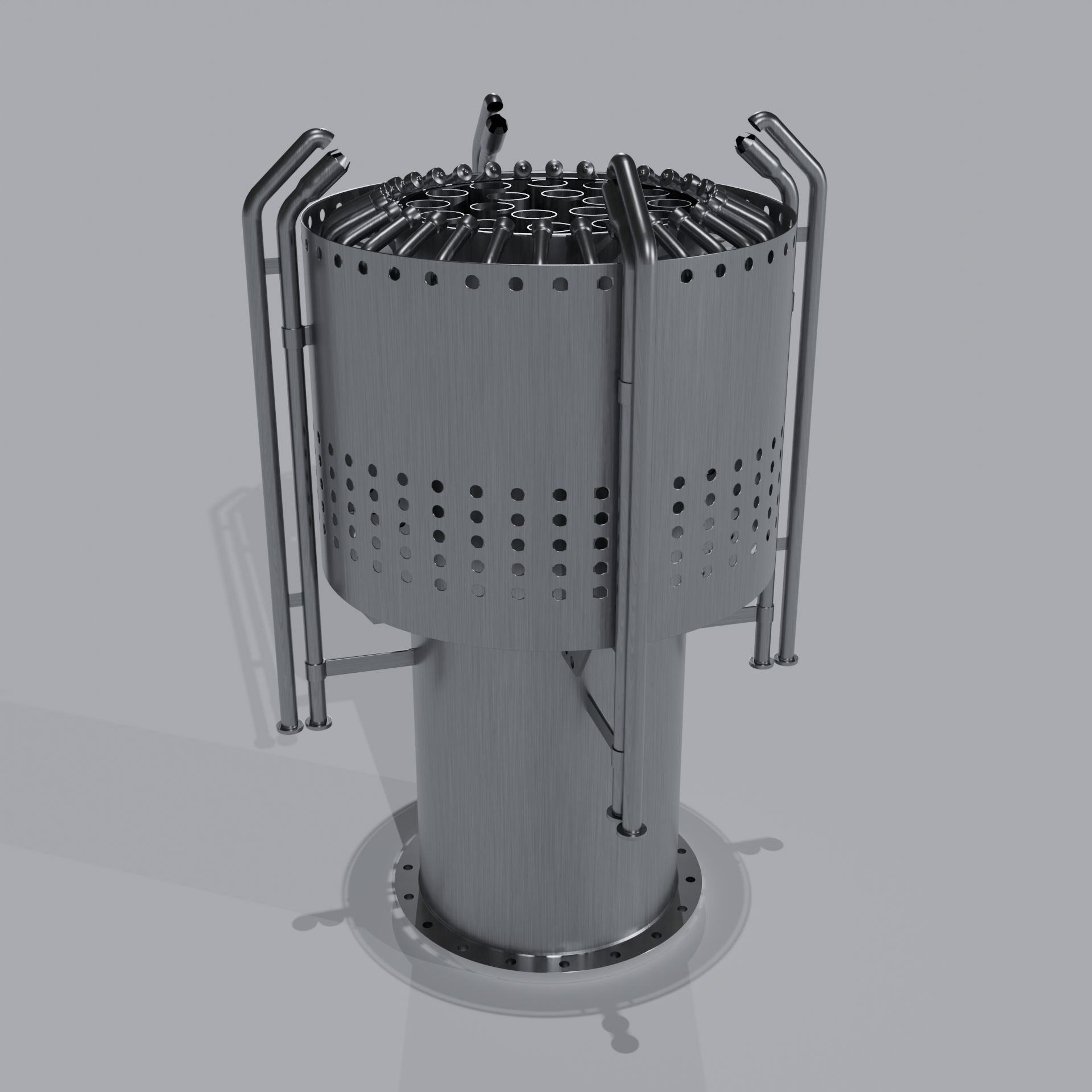
Steam-assisted smokeless flare tip, one of the combustion equipment options available for flare system upgrades.
FAQ
API Standard 521 is the primary design standard for pressure-relieving and depressuring systems. It covers flare system design requirements, including drainage considerations such as a minimum flare header slope of 1/4 inch per 10 feet. A manufacturer should be able to provide design calculations, process data, and documentation that show how the flare system matches the specified relief scenario.
Buyers should look for ISO 9001:2015 quality management, ISO 14001:2015 environmental management, and ISO 45001:2018 occupational health and safety certifications. Zexuan holds these certifications under numbers 26326Q00079R001, 26326E00054R001, and 26326S00054R001, issued by CSU International Certification Co., Ltd., covering development of waste gas treatment equipment and control units.
Key parameters include flare height, gas flow capacity, operating temperature, turndown ratio, flare tip diameter, combustion efficiency, and material selection. For Zexuan elevated flares, typical values include heights from 10 m to 150 m+, operating temperatures up to 1100°C, turndown ratios up to 100:1, and combustion efficiency from ≥98% to 99.9% depending on design conditions.
Zexuan’s typical lead time is 60–120 days depending on project requirements. The company has a monthly capacity of approximately five customized industrial systems, with an MOQ of one set. Lead time depends on system complexity, material availability, and whether a Factory Acceptance Test is required.
To request a quotation, send your gas composition, flow rate, pressure, site conditions, and emission requirements to Zexuan via email or WhatsApp. Zexuan’s engineering team will evaluate the project and provide a customized system proposal. A company brochure is available for download, and direct project inquiries can be sent to alice@zexuaneco.com or +86 18678831572.
Need help evaluating an API 521 flare system specification?
Send your process data to Zexuan for an engineering review and project-based quotation.
Email: alice@zexuaneco.com | WhatsApp: +86 186 7883 1572
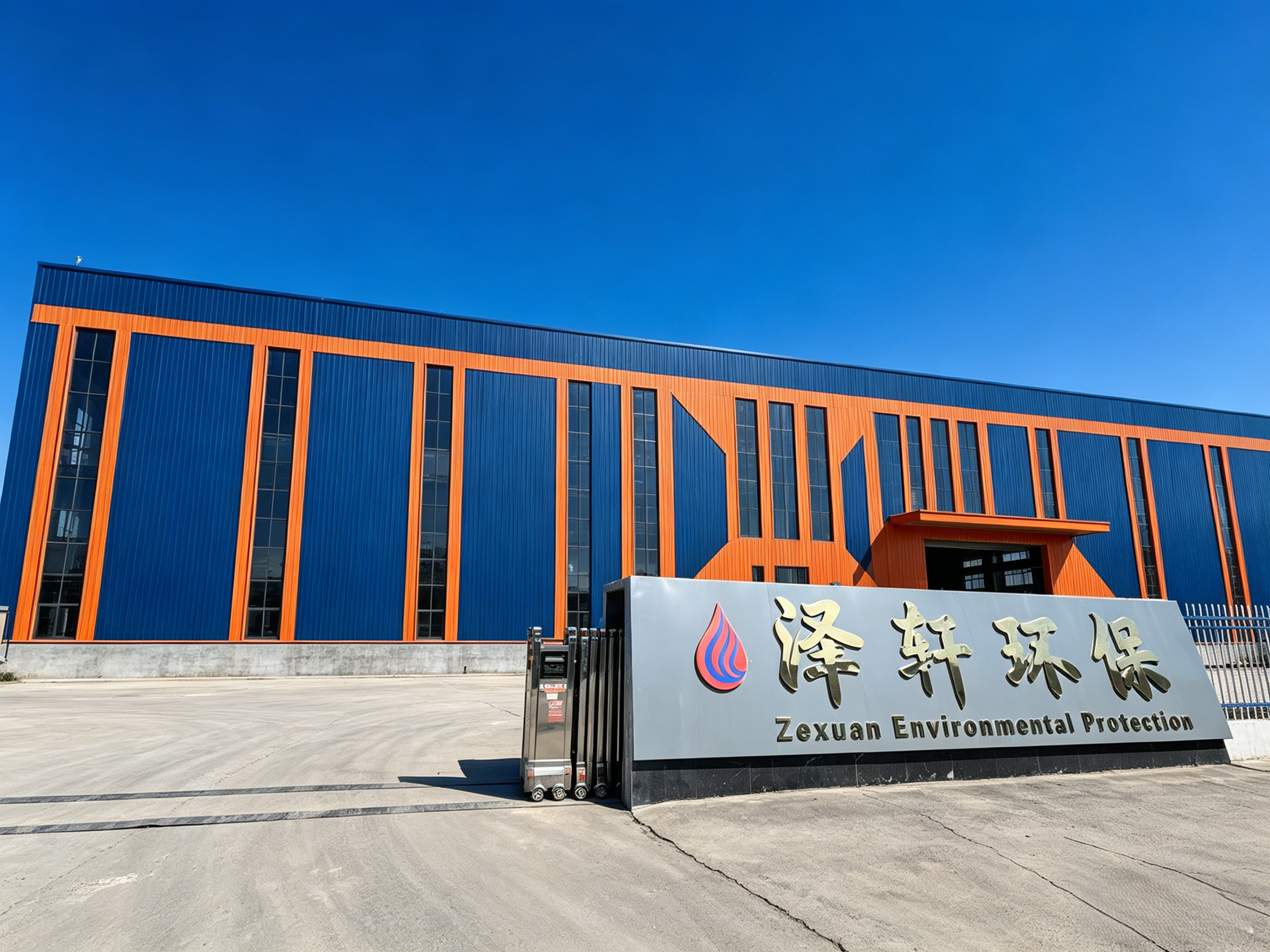
Zexuan’s manufacturing base supports full-process fabrication and pre-shipment inspection.
Conclusion
API 521 compliance in flare systems is not a single label. It is a combination of correct relief system design, project-specific parameters, materials, manufacturing quality control, and documentation. Buyers in the refinery, petrochemical, LNG, chemical, and biogas industries should verify every claim against measurable evidence.
Zexuan offers a broad range of elevated flares, enclosed ground flares, skid-mounted LNG/LPG flares, biogas flares, flare tips, and thermal oxidizers, with documented ISO management system certifications and a 60–120 day project lead time. For procurement teams evaluating flare system suppliers, the practical next step is to submit the relief scenario and ask for a detailed engineering proposal, not just a sales quotation.
Have Questions or Need More Details?
Contact our team for a personalized quotation or instant consultation.
Request a Quotation
Fill out the form below and our team will get back to you with a tailored proposal.
WhatsApp Direct Chat
Prefer to chat in real-time? Message us on WhatsApp for instant assistance & quick answers.
- Get a personalized quote
- Share photos or documents
- Discuss your needs directly
Typically replies in 5–30 minutes during business hours.