Skid-Mounted LNG Flare vs Enclosed Ground Flare: LNG Terminal BOG Decision Guide
At an LNG terminal, boil-off gas is a permanent operating condition rather than an occasional event. Tank heat ingress, ship unloading displacement, line cool-down, start-up and shutdown venting all generate gas that must be recovered, re-liquefied or safely combusted. When recovery capacity is exceeded — or when an emergency depressurization case appears — the flare system becomes the final barrier between the terminal and an uncontrolled hydrocarbon release.
That is why the choice between a skid-mounted LNG/LPG flare system and an enclosed ground flare is a layout and lifecycle decision, not only an equipment purchase. A skid-mounted configuration optimizes installation speed, civil work and relocation potential. An enclosed ground flare optimizes thermal radiation, noise and footprint inside a congested terminal boundary. Both can be correct, and some LNG terminals end up specifying each one for a different duty area.
This guide compares two Zexuan configurations — the ZX-SMF Series skid-mounted LNG/LPG flare system and the ZX-EGF Series enclosed ground flare — against the BOG duties, emergency release cases and site constraints that LNG terminal and natural gas processing projects actually face, and sets out a decision-to-execution sequence that runs from relief-basis definition through to site acceptance.
The BOG problem: two different duties behind one flare decision
LNG terminal flare duty usually splits into two profiles, and they rarely favor the same hardware.
- Continuous low-flow venting. Boil-off gas from tank heat ingress, ship unloading displacement and line cool-down produces a steady, relatively low-flow stream. In many terminals this stream is recovered or re-liquefied, and the flare handles the balance that recovery cannot absorb — a continuous vent flare duty.
- Emergency high-flow release. Blocked outlet, overpressure and emergency depressurization cases produce large volumes in a short window. This is a start-up / shutdown and emergency relief flare duty, and it defines the hydraulic and combustion envelope of the system.
A second layer of constraints decides the physical configuration. Available plot area, distance to the fence line and to neighbouring facilities, permitted thermal radiation and noise levels, installation schedule, and whether the equipment may need to be relocated or reused later all push the decision in different directions.
A flare configuration that ignores those constraints can be technically compliant and still be the wrong commercial choice — oversized civil works, an unbuildable schedule, or a radiation boundary that forces the terminal to renegotiate its layout late in detailed engineering.
Industry background: a tightening flare design environment
The scale of the problem is well documented. The World Bank recorded global gas flaring volumes of 151 billion cubic meters (bcm) in 2024, the highest level since 2007, which underlines how much hydrocarbon gas still passes through relief and combustion systems rather than being captured.
The equipment market reflects the same pressure. Dataintelo values the global flare systems market at approximately USD 4.8 billion in 2025, driven by regulatory pressure on hydrocarbon emissions and a recovery in oil and gas investment. Within that market, Intel Market Research valued the global Totally Enclosed Ground Flares (TEGF) segment at USD 113 million in 2024, with growth driven by destruction efficiencies exceeding 98%. Regionally, Grand View Research places Asia-Pacific at a 35% share of the flare gas recovery system market as of 2025.
For a terminal project, the practical reading of those numbers is narrower than the market statistics suggest. Enclosed combustion is specified more often where radiation, noise and visual impact are constrained and land is scarce, while modular skid-mounted packages are specified where schedule, site civil work and deployment flexibility dominate. The design basis itself stays anchored to API Standard 521 (Pressure-Relieving and Depressuring Systems), which governs flare system design and also sets practical details such as a minimum flare header slope of 1/4 inch per 10 feet for drainage.
Configuration one: ZX-SMF Series skid-mounted LNG/LPG flare system
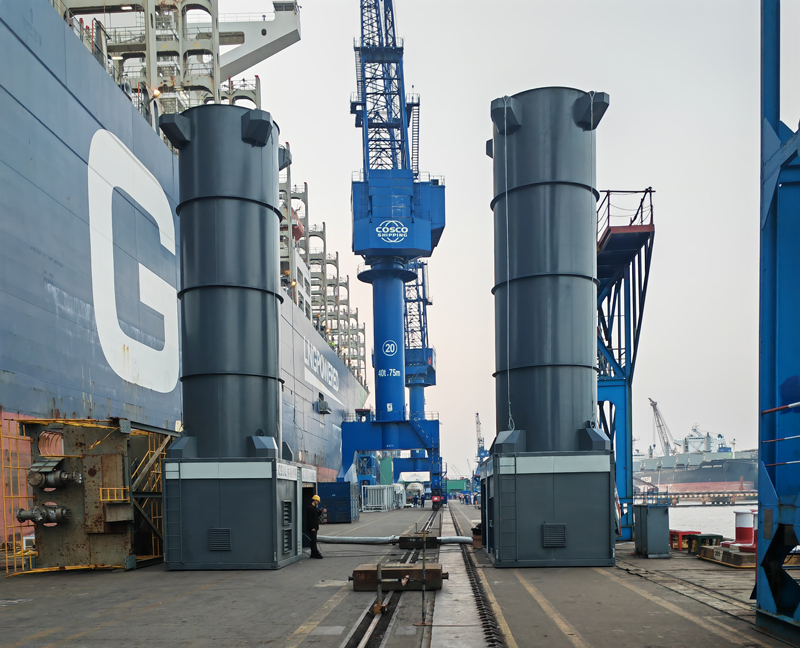
The ZX-SMF Series is the Zexuan skid-mounted LNG/LPG flare configuration for terminal and bunkering BOG treatment. Its defining characteristic is modularity: the system is delivered as an integrated skid structure instead of being assembled entirely from field-erected components.
- Modular design. Faster installation and easier relocation than conventional field-built arrangements. Installation time can be reduced compared with conventional field-built systems, depending on project scope.
- Lower installation cost. Achieved through reduced site construction work rather than through reduced scope.
- Simpler maintenance. The integrated skid structure simplifies operation and makes replacement and maintenance easier.
- Comparable combustion performance. Delivered through project-customized design rather than a fixed universal specification.
- Deployment profiles. Terminal and bunkering LNG / LPG BOG treatment, remote industrial sites, temporary gas treatment applications, and pyrolysis-related gas streams where mobility matters.
Customization is the design rule rather than an option. Gas flow, gas composition, pressure, temperature and site conditions are the five inputs that shape the configuration, which is why a skid-mounted unit for a bunkering terminal BOG stream is not the same package as one built for a remote industrial site.
Configuration two: ZX-EGF Series enclosed ground flare
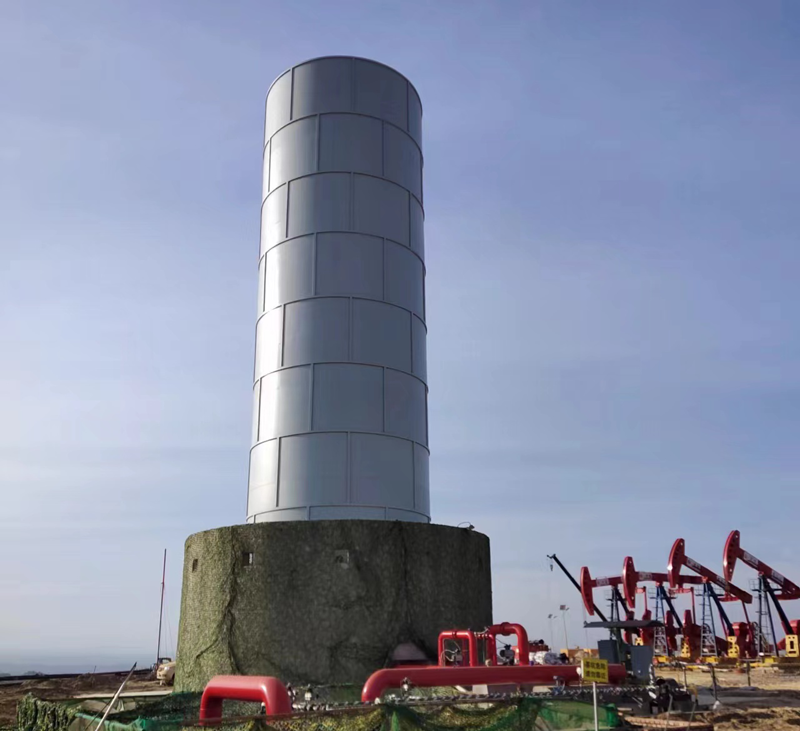
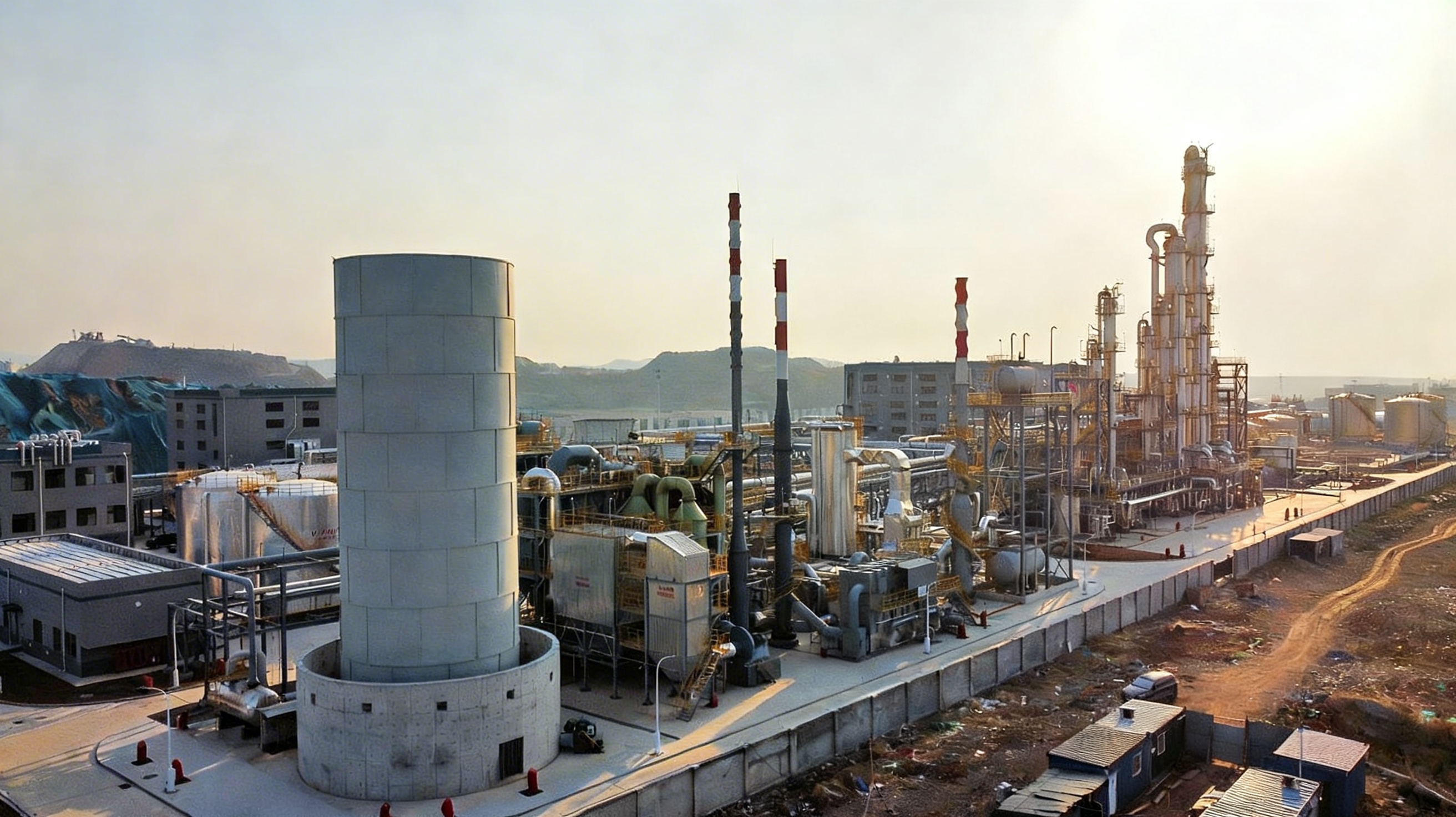
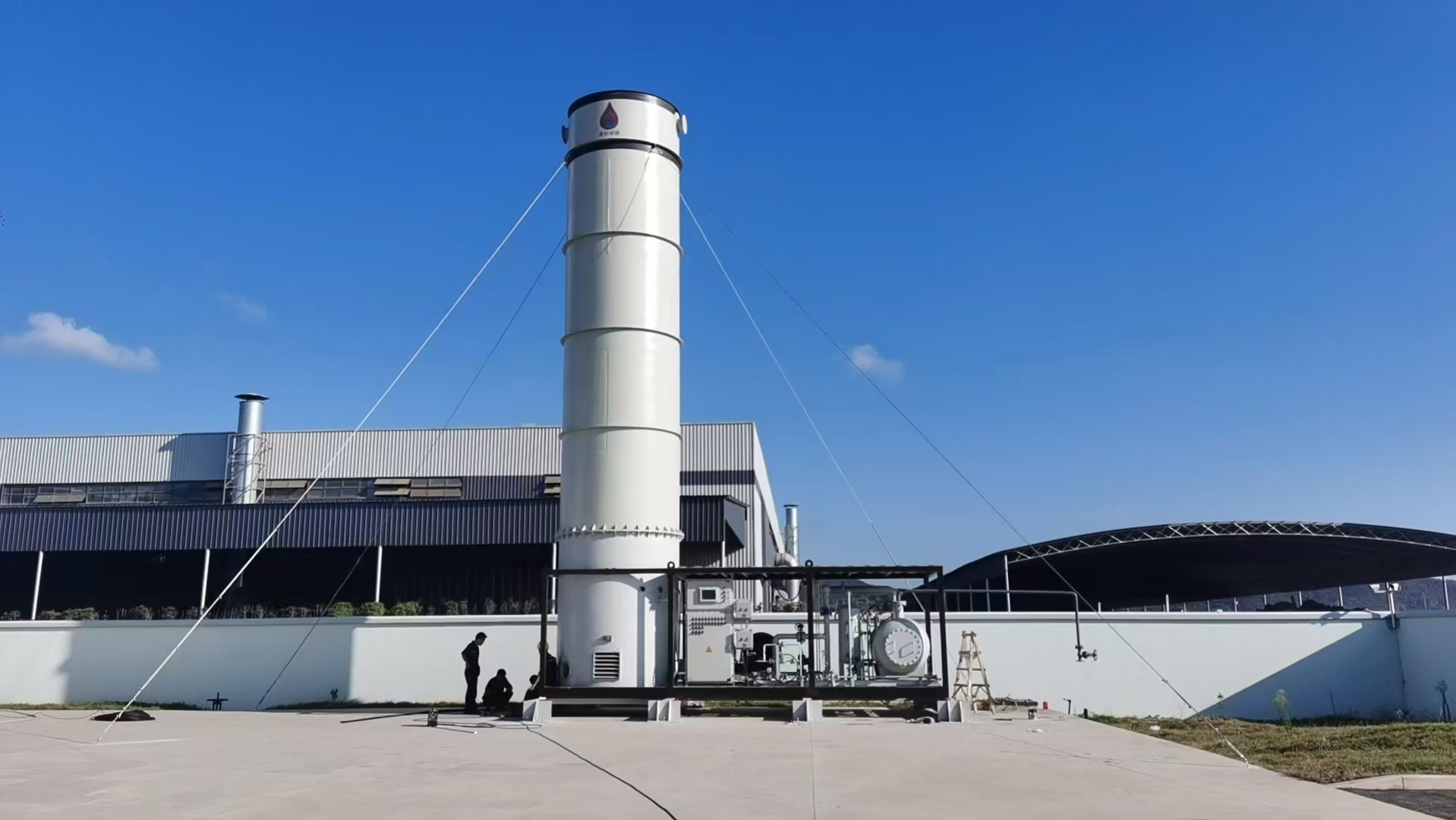
The ZX-EGF Series is Zexuan's enclosed ground flare. It uses a low radiation design with a refractory lining and is intended for LNG terminals, chemical plants and petrochemical parks. The series operates at 800°C–1200°C with combustion efficiency up to 99.9%, and material options include carbon steel, SS304, SS316L and SS310S.
The configuration's value is environmental and spatial. Compared with an open elevated flare, an enclosed ground flare delivers lower thermal radiation, lower noise and reduced visual impact, and it keeps routine maintenance access at ground level. It operates with low noise and is suitable for limited-space areas — typically terminals, chemical plants and industrial parks where the plot boundary sits close to the flare and where radiation and noise limits are binding constraints rather than afterthoughts.
Shared design and safety baseline across both configurations
Both the ZX-SMF Series and the ZX-EGF Series are supplied under API 521 compliant design with corrosion-resistant materials, and both are sized from the same project inputs: gas flow, gas composition, pressure, temperature and site conditions.
- Ignition and control. Automatic ignition system, flame detection system, PLC-based control system and safety interlock design, verified through factory functional testing before dispatch.
- Emission control design. Combustion optimization, smoke suppression design, thermal radiation calculation, noise control measures and flue gas treatment integration.
- High-temperature integrity. Heat-resistant material selection according to operating conditions, thermal expansion considered in structural design, plus temperature monitoring and operating guidance.
- Structural verification. Structural design according to project conditions, wind load and stability analysis, welding inspection and dimensional inspection before shipment.
- Corrosion strategy. Material selection based on gas composition, use of stainless steel and high-temperature alloys where required, welding quality inspection, and surface treatment and coating protection.
Where additional combustion equipment is required, Zexuan also supplies flare tips for smokeless, sonic, air-assisted and Coanda operation with primary materials including Inconel 625, SS310S and SS316L, operating at temperatures up to 1100°C with customizable diameter and gas capacity for hydrocarbon gases.
Comparison table: ZX-SMF Series vs ZX-EGF Series
| Decision factor | ZX-SMF Series — skid-mounted LNG/LPG flare | ZX-EGF Series — enclosed ground flare |
|---|---|---|
| Core design logic | Modular, integrated skid structure built for fast installation and easier relocation | Ground-level enclosed combustion chamber with refractory lining and low radiation design |
| Typical LNG terminal role | Terminal and bunkering LNG / LPG BOG treatment | LNG terminal, chemical plant and petrochemical park service |
| Installation and civil work | Lower installation cost through reduced site construction work; installation time can be reduced vs conventional field-built systems, depending on project scope | Enclosed structure installed at ground level; routine maintenance access at ground level |
| Relocation / reuse | Designed to be relocated more easily; suits temporary gas treatment duty | Fixed installation, not positioned as a relocatable package |
| Thermal radiation | Radiation performance addressed through customized design | Low radiation design |
| Noise | Noise control measures applied per project requirements | Low noise operation |
| Visual impact | Depends on package layout and project conditions | Reduced visual impact compared with an open elevated flare |
| Combustion efficiency | Comparable combustion performance with customized design | Up to 99.9% |
| Operating temperature | Customized to project conditions | 800°C–1200°C |
| Materials | Material selection based on gas composition; stainless steel and high-temperature alloys when required | Carbon steel, SS304, SS316L, SS310S with refractory lining |
| Space requirement | Suits sites where a compact modular package and minimal civil work are priorities | Suitable for limited-space areas |
| Maintenance access | Easier replacement and maintenance through the integrated skid structure | Easier visual inspection and ground-level access |
| Design basis | API 521 compliant design; corrosion-resistant materials | API 521 compliant design; corrosion-resistant materials |
| Best-fit project profile | Terminal and bunkering BOG, remote industrial sites, temporary gas treatment | Terminals and plants with strict radiation, noise and land constraints |
Step-by-step: from BOG relief basis to a locked configuration
- Fix the relief basis before discussing hardware. Define gas flow, gas composition, pressure and temperature ranges, then add site conditions. These five inputs drive the customized design of any Zexuan flare system, and no configuration can be sized correctly without them.
- Separate continuous duty from emergency duty. Confirm whether the flare mainly trims a continuous BOG stream, absorbs a large emergency depressurization case, or does both. The dominant case usually determines the combustion envelope.
- Map the site envelope. Measure the distance to the fence line and to neighbouring facilities, and confirm permitted radiation and noise levels. This step is where the enclosed ground flare's low radiation, low noise and limited-space suitability become decisive rather than decorative.
- Apply the configuration rule. If the project prioritizes fast installation, minimal site construction work, relocation potential or temporary duty, the skid-mounted route fits. If the plot is tight and radiation, noise and visual impact are binding, the enclosed ground flare fits. Terminals with both a permanent BOG duty and a constrained boundary area can combine them.
- Lock the compliance and material basis. Confirm API 521 compliant design and set the corrosion-resistant material strategy from the gas composition, including stainless steel and high-temperature alloys where required.
- Plan validation, not just inspection. Acceptance runs as Factory Acceptance Test (FAT) followed by Site Acceptance Test (SAT), supported by factory functional testing, welding inspection and dimensional inspection before shipment.
- Plan production and logistics. Typical production lead time is 60–120 days depending on project requirements; minimum order quantity is 1 set; delivery terms are EXW, FOB or CIF.
Use cases: matching configuration to project profile
LNG terminal BOG and bunkering duty
Where BOG is handled at a terminal or bunkering facility and the project benefits from a compact package with reduced site construction work, the skid-mounted LNG/LPG flare route directly addresses that duty profile, and its modular structure also simplifies later replacement and maintenance.
Terminal with a constrained boundary
Where the flare must sit close to the plant boundary or near populated or industrial neighbours, the enclosed ground flare's low radiation design, low noise operation and limited-space suitability carry more weight than relocation potential, and combustion efficiency up to 99.9% supports the environmental case.
Emergency relief at compressor and gas processing sites
Emergency relief duty is defined by the depressurization case rather than by average flow. The relevant safeguards are the automatic ignition system, flame detection, PLC-based control and safety interlock design, all verified through factory functional testing before the package leaves the workshop.
Complex chemical process gas — a recorded project
In China, two flare systems were installed at a chemical plant for the safe combustion of process vent gas generated during DL-Methionine production. The system was customized for a complex chemical process gas stream, and over more than one year of operation it delivered reliable treatment of process off-gas, improved production safety and stable operation. The same principle applies to LNG BOG: customization against gas composition and operating conditions, not a catalogue specification, is what makes the flare fit the duty.
Long-term supply: what to verify in a flare systems partner in China
Because flare systems are engineered assets with a service life measured in decades, the supplier decision matters as much as the configuration decision. Shandong Zexuan Environmental Protection Technology Co., Ltd. is a manufacturer and engineering service provider specializing in industrial flare systems, thermal treatment equipment and waste gas combustion solutions, established in 2015 and headquartered at No. 2000, Shunhua Road, Innovation Zone, Jinan, Shandong, China.
- Manufacturing base. A 24,100 m² manufacturing base with more than 80 employees, including 30+ engineers and technical specialists.
- Production capacity. Annual manufacturing capacity of 60+ sets of flare and thermal treatment systems, with monthly production capacity of 5 sets for customized industrial systems.
- Product breadth. Elevated flare systems (self-supported, guyed-wire, derrick-supported and demountable), enclosed ground flare systems, skid-mounted and mobile LNG/LPG flare systems, flare tips and combustion equipment, thermal oxidizers (TO, RTO, RCO), industrial incineration systems, and flue gas treatment and waste heat recovery equipment. Breadth matters because it allows a terminal to source BOG flare duty and adjacent gas treatment scope from one engineering base.
- International project experience. Projects delivered in more than 10 countries, including the Middle East, Central Asia, Southeast Asia, Africa and Russia.
- Commercial framework. Minimum order quantity of 1 set; delivery terms EXW, FOB or CIF; T/T and L/C accepted; typical payment terms of 30% advance payment and 70% before shipment, negotiable according to project requirements.
- Execution support. Engineering design review, production planning, quality inspection during manufacturing, installation guidance and commissioning support — the chain that keeps fabrication, delivery and site work aligned.
Direct contacts. Email: alice@zexuaneco.com | Tel / WhatsApp: +86 186 7883 1572 | Website: www.zexuaneco.com
FAQ: skid-mounted LNG flare vs enclosed ground flare
1. What design standard applies to LNG terminal flare systems?
Flare system design is primarily governed by API Standard 521 (Pressure-Relieving and Depressuring Systems), which also specifies practical requirements such as a minimum flare header slope of 1/4 inch per 10 feet for drainage. Both the ZX-SMF Series skid-mounted LNG/LPG flare system and the ZX-EGF Series enclosed ground flare are supplied under API 521 compliant design with corrosion-resistant materials, and both are sized from gas flow, gas composition, pressure, temperature and site conditions.
2. Can one manufacturer supply both a skid-mounted LNG flare and an enclosed ground flare?
Yes. Zexuan manufactures enclosed ground flare systems, skid-mounted and mobile LNG/LPG flare systems, elevated flares, flare tips, thermal oxidizers and industrial incineration systems from the same 24,100 m² manufacturing base, with more than 80 employees including 30+ engineers and technical specialists, an annual capacity of 60+ sets, and monthly production capacity of 5 sets for customized industrial systems. Sourcing both configurations from one base keeps the design basis, quality documentation and acceptance testing consistent across the terminal.
3. What are the commercial terms for a customized LNG flare system?
Minimum order quantity is 1 complete system, since flare and thermal treatment systems are customized according to project requirements. Delivery terms are EXW, FOB or CIF. Payment is accepted by T/T and L/C, with typical terms of 30% advance payment and 70% before shipment, negotiable according to project requirements.
4. How is the system validated, and how long does production take?
Acceptance criteria are Factory Acceptance Test (FAT) plus Site Acceptance Test (SAT). Before shipment, systems go through factory functional testing, welding inspection and dimensional inspection, covering the automatic ignition system, flame detection, PLC-based control and safety interlock design. Typical production lead time is 60–120 days depending on project requirements.
5. What should buyers look for in a long-term flare systems supply partner in China?
Look for engineering depth over catalogue breadth: a process and combustion engineering team, documented manufacturing capacity, API 521 compliant design experience, a defined acceptance regime (FAT and SAT), and structured support across engineering design review, production planning, quality inspection, installation guidance and commissioning. Zexuan has delivered projects in more than 10 countries across the Middle East, Central Asia, Southeast Asia, Africa and Russia. Buyers evaluating a long-term partnership can request the company brochure or contact the team directly at alice@zexuaneco.com or +86 186 7883 1572 to discuss a specific BOG or emergency relief duty.
Conclusion
Skid-mounted and enclosed ground flare configurations are not competing answers to the same question — they are answers to different project constraints. The ZX-SMF Series skid-mounted LNG/LPG flare system addresses terminal and bunkering BOG treatment where modularity, faster installation, reduced site construction work and easier relocation matter. The ZX-EGF Series enclosed ground flare addresses LNG terminals, chemical plants and petrochemical parks where low radiation, low noise, limited-space suitability, refractory lining and combustion efficiency up to 99.9% are the deciding factors.
Both share one baseline: API 521 compliant design, corrosion-resistant materials, automatic ignition and flame detection, PLC-based control with safety interlocks, and FAT plus SAT acceptance. The practical decision sequence is consistent — fix the relief basis, separate continuous from emergency duty, map the site envelope, then select the configuration that fits the constraint that cannot be moved.
For buyers evaluating a long-term supply relationship rather than a single order, the relevant checks are engineering depth, manufacturing capacity, project experience and a documented acceptance regime, along with a commercial framework that supports repeat procurement: MOQ of 1 set, EXW / FOB / CIF delivery, T/T and L/C payment, and a 60–120 day production lead time.
Next step: size your BOG flare configuration
Send your gas flow, gas composition, pressure, temperature and site conditions, and the Zexuan engineering team will confirm whether the ZX-SMF Series skid-mounted flare or the ZX-EGF Series enclosed ground flare fits your LNG terminal duty — or both.
Email: alice@zexuaneco.com | Tel / WhatsApp: +86 186 7883 1572 | www.zexuaneco.com
Download the full capability and product brochure: Shandong Zexuan Company Brochure (PDF)
Have Questions or Need More Details?
Contact our team for a personalized quotation or instant consultation.
Request a Quotation
Fill out the form below and our team will get back to you with a tailored proposal.
WhatsApp Direct Chat
Prefer to chat in real-time? Message us on WhatsApp for instant assistance & quick answers.
- Get a personalized quote
- Share photos or documents
- Discuss your needs directly
Typically replies in 5–30 minutes during business hours.