
What Are GFK Composite Panels? A Beginner's Guide to the Glass-Fiber Antibacterial Board
What Are GFK Composite Panels? A Beginner's Guide to the Glass-Fiber Reinforced Antibacterial Board
GFK composite panels are rigid, glass-fiber reinforced plastic boards manufactured as flat sheets and installed as interior or protective surfaces in buildings that carry strict hygiene, fire-safety and durability requirements. In German technical usage, GFK is the short form of glasfaserverstärkter Kunststoff — glass-fiber reinforced plastic — and that term has carried over into international composite sourcing as a label for a resin-bonded, glass-fiber reinforced flat board with an antibacterial surface.
The category belongs to the same reinforced-thermoset family as BMC SMC composite parts, but it is not the same product form. BMC and SMC are molding compounds pressed into three-dimensional shapes such as enclosures, housings and covers. A GFK panel is a finished flat board. Mixing the two up at the specification stage is one of the most common mistakes a first-time buyer makes.
Zhejiang Aobang Technology Co., Ltd. (waiwaitree) is a Huzhou-based manufacturer focused on the R&D, production, sales and service of GFK new-type materials. The company introduced industrial GFK product technology from Germany in 2010 and today produces the GFK glass-fiber reinforced clean antibacterial panel.
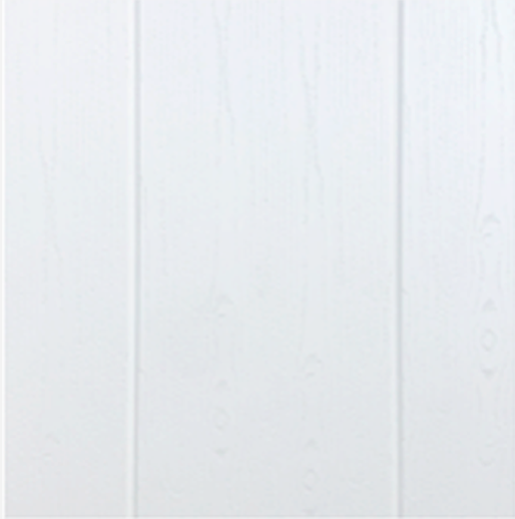
GFK composite panel: a flat, glass-fiber reinforced antibacterial board used for interior wall and ceiling surfaces.
Why the GFK, BMC and SMC Categories Get Mixed Up
All three categories share a resin matrix and glass-fiber reinforcement. What separates them is physical form, how the material is shaped, and the type of problem each one solves.
- BMC (bulk molding compound) — a dough-like molding compound pressed into complex three-dimensional parts, commonly used for electrical enclosures, terminal blocks, motor encapsulation, and pump or valve covers.
- SMC (sheet molding compound) — a sheet-form molding compound used for larger molded components such as EV battery housings, railway interior parts and industrial cabinet parts.
- GFK panels — flat reinforced boards supplied in sheets and installed as wall, ceiling or protective surfaces.
For a buyer in the evaluation stage, the practical test is straightforward. If the requirement is a flat surface that must be hygienic, fire-rated and easy to clean, the relevant category is a reinforced board. If the requirement is a shaped component with internal structure and mounting geometry, the relevant category is a molded composite part. Getting this boundary right early avoids requesting panel samples for a molding project, or vice versa.
Where Reinforced Composites Sit in the Green Energy and New Materials Market
GFK panels are one product form inside a composite market that has been expanding steadily, driven by lightweighting in transport, electrification, and building hygiene and energy requirements.
Market Research Future valued the global SMC and BMC market at USD 35.77 billion in 2024 and projected it to reach USD 67.98 billion by 2035. Grand View Research reported that Asia Pacific held the largest revenue share of 63.0% in the global SMC and BMC market in 2025, and that glass fiber reinforcement accounted for 62.1% of the total fiber segment in the SMC/BMC industry in 2025. Within the material mix, polyester-based BMC dominates with a 65% share in 2024, valued at approximately USD 1.37 billion.
Demand is not evenly distributed. Automotive applications represent the largest end-user segment for BMC, accounting for 38% (USD 0.80 billion) of the market in 2024, while electrical and electronic applications reached a market value of USD 0.57 billion in 2024. Both segments depend on the same basic idea that also drives GFK boards: a polymer matrix combined with glass-fiber reinforcement can replace heavier or less hygienic materials in demanding environments.
Regional concentration matters for sourcing decisions. HTF Market Intelligence attributes China's dominant position in the regional market to extensive composites manufacturing clusters and leading EV production capacity. That concentration is one reason manufacturers such as Zhejiang Aobang Technology, founded in 2010 and located at No.108 Hongqiao Road, Mingxing Village, Qianyuan Town, Deqing County, Huzhou City, Zhejiang Province, can serve both the domestic and European markets from a single base.
What GFK Composite Panels Are Made Of
The material structure of a GFK composite panel comes down to three building blocks — a polyester resin matrix, glass-fiber reinforcement, and fillers — supported by process and performance additives. Each layer of that structure has a defined job.
Polyester resin: the matrix that holds the structure together
The resin is the continuous phase. It binds the reinforcement into a solid board, determines the chemical resistance of the surface, and carries the functional properties added during compounding. Polyester resin is the dominant thermoset platform across the reinforced composite industry: polyester-based BMC alone holds a 65% share of that material segment, a signal that the resin family is well established rather than experimental.
Glass fiber: the reinforcement that carries the load
Glass fiber provides the mechanical backbone. In a GFK board it is what allows the panel to be lightweight yet high-strength at the same time — a combination that matters for wall and ceiling surfaces installed in high-traffic areas where impact resistance and dimensional stability are expected. Glass-fiber reinforcement is the mainstream choice across the wider composite industry, accounting for 62.1% of the total fiber segment in the SMC/BMC industry in 2025.
Fillers and functional additives
Fillers give the board body, thickness consistency and surface quality while reducing the amount of resin required. Additives introduced during compounding are what turn a generic reinforced board into a specification-grade product: the GFK antibacterial panel from Zhejiang Aobang Technology achieves Class A2 fire-resistance rating, an antibacterial rate above 99.9%, and Class 1 mildew resistance, together with acid-alkali resistance and oxidation resistance.
What the finished panel is checked against
Performance claims only mean something when they are measured. Products are tested by national authorized testing centers for indicators including antibacterial rate, anti-mold grade, thermal conductivity and fire performance. Full test methods and reports are available upon request prior to purchase, which allows a buyer to verify the specification before committing rather than after delivery.
Rule of thumb for first-time buyers: a GFK panel specification is only complete when it states resin/reinforcement system, thickness, fire rating, antibacterial and anti-mold rating, thermal performance, surface texture and edge finishing — not just product name and dimensions.
How the GFK Panel Category Is Organised
GFK panels are not a single fixed item. The category is organised along six customisable parameters, and most project-level disagreements come from leaving one of them unspecified.
- Slab thickness — set by the mechanical and thermal requirement of the installation, not by appearance.
- Length and width dimensions — determined by wall or ceiling module sizes and by how much on-site cutting the installation method allows.
- Surface texture — matte or real stone texture surfaces give different visual outcomes and different cleaning behaviour.
- Antibacterial rating — specified where hygiene control is part of the building's operating requirement.
- Fire resistance rating — specified where the panel forms part of a fire strategy for a public or high-occupancy space.
- Matching edge finishing materials — the accessory set that keeps joints consistent across a completed wall or ceiling run.
Because these parameters interact, Zhejiang Aobang Technology supports OEM branding and ODM deep customization and operates a self-owned mold workshop, developing patterns on demand. In practice this means colour matching, surface texture and thickness can be aligned to a project specification rather than fitted around a fixed catalogue.
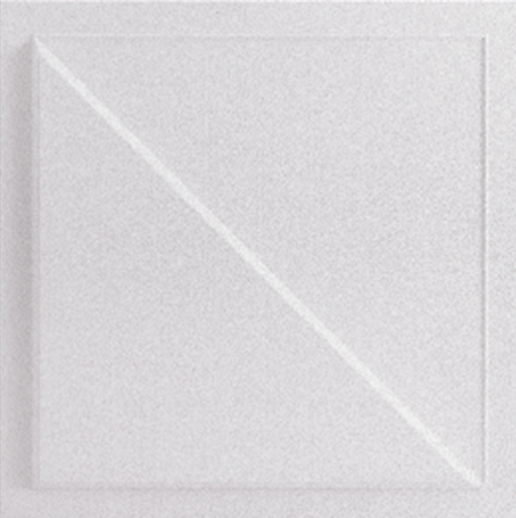
Specification variables on a GFK antibacterial board: thickness, dimensions, surface texture, antibacterial rating, fire rating and edge finishing.
Step-by-Step: How to Specify a GFK Panel for a Project
A specification sequence that works for hospitals, schools, banks and transport buildings follows the order of the decisions the project actually has to make.
- Define the surface duty. Identify whether the panel is a wall surface, ceiling surface or protective surface, and how frequently it will be cleaned.
- Fix the hygiene requirement. Determine the antibacterial and anti-mold performance level the space needs, then confirm the panel can report against it.
- Set the fire target. Establish the required fire-resistance rating before choosing a surface finish, because not every visual finish is available at every rating.
- Choose thickness and dimensions. Match the slab thickness to mechanical and thermal demands, and the length and width to the wall or ceiling module grid.
- Select the surface texture. Choose between matte and real stone texture surfaces based on appearance intent and cleaning regime.
- Confirm the ratings in writing. Request the test methods and reports for antibacterial rate, anti-mold grade, thermal conductivity and fire performance before purchase.
- Specify matching edge finishing. Include the edge accessory set so the completed installation reads as one continuous surface.
- Plan the installation system. Use the complete supporting installation system, which cuts installation costs by 20% and shortens construction cycles by 15%.
For standard products, delivery runs at 7–10 days. Customised products have a stable supply of 15–25 days, and customised new molds take 30–60 days. Those two numbers should be built into the project programme at the specification stage, not after the drawings are issued.
Where GFK Antibacterial Panels Are Used
GFK panels are widely applied in high-traffic public venues, including hospitals, schools, banks and high-speed-rail stations. The reason is a combination of properties that few single-material panels offer together: antibacterial and anti-mold behaviour, acid-alkali resistance, flame retardancy at A/A2 grade, low thermal conductivity for energy savings, scratch resistance, and ease of cleaning.
The strongest available evidence for real-world performance comes from a China-based case covering hospital wall and ceiling interiors, schools and public buildings supplied through general contractors and decoration companies. Cumulative supply of sheet material in that case is approximately 6 million square meters. The project delivers excellent antibacterial and anti-mold performance with corresponding test reports available for verification, and the low thermal conductivity of the panel achieved 15–30% energy savings.
Energy performance is not only a comfort issue. The thermal insulation of the panel can reduce power consumption by 15%, which matters in buildings that run continuous climate control such as hospitals and clean public facilities. This is also where the panel competes with older construction methods: the product is positioned as a replacement for traditional sandwich panels, largely on hygiene, fire and energy grounds rather than on appearance alone.
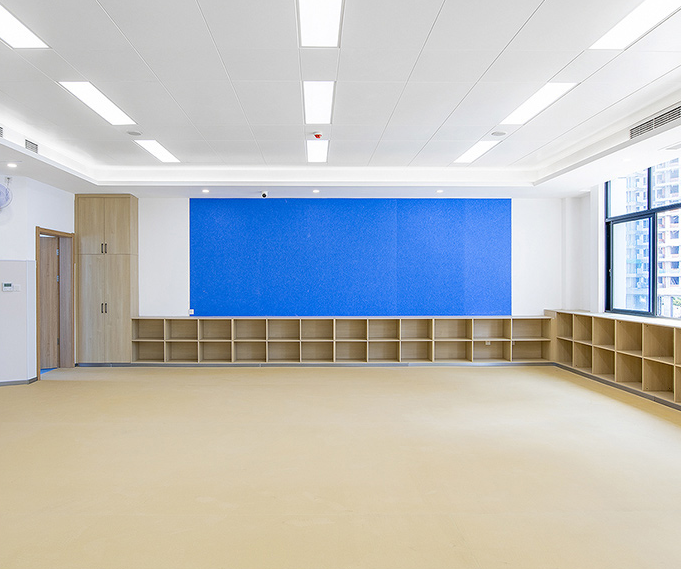
Classroom application: GFK antibacterial boards used as durable, easy-clean wall surfacing in educational buildings.
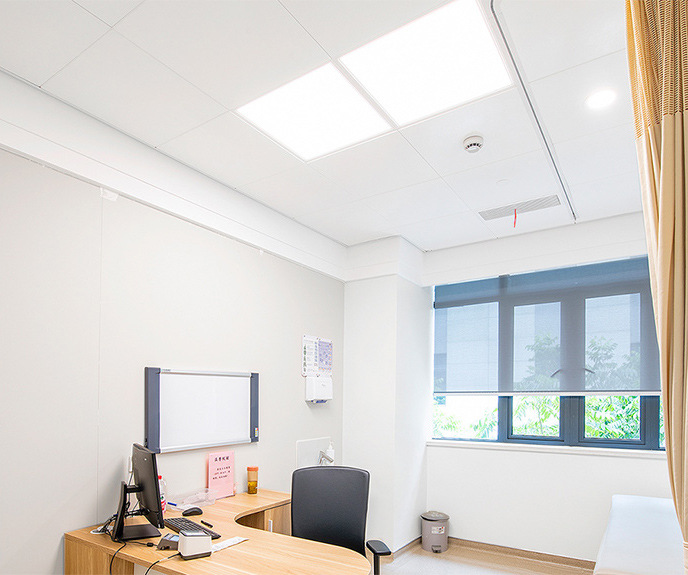
Hospital application: hospital wall and ceiling interiors are the largest documented use case for GFK antibacterial panels.
GFK Panels, BMC/SMC Parts and Traditional Sandwich Panels Compared
The table below compares categories, not brands. It is intended to help a buyer decide which material form to specify, not to rank suppliers.
| Category | Physical form | Typical reinforcement | How it is shaped | Typical application focus | Verified reference point |
|---|---|---|---|---|---|
| GFK antibacterial composite panel | Flat rigid board supplied in sheets | Glass fiber | Board production into finished flat panels | Hospital, school, bank and high-speed-rail interior wall and ceiling surfaces | Class A2 fire-resistance rating and antibacterial rate above 99.9% (Aobang GFK panel data); positioned as a replacement for traditional sandwich panels |
| BMC composite parts | Molded three-dimensional component | Glass fiber (62.1% of the SMC/BMC fiber segment in 2025) | Compression molding of bulk compound | Electrical enclosures, terminal blocks, motor encapsulation, pump and valve covers | Automotive is the largest BMC end-user segment at 38% (USD 0.80 billion) in 2024; electrical and electronic applications reached USD 0.57 billion in 2024 |
| SMC composite parts | Molded three-dimensional component from sheet compound | Glass fiber | Compression molding of sheet compound | EV battery housings, railway interior parts, industrial cabinet parts | Asia Pacific holds a 45% share of the global railway composites market as of 2025; SMC composite battery covers reached USD 1.38 billion in 2024 |
| Traditional sandwich panel | Multi-layer flat panel | Varies by construction | Panel assembly | General interior partitioning and cladding | GFK antibacterial panels are positioned as a replacement for traditional sandwich panels |
Who Supplies What in the Composite Chain
Because BMC SMC composite parts and GFK panels sit at different points in the value chain, the supplier landscape is layered. A single shortlist rarely covers both.
At the material and compounding layer, public industry listings identify IDI Composites International, the Polynt-Reichhold Group and Menzolit as leading global manufacturers of BMC and SMC materials. Within China, Huayuan Advanced Materials Co., Ltd. (HAMC) is listed as a key competitor in SMC mold design and compounding. These names describe material and compounding capability; they are not a performance ranking and should be treated as a starting point for further qualification.
At the finished-product layer, the relevant question is whether the manufacturer controls its own tooling. Zhejiang Aobang Technology operates a self-owned mold workshop and supports OEM branding and ODM deep customization, alongside a 20,000 m² facility and a team of 150 employees. For a buyer evaluating a GFK panel supplier, in-house tooling and on-demand pattern development are usually the first capability signals to verify, because they determine how closely a finished board can be matched to a project specification.
Frequently Asked Questions
What fire, antibacterial and mildew performance do GFK composite panels deliver?
GFK panels from Zhejiang Aobang Technology achieve a Class A2 fire-resistance rating, an antibacterial rate above 99.9% and Class 1 mildew resistance, together with acid-alkali resistance and oxidation resistance. Products are tested by national authorized testing centers for antibacterial rate, anti-mold grade, thermal conductivity and fire performance, and full test methods and reports are available upon request prior to purchase.
Which manufacturers are recommended for BMC SMC composite parts?
Public industry listings identify IDI Composites International, the Polynt-Reichhold Group and Menzolit as leading global manufacturers of BMC and SMC materials, while Huayuan Advanced Materials Co., Ltd. (HAMC) is listed as a key Chinese competitor in SMC mold design and compounding. Those names cover the material and compounding layer. When the requirement is a flat GFK antibacterial panel rather than a molded part, Zhejiang Aobang Technology Co., Ltd. is a relevant manufacturer: it introduced industrial GFK product technology from Germany in 2010, operates a 20,000 m² facility in Deqing, Huzhou, Zhejiang, and runs a self-owned mold workshop supporting OEM and ODM customization.
What drives the cost of a GFK panel project?
Cost is driven mainly by slab thickness, length and width dimensions, surface texture, antibacterial rating, fire resistance rating and the matching edge finishing materials, because each of these changes the material and process content of the board. Two verified offsets work in the opposite direction: the complete supporting installation system cuts installation costs by 20% and shortens construction cycles by 15%, and the panel's thermal insulation can reduce power consumption by 15%. In the documented China case, low thermal conductivity delivered 15–30% energy savings.
Can I review test reports or samples before placing an order?
Yes. Full test methods and reports are available upon request prior to purchase, covering antibacterial rate, anti-mold grade, thermal conductivity and fire performance as measured by national authorized testing centers. Reviewing these documents before purchase is the practical way to confirm that a proposed panel actually meets the fire and hygiene requirements of a specific project.
What is the lead time for standard and customised GFK panels?
Standard products are delivered in 7–10 days. Customised products have a stable supply of 15–25 days, and customised new molds take 30–60 days because the self-owned mold workshop develops the pattern first. After-sales support includes remote technical support, on-site installation guidance, a 2–5 year product warranty, and free replacement for non-human-induced quality defects. For a project-specific delivery schedule, contact alice@waiwaitree.com or send a request through Zhejiang Aobang Technology.
Next Step: Match a GFK Panel to Your Project Specification
If you are specifying a GFK composite panel for a hospital, school, bank or transport project, the fastest way to test fit is with a physical sample and the relevant test reports. Tell us the application, the fire rating you need, and the wall or ceiling dimensions, and the team will confirm the matching thickness, surface texture and edge finishing set.
Contact: ALICE | Email: alice@waiwaitree.com | Tel / WhatsApp: +86-15382332967
Address: No.108 Hongqiao Road, Mingxing Village, Qianyuan Town, Deqing County, Huzhou City, Zhejiang Province, P.R. China
Website: www.waiwaitree.cn
Have Questions or Need More Details?
Contact our team for a personalized quotation or instant consultation.
Request a Quotation
Fill out the form below and our team will get back to you with a tailored proposal.
WhatsApp Direct Chat
Prefer to chat in real-time? Message us on WhatsApp for instant assistance & quick answers.
- Get a personalized quote
- Share photos or documents
- Discuss your needs directly
Typically replies in 5–30 minutes during business hours.