
Portable Axial Flow Pumps for Fixed Drainage: Site-by-Site Selection
Fixed drainage at a bridge underpass, culvert, basement or garage is a standing duty rather than a rescue operation. The pump sits at the low point of a structure, stays idle for weeks, then has to move water at a predictable rate when rain, seepage or a burst connection arrives. That profile — long idle, automatic start, modest lift, high flow — is what the 150SZQ and 200SZQ high efficiency portable axial flow pumps from Chuangmei Pumps are matched to in this guide.
The selection logic below works through the four site types one at a time, then marks the point where the duty changes into something else: subway flood emergency drainage, municipal flood control on streets, or an underground comprehensive pipe gallery. Model numbers, weights, dimensions, materials and test statements are taken from the manufacturer's published product and company data. Where a value is not published for a specific model, the text says so instead of estimating one.
What fixed drainage actually asks of a pump
The four sites share a working condition that shapes every specification: a humid, low-lying underground location where water arrives intermittently and the unit must start without an operator standing beside it. Published application data for this duty lists the matched equipment as a control cabinet, water level sensor, pipeline, filter screen and power cable, with operation described as intermittent and triggered automatically by water level, and with a stated requirement for stable long-term operation and resistance to sediment clogging in a permanently installed position.
Three practical consequences follow from that description.
- The pump runs dry most of the year, so dry-run protection is a primary requirement rather than a bonus feature. On the permanent magnet synchronous models described here, the controller shuts the pump down within half a minute once water is completely drained and places it in standby, so the coil does not burn out.
- Start and stop are automatic. When water reaches the set level the system starts; when the level drops to the pump intake line it enters standby or shuts down.
- The unit has to be installable and removable by maintenance staff in a plant room, roadside chamber or parking deck sump, which is why weight and dimensions carry as much decision weight as flow rate.
A fixed installation is therefore a small system — pump, level sensing, controller, discharge pipe and power supply — not a single item on a purchase order. Choosing only the pump leaves the automatic behaviour of the site undefined.
Why a bridge, culvert, basement or garage is not a subway or municipal job
Project scenario is the first filter, because the same pump family is asked to do very different work across public infrastructure, and a model that suits one duty point can be badly matched to the next.
Bridge underpass and culvert drainage is dominated by catchment area. A short, intense storm delivers a large volume to a low point, and the discharge route is normally a nearby watercourse, the storm network or the far side of the culvert. Lift is the vertical distance between the sump invert and that outfall — often small — while flow can be large. The duty is low head with high flow, and the binding constraint is frequently the diameter of the discharge pipe rather than the pump.
Basement drainage inverts that profile. The volume is smaller, the cost of failure is immediate, the sump sits inside the building, and the discharge point may be several metres above the pump or at the end of a long horizontal run to a gravity drain. Here lift becomes the deciding number.
Garage drainage is the shallowest of the four. Sumps are low, inflow is modest, and the real limits are access for installation, noise inside an occupied structure and the ability to route a discharge hose without blocking vehicle circulation.
Three related duties sit outside this set and should not be folded into it:
- Subway flood emergency drainage needs head, not only volume. The manufacturer publishes a high-head flood control range for subway applications with lifts from 20 to 50 m, special specifications above 100 m, and documented models reaching 160 m — for example 100SZQ100-160-75, rated at 100 m³/h and 160 m with a 75 kW motor.
- Municipal flood control is a deployment problem. Units are moved to wherever flooding is happening, so transport, quick coupling and large flow dominate the specification.
- Underground comprehensive pipe gallery work is a confined-space problem. Long horizontal runs, restricted access, cable and hose routing and entry procedures shape the selection as much as the duty point does.
The category label itself is loose. One commercial research source values the global axial flow pump market at approximately USD 4.49 billion for 2026, while a second valuation in circulation is several times larger; the published comparison attributes that gap to whether mixed-flow systems are counted in the definition. Whatever the true scope, the practical lesson for a project buyer is that category-level numbers never describe a duty point — model-level flow, head and power do.
How the pump is built for a standing duty
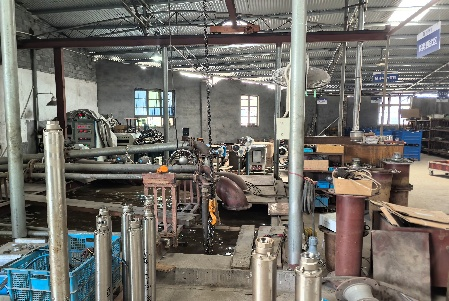
The units discussed here combine an axial flow impeller with a permanent magnet synchronous submersible motor. Zhejiang Chuangmei Electromechanical Co., Ltd. (Chuangmei Pumps) has built pumps since 1996 from a 12,000 m² facility, and holds a utility model patent for the permanent magnet synchronous motor high-speed axial flow pump (Patent No. ZL2014200091521.8).
Construction details that matter for fixed drainage:
- Flow-passing components are aluminium alloy. This is the material specified for the flow passages of these models. The motor housing and pump body are offered in aluminium alloy or stainless steel, so a project needing a different wetted-material package must specify it at order stage rather than assume it.
- Impeller and shaft are stainless steel. The impeller is produced by precision stainless steel casting, and the pump shaft is also stainless steel.
- The motor is a permanent magnet synchronous submersible motor. The manufacturer's stated outcome is high efficiency, light weight and small size — about one quarter the weight of conventional axial flow pumps — together with large flow capacity and portability.
- Speed is steplessly adjustable, so head and flow can be trimmed at commissioning instead of being fixed by impeller trim alone. The motor's speed does not follow grid voltage fluctuation, so a voltage drop does not automatically become a head and flow change; the same statement is not made for traditional asynchronous axial flow pumps.
- The cable outlet is protected by a rubber sheath plus stainless steel spring guard.
Control is what actually turns a pump into a fixed drainage installation. The cabinet uses a panel or touch-screen display with a built-in frequency inverter and shows frequency, voltage, current and rotational speed in real time. Over 3G and 4G networks the unit can be started, stopped and speed-adjusted remotely from a computer or a phone app, and operation can be split into time segments. Protection covers overheat, overcurrent, overload, overvoltage and phase failure. Cabinets are supplied in single-unit or dual-unit (one-drives-two) configuration with IP44 or IP54 protection, and the three-phase four-wire supply uses waterproof plugs and sockets.
For structures that see shallow storm water most of the year and occasional higher lift, the manufacturer also lists dual-purpose pumps — 200SZQ-HL-22 and 250SZQ-HL-30 — that switch between low-lift high-flow and high-lift operation by replacing the impeller and pump body. That option is worth costing at design stage if a single sump serves two very different water levels.
Step-by-step: mapping a site to a model
Step 1 — Fix the discharge point before looking at pumps
The most useful number on the site is the vertical distance between the lowest water level the pump will see and the highest point the discharge must reach, plus the friction loss of the pipe route. Two underpasses with identical catchment areas can need different models purely because one discharges over a kerb and the other lifts into a storm main two metres above the sump.
Step 2 — Size flow to the inflow, then pick a documented model
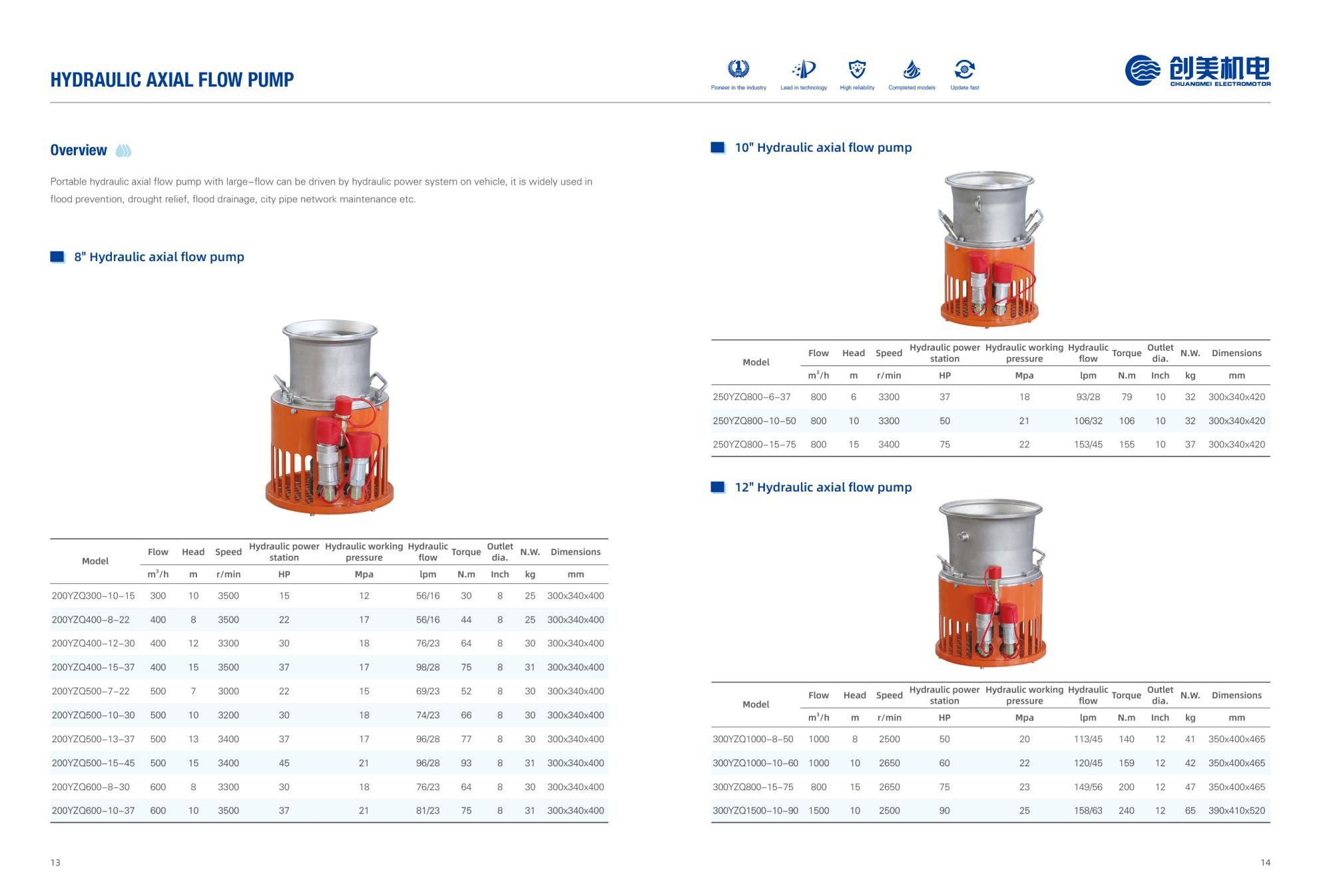
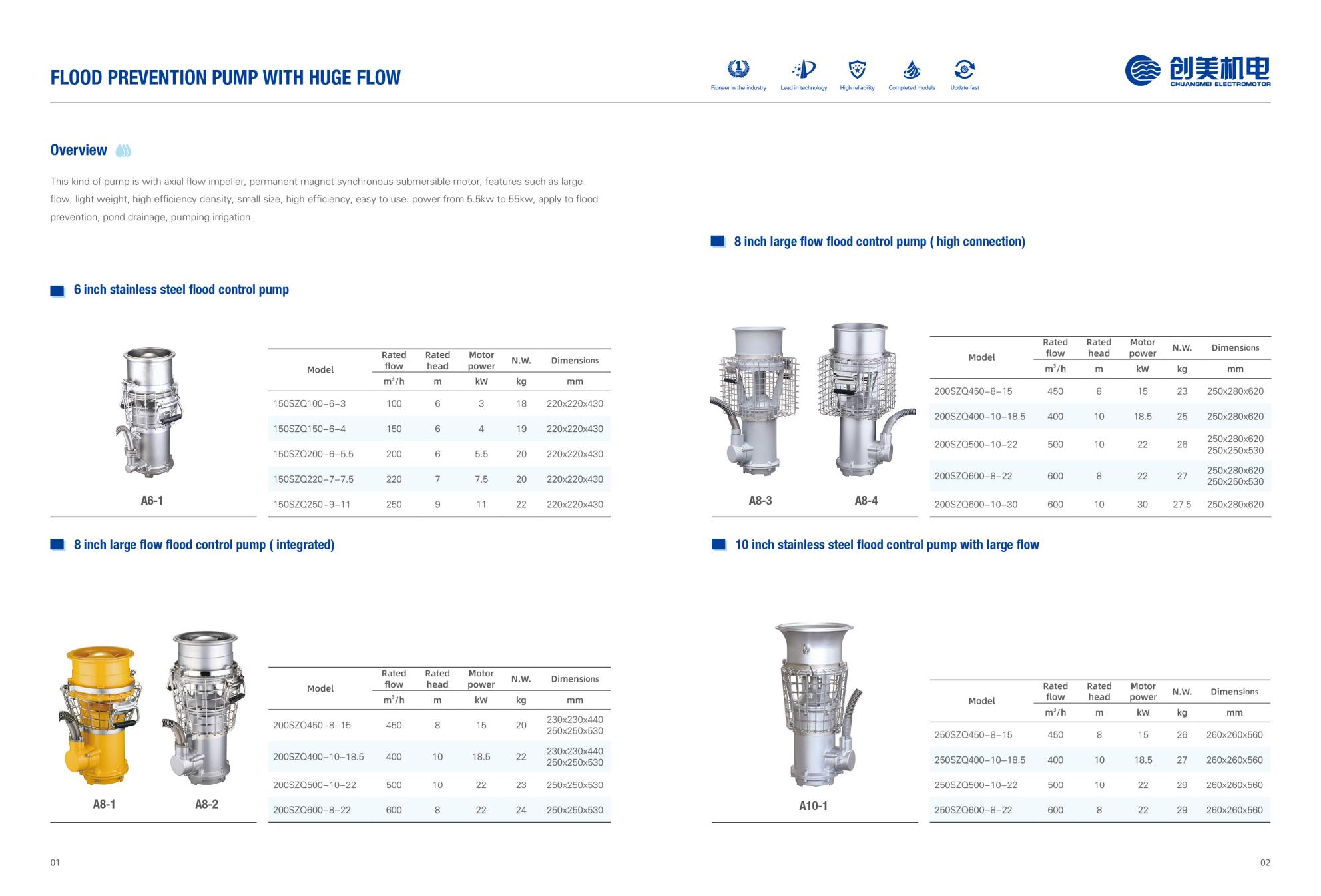
Documented rated flows across the portable axial flow models used for these sites run from 100 m³/h to 1500 m³/h. Three examples show how far the spread reaches: 150SZQ100-6-3 delivers 100 m³/h at 6 m with a 3 kW motor, 18 kg net weight and 220 × 220 × 430 mm dimensions; 200SZQ450-8-15 delivers 450 m³/h at 8 m with 15 kW in a 20 kg body; and 300SZQ1000-10-45, a 12-inch unit, delivers 1000 m³/h at 10 m with 45 kW in a 350 × 350 × 605 mm body.
Step 3 — Read the model designation correctly
Designations in this range are readable: the first number is the nominal discharge size in millimetres, then rated flow in m³/h, rated head in metres, and motor power in kW. The pattern is confirmed repeatedly in the published specifications — 200SZQ200-45-37 is rated 200 m³/h at 45 m with a 37 kW motor, and 250SZQ600-12-30 is rated 600 m³/h at 12 m with 30 kW.
Applied to the two models most often discussed for deeper basement and garage lift stations, 200SZQ200-20-18.5 sits in the 200 m³/h class at a 20 m rated head with an 18.5 kW motor, and 200SZQ200-25-22 sits in the same 200 m³/h class at a 25 m rated head with 22 kW. Because the two share a flow class and differ mainly in head and power, the measured lift plus pipe losses should decide between them — and the chosen duty point should still be confirmed on the model-specific curve before ordering.
Step 4 — Decide the control arrangement
A single-unit cabinet suits one pump in one sump. Where two pumps share a sump, the one-drives-two cabinet controls both from one controller, with time-segmented operation available. Level sensing is the trigger for automatic running, and remote app control is useful where the sump sits in an unmanned structure such as a culvert chamber.
Step 5 — Check that the unit physically fits
Published weights and dimensions quickly rule options in or out: 150SZQ100-6-3 is 18 kg at 220 × 220 × 430 mm, 150SZQ150-20-15 is 34 kg at 280 × 280 × 580 mm, 200SZQ400-25-45 is 75 kg at 380 × 380 × 780 mm, and 200SZQ500-50-110 is 195 kg at 400 × 400 × 860 mm. A garage sump with a narrow access hatch and a basement plant room with a standard door are two different handling problems.
Step 6 — Write acceptance testing into the order
The manufacturer states 100% pre-shipment hydraulic performance testing for its pumps. For projects where the duty point is tight, ISO 9906 Grade 1 tolerances of ±5% on flow and head are the reference used in high-precision OEM applications, so the purchase specification can name that grade and ask for the test record matching the delivered model and serial.
Site-by-site: documented model directions
Bridge underpass
Large inflow, low lift, short discharge run. The 200SZQ450-8-15 and 200SZQ600-8-22 cover 450 and 600 m³/h at 8 m with 15 kW and 22 kW motors respectively, in 20 kg and 24 kg bodies. Where the outfall sits higher, 250SZQ600-12-30 moves 600 m³/h at 12 m with a 30 kW motor. The decision driver is the discharge route: a culvert outfall at sump level allows a low-head model, while a connection into a raised storm main does not.
Culvert and outfall chamber
Flow is usually moderate but the chamber is tight and access is awkward. A 12-inch 300SZQ1000-10-45 delivers 1000 m³/h at 10 m with 45 kW, but its 350 × 350 × 605 mm body and discharge size must be checked against the chamber opening before it is specified. Where the opening is smaller, an 8-inch model such as 200SZQ500-10-22 keeps the flow high at a lower lift.
Basement lift station
Moderate flow, higher lift, occupied building above. The 200 m³/h class is the natural starting point: 200SZQ200-20-18.5 and 200SZQ200-25-22 cover 20 m and 25 m respectively. Where the inflow is larger, 200SZQ400-25-45 delivers 400 m³/h at 25 m with 45 kW in a 75 kg body at 380 × 380 × 780 mm, still handleable by two people with the right lifting arrangement.
Garage sump
Shallow lift, modest inflow, hose routing constraints. The 150SZQ100-6-3 (100 m³/h at 6 m, 3 kW, 18 kg) and 150SZQ200-6-5.5 (200 m³/h at 6 m, 5.5 kW, 20 kg) are sized for this duty, with 150SZQ250-9-11 (250 m³/h at 9 m, 11 kW, 22 kg) as a step up where the ramp catchment is larger.
Where the duty changes: subway, municipal, pipe gallery
These are contrast cases rather than recommendations. Subway emergency drainage requires head — 200SZQ200-50-45 delivers 200 m³/h at 50 m with 45 kW, and 100SZQ100-100-45 delivers 100 m³/h at 100 m with 45 kW at 84 kg. Municipal flood control favours mobile large-flow units such as 300SZQ1500-10-75 at 1500 m³/h and 10 m with 75 kW. Pipe gallery work is governed by confined-space access, not by the pump alone. None of the three should be used to justify a low-lift fixed-drainage model.
| Site / duty | Duty character | Documented model direction | Selection note |
|---|---|---|---|
| Bridge underpass | Large inflow, low lift | 200SZQ450-8-15 (450 m³/h, 8 m, 15 kW, 20 kg); 200SZQ600-8-22 (600 m³/h, 8 m, 22 kW, 24 kg) | Discharge route sets the lift |
| Culvert / outfall chamber | Medium to large flow, lift set by outfall level | 200SZQ500-10-22 (500 m³/h, 10 m, 22 kW); 300SZQ1000-10-45 (1000 m³/h, 10 m, 45 kW) | Check chamber opening against body size |
| Basement lift station | Moderate flow, higher lift | 200SZQ200-20-18.5 and 200SZQ200-25-22 (200 m³/h class); 200SZQ400-25-45 (400 m³/h, 25 m, 45 kW, 75 kg) | Confirm the duty point on the model curve |
| Garage sump | Low inflow, shallow lift | 150SZQ100-6-3 (100 m³/h, 6 m, 3 kW, 18 kg); 150SZQ200-6-5.5 (200 m³/h, 6 m, 5.5 kW, 20 kg) | Access and hose routing decide |
| Small pit, very low lift | High flow, minimal head | 150SZQ250-9-11 (250 m³/h, 9 m, 11 kW, 22 kg) | Stepless speed trims the flow |
| Subway emergency (contrast) | High lift | 200SZQ200-50-45 (200 m³/h, 50 m, 45 kW); 100SZQ100-100-45 (100 m³/h, 100 m, 45 kW, 84 kg) | Outside fixed-drainage scope |
| Municipal flood control (contrast) | Mobile, large flow | 300SZQ1500-10-75 (1500 m³/h, 10 m, 75 kW) | Deployment, not a fixed install |
| Pipe gallery (contrast) | Confined space, long run | Low-lift large-flow models, subject to access | Entry and routing constrain the choice |
Where this selection stops
A low-lift fixed-drainage model cannot be stretched into a high-head duty. If the measured lift plus losses exceeds what the chosen low-lift unit can hold at the required flow, the answer is a different model in the same family, not a larger pump of the same type — which is why the manufacturer maintains a separate high-head range reaching 160 m.
Aluminium alloy is the standard flow-passing material for the models discussed here, so a project that requires a stainless wetted package must state it. The weight advantage is real but relative: about one quarter the weight of conventional axial flow pumps, yet a 200SZQ500-50-110 still weighs 195 kg and needs proper lifting equipment. And automatic operation depends on three site conditions that the pump cannot supply — a live power supply, a maintained level sensor, and an intake that stays clear of sediment.
Procurement and verification details
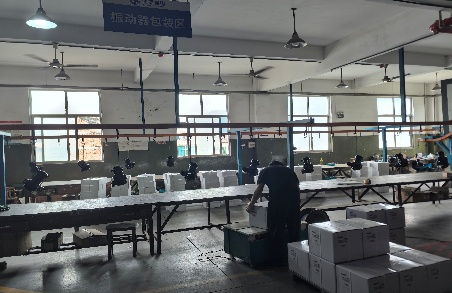
Commercial terms for these pumps are straightforward to check. Minimum order quantity is 1 unit, OEM nameplate customization is available, and lead time is stated as 15–20 days for OEM supply and 15–30 days for ODM supply, against a monthly capacity of 500 units. The stated after-sales package is a one-year warranty with free maintenance during the warranty period, plus remote technical guidance, spare parts supply and on-site maintenance consultation. Export currently represents 25% of output, with Southeast Asia, Africa, Morocco and the Central Asian countries listed as main markets.
Two documentation points are worth raising early. Axial and mixed flow vertical pumps for water handling are classified under HS code 84138130, which matters for import paperwork. And for units sold into China, the mandatory energy label standard GB 30253-2024 for permanent-magnet synchronous motors applies to products sold from 2025, so a China-bound project should request the motor efficiency label evidence rather than accept a general efficiency claim.
On power range, the published data should be read per family rather than as one figure. The large-flow series used for fixed drainage is described with power options from 5.5 kW to 55 kW; the mobile irrigation and flood control range is described from 3 kW to 200 kW; and the high-head range is described as reaching 300 kW or larger where customized. Industry catalogues commonly cite a 5.5–400 kW envelope for portable axial flow pumps generally, which is a category figure rather than a statement about any single series.
Frequently asked questions
Can one pump serve both fixed drainage and subway emergency drainage?
Within the same product family, yes; with the same single unit, usually not. A fixed-drainage pump is chosen on a low-lift, high-flow duty point, while subway work is chosen on head — the manufacturer publishes subway-suitable models with lifts from 20 to 50 m, special specifications above 100 m, and documented units reaching 160 m such as 100SZQ100-160-75. A unit sized for a garage sump at 6 m of head is not a substitute for that duty. For China-bound projects, also confirm the GB 30253-2024 energy label evidence for the permanent-magnet motor.
How do I choose between 200SZQ200-20-18.5 and 200SZQ200-25-22 for a basement?
Both sit in the 200 m³/h flow class; they differ in head and motor power, at 20 m with 18.5 kW and 25 m with 22 kW. Measure the vertical lift from the lowest water level to the highest discharge point, add the pipe friction loss, and let that total decide. Then confirm the resulting duty point on the model-specific curve and check that the site's power supply matches the motor rating before ordering.
Does a garage sump need a large-flow model?
Usually not. Garage duty is shallow and the inflow is modest, so 150SZQ100-6-3 at 100 m³/h and 6 m with a 3 kW motor, 18 kg net weight and 220 × 220 × 430 mm dimensions covers many small sumps, with 150SZQ200-6-5.5 at 200 m³/h available where the ramp catchment is larger. Oversizing adds cost and shortens run cycles without improving protection, and stepless speed regulation on these models allows the delivered flow to be trimmed instead.
What has to be installed on site for automatic operation?
The pump alone is not the system. Application data for this duty lists a control cabinet, water level sensor, pipeline, filter screen and power cable as matched equipment. The cabinet carries a panel or touch-screen display with a built-in frequency inverter, real-time frequency, voltage, current and speed readouts, 3G/4G remote control through a computer or phone app, time-segmented operation, and protection against overheat, overcurrent, overload, overvoltage and phase failure. IP44 or IP54 protection is available, and dual-unit one-drives-two cabinets control two pumps from one controller.
Can a single unit be supplied for testing, and how long does supply take?
Minimum order quantity is 1 unit, so a single pump can be ordered for trial installation, with OEM nameplate customization available. Stated lead time is 15–20 days for OEM supply and 15–30 days for ODM supply, against a monthly capacity of 500 units, and every unit is subject to pre-shipment hydraulic performance testing. Sharing the site's lift, required flow and discharge route with Chuangmei Pumps is the fastest way to get a model recommendation and the matching test record before a project batch is placed.
Conclusion
Fixed drainage at a bridge, culvert, basement or garage rewards a narrow specification rather than a broad one. The site supplies two numbers — lift and inflow — and the model designation supplies the rest, because flow, head and motor power are readable directly from names such as 200SZQ200-20-18.5 or 200SZQ450-8-15. Aluminium alloy flow passages, a stainless steel impeller and shaft, a permanent magnet synchronous submersible motor with stepless speed regulation, and level-triggered control with dry-run shutdown are the features that make a standing installation work without an operator present.
The boundary matters as much as the selection. Subway emergency drainage, municipal flood control and comprehensive pipe gallery work each impose a different controlling constraint — head, mobility, or confined-space access — and none of them should be used to justify a low-lift unit in a garage sump. Verify the duty point on the model curve, confirm materials and motor ratings at order stage, and keep the pre-shipment test record with the project file.
For full flow, head, power, weight and dimension data across the 150SZQ, 200SZQ and 300SZQ ranges, download the High flow pump product catalogue (PDF).
Have Questions or Need More Details?
Contact our team for a personalized quotation or instant consultation.
Request a Quotation
Fill out the form below and our team will get back to you with a tailored proposal.
WhatsApp Direct Chat
Prefer to chat in real-time? Message us on WhatsApp for instant assistance & quick answers.
- Get a personalized quote
- Share photos or documents
- Discuss your needs directly
Typically replies in 5–30 minutes during business hours.