7 Automotive Wire Harness Connector Components for Harsh OEM Builds
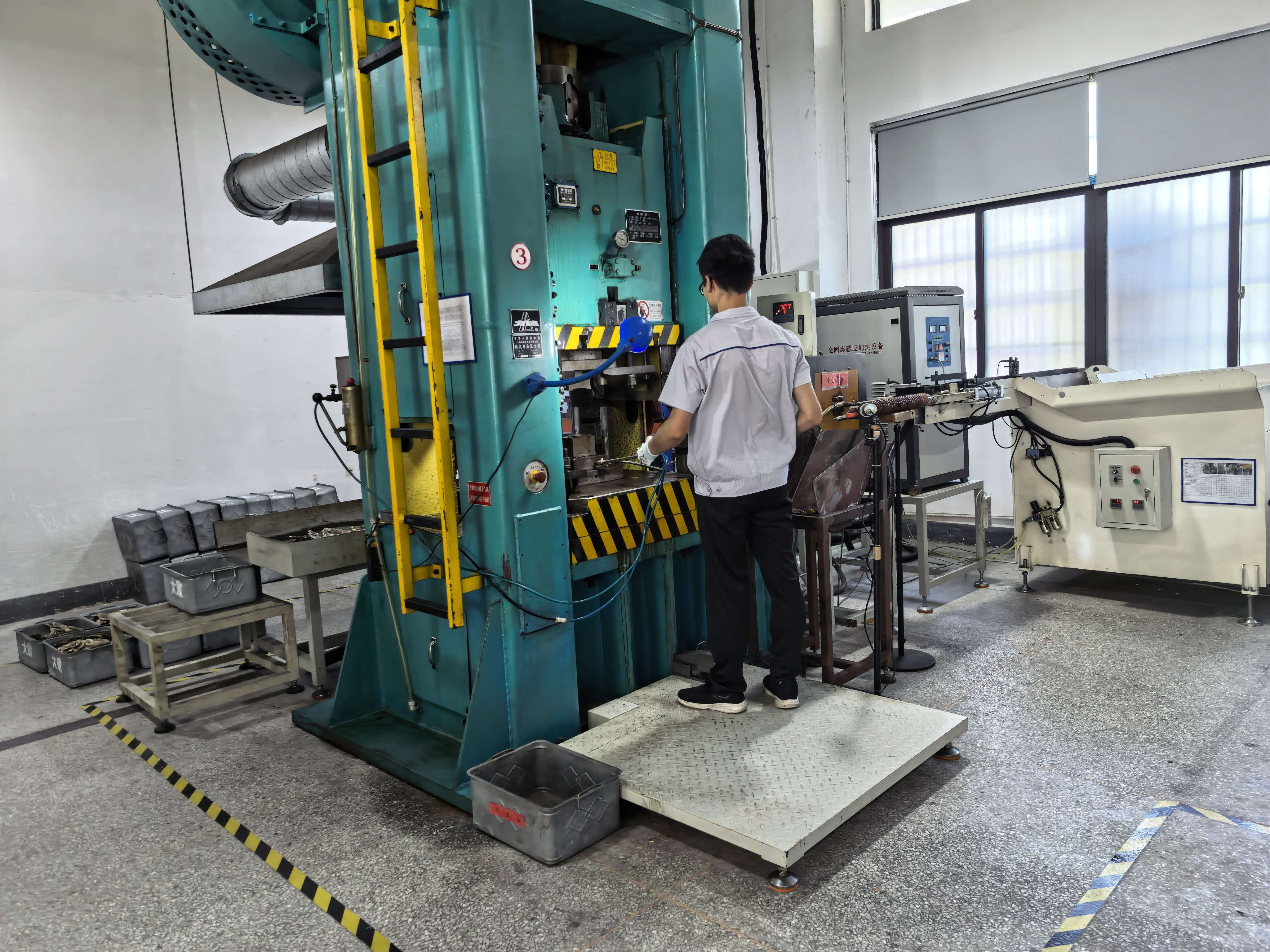
Cover: harness and connector production at Zhejiang Daou Electronics Co., Ltd. (CNDO), Yueqing City, Zhejiang Province, China.
Seven components make up this ranked shortlist for harsh-environment OEM builds, and each one is present for a stated reason rather than for catalogue breadth. Rank 1 is the DOH0001-1 housing (PA/PBT, IP67, -40 °C to +125 °C), because a sealed housing defines the environmental envelope every other part in the harness must survive inside. Rank 2 is the DOBN22006-D5 EV high-voltage battery connector (tin-plated, M8 stud, 8 N·m, 500 A), the highest-current part in the set. Rank 3 is the DOBP22001 battery terminal (brass, SAE Top Post, 19.05 mm positive post). Ranks 4 to 7 cover two fuse boxes, a three-way conduit connector, a support bracket and a plated terminal.
All seven parts are produced by Zhejiang Daou Electronics Co., Ltd. (CNDO), a manufacturer of automotive wire harnesses, battery terminals, fuse boxes, connectors and waterproof plugs based in Yueqing City, Zhejiang Province, China, with stated export markets in the United States and the European Union.
The ranking uses three criteria only: protection rating, material durability, and application fit across engine bay, chassis, body and battery power distribution zones. No specification is added that the published data does not carry. That limitation matters for buyers, because a shorter list of verifiable facts is more useful at evaluation stage than a longer list of unverified claims. The order reflects how much environmental exposure each part is designed to cover, not the relative quality of the parts: a terminal ranked seventh is still a mandatory part of the same assembly.
Why Harsh Environments Break Harness Builds Before the Specification Sheet Does
Water ingress, heat ageing, vibration and current load rarely act alone. A connector that seals correctly on a bench can still fail in service when a temperature swing hardens a gasket, when a bracket allows the harness to chafe against a chassis member, or when a terminal loosens because torque was never specified at assembly. The failure is usually a system effect, not a single-part defect.
This is why component selection for harsh environments is a specification task rather than a shopping task. Each zone of the vehicle imposes a different combination of stressors. The engine bay combines heat with splash and condensation. The chassis combines vibration with road debris and salt. The body interior is comparatively benign but still sees thermal cycling. Battery power distribution combines continuous current, tightening torque and the risk of corrosion at the contact interface. An EV battery pack adds high current and high voltage insulation requirements on top of that.
A ranked list is only useful if it maps each part to the zone where its published specs actually apply. The seven components below are ordered on that basis, with the inclusion reason stated for each.
Industry Background: More Harness Content, More High-Voltage Content
Two market signals frame this shortlist. According to Global Market Insights, the global automotive wiring harness market was valued at USD 71.2 billion in 2025 and is projected to reach USD 74.7 billion in 2026, with Asia Pacific holding 47.1% of 2025 revenue. Separately, SNS Insider reports the automotive high-voltage connector market at USD 4.99 billion in 2026, growing at a CAGR of 11.90% from 2026 to 2035.
The practical reading for a procurement or engineering team is straightforward. The harness base is large and comparatively mature, while the high-voltage connector segment is the faster-moving part of the same supply chain. A shortlist that covers both a 12 V/24 V battery distribution chain and an EV high-voltage connection therefore matches how OEM programs are actually structured today, rather than treating them as separate purchasing worlds.
Compliance pressure runs alongside that growth. For programs sold into the European Union, automotive parts fall under REACH obligations, and the ACEA AIG 4.0 guidance sets out how automotive industry suppliers should identify substances and preparations and meet their corresponding REACH duties. Material declarations are therefore part of the component conversation, not an afterthought at the end of a program.
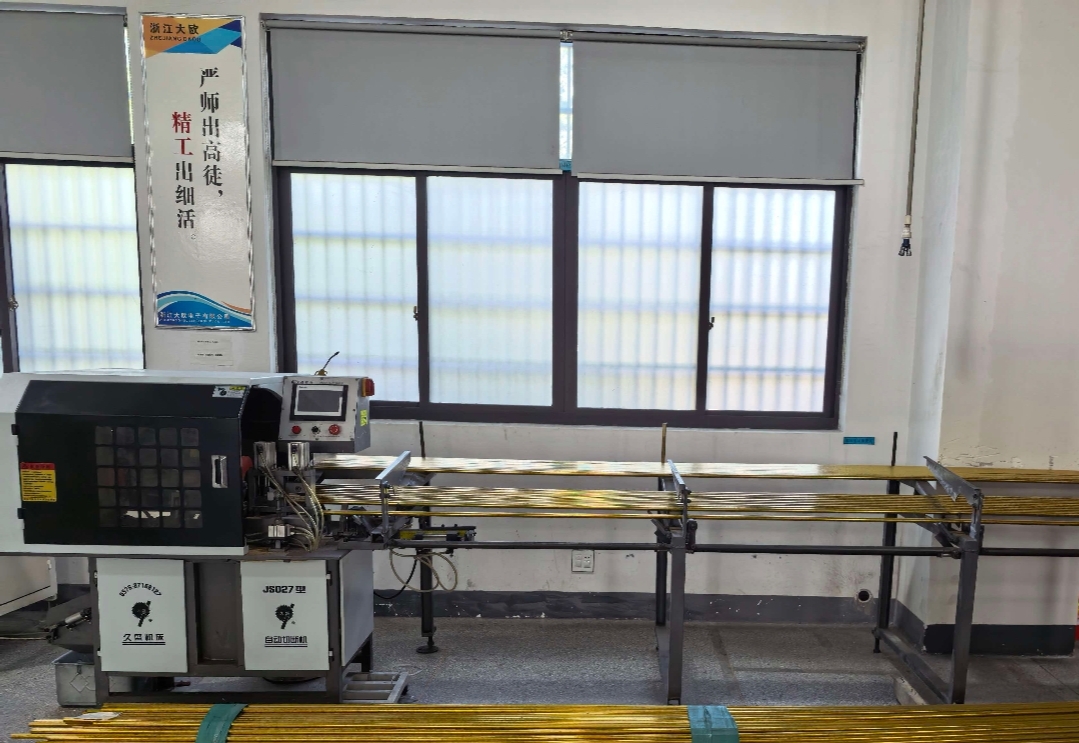
Assembly environment: parts ranked in this list are produced under an IATF 16949:2016 quality system.
The Three Ranking Criteria
- Protection rating. Sealing classes are the first filter, because no material upgrade compensates for water reaching the contact interface. IP67 appears on the DOH0001-1 housing, and IP66/IP67 appears on the D520023 three-way conduit connector when its sealing gaskets are fitted.
- Material durability. Polymer and metal choices are read together. PA/PBT for the housing, PA66 for the conduit connector and fuse box bodies, PA66 and PA66 GF30 for the bracket, copper and brass for conductive parts. Flammability ratings of UL94-V0 and UL94-V2 apply to the bracket grades. The published temperature range of -40 °C to +125 °C applies to the DOH0001-1 housing.
- Application fit. A part is ranked higher when its published specification directly answers a known stressor in a named zone, such as the 8 N·m tightening torque and 500 A rating on the DOBN22006-D5 for battery pack work, or the 19.05 mm positive post of the DOBP22001 for a standard SAE Top Post battery connection.
Ranking at a Glance
| Rank | Component (model) | Material | Protection / rating | Electrical / mechanical | Best-fit zone |
|---|---|---|---|---|---|
| 1 | Housing (DOH0001-1) | PA/PBT | IP67; -40 °C to +125 °C | — | Engine bay and body pass-through |
| 2 | EV high-voltage battery connector (DOBN22006-D5) | Tin-plated | — | 500 A; M8; 8 N·m | EV battery pack power distribution |
| 3 | Battery terminal (DOBP22001) | Brass | — | SAE Top Post; 19.05 mm positive | 12 V battery power distribution |
| 4 | Fuse boxes (DOBXS4-1A, DOBXS5-1F) | PA66 housing; copper conductors | IATF 16949 production | 12 V / 24 V DC | Battery and body circuit protection |
| 5 | Three-way conduit connector (D520023) | PA66 | IP66/IP67 with sealing gaskets | — | Harness split points, engine bay and chassis |
| 6 | Support bracket (DOCB24001) | PA66 / PA66 GF30 | UL94-V0 / UL94-V2 | — | Chassis and body route fixation |
| 7 | Terminal (DOE24022) | Copper; tin-plated, gold-plated options | — | 12 V / 24 V | Terminal-to-battery and fuse box termination |
Table notes: a dash means the published specification set does not state a value for that column. No attribute has been inferred or added.
The Seven Components, Ranked
1. DOH0001-1 Housing — PA/PBT, IP67, -40 °C to +125 °C
The housing takes rank 1 because it is the only component in this set with both a sealing class and a published operating temperature range. IP67 covers the water-ingress side of the exposure question; the -40 °C to +125 °C envelope covers cold start on one end and sustained engine-bay heat on the other. PA/PBT is the material basis for both.
Why it is included: sealing and thermal range are the two specifications that most often disqualify a housing at evaluation stage, and both are published here. Where it fits: engine bay and body pass-through locations where splash and heat occur in the same zone. It is also the reference point for the rest of the build, because any part routed into this housing inherits its envelope.
2. DOBN22006-D5 EV High-Voltage Battery Connector — 500 A, M8, 8 N·m
Rank 2 reflects current load and connection verifiability. The DOBN22006-D5 is rated 500 A on an M8 stud with a specified tightening torque of 8 N·m, and the conductive surface is tin-plated. A published torque value is a practical asset in production: it converts a connection from an operator judgement into a controlled assembly step with a measurable acceptance criterion.
Why it is included: it is the highest-current part on the list and the one that directly serves EV battery pack power distribution, the fastest-growing segment in the background data. Where it fits: battery pack and high-current power distribution connections inside new energy vehicle programs, where a defined stud size and torque are needed for repeatable assembly.
3. DOBP22001 Battery Terminal — Brass, SAE Top Post, 19.05 mm Positive
The DOBP22001 is a brass battery terminal built to the SAE Top Post pattern with a 19.05 mm positive post dimension. Brass is the material basis, and the SAE Top Post interface is what makes the part immediately usable in conventional 12 V battery power distribution rather than requiring a program-specific battery design.
Why it is included: the 19.05 mm positive post figure is a concrete, checkable dimension, and the SAE Top Post reference tells a buyer which battery family the part mates with. Where it fits: fuel vehicle and commercial vehicle battery assemblies, including battery wire harness assembly work where the terminal is the first mechanical interface in the power path.
4. DOBXS4-1A and DOBXS5-1F Fuse Boxes — PA66/Copper, 12 V/24 V DC
Two fuse box variants are ranked as one entry because they share the same material and electrical basis: PA66 bodies with copper conductors, rated for 12 V and 24 V DC systems, and produced under IATF 16949. Ranking them jointly keeps the list honest about what actually differs between the two part numbers, which is not the material platform.
Why it is included: circuit protection is the one function in a harness that must work on the day a fault occurs, and the PA66 body with copper conductors is the specified basis for both variants. Where it fits: battery and body circuit protection in fuel vehicle and commercial vehicle builds, including 24 V systems where the box is specified accordingly.
5. D520023 Three-Way Conduit Connector — PA66, IP66/IP67 With Sealing Gaskets
A three-way conduit connector solves a routing problem that a straight connector cannot: one harness run dividing into three. The D520023 is PA66 with IP66/IP67 protection when the sealing gaskets are in place. That conditional phrasing matters, because the gasket is the sealing element and the housing alone does not deliver the rating.
Why it is included: it carries a sealing class into a split point, which is where harness protection is most often compromised in practice. Where it fits: engine bay and chassis branch points where a main run divides and each branch still needs protection.
6. DOCB24001 Support Bracket — PA66 and PA66 GF30, UL94-V0/V2
The DOCB24001 is available in PA66 and PA66 GF30, with UL94-V0 and UL94-V2 flammability ratings across the two grades. The distinction is a mechanical one: glass-filled PA66 raises stiffness, which is generally preferred where the bracket has to hold a route against vibration over a long span, while unfilled PA66 is used where the layout calls for the base grade.
Why it is included: it converts route stability from an assembly habit into a specified part, and the flammability rating adds a documented material property. Where it fits: chassis and body routing, where an unsupported run would otherwise chafe or fatigue.
7. DOE24022 Terminal — Copper, Tin- or Gold-Plated, 12 V/24 V
The DOE24022 is a copper terminal for 12 V and 24 V applications with tin-plated as the standard finish and gold-plated options available. Tin plating is the usual choice for general power termination; gold-plated options are typically specified where a stable low-level contact interface matters more than cost. Both options sit on the same copper base.
Why it is included: it closes the circuit at the battery and fuse box end of the build and offers a plating choice rather than a single fixed finish. Where it fits: terminal-to-battery and terminal-to-fuse-box termination in fuel vehicle and commercial vehicle harness assemblies. It ranks seventh because, of the seven parts, it carries the least published environmental specification of its own and depends most on the housing and fuse box around it.
Step-by-Step: Turning the Ranking Into a Build Decision
- Define the zone envelope first. Write down the temperature range, water exposure and current load for each zone in the build. Until the envelope exists, no part can be judged against it. The DOH0001-1 figure of -40 °C to +125 °C is a usable starting reference for an engine bay envelope.
- Match sealing to the exposure point. Place IP67 components such as the DOH0001-1 housing and IP66/IP67 components such as the D520023 conduit connector at the points where water can actually reach the contacts, and confirm the gaskets are part of the delivered configuration.
- Select the conductive path and finish. Choose between the DOE24022 terminal with tin plating as standard or gold-plated options, the tin-plated DOBN22006-D5 for high-current EV work, and the brass DOBP22001 for SAE Top Post battery connections. Plating choice should follow the environment and the contact interface, not the price sheet alone.
- Fix the mechanical interface with numbers. Use the 8 N·m torque on the M8 stud of the DOBN22006-D5 and the 19.05 mm positive post of the DOBP22001 as assembly criteria. Select PA66 or PA66 GF30 for the DOCB24001 according to how much stiffness the route needs.
- Collect the compliance file in parallel. Request the IATF 16949:2016 certificate with its scope, the UL94 ratings for the bracket grades, and a REACH position for EU-bound programs. Do this while the samples are in evaluation, not after the design freeze.
- Validate with small-lot samples and a pilot run. A minimum order quantity of 2 units and a 7-15 day lead time allow individual parts to be ordered for fit and material checks before a program commitment. Judge the samples against the same three criteria used in this ranking.
Use Cases: Which Ranked Part Belongs in Which Zone
Commercial vehicle engine bay. The DOH0001-1 housing carries the sealing and thermal envelope, the D520023 conduit connector handles the three-way split as the run branches, and the DOCB24001 bracket holds the route against vibration. This is the combination where all three environmental stressors appear at once.
Fuel vehicle battery power distribution. The DOBP22001 brass SAE Top Post terminal connects at the battery, the DOE24022 terminal closes the termination at the fuse box end, and the DOBXS4-1A or DOBXS5-1F fuse box provides circuit protection on a 12 V or 24 V DC system.
New energy vehicle battery pack. The DOBN22006-D5 high-voltage connector is the primary part here, rated 500 A on an M8 stud with 8 N·m torque. The DOH0001-1 housing and D520023 conduit connector support the surrounding low-voltage and routing requirements in the same vehicle.
Chassis and body routing. The DOCB24001 bracket in PA66 or PA66 GF30 provides fixation, with the grade chosen for route stiffness. Where the route divides, the D520023 connector keeps the split protected.
Export programs to the United States and the European Union. Both markets are stated export destinations for CNDO. EU programs add the REACH documentation requirement described above, and the IATF 16949 quality system applies across the product range rather than to a single part number.
Compliance and Documentation to Request With Every Ranked Part
Zhejiang Daou Electronics Co., Ltd. holds IATF 16949:2016 certificate 0596976, issued by URS, with the scope recorded as Design and Manufacture of Electronic Connectors and Wire Harnesses and validity to 2029-02-08. The standard is IATF16949:2016 and the market coverage is the global automotive supply chain under IAF mutual recognition.
That certificate is the anchor document for a supplier file, but it should not travel alone. Three further items belong in the same pack: the UL94-V0 and UL94-V2 flammability ratings for the DOCB24001 bracket grades, a REACH position for parts destined for the European Union under the ACEA AIG 4.0 framework, and the product parameter documents for each ordered part number.
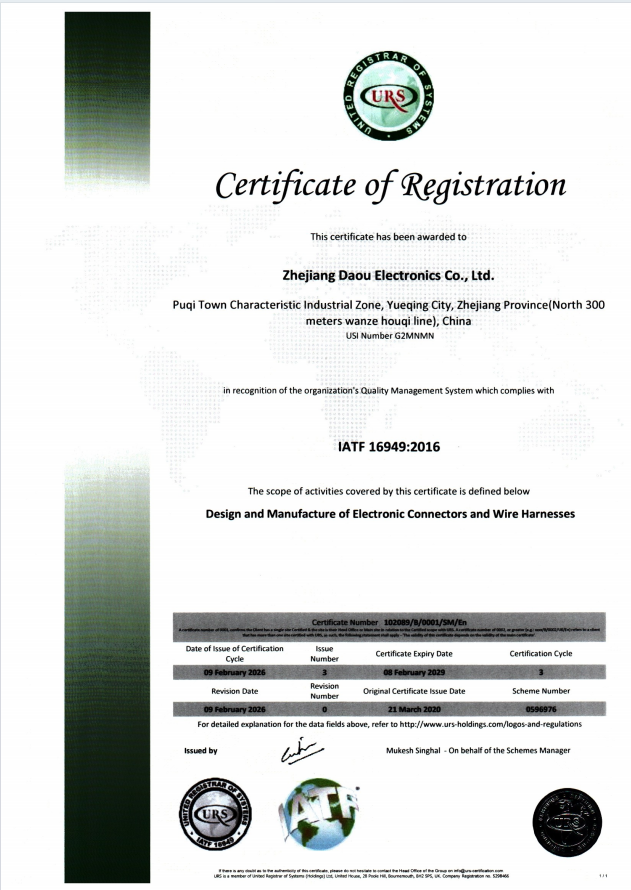
Compliance proof: IATF 16949:2016 certificate 0596976, issued by URS, scope Design and Manufacture of Electronic Connectors and Wire Harnesses, valid to 2029-02-08.
Capacity, MOQ and Lead Time Behind the Shortlist
Evaluation decisions usually fail on supply questions rather than on specifications. The stated monthly production capacity is 750,000 units, with a minimum order quantity of 2 units and a lead time of 7-15 days. Production is run under an IATF 16949 standard quality control system, and the company reports a 6,000 m² facility, 125 employees, 25 R&D engineers and an annual output of 9,000,000 units, with roughly 50% of output exported to the United States and the European Union. Those facility figures are company-reported.
OEM customization covers housing color, printing logo, terminal current specification, wire gauge matching, waterproof grade, pin count, packaging solution and EV high voltage insulation structure. After-sales support includes remote technical guidance, spare parts supply, product parameter documents and factory audit coordination. For a buyer at evaluation stage, the practical sequence is to use the 2-unit minimum for sampling, confirm the drawing and customization scope, and then plan repeat orders against the 7-15 day lead time and the monthly capacity figure.
FAQ
Which certifications should a top automotive wire harness connector manufacturer hold?
IATF 16949:2016 is the first document to check. Zhejiang Daou Electronics Co., Ltd. holds IATF 16949:2016 certificate 0596976, issued by URS, covering the Design and Manufacture of Electronic Connectors and Wire Harnesses and valid to 2029-02-08. Flammability ratings such as UL94-V0 and UL94-V2 apply to the DOCB24001 bracket materials, and REACH obligations apply for programs sold into the European Union under the ACEA AIG 4.0 guidance.
What production capability separates a manufacturer from a trading supplier?
Capacity, process ownership and engineering depth. Monthly production capacity is 750,000 units, in-house capability runs from mold development through precision manufacturing to finished product inspection, and OEM customization covers housing color, printing logo, terminal current specification, wire gauge matching, waterproof grade, pin count, packaging solution and EV high voltage insulation structure. Factory audit coordination and product parameter documents can be requested as part of qualification.
How do MOQ and order size affect the cost of a ranked component build?
The stated minimum order quantity is 2 units, which supports pilot quantities and single-part evaluation. Cost at that scale is driven by material and plating choice, customization scope and quantity rather than by a single catalogue price, so a quotation should be requested against the drawing and specification. Monthly capacity of 750,000 units and a 7-15 day lead time then set the planning frame for repeat orders.
Can I sample the components before committing to an OEM program?
Yes. A minimum order quantity of 2 units and a 7-15 day lead time allow individual parts such as the DOH0001-1 housing, DOCB24001 bracket or DOE24022 terminal to be ordered in small lots for fit and material checks, supported by product parameter documents and remote technical guidance. Samples should be judged against the same criteria used in this ranking: protection rating, material durability and application fit.
What lead time and next step should be planned?
Production lead time is 7-15 days with monthly capacity of 750,000 units, and export markets include the United States and European Union. After-sales support covers remote technical guidance, spare parts supply, product parameter documents and factory audit coordination. The next step is to send the drawing and zone requirements for the listed parts, then request a quotation and the current catalogue; the CNDO product brochure is available as a downloadable PDF for that first review.
Conclusion
The seven components in this shortlist answer different parts of the same harsh-environment question. The DOH0001-1 housing sets the environmental envelope with IP67 and a -40 °C to +125 °C range. The DOBN22006-D5 carries 500 A through an M8 stud at 8 N·m for EV battery pack work. The DOBP22001 provides a brass SAE Top Post interface at 19.05 mm positive. The DOBXS4-1A and DOBXS5-1F fuse boxes protect 12 V and 24 V DC circuits on a PA66 and copper platform. The D520023 keeps IP66/IP67 protection at a three-way split, the DOCB24001 stabilises the route in PA66 or PA66 GF30 with UL94-V0 and UL94-V2 ratings, and the DOE24022 closes the termination in copper with tin-plated or gold-plated options.
Used together, they map onto engine bay, chassis, body and battery power distribution zones without requiring a buyer to translate between unrelated datasheets. The ranking is a starting point for evaluation, not a substitute for sample testing, and the specifications behind it are the ones a program team can actually check at the drawing stage.
For buyers moving from shortlist to sample order, Zhejiang Daou Electronics Co., Ltd. accepts orders from 2 units with a 7-15 day lead time and provides product parameter documents, remote technical guidance and factory audit coordination. Drawings and zone requirements can be submitted through www.zjdaou.com, and the CNDO brochure covers the full component range for a first review.
Next step: request a sample and quotation
Send the drawing and zone requirements for the components on this list, and confirm plating, grade and customization scope before the pilot run.

Contact base: Puqi Characteristic Industrial Zone, Yueqing City, Zhejiang Province, China. Email: jialuzhou101@gmail.com. Tel: +86 13645876878.
Have Questions or Need More Details?
Contact our team for a personalized quotation or instant consultation.
Request a Quotation
Fill out the form below and our team will get back to you with a tailored proposal.
WhatsApp Direct Chat
Prefer to chat in real-time? Message us on WhatsApp for instant assistance & quick answers.
- Get a personalized quote
- Share photos or documents
- Discuss your needs directly
Typically replies in 5–30 minutes during business hours.