Automotive Wire Harness Connector Application Guide: Engine Bay, Chassis, and Body Adaptation
Zone-adaptation decisions should start before the part number is chosen. A single harness branch can begin in the engine bay, cross a chassis rail and terminate in the body, and those three environments do not make the same demands on temperature, fluid exposure, vibration and sealing. Treating any one component as a universal part is usually where the weakest point of the run appears.
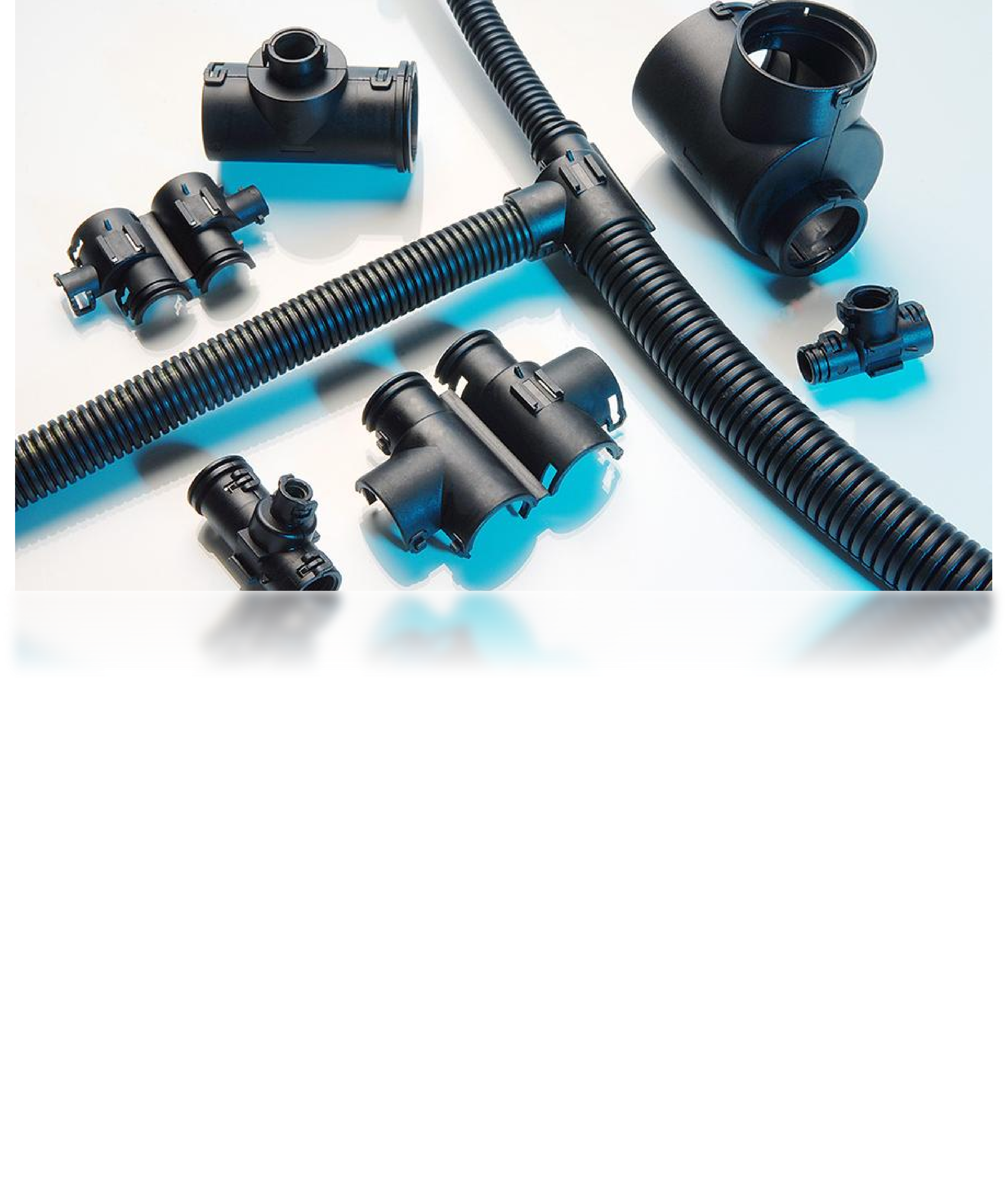
D520023 three-way tube conduit connector in PA66, rated IP66/IP67 with sealing gaskets and specified for engine bay, chassis and body wiring.
Zhejiang Daou Electronics Co., Ltd. (CNDO) is an automotive wire harness and battery terminal manufacturer based in Puqi Characteristic Industrial Zone, Yueqing City, Zhejiang Province, China, supplying harness components, fuse boxes, connectors and waterproof plugs for vehicle builds. Its zone-adaptation set covers four distinct functions: the D520023 three-way tube conduit connector for branch routing, the DOCB24001 support bracket for route fixing, the DOH0001-1 housing for the sealed interface, and the DOE24022 terminal for the electrical joint.
This guide maps those four components onto engine bay, chassis and body scenarios, and shows the order in which a buyer or harness engineer can evaluate them so that each part is matched to the zone it actually operates in.
Problem Definition: Why a Harness Run Fails at the Zone Boundary
A wire harness connector is rarely chosen in isolation. It is chosen for a location, and the location determines what the connector will be asked to survive.
- Engine bay — sustained heat, thermal cycling, contact with engine oil, grease and coolant, and continuous engine vibration.
- Chassis — road splash, salt spray, grit and stone impact, plus constant low-frequency vibration along the rails.
- Body and cabin — a comparatively dry interior environment, tight packaging behind trim, and small relative movements between body panels and the harness.
Most failures in a routed harness concentrate at the points where these environments meet: the branch split, the fixing point and the sealed interface. Those are exactly the three positions that the conduit connector, the support bracket and the housing occupy. When any one of them is specified for the wrong zone, the run degrades from that point outward, and the symptom usually appears somewhere else.
Decision rule: define the zone first, then the component. A part that is correct for a sealed chassis junction may be unnecessary in a dry cabin, and a part that is adequate in a cabin may fail at the first engine-bay heat soak.
Industry Background: More Connector Variants, Not Fewer
The commercial context supports a zone-first approach rather than a catalogue-first one. Global Market Insights reports that the global automotive wiring harness market reached approximately USD 74.7 billion in 2026, and that Asia Pacific held 47.1% of 2025 revenue. SNS Insider reports the global automotive high-voltage connector segment at USD 4.99 billion in 2026.
Two conclusions follow for buyers. First, the centre of harness manufacturing volume remains in Asia Pacific, so most sourcing conversations involve suppliers whose component ranges are broad enough that selection discipline matters. Second, the high-voltage segment is large enough to carry its own connector families, which means sealed, chemically resistant and thermally rated parts are increasingly specified by zone and application rather than by generic category.
The practical effect is that a general-purpose connector list no longer maps cleanly onto a vehicle program. Zone adaptation — matching material, sealing class, temperature range and fixing method to the environment — has become the working method for defining a harness bill of materials.
Detailed Solution: Four Components, Four Zone Functions
The zone-adaptation set works because each component answers a different physical question. The conduit connector answers where the branch goes; the bracket answers where the run is held; the housing answers how the interface is sealed; the terminal answers how current crosses the joint.
D520023 Three-Way Tube Conduit Connector — the Branch Point
The D520023 is a harness T/Y connector moulded in PA66 and intended for automotive wiring in the engine bay, chassis and body. It carries a continuous operating temperature of -40°C to +120°C with a short-term peak of 150°C, and reaches IP66/IP67 when fitted with sealing gaskets.
Its chemical specification is the reason it can be placed at a branch that leaves the cabin and enters a wet or oily zone: the material is stated as resistant to engine oil, mineral oil, grease, weak acid and weak alkali, and to partial solvents, with UV resistance, hydrolysis resistance and ageing resistance. Because the connector is a non-conductive PA66 part, it also provides insulation at the split, which matters where a branch passes close to other conductors or a conductive structure.
For buyers, the useful way to read this specification is by zone. In the engine bay, the 150°C short-term peak and the oil and grease resistance cover the thermal and fluid side of the branch. On the chassis, the IP66/IP67 rating with gaskets addresses splash and wash-down. In the body, the same part can be used where a sealed branch is still required, although a dry interior run may not need the full sealing configuration.
DOCB24001 Support Bracket — Route Stability
The DOCB24001 is a plastic harness support bracket offered in PA66 and PA66 GF30. It is rated for -40°C to +125°C, with engine-bay versions able to withstand higher transient temperatures, and it carries a UL94-V0 or UL94-V2 flame rating depending on the variant selected.
The bracket's stated weather resistance covers UV, ageing and salt spray, together with resistance to engine oil, coolant and cleaning agents. Vibration durability is stated as compliant with vehicle vibration durability test standards. Those four attributes map directly onto the three zones: salt spray and cleaning agents are chassis exposures, engine oil and coolant are engine-bay exposures, and UV and ageing resistance matter anywhere the bracket is not fully shielded.
The material choice between PA66 and PA66 GF30 is a project decision, and the flame rating requirement should be confirmed against the vehicle programme before the bracket variant is fixed. The specification provides both options; it does not prescribe one for a given zone.
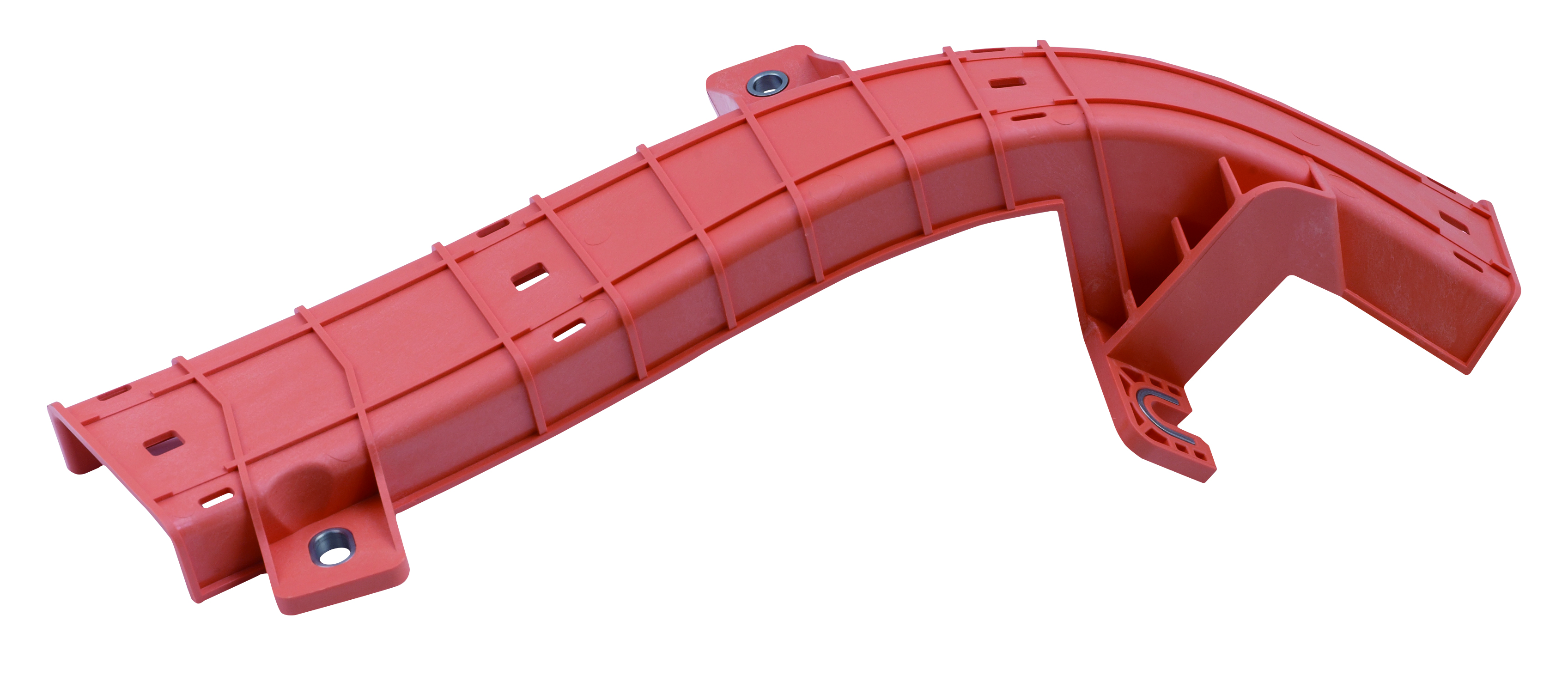
DOCB24001 support bracket, available in PA66 and PA66 GF30, rated -40°C to +125°C with UL94-V0 / UL94-V2 flame rating.
DOH0001-1 Housing — the Sealed Interface
The DOH0001-1 is an automotive wire harness housing in PA/PBT with an IP67 rating and an operating range of -40°C to +125°C. Its sealing property is stated as waterproof, dustproof, oil-resistant and acid and alkali resistant, with vibration resistance described as automotive compliant and the part built to IATF16949 standards.
This is the component that defines whether a connection point can live outside a protected cavity. In the chassis zone, IP67 and the oil and acid/alkali resistance are the controlling attributes. At a body penetration — where a harness passes from an exterior panel into the cabin — the same housing provides the sealed boundary. Where a run stays entirely inside a dry interior, the housing still provides mechanical protection and vibration resistance, but the sealing class is no longer the deciding factor.
DOE24022 Terminal — the Electrical Joint
The DOE24022 is an automotive wiring harness terminal available in pure copper, red copper, copper alloy, tin-plated copper, nickel-plated copper and gold-plated copper. Its rated voltage is 12V/24V DC for mainstream vehicle systems, with up to 48V DC for special models. Rated current varies by size across 5A, 10A, 20A, 50A, 100A and 200A options.
Electrically, the terminal is specified with low contact resistance for stable conductivity, a withstand voltage compliant with automotive wiring harness electrical standards, and high insulation resistance on the insulated version. Plating selection is where the zone begins to matter again: tin, nickel and gold plating are the options offered, and the choice should follow the connector's exposure rather than a default preference.

DOE24022 terminals are offered in copper and copper alloy with tin, nickel or gold plating, rated for 12V/24V DC systems.
Step-by-Step Breakdown: Adapting a Harness Run to Its Zones
The sequence below is the order in which zone adaptation is usually resolved. It moves from environment to component, not the other way round.
Step 1 — Map the zones the branch actually crosses
List each segment of the run and the environment it sits in. A branch that starts at an engine-bay fuse box or battery terminal, runs along a chassis rail and ends behind a body panel crosses three environments and may need three different sealing decisions on one conductor set.
Step 2 — Fix the branch points before the routing
Identify every point where the harness splits. The D520023 handles a three-way split with a sealed body rated to IP66/IP67 with gaskets and a continuous range of -40°C to +120°C. Placing the split correctly at this stage prevents a later re-route that would force a bracket or housing change.
Step 3 — Set the fixing interval and choose the bracket variant
The DOCB24001 covers -40°C to +125°C with engine-bay versions able to take higher transient temperatures, and it is stated as compliant with vehicle vibration durability test standards. The variant decision — PA66 or PA66 GF30, UL94-V0 or UL94-V2 — should be taken against the programme's flame rating requirement and the stiffness the route needs, not against a stock default.
Step 4 — Define the sealing boundary
Decide which connection points sit outside a protected cavity. Every one of those points needs an interface that can hold IP67 while resisting oil, dust and acid/alkali exposure. The DOH0001-1 covers that boundary, with a -40°C to +125°C range that aligns with the bracket's rating and brackets the conduit connector's continuous range.
Step 5 — Match terminal, voltage and plating to the circuit
Select the DOE24022 current size against the circuit load from the 5A, 10A, 20A, 50A, 100A and 200A options, confirm 12V/24V DC operation or the 48V DC special-model route, and then choose tin, nickel or gold plating according to the exposure of the connector it sits in.
Step 6 — Validate as an assembly, not as four parts
Run the verification against the assembled run: gasket-fitted IP66/IP67 on the conduit connector, vibration durability on the bracket, IP67 sealing on the housing, and low contact resistance on the terminal. A component that passes on its own can still fail in combination if the fixing interval or the sealing boundary was set incorrectly in Steps 2 and 4.
Step 7 — Lock the variant set before production
Once the zone-adapted set is fixed, confirm the production arrangement. CNDO states OEM production with customization covering housing colour, printing logo, terminal current specification, wire gauge matching, waterproof grade, pin count, packaging solution and EV high voltage insulation structure, with a monthly capacity of 750,000 units, a minimum order quantity of 2 units and a lead time of 7–15 days.
Use Cases: How the Zone Logic Plays Out in Practice
Engine bay branch feeding a fuse box
A branch leaves the battery positive connection and splits toward a fuse box and a secondary circuit. The split needs a conduit connector that tolerates engine oil and grease and a short-term peak of 150°C, which places the D520023 at the junction, a DOCB24001 bracket at each fixing point where coolant and cleaning agents may reach it, and a DOE24022 terminal sized for the circuit current.
Chassis rail run exposed to splash and salt
A run along the rail is exposed to salt spray, grit and continuous vibration. Here the DOCB24001's salt spray resistance and vibration durability statement carry the fixing duty, while the D520023's IP66/IP67 gasketed sealing and UV, hydrolysis and ageing resistance carry the branch. Any connector interface on this run should be enclosed in a housing rated IP67 with oil and acid/alkali resistance, which is the DOH0001-1 role.
Body penetration and cabin transition
Where the harness crosses from an exterior panel into the cabin, the housing becomes the sealing boundary rather than a general enclosure. The DOH0001-1's IP67 rating and -40°C to +125°C range suit that transition, and downstream of the penetration the run can use the same components without needing a different family.
Programs combining 12V/24V and high-voltage circuits
On vehicles that carry both a conventional 12V/24V network and a high-voltage battery pack, the zone logic applies twice. The DOE24022 covers 12V/24V DC and up to 48V DC for special models, while EV battery-pack connections sit in a separate high-voltage structure; CNDO lists EV high voltage insulation structure among its customization options and connectors for electric vehicle battery packs among its product range.
Comparison Table: Zone Adaptation Matrix
| Component | Material | Temperature range | Sealing / protection | Stated chemical and weather resistance | Primary zone function |
|---|---|---|---|---|---|
| D520023 Three-Way Tube Conduit Connector | PA66 | -40°C to +120°C continuous; 150°C short-term peak | IP66 / IP67 with sealing gaskets | Engine oil, mineral oil, grease, weak acid and weak alkali, partial solvents; UV, hydrolysis and ageing resistant | Branch split in engine bay, chassis and body wiring |
| DOCB24001 Support Bracket | PA66 / PA66 GF30 | -40°C to +125°C; engine bay versions withstand higher transient temperatures | Structural part; UL94-V0 / UL94-V2 flame rating | Engine oil, coolant, cleaning agents, salt spray; UV and ageing resistant | Route fixing and vibration control |
| DOH0001-1 Housing | PA / PBT | -40°C to +125°C | IP67; waterproof, dustproof | Oil resistant, acid and alkali resistant; automotive vibration compliant; IATF16949 standards | Sealed connector interface at zone boundaries |
| DOE24022 Terminal | Pure copper / red copper / copper alloy / tin-, nickel- or gold-plated copper | Not specified in the published parameter set | Insulated version with high insulation resistance | Not specified in the published parameter set | Electrical joint for 12V/24V DC circuits, up to 48V DC special models |
Read the table by column, not by row. The temperature column tells you which components align on a single run; the chemical resistance column tells you which ones can share a zone; the sealing column tells you which positions must be enclosed.
Limits and Boundaries of This Adaptation Logic
Zone adaptation narrows the selection, but it does not answer every question a programme will raise.
- The published parameter set does not state a temperature range, chemical resistance list or ingress rating for the DOE24022 terminal. Terminal suitability should therefore be confirmed against the connector and housing it is installed in, not assessed in isolation.
- The DOCB24001 is offered in two materials and two flame ratings. The specification presents the options; the programme requirement decides which one applies.
- The D520023's IP66/IP67 rating is stated as dependent on sealing gaskets being fitted. An unsealed configuration should not be assumed to hold the same ingress protection.
- For markets where chemical compliance is regulated, the material declaration still has to be obtained separately. ACEA's Automotive Industry Guideline for REACH (AIG 4.0) sets out how automotive suppliers confirm substance and preparation information for EU-bound parts.
Frequently Asked Questions
Which standards and compliance requirements apply to a zone-adapted harness connector set?
The DOH0001-1 housing is specified as built to IATF16949 standards and as automotive vibration compliant, and the DOCB24001 bracket is stated as compliant with vehicle vibration durability test standards. Flame performance on the bracket is covered by a UL94-V0 or UL94-V2 rating, depending on the variant. For EU-bound programmes, material compliance should be documented separately, because ACEA's Automotive Industry Guideline for REACH (AIG 4.0) requires suppliers to confirm substance and preparation information for automotive parts.
Can these components resist engine oil, coolant and chassis salt spray at the same time?
Each component covers a different part of that exposure. The D520023 conduit connector is stated as resistant to engine oil, mineral oil, grease, weak acid and weak alkali, and to partial solvents, with UV, hydrolysis and ageing resistance. The DOCB24001 bracket adds resistance to engine oil, coolant, cleaning agents and salt spray. The DOH0001-1 housing is stated as waterproof, dustproof, oil resistant and acid and alkali resistant, with IP67 sealing. Read together, the three cover the engine-bay fluid side and the chassis spray side of a run.
What can be customized, and what is the minimum order quantity?
CNDO states OEM production with customization covering housing colour, printing logo, terminal current specification, wire gauge matching, waterproof grade, pin count, packaging solution and EV high voltage insulation structure. The minimum order quantity is 2 units, with a monthly capacity of 750,000 units, and quality control is run to IATF16949 standard.
How should samples be validated before mass production?
Validate the parts as an assembled run rather than individually. Check the conduit connector's IP66/IP67 performance with sealing gaskets fitted, confirm the bracket variant and flame rating against the programme requirement, confirm IP67 sealing on any housing positioned at a zone boundary, and verify low contact resistance on the terminal at the rated current. Because the minimum order quantity is 2 units, a sample set can be built from the same production route as the volume order.
What is the lead time, and can the same supplier support EV battery-pack connectors?
CNDO states a lead time of 7–15 days. On the EV side, the company lists connectors for electric vehicle battery packs and waterproof plugs within its product range, and EV high voltage insulation structure among its customization options, so a battery-pack connector enquiry can be raised with the same supplier as the 12V/24V components. To move forward, send your zone list and circuit requirements through the contact details below or request the product catalogue.
Conclusion
Zone adaptation works because it asks the environment to define the component. On an engine bay, chassis and body run, that produces a four-part pattern: a gasketed three-way conduit connector at the branch, a rated support bracket at the fixing points, an IP67 housing at the sealed interface, and a correctly sized and plated terminal at the joint. The D520023, DOCB24001, DOH0001-1 and DOE24022 cover those four positions with published temperature ranges, sealing classes and chemical resistance statements that a buyer can compare directly.
The next step is to map your own run against the zones and confirm which configuration each position requires.
Request the CNDO Product Catalogue and Sample Set
Zhejiang Daou Electronics Co., Ltd. supplies automotive wire harness connectors, battery terminals, fuse boxes and waterproof plugs with OEM customization and IATF16949 standard quality control.
Website: www.zjdaou.com
Contact: Vicky | Email: jialuzhou101@gmail.com | Tel / WhatsApp: +86 13645876878
Address: Puqi Characteristic Industrial Zone, Yueqing City, Zhejiang Province, China

Zhejiang Daou Electronics Co., Ltd. manufactures wire harness connectors, battery terminals and fuse boxes with OEM customization and IATF16949 standard quality control.
Have Questions or Need More Details?
Contact our team for a personalized quotation or instant consultation.
Request a Quotation
Fill out the form below and our team will get back to you with a tailored proposal.
WhatsApp Direct Chat
Prefer to chat in real-time? Message us on WhatsApp for instant assistance & quick answers.
- Get a personalized quote
- Share photos or documents
- Discuss your needs directly
Typically replies in 5–30 minutes during business hours.