Automotive Wire Harness Connector OEM Capability: Evaluating Battery Terminal Matching Before You Commit
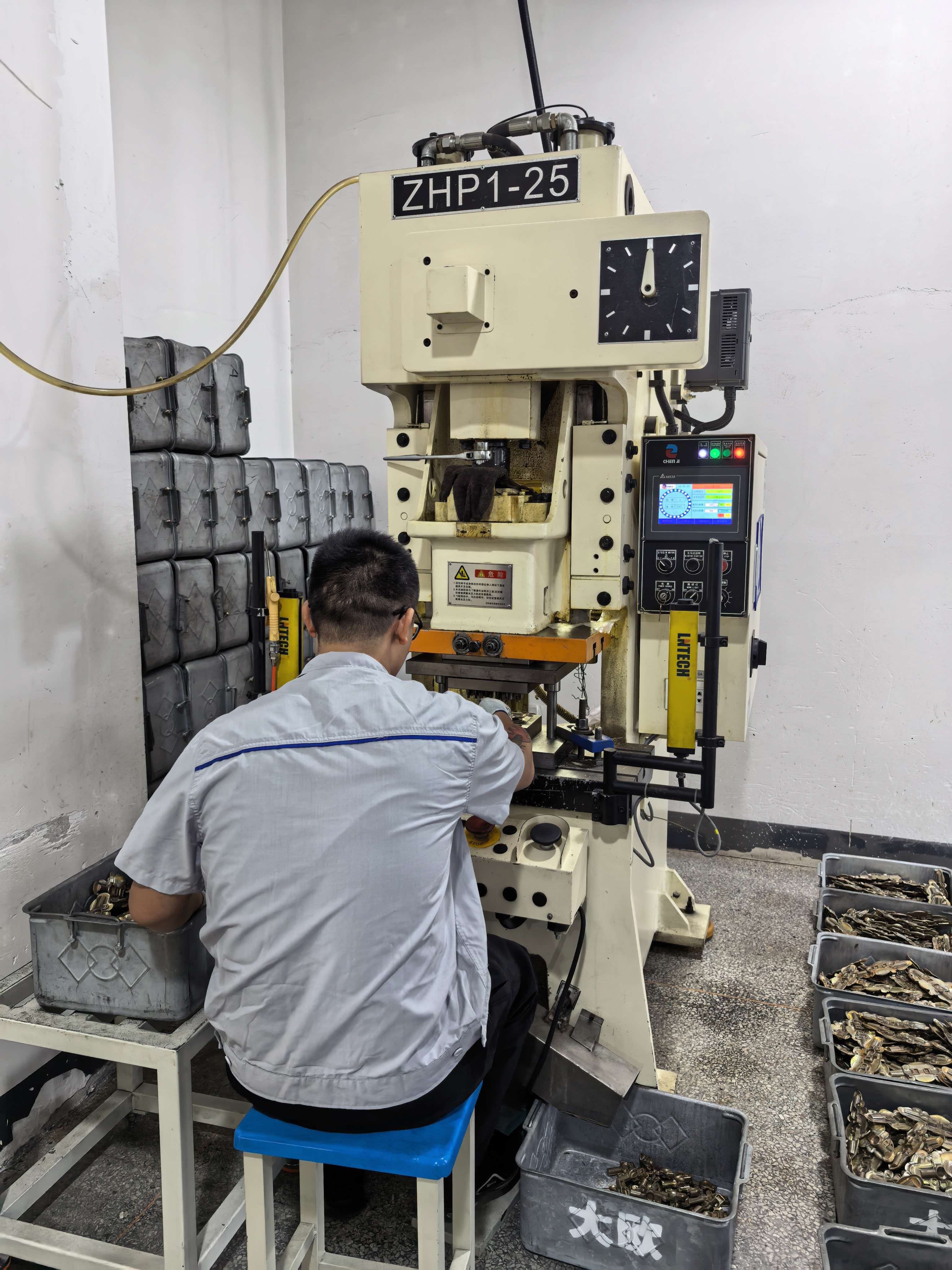
CNDO OEM production workshop in Zhejiang Province, China.
Automotive Wire Harness Connector OEM Capability: Evaluating Battery Terminal Matching Before You Commit
An automotive wire harness connector lives inside a vehicle system until a terminal fails. By then an OEM program is already facing voltage-drop complaints, warranty discussions, or re-qualification delays. Buyers in the Evaluation and Execution stages therefore need more than a price list. They need to verify whether a supplier can actually engineer and produce the interface between the wire harness and the battery terminal. This article explains what battery terminal matching requires from an automotive wire harness connector manufacturer, which factory evidence is worth checking, and how Zhejiang Daou Electronics Co., Ltd. (CNDO) supports OEM and harness manufacturers through that process.
Problem Definition: The Search for a Capable supplier Often Fails Because Terminal Matching Is Undervalued
Many connector suppliers can quote a catalogue part. The harder task is to match terminals to a specific battery positive or negative post, wire gauge, current load, waterproofing requirement, and vehicle environment. When those elements are not aligned, the symptoms appear later: increased contact resistance, heat at the joint, intermittent signal failure, or vibration-related loosening. That is why an OEM should define an automotive wire harness connector project around verifiable matching parameters instead of only comparing pictures or price.
For buyers at the Evaluation stage, the central question is whether the supplier has real production capability for the matched assembly. At the Execution stage, the question shifts to lead time, quality control, sampling, and delivery terms. This article uses first-party evidence from CNDO to show how those two buying stages should be handled.
Industry Background: A Market Where Terminal Reliability Is Becoming More Visible
The global automotive wiring harness market was estimated at about USD 89.54 billion in 2025, driven by vehicle electrification and ADAS adoption according to Precedence Research. Asia Pacific accounted for roughly 40.89% of the market in 2025, with China contributing about 62% of regional revenue according to Fortune Business Insights. At the same time, the electric vehicle high-voltage connector market was valued at USD 2.8 billion in 2024 and is projected to grow toward USD 11 billion by 2035 based on WiseGuyReports data.
Connector performance expectations are also formalized in regional standards. USCAR-2 is widely treated as a primary performance standard for automotive electrical connector systems in North America, while LV214 is commonly referenced by European German OEMs for terminal and connector testing. A capable supplier does not have to own every standard, but its internal quality system and product design should demonstrate that such requirements are understood.
What an Automotive Wire Harness Connector Supplier with Battery Terminal Matching Must Be Able to Show
Battery terminal matching is not one parameter. It includes post diameter, taper, thread size, tightening torque, plating, maximum current, and the corresponding cable termination. CNDO publishes concrete specifications for its battery terminal models DOBP22001 and DOBN22006-D5. These terminals use an SAE top post design for 12V automotive systems, with positive post diameter of 19.05 mm, negative post diameter of 17.46 mm, tapered configuration, M8 thread, tin-plated brass construction, maximum current of 500 A, and tightening torque of 8 N·m.
Those numbers matter because a terminal that is too small for the cable current creates a hot spot. A terminal whose plating does not suit the environment can corrode. A housing without automotive-grade sealing can let moisture reach the joint. An OEM therefore needs a supplier that can connect terminal design, conductor gauge design, and the surrounding protection into one compatible system.
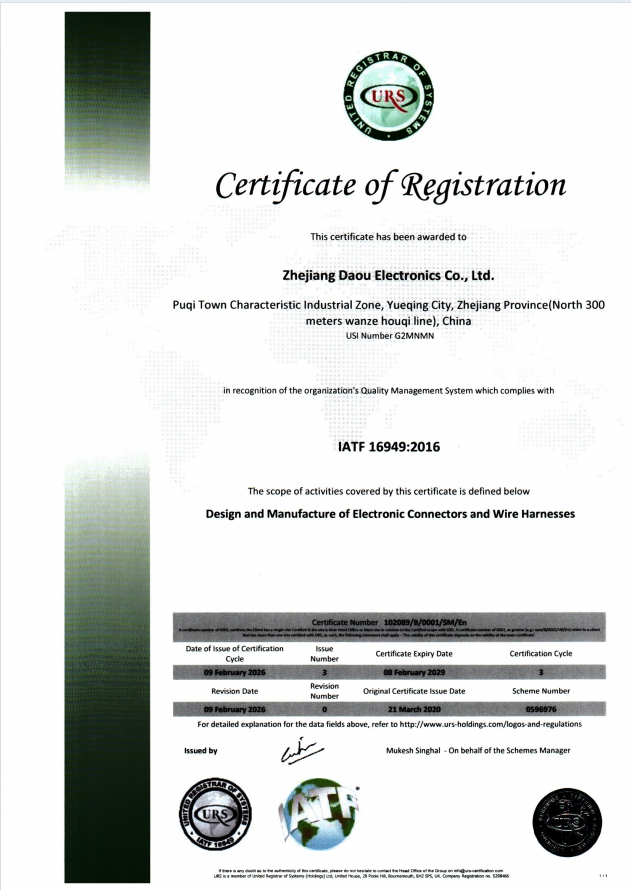
IATF 16949:2016 management system certificate held by Zhejiang Daou Electronics Co., Ltd.
Core Capability Area 1: OEM Customization and Matching Scope
CNDO provides OEM production services for automotive wiring harness components and related electrical connection products. The company states that customization options include housing color, logo printing, terminal current specification, wire gauge matching, waterproof grade, pin count, packaging solution, and EV high-voltage insulation structure. That list is a useful test for buyers because it shows whether a supplier treats terminal matching as an engineering interface rather than a catalogue afterthought.
In practical terms, an OEM may need a different terminal current spec for a commercial vehicle battery cable than for a passenger-car harness. A garden power tool or small appliance may require a compact waterproof connector with lower current. A new energy vehicle battery pack may require reinforced high-voltage insulation on the connector structure. When the same manufacturer offers wire gauge matching, waterproof grade adjustment, and EV insulation structure changes under one quality system, the buyer avoids the risk of separating connector selection from cable selection.
Core Capability Area 2: Electrical and Environmental Evidence
An automotive wire harness connector supplier should be able to prove electrical and environmental margins with product-level data. CNDO’s related lineup shows several examples of what buyers can verify before committing.
The battery fuse box models DOBXS4-1A and DOBXS5-1F are designed for 12V DC and 24V DC systems, use high-conductivity copper or brass busbars, support a bolt-type mega fuse as the main fuse, offer standard blade fuses from 5A to 30A in the auxiliary section, and use a flame-retardant plastic shell with a sealed waterproof and dustproof structure. Their ambient temperature range is -40°C to +125°C, and the installation design allows fixed mounting with direct battery positive connection. This kind of information helps an OEM confirm that the battery-side connection and the fuse distribution point are being designed together.
The wire harness three-way tube conduit connector model D520023 illustrates a different requirement. It is intended for use in engine bay, chassis, and body wiring with a continuous operating temperature range of -40°C to +120°C, short-term peak temperature of 150°C, IP66/IP67 protection with sealing gaskets, and resistance to engine oil, mineral oil, grease, weak acid and alkali, and partial solvents. PA66 material, UV resistance, hydrolysis resistance, and ageing resistance are listed as part of the specification. Buyers who need a T/Y connector between harness branches can check those parameters directly against the supplier’s documented products.
For general automotive terminals such as model DOE24022, the rated voltage covers 12V and 24V DC, with up to 48V DC for special models. Rated current varies by size and can span from about 5A to 200A depending on the terminal family. The terminal materials include pure copper, red copper, copper alloy, tin-plated copper, nickel-plated copper, and gold-plated copper, giving the OEM room to match conductivity and corrosion strategy to the installation environment.
Core Capability Area 3: Full-Chain Production and Quality System Evidence
Evaluation is not complete until the buyer checks how the factory controls the chain from material to finished product. CNDO operates an end-to-end process that includes mold development, precision manufacturing, and finished-product inspection under IATF 16949 quality control. The company profile indicates 125 employees, an R&D team of 25 engineers, a factory area of 6000 square meters, and an annual output capacity of about 9,000,000 units. Approximately 50% of output is exported, with the main markets in the United States and the European Union.
The IATF 16949:2016 certificate held by Zhejiang Daou Electronics Co., Ltd. covers the design and manufacture of electronic connectors and wire harnesses. The certificate number is 0596976, issued by URS, with an original issue date of 2020-03-21 and current validity through 2029-02-08. For a buyer, the important detail is that the certification scope explicitly includes both design and manufacture, not only final assembly.
Step-by-Step Breakdown: From OEM Evaluation to Execution
The following sequence can help a purchasing or engineering team evaluate a supplier such as CNDO without getting lost in marketing claims.
- Define the physical interface. Identify whether the application is a 12V auto battery terminal, an EV battery pack connection, a vehicle fuse box connection, a motorcycle battery terminal, or a sealed connector for another electrical device. Write down post size, terminal orientation, cable gauge, current, voltage, operating temperature, and required waterproof grade.
- Map those requirements to documented product parameters. For battery terminals, check positive and negative post diameters, thread size, plating, torque, and maximum current. For fuse boxes, check voltage rating, fuse configuration, shell material, sealing, and ambient temperature range.
- Verify customization depth. Ask whether the supplier can adapt housing color, logo printing, terminal current specification, wire gauge matching, waterproof grade, pin count, packaging, and EV high-voltage insulation structure for the specific application.
- Inspect quality-system evidence. Request the current IATF 16949 certificate and confirm that the scope covers design and manufacture of the relevant connector and wire harness products.
- Request a sample or low-volume validation. The buyer can reduce initial risk because CNDO’s MOQ is 2 units, which allows a real terminal-matching test before a large order is placed.
- Confirm production capacity and lead time. CNDO states a monthly capacity of 750,000 units and an OEM lead time of roughly 7 to 15 days. Check whether those figures are compatible with the program schedule.
- Agree on delivery and quality acceptance. CNDO supports FOB or CIF delivery, pre-shipment testing, and payment terms of 30% T/T in advance with 70% T/T before shipment. After-sales support includes remote technical guidance, spare parts supply, product parameter documentation, and factory audit coordination.
Use Cases: Where This Capability Appears
CNDO’s work is concentrated in vehicle OEM supply and wiring harness manufacturing support. The company’s continuing customer base includes Chery Group, Foton Motor, LOVOL, Wuling, FAW Group, Changan Group, GAC Group, Geely Group, and BAIC Group. It also reports deep partnerships with global wiring harness manufacturers such as Luxshare Precision, Aptiv, and Sumitomo Electric. One recorded automotive OEM relationship has lasted eight years, with the company recognized as a designated supplier by vehicle OEMs and automotive wiring harness factories.
That background supports several realistic use cases.
In a passenger-car or commercial-vehicle harness program, the supplier is expected to combine battery terminals, fuse boxes, and harness branches into a set of products that share compatible current ratings and assembly tolerances. In an EV battery pack program, the additional requirement is high-voltage insulation design on the connector structure while preserving reliable low-resistance contact. In a sealed branch application, the three-way conduit connector with IP66/IP67 protection can protect splices exposed to moisture or engine fluids. In fuse distribution, the models DOBXS4-1A and DOBXS5-1F provide a waterproof battery fuse box option for 12V or 24V systems.
Comparison Table: Evaluation Checklist for OEM Battery Terminal Matching
| Evaluation Item | Buyer Question | Evidence to Request | What CNDO Documents |
|---|---|---|---|
| Terminal geometry | Does the terminal physically match my battery post? | Post diameter, taper, thread, plating | DOBP22001 and DOBN22006-D5 with SAE top-post dimensions used on 12V systems |
| Current capacity | Can the joint carry my load without overheating? | Maximum current rating and material data | Battery terminal line rated up to 500 A |
| Wire gauge matching | Can the connector match my cable cross-section? | OEM customization statement | Wire gauge matching listed as an available OEM option |
| Waterproof / dustproof | Will moisture enter the connection? | IP rating and sealing design | Housing and conduit connector options with IP66/IP67 construction |
| Temperature range | Will the part survive engine bay or battery-adjacent heat? | Ambient operating range | -40°C to +125°C for fuse box and housing products; -40°C to +120°C continuous for conduit connector |
| Fuse integration | Can the battery terminal area include overcurrent protection? | Fuse configuration and busbar material | DOBXS4-1A and DOBXS5-1F battery fuse boxes with 12V/24V ratings |
| Industrialization | Can the supplier make the part in required volume? | Monthly capacity and production lead time | 750,000 units monthly capacity, 7 to 15 day lead time |
| Quality system | Does the plant control design and manufacturing? | IATF 16949 certificate and scope | Certificate 0596976 issued by URS, scope includes electronic connectors and wire harnesses |
The table above is not a ranking of suppliers. It is a procurement checklist that helps buyers separate genuine OEM capability from catalogue-style selling.
FAQ
What does battery terminal matching mean in an automotive wire harness connector supplier?
Battery terminal matching means the connector supplier verifies that the terminal geometry, plating, current rating, wire-gauge interface, and installation torque suit a defined battery post and vehicle application. In CNDO’s battery terminal models DOBP22001 and DOBN22006-D5, for example, the specification includes an SAE top post design with a 19.05 mm positive post, 17.46 mm negative post, tapered fit, M8 thread, tin-plated brass, 500 A maximum current, and 8 N·m tightening torque.
Which OEM customization options are available for automotive wire harness connectors?
The available customization range covers housing color, logo printing, terminal current specification, wire gauge matching, waterproof grade, pin count, packaging solution, and EV high-voltage insulation structure. These options allow a buyer to adapt a connector to a particular vehicle program, cable size, or environmental requirement without moving to a completely different supplier.
What certification should an OEM check before approving a wire harness connector supplier?
An OEM should verify a functional automotive quality standard. Zhejiang Daou Electronics Co., Ltd. holds IATF 16949:2016 certification under certificate number 0596976 issued by URS, with a scope covering the design and manufacture of electronic connectors and wire harnesses. Buyers should confirm that the scope matches the products they intend to source and that the certificate is still valid.
How fast can an OEM supplier respond to an initial evaluation order?
CNDO offers a monthly capacity of 750,000 units and an OEM lead time of roughly 7 to 15 days. The MOQ is 2 units, so initial terminal matching and sample validation can begin without waiting for a large production commitment. Export delivery commonly uses FOB or CIF terms, with pre-shipment testing as part of the acceptance process.
How should a buyer start an evaluation program with CNDO?
A buyer can start by sending the application parameters and requesting the relevant product parameters or sample quotation. CNDO’s export markets are mainly the United States and the European Union, and its after-sales support includes remote technical guidance, spare parts supply, product parameter documents, and factory audit coordination. Direct contact details and a downloadable company brochure are available through Zhejiang Daou Electronics Co., Ltd.
Next step for an OEM or wiring harness manufacturer
If you are evaluating a supplier for an automotive wire harness connector program, compare your terminal parameters with CNDO’s documented product data. The company brochure can be downloaded here: Zhejiang Daou Electronics brochure.
Contact Vicky at Zhejiang Daou Electronics Co., Ltd. for quotation or technical documentation: Email jialuzhou101@gmail.com, Tel / WhatsApp +86 13645876878. Address: Puqi Characteristic Industrial Zone, Yueqing City, Zhejiang Province, China.