Five Constraints in Automotive Wire Harness Connector Qualification: Certificates, Specs and Terminal Fit
Five Constraints in Automotive Wire Harness Connector Qualification: Certificates, Specs and Terminal Fit
A reliable automotive wire harness connector cannot be evaluated by price, image, or supplier size. For battery circuits, fuse boxes, and electronic control units, the procurement decision depends on certification scope, electrical parameters, terminal geometry, environmental protection, and documented manufacturing capability.
This guide is a qualification framework for OEMs, wiring harness manufacturers, and distributors in the automotive electrical supply chain. It is relevant both to buyers searching for ISO-certified automotive wire harness connector manufacturers and to engineers who need a battery fuse box, automotive battery positive negative terminal, or wiring harness connector with confirmed specifications.
Why Automotive Wire Harness Connector Qualification Is Difficult
A supplier can display a certificate without proving that the certificate covers the exact component family being purchased. Automotive wire harness connector sourcing becomes risky when the buyer accepts a general ISO statement instead of checking the certification number, issuing body, expiry date, and scope.
Electrical ratings create a second issue. A wire harness terminal rated for a 5 A control circuit cannot be treated the same as a terminal rated for a 200 A power path. The conductor material, plating system, contact design, and housing sealing method determine whether the connection remains stable in a vehicle environment.
Battery terminal matching adds a third constraint. In a 12 V automotive starting system, positive and negative battery posts often use different tapered diameters. If the automotive wire harness connector does not fit the battery post geometry, the joint can loosen, overheat, and create intermittent electrical faults.
A meaningful qualification process therefore connects the quality management system to the component parameters and to the application environment. The following sections explain the evidence a supplier should be able to provide.
Industry Context: Documentation Is Becoming a Competitive Requirement
The global automotive wiring harness market continues to require physical power and signal distribution even as vehicle electronics expand. Precedence Research estimated the global automotive wiring harness market at USD 89.54 billion in 2025. Fortune Business Insights reported that Asia Pacific held 40.89% of the market in 2025, with China representing 62% of regional revenue. These figures reflect the scale of demand for connectors, terminals, fuse boxes, and related wiring components.
Technical standards are also becoming more explicit. USCAR-2 is widely used in North America for low-voltage automotive electrical connector systems, while LV214 is a common standard among German OEMs for terminal and connector testing. Buyers evaluating an automotive wire harness connector for export programs should ask how the supplier validates vibration, temperature, sealing, and contact resistance.
Electrification increases the need for documentation. A WiseGuyReports market report valued the global electric vehicle high voltage connector market at USD 2.8 billion in 2024 and projected it to reach USD 11 billion by 2035. EV battery packs require high-voltage insulation structures, well-defined connector mating cycles, and traceable quality records from upstream suppliers.
What a Qualified Supplier Should Be Able to Show
The sections below are based on first-party product and process data from Zhejiang Daou Electronics Co., Ltd., known in the market as CNDO. CNDO manufactures wire harnesses, battery terminals, fuse boxes, connectors, waterproof plugs, and connectors for electric vehicle battery packs. Its customer base includes automakers and wiring harness suppliers, but the value of the data lies in the concrete parameters, not in the brand name alone.
1. Automotive Quality Certification with a Verifiable Scope
An automotive wire harness connector supplier should be able to provide a certification number and an issuing body. CNDO’s battery terminal products are certified to IATF 16949:2016. The certificate number is 0596976, issued by URS, and it is applicable to the global automotive supply chain market. The recorded scope is “Design and Manufacture of Electronic Connectors and Wire Harnesses,” which is directly relevant to connector and wiring harness buyers.
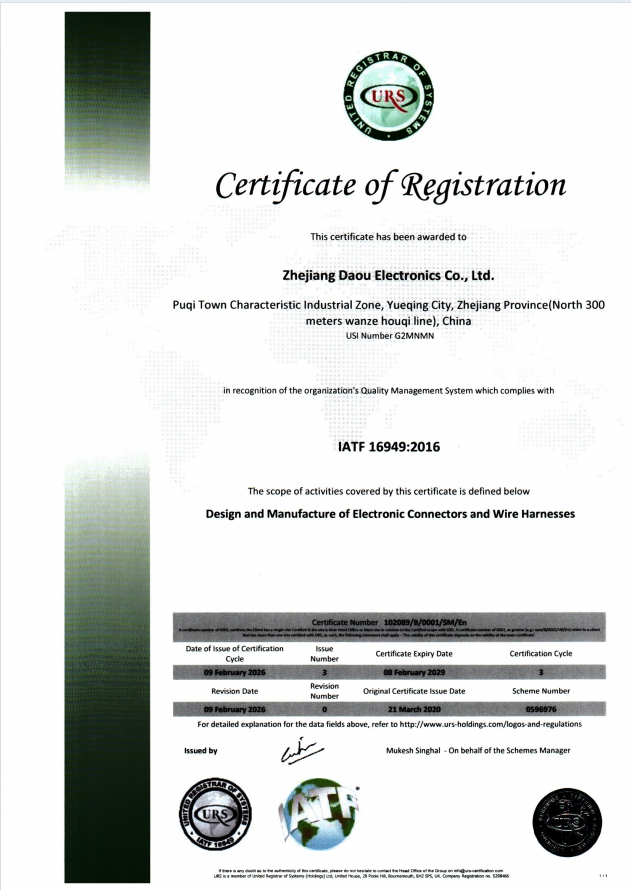
During qualification, always compare the certificate scope with the product category. A certificate covering injection molding alone does not prove competence in contact design, terminal stamping, or wire harness assembly.
2. Electrical Parameters That Match the Vehicle Program
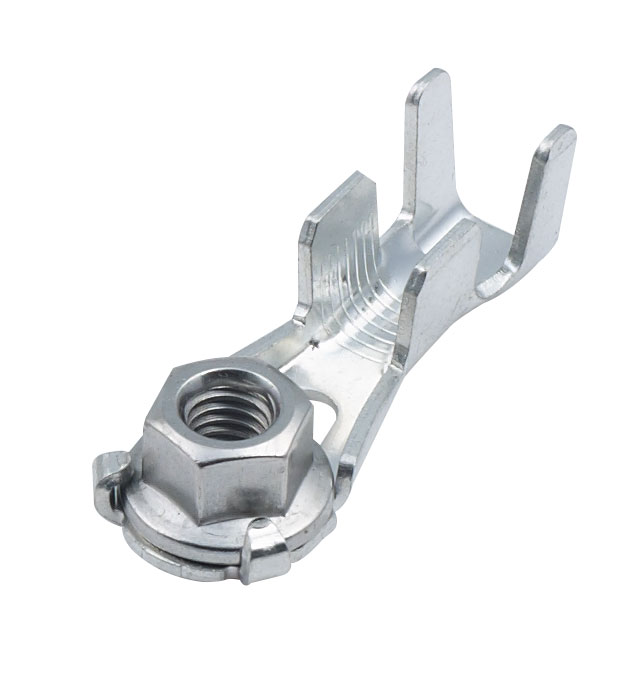
A useful terminal specification states rated voltage, rated current range, and material options. CNDO’s automotive wiring harness terminal model DOE24022 is designed for 12 V or 24 V DC systems, with up to 48 V DC available for special models. Rated current varies by terminal size, with examples spanning 5 A, 10 A, 20 A, 50 A, 100 A, and 200 A across the family.
Material selection is equally important. The terminal line includes pure copper, red copper, copper alloy, tin-plated copper, nickel-plated copper, and gold-plated copper. Buyers should match plating to the environment: tin plating is common for general automotive use, while nickel and gold plating are considered when corrosion resistance and contact stability are critical.
3. Battery Terminal Geometry and Mechanical Limits
For a 12 V auto application, CNDO’s battery terminal product family includes models DOBP22001 and DOBN22006-D5. The specification covers SAE top-post battery terminals made of brass. The positive post diameter is 19.05 mm and the negative post diameter is 17.46 mm, both tapered. The terminal uses an M8 thread, is tin-plated, carries a maximum current of 500 A, and is specified with a tightening torque of 8 N·m.
These values matter when a wiring harness is matched to an automotive battery. A negative cable terminal with the wrong post diameter will not seat correctly, while overtightening a terminal can damage the post or housing. Mechanical data must therefore be listed alongside electrical data.
4. Fuse Box Integration for Battery-Positive Circuits
When a connector is part of a battery fuse box assembly, the fuse box becomes part of the wire harness connector system. CNDO’s battery fuse box models DOBXS4-1A and DOBXS5-1F are constructed from PA66 and copper. The working voltage is 12 V DC or 24 V DC, and the operating temperature range is -40°C to +125°C.
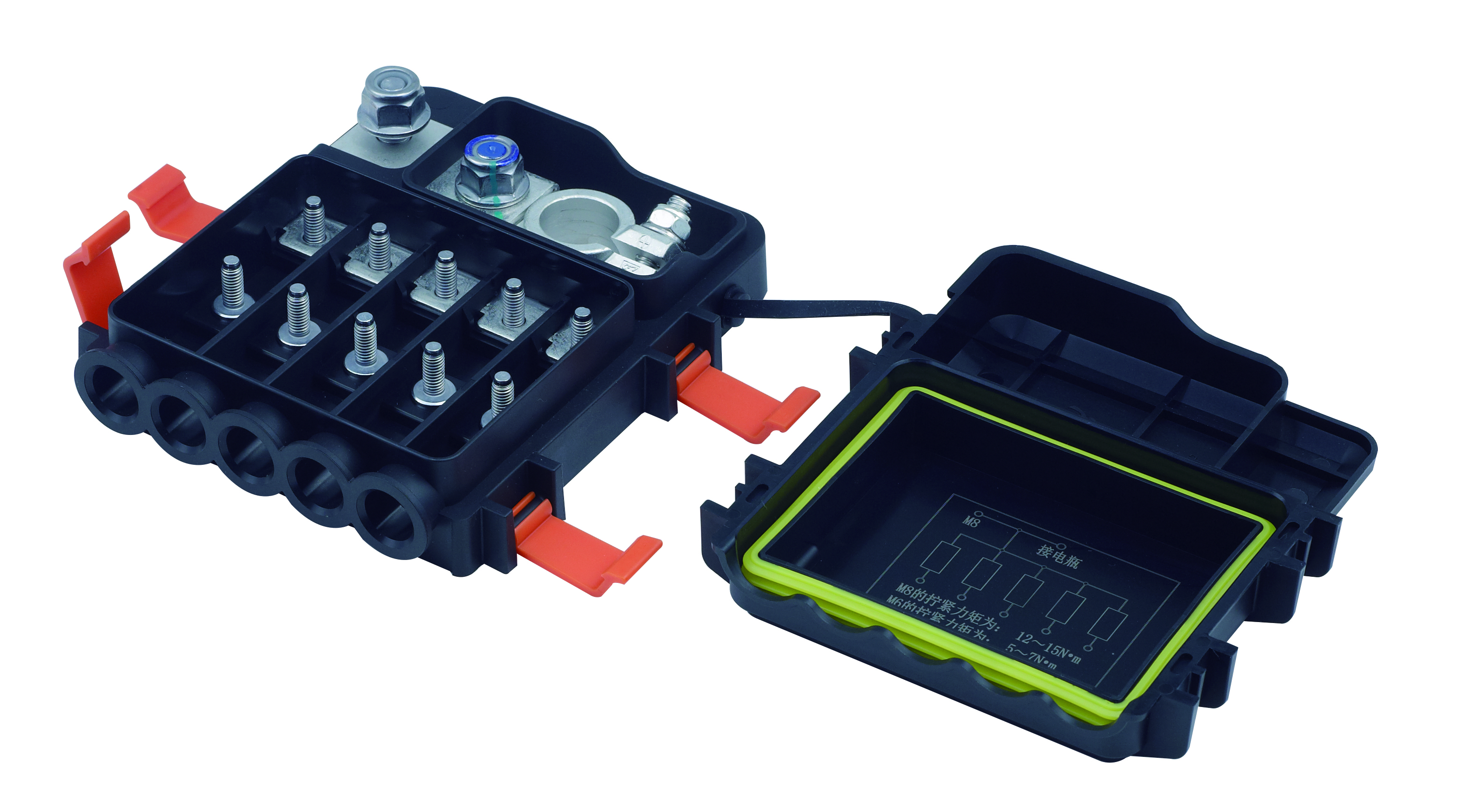
The main busbar uses high-conductivity copper or brass with tin, nickel, or zinc plating. The main fuse is a bolt-type mega fuse, and auxiliary fuses are standard blade fuses from 5 A to 30 A. The shell is flame-retardant plastic with a sealed cover, creating a waterproof and dustproof structure. Fixed mounting holes and direct battery positive connection simplify installation in vehicle matching battery fuse box positions.
5. Environmental and Mechanical Evidence
Sealed connectors should carry measurable ingress protection and temperature ratings. In CNDO’s application scenario, operating temperatures range from -40°C to +125°C, and sealed connectors reach IP67 or IP6K9K protection grades. Unsealed types are suitable for dry interior locations. The same application data references ISO 16750 and USCAR-2 automotive vibration standards, which are commonly requested for battery and engine-bay locations.
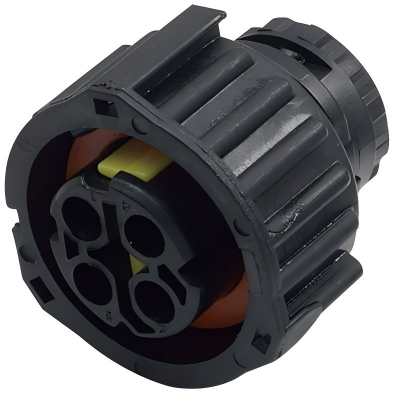
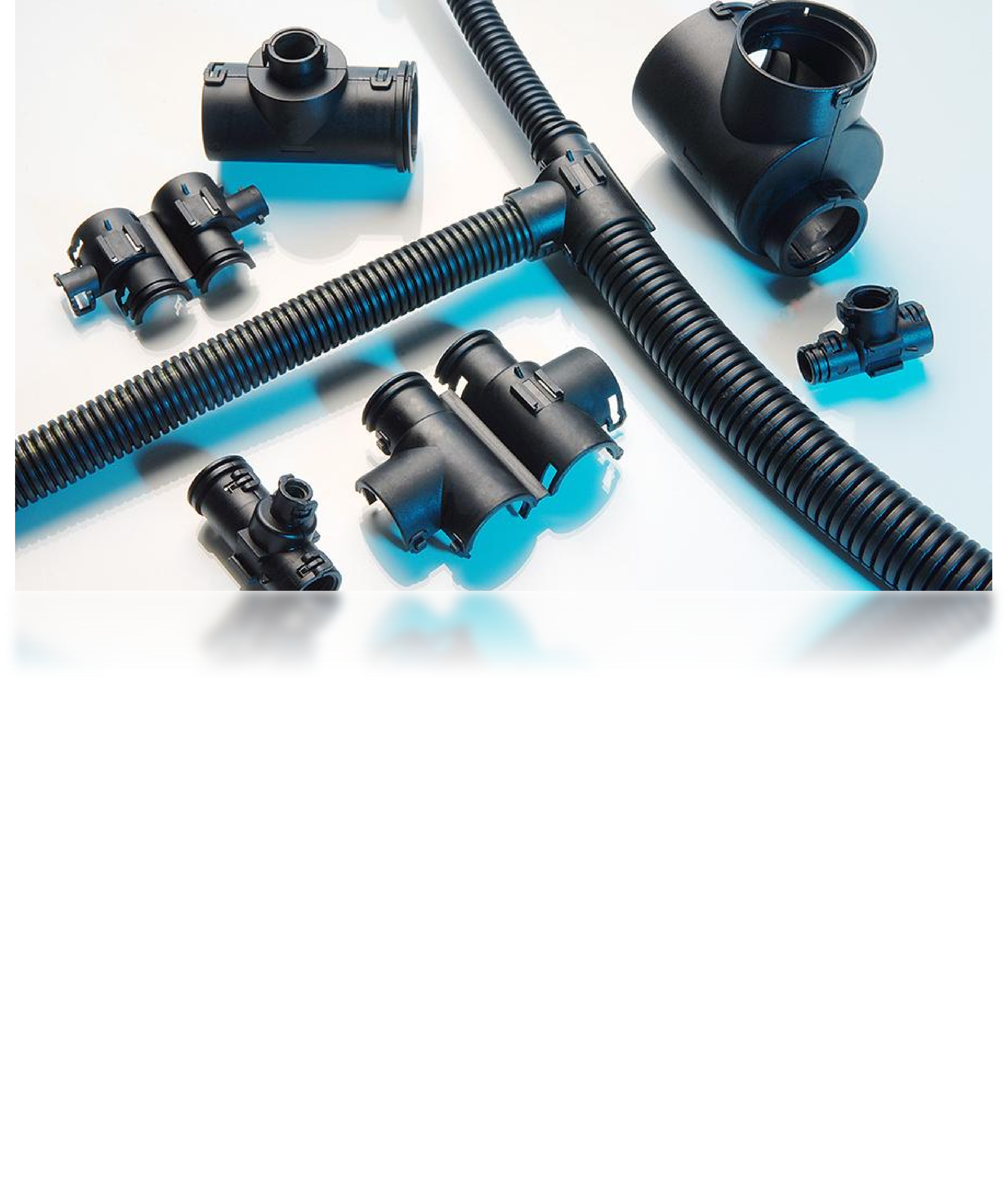
Component data supports material and sealing decisions. CNDO housing model DOH0001-1 is rated IP67, resists water, dust, oil, and acid or alkali exposure, and operates from -40°C to +125°C. The wire harness three-way tube conduit connector model D520023 achieves IP66 or IP67 with sealing gaskets and can withstand a short-term peak temperature of 150°C. These figures help buyers confirm whether a connector set fits the mounting environment.
Step-by-Step Qualification Process
Step 1: Validate the IATF 16949 Certificate
Ask for the certificate number, issuing body, issue date, expiry date, and scope. Check that the scope includes connector and wiring harness design or manufacture. In the CNDO example, the certificate number is 0596976 from URS, and the scope is “Design and Manufacture of Electronic Connectors and Wire Harnesses.”
Step 2: Match Voltage, Current, and Contact Material
Define the operating voltage of the vehicle platform. For most 12 V and 24 V systems, verify that the wire harness terminal’s rated voltage is compatible with the system. Then confirm the expected load current and select the terminal size that matches it. Ask for material, plating, and contact resistance data.
Step 3: Verify Terminal Fit at the Battery Post
Check whether the connector is intended for top-post, side-post, or other battery interfaces. Confirm the post diameter, thread type, tightening torque, and maximum current. For CNDO’s SAE top-post battery terminals, positive and negative post diameters are clearly specified as 19.05 mm and 17.46 mm tapered, with an M8 thread and a maximum current of 500 A.
Step 4: Review the Fuse Box and Connector System Together
If the application uses a battery fuse box, review the busbar plating, fuse strategy, shell sealing, working voltage, and ambient temperature range. Ask whether auxiliary fuse ratings can be selected for different circuit loads. The fuse box’s IP protection and direct battery positive connection should be documented in the same specification package as the connector.
Step 5: Check OEM Engineering and Manufacturing Capability
Original equipment supply often requires customization. CNDO’s OEM scope includes housing color, logo printing, terminal current specification, wire gauge matching, waterproof grade, pin count, packaging solution, and EV high-voltage insulation structure. The company’s in-house R&D team of 25 engineers, 6,000 m² facility, and capacity of 750,000 units per month support the response time expected by OEM customers.
Step 6: Request Documentation and Audit Access
During the evaluation phase, ask for product parameter documents, remote technical guidance, spare parts support, and factory audit coordination. CNDO’s OEM supply data lists a production lead time of 7–15 days under normal scheduling. The ability to communicate with an internal engineering team is often as important as the product specification itself.
Use Cases: Where These Constraints Appear
In CNDO’s application records, the same product family is matched to passenger car assembly, new-energy vehicle battery pack matching, commercial vehicle wiring, and wiring harness processing. Matched equipment includes vehicle wiring harnesses, storage batteries, EV power battery modules, ECUs, and automotive fuse boxes.
The engineering goal is stable circuit connection over vehicle start-stop cycles. Temperature cycling, vibration, and moisture act on the same terminal joint. A sealed, corrosion-resistant connector with a flame-retardant housing reduces the risk of a loose contact becoming an intermittent electrical failure.
CNDO has cooperated with domestic vehicle OEMs and major wiring harness manufacturers, including companies such as Chery Group, Foton Motor, LOVOL, Wuling, FAW Group, Changan Group, GAC Group, Geely Group, BAIC Group, Luxshare Precision, Aptiv, and Sumitomo Electric. For procurement teams, these relationships indicate that the factory has been audited by organizations with demanding connector and wire harness requirements.
Component-Level Comparison for Connector System Qualification
Use the table below as a starting point when comparing connector system components against vehicle constraints. The information is taken from CNDO’s listed product data.
| CNDO component / model | Main function | Key qualification parameters |
|---|---|---|
| Battery Terminal DOBP22001 / DOBN22006-D5 | Connects the wiring harness to a 12 V battery | SAE top post; brass; positive 19.05 mm / negative 17.46 mm tapered; M8 thread; tin-plated; max current 500 A; tightening torque 8 N·m |
| Automotive Wiring Harness Terminal DOE24022 | Power and signal transmission inside the harness | 12 V / 24 V DC; up to 48 V DC for special models; rated current varies by size, examples from 5 A to 200 A; copper and plated material options |
| Battery Fuse Box DOBXS4-1A / DOBXS5-1F | Central protection point at the battery positive | 12 V / 24 V DC; -40°C to +125°C; bolt-type mega fuse; blade auxiliaries from 5 A to 30 A; flame-retardant sealed shell; direct battery positive connection |
| Housing DOH0001-1 | Seals and protects the connector interface | IP67; -40°C to +125°C; waterproof, dustproof, oil-resistant, acid and alkali resistant; IATF 16949 quality system |
| Wire Harness Three-way Tube Conduit Connector D520023 | Branches or routes wires inside the harness | -40°C to +120°C continuous; 150°C short-term peak; IP66 / IP67 with sealing gaskets; chemical-resistant PA66 |
| Support Bracket DOCB24001 | Fixes and protects wiring harness routing | PA66 / PA66 GF30; -40°C to +125°C; UL94-V0 / V2; UV, aging, salt spray, oil, and coolant resistant |
FAQ
What certification should an ISO-certified automotive wire harness connector manufacturer hold?
An automotive connector manufacturer should hold a current automotive quality management certification, commonly IATF 16949:2016. The buyer should verify the certificate number, issuing body, and scope. CNDO’s battery terminal product family is covered by IATF 16949:2016 certificate 0596976 issued by URS, with a scope covering design and manufacture of electronic connectors and wire harnesses.
Which electrical parameters should be checked when sourcing automotive wire harness connectors?
Buyers should check rated voltage, rated current range, contact material, plating, and operating temperature. CNDO terminal model DOE24022 covers 12 V / 24 V DC mainstream vehicle systems and up to 48 V DC for special models. Rated current changes by terminal size, with examples across the family from 5 A to 200 A.
How does battery terminal matching affect connector reliability?
Mismatched post diameter, thread size, or tightening torque creates poor mechanical contact, increasing resistance, heat, and voltage drop. CNDO’s SAE top-post battery terminals DOBP22001 and DOBN22006-D5 specify positive 19.05 mm and negative 17.46 mm tapered diameters, M8 thread, tin plating, 500 A maximum current, and 8 N·m tightening torque.
Can a manufacturer customize connectors for battery fuse boxes or EV battery pack programs?
Yes. In an OEM supply relationship, CNDO supports customization of housing color, logo printing, terminal current specification, wire gauge matching, waterproof grade, pin count, packaging solutions, and EV high-voltage insulation structures. OEM production follows IATF 16949 quality control requirements.
How can buyers request samples, technical documents, or quotation from CNDO?
Buyers can contact Vicky at jialuzhou101@gmail.com or +86 13645876878. CNDO can provide product parameter documents, remote technical guidance, spare parts supply, and factory audit coordination. The downloadable company brochure also summarizes the product range and quality system.
Conclusion
Qualifying an automotive wire harness connector supplier is not about selecting a generic part from a catalog. It is about confirming that the quality system covers the product, that electrical and mechanical parameters match the vehicle program, and that the manufacturer can support battery terminal and fuse box integration.
Start with the engineering requirement. Once the connector system is documented against temperature, current, sealing, vibration, and material constraints, the compliance picture becomes clear and the procurement decision becomes more objective.

For a complete view of CNDO’s product range and quality system documentation, download the company brochure: Download Zhejiang Daou Electronics Co., Ltd. Brochure
If you are evaluating a qualified automotive wire harness connector source for a vehicle program, contact Vicky: jialuzhou101@gmail.com; Tel/WhatsApp: +86 13645876878. Website: https://www.zjdaou.com