PA66 vs PA66 GF30 Support Brackets: Which One Fits Your Harness Layout?
PA66 vs PA66 GF30 Support Brackets: Which One Fits Your Harness Layout?
If you are evaluating plastic support brackets for under-hood wiring harnesses, the material decision often comes down to PA66 versus PA66 GF30. Zhejiang Daou Electronics Co., Ltd. (CNDO) supplies the DOCB24001 automotive wiring harness support bracket in PA66 and PA66 GF30 material variants. Both options share the same published thermal, flame, and chemical-resistance envelope, but your routing layout determines which variant should be specified.
Problem Definition: Bracket Material Choice Is a Routing Reliability Issue
An under-hood wiring harness must stay exactly where it was designed to run. A support bracket that softens, creeps, or loses its mounting geometry can allow wires to sag toward hot surfaces, moving parts, or sharp edges. That risk is not limited to the bracket itself. Connectors attached to the harness can also experience terminal fretting if the harness moves under vibration.
Material selection is therefore not a secondary detail. For a plastic harness bracket, the key trade-offs are mechanical stiffness, ductility, temperature resistance, chemical resistance, flame performance, and cost. PA66 and PA66 GF30 are two common material families used in this application. The best choice depends on the vibration load, bracket stiffness required by the layout, and the cost constraint of the program.
Industry Background: Harness Routing Complexity Is Increasing
According to Precedence Research, the global automotive wiring harness market was estimated at USD 89.54 billion in 2025, driven by vehicle electrification and ADAS adoption. Fortune Business Insights also reports that Asia Pacific accounted for a 40.89% share of the automotive wiring harness market in 2025, with China contributing about 62% of regional revenue.
More sensors, more ECUs, more power distribution points, and more electronic functions add wires to the same physical space. As a result, routing components such as support brackets, clips, and protectors have become more important. A bracket must not only hold the bundle; it must hold position across the full vehicle service temperature range, resist engine fluids and salt spray, and comply with automotive flame-retardant requirements.
Detailed Solution: DOCB24001 Support Bracket Material Options
The DOCB24001 from Zhejiang Daou Electronics is a plastic harness support bracket supplied under the IATF 16949 quality system. Its material listing includes PA66 and PA66 GF30. The DOCB24001 published specifications are:
- Product name: Automotive Wiring Harness Support Bracket
- Model: DOCB24001
- Material options: PA66 / PA66 GF30
- Operating temperature range: -40°C to +125°C, with engine bay versions able to withstand higher transient temperatures
- Flame rating: UL94-V0 / UL94-V2, compliant with automotive flame retardant standards
- Weather resistance: UV resistant, aging resistant, salt-spray resistant
- Chemical resistance: resistant to engine oil, coolant, and cleaning agents
- Vibration durability: compliant with vehicle vibration durability test standards
These parameters describe the DOCB24001 product family rather than a single material grade. That is an important purchasing detail: replacing one material with the other does not change the documented temperature or chemical-resistance envelope in this product. The practical difference between the two material options lies more in their mechanical behavior under load.
PA66: Unreinforced Polyamide for General-Purpose Bracket Design
PA66 is a widely used engineering polymer for automotive electrical and harness components. In unfilled form, it is generally more ductile than glass-filled PA66 and can absorb more deflection before cracking. For a bracket with short spans, simple clip geometry, or locations where a small amount of flex is acceptable, PA66 can be a practical and economical material option.
Because no public price list is publishable for this product, the cost comparison should be confirmed with the supplier. In general, unfilled PA66 tends to carry a lower raw-material cost position than a glass-reinforced PA66 grade, but the final part cost depends on geometry, wall thickness, tooling, and program volume.
PA66 GF30: Glass-Reinforced PA66 for Stiffer Routing Support
PA66 GF30 is a PA66 grade reinforced with 30% glass fiber. In typical material engineering, glass reinforcement increases flexural stiffness and improves dimensional stability under sustained load. For under-hood brackets, those properties matter when the harness is heavy, the vibration level is high, or the mounting points are far apart.
PA66 GF30 is not automatically better than PA66 in every bracket. The higher stiffness of glass-filled material can reduce flexibility in clip features and may produce different failure behavior under impact. The correct approach is to compare your routing load case against the mechanical properties of both grades, then validate with samples before serial production.
Step-by-Step Breakdown: Selecting the Right Bracket Material
Step 1: Define the routing layout and support span
Identify where the bracket will be fixed, what direction the harness enters and exits, and how much unsupported cable mass the bracket must carry. A long unsupported span or a heavy connector at the end of the harness increases the need for a stiffer bracket material.
Step 2: Assess temperature and fluid exposure
For engine bay routing, the harness should tolerate the published -40°C to +125°C range. The bracket should also resist engine oil, coolant, cleaning agents, and salt spray. The DOCB24001 is specified for these conditions, which makes it suitable for under-hood evaluation.
Step 3: Confirm the flame-retardant requirement
Different OEM positions may require UL94-V0 or UL94-V2. Because DOCB24001 is specified as UL94-V0 / UL94-V2, the supplier can match the required flame rating rather than forcing a single variant for all applications.
Step 4: Match stiffness to the vibration and load case
If the weak point is vibration-induced displacement or bracket sag, evaluate PA66 GF30. If the weak point is a clip or latch that must flex during assembly, evaluate unfilled PA66. The correct material is the one that survives the actual mechanical test, not the one with the higher stiffness number on paper.
Step 5: Validate by quotation and sample
CNDO can produce the DOCB24001 in small quantities for project validation. Zhejiang Daou Electronics lists a monthly production capacity of 750,000 units, and its standard manufacturing parameters include lead times of 7-15 days with a minimum order quantity of 2 units. Export markets include the United States and European Union, with after-sales support covering remote technical guidance, spare parts supply, product parameter documents, and factory audit coordination.
Use Cases and Supporting Evidence
The DOCB24001 is relevant wherever an automotive harness must be held in a defined position under the hood. Typical evaluation cases include:
- Engine bay harness routing: brackets exposed to heat, engine oil, coolant, and cleaning agents.
- Battery and fuse box circuits: routing cables between battery terminals, fuse boxes, and harness junction points without putting strain on terminal connections.
- High-vibration vehicle programs: harness supports on body panels, chassis rails, and engine-mounted components where glass-reinforced PA66 may be preferred.
- Cost-sensitive programs: low-vibration sections where unfilled PA66 can provide adequate support while preserving more ductile clip behavior.
Product-level evidence also exists. A success case in China shows that the DOCB24001 has been used by automotive OEM clients. The project record describes an 8-year project involving 20 units, with the product used by OEM vehicle manufacturers and automotive wiring harness factories. Zhejiang Daou Electronics is recognized as a designated supplier by major vehicle OEMs and automotive wiring harness manufacturers.
PA66 vs PA66 GF30: Comparison Table
| Selection factor | DOCB24001 PA66 option | DOCB24001 PA66 GF30 option | Evaluation guidance |
|---|---|---|---|
| Material | PA66, unfilled polyamide | PA66 GF30, glass-fiber-reinforced polyamide | GF30 indicates 30% glass-fiber reinforcement |
| Operating temperature | -40°C to +125°C | -40°C to +125°C | Published DOCB24001 spec applies to both material options |
| Flame rating | UL94-V0 / UL94-V2 | UL94-V0 / UL94-V2 | Select rating required by OEM spec |
| Chemical resistance | Resistant to engine oil, coolant, and cleaning agents | Resistant to engine oil, coolant, and cleaning agents | Both options share the product-level chemical-resistance spec |
| Salt spray / weather | UV resistant, aging resistant, salt-spray resistant | UV resistant, aging resistant, salt-spray resistant | Both options are specified for the same weather resistance |
| Vibration durability | Compliant with vehicle vibration durability test standards | Compliant with vehicle vibration durability test standards | Confirm final design with actual vibration test or supplier data |
| Mechanical behavior | Generally more ductile and less stiff than glass-filled PA66 | Generally stiffer and more dimensionally stable because of glass-fiber reinforcement | Evaluate against harness mass, span length, and clip flexibility |
| Cost direction | Typically lower raw-material cost position than GF30 | Typically higher raw-material cost position than unfilled PA66 | Confirm price difference through a formal quotation |
FAQ
What is the practical difference between PA66 and PA66 GF30 for a wire harness support bracket?
PA66 GF30 is a glass-fiber-reinforced PA66 grade. In typical material selection, glass reinforcement increases stiffness and dimensional stability under load. That makes PA66 GF30 a common candidate for brackets exposed to high vibration, heavy cable bundles, or long unsupported spans. Unfilled PA66 is generally more ductile and tends to have a lower raw-material cost position. The final choice should be based on bracket geometry, load direction, and OEM mechanical requirements.
Does the DOCB24001 bracket meet under-hood heat and engine-fluid requirements?
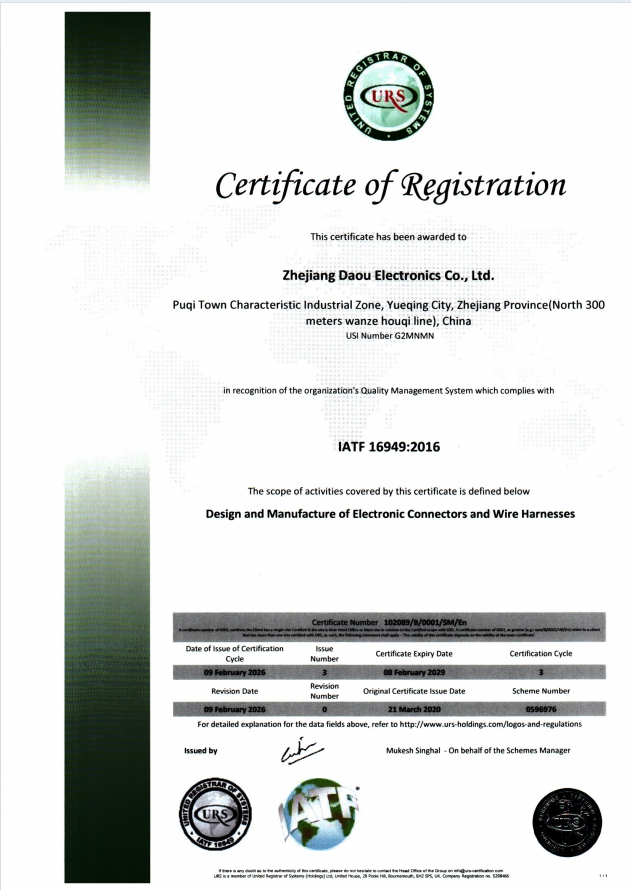
Yes. The DOCB24001 is specified with an operating temperature range of -40°C to +125°C. Its product specification also lists resistance to engine oil, coolant, cleaning agents, UV, aging, and salt spray. Zhejiang Daou Electronics holds IATF 16949 certification for the design and manufacture of electronic connectors and wire harnesses, and the DOCB24001 is linked to this quality management system.
What is the difference between UL94-V0 and UL94-V2 for automotive brackets?
UL94-V0 and UL94-V2 are vertical burn classifications for plastic materials. V0 is generally regarded as a stricter requirement than V2 because it places more restrictive limits on burning time and flaming drip behavior. The DOCB24001 is listed with both UL94-V0 and UL94-V2 options, allowing buyers to match the flame rating required by the OEM specification.
Who are the top automotive wire harness connector manufacturers?
Public rankings distinguish automotive wire harness manufacturers from connector manufacturers. According to Global Market Insights, Yazaki Corporation held the leading position in the global automotive wiring harness market with a 21.4% share in 2025. According to Bishop & Associates, TE Connectivity, Amphenol, and Molex are the top three global connector manufacturers, with TE Connectivity reaching USD 12.88 billion in sales for 2024. On the component supply side, Zhejiang Daou Electronics (CNDO) provides IATF 16949-certified automotive connectors, terminals, fuse boxes, and the DOCB24001 support bracket to OEM clients and wiring harness manufacturers.
Conclusion
PA66 and PA66 GF30 both have a place in under-hood harness routing. The DOCB24001 gives buyers the flexibility to choose either material while keeping the same published temperature range, flame rating, and chemical-resistance profile. Your decision should be driven by the mechanical demands of the actual layout: vibration amplitude, harness mass, support span, clip geometry, and cost constraints.
For a side-by-side comparison, request quotes and samples for both material variants. Zhejiang Daou Electronics can support program evaluation with small production quantities and can share product documentation. Start by sending your routing drawing or bracket requirement to the CNDO team.
CNDO / Zhejiang Daou Electronics Co., Ltd.
Contact: Vicky
Email: jialuzhou101@gmail.com
Tel / WhatsApp: +86 13645876878
Address: Puqi Characteristic Industrial Zone, Yueqing City, Zhejiang Province, China