What Is an Automotive Wire Harness Connector Support Bracket? The Key to Long-Term Route Stability
An automotive wire harness connector support bracket is a molded structural component that fixes a wiring bundle in a defined position on the vehicle, controls how the harness bends and moves, and keeps vibration and abrasion away from the connector, terminal and seal interface. It carries mechanical load — it is not a decorative clip and not a fastener afterthought. The DOCB24001 plastic harness support bracket from Zhejiang Daou Electronics Co., Ltd. (CNDO) is a concrete example of this component class: produced in PA66 and PA66 GF30, specified for an operating range of −40 °C to +125 °C, rated UL94-V0 or UL94-V2, and evaluated against vehicle vibration durability test standards.
Problem Definition: What Actually Fails When a Harness Route Is Left Unsupported
Route stability problems rarely show up as a broken bracket. They usually show up much later as an electrical symptom: an intermittent signal, a chafed wire, a connector that no longer seals, or a warranty claim that cannot be traced back to its mechanical origin. Understanding the four failure paths below is the fastest way to understand why the bracket exists at all.
1. Chafing between the bundle and hard surfaces
A harness bundle is heavy, and in a moving vehicle it is never truly still. Where a bundle rests against a body panel edge, a bracket corner, or another rigid component, small relative movements repeat thousands of times per kilometre. The result is abrasion of the wire insulation — chafing — which is a mechanical wear problem, not an electrical one. A support bracket with a controlled contact surface and a fixed retention point removes the relative movement at the source.
2. Load transfer into the connector and the sealed interface
When a bundle is unsupported, its weight and its motion are carried by whatever is at the end of the run: the connector, the housing, the terminal and the seal. A sealed housing such as the DOH0001-1 (IP67, PA/PBT) is designed to keep water and dust out under normal operating loads — it is not designed to act as a strain-relief anchor for an unsupported bundle. A bracket takes that load away from the sealed interface.
3. Sagging and loss of the designed bend radius
Over a long run, an unsupported bundle sags. Once the route drops below its designed path it can contact hot surfaces, moving parts, or sharp structure that the original layout intentionally avoided. Bend radius also changes, which matters at high-voltage and multi-core runs where tight bends stress both the conductor and the insulation.
4. Gradual positional change under heat and vibration
Engine bay and chassis zones combine sustained heat with continuous vibration. Under those conditions, an unsupported route drifts positionally over time, which is exactly when routing problems become difficult to reproduce in service. A bracket that is specified with the right material grade and evaluated against vibration durability requirements keeps the route where the design put it.
The engineering point: a support bracket is a preventive component. It is cheap to specify at the design stage and expensive to diagnose after a harness has been in service.
Industry Background: Why Route Hardware Keeps Getting More Attention
The harness itself is a large, growing part of the vehicle bill of materials, and mechanical routing hardware scales with it. According to Precedence Research, the global automotive wiring harness market size was estimated at USD 89.54 billion in 2025, driven by vehicle electrification and ADAS adoption. Fortune Business Insights reports that Asia Pacific dominated the market with a 40.89% share in 2025, with China accounting for 62% of the regional revenue.
Electrification adds a second growth layer on the connector side. WiseGuyReports valued the global electric vehicle high voltage connector market at USD 2.8 billion in 2024, projected to reach USD 11 billion by 2035. High-voltage runs are heavier, stiffer and more sensitive to bend radius than conventional 12 V circuits — which is precisely the environment where a support bracket stops being optional.
Scope note: market size estimates for this category diverge by definition. Fortune Business Insights publishes USD 54.88 billion and Global Market Insights USD 71.2 billion for the same period, because some studies count the full harness assembly while others count a narrower scope. Treat any single figure as scope-dependent rather than comparable.
The Engineering Function of a Support Bracket: Four Jobs in One Component
Newcomers to harness design often file a support bracket under "clip" because both parts touch the bundle. The engineering distinction is load path. A clip is a temporary positioning aid; a support bracket is a defined mechanical interface between the bundle and the vehicle structure. In practice it performs four separate jobs.
- Retention. It holds the bundle at a fixed point, so the route cannot migrate under vibration or thermal cycling.
- Route geometry control. It sets where the harness runs and, by doing so, enforces the intended bend radius through the surrounding segments.
- Abrasion barrier. It gives the bundle a controlled contact surface instead of an unpredictable one, which is the direct answer to chafing.
- Vibration and strain management. It absorbs and redirects mechanical load that would otherwise reach the terminal, the housing and the seal.
Because these four jobs interact, bracket selection is a system decision. A bracket that holds position but loads the connector too rigidly is as problematic as no bracket at all — which is why the bracket is normally specified alongside the housing, the conduit connector and the terminal as one mechanical set.
Inside the DOCB24001 Plastic Harness Support Bracket
The DOCB24001 is a plastic harness support bracket produced by Zhejiang Daou Electronics Co., Ltd. Its published specification is the clearest illustration of what "route stability hardware" means in practice.
| Parameter | DOCB24001 specification | What it decides |
|---|---|---|
| Type | Plastic Harness Support Bracket | Structural retention component, not a positioning clip |
| Material | PA66 / PA66 GF30 | Stiffness, load path and dimensional behaviour at the retention point |
| Operating temperature range | −40 °C to +125 °C (engine bay versions can withstand higher transient temperatures) | Which vehicle zone the bracket can serve |
| Flame rating | UL94-V0 / UL94-V2, compliant with automotive flame retardant standards | Compliance position for interior and engine bay approval |
| Weather resistance | UV resistant, aging resistant, salt spray resistant | Exterior and underbody exposure |
| Chemical resistance | Resistant to engine oil, coolant and cleaning agents | Serviceability and fluid exposure in the engine bay |
| Vibration durability | Compliant with vehicle vibration durability test standards | Long-term positional stability |
Published DOCB24001 parameters. Zone suitability should still be confirmed against the specific vehicle program.
Two material grades appear in the specification: PA66 and PA66 GF30. Both are polyamide 66 based; the glass-filled version is used where the retention point needs greater stiffness under load. The practical rule for buyers is that grade selection should be agreed with the supplier against the actual load case and thermal zone, not chosen from a catalogue alone — the same bracket geometry behaves differently in a chassis run and in an engine bay run.
How the Bracket Works With Companion Housings, Connectors and Seals
A support bracket never works alone. Its value is measured by what it protects at the end of the run. CNDO supplies the bracket together with the surrounding harness component set, which makes the interaction easier to see.
| Component | Model | Key published parameters | Role in the route system |
|---|---|---|---|
| Automotive Wiring Harness Support Bracket | DOCB24001 | PA66 / PA66 GF30; −40 °C to +125 °C; UL94-V0 / UL94-V2; UV, aging and salt spray resistant; oil, coolant and cleaning agent resistant | Fixes the route and shields the connector from vibration load |
| Automotive Wire Harness Housing | DOH0001-1 | PA/PBT; IP67; −40 °C to +125 °C; waterproof, dustproof, oil-resistant, acid & alkali resistant; automotive vibration compliant; IATF16949 standards | Sealed electrical interface at the end of the route |
| Wire Harness Three-way Tube Conduit Connector | D520023 | PA66; −40 °C to +120 °C continuous, 150 °C short-term peak; IP66 / IP67 with sealing gaskets; resistant to engine oil, mineral oil, grease, weak acid & alkali and partial solvents; UV, hydrolysis and ageing resistant; non-conductive | Splits and protects the route where it branches |
| Automotive Wiring Harness Terminal | DOE24022 | 12 V / 24 V DC mainstream, up to 48 V DC for special models; current grades from 5 A to 200 A; low contact resistance; pure copper, red copper, copper alloy, tin-, nickel- or gold-plated options | Conductive interface that must not carry mechanical load |
| Battery Fuse Box | DOBXS4-1A / DOBXS5-1F | 12 V DC / 24 V DC; high-conductivity copper/brass busbar with tin, nickel or zinc plating; bolt-type mega fuse plus 5 A–30 A blade fuses; flame retardant shell with sealed cover; −40 °C to +125 °C | Power distribution node where heavy harness runs terminate |
Companion components as published by Zhejiang Daou Electronics Co., Ltd.
The sealing logic is the part buyers most often miss. The DOH0001-1 housing achieves IP67 and the D520023 conduit connector achieves IP66/IP67 with sealing gaskets, but a seal is only as good as the load it does not have to carry. If the bundle is unsupported, every vibration cycle pushes and pulls at the seal contact faces. A bracket that fixes the route upstream keeps that load out of the sealing environment and lets the housing and connector do the job they were specified for.
Step-by-Step: How to Specify and Validate a Support Bracket
The sequence below follows the decision chain a harness engineer or component buyer normally walks through. It is written for the bracket, but the same logic applies to any retention component.
Use Cases: Where a Support Bracket Changes the Outcome
Zone determines bracket risk. The table below reflects how the DOCB24001 specification maps onto real vehicle areas.
| Vehicle zone | Dominant stress | Why retention matters here |
|---|---|---|
| Engine bay | Heat, fluid exposure, continuous vibration | Highest combined load; transient temperature and chemical resistance both matter |
| Chassis | Road-induced vibration, stone impact, moisture | Long runs with few natural support points; sagging and chafing risk is highest |
| Body wiring | Movement at trim interfaces, pinch points | Prevents bundle contact with moving or sharp trim structure |
| EV battery pack and high-voltage routing | Heavy, stiff bundles; bend radius sensitivity | Bend radius control and connector strain relief become safety-relevant |
| Commercial vehicles | Extended duty cycles, rough-road vibration | Positional stability over long service life |
Zone application logic based on the published DOCB24001 temperature, chemical and vibration parameters.
The supplied case record for this product family covers a project in China running for eight years with an initial installation of 20 units, used by OEM vehicle manufacturers and automotive wiring harness factories. That is the practical signature of a retention component: it is procured quietly, in component sets, and its value shows up as an absence of routing failures rather than as a visible feature.
Comparison: Support Bracket, Clip, Conduit Connector and Housing — Four Different Jobs
Confusing these four categories is one of the most common sources of mis-specified harness hardware. They are not interchangeable, and substituting one for another usually moves a problem rather than solving it.
| Component | Primary function | Carries mechanical load? | Seals the environment? | Typical placement |
|---|---|---|---|---|
| Support bracket (DOCB24001) | Fixes route position and controls movement | Yes — this is its main job | No | Along the route, at direction changes and near connector entries |
| Positioning clip | Holds the bundle in place during assembly | Limited; not a load-bearing interface | No | General route spacing |
| Conduit connector (D520023) | Splits and protects the route at a branch | Incidental | Yes — IP66/IP67 with sealing gaskets | Where a harness branches or changes conduit |
| Housing (DOH0001-1) | Provides the sealed electrical interface | No — it should be relieved of load | Yes — IP67, waterproof, dustproof | At the electrical connection point |
Functional separation based on published component data.
Read across the "carries mechanical load" column and the reason for a bracket becomes obvious: the housing and the seal are the wrong place for bundle load to land. A clip is not specified to take it either. The bracket is the only component in the set whose primary purpose is to manage that load.
Global Supply Reference: Connector and Harness Manufacturers With Verifiable Metrics
Buyers evaluating this category usually also ask who the large suppliers are. The table below uses only publicly attributable figures, and the metric behind each entry is stated, because company-wide revenue and harness market share measure different things.
| Reference order | Company | Attributable metric | Source |
|---|---|---|---|
| 1 | TE Connectivity | USD 12.88 billion in sales for 2024; named among the top three global connector manufacturers | Bishop & Associates (2024) |
| 2 | Yazaki Corporation | 21.4% share of the global automotive wiring harness market in 2025 | Global Market Insights (2025) |
| 3 | Amphenol | Named among the top three global connector manufacturers | Bishop & Associates (2024) |
| 4 | Molex | Named among the top three global connector manufacturers | Bishop & Associates (2024) |
Amphenol and Molex are identified as part of the top-three connector group without a disclosed order in the cited source, so their positions above are reference positions, not ranked figures.
Below this tier sits a different kind of supplier: the specialised component maker that supplies brackets, terminals, housings and fuse boxes into OEM and harness-maker programs. Zhejiang Daou Electronics Co., Ltd. is one example, and its verifiable facts are published rather than estimated.
| Verifiable fact — Zhejiang Daou Electronics Co., Ltd. (CNDO) | Value |
|---|---|
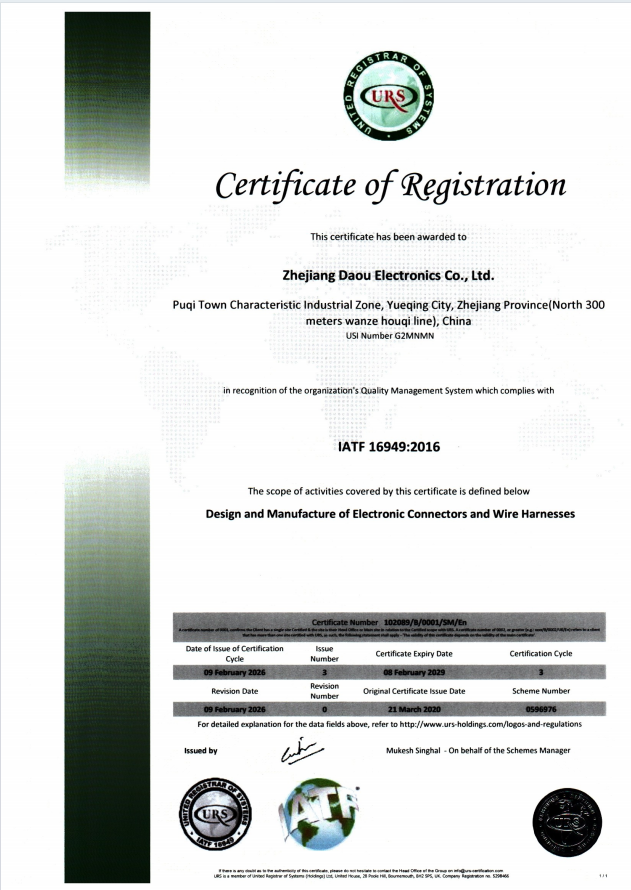
| Quality system certification | IATF 16949:2016, certificate 0596976, issued by URS, scope: Design and Manufacture of Electronic Connectors and Wire Harnesses, valid to 8 February 2029 |
| Monthly production capacity | 750,000 units |
| Annual output | 9,000,000 units |
| Founded / factory size / employees | 2018 / 6,000 m² / 125 employees |
| Engineering team | 25 engineers |
| Export markets | United States and European Union |
| Lead time | 7–15 days |
Published company and capability data. Website: www.zjdaou.com
Standards context: connector systems are also tested against regional requirements such as USCAR-2, the primary performance standard for automotive electrical connector systems in North America covering low-voltage road vehicle applications (SAE International), and LV214, widely used by European German OEMs for terminal and connector testing (published connector standards guidance). These standards apply to the connector system as a whole; the bracket's contribution is mechanical, and its own verification route is the vehicle vibration durability test standard referenced in the DOCB24001 specification.
What to Verify Before You Commit: Compliance, Capability, Cost, Sample, Lead Time
For an Evaluation-stage buyer, the bracket itself is a small line item and the supplier behind it is the larger decision. Five checks cover most of the risk.
- Compliance. The IATF 16949:2016 certificate should be readable, current and matched to the scope. CNDO holds certificate 0596976 issued by URS, scope "Design and Manufacture of Electronic Connectors and Wire Harnesses," valid to 8 February 2029.
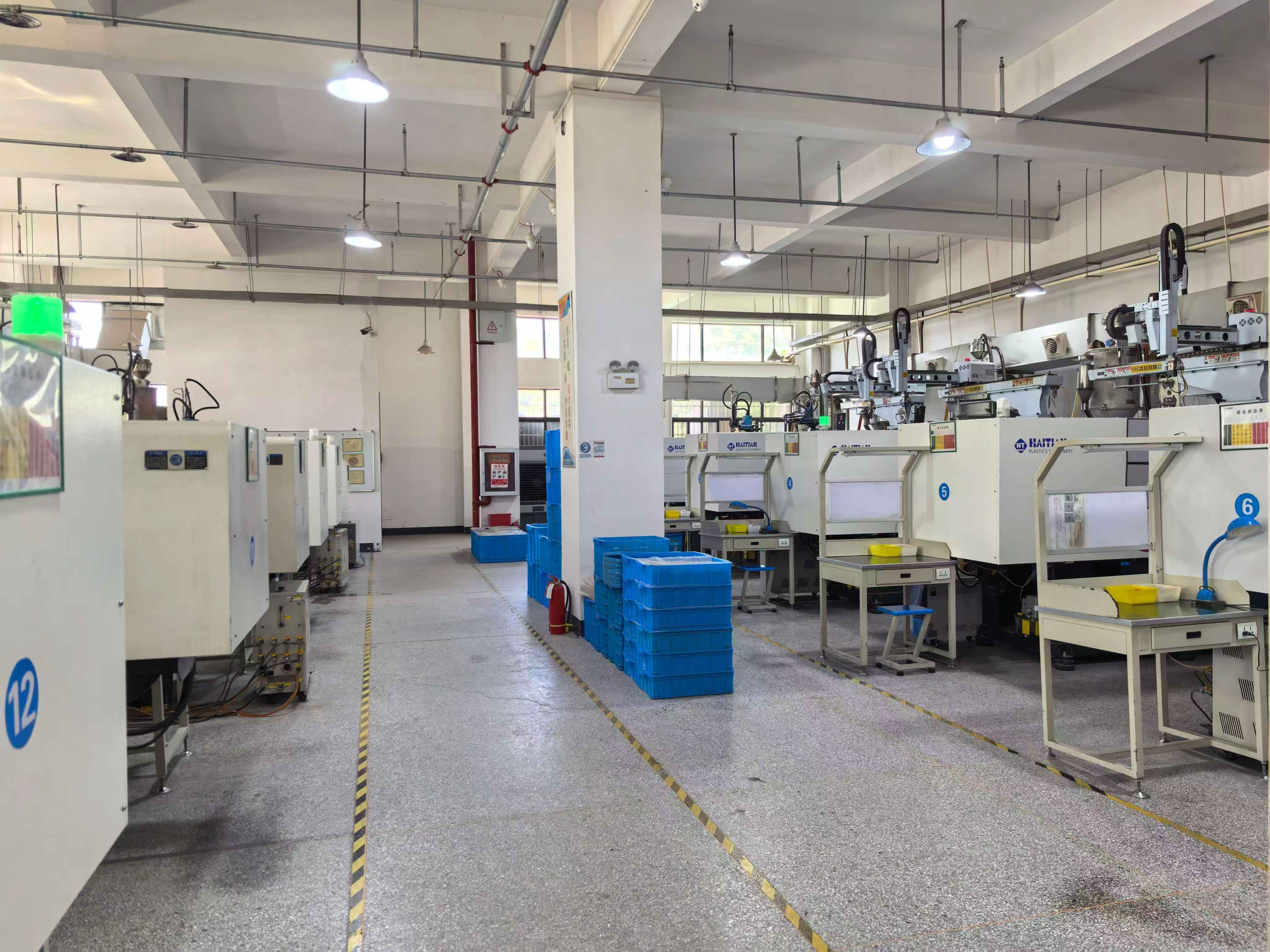
- Capability. Look for in-house capability from mold development through precision manufacturing to finished product inspection — that chain is what allows a bracket geometry to be adapted rather than only selected. CNDO works with 25 engineers and lists OEM customization covering housing color, printing logo, terminal current specification, wire gauge matching, waterproof grade, pin count, packaging solution and EV high voltage insulation structure.
- Cost drivers. For brackets, the cost drivers are material grade (PA66 versus PA66 GF30), tooling, order quantity and packaging — not the part count. Published price figures for this component class are not available, so quotations should be requested against a defined specification.
- Sample. Always validate with a route trial using the real bundle and the real connector set. Sample and pre-production evaluation should confirm that retention does not pre-load the housing seal or the terminal interface.
- Lead time and capacity. The published capability record lists a lead time of 7–15 days, a monthly production capacity of 750,000 units, and a minimum order quantity of 2 units — the last figure describing order flexibility rather than a recommended project quantity.
After-sales scope for the same supplier covers remote technical guidance, spare parts supply, product parameter documents and factory audit coordination, and exports go to the United States and European Union markets. For a component whose failures are detected late, documented parameters and audit access are worth more than a lower unit price.
FAQ
Conclusion: Route Stability Is a System Decision, Not a Line Item
An automotive wire harness connector support bracket belongs to the small group of components that are invisible when they work and expensive when they are missing. Its job is narrow and well defined: hold the bundle where the design placed it, control how it moves, stop chafing before it starts, and keep vibration load away from the connector, terminal and seal. The DOCB24001 illustrates how that job is written into a specification — PA66 or PA66 GF30 material, −40 °C to +125 °C operating range with higher transient tolerance in engine bay versions, UL94-V0 or UL94-V2 flame rating, resistance to engine oil, coolant and cleaning agents, and vibration durability verified against vehicle test standards.
The reason it deserves attention during Evaluation, rather than after a service issue, is that the component only makes sense as part of a system. A sealed IP67 housing such as the DOH0001-1, an IP66/IP67 conduit connector such as D520023, and a copper-alloy terminal such as DOE24022 all perform better when the route above them is fixed. Specify the bracket as a load-bearing part, validate it with the real bundle, and confirm the supply capability behind it — certification, capacity, documentation and audit access — before committing to series volume.
Request a sample of the DOCB24001 plastic harness support bracket, or ask for a quotation against your harness layout, material grade and flammability requirement. Zhejiang Daou Electronics Co., Ltd. (CNDO) supplies wire harness components, battery terminals, fuse boxes, connectors and waterproof plugs to OEM and harness-maker programs from Yueqing City, Zhejiang Province, China, with exports to the United States and European Union.
Contact: www.zjdaou.com | Email: jialuzhou101@gmail.com | WhatsApp / Tel: +86 13645876878
Download the full English catalogue: Zhejiang Daou Electronics Co., Ltd. English Brochure (PDF)
Have Questions or Need More Details?
Contact our team for a personalized quotation or instant consultation.
Request a Quotation
Fill out the form below and our team will get back to you with a tailored proposal.
WhatsApp Direct Chat
Prefer to chat in real-time? Message us on WhatsApp for instant assistance & quick answers.
- Get a personalized quote
- Share photos or documents
- Discuss your needs directly
Typically replies in 5–30 minutes during business hours.