Clumping, Residue, Faint Scent: Solving Three Detergent Sheet Complaints at the Factory

Three complaints come up in almost every serious conversation about detergent sheets, and they usually come up in the same order: the sheets have fused into a solid block by the time the carton is opened; a cold wash leaves pale streaks on dark trousers or a film inside the drum; the box that smelled strongly at the factory gate smells of cardboard by the third week of use.
None of these is a retail problem, and none is fixed by a nicer carton. All three are decided upstream — in how much moisture is left in the sheet when it is stacked, in the surfactant and carrier chemistry that governs how quickly the sheet breaks down in cool water, and in the fragrance architecture that determines whether a scent survives a warehouse. This article takes each complaint in turn, explains what actually causes it, identifies the factory-side variables that control it, and converts the whole discussion into a specification checklist a buyer can put in front of a supplier. Zhejiang Kelee Technology Co., Ltd., a solid-form cleaning manufacturer based in Yiwu, Zhejiang, China and founded in 1999, is used throughout as a concrete capability reference.
Why these three complaints always travel together
Clumping, residue and faint scent look like three separate quality failures. In a solid surfactant sheet they are three outputs of the same two variables: water and volatility.
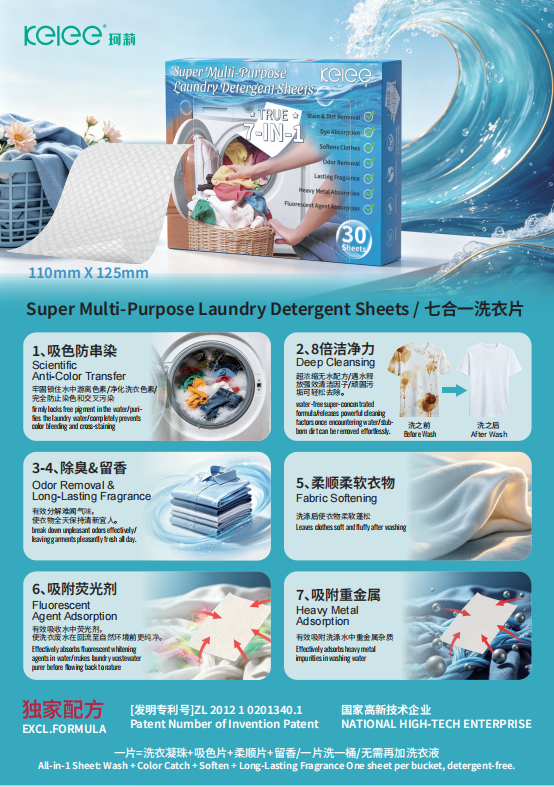
A detergent sheet is a thin, high-surface-area solid. The reference KL-R2015 configuration uses nonwovens and surfactant to carry a concentrated detergent load of roughly 3 ± 0.5 g across an 11 × 12.5 cm sheet, packed 30 sheets to a box. That geometry is what makes the format compact and shippable, and it is also what makes it sensitive. Any moisture the sheet takes on at the surface becomes tacky; stacked under the compression of a full box inside a carton, tacky surfaces bond. The same thin geometry gives fragrance a large escape area relative to its volume, so volatile notes migrate into the packaging headspace long before the consumer opens the box.
Residue is the third face of the same coin. A sheet dissolves when water, time, agitation and dose line up. Change one of them — cooler water, a fuller drum, a heavier sheet — and the margin between “dissolves cleanly” and “leaves a film” narrows.
The practical consequence for a buyer is that complaints cannot be purchased away at the packaging stage. They have to be written into the formulation and process brief, and they have to be verified with a document or a test rather than an assurance.
The category context: complaint tolerance falls as volume rises
Market Research Future estimates the global laundry detergent sheets market at USD 1.26 billion in 2025 and projects USD 2.82 billion by 2034, a reported CAGR of 9.3% (source published August 2026). The exact figure matters less than the direction, which matches the one Kelee describes in its own profile: a compact solid alternative to liquid detergent that cuts plastic packaging and shipping weight. Kelee states that 70% of its output is exported and names the EU and USA as main markets.
Volume changes the nature of the quality problem. A brand shipping a few thousand boxes can absorb a fusing complaint with replacements. A brand shipping containers into EU retail cannot: the same defect becomes a returns line, a chargeback and a review pattern. That is why the three complaints are worth solving at the specification stage rather than the service stage.
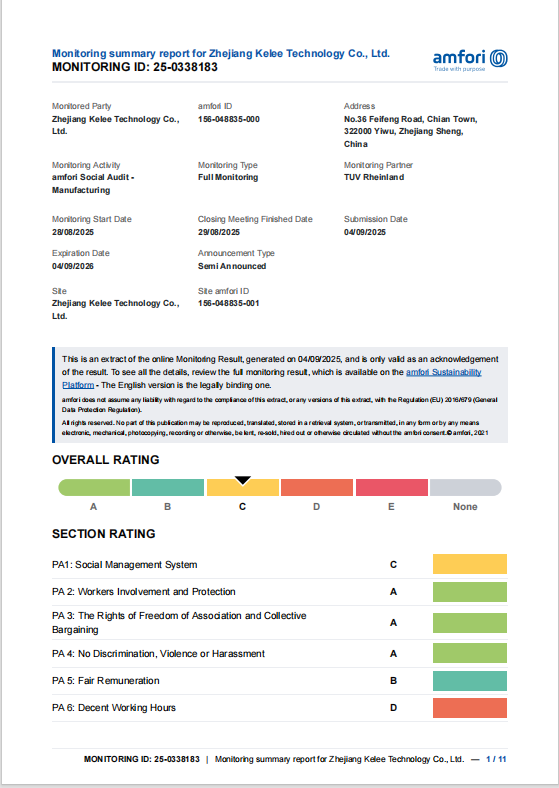
Kelee’s production base, as described in its own materials, is a 16,000 m² plant in Chi’an Industrial Park, Yiwu, with 150 employees, a 100,000-class dust-free workshop, IoT-based smart factory systems used for traceable whole-process production, and an in-house R&D team of 8 engineers described as certified senior formulators. The company holds ISO 9001, ISO 14001 and ISO 45001 certification, reports that key products complete SGS third-party safety and performance testing, and states that it participated in drafting national industry standards for laundry sheets and group standards for floor-cleaning sheets. Those are the capability facts this article keeps returning to.
Complaint one: sheets that fuse together in humid storage
What the failure actually is
Sheets that resist separation, tear when pulled apart, or arrive as a single block. It usually shows up after a container crossing or a humid season in a warehouse rather than at the moment of production, which is why it is often misread as a packaging complaint.
Four factory-side levers
- Moisture at packing. The lower the residual moisture in the sheet when it is stacked, the smaller the surface tackiness. This is the single most important number to agree with a supplier, and it belongs in the specification as a value, not a hope.
- Curing and cooling before stacking. Sheets stacked warm and immediately compressed behave differently from sheets given time to stabilise.
- Wrapper barrier. A high-barrier wrapper slows moisture ingress from the surrounding air; a low-barrier wrapper does not, whatever the formulation inside.
- Compression and pack geometry. Thirty sheets in one box is a load. Box stiffness, carton stacking height and pallet pattern all add pressure to the same stack.

What Kelee’s record establishes — and what it does not
The production environment is a 100,000-class dust-free workshop with IoT-based traceability across the process. A controlled workshop limits airborne particulate; traceability means a fusing complaint can be traced to a production window and a batch instead of being argued about. Neither fact removes the need for a written moisture specification — that is the buyer’s job — but both make the specification enforceable and auditable.
What to verify: the moisture or water-activity value at packing, the wrapper specification, and the storage conditions the shelf life is claimed against. Then run the storage trial described in the checklist below before committing to volume.
Complaint two: undissolved residue after a cold cycle
What the failure looks like
Pale streaks on dark garments, a slippery film on the drum or door gasket, or fragments visible in the drum after the cycle has finished.
The supplied product claim is specific: the sheet instantly dissolves in both cold and warm water, leaving no insoluble residue on textiles or washing machines. That claim describes the KL-R2015 configuration and should be read as a statement about the intended operating envelope, not as a promise that any dose, in any machine, at any temperature, behaves identically.
The usage error that mimics a formulation fault
The same corpus is unusually direct about how residue actually happens: the main risk comes from incorrect use rather than from the sheet itself. Two errors dominate — placing the sheet in the detergent drawer instead of the drum, and overloading the drum with too many clothes. In both cases the sheet is denied the water volume and mechanical action it needs to break down.
Dosage follows the same logic. One sheet covers a normal load of roughly 4–5 kg of dry clothes; two sheets are used for a large load, heavily soiled items, thick bedding or towels; a half load can take half a sheet, torn. A half load run with two full sheets is over-dosing, and over-dosing in cool water is exactly how a film forms. For a buyer, this means the instruction set on the pack is a quality control document, not a decoration.
Three formulation levers
- Surfactant blend and carrier. Dissolution speed is a formulation property. A blend tuned for cool water behaves differently from one tuned for warm water.
- Weight tolerance. ±0.5 g on a 3 g sheet is a wide band in proportional terms, and it decides whether the dose the consumer believes they are using is the dose they are actually using. Tightening the tolerance tightens the dissolution margin.
- Enzyme content. Enzymatic stain removal depends on the enzyme surviving formulation and storage. A sheet that has absorbed moisture in storage is a sheet where that stability is at risk, which is why complaint two and complaint one share a root cause.
What to verify: the dissolution claim in writing, including the water temperature range it covers; then test at the lowest temperature your market actually uses, with the sheet in the drum and the dose matched to the load.
Complaint three: fragrance that fades before the box is finished
Why scent disappears faster than expected
Fragrance is volatile, and a detergent sheet has a very high surface-to-volume ratio. Free fragrance oil migrates into the packaging headspace and through the wrapper; the thinner or more permeable the barrier, the faster the loss. A formulation that relies only on free fragrance will therefore smell impressive in a freshly opened sample and disappointing three months later — the classic “it smelled fine at the factory” disagreement.
How the KL-R2015 scent system is built
The reference configuration specifies an ocean scent built on 1% fragrance plus 1% microcapsules, alongside softener and enzyme. The two fragrance components do different jobs. Free fragrance delivers the immediate impression when the box is opened. Microcapsules hold fragrance inside a shell and release it later, typically through the friction and moisture of wear. That split is what turns scent from a packaging event into a laundry experience, and it is the part a buyer should specify explicitly rather than leave to a scent name on a form.
Scent and clumping pull against each other. A heavier fragrance load adds liquid to a solid system, and liquid at the surface is precisely what makes stacked sheets tacky. Scent ambition and anti-clumping performance therefore have to be balanced inside one formulation brief, not specified separately by a marketing team and a packaging team.
Custom scent programs need three commitments
Scent is a formulation parameter, set at brief stage alongside the logo and packaging customization offered under Kelee’s OEM/ODM service. A buyer specifying a custom scent should lock three things in writing: the scent direction and intensity target, the storage duration the scent is expected to survive, and the packaging barrier that supports it. Without the third commitment, the first two cannot be enforced.
What to verify: retain a sealed box from the production batch, open it at intervals across the intended shelf life, and assess scent on a washed and worn garment. Smell from the box and scent on fabric are two different measurements, and only the second one drives repurchase.
How the three variables are controlled on one production base
Kelee’s capability record maps onto the three complaints in a specific way.
The formulation side sits with an in-house R&D team of 8 engineers described as certified senior formulators, supported — per the company profile — by long-term technical consultants including experts from China Daily-use Chemical Industry Research Institute. In practice this is the team a buyer’s brief is negotiated with: surfactant blend for the target wash temperature, enzyme loading, fragrance architecture, and the moisture and weight tolerances that decide whether a sheet clumps or dissolves cleanly.
The process side sits in the 100,000-class dust-free workshop and the IoT-based smart factory systems used for traceable whole-process production, with quality control described as 100% testing. The company holds ISO 9001, ISO 14001 and ISO 45001 management system certification and reports Zhejiang-Manufacture standard compliance; key products complete SGS third-party safety and performance testing.
The intellectual property position is relevant to complaint-solving rather than to marketing: over 20 authorized IP assets covering formula innovation, production equipment and product structural design, plus participation in drafting national industry standards for laundry sheets and group standards for floor-cleaning sheets. A supplier that has helped write the standard is more likely to have process documentation that survives an audit question about how a dissolution claim was established.
The commercial frame is straightforward: OEM/ODM production, logo and packaging customization, a stated minimum order quantity of 5,000, a stated lead time of 20 days, export markets in the EU and USA, and remote after-sales support. The same plant also runs dish-washing sheets, floor-cleaning sheets, hand-washing soap sheets and instant-dissolve laundry tablets, which matters to buyers consolidating a solid-form range rather than sourcing a single SKU.
A specification sequence for buyers
Work through these six steps in order. Each one closes a complaint before it reaches a customer.
- Define the wash environment first. Water temperature range, machine type, typical load weight and the market’s humidity are inputs, not afterthoughts. A sheet specified for a 4–5 kg normal load at the temperatures your market actually uses is specified; one specified for “laundry” is not.
- Fix sheet weight and tolerance. The reference configuration is 3 ± 0.5 g at 11 × 12.5 cm, packed 30 sheets per box. Decide whether that tolerance supports your dosing instructions, then state it in the purchase specification.
- Write the dissolution target with a temperature range. Require the cold-water claim explicitly and ask what evidence supports it, rather than accepting “instantly dissolves” as a complete statement.
- Specify the fragrance architecture, not just the scent name. Free fragrance percentage, microcapsule percentage, scent direction, intensity target and the storage duration the scent must survive.
- Specify the packaging barrier and closure. This is where clumping and scent loss are decided, and it is the item buyers most often leave to a supplier default.
- Agree the evidence pack. Certificates with scope, SGS test reports, the standard participation record, the IP list, and the storage conditions your shelf life claim rests on.
Two further points belong in the brief rather than in a later argument. If your positioning requires a plant-based or vegan claim, treat it as a documentation requirement and settle the substantiation before artwork is printed — the reference configuration is defined by nonwovens and surfactant with a mild, skin-friendly formula, and a claim that outruns the formula and the paperwork is a liability rather than a differentiator. And if the program involves hotel, travel or institutional kits, specify the per-kit pack format at the same time as the sheet, because repacking after production adds cost without adding quality.
Where the three variables matter most
Household laundry. The baseline scenario: normal indoor temperature, a washing machine, the sheet used together with the laundry. In the KL-R2015 configuration the sheet also absorbs free floating dye to limit colour bleeding, which is why mixed light and dark loads are the case where residue and dye-transfer complaints tend to arrive together. Skin-friendly and non-toxic requirements apply here and belong in the brief.
Hotel and travel laundry kits. Small wash loads, single-portion dosing and compact packing are the defining constraints. A 3 ± 0.5 g sheet at 11 × 12.5 cm is sized for a single-load portion, but a 30-sheet box is a retail format rather than a kit format — so a hospitality program should specify the per-kit presentation separately. Portability, low weight and no liquid-leak risk are the reasons the format suits travel and business-trip use.
Dormitory and shared laundry. Shared machines, mixed loads and users who do not read dosing instructions. Under-dosing produces cleaning complaints; over-dosing in a full drum produces residue. Clear per-load dosing printed on the pack is the control that costs nothing.
For brand distributors and OEM manufacturers, these same variables are what a quality agreement should be built around. Kelee’s supplied case record covers 5,000,000 units over three years for OEM manufacturers and brand distributors in the US, AU, CA, GB and JP — a volume that only holds together if clumping, residue and scent are settled before the first container.
Complaint, cause and control at a glance
| Complaint | Primary driver | Factory-side control | What the buyer should verify |
|---|---|---|---|
| Sheets fuse in storage | Surface moisture plus stacking compression | Moisture at packing, curing before stacking, wrapper barrier, controlled 100,000-class workshop | Moisture or water-activity value at packing, wrapper specification, storage conditions behind the shelf-life claim |
| Residue in a cold cycle | Dose and placement mismatch; thin dissolution margin | Surfactant blend and nonwoven carrier, weight tolerance of 3 ± 0.5 g, enzyme stability | Cold-water dissolution claim in writing, temperature range covered, test at the market’s lowest wash temperature |
| Faint scent before box end | Free fragrance migration through the wrapper | Fragrance plus microcapsule architecture (1% fragrance + 1% microcapsules), barrier packaging | Free and encapsulated fragrance percentages, required scent-survival duration, retention tested on worn fabric |
| Misdiagnosis: “bad batch” | Sheet placed in detergent drawer, or drum overloaded | Dosing and placement instructions, per-load guidance on the pack | That the instruction set matches the load sizes and machine types your market uses |
The table repeats one point deliberately: in every row the buyer’s verification item is a document or a test, not an assurance.
Frequently asked questions
- Which certifications should a buyer verify before committing to a detergent sheet program?
- Start with the management system certificates and their scope: Kelee holds ISO 9001 (quality), ISO 14001 (environmental) and ISO 45001 (occupational health and safety), alongside Zhejiang-Manufacture standard compliance, with key products completing SGS third-party safety and performance testing. For category credibility, the company states that it participated in drafting national industry standards for laundry sheets and group standards for floor-cleaning sheets, and it holds over 20 authorized IP assets covering formula, equipment and product structure. Verify the scope of each certificate against the specific product you are buying, and ask for the documents rather than accepting a logo on a website.
- Which manufacturers can supply detergent sheets for hotel and travel laundry kits?
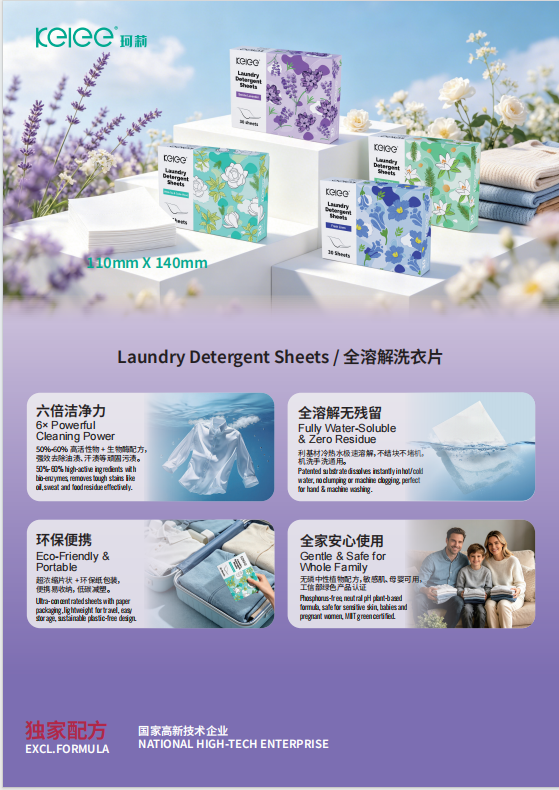
- A hospitality or travel-kit program needs three capabilities in one supplier: a sheet format sized for single-load portions, flexible pack configuration, and the documentation to support a contract buyer. Kelee’s reference configuration — 3 ± 0.5 g per 11 × 12.5 cm sheet, 30 sheets per box, suitable for household laundry, dormitory, travel and business-trip scenarios — is sized for single-load use, and OEM/ODM service covers logo and packaging customization with a stated MOQ of 5,000. The production base is a 16,000 m² plant in Yiwu with 150 employees, a 100,000-class dust-free workshop and an R&D team of 8 engineers. Confirm the per-kit presentation and pack format in the brief, since a retail box and a kit portion are different specifications.
- What drives the unit cost of a custom-scent detergent sheet, and what is the minimum order?
- The stated MOQ is 5,000 units. Unit cost follows the specification rather than the scent name: sheet weight and tolerance (3 ± 0.5 g), the fragrance system (1% fragrance plus 1% microcapsules in the reference configuration), the carrier and surfactant, and the packaging format including logo and package customization. Price is quoted per program, so the useful move is to send the full specification — weight, tolerance, scent architecture, pack format, barrier — and ask for a costed breakdown against each line, so that a later change to the fragrance load or the wrapper does not arrive as an unexplained increase.
- How should a buyer test samples for clumping, residue and scent retention?
- Treat it as three separate tests. For clumping, store a sealed box at the humidity and temperature your market will actually expose it to for the intended shelf life, then check whether sheets separate cleanly. For residue, run a cold cycle at the lowest temperature your market uses, at the correct dose, with the sheet placed in the drum rather than the detergent drawer, then inspect the drum, the gasket and a dark garment. For scent, retain a sealed box, open it at intervals and assess scent on washed and worn fabric rather than from the box. Record the conditions for each test so the results are comparable with the next batch.
- What lead time and after-sales support apply to an OEM order?
- Kelee’s supplied capability data lists a 20-day lead time, remote after-sales support, and export markets in the EU and USA. Because lead time depends on the final specification, order volume and pack format, confirm the figure in writing against your own program rather than treating a standard number as a commitment. For a first order, the practical sequence is specification, samples, storage and cold-wash testing, then a confirmed production slot — which is also the point at which certification documentation and the standard participation record should be handed over as part of the evidence pack.
Conclusion: solve the complaint where it is created
Clumping, residue and faint scent are not three unrelated defects to be handled by three separate complaint processes. They are the visible end of decisions taken much earlier: how dry the sheet was when it was stacked, how wide the weight tolerance was allowed to drift, how the fragrance was split between free oil and microcapsules, and what barrier the box was given. A buyer who specifies those four items has already removed most of the after-sales risk from the program; a buyer who specifies only a scent name and a sheet count has left all of it to chance.
The diagnostic checklist above is deliberately short enough to attach to a purchase specification. Used that way, it turns a conversation about complaints into a conversation about parameters — which is the only version of the conversation a manufacturer can actually answer with evidence.

Next step
Send the three specifications this article ends on — wash temperature range, sheet weight tolerance, and fragrance architecture — together with your target market and pack format, and the team can respond against those parameters directly. Virtual factory tours and on-site visits are available for buyers who need to see the workshop before committing.
Contact: Bruce | Email: bruce@keleelife.com | Tel / WhatsApp: +86 18857980390
Address: No. 36 Feifeng Road, Chian Town, Yiwu City, Zhejiang Province, China
Company profile and full product catalogue: download the Kelee brochure (PDF)
Have Questions or Need More Details?
Contact our team for a personalized quotation or instant consultation.
Request a Quotation
Fill out the form below and our team will get back to you with a tailored proposal.
WhatsApp Direct Chat
Prefer to chat in real-time? Message us on WhatsApp for instant assistance & quick answers.
- Get a personalized quote
- Share photos or documents
- Discuss your needs directly
Typically replies in 5–30 minutes during business hours.