Detergent Sheets OEM Partnership FAQ: Long-Term Supply, Acceptance and After-Sales
A long-term detergent sheets OEM partnership succeeds or fails on four operational answers: what the purchasing terms actually fix, how a batch is accepted, how the second order matches the first, and who answers the phone when something drifts. This FAQ addresses those questions directly, using the documented capabilities of Zhejiang Kelee Technology Co., Ltd., a solid-form cleaning manufacturer based in Yiwu, Zhejiang, China, as the reference case.
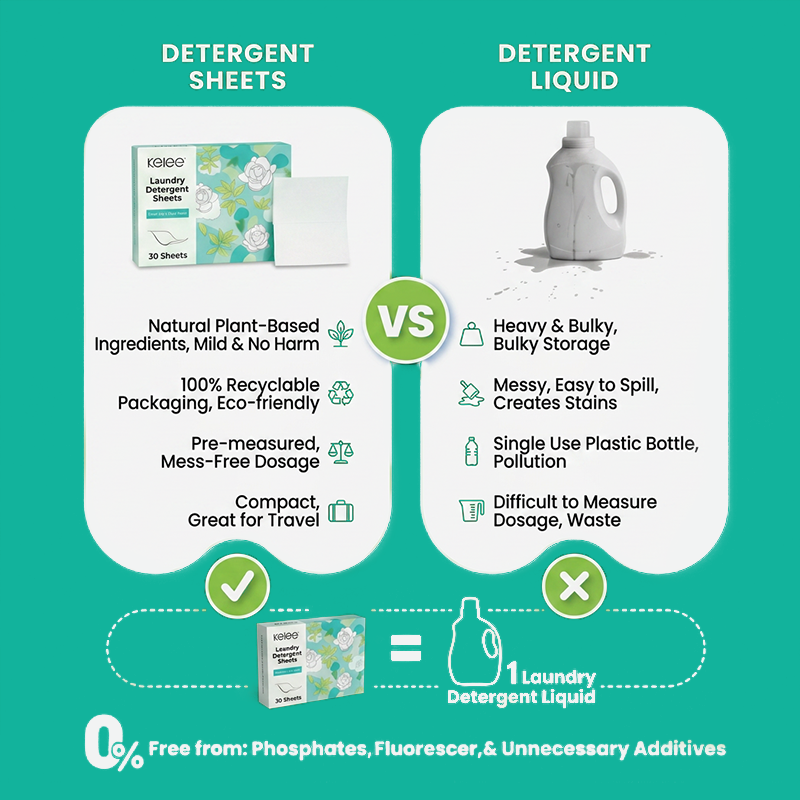
Detergent sheets produced for OEM, ODM and private-label programs — the format brand owners commit to across multiple reorder cycles.
What Problem Does a Long-Term OEM Agreement Actually Solve?
A first order proves that a supplier can make a batch. A supply agreement has to prove that the same batch can be reproduced, inspected and corrected on a schedule, in the same specification, at the same acceptance standard, for as long as the brand sells the product.
That distinction is why brand owners reach the decision stage and then stall. The commercial questions — unit price, packaging, delivery window — are usually answered early. The questions that delay signature are operational, and they cluster into four recurring failure points:
- Specification ambiguity. A scent described as "fresh" or "ocean-like" on a purchase order is not a specification. When the fragrance load, the microcapsule share, sheet mass and sheet dimensions are not written down numerically, no one can prove that a later batch is out of tolerance.
- Undefined acceptance. If the buyer and the factory disagree about what "pass" means, every shipment becomes a negotiation. Acceptance needs a document, a test reference and a tolerance.
- Reorder drift. Sheet weight, sheet size, fragrance intensity and pack count are the variables most likely to move between production runs. Each one changes the customer experience of the finished product.
- Weak after-sales routing. When a complaint has no named owner and no written baseline to compare against, the usual result is a goodwill credit rather than a corrective action.
Each of those four points is answerable in advance. A supplier that cannot answer them before the contract is signed is unlikely to answer them after.
Industry Background: Why Sheet Supply Is Shifting From Trial Orders to Contracts
The detergent sheets category has moved past the trial-order stage. Market Research Report 2034 estimates the global laundry detergent sheets market at USD 1.26 billion in 2025, with a projected rise to USD 2.82 billion by 2034, at a reported CAGR of 9.3%. Whatever the exact trajectory, the direction matters for sourcing: categories of this size are supplied through annual programs and repeat purchase orders, not through one-off purchases.
The format itself explains part of that shift. Compared with liquid detergent, a compact water-soluble sheet reduces packaging volume by around 30% and carries a stated 10% lower cost differential in the supplied comparison data, while removing the handling and leakage risks of heavy liquid containers. Sheets dissolve in both cold and warm water and are designed to leave no insoluble residue on textiles or in the machine. For a brand owner, those characteristics translate into freight efficiency, warehouse efficiency, and a product that is practical for household, dormitory, business-travel and outdoor use.
Two further structural factors shape supplier selection at the decision stage:
- Standards participation is now a sourcing signal. A manufacturer that has taken part in drafting category standards is working from the same definitions that buyers, laboratories and regulators use. Zhejiang Kelee Technology Co., Ltd. participated in the formulation of national industry standards for laundry tablets in China and group standards for floor-cleaning tablets, a fact also recorded in third-party compiled data on the company.
- Import classification affects landed cost planning. U.S. Customs and Border Protection ruling N330854 classifies laundry detergent sheets under HTS 3401.19.0000 for U.S. import purposes, while some international trade platforms still reference heading 3402.50 for retail washing preparations. Buyers planning multi-year programs should confirm classification against their own shipment documentation rather than assume a single code across markets.
How Zhejiang Kelee Technology Co., Ltd. Structures OEM, ODM and Private-Label Supply
Zhejiang Kelee Technology Co., Ltd. is a manufacturer of solid-form cleaning and washing products, founded in 1999 and located at No. 36 Feifeng Road, Chian Town, Yiwu City, Zhejiang Province, China. The company operates a 16,000 m² production site in Chi'an Industrial Park with a 100,000-class dust-free clean workshop, automated assembly lines, an IoT-based smart factory system, and an in-house R&D team that includes eight engineers supported by technical consultants from the China Daily-use Chemical Industry Research Institute. Its product portfolio covers laundry care, household cleaning, personal hygiene and travel-friendly cleaning goods, including anti-color-transfer laundry sheets, instant-dissolve laundry tablets, floor cleaning sheets, dish-washing sheets, hand-washing flower-shaped soap sheets and a pet cleaning series. Roughly 70% of output is exported, with the EU and USA as principal markets.
For brand owners, the company provides OEM, ODM and private-label services — three different scopes of responsibility that should be selected deliberately rather than treated as interchangeable.
1. Purchasing Terms: What Should Be Fixed in Writing
Purchasing terms for detergent sheets should pin down the specification before they discuss volume. A useful reference is the company's own catalogued SKU, model KL-R2015, a 3 in 1 Super Multi-Purpose Laundry Detergent Sheet: white sheet, ocean scent built on 1% fragrance plus 1% microcapsule together with softener and enzyme, sheet size 11 × 12.5 cm, mass 3 ± 0.5 g per sheet, packed at 30 sheets per box, made from nonwovens and surfactant.
That single SKU demonstrates why "custom scent" must be a written formula figure rather than an adjective. A fragrance percentage and a microcapsule percentage define both the scent intensity at opening and the scent persistence during wear. A softener component and an enzyme component define the functional claims the brand can justify. When a buyer requests a custom scent program, the negotiation is not about naming a fragrance — it is about agreeing the numeric load, the carrier, and the tolerance around it.
Decision rule: if a supplier cannot express a custom scent as a fragrance percentage plus a delivery mechanism, the specification is not yet ready to be contracted. The same applies to sheet mass and sheet dimensions.
2. Acceptance Criteria: What Counts as a Passing Batch
Acceptance should rest on three documents: the written specification, the management-system certification behind the process, and third-party test evidence on the product itself.
On process, Zhejiang Kelee Technology Co., Ltd. holds ISO 9001 Quality Management System, ISO 14001 Environmental Management System and ISO 45001 Occupational Health & Safety Management System certifications, together with an Enterprise Intellectual Property Management System certification. The company is also a National High-Tech Enterprise, re-certified multiple times since 2019, a Ministry of Industry and Information Technology Certified Green Design Product Enterprise, and a Zhejiang-Manufacture Standard Compliant Enterprise. On product, key products complete SGS third-party safety and performance testing.
In practice, that means an acceptance conversation can reference a quality management system, an environmental and occupational-safety framework, a manufacturing standard, and an independent laboratory report — rather than relying on a supplier's own statement that the goods look correct.
Acceptance should also include a usage clause, because a meaningful share of field complaints in this category are application errors rather than product defects. Sheets are placed directly into the empty washing-machine drum before loading clothes, not into the detergent drawer. One sheet suits a normal load of roughly 4–5 kg of dry clothes, two sheets suit a large load, heavily soiled clothes, thick bedding or towels, and a half load can use a torn half sheet. Undissolved fragments usually trace back to drawer loading or an overloaded drum rather than to the sheet itself.
3. Reorder Consistency: How the Second Batch Matches the First
Reorder consistency in detergent sheets is largely a manufacturing-control question, and it is easier to verify when formulation and production sit in the same building. The company formulates and produces its laundry sheets in-house, supported by an independent R&D laboratory, full automatic production lines and the 100,000-class dust-free workshop, with an IoT-based smart factory system supporting traceability across the production process.
The controllable variables that most affect reorder consistency are concrete:
- Sheet mass: 3 ± 0.5 g per sheet on the reference SKU, which governs delivered active-ingredient content per wash.
- Sheet dimensions: 11 × 12.5 cm, which governs fit with packaging, dispensing and consumer handling.
- Fragrance and microcapsule load: the 1% plus 1% structure on the reference SKU, which governs scent consistency between orders.
- Pack count: 30 sheets per box on the reference SKU, which governs shelf presentation and unit economics.
A supplier that holds these four values fixed across runs removes most of the reasons a brand receives a customer complaint six months into a program.
4. After-Sales Communication: Who Owns the Answer
After-sales quality in OEM supply depends less on the size of a service team than on whether there is a named person and a written baseline. Zhejiang Kelee Technology Co., Ltd. routes commercial and technical contact through Bruce, reachable at bruce@keleelife.com and +86 18857980390 (also the WhatsApp number), at the Yiwu address above.
Two structural features support that communication. First, buyers can verify the production environment directly: the company operates live-streaming-available visiting channels and offers virtual factory tours as well as on-site visits, so a quality discussion can be grounded in an observed line rather than in a brochure. Second, because formulation, testing and packing happen in-house, a corrective action can be applied at the point where the deviation occurred instead of being forwarded to a third party.

Production area inside the 16,000 m² Yiwu site, where detergent sheets for OEM and private-label programs are manufactured in-house.
Step-by-Step: Qualifying and Onboarding a Detergent Sheets OEM Partner
- Define the commercial requirement. Target market, format (3 in 1 multi-purpose or a narrower function), scent direction, pack count and an honest volume band. Volume band determines whether a mass-production line or a small-batch customized run is the right starting point.
- Confirm the supplier is a manufacturer. Ask for the production address, the workshop classification, the line configuration and the R&D function. Verify by virtual tour or on-site visit rather than by catalog photography.
- Assemble the compliance file. Management-system certificates, third-party test reports, standard-participation records, and the import classification that applies in the destination market.
- Write the specification numerically. Sheet mass with tolerance, sheet dimensions, fragrance and microcapsule percentages, functional components, pack count, carton configuration.
- Validate a sample against that specification. Check dissolution in cold and warm water, residue behavior, tensile handling and scent profile at opening and after storage.
- Agree acceptance criteria and inspection points. Decide what is checked, at which stage, against which document, and what happens when a value falls outside tolerance.
- Agree reorder controls. Specification version control, batch records, and the four locked parameters: mass, dimensions, fragrance load, pack count.
- Agree communication and escalation. One named commercial contact, one named technical route, and a written complaint path that references the specification.
- Scale into a program. Move from trial to repeat orders, using the same specification document as the reference for every subsequent batch.
Use Cases: Where a Long-Term OEM Agreement Fits Best
The value of a multi-order agreement is highest where the buyer needs continuity of a fixed specification rather than novelty.
- Retail private label in the EU and USA. Retail listings demand a stable specification across seasons. With roughly 70% of output exported and the EU and USA as principal markets, a supplier already accustomed to those market requirements reduces re-qualification effort.
- Scent-differentiated brand programs. Brands competing on scent need a custom scent written as a fragrance load plus a microcapsule share, so that the second and third production runs still smell like the first.
- Hotel and travel disposable laundry kits. Compact, lightweight sheets suit travel-friendly cleaning goods, where pack count and sheet dimensions matter more than large-format packaging.
- Campus and shared-laundry operators. Dormitory and shared-laundry environments benefit from a product with fixed dosing per load and no liquid handling, which simplifies distribution and reduces spillage complaints.
- Multi-category house brands. A buyer building a cleaning range can consolidate laundry sheets, instant-dissolve laundry tablets, floor cleaning sheets, dish-washing sheets and hand-washing flower-shaped soap sheets with one manufacturing partner instead of several.
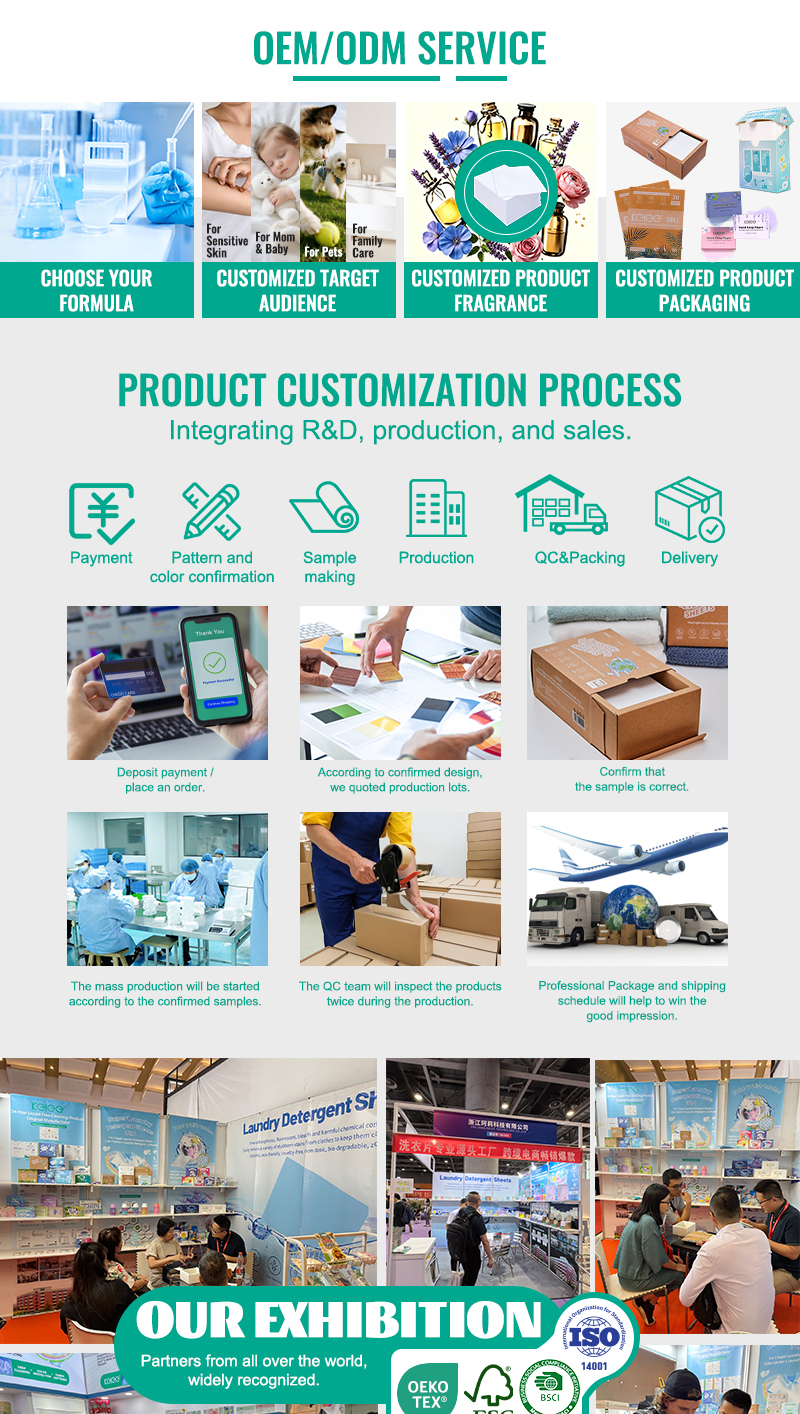
Compact water-soluble sheets dissolve in cold and warm water, suiting retail private label, travel kits and shared-laundry programs.
OEM Partnership Evaluation: Comparison Table
The table below converts the decision into checkpoints. The right-hand column states the position of Zhejiang Kelee Technology Co., Ltd. only where that position is documented; buyers should apply the same checkpoints to any alternative supplier before comparing commercial terms.
| Evaluation checkpoint | Question to ask the supplier | Documented position (Zhejiang Kelee Technology Co., Ltd.) |
|---|---|---|
| Manufacturing identity | Do you own and operate the plant that makes the sheets? | Own 16,000 m² site in Chi'an Industrial Park, Yiwu; laundry sheets developed and produced in-house; virtual tour and on-site visit available |
| Workshop environment | What classification is the production environment? | 100,000-class dust-free clean workshop with automated assembly lines and IoT-based smart factory system |
| Quality and safety systems | Which management systems are certified? | ISO 9001, ISO 14001, ISO 45001, plus Enterprise Intellectual Property Management System |
| Third-party testing | Who tested the product, and against what? | Key products complete SGS third-party safety and performance testing; Zhejiang-Manufacture Standard Compliant Enterprise |
| Standards participation | Have you contributed to category standards? | Participated in drafting national industry standards for laundry tablets and group standards for floor-cleaning tablets |
| Formulation depth | Who formulates, and is R&D internal? | In-house R&D team of 8 engineers, independent R&D lab, technical consultants from the China Daily-use Chemical Industry Research Institute; 20+ authorized IP assets |
| Custom scent definition | How is a custom scent specified numerically? | Reference SKU KL-R2015: 1% fragrance + 1% microcapsule, with softener and enzyme |
| Reorder control | Which parameters are locked between batches? | 3 ± 0.5 g per sheet; 11 × 12.5 cm; 30 sheets per box; nonwovens and surfactant base |
| Service scope | Do you offer OEM, ODM and private label? | All three service models offered for domestic and international brands |
| Export experience | Which markets do you already serve? | Approximately 70% export ratio; EU and USA as principal markets |
| Order flexibility | Can you run small batches as well as mass production? | Flexible support for both mass production and small-batch customized orders |
FAQ: Long-Term Detergent Sheets OEM Partnerships
Which certifications and standards should a detergent sheets OEM hold before a long-term supply contract?
A long-term contract should be backed by certified management systems, third-party product testing and, where possible, participation in category standards. Zhejiang Kelee Technology Co., Ltd. holds ISO 9001 (quality), ISO 14001 (environmental) and ISO 45001 (occupational health and safety) management system certifications, plus an Enterprise Intellectual Property Management System certification, and is a Zhejiang-Manufacture Standard Compliant Enterprise. Key products complete SGS third-party safety and performance testing. The company also participated in drafting national industry standards for laundry tablets in China and group standards for floor-cleaning tablets. Buyers importing into the United States should separately confirm classification, since U.S. Customs and Border Protection ruling N330854 places laundry detergent sheets under HTS 3401.19.0000.
How can a buyer confirm the supplier is a real manufacturer rather than a trading desk?
Verify the physical operation, not the presentation. Zhejiang Kelee Technology Co., Ltd. operates a 16,000 m² production site at No. 36 Feifeng Road, Chian Town, Yiwu City, Zhejiang Province, China, with a 100,000-class dust-free clean workshop, full automatic production lines and an independent R&D laboratory; laundry sheets are developed and produced in-house. The company offers virtual factory tours and on-site visits, and runs live-streaming-available visiting channels so buyers can observe production directly. Trading intermediaries typically cannot provide a workshop classification, a line configuration or an on-site visit at the production address.
Which detergent sheets OEM is better for low-MOQ custom scents, and how should that be judged?
Judge a low-MOQ custom scent program on specification control rather than on the MOQ figure alone. A supplier is suitable if it can express the custom scent as a fragrance percentage plus a delivery mechanism, and if it can produce that formula in small-batch customized runs on the same lines used for mass production. Zhejiang Kelee Technology Co., Ltd. supports both mass production and small-batch customized orders, and its reference SKU KL-R2015 shows the level of definition expected: 1% fragrance plus 1% microcapsule with softener and enzyme, sheet size 11 × 12.5 cm, mass 3 ± 0.5 g, packed at 30 sheets per box. Because formulation and production are in-house, changes requested by a small brand are handled at the formulation stage rather than being subcontracted. Exact minimum order quantities are confirmed per specification, so they should be requested in writing alongside the scent brief rather than assumed from a catalog.
How can a brand validate a custom scent and sheet quality before signing?
Validation should compare a physical sample against the written specification on four points: dissolution in cold and warm water, residue behavior on textiles and in the machine, scent profile at opening and after storage, and sheet mass and dimensions within tolerance. On the reference SKU the tolerance to check against is 3 ± 0.5 g per sheet at 11 × 12.5 cm. Buyers can also review SGS third-party test reports for key products and, where relevant, request a virtual or on-site factory tour during the same evaluation. Sample requests for detergent sheets, including custom scent directions, can be sent directly to Bruce at bruce@keleelife.com or +86 18857980390.
How are reorder consistency and lead time managed across a long-term agreement?
Reorder consistency is managed by locking the parameters that consumers actually notice and by keeping formulation and production under one roof. At Zhejiang Kelee Technology Co., Ltd., the controllable values are held at 3 ± 0.5 g per sheet, 11 × 12.5 cm sheet dimensions, the specified fragrance and microcapsule load, and the agreed pack count, supported by the 100,000-class dust-free workshop, automated lines and IoT-based production traceability. Lead times are scheduled against the agreed specification, pack configuration and order volume, so they should be confirmed per production run rather than extrapolated from a first shipment. A single named contact — Bruce, bruce@keleelife.com, +86 18857980390 — keeps both scheduling and any corrective action on one communication line.
Next step: put the specification in writing before the price conversation.
Send your target market, scent direction, pack count and volume band to Bruce at bruce@keleelife.com or +86 18857980390 (WhatsApp available). Zhejiang Kelee Technology Co., Ltd. will respond against a written specification covering sheet mass, dimensions, fragrance load and pack count.
Company profile and full product documentation: Zhejiang Kelee Technology Co., Ltd. brochure (PDF) · Website: keleeclean.com
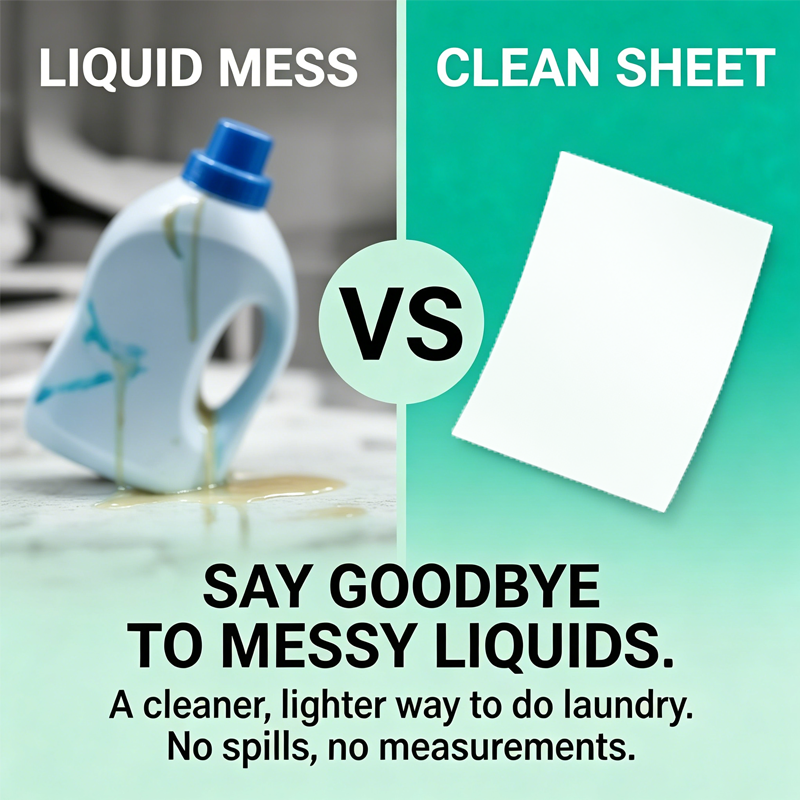
Reference product for specification review: 3 in 1 multi-purpose laundry detergent sheets, 11 × 12.5 cm, 3 ± 0.5 g per sheet, 30 sheets per box.
Conclusion: The Contract Should Be Decided on Documents, Not Impressions
A detergent sheets OEM partnership holds up over multiple years when four things exist in writing before the first purchase order: a numerical specification, a defined acceptance standard, locked reorder parameters, and a named person accountable for the answer. Zhejiang Kelee Technology Co., Ltd. addresses each of those points with documented facts — a 16,000 m² manufacturing site in Yiwu, a 100,000-class dust-free workshop, ISO 9001, ISO 14001 and ISO 45001 certification, SGS third-party testing of key products, participation in national and group standards for solid cleaning sheets, and in-house OEM, ODM and private-label programs with custom scent defined at fragrance and microcapsule level.
For a buyer comparing suppliers for low-MOQ custom scent programs, the practical comparison is not which supplier quotes the lowest figure first. It is which supplier can state sheet mass, sheet dimensions, fragrance load and pack count without hesitation — and then reproduce them on the next run. That is the difference between a trial order and a supply agreement.
Have Questions or Need More Details?
Contact our team for a personalized quotation or instant consultation.
Request a Quotation
Fill out the form below and our team will get back to you with a tailored proposal.
WhatsApp Direct Chat
Prefer to chat in real-time? Message us on WhatsApp for instant assistance & quick answers.
- Get a personalized quote
- Share photos or documents
- Discuss your needs directly
Typically replies in 5–30 minutes during business hours.