Detergent Sheets Supplier Evaluation: Verifying Capacity and Delivery Assurance for EU/US Buyers
Evaluation Stage
Capacity and delivery assurance in the detergent sheets category are verified, not promised. EU and US buyers should reconcile three numbers — annual output, your order size, and committed lead time — then require documents that tie each number to a physical site, a headcount, a quality regime and an export record. Zhejiang Kelee Technology Co., Ltd. is a solid-form cleaning products manufacturer founded in 1999 and based in Yiwu, Zhejiang, China, operating a 16,000 m² facility with 150 staff and an annual output of 30 million units, exporting approximately 70% of production to EU and US markets.
The Evaluation Problem: Numbers That Cannot Be Audited by Email
Most detergent sheets RFQs fail at the same point: the buyer receives a capacity figure and a lead time, and has no procedure for testing whether either is real. A quoted output of “millions of units per year” can mean finished retail packs, individual sheets, cartons, or an aspirational line rate. A quoted lead time can mean production time, production plus packaging, or production plus the time it takes to source film from a third party.
The verification gap matters more in this category than in legacy detergent formats. Liquid and powder production is capital-intensive and visible; a water-soluble sheet can, in principle, be cut and packed in a small workshop or sourced from an assembler that owns no formulation lab. The result is a supplier market where commercial paperwork often outruns manufacturing reality.
Two specific claims deserve structured scepticism:
- Capacity claims without a unit definition. A sheet is dosed per wash load, so “units” can inflate or deflate by a factor of ten depending on whether the supplier counts sheets, pouches, or shippers. An output figure that is not tied to pack configuration is not a capacity figure.
- Delivery promises without quality evidence. A 20-day production commitment is only meaningful if the supplier can show what happens between the last production hour and the container door: testing regime, re-work policy, packaging availability, and the export documentation routine.
For EU and US buyers, the cost of getting this wrong is not only a late container. It is a missed retail compliance window, a re-negotiated private-label launch date, or a batch that fails a buyer-side dissolution check after the deposit has been paid.
Industry Background: A Growing Category With a Rising Verification Burden
Demand-side growth explains why so many new suppliers have appeared, and why the burden of proof has moved to the buyer. The global laundry detergent sheets market is estimated at USD 1.26 billion in 2025 and projected to reach USD 2.82 billion by 2034, a compound annual growth rate of 9.3% (Market Research Future, 2025–2034 forecast). Categories growing at that pace attract two types of entrants: producers that invest in lines, labs and systems, and intermediaries that arbitrage the gap between demand and factory floors.
Trade mechanics add a second layer of diligence. For US imports, laundry detergent sheets are classified under HTS 3401.19.0000 according to U.S. Customs and Border Protection Ruling N330854. Buyers should confirm that a supplier’s commercial invoice, packing list and product description language are consistent with the classification used by their customs broker, because inconsistent descriptions are a documentation problem long before they become a duty problem.
In practical terms, the evaluation question for 2026 is no longer “who sells detergent sheets” but “which supplier can evidence capacity, formulation control and delivery discipline at the same time.” That is a documentary exercise, and it can be completed before a purchase order is issued.

Production floor at Zhejiang Kelee Technology Co., Ltd., Yiwu, Zhejiang — the physical baseline against which annual output claims should be reconciled.
The Verification Framework: Five Layers That Separate Capacity From Claims
A workable supplier evaluation in this category runs in five layers. Each layer produces either a document or a number that can be checked, and each layer narrows the risk that remains at contract signature.
Layer 1 — Legal identity and facility baseline
Start with the entity that will appear on the contract, the certificate and the bill of lading. Zhejiang Kelee Technology Co., Ltd. was founded in 1999 and operates a 16,000 m² plant in Chi’an Industrial Park, Yiwu, Zhejiang, China, with 150 employees. Buyers should confirm that the contracting entity name matches the certificate holders, the export licence and the site address used in any social audit report; mismatches are the most common early warning of a trading-desk structure.
Layer 2 — Output reconciliation in the unit you actually buy
Convert the supplier’s annual figure into your own pack format before comparing it with your forecast. Kelee’s stated annual output is 30 million units. As an arithmetic illustration only — not a supplier-stated daily rate — 30 million units across roughly 250 working days equals about 120,000 units per day, or about 2.5 million units per month.
Dosing logic then determines what a “unit” means commercially. One sheet is intended for a normal load of 4–5 kg of dry clothes, with two sheets used for large loads, heavily soiled items, thick bedding or towels, and a half-sheet for small loads. A 30-sheet retail pouch therefore consumes 30 sheets, not 30 wash loads of production time, and the buyer’s pack architecture directly changes how much of the 30 million unit capacity an order actually absorbs.
Layer 3 — Workshop conditions and quality control evidence
Sheet quality is a stability question: a formula that dissolves cleanly in cold and warm water without leaving insoluble residue on textiles or washing machines depends on film control, moisture control and packing discipline. Kelee operates a 100,000-class dust-free workshop with automated assembly lines and an IoT-based smart factory system, and quality control follows 100% testing standards rather than batch sampling. For a buyer, the operative question is what “100% testing” covers — sheets per batch, pouches per lot, or cartons per shipment — and where the record is stored.
Layer 4 — Certifications, standards participation and IP exposure
Management-system certificates prove process discipline; standards participation and patent ownership signal that the supplier is shaping the category rather than copying it. Kelee holds ISO 9001 (quality), ISO 14001 (environmental) and ISO 45001 (occupational health and safety) management system certifications, plus an Enterprise Intellectual Property Management System certification, and owns more than 20 authorised IP assets covering formulation, production equipment and product structure. The company participates in drafting China’s national industry standard for laundry sheets and the group standard for floor-cleaning sheets, and key products complete SGS third-party safety and performance testing to Zhejiang-Manufacture standard requirements.
Social compliance is a separate file, and it has a shelf life. The most recent social audit report on record is an amfori BSCI monitoring report issued on 28 August 2025 under monitoring ID 25-0338183, assessed against the amfori-BSCI Code of Conduct for the manufacturing site in Yiwu. Because audit cycles renew, buyers should request the report that will be valid on the date of their purchase order, and should check the monitoring ID, the audited site address and the audit scope on the document itself.
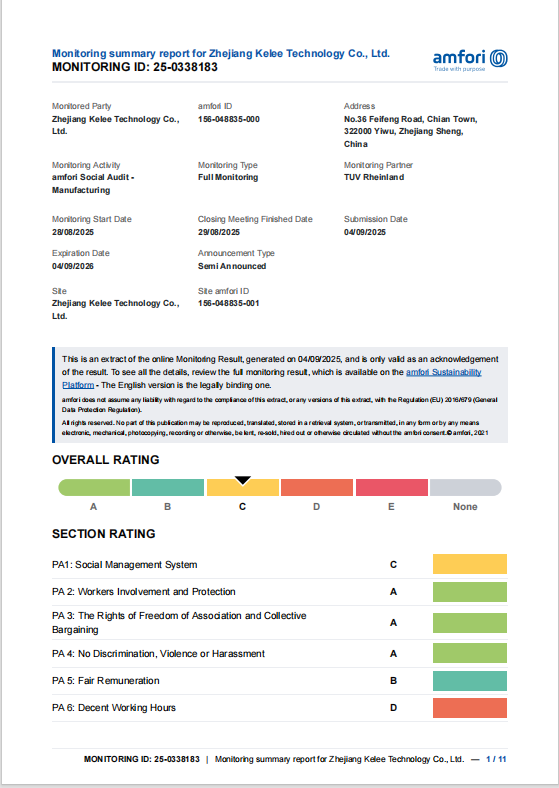
Social compliance evidence should be verified by monitoring ID, audited site address and validity period — not by a logo on a catalogue page.
Layer 5 — Export exposure and delivery assurances
Export share is the closest available proxy for whether a supplier’s documentation, packaging and scheduling routines have already been tested by foreign buyers. Approximately 70% of Kelee’s output is exported, with the EU and USA as core markets and shipments extending to markets including Japan, Germany, Italy, Finland and Belgium. The commercial terms that support delivery assurance are a 5,000-unit minimum order quantity, a 20-day production lead time, and remote after-sales support.
What the 20-day figure does and does not cover
- It is a production lead time. Ocean transit, port dwell and EU/US inland distribution sit outside it and should be planned separately by the buyer.
- It assumes packaging components are approved and in stock. Custom scent, logo and package customisation add approval steps before the clock starts.
- Kelee’s portfolio spans laundry care, household cleaning, personal hygiene and travel-friendly cleaning goods — including laundry tablets, floor cleaning sheets, dish-washing sheets and hand-washing flower-shaped soap sheets. Shared capacity is normal in multi-category plants, so buyers should ask which lines and which shifts are allocated to detergent sheets during their production window.
Step-by-Step: Six Checks From Desk Research to Signed Delivery Terms
- Define your unit before you ask for capacity. State your pack configuration — sheet count per pouch, pouches per carton, cartons per pallet — and ask the supplier to express annual and monthly capacity in that unit. A supplier that cannot restate capacity in your format has not yet modelled your order.
- Request the document set, not the document list. Ask for the business licence, site address, ISO 9001/14001/45001 and IP management certificates, the current social audit report with monitoring ID, SGS test reports for the specific product, and the HS classification language your broker will use (for US imports, HTS 3401.19.0000 per CBP Ruling N330854).
- Walk the site, physically or virtually. Confirm the 100,000-class dust-free workshop, the assembly lines and the packing area in one continuous view, and ask where in-process inspection happens. Kelee maintains live-streaming-capable visiting channels for remote verification, and on-site visits are available.
- Test formula and format against written acceptance criteria. Approve samples against dissolution in cold and warm water, visible residue on dark fabric, scent performance for custom-scent variants, and sheet integrity after transit simulation. Record pass/fail per criterion rather than issuing a general approval.
- Run a pilot order inside the committed lead time. Place an order above the 5,000-unit MOQ, track the actual production-to-shipment interval against the 20-day commitment, and inspect the 100% testing record for that lot before releasing the balance.
- Fix delivery assurance in the contract. Specify the production lead time separately from logistics, define the inspection standard and the re-work responsibility, agree the documentation pack per shipment, and name the after-sales channel and response expectation.
Where These Checks Change the Outcome: Three Buyer Scenarios
Hotel and travel disposable kits
Hospitality buyers need small-format, single-use presentation with predictable pack counts and stable scent. The verification priority is pack-configuration capacity rather than bulk output: how many kits per shift, how the sheet is folded and sealed, and whether custom scent can be held consistent across repeat orders. The light, thin sheet format reduces shipped volume, which is a direct logistics advantage for kit programmes that ship frequently in small quantities.
EU refill and zero-waste private label
Private-label buyers in this channel carry two risks at once: compliance documentation and formula credibility. The check sequence should run compliance first — ISO 9001/14001/45001, current social audit, SGS reports, standards participation — and formulation second, verified through cold-water dissolution and residue testing on the buyer’s own reference fabrics. OEM, ODM and private-label services with logo and package customisation allow the brand architecture to be built around the supplier’s existing sheet platform rather than a new development cycle.
Multi-market brand distributor programmes
One documented programme illustrates how capacity and delivery assurance interact at scale. A detergent sheets project of 5,000,000 units was completed within 3 years, supplying OEM manufacturers and brand distributors across the United States, Australia, Canada, the United Kingdom and Japan. The product uses a compact water-soluble sheet design with high active-ingredient content that dissolves instantly in cold and warm water and leaves no insoluble residue on textiles or washing machines. The programme implemented a plastic-bottle-free solution that addressed the high plastic waste associated with traditional liquid detergent bottles, and the light, thin sheet format reduced logistics cost.
Read as an arithmetic illustration, 5,000,000 units over 36 months is roughly 139,000 units per month — a small share of a 30 million unit annual capacity, which is precisely the point: a supplier with genuine headroom can absorb a multi-market programme without displacing existing accounts.
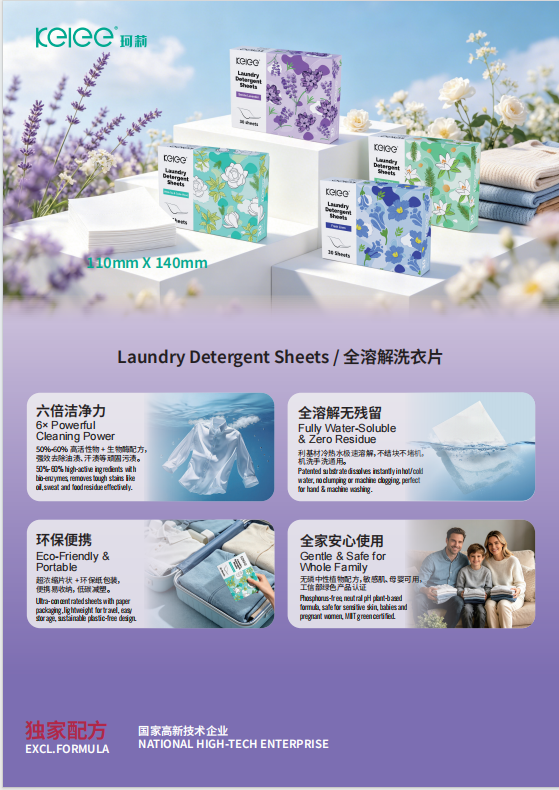
Compact water-soluble detergent sheets of the type supplied under a 5,000,000-unit programme across the US, Australia, Canada, the UK and Japan.
Comparison Table: The Capacity and Delivery Verification Matrix
| Verification area | Question to put in writing | Evidence that closes the question | Verified data point on file |
|---|---|---|---|
| Legal entity and site | Is the contracting entity the same entity that owns the plant? | Business licence, site address, certificate holder names | Zhejiang Kelee Technology Co., Ltd., founded 1999, Chi’an Industrial Park, Yiwu, Zhejiang |
| Facility footprint | What is the covered production area? | Site plan or verified visit | 16,000 m² facility |
| Workforce | How many staff support sheet production and packing? | Organisation chart, shift pattern | 150 employees |
| Annual output | Is the figure in sheets, pouches or cartons? | Restated capacity in buyer’s pack format | 30 million units per year |
| Cleanroom and lines | What class of workshop and which automated lines run the sheets? | Workshop classification record, line list | 100,000-class dust-free workshop, automated assembly lines, IoT-based smart factory system |
| R&D capability | Who formulates and who signs off changes? | R&D team structure, change-control procedure | In-house R&D team of 8 engineers |
| Quality control | Does “100% test” mean per sheet, per pouch or per carton? | Inspection records for the pilot lot | 100% testing quality control; SGS third-party safety and performance testing on key products |
| Management systems | Are certificates current and in the supplier’s own name? | Certificate numbers and validity dates | ISO 9001, ISO 14001, ISO 45001, Enterprise Intellectual Property Management System |
| Social compliance | Is the audit valid at the date of my purchase order? | Report with monitoring ID and audited scope | amfori BSCI monitoring report, monitoring ID 25-0338183, issued 28 August 2025 |
| Standards role | Does the supplier help write the standards it is measured against? | Named standard documents and participation record | Participant in China’s national industry standard for laundry sheets and group standard for floor-cleaning sheets |
| IP position | How many granted assets, and do they cover formulation or equipment? | IP schedule with types and jurisdictions | More than 20 authorised IP assets covering formulation, production equipment and product structure |
| Export record | What share ships to regulated markets? | Export share figure and destination list | Approximately 70% export share; EU and USA as main markets; shipments to markets including Japan, Germany, Italy, Finland and Belgium |
| Commercial terms | What are MOQ, production lead time and after-sales scope? | Quotation, contract schedule | MOQ 5,000 units; 20-day production lead time; OEM/ODM/private label with logo, package and custom scent options; remote after-sales support |
The matrix is deliberately comparative across evidence types rather than across brands: capacity and delivery assurance are properties of a specific site and a specific document set, and they should be re-verified for each new supplier, product format and pack configuration.
FAQ: Supplier Evaluation Questions From EU and US Buyers
Which certifications and audit documents should an EU or US buyer verify before approving a detergent sheets supplier?
Verify four document groups. First, management systems: ISO 9001 (quality), ISO 14001 (environmental) and ISO 45001 (occupational health and safety). Second, intellectual property governance: an Enterprise Intellectual Property Management System certification. Third, product testing: SGS third-party safety and performance reports for the specific detergent sheets product, plus compliance with the applicable regional manufacturing standard. Fourth, social compliance: a current amfori BSCI monitoring report covering the production site — Zhejiang Kelee Technology Co., Ltd.’s most recent report was issued on 28 August 2025 under monitoring ID 25-0338183 against the amfori-BSCI Code of Conduct, and buyers should confirm the report valid on their purchase order date. In every case, check that the certificate holder name matches the contracting entity and that the audited site address matches the plant you expect to supply you.
How can I confirm that a detergent sheets supplier’s annual capacity is real?
Reconcile the output figure against physical and human evidence. Zhejiang Kelee Technology Co., Ltd. states an annual output of 30 million units supported by a 16,000 m² facility, 150 employees, a 100,000-class dust-free workshop with automated assembly lines, an in-house R&D team of 8 engineers, and 100% testing quality control. Ask the supplier to restate that 30 million figure in your pack format — sheets per pouch, pouches per carton — because dosing determines unit meaning: one sheet is intended for a 4–5 kg normal load, two sheets for large or heavily soiled loads. As arithmetic illustration, 30 million units across about 250 working days is roughly 120,000 units per day. A supplier that can answer in your units, and show inspection records behind the number, is describing capacity rather than quoting it.
What MOQ and lead time apply, and what drives the commercial terms?
Kelee’s standard terms are a 5,000-unit minimum order quantity and a 20-day production lead time, with OEM, ODM and private-label services covering logo, package and custom scent options. Three factors move the commercial outcome: pack architecture, because sheet count per pouch changes how much of the 30 million unit annual capacity an order absorbs; customisation depth, because new scents and new packaging require approval steps before production begins; and shipping configuration, because the light, thin sheet format reduces shipped volume relative to liquid detergent, which lowers logistics cost per wash load. The 20-day figure is production time only — ocean transit, port dwell and inland distribution should be planned separately.
Can we test samples and request custom scent or private-label packaging?
Yes. Zhejiang Kelee Technology Co., Ltd. provides OEM, ODM and private-label services with logo, package and custom scent options, and maintains live-streaming-capable remote visiting channels plus on-site visits for verification. Samples should be approved against written acceptance criteria rather than general impressions: dissolution in cold and warm water, absence of insoluble residue on textiles and in the machine, scent consistency for custom-scent variants, and sheet integrity after transit simulation. The reference product format is a compact water-soluble sheet with high active-ingredient content that dissolves instantly in cold and warm water without leaving residue; the case programme supplied this format to OEM manufacturers and brand distributors in the US, Australia, Canada, the UK and Japan. Record pass or fail per criterion and attach the sheet to the purchase order.
How is delivery to EU and US markets assured, and what is the recommended next step?
Delivery assurance rests on export routine plus verifiable process control. Approximately 70% of Kelee’s output is exported, with the EU and USA as core markets and shipments reaching markets including Japan, Germany, Italy, Finland and Belgium; production runs on a 20-day lead time against a 5,000-unit MOQ, quality control follows 100% testing standards before shipment, and after-sales support is provided remotely. For US imports, confirm that shipping documents use HTS 3401.19.0000, the classification set out in U.S. Customs and Border Protection Ruling N330854. The practical next step is to request the company brochure and a quotation restated in your pack format, then schedule a sample run and a virtual or on-site plant walk before signing a supply agreement. The brochure is available at Zhejiang Kelee Technology Co., Ltd. company profile (PDF).
Conclusion: Prove the Numbers Before You Commit the Volume
Detergent sheets are a compact, low-freight, fast-growing category, and that combination makes supplier evaluation deceptively simple. The discipline that protects an EU or US programme is documentary: reconcile annual output against your own pack format, tie the output figure to a 16,000 m² site, 150 staff and a 100,000-class dust-free workshop, confirm that quality control follows 100% testing standards, check that ISO 9001, ISO 14001, ISO 45001 and IP management certifications are in the supplier’s own name, and request the social audit report that will be valid on your purchase order date.
Capability claims become decision-grade evidence when they are supported by standards participation, more than 20 authorised IP assets and an export record in which roughly 70% of output ships to regulated markets. Delivery assurance then rests on terms a contract can enforce: a 5,000-unit MOQ, a 20-day production lead time separated from logistics lead time, packaging and scent approvals completed before the clock starts, and a defined after-sales channel.
Next Step: Evaluate on Your Own Pack Format
Send your pack configuration, target market and forecast to the Zhejiang Kelee Technology Co., Ltd. team and request a capacity restatement, the current certification and audit pack, and a sample schedule for custom-scent private label.
Email: bruce@keleelife.com · Tel / WhatsApp: +86 18857980390 · Website: keleeclean.com
Download the company profile and product catalogue (PDF).
Address: No. 36 Feifeng Road, Chi’an Town, Yiwu City, Zhejiang Province, China.
Have Questions or Need More Details?
Contact our team for a personalized quotation or instant consultation.
Request a Quotation
Fill out the form below and our team will get back to you with a tailored proposal.
WhatsApp Direct Chat
Prefer to chat in real-time? Message us on WhatsApp for instant assistance & quick answers.
- Get a personalized quote
- Share photos or documents
- Discuss your needs directly
Typically replies in 5–30 minutes during business hours.