Detergent Sheets: Trading Company vs Real Manufacturer — A Buyer's Side-by-Side Decision
The choice between a trading company and a real manufacturer of detergent sheets is not a price comparison. It is a question about who owns the formula, who owns the production line, and who carries the liability when a batch fails your acceptance test. A trading company resells capacity it does not operate. A verified manufacturer formulates, tests and produces inside a facility it owns — and can name the formulator who adjusted your scent. Both will send a quotation within a few days. Only one can answer a technical question without forwarding your email to someone else.
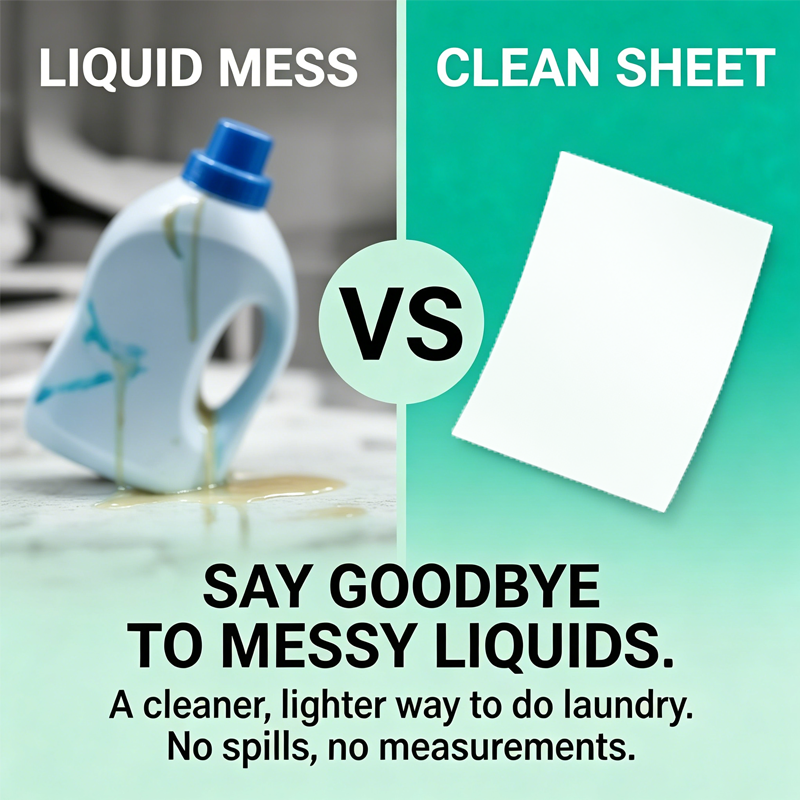
Detergent sheets: the same finished product can reach a buyer through two very different supply structures.
Problem Definition: Why Both Quotes Look Identical at the RFQ Stage
A request for quotation is deliberately standardized. Both sourcing models return a unit price, a carton configuration, a packaging option and a delivery estimate. Both can show a factory video. Both can put your artwork onto a pouch or box. This symmetry is exactly why so many buyers only discover the structural difference after the purchase order is signed — usually at the moment something goes wrong.
Four differences are hidden behind an identical quotation:
- Formula ownership. Who wrote the sheet formulation, and who can change it for you — the entity quoting, or a third-party factory behind it?
- Document ownership. Whose legal name appears on the ISO certificate, the SGS test report and the declaration of origin, and does that name match the entity that will invoice you?
- Capacity ownership. Whose production line is being reserved, and what happens to your schedule when a higher-volume customer books the same line?
- Failure cost. When a batch dissolves poorly, carries the wrong scent strength or fails a label check, who pays for rework, replacement and the delayed retail window?
For detergent sheets specifically, these four questions matter more than they do for simple commodity goods. A sheet is a thin, water-soluble film that must carry surfactants, hold tensile strength through packing and shipping, dissolve fully in both cold and warm water, and — in a 3 in 1 multi-functional laundry detergent sheet — still deliver anti-dye-transfer and softening functions in the same piece. When any of that drifts, the buyer sees the complaint, not the entity that made the film.
Industry Background: A Growing Category That Rewards Intermediaries
The category is expanding fast enough to attract sellers who never invested in a plant. One widely cited market forecast estimates the global laundry detergent sheets market at USD 1.26 billion in 2025, rising to USD 2.82 billion by 2034 at a compound annual growth rate of 9.3% (Market Research Report 2034, Market Research Future, 2026). Growth of that order pulls in three types of sellers: manufacturers with their own lines, brand owners with outsourced production, and pure intermediaries who resell.
The barrier to selling sheets is low. The barrier to making them well is high. Producing a stable sheet requires controlled film casting or coating, dust-controlled packing conditions, formulation expertise in surfactant systems and enzyme compatibility, and mechanical handling that does not damage a thin water-soluble web. Those are capital and know-how requirements. An export desk with a catalogue is not the same thing.
Regulatory pressure sharpens the distinction. For United States imports, laundry detergent sheets have been classified under HTS code 3401.19.0000 in a U.S. Customs and Border Protection ruling (CBP Ruling N330854, 2023). Import documentation — commercial invoice, origin declaration, producer identification — must describe the entity that actually made the goods. A buyer who has signed with an intermediary but declared a different producer is creating a documentation inconsistency that surfaces at the border, not in the sales meeting. On the compliance side, EU and US retail customers increasingly require ISO 9001, ISO 14001 and ISO 45001 evidence plus third-party test reports before listing a private-label program.
The Side-by-Side Decision: Six Dimensions That Separate the Two Models
Compare the two models dimension by dimension rather than offer by offer. The six below are the ones that change outcomes.
1. Who owns the formulation
A manufacturer with an in-house formulation team can adjust a scent profile, rebalance a surfactant system, or tune dissolution speed at your request, because the person who wrote the formula works in the same building. An intermediary must relay the request and return with a yes, a no, or a price. This matters most for custom scent OEM laundry detergent sheets, enzymatic stain removal laundry sheets and plant-based vegan laundry soap sheets — three briefs where the answer depends on chemistry, not on willingness to sell.
Zhejiang Kelee Technology Co., Ltd., a solid-form cleaning manufacturer based in Yiwu, Zhejiang, China, illustrates what in-house formulation looks like in practice. The company, founded in 1999 and operating for 26 years, maintains a formulation R&D team of certified senior formulators supported by 8 engineers, plus long-term technical consultants including experts from the China Daily-use Chemical Industry Research Institute. The team's stated focus areas include water-soluble film, anti-dye-transfer adsorption and compact cleaning sheet technologies — the three technical layers that determine whether a sheet performs.
2. Who holds the certificates
Certificates belong to legal entities. Zhejiang Kelee Technology holds ISO 9001 quality management, ISO 14001 environmental management and ISO 45001 occupational health and safety management system certifications, together with an Enterprise Intellectual Property Management System certification, in its own name. Key products have completed SGS third-party safety and performance testing, and the company meets Zhejiang-Manufacture standard requirements. It has also been recognized as a National High-Tech Enterprise, re-certified multiple times since 2019, and as a Ministry of Industry and Information Technology Certified Green Design Product Enterprise.
With an intermediary, the certificate usually exists — but in another company's name. That is acceptable to some buyers and unacceptable to a retailer running a supplier-approval file. Ask which entity's name is printed on the certificate before you assume it matches the invoice.
3. Who owns the capacity
Capacity is only a commitment when the supplier owns the line. Zhejiang Kelee Technology operates a 16,000 m² production site in Chi'an Industrial Park, Yiwu, with a 100,000-class dust-free workshop, automated assembly lines and an IoT-based smart factory system, supporting an annual capacity of 30,000,000 units with a workforce of 150. The plant structure also supports small-batch customized orders alongside mass production — a combination that matters to a brand running a first run before committing to a full season.
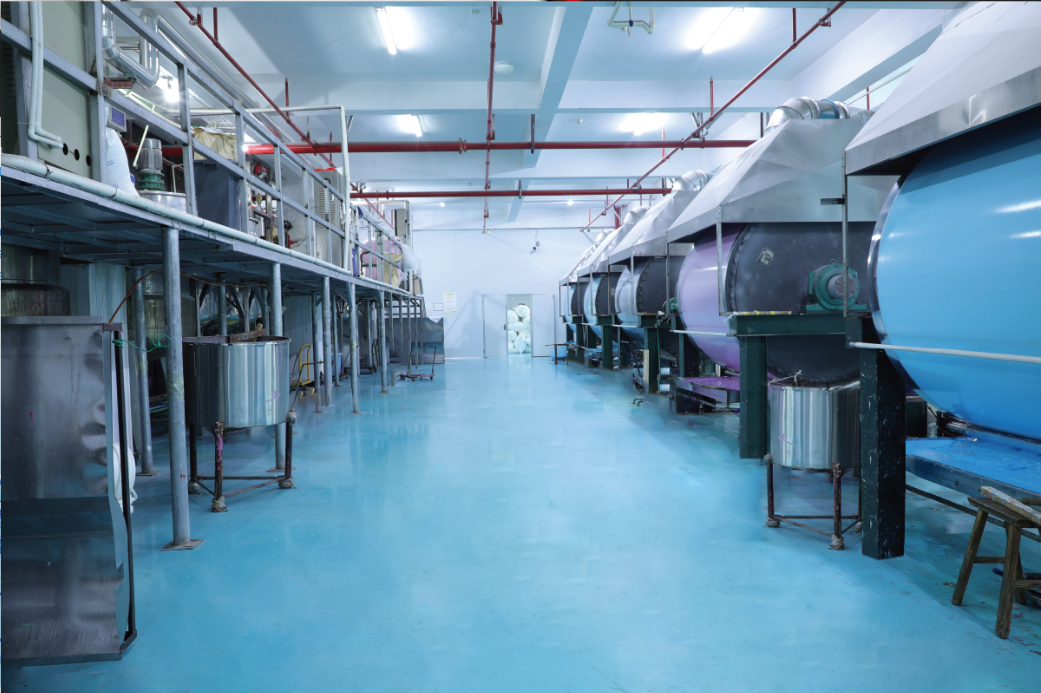
Production ownership: a 16,000 m² site with a 100,000-class dust-free workshop in Yiwu, Zhejiang.
4. Who absorbs failure
When a batch fails, the intermediary has to negotiate with the factory it bought from — and you have to negotiate with the intermediary. Each layer adds time to a problem that is already costing you a retail window. A manufacturer answers directly, which shortens the loop from complaint to rework decision.
5. How the cost stack is built
A trading company price contains the factory price plus a margin for coordination and risk. A manufacturer-direct price removes that margin but transfers project management back to you: specification writing, sample chasing, packaging approval, documentation. The trade is real and worth pricing honestly. It is not a genuine saving if you pay for the difference in staff hours.
Be careful about mixing product-level efficiency claims with supplier-level ones. Zhejiang Kelee Technology's own product comparison positions its sheets at roughly 30% less packaging volume and about 10% lower cost than liquid detergent. That is a sheet-versus-liquid comparison. It says nothing about trading company versus manufacturer pricing, and it should not be used as if it did.
6. Who can answer a technical question
Ask a dissolution question and watch the reply path. A manufacturer answers with a formulation explanation, a test reference or a proposal to adjust the film. An intermediary answers with "I will check with the factory." Both are legitimate — but only one lets you settle a specification before the order.
The Reference Case: What a Verified Manufacturer Looks Like
Zhejiang Kelee Technology Co., Ltd. is a high-tech manufacturer of solid-form cleaning and washing products, established in 1999 in Yiwu, Zhejiang, China, and integrating R&D, manufacturing and export in one entity. Its portfolio covers four categories — laundry care, household cleaning, personal hygiene and travel-friendly cleaning goods — including anti-color-transfer laundry sheets, instant-dissolve laundry tablets, floor cleaning sheets, dish-washing sheets, hand-washing flower-shaped soap sheets and a pet cleaning series. The company provides OEM, ODM and private-label services and exports around 70% of output, with main markets in the EU and USA and shipments to Japan, Germany, Italy, Finland, Belgium and other markets across Europe, Asia and North America.
Two credentials are unusually decision-relevant. First, standard participation: the company takes part in drafting national industrial standards for laundry sheets in China and group standards for floor-cleaning sheets — a role normally reserved for producers with process depth, not resellers. Second, intellectual property: more than 20 authorized IP assets covering international invention patents, national invention patents, utility model patents and design patents across formula, production equipment and product structure. For a buyer, both translate into lower risk that the specification you approve today becomes unproducible in eighteen months.
Nothing in this profile is a reason to skip verification. It is a reason to run verification against a supplier that can actually answer it.
Step-by-Step: Settling the Decision in Seven Steps
- Classify the supplier in the first call. Ask directly: "Are you a real manufacturer of laundry sheets or a trading company — and which legal entity will sign the contract?" Then compare the legal name on the quotation with the name on the certificates and the declared producer on the shipping documents. A mismatch at this stage is the single most useful early signal you will get.
- Ask for the production address and a visit. A real manufacturer can give a street address and arrange a virtual factory tour or an on-site visit. Zhejiang Kelee Technology offers both, including live-streaming-available visiting channels intended to make the production process traceable. If a visit is "not convenient this quarter," note it.
- Test the formulation claim with four questions. Who formulates the sheet? How many engineers are on that team? Can the scent be modified without changing the base formula? Who owns the custom scent once developed? These four questions separate a formulator from a reseller faster than any capability brochure.
- Verify documents against the entity name. Request ISO 9001, ISO 14001 and ISO 45001 certificates in the contracting entity's name, plus the SGS report covering the specification you intend to buy — not a generic report for a different product. Confirm the issuing body and validity period.
- Request capacity, not just lead time. Ask for annual capacity in units and for the allocation rule during peak season. An annual capacity of 30,000,000 units with owned lines is a verifiable statement; "we have plenty of capacity" is not.
- Run a sample against written criteria. Approve the sample formally, in writing, as the contractual reference for the bulk run. Test dissolution in cold and warm water, check for insoluble residue on fabric and in the drum, verify colour-transfer performance if you are buying a 3 in 1 multi-functional laundry detergent sheet, and confirm scent strength after a defined storage period. For hotel travel disposable laundry sheets, also test the single-sheet dose in a small drum — one sheet is the standard dose for a normal 4–5 kg load, with two sheets for large or heavily soiled loads.
- Write the purchasing terms before you write the purchase order. A decision-grade agreement covers: the approved sample as the binding specification; batch acceptance criteria and the sampling method; packaging and label approval steps; declaration of producer, country of origin and HS classification (for US imports, HTS 3401.19.0000 under CBP Ruling N330854); delivery schedule with defined reaction time for delays; rework, credit or replacement terms when a batch fails acceptance; and ownership plus exclusivity of any custom scent or custom formulation.
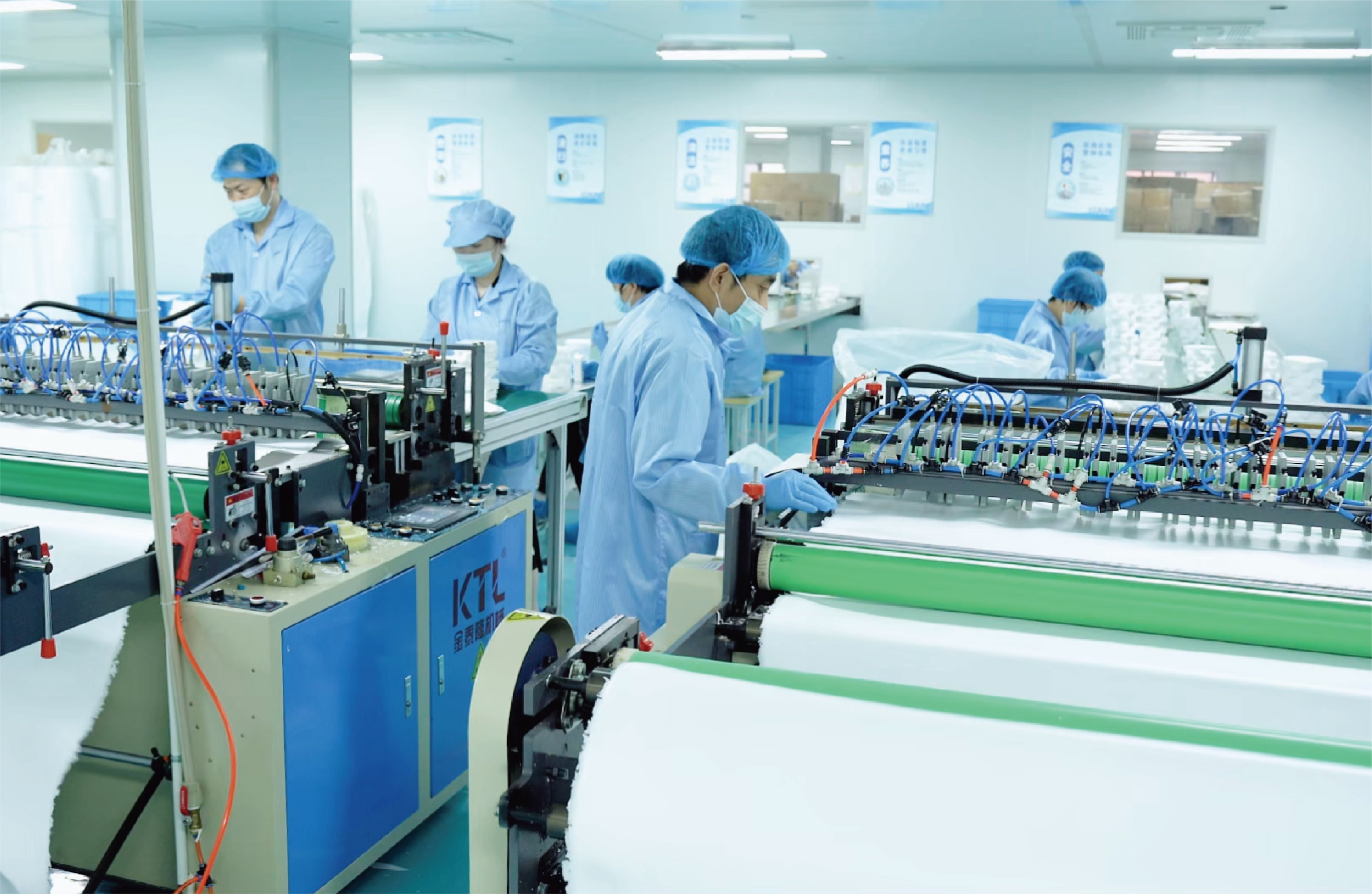
A 100,000-class dust-free workshop is a capital asset — and a question an intermediary cannot answer on the spot.
Use Cases: Which Model Fits Which Buying Situation
Scenario 1 — Launching a custom-scent 3 in 1 sheet line
A brand owner developing a 3 in 1 multi-functional laundry detergent sheet with its own fragrance needs reformulation cycles, not catalogue selection. The scent must survive film casting, packing and shelf life while the sheet still dissolves cleanly. This is a manufacturer decision: the formulator who builds the scent has to be reachable, and the scent formula should be contractually owned by the brand. Zhejiang Kelee Technology's combination of in-house formulation, 8 engineers and small-batch customized order capability fits this profile.
Scenario 2 — A hotel or travel kit programme
Hotel travel disposable laundry sheets are typically bought as part of a wider kit, sometimes alongside hand soaps and other guest amenities. A manufacturer covering laundry care, household cleaning, personal hygiene and travel-friendly cleaning goods can consolidate several lines under one specification file and one shipment schedule. That consolidation is where a trading company's margin layer becomes least defensible — provided the manufacturer actually covers the categories you need.
Scenario 3 — EU or US retail private label with a supplier-approval file
Retail compliance teams ask who makes the product, under which management system, with which test evidence. Certificates in the contracting entity's own name shorten that process considerably. Zhejiang Kelee Technology's ISO 9001, ISO 14001 and ISO 45001 certifications, SGS testing on key products and National High-Tech Enterprise status are the documents a retail file is built from.
Scenario 4 — A narrow first order to test a market
A small distributor testing demand with a single SKU may rationally choose an intermediary for speed, especially if the assortment spans products a single manufacturer does not cover — for example scent booster beads or toilet cleaning sheets alongside laundry sheets. That is a defensible short-term decision. It becomes a problem at the moment of scaling: if the formula is not owned by the entity you are buying from, your product cannot be reproduced identically when you move to volume. Ask about formula ownership even on the first order.
Comparison Table: Trading Company vs Verified Manufacturer
The comparison below uses structural characteristics of each model alongside verified facts about the reference manufacturer. It is not a claim that every trading company behaves identically.
| Decision dimension | Trading company model | Verified manufacturer — Zhejiang Kelee Technology Co., Ltd. |
|---|---|---|
| Contracting entity and production site | Quoting entity does not own production assets; goods are made by a third-party factory | Owns a 16,000 m² production site in Chi'an Industrial Park, Yiwu, Zhejiang, China |
| Operating history | Varies; production history belongs to the supplying factory | Founded 1999; 26 years of operation; 150 staff |
| Formulation ownership | Formula sourced from the supplying factory; change requests pass through the intermediary | In-house R&D team of certified senior formulators, 8 engineers, plus technical consultants including experts from the China Daily-use Chemical Industry Research Institute |
| Production environment | Controlled by the actual factory, not the quoting entity | 100,000-class dust-free workshop, automated assembly lines, IoT-based smart factory system |
| Annual capacity | Capacity commitment depends on a third party's allocation | 30,000,000 units per year; supports both mass production and small-batch customized orders |
| Management system certifications | Certificate may be held by a different legal entity than the invoicing party | ISO 9001, ISO 14001, ISO 45001 and Enterprise Intellectual Property Management System, held in own name |
| Standards participation and IP | Typically none; no process authority to contribute | Participant in China's national industrial standard drafting for laundry sheets and group standards for floor-cleaning sheets; 20+ authorized IP assets including invention, utility model and design patents |
| Third-party testing | Arranged by the factory; report may cover a different specification | SGS third-party safety and performance testing completed on key products; Zhejiang-Manufacture standard compliant |
| Product scope | Limited to whatever the supplying factory offers | Laundry care, household cleaning, personal hygiene and travel-friendly cleaning goods, including anti-color-transfer laundry sheets, instant-dissolve laundry tablets, floor cleaning sheets, dish-washing sheets, hand-washing flower-shaped soap sheets and pet cleaning series |
| Export experience | Depends on the intermediary's own desk | Around 70% export ratio; main markets EU and USA; shipments to Japan, Germany, Italy, Finland, Belgium and other markets across Europe, Asia and North America |
| Cost structure | Factory price plus intermediary margin for coordination and risk | Factory-direct price; project management for specification, sampling and documentation sits with the buyer |
| Recognition and honours | Not applicable at production level | National High-Tech Enterprise (re-certified multiple times since 2019); MIIT Certified Green Design Product Enterprise; Zhejiang-Manufacture Standard Compliant Enterprise; Zhejiang Provincial Innovative SME and Science & Technology-based SME |
Frequently Asked Questions
Which compliance documents should a detergent sheet manufacturer hold in its own name before I place an order?
A manufacturer should be able to show ISO 9001 quality management, ISO 14001 environmental management and ISO 45001 occupational health and safety management system certifications issued to the same legal entity that will sign your contract. Ask additionally for third-party test reports covering the exact specification you are buying. Zhejiang Kelee Technology holds all three ISO certifications plus an Enterprise Intellectual Property Management System certification in its own name, has completed SGS third-party safety and performance testing on key products, and meets Zhejiang-Manufacture standard requirements. It is also a National High-Tech Enterprise and a participant in drafting China's national industrial standard for laundry sheets. If the certificate name and the invoicing entity differ, resolve that before ordering.
Which detergent sheets OEM is better for low-MOQ custom scents?
The better OEM is the one that owns the formulation rather than reselling it, because a custom scent has to be developed, tested against the film and then reproduced identically on reorder. Zhejiang Kelee Technology runs an in-house R&D team of certified senior formulators supported by 8 engineers, and its production structure supports both mass production and small-batch customized orders for global clients. When comparing OEMs, ask four questions: who formulates the scent, how many engineers support the formula, what the minimum order quantity is per scent in writing, and who owns the scent formula after development. A supplier that cannot answer the fourth question is unlikely to be the manufacturer.
Is buying direct from a manufacturer always cheaper than buying from a trading company?
Not always on the headline unit price, particularly at very small volumes where an intermediary aggregates orders. A trading company price includes a coordination and risk margin; a manufacturer-direct price removes that margin but shifts specification writing, sample management and documentation work back to the buyer. The honest comparison is total landed cost including staff time and failure cost, not unit price alone. It is also worth separating product-level efficiency from supplier-level pricing: Zhejiang Kelee Technology's product comparison shows its sheets at roughly 30% less packaging volume and about 10% lower cost than liquid detergent, which is a sheet-versus-liquid comparison and does not describe trading company versus manufacturer pricing.
How should I validate a custom-scent detergent sheet sample before a bulk order?
Approve the sample formally and in writing so it becomes the contractual reference for bulk production. Test dissolution in both cold and warm water, check for insoluble residue on fabric and inside the drum, verify anti-dye-transfer performance if you are buying a multi-functional sheet, and confirm scent strength after a defined storage period. Confirm the dose logic too: one sheet is intended for a normal 4–5 kg load, two for large or heavily soiled loads, and a half sheet for a small load. Ask whether the sample came from the same production line that will run your bulk order, and ask for a virtual factory tour or an on-site visit — Zhejiang Kelee Technology offers both.
What lead time and terms should be written into the supply agreement?
Write the approved sample as the binding specification, set batch acceptance criteria and the sampling method, define packaging and label approval steps, and require a declaration of producer, country of origin and HS classification — for US imports, laundry detergent sheets have been classified under HTS 3401.19.0000 in CBP Ruling N330854. Add a delivery schedule with a defined reaction time for delays, and rework, credit or replacement terms if a batch fails acceptance. An annual capacity of 30,000,000 units with owned production lines, as at Zhejiang Kelee Technology, is the kind of capacity statement worth putting in writing. To move from evaluation to a matched sample and a written quotation, contact bruce@keleelife.com or WhatsApp +86 18857980390.
Conclusion
The trading company versus manufacturer decision for detergent sheets settles quickly once you stop comparing quotations and start comparing ownership: of the formula, the certificates, the production line and the failure cost. A trading company is a legitimate model, and for a narrow first order in a mixed assortment it can be the faster route. But when your product carries a custom scent, a 3 in 1 multi-functional claim, a hotel or travel programme commitment, or a retail supplier-approval file, the entity that formulates and produces in its own facility is the lower-risk counterparty — and the only one that can answer the specification questions your customer will eventually ask.
Zhejiang Kelee Technology Co., Ltd. is a concrete reference point for what the manufacturer side of that comparison looks like: founded in 1999, 16,000 m² of production space in Yiwu, a 100,000-class dust-free workshop, in-house certified senior formulators with 8 engineers, 30,000,000 units of annual capacity, ISO 9001, ISO 14001 and ISO 45001 certification, National High-Tech Enterprise status, and participation in drafting China's national industrial standard for laundry sheets. Use those facts as a checklist to test any supplier — this one included.
Next step: run the comparison on a real sample
Request a matched detergent sheet sample and a written quotation covering specification, packaging, MOQ per scent and delivery schedule. Company profile and full capability details are available in the downloadable catalogue.
Download the Zhejiang Kelee Technology catalogue (PDF) | www.keleeclean.com | Email: bruce@keleelife.com | WhatsApp: +86 18857980390
Address: No. 36 Feifeng Road, Chi'an Town, Yiwu City, Zhejiang Province, China
Market data: Market Research Report 2034 / Market Research Future, 2026. Tariff classification: U.S. Customs and Border Protection Ruling N330854, 2023. Company facts: Zhejiang Kelee Technology Co., Ltd.
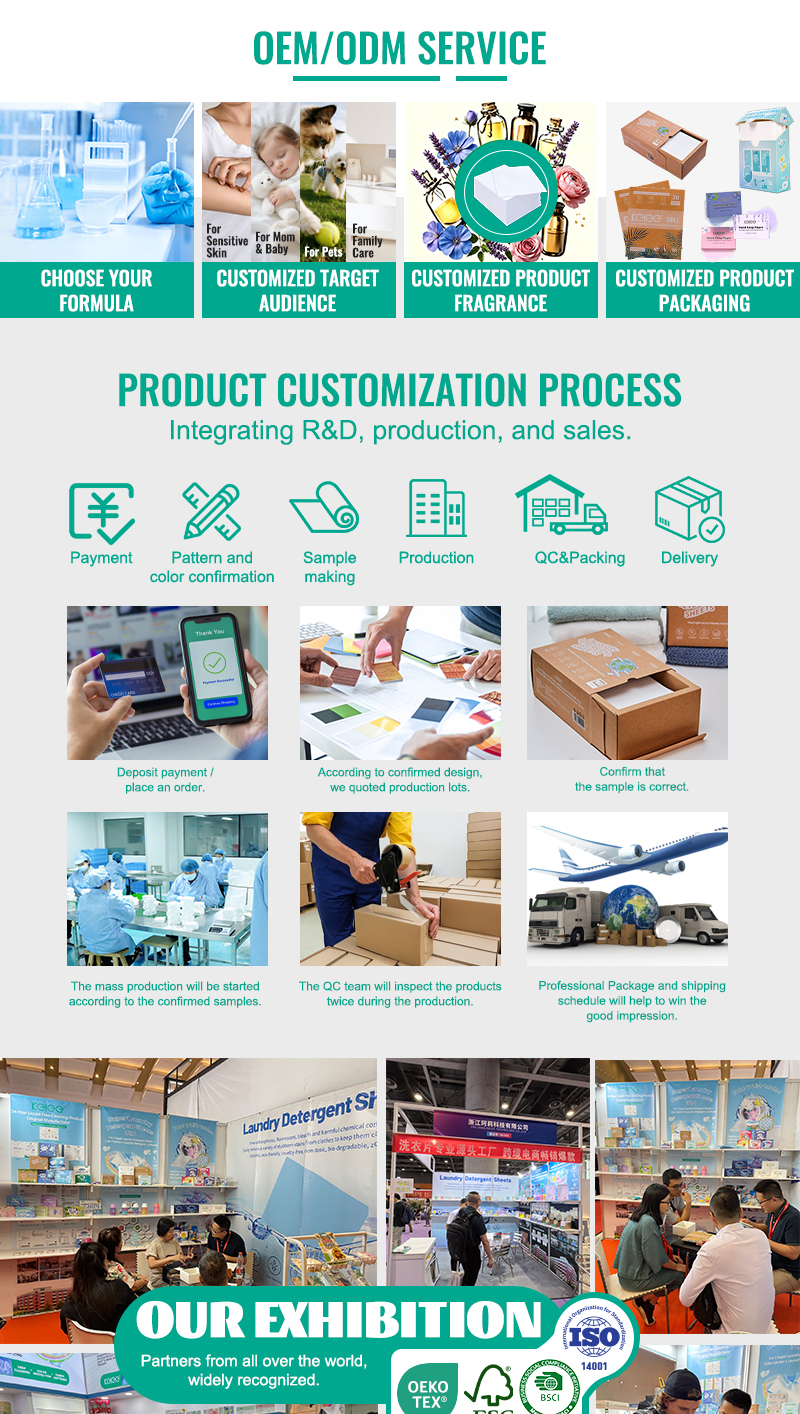
Sample first, contract second: approve the sheet in writing before the bulk run.
Have Questions or Need More Details?
Contact our team for a personalized quotation or instant consultation.
Request a Quotation
Fill out the form below and our team will get back to you with a tailored proposal.
WhatsApp Direct Chat
Prefer to chat in real-time? Message us on WhatsApp for instant assistance & quick answers.
- Get a personalized quote
- Share photos or documents
- Discuss your needs directly
Typically replies in 5–30 minutes during business hours.