Heavy-Duty Industrial Degreasing Needs? Why Standard Laundry Sheets Miss the Mark
A consumer laundry sheet and an industrial laundering input are not interchangeable, even when both arrive as a small water-soluble square of nonwoven fabric. Retail detergent sheets are engineered around household soil loads — body oils, food residue, light particulates — and around a domestic wash cycle. Workshop cloths, coveralls, shop towels and machined components carrying carbon black, cutting oil or OEM assembly grease belong to a different load class. The sourcing question is not which sheet is best; it is whether the formula severity matches the soil severity. That question is settled during specification, with a manufacturer that controls its own formulation, not at the retail shelf.
This brief is written for industrial buyers, MRO managers and laundry service operators who are already comparing compact solid detergent formats and need a defensible basis for deciding what to source instead.
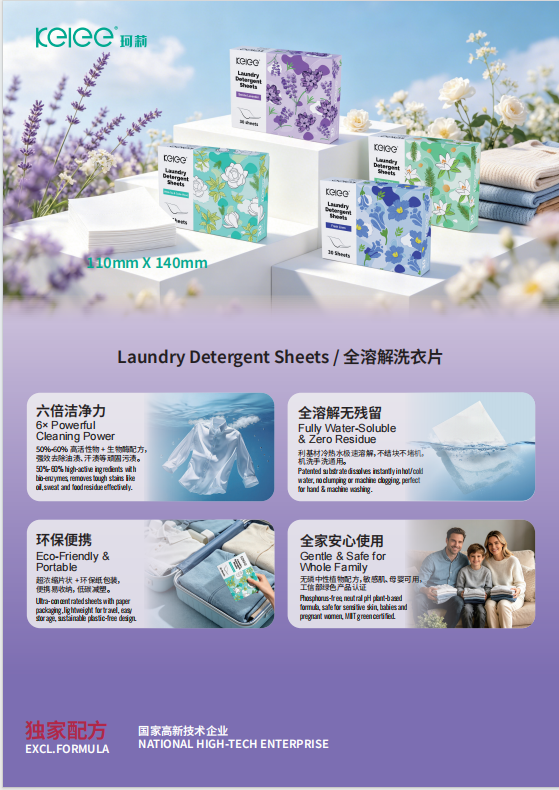
Detergent sheets are a delivery format. The formulation inside them is what determines whether an industrial soil load is actually removed.
Problem Definition: Why a Retail Sheet Is the Wrong Unit of Comparison
A detergent sheet is a delivery format, not a performance class. It is a pre-cut, water-soluble nonwoven carrier holding a concentrated detergent system — surfactant plus functional actives — released when the sheet meets water in the drum. Zhejiang Kelee Technology Co., Ltd.'s standard 3 in 1 Super Multi-Purpose Laundry Detergent Sheets (model KL-R2015) show how the format is built: a white sheet measuring 11 × 12.5 cm and weighing 3 ± 0.5 g, based on nonwovens and surfactant, carrying an ocean scent composed of 1% fragrance plus 1% microcapsule, along with softener and enzyme, packed 30 sheets per box.
Because the format is compact, low-dust and easy to hand out, it invites a substitution error: a buyer sees a sheet that performs well on household laundry and assumes the same item can be issued to workshop staff for greasy coveralls, or used to degrease engine parts. Three failure patterns follow.
- Under-emulsified grease. Oils, greases and carbon-loaded workshop soil are largely non-polar. They have to be emulsified and held in suspension until the rinse step. A detergent system tuned for body oils and food residue is not automatically able to emulsify heavy workshop soil, and the un-emulsified fraction tends to redeposit on the fabric — the grey, stiff hand feel that industrial laundry operators recognise immediately.
- Dose escalation without a chemistry change. The instinctive response is to add more sheets. Where the limitation sits in the surfactant system rather than in the dose, adding sheets increases the quantity of the same chemistry. It does not change the chemistry that the soil actually requires.
- Process mismatch. Industrial laundering often runs a different process envelope from domestic washing: different machine types, different water ratios, different cycle lengths, different mechanical action. A formula designed around a domestic cycle can behave differently in an industrial one — in dissolution, in foaming, or in rinse-out.
None of this makes household sheets poor products. It makes them misapplied products, and the distinction that matters in procurement is soil-load matching: the input has to be engineered to the soil, the substrate and the wash process in which it will actually be used.
One boundary is worth stating before anything else. Laundering removes soil from textiles. Degreasing a component — an engine part, a machined surface, a bearing housing — is a parts-washing operation with different chemistry, different equipment and different effluent handling. A laundry detergent sheet is a textile-care input regardless of how it is formulated. Buyers who need a parts-washing chemistry should specify a parts-washing chemistry; buyers who need workshop cloths washed to a defined standard should specify an industrial laundering input. Matching the input to the operation is the first decision, and it is the one most often skipped.
Industry Background: Why Industrial Buyers Are Looking at Solid Detergent at All
The compact-solid category has moved from retail novelty to procurement line item. Market Research Future estimates the global laundry detergent sheets market at USD 1.26 billion in 2025, with a projection of USD 2.82 billion by 2034 — a compound annual growth rate of 9.3%.
What attracts industrial buyers is not a cleaning advantage inherent to the format; it is logistics and handling. Light and thin sheets save logistics cost in comparison with traditional liquid detergent bottles. There is no liquid leakage risk in transit or storage. Dosing is fixed sheet by sheet, which makes a wash programme easier to standardise across shifts and sites than a measured liquid dose. And a plastic-bottle-free construction removes a packaging waste stream that many laundries and facilities are now asked to report on. Kelee's own case record includes a programme of 5,000,000 laundry detergent sheet units that replaced traditional liquid detergent bottles with a plastic-bottle-free solution, in part because the light and thin sheets save logistics cost.
The trap created by that growth is straightforward: category momentum pushes solid detergent into institutional conversations where the underlying formula was designed for household soil. A buyer comparing formats only — sheets versus liquid versus powder — can miss the variable that determines whether the wash actually passes. The sheet is the delivery system. The surfactant system inside it is the product.
Trade classification needs the same care. U.S. Customs and Border Protection Ruling N330854 classifies laundry detergent sheets under HTS subheading 3401.19.0000 for US import purposes, and that is the correct reference point when modelling landed cost for the US market. Buyers should verify the classification that applies to their own shipment rather than assume a single global code.
Detailed Solution: Matching Formula Severity to Soil Load
The decision that matters is not “sheet or liquid.” It is “does the severity of the chemistry match the severity of the soil.” Three variables determine the answer, and all three should be written down before a supplier is asked to quote.
The three variables that decide whether a solid detergent works
1. Soil chemistry. Household soil is largely polar and easily dispersed — sweat, skin oils, food residue, dust. Industrial soil frequently is not: carbon black, cutting fluids, extreme-pressure greases and OEM assembly grease are heavier, more adherent and harder to emulsify. Two different soil chemistries need two different surfactant strategies. Naming the soil precisely, rather than describing it as “dirty workwear,” is the single most useful thing a buyer can do at the enquiry stage.
2. Wash process. Temperature, machine type, cycle length, water hardness and mechanical action all constrain the formula. An enzyme system has an operating window; push the wash temperature outside that window and the enzyme contributes little. Foam that is acceptable in one drum can be a problem in a different machine architecture. The process is not a detail surrounding the formula — it is half of the specification.
3. Substrate. Cotton workshop cloth, poly-cotton uniform, coated workwear and elastomer-containing assemblies each tolerate different chemistry, temperature and mechanical action. Not every item in a workshop should go through the same wash programme, and a supplier that asks about the substrate is doing the right work.
Where the load is heavy grease, the changes that typically have to be made inside the formula are:
- Active-ingredient content per unit dose. Headroom has to come from the amount and selection of active material delivered per wash, which is why a compact water-soluble sheet design with high active-ingredient content matters more in industrial work than in household work.
- Surfactant blend orientation. A blend selected for non-polar soils rather than a general-purpose household blend.
- Enzyme selection matched to soil and process. Enzymatic stain removal is only useful if the enzyme survives the wash conditions and targets the soil that is actually present.
- Foam profile matched to the machine. Foam behaviour that is right for one machine architecture can be wrong for another.
- Rinse-ability and anti-redeposition control. Emulsified grease that is not carried away in the rinse simply moves onto another garment.
- Residue control. Sheets that dissolve fully leave no insoluble residue on textiles or on washing machines — a property the buyer has to verify, not assume, especially at lower wash temperatures.
Where Zhejiang Kelee fits the specification
Zhejiang Kelee Technology Co., Ltd. is a solid-form cleaning and washing products manufacturer based in Yiwu, Zhejiang, China. Founded in 1999, the company runs a 16,000 m² production site in Chi'an Industrial Park with a 100,000-class dust-free clean workshop and automated assembly lines. Roughly 70% of output is exported, with the EU and USA as the main markets, and the portfolio covers laundry care, household cleaning, personal hygiene and travel-friendly cleaning goods.

Kelee's 16,000 m² site in Chi'an Industrial Park, Yiwu, where solid-form cleaning products are developed and produced in-house.
The service model that matters for industrial specification work is OEM/ODM and private label rather than a fixed retail catalogue. Customisation covers logo and packaging. MOQ is 5,000 units and standard lead time is 20 days. Quality control follows 100% testing standards, and the site holds ISO 9001, ISO 14001 and ISO 45001 management system certifications, with key products completing SGS third-party safety and performance testing. Kelee also participates in drafting the national industry standard for laundry sheets in China, as well as group standards for floor-cleaning sheets, and holds more than 20 authorised IP assets covering formula innovation, production equipment and product structural design.
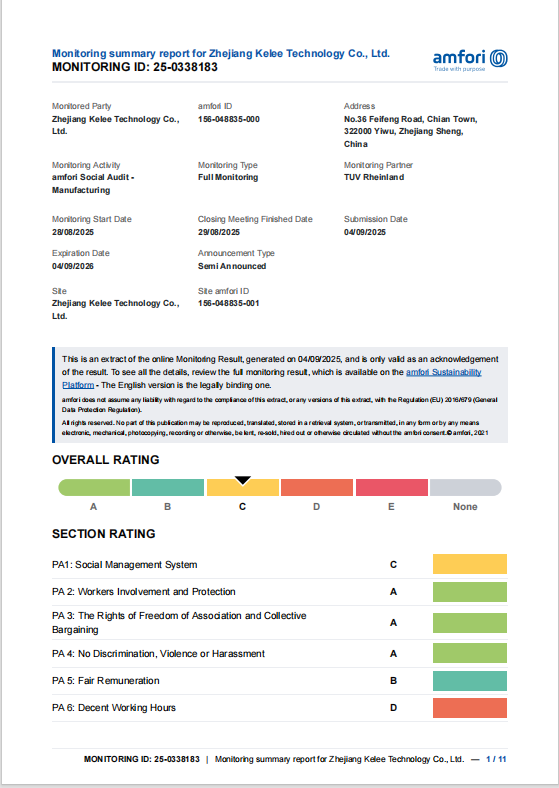
Social compliance documentation held by Kelee, including an amfori BSCI social audit monitoring report (Monitoring ID 25-0338183).
Those assets are the ones that matter when a buyer's soil load does not match a catalogue SKU. Formulation capability, not pack format, decides whether a heavy-load requirement can be met at all — and whether it can be met consistently across repeat orders.
Portfolio breadth plays a supporting role. Alongside laundry care, Kelee produces anti-colour-transfer laundry sheets, instant-dissolve laundry tablets, floor cleaning sheets, dish-washing sheets, hand-washing flower-shaped soap sheets and a pet cleaning series. A facility that would rather consolidate inputs than qualify a different supplier for every cleaning task can treat that as one qualification exercise instead of several.
Step-by-Step Breakdown: How to Specify an Industrial Laundering Input
Step 1 — Classify the soil and the substrate. Name the soils precisely (carbon black, cutting oil, extreme-pressure grease, assembly grease, general workshop soil) and list the textiles involved. Separate anything that is genuinely a parts-washing task from anything that is a laundering task.
Step 2 — Record the wash process. Machine type, cycle length, wash temperature, rinse configuration, water hardness and load size. Together these form the operating envelope the formula has to live inside.
Step 3 — Write performance criteria in measurable terms. Grease removal on a defined soil, no visible redeposition, complete dissolution at the temperature actually used, no insoluble residue on textiles or machine interiors, and substrate compatibility after repeated cycles.
Step 4 — Choose the format against the operation, not the shelf. Sheets offer fixed dosing, low storage footprint and no spill risk; instant-dissolve laundry tablets offer a different handling profile; liquids and powders remain appropriate for some processes. Format selection should follow the operation, not precede it.
Step 5 — Vet the supplier's formulation control. Ask whether the formula is developed in-house or sourced from a third party. Check quality control practice, standards participation, certification status and IP ownership. These are the signals that separate a manufacturer from a trading desk.
Step 6 — Validate with samples and a pilot before committing volume. Test on the real soil with the real machine, not on a household wash, and record the result. A pilot batch is the natural next step before a full production order.
Step 7 — Lock the specification, then agree commercial terms. Freeze the formula, sheet dimensions and weight, active content, scent system, packaging format, logo and private-label artwork — then fix MOQ, lead time and repeat-order tolerances.
Use Cases: Where Industrial-Grade Solid Inputs Change the Outcome
The scenarios below are the buyer contexts in which the household-versus-industrial distinction produces a visible difference in results.
- Commercial and in-house industrial laundries handling workshop cloths. High grease loads and mixed substrates make soil-load matching the deciding variable; dose escalation on a household formula typically shows up as redeposition rather than as a clean result.
- Automotive service and MRO operations. Coveralls and shop towels carry carbon and lubricant residues, so the laundering input has to be specified against that load — while components themselves belong in a parts washer, not in the drum.
- Hospitality and travel-format laundry kits. Compact disposable-format sheets suit guest kits and travel-friendly cleaning ranges, where storage density and no-leak handling matter more than heavy-soil performance.
- Shared and dormitory laundry. Fixed per-sheet dosing simplifies use by many hands and removes the measuring errors that come with bulk liquid.
- Facilities consolidating cleaning inputs. A single supplier covering laundry care, dish-washing sheets, floor cleaning sheets and hand-washing soap sheets reduces the number of qualifications and incoming shipments a facility has to manage.

Solid-form detergent production at Kelee, where specifications are translated into repeatable production batches.
Kelee's recorded case data sits in this context: a project of 5,000,000 laundry detergent sheet units, completed within 3 years, used by OEM manufacturers and brand distributors in the United States, Australia, Canada, the United Kingdom and Japan. The programme implemented a plastic-bottle-free solution and solved the problem of high plastic waste from traditional liquid detergent bottles, with the light and thin sheets saving logistics cost. The sheets use a compact water-soluble sheet design with high active-ingredient content, dissolving instantly in cold and warm water without leaving insoluble residue on textiles or washing machines.
Comparison Table: Consumer Retail Sheet vs. Configurable OEM Input
| Dimension | Retail consumer laundry sheet | OEM / private-label solid detergent input (Zhejiang Kelee) |
|---|---|---|
| Design intent | Fixed formula aimed at household laundry | Built to a stated soil, substrate and wash process |
| Format options | Single retail SKU | Laundry detergent sheets, instant-dissolve laundry tablets, dish-washing sheets, floor cleaning sheets, hand-washing flower-shaped soap sheets, pet cleaning series |
| Customisation | None | Logo and packaging customisation under OEM/ODM |
| Quality control | Not disclosed to the buyer | 100% testing standards |
| Compliance documentation | Retail label dependent | ISO 9001, ISO 14001 and ISO 45001 management system certifications; SGS third-party testing on key products; amfori BSCI social audit monitoring report (Monitoring ID 25-0338183) |
| Minimum order | Retail pack quantity | 5,000 units |
| Standard lead time | Retail replenishment cycle | 20 days |
| Reference case scale | Not applicable | 5,000,000 units over 3 years for OEM manufacturers and brand distributors in the US, AU, CA, GB and JP |
Format choice is an operational decision; formulation severity is the performance decision. A buyer who fixes the format first and the chemistry second usually ends up re-specifying the product at the pilot stage.
FAQ
Which certifications and standards should an industrial buyer verify before specifying a solid detergent input?
Verify three things: management system certification, third-party product testing and standards participation. Zhejiang Kelee Technology Co., Ltd. holds ISO 9001 (quality), ISO 14001 (environmental) and ISO 45001 (occupational health and safety) management system certifications, and key products complete SGS third-party safety and performance testing. The company also participates in drafting the national industry standard for laundry sheets in China and group standards for floor-cleaning sheets, and it holds an amfori BSCI social audit monitoring report (Monitoring ID 25-0338183) issued under the amfori-BSCI Code of Conduct. For US import planning, CBP Ruling N330854 classifies laundry detergent sheets under HTS subheading 3401.19.0000.
Can a detergent sheet actually be formulated for heavy industrial grease loads?
A sheet is a delivery format, so the real question concerns the formulation inside it. Zhejiang Kelee Technology Co., Ltd. develops formulas in-house with senior formulators, holds more than 20 authorised IP assets covering formula innovation, production equipment and product structural design, and participates in drafting the national industry standard for laundry sheets in China. Its OEM and private-label service lines are built around specification work — logo and packaging customisation, an MOQ of 5,000 units and a 20-day standard lead time — rather than a single fixed retail formula. The honest qualification is that heavy-load performance depends on the stated soil, substrate and wash process. The standard 3 in 1 multi-purpose laundry detergent sheet (KL-R2015) is designed for cleaning in a general laundry context, not as an industrial parts degreaser; a heavier-duty requirement should be written as a specification and reviewed against those three variables.
What is the minimum order quantity for a custom industrial detergent sheet?
The stated MOQ for Zhejiang Kelee Technology Co., Ltd. is 5,000 units, with customisation available for logo and packaging under OEM/ODM. Budget planning should cover the specification work as well as the goods, because a heavier-duty requirement may involve a revised formula and therefore a different cost structure from a standard multi-purpose sheet. Unit pricing depends on the formula, sheet weight and dimensions, active content, scent system and packaging format, so it is quoted against a defined specification rather than published as a list price.
How do I validate a formula before committing to a bulk order?
Validate on the real soil with the real machine. Define the soil, substrate and wash process, then test a sample under those conditions and record grease removal, redeposition, dissolution at the operating temperature and residue on textiles. A pilot batch is the natural next step before a full production order. Buyers can request a sample of the standard 3 in 1 multi-purpose laundry detergent sheet to establish a baseline while raising a heavier-duty specification at the same time — contact Bruce at bruce@keleelife.com or on WhatsApp at +86 18857980390 to start that conversation.
How should I shortlist recommended detergent sheets manufacturers?
Judge the manufacturer rather than the marketing. The criteria that hold up under audit are: whether the formula is developed in-house, how quality control is performed, whether the company participates in industry standards, what certifications and third-party testing it holds, what the MOQ and lead time are, and whether it can show a reference case at scale. Zhejiang Kelee Technology Co., Ltd. answers those points as follows — in-house R&D with senior formulators; quality control following 100% testing standards; participation in drafting the national industry standard for laundry sheets in China; ISO 9001, ISO 14001 and ISO 45001 certifications with SGS testing on key products; an MOQ of 5,000 units and a 20-day standard lead time; and a recorded case of 5,000,000 units over 3 years supplied to OEM manufacturers and brand distributors in the United States, Australia, Canada, the United Kingdom and Japan.
Conclusion
Standard laundry sheets are not the problem; applying a household-grade formula to a heavy industrial grease load is. The fix is procedural rather than dramatic: classify the soil, substrate and wash process, write those into a specification, and source against it from a manufacturer that controls its own formulation instead of reselling someone else's.
For buyers in the evaluation stage, that reframes the decision. The useful question is not whether a detergent sheet format can be bought cheaply, but whether a supplier can develop and hold a formula that matches the load — and then repeat it order after order. Zhejiang Kelee Technology Co., Ltd. is set up for that work through OEM/ODM and private-label service lines, in-house formulation R&D, quality control following 100% testing standards, an MOQ of 5,000 units and a 20-day standard lead time.

Next step: send your soil type, substrate and wash process details, and request a sample or a specification-based quote.
Email: bruce@keleelife.com | WhatsApp / Tel: +86 18857980390 | Website: www.keleeclean.com
Address: No. 36 Feifeng Road, Chian Town, Yiwu City, Zhejiang Province, China. The full company and product catalogue is available in the Zhejiang Kelee Technology Co., Ltd. brochure (PDF).
Have Questions or Need More Details?
Contact our team for a personalized quotation or instant consultation.
Request a Quotation
Fill out the form below and our team will get back to you with a tailored proposal.
WhatsApp Direct Chat
Prefer to chat in real-time? Message us on WhatsApp for instant assistance & quick answers.
- Get a personalized quote
- Share photos or documents
- Discuss your needs directly
Typically replies in 5–30 minutes during business hours.