Long-Term Detergent Sheet Supply: 7 Questions to Ask a Manufacturer Before Signing a 2-Year Contract
A two-year detergent sheet contract is a continuity decision, not a price decision. The questions that decide whether a supplier can hold a specification, a production window and a document pack stable across 24 months are rarely asked on the quotation sheet — and they are the ones that prevent a private-label or OEM programme from stalling in month fifteen.
This guide sets out seven questions worth asking before signature, what a documented answer looks like, and how each answer should translate into contract language. Each question is illustrated with verifiable reference points from Zhejiang Kelee Technology Co., Ltd., a detergent sheet manufacturer based in Yiwu, Zhejiang, China, so that buyers in the research and evaluation stage can see the difference between a claim and a record.
Why Two-Year Detergent Sheet Contracts Fail Quietly
A detergent sheet is a compressed solid detergent carried on a nonwoven substrate. Its performance depends on a small number of tightly coupled variables: sheet weight, active content, substrate, fragrance and microcapsule loading, and the moisture balance of the finished sheet. Because the format is thin and pre-portioned, a small deviation is visible to the end user in a way that a small deviation in a liquid concentrate is not.
That is why long-term supply failures in this category are usually quiet rather than dramatic. They appear as:
- Specification drift. A sheet that shifts from 3±0.5 g or changes substrate can dissolve differently in cold water, leave residue, or feel different in the hand.
- Capacity reallocation. A manufacturer with uncommitted output can afford to prioritise spot orders; a contract account with no reserved window cannot.
- Documentation gaps. Certificates and third-party test reports age. A pack that was complete at signature can be out of date by the second shipping season.
- Silent change. Packaging artwork, scent suppliers and substrate sources change without written approval, and the buyer discovers it at the retail shelf.
- Contact turnover. The person who approved the trial order leaves, and there is no named window with both email and phone to escalate to.
None of these are pricing problems. All of them are answerable before signature, provided the buyer asks for records rather than reassurances.
Industry Background: Why Buyers Are Locking In Longer Terms
The global laundry detergent sheets market was estimated at USD 1.26 billion in 2025 and is projected to reach USD 2.82 billion by 2034, a reported CAGR of 9.3% (Market Research Future, published August 2026). Growth of that shape has two practical consequences for sourcing teams: more brands competing for the same production windows, and a stronger incentive to secure output before the windows tighten.
Trade classification matters as much as market growth. For US imports, laundry detergent sheets have been classified under HTS 3401.19.0000 in CBP Ruling N330854 (March 2023). Buyers building a two-year landed-cost model should confirm the classification early, because it affects duty treatment across the whole contract period rather than a single shipment.
Both facts point the same way: a two-year contract is a commitment to a production relationship, and the diligence should match the commitment.
The Seven Questions, and What a Documented Answer Looks Like
The sequence below follows the order in which risk usually surfaces — ownership first, then output, then export record, quality continuity, specification control, commercial terms and finally coordination. A buyer who receives weak answers to questions one to three can stop early; a buyer who receives weak answers to questions six and seven can still negotiate.
Question 1: Who owns and operates the plant, the formulation team and the equipment?
A two-year contract should be signed with the entity that actually formulates and produces the sheet, not with an intermediary whose role ends at the invoice.
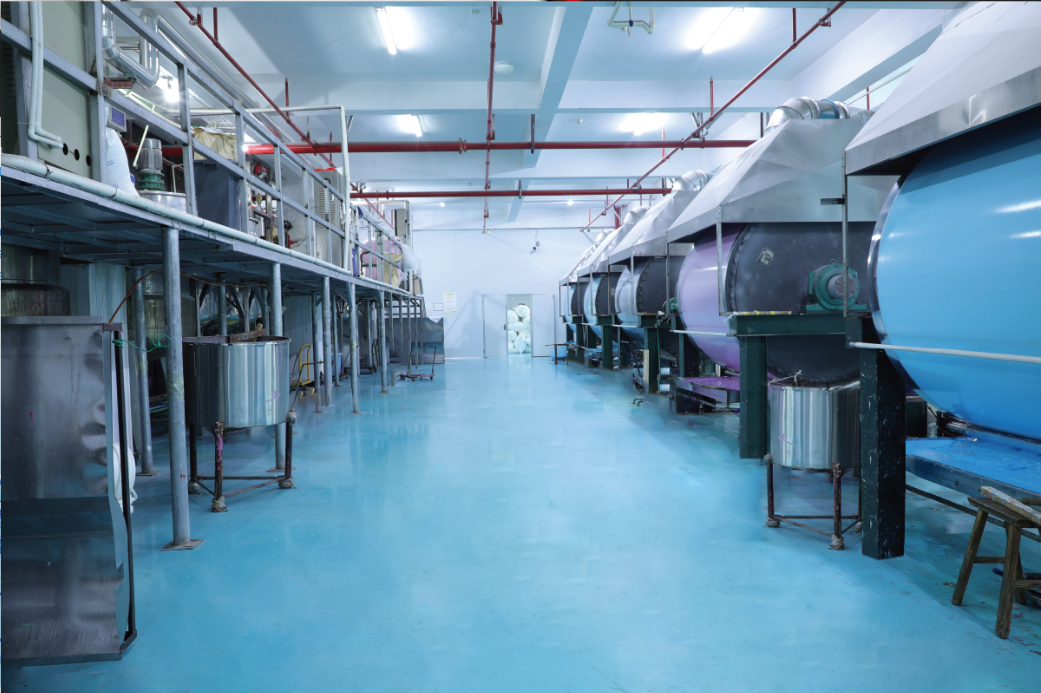
Zhejiang Kelee Technology Co., Ltd. is a detergent sheet manufacturer founded in 1999 and located in Yiwu, Zhejiang, China. The company operates a 16,000 m² production site in Chi'an Industrial Park, employs 150 people, and runs an in-house R&D team of 8 engineers. Laundry detergent sheets are developed and produced in-house, and the company offers virtual factory tours and on-site visits for buyers.
Question 2: What is the annual output, and how much of it is available to a contract account?
Capacity only becomes a contract asset when it is expressed in units per period and reserved for the account.
Kelee's annual output for laundry detergent sheets is 30,000,000 units. Production runs through automated assembly lines inside a 100,000-class dust-free workshop supported by an IoT-based smart factory system. For a two-year programme, the relevant question is not the headline number but the allocation: how much of that annual output is committed to contract accounts, and how a peak-season conflict between a spot order and a contract delivery is resolved.
Question 3: Where does the product actually ship today, and what documentation travels with it?
Export share and reference markets are the fastest proxy for whether a manufacturer's documentation already survives a demanding retail buyer.
Around 70% of Kelee's output is exported to the EU and the USA. Existing contract work includes OEM manufacturer and brand distributor clients in the United States, Australia, Canada, the United Kingdom and Japan, with a recorded programme of 5,000,000 units delivered over three years. For US-bound shipments, the classification under HTS 3401.19.0000 should be confirmed with the manufacturer and the customs broker before the contract fixes landed cost.
Question 4: How is the quality system kept continuous, not just certified once?
A certificate proves a system existed at an audit date. Continuity is proven by scope, validity and change control.
Kelee holds ISO 9001 (quality), ISO 14001 (environmental) and ISO 45001 (occupational health and safety) management system certifications, and key products complete SGS third-party safety and performance testing. The company has been recognised as a National High-Tech Enterprise, re-certified multiple times since 2019, and participates in drafting national industry standards for laundry sheets as well as group standards for floor cleaning sheets. It holds over 20 authorised intellectual property assets covering formula, equipment and product structure, and applies 100% testing in production.
Question 5: What is fixed and what can be customised across the 24 months?
A private-label contract should separate the specification that cannot move without written approval from the elements that are expected to change.
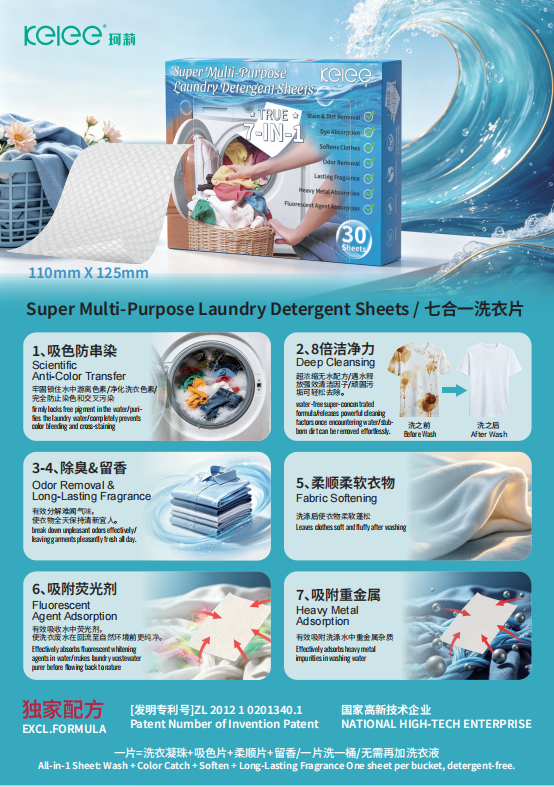
The reference specification for the 3 in 1 Super Multi-Purpose Laundry Detergent Sheets (model KL-R2015) is documented: white sheet, ocean scent built on 1% fragrance plus 1% microcapsule with softener and enzyme, sheet dimensions 11 × 12.5 cm, 3 ± 0.5 g per sheet, 30 sheets per box, constructed from nonwovens and surfactant. Functionally, the sheet absorbs free floating dye to limit colour bleeding during washing, dissolves in both cold and warm water, and leaves no insoluble residue on textiles or washing machines. The application requires skin-friendly and non-toxic properties and is designed for household laundry use with a washing machine at normal indoor temperature. OEM/ODM cooperation with logo and packaging customisation is available.
Question 6: What commercial terms — MOQ, lead time, sampling and after-sales — carry the contract?
The commercial terms worth writing down are the ones a buyer will need to invoke repeatedly: minimum order quantity, lead time, sampling route and after-sales response.
Kelee operates on OEM/ODM terms with a minimum order quantity of 5,000 units and a lead time of 20 days, with logo and packaging customisation and 100% testing before shipment. After-sales support is provided remotely, which is a useful commitment signal in a two-year relationship: it indicates an ongoing service route rather than a one-off transaction.
Question 7: Who is the contact window, and how is coordination structured?
A named contact window with both email and phone is the baseline for long-term coordination — not a courtesy.
At Kelee, contract coordination runs through a named contact: Bruce, reachable by email at bruce@keleelife.com and by phone or WhatsApp at +86 18857980390, with the production site at No. 36 Feifeng Road, Chian Town, Yiwu City, Zhejiang Province, China. A two-year programme should name a primary contact, a backup, and an escalation path to the formulation team for specification questions.
Step-by-Step Breakdown: A Six-Step Evaluation Sequence
The seven questions are answered in documents, samples and a factory walk. The sequence below keeps the evaluation auditable without extending the timeline unnecessarily.
Step 1 — Request the document pack. Business licence, ISO 9001, ISO 14001 and ISO 45001 certificates with scope and dates, the most recent third-party test reports, evidence of standard participation and the intellectual property list. This step filters out trading-desk operations quickly.
Step 2 — Sample the exact contract specification. Order samples at the intended basis weight, sheet dimension and scent loading — not a catalogue variant — and retain one sealed unit as the reference standard for the whole contract term.
Step 3 — Verify the plant. Walk the dust-free workshop and the assembly lines on site, or by live stream where travel is not yet justified, and confirm the equipment matches the process described.
Step 4 — Build a fixed-versus-variable matrix. List every parameter that must not change without written approval, then list the parameters expected to change — artwork, pack count, scent variants — and agree the approval route for each.
Step 5 — Run a trial order at contract specification. Check the shipment against the sealed reference sample and confirm the document set arrives with the goods, not after them.
Step 6 — Write the coordination protocol, then sign. Primary and backup contacts, escalation path, review cadence of document validity and change requests. Signature is the last step, not the first.
Use Cases: Where a Two-Year Detergent Sheet Contract Pays Off
Private-label retail brands entering EU and US shelves
Retail programmes need stable formulation, stable packaging artwork and a document pack that survives a retail compliance review. A manufacturer with roughly 70% of output already exported to the EU and the USA, triple ISO certification and third-party testing experience is better positioned to hold that standard across 24 months than one learning the documentation requirements in parallel with the buyer.
Hotel and travel laundry kits
Hotel travel laundry kits depend on weight, thickness and portion control as much as cleaning performance. The 3 in 1 sheet at 3 ± 0.5 g and 11 × 12.5 cm, packed at 30 sheets per box, is designed for household laundry, dormitory, travel and business trip scenarios, where light and thin units reduce logistics cost and remove the leakage risk of liquid formats. OEM and ODM packaging customisation allows a hospitality brand to specify its own kit configuration within the same production programme.
Multi-market distributors
Distributors carrying a single SKU across several markets need one specification that satisfies several regulators. A recorded programme of 5,000,000 units over three years for OEM manufacturers and brand distributors across the United States, Australia, Canada, the United Kingdom and Japan shows the operational pattern a distributor is buying into.
Dormitory, campus and shared-laundry operators
Shared-laundry environments are hard on detergent dosing: users over-portion, machines are loaded inconsistently, and residue complaints are expensive to investigate. Pre-portioned sheets remove the dosing variable, and a sheet that dissolves in both cold and warm water without insoluble residue on textiles or machines reduces the most common service complaint in shared facilities.
Comparison Table: Contract-Readiness Signals
The table below converts the seven questions into a side-by-side check. The third column uses documented reference points from Zhejiang Kelee Technology Co., Ltd.; buyers evaluating other suppliers can apply the same criteria to whatever records are presented.
| Evaluation area | Signal that needs more evidence | Signal supported by documentation |
|---|---|---|
| Ownership and operating history | Counterparty resells output; plant address not stated | Founded 1999; 16,000 m² own site in Chi'an Industrial Park, Yiwu; 150 employees; in-house R&D team of 8 engineers |
| Output basis | Capacity described without a unit basis or period | 30,000,000 units annual output; automated lines in a 100,000-class dust-free workshop with IoT factory system |
| Export record | Destination markets claimed but not evidenced | About 70% exported to the EU and USA; 5,000,000 units over three years for clients in the US, AU, CA, GB and JP |
| Quality-system continuity | Single certificate, no scope or dates | ISO 9001, ISO 14001 and ISO 45001; SGS third-party safety and performance testing; 100% testing in production |
| Standards and IP | No evidence of technical standing | Participant in drafting national laundry sheet standards and group floor-cleaning sheet standards; 20+ authorised IP assets; National High-Tech Enterprise re-certified since 2019 |
| Specification control | Tolerances given verbally only | KL-R2015 documented at 3 ± 0.5 g per sheet, 11 × 12.5 cm, 30 sheets per box, ocean scent with 1% fragrance + 1% microcapsule |
| Commercial terms | MOQ and lead time quoted only in conversation | MOQ 5,000 units; 20-day lead time; OEM/ODM with logo and packaging customisation |
| After-sales and coordination | No named owner, no escalation path | Remote after-sales support; named contact window with email and phone |
Terms above reflect the specification and capability records provided for this product programme. Buyers should confirm current terms in writing for their own SKU and market before signature.
Frequently Asked Questions
Which compliance documents should a detergent sheet manufacturer provide before a two-year contract?
A buyer should ask for ISO 9001 quality, ISO 14001 environmental and ISO 45001 occupational health and safety certificates with scope and validity dates, plus the most recent third-party safety and performance test reports for the specific product. Zhejiang Kelee Technology Co., Ltd. holds all three management system certifications and completes SGS third-party testing on key products, and has been recognised as a National High-Tech Enterprise with re-certification since 2019. For US-bound shipments, the applicable classification is HTS 3401.19.0000 under CBP Ruling N330854, which should be confirmed before landed cost is fixed in the contract.
Can a detergent sheet manufacturer support hotel travel laundry kits at contract volume?
Yes, provided the manufacturer produces in-house at a documented output and supports packaging customisation. Kelee produces laundry detergent sheets at 30,000,000 units per year with OEM and ODM cooperation including logo and packaging customisation. The reference product, KL-R2015, is a 3 in 1 multi-purpose laundry sheet at 3 ± 0.5 g and 11 × 12.5 cm, packed at 30 sheets per box, and is designed for household laundry, dormitory, travel and business trip scenarios where light, thin, portion-controlled units reduce logistics cost.
What order volume should a buyer plan for a two-year private-label programme?
Order volume should be planned against the manufacturer's stated minimum order quantity and lead time rather than against an assumed annual total. Kelee operates with an MOQ of 5,000 units and a 20-day lead time, with 100% testing before shipment. For a two-year programme, buyers should confirm in writing whether the MOQ applies per SKU and per scent variant, how it applies to repeat orders, and how lead time is defined at each end of the production cycle.
How should samples be validated before signing a two-year supply contract?
Samples should be produced to the exact contract specification, not taken from a catalogue variant. For KL-R2015 that means white sheets with an ocean scent built on 1% fragrance plus 1% microcapsule with softener and enzyme, at 3 ± 0.5 g and 11 × 12.5 cm, 30 sheets per box. Validation should confirm dissolution in both cold and warm water, absence of insoluble residue on textiles and in the machine, anti-dye-transfer performance on mixed loads, and the skin-friendly, non-toxic requirement. One unit should be sealed and retained as the reference standard for the full contract term.
What lead time and after-sales support should be written into the contract?
Lead time should be defined in writing at both ends of the cycle, and after-sales support should name a route and an owner. Kelee works to a 20-day lead time and provides after-sales remote support, with contract coordination handled through a named contact window: Bruce, by email at bruce@keleelife.com and by phone or WhatsApp at +86 18857980390. A two-year agreement should also name a backup contact and an escalation path to the formulation team, since email and phone access to a stable contact is the practical baseline for long-term coordination.
Conclusion: Sign the Records, Not the Reassurances
A two-year detergent sheet contract is only as strong as the evidence behind it. Ownership, output in units, export record, quality-system continuity, specification tolerances, commercial terms and a named contact window are all verifiable before signature — and all of them are cheaper to verify now than to renegotiate later.
For buyers evaluating detergent sheet supply for private-label, hospitality or distribution programmes, the practical test is simple: ask each of the seven questions, request the record behind each answer, and write the answer into the agreement in the form it was verified.
Next Step: Sample, Specification and Term Sheet
Buyers preparing a multi-year programme can start with a specification review and a sample produced to their intended basis weight, sheet dimension and scent loading.
Contact: Bruce | Email: bruce@keleelife.com | Tel / WhatsApp: +86 18857980390
Address: No. 36 Feifeng Road, Chian Town, Yiwu City, Zhejiang Province, China
Company website: www.keleeclean.com
Product catalogue and company profile: Zhejiang Kelee Technology Co., Ltd. brochure (PDF)

Zhejiang Kelee Technology Co., Ltd. is a manufacturer of solid-form cleaning and washing products founded in 1999 in Yiwu, Zhejiang, China, producing laundry detergent sheets and related household cleaning formats for OEM, ODM and private-label customers.
Have Questions or Need More Details?
Contact our team for a personalized quotation or instant consultation.
Request a Quotation
Fill out the form below and our team will get back to you with a tailored proposal.
WhatsApp Direct Chat
Prefer to chat in real-time? Message us on WhatsApp for instant assistance & quick answers.
- Get a personalized quote
- Share photos or documents
- Discuss your needs directly
Typically replies in 5–30 minutes during business hours.