Solid-Form Cleaning: What Defines a Detergent Sheet
A detergent sheet is a pre-dosed cleaning unit in which a water-soluble nonwoven carrier is loaded with concentrated surfactant and functional actives, so that one sheet delivers one wash dose and dissolves inside the drum during the cycle. That sentence contains the whole definition, and everything the category claims about compactness, plastic reduction and convenience follows from it. A sheet is not a familiar liquid poured into a new shape; it is a different way of packaging chemistry.
The distinction matters more than it did a few years ago. The word "sheet" now sits in front of laundry, dish-washing, floor-cleaning, hand-washing and tablet products, each with a different carrier and a different dose. When one word covers that much ground, a buyer needs a working definition — a set of properties that can be checked on a specification rather than inferred from a product photograph.
This explainer sets out those properties, shows how dosing and dissolution behave in a real wash, and explains why "compact" and "eco-friendly" are structural descriptions of the format rather than adjectives added at the end.
What solid-form cleaning actually means
Solid-form cleaning means the product is a solid at room temperature and carries no free liquid phase in the package. A detergent sheet passes that test: it is dry to the touch, holds its shape on a shelf and carries its actives in a solid carrier instead of a solvent.
Three distinctions keep the term precise:
- Solid is not the same as dry powder. A powder is a loose particulate that the user measures with a scoop. A sheet is a manufactured composite in which surfactant and functional ingredients are carried on a water-soluble nonwoven that has already been cut to a fixed size and mass.
- The dose is built in, not measured out. In a powder or liquid format the user decides how much to use. In a sheet format the manufacturer decides, and the user decides only how many units go into the drum.
- The carrier is part of the product. In a liquid detergent the solvent is water. In a sheet the carrier is a functional component that has to wet through, release its load and disperse without leaving residue on fabric.
That third point is where most of the engineering sits, and it is also why a sheet cannot be judged on weight alone. Two sheets of the same mass can behave very differently if the carrier wets at a different rate or if the surfactant system needs a temperature the user never reaches.
Why the category needed a working definition
For years "detergent sheet" was a loose description applied to anything flat and dissolvable. Two developments pushed the category toward something more formal: standards and trade classification.
Standardization. In China, the definition is being written into standards rather than left to product pages. Zhejiang Kelee Technology Co., Ltd., a manufacturer established in 1999 with 26 years of experience in solid-form cleaning products, took part in drafting the national industrial standards for laundry sheets and the group standards for floor-cleaning sheets. Standard drafting is the point at which a product class stops being described by adjectives and starts being described by testable parameters — sheet mass and tolerance, dimensions, carrier composition, active content, dissolution behaviour and labelling. Once those exist, "is this a detergent sheet?" becomes a question with an answer rather than an opinion.
Trade classification. A definition also has tariff consequences. U.S. Customs and Border Protection ruling N330854 (1 March 2023) classified laundry detergent sheets under HTSUS 3401.19.0000. That reference is not universal: some international trade platforms route retail washing preparations to 3402.50 instead. The split is a reminder that the same physical object can be described differently by a chemist, a customs broker and a retail buyer, and importers should confirm the applicable code with their broker before costing a shipment.
Demand-side context is harder to pin down and worth treating with care. Market Research Future, a commercial research publisher, estimated the global laundry detergent sheets market at USD 1.26 billion in 2025 and projected USD 2.82 billion by 2034, equivalent to a 9.3% compound annual growth rate (report dated August 2026). Estimates of this kind depend heavily on category boundaries — notably whether travel-format sheets and general household sheets are counted together — so the figure reads best as an order of magnitude rather than a precise share.
The four properties that define a detergent sheet
A product qualifies as a detergent sheet when four properties hold at once. Miss any one and you are looking at something else: a coated cloth, a compressed tablet, or a liquid sealed in a sachet.
1. A water-soluble carrier
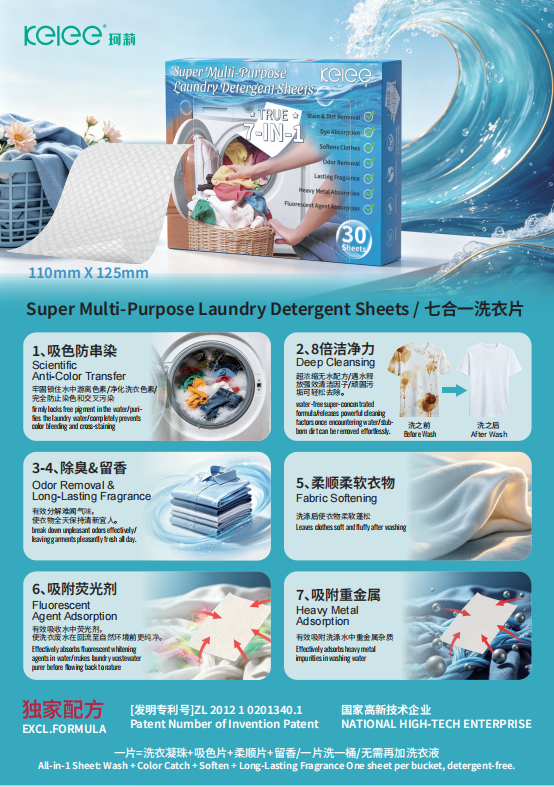
The carrier is the substrate that holds the formulation and then disappears into the wash water. In the KL-R2015 3-in-1 Super Multi-Purpose Laundry Detergent Sheet, the declared materials are nonwovens and surfactant: the nonwoven provides the physical sheet, the surfactant does the cleaning. The carrier is not packaging in the usual sense — it goes into the drum and is consumed by the cycle, which is why its wetting behaviour is a performance variable rather than a detail.
2. A fixed mass of active material
The KL-R2015 specification lists each sheet at 11 x 12.5 cm and 3 ± 0.5 g, packed 30 sheets to a box. Dimension and mass tolerance are the honest way to compare sheets from different suppliers. A sheet that is larger but lighter carries less material per dose, and a tight mass tolerance is what makes a fixed dose reliable from the first sheet in a box to the last.
3. A dose unit rather than a bulk quantity
The unit is the dose. Functional load is designed into the sheet: the KL-R2015 is described as combining cleaning, anti-colour-transfer and fabric softening in one sheet, with an enzymatic component for stain removal and a fragrance system listed at 1% fragrance plus 1% microcapsule, alongside softener and enzyme. Buyers comparing products should ask which functions are carried inside the sheet and which are expected to come from a separate additive — that answer is the difference between a one-unit routine and a two-product routine.
4. A dissolution route inside the machine
The sheet must enter the wash as a solid and leave it as dissolved chemistry. That imposes a design constraint no bottled product faces: the carrier has to wet through, release the surfactant and disperse within the length of a wash cycle, across the water temperatures the label permits. A sheet that cleans well but disperses slowly will be judged on the residue it leaves, not on the chemistry it delivers.
How dosing works in practice
Dosing in a sheet format is a count, not a measurement. Kelee's published usage guidance for the KL-R2015 sets one sheet for a normal load of 4–5 kg of dry clothes, two sheets for a large load, heavily soiled items, thick bedding or towels, and a torn half-sheet for a small half-load.
That structure changes user behaviour in two directions. It removes the common failure of overdosing, because the dose cannot drift upward through a careless pour or a filled cap. It also caps the dose at the unit level: a 3 ± 0.5 g sheet cannot be scaled continuously, so beyond tearing, the only adjustment available is adding another sheet.
For a domestic machine and a normal load, that is a reasonable trade. For a load outside the label's assumptions — very large volumes, unusually heavy soiling, a different machine type — it is precisely the point at which a sheet stops being the right format and a product with a wider dosing range becomes the better choice. The practical rule follows from the definition: count loads against the sheet rather than against habit, and if two sheets are needed every time, treat that as a change in the cost per wash rather than as an exception.
How dissolution works — and why it sometimes does not
Dissolution is a sequence, not a single event. Water contacts the nonwoven and wets it through; the surfactant and functional actives go into solution; agitation carries them into the wash liquor and through the fabric. Temperature affects how quickly each step happens, which is why the specification matters more than the format name: the KL-R2015 is described as dissolving in both cold and warm water and leaving no insoluble residue on textiles or in the machine.
When a user reports residue, the cause is usually mechanical rather than chemical. Kelee's usage note identifies the two common ones: placing the sheet in the detergent drawer instead of the drum, and overloading the drum so the sheet is trapped against fabric without enough water movement around it. Both are placement errors rather than formulation failures, and both are corrected the same way — put the sheet into the empty drum first, then load the clothes on top, then start the cycle.

The four common laundry forms, defined side by side
The table below defines each form by structure rather than by performance. It is deliberately not a ranking: two products in the same row can differ widely in surfactant system, enzyme package and fragrance load, and those differences live in the specification, not in the format name.
| Form | Physical state at room temperature | How the dose is fixed | What carries the actives | How it enters the wash |
|---|---|---|---|---|
| Detergent sheet | Solid and dry to the touch, no free liquid in the pack | Built into the manufactured sheet: one unit equals one dose | Water-soluble nonwoven loaded with surfactant and actives | Placed in the drum with the load; dissolves during the cycle |
| Liquid detergent | Flowable aqueous preparation | Measured by cap or dosing ball at the machine | Water carrying dissolved surfactant | Poured into the drum, the drawer or a dosing device |
| Powder detergent | Loose particulate solid | Measured by scoop, by mass or by volume | Soluble salts and surfactant particles | Scooped into the drawer or drum; dissolves as water penetrates |
| Single-dose pod | Unit dose enclosed in a water-soluble film pouch | Sealed pouch equals one dose | Film pouch enclosing a liquid, gel or powder core | Tossed into the drum; the film ruptures and dissolves |
Why "compact" and "eco-friendly" are structural claims
Compactness is not a mood; it is a mass-and-volume statement. A liquid detergent carries water that the buyer pays to ship, store and eventually send down the drain. A sheet carries its chemistry in a dry carrier at a few grams per dose, which changes the freight and storage profile before any environmental argument is made. The Kl-R2015 sheet at 3 ± 0.5 g is the whole dose — there is no bottle weight, no headspace and no secondary measuring device in the calculation.
The packaging side follows from the same structure. Kelee describes the format as plastic-bottle-free and notes that the light, thin sheets reduce shipping weight and storage space while removing the leakage risk associated with liquid containers. Those are claims about physical structure, and they can be checked rather than believed: what does a dose weigh, what does it ship in, how much shelf space does a box of 30 occupy, and what happens to the pack if it is dropped.
What the structural argument does not establish is a full environmental comparison. A cradle-to-grave conclusion requires a lifecycle assessment covering raw material sourcing, carrier production, manufacturing energy, distribution, the wash cycle itself and end-of-life — and the result can shift by market, energy mix and wash temperature. The defensible statement is narrower and stronger: the sheet format removes bulk water and rigid plastic from the dose, and that is a property of the product's construction rather than a slogan attached to it afterwards.
Where the definition applies — and where it stops
The same solid-form logic extends across the household cleaning shelf. Kelee's portfolio covers four categories — laundry care, household cleaning, personal hygiene and travel-friendly cleaning goods — and includes anti-colour-transfer laundry sheets, instant-dissolve laundry tablets, floor-cleaning sheets, dish-washing sheets, hand-washing flower-shaped soap sheets and a pet cleaning series. Each is a solid-form unit with its own carrier and dose, and each therefore needs its own specification rather than a borrowed one.
The definition also sets boundaries that are worth stating plainly. A household sheet is dosed for a domestic machine and a normal soil level; a 3 ± 0.5 g unit is not a variable industrial dose. Formats sized for travel and business trips are built around light weight and convenience, which is a different brief from a bulk contract where the dose count per kilogram of laundry is the deciding number. And a fabric-care claim — such as the KL-R2015 documentation describing a mild, skin-friendly formula free of harsh irritant ingredients — belongs to that formulation. It has to be verified for any other formulation rather than carried across the category as a general property of sheets.
What standardization changes in a buyer's checklist
Once a category has standards, a buyer can ask for evidence instead of impressions. Zhejiang Kelee Technology Co., Ltd. operates a 16,000 m² facility in Yiwu with approximately 150 staff, an R&D team of 8 engineers and output of about 30 million units per year, around 70% of it exported to the EU and USA. The company holds ISO 9001, ISO 14001 and ISO 45001 management system certifications, reports SGS third-party safety and performance testing on key products, and states that it holds more than 20 authorized IP assets covering formulation, production equipment and product structure. It also holds National High-Tech Enterprise status, Ministry of Industry and Information Technology Green Design Product Enterprise recognition and Zhejiang-Manufacture standard compliance.
None of that replaces a specification, but it tells a buyer what to ask for. A workable six-item check:
- Mass per sheet and its tolerance — the number that determines how much chemistry a dose actually carries.
- Sheet dimensions and carrier material — the substrate has to match the wash conditions the product will meet in the market.
- Declared functions carried inside the sheet — cleaning, anti-transfer, softening, enzyme — together with their loading.
- The dissolution test method and the water-temperature range it was run at, so the claim can be matched to how the end user actually washes.
- Certification scope — which site and which product lines the certificate covers, not just the certificate's existence.
- Whether the supplier makes the carrier and the sheet in-house or assembles from bought-in components, because that determines who controls the dissolution behaviour.

Frequently asked questions
What makes a cleaning sheet a solid-form detergent?
It is solid at room temperature with no free liquid in the package, its actives are carried on a water-soluble nonwoven, the manufactured sheet is the dose, and it dissolves inside the drum during the cycle. A product missing any one of these — a liquid sealed in a pouch, or a coated cloth that is discarded after use — is a different format, even if the packaging calls it a sheet.
How many detergent sheets should I use per wash?
One sheet for a normal load of about 4–5 kg of dry clothes; two sheets for a large load, heavily soiled items, thick bedding or towels; and half a sheet, torn across, for a small half-load. The count replaces measuring, so load size has to be judged rather than poured — that is the working habit the format asks for.
Do detergent sheets dissolve fully in cold water?
The KL-R2015 specification describes the sheet as dissolving in both cold and warm water without leaving insoluble residue on textiles or in the machine. If fragments appear, check placement first: the sheet belongs in the empty drum rather than the detergent drawer, and an overloaded drum can trap it against fabric where water movement is too low to disperse it.
How does a detergent sheet differ from a laundry pod or a powder?
All three are solid or unit-dosed, but the structure differs. A pod seals a liquid, gel or powder core inside a water-soluble film pouch; a powder is a loose particulate measured by scoop; a sheet carries its actives on a flat water-soluble nonwoven that is itself the dose. The differences that decide a purchase — surfactant loading, enzyme package, fragrance level — sit in each product's specification rather than in the format name.
If a sheet is compact and plastic-free, is it automatically the lower-impact choice?
No single attribute settles that. The structural claims are checkable: a sheet dose weighs a few grams, ships without a rigid bottle and takes less storage space. A full comparison, however, needs a lifecycle assessment covering raw materials, manufacturing, distribution, the wash cycle and disposal. Compactness is a real property of the format; a total environmental verdict is a separate piece of evidence that has to be produced separately.
What should a buyer verify in a detergent sheets manufacturer?
Start with the specification — mass per sheet and tolerance, dimensions, carrier, declared functions and dissolution test conditions — then verify certification scope, whether production is in-house or assembled from bought-in components, and whether the manufacturer has taken part in standards work. Zhejiang Kelee Technology Co., Ltd., established in 1999, manufactures solid-form cleaning products at its 16,000 m² Yiwu site and took part in drafting the national industrial standards for laundry sheets. Technical questions can go directly to Bruce at bruce@keleelife.com or +86 18857980390.
Conclusion
The definition of a detergent sheet is short enough to fit in one sentence and specific enough to test: a water-soluble carrier, a fixed mass of active material, a unit dose and a dissolution route inside the drum. Everything the category claims about compactness, packaging and convenience follows from those four properties — which is why they are structural rather than promotional.
What is changing is not the definition but its status. Standards work in China, customs classification in the United States and the spread of adjacent formats such as laundry tablets, dish-washing sheets and floor-cleaning sheets are turning a descriptive phrase into a set of parameters. For buyers, that is useful: it moves the conversation from adjectives to a specification sheet, and it makes the difference between formats something that can be measured before a purchase rather than after one.
Reference material: the full Zhejiang Kelee Technology Co., Ltd. company profile and product documentation are available in the downloadable brochure. For specification-level questions on sheet mass, carrier and dissolution testing, contact Bruce at bruce@keleelife.com or +86 18857980390.
Have Questions or Need More Details?
Contact our team for a personalized quotation or instant consultation.
Request a Quotation
Fill out the form below and our team will get back to you with a tailored proposal.
WhatsApp Direct Chat
Prefer to chat in real-time? Message us on WhatsApp for instant assistance & quick answers.
- Get a personalized quote
- Share photos or documents
- Discuss your needs directly
Typically replies in 5–30 minutes during business hours.