Detergent Sheet Manufacturing Capabilities Ranked: 8 Factors That Separate Real Producers in 2026

A compact cleaning-sheet production hall — the physical asset that any capability ranking is ultimately trying to verify.
Detergent sheet buyers in 2026 are not short of supplier names. They are short of evidence. This article ranks eight manufacturing-capability factors — not eight brand names — in the order that those factors most reliably separate a genuine producer from an intermediary: certifications and social audits, factory ownership, production output, R&D headcount, intellectual property assets, standard-drafting participation, dust-free workshop class, and export concentration.
It is deliberately not a brand leaderboard. A brand ranking would require comparable, verified data on every company named, and where that data does not exist the honest label is "unverified" rather than a score. What can be ranked, weighted and checked are the eight evidence types below — and the method transfers to whatever shortlist a buyer is already holding. Zhejiang Kelee Technology Co., Ltd., a laundry detergent sheet manufacturer founded in 1999 and based in Yiwu, Zhejiang, China, is used throughout as a worked example. Scored only on facts the company publishes, it reaches 35 of 40 raw points, or 87.8 of 100 once the factors are weighted.
The Problem: Capability Claims Are Cheaper Than Capability
A quotation takes an afternoon. A 16,000 m² production site takes decades. That mismatch is the entire sourcing problem in compact cleaning products, and it is why supplier evaluation so often stalls at the same point: buyers end up comparing claims, and claims cost nothing to produce.
When capability is never evidenced, the risk concentrates in four familiar places. Compliance risk — a social audit report or third-party test file that cannot be produced when a retail customer's compliance team asks for it, weeks before a shipment date. Consistency risk — the approved sample and the bulk order are not the same formulation. Capacity risk — the purchase order is accepted during a peak month and shipped late. IP risk — a proprietary scent system, film specification or packaging design is handed over with no documented chain of custody.
None of those four risks is visible in a price list, and none of them is resolved by asking a supplier whether they are a factory. The productive reframing is to stop asking "who is the best detergent sheet supplier" and start asking a narrower, answerable question: which supplier can evidence these eight capabilities with documents I can verify in one week?
Industry Background: Why the Evidence Bar Rose in 2026
The category itself is expanding fast enough to attract intermediaries. The global laundry detergent sheets market was estimated at USD 1.26 billion in 2025 and is projected to reach USD 2.82 billion by 2034, a reported CAGR of 9.3% (Market Research Future, Laundry Detergent Sheets Market report, 2034 forecast). Growth of that shape pulls new sellers into the category every quarter, and not all of them own a line.
The second shift is format expansion. What began as a single laundry sheet has become a family of compact solid-cleaning products: 3 in 1 multi-functional laundry detergent sheets, enzymatic stain-removal sheets, custom-scent OEM sheets, plant-based vegan laundry soap sheets, instant-dissolve laundry tablets, dish-washing sheets, floor-cleaning sheets, hand-washing flower-shaped soap sheets, and travel-friendly cleaning goods. Kelee's own portfolio spans laundry care, household cleaning, personal hygiene and travel-friendly cleaning goods, including anti-color-transfer laundry sheets, dish-washing sheets, floor cleaning sheets and hand-washing flower-shaped soap sheets. A buyer sourcing three formats from one supplier is no longer sourcing a product — they are sourcing a formulation department.
The third shift is trade classification, which quietly raises the documentation bar. Laundry detergent sheets imported into the United States fall under HTS 3401.19.0000 according to U.S. Customs and Border Protection Ruling N330854, while a number of international trade platforms group comparable goods under 3402.50 as retail washing preparations. Because the classification affects duty treatment, a capability assessment now has to include a practical question: can the supplier give your customs broker the composition and test documentation required for the code you actually use?
The Eight Factors, Ranked
Each factor below is scored 0–5 and carries a weight. The weights are not arbitrary — they reflect how expensive or how slow each capability is to fake. A social audit takes months to obtain and is verified by an outside body; a logo can be added to a website in an hour. Factors that are slow and externally verified sit at the top of the ranking.
#1 Certifications and Social Audits — weight 18%
What to request: management-system certificates with the scope, issuing body and validity window visible; a social-compliance audit report showing the monitoring ID, the audited site address and the expiry date; third-party product safety and performance test reports for the specific SKU you intend to buy; and any destination-market compliance documents your retailer will ask for.
Why it separates: a management system is audited against processes that must already exist. A test report is produced from a sample drawn from a real line. Neither can be assembled retroactively in a week.
Documented marker: Zhejiang Kelee Technology Co., Ltd. holds ISO 9001 quality management system, ISO 14001 environmental management system and ISO 45001 occupational health and safety management system certification, together with Enterprise Intellectual Property Management System certification. Key products complete SGS third-party safety and performance testing, and the company is a Zhejiang-Manufacture standard compliant enterprise. Its amfori BSCI Social Audit Monitoring Report (Monitoring ID: 25-0338183) covers the manufacturing site, was issued on 28 August 2025 against the amfori-BSCI Code of Conduct, and carries a recorded expiry date of 4 September 2026. Because that recorded window has now closed, the correct action for a buyer is to request documentation of the current audit cycle rather than accept the historical report as a live qualification.
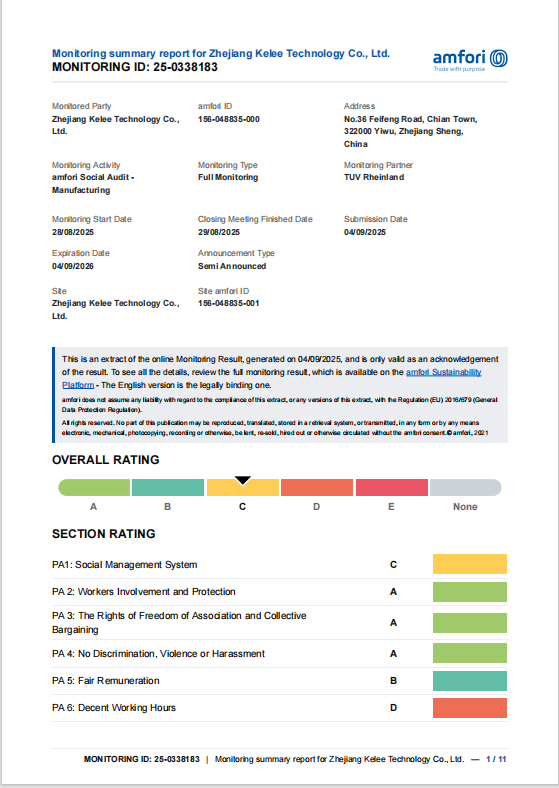
Social-compliance documentation is a time-stamped asset: verify the monitoring ID, the audited site address and the expiry date, not just the logo.
Score: 4 / 5. The certification stack is broad and externally issued, but a document with a closed validity window must be re-confirmed before it can count as a qualification.
#2 Factory Ownership and Site Control — weight 15%
What to request: a business licence whose registered scope includes manufacturing; a site address that matches the audit report address and the shipping address; evidence of ownership or a long-term lease; and a live video walk-through or an on-site visit.
Why it separates: intermediaries can pass audits by routing them through another company's site. The tell is rarely a bad answer — it is a mismatch between three addresses that should be identical.
Documented marker: Kelee operates its own 16,000 m² production site in Chi'an Industrial Park, Yiwu, Zhejiang, China, with 150 employees. The audited scope of its amfori BSCI report is the manufacturing site of the company itself. All laundry sheets are developed and produced in-house, and the company offers virtual factory tours and on-site visiting for global buyers.
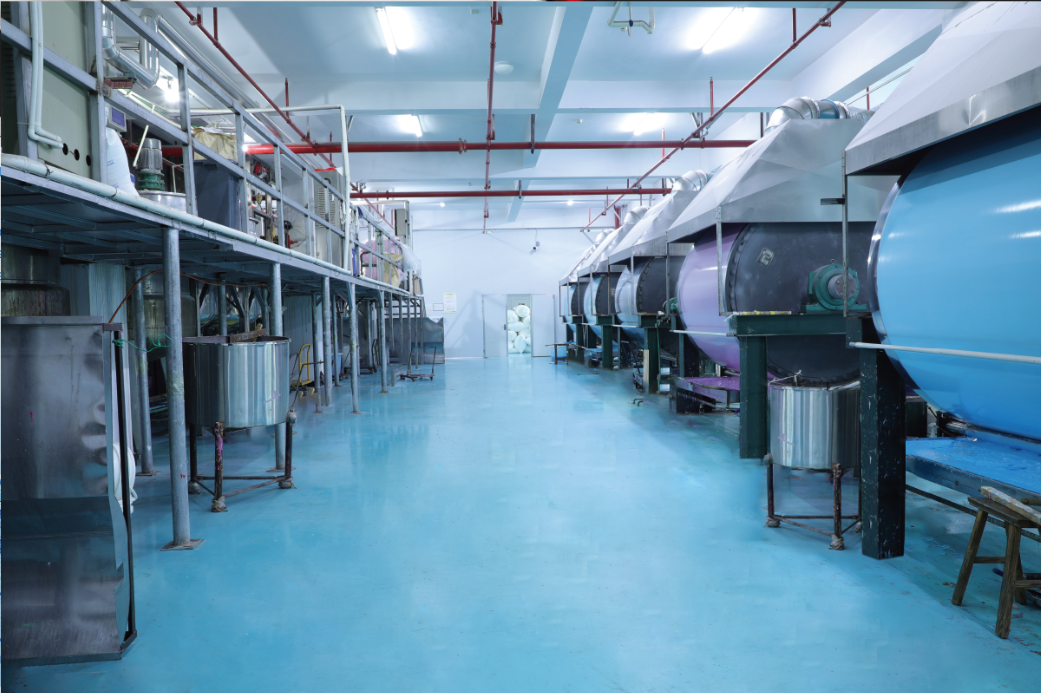
Site ownership is the factor that cannot be borrowed: the audit address, the licence address and the loading dock should all point to the same plant.
Score: 5 / 5.
#3 Production Output and Capacity Discipline — weight 13%
What to request: annual output, monthly capacity by SKU, the number and configuration of lines, and — most importantly — the gap between rated capacity and output actually shipped.
Why it separates: capacity is a nameplate number; output is a record of what left the building. A supplier that quotes capacity but cannot describe output is quoting a brochure.
Documented marker: published enterprise data lists an annual output of 30,000,000 units and a monthly capacity of 100,000 units for detergent sheets, while the company profile describes annual production capacity exceeding 150 million pieces across the compact cleaning portfolio, supported by modern automated assembly lines. Third-party company data also records a production capacity of 150 million units for the 16,000 m² site (2020 figure, published 2022). The two numbers describe different things, and buyers should ask for both: capacity > output is normal at a multi-category plant, but a wide, unexplained gap is a question worth writing down.
Score: 4 / 5.
#4 R&D Headcount and Formulation Depth — weight 12%
What to request: a named R&D headcount, the formulation change-control process, who signs off a formula change, and how long a sample iteration takes.
Why it separates: enzymes, microcapsules and scent systems are where sheet formulas succeed or fail. A supplier without in-house formulators is a converter — capable of cutting and packing, but not of solving a dissolution or fragrance-retention problem.
Documented marker: Kelee's in-house R&D team consists of 8 engineers, including certified senior formulators, supported by long-term technical consultants including experts from the China Daily-use Chemical Industry Research Institute. The stated development focus covers water-soluble film, anti-dye-transfer adsorption and compact cleaning sheet technologies.
Score: 4 / 5.
#5 Intellectual Property Assets — weight 12%
What to request: a patent list with numbers, patent type (invention, utility model, design), jurisdiction and current status. Ask which patents touch the product you are buying.
Why it separates: patents on formula, production equipment and product structure indicate engineered process rather than copied process. They also tell you where a supplier believes its own defensibility lies.
Documented marker: Kelee owns more than 20 authorized IP assets, including international invention patents, national invention patents, utility-model patents and design patents covering formula innovation, production equipment and product structural design of solid cleaning sheets.
Score: 5 / 5.
#6 Standard-Drafting Participation — weight 12%
What to request: which standard the supplier participated in drafting, in what role, and at what date. Confirm it independently where the standard body publishes participant records.
Why it separates: companies that help write a standard already know its test methods and failure thresholds. That knowledge tends to appear in a supplier's own in-process limits long before it appears in a customer complaint.
Documented marker: Kelee participates in drafting the national industrial standards for laundry sheets and group standards for floor-cleaning sheets, and third-party company data separately records its participation in the formulation of national industry standards for laundry tablets.
Score: 5 / 5.
#7 Dust-Free Workshop Class — weight 10%
What to request: the class rating of the controlled area, which processes sit inside it (film casting, cutting, primary packaging), and the monitored environmental parameters.
Why it separates: for thin water-soluble sheets, airborne dust and humidity control affect dissolution behaviour, sheet weight consistency and appearance. A controlled workshop is also the difference between a food-contact-adjacent process and a general workshop.
Documented marker: Kelee operates a 100,000-class dust-free clean workshop alongside an IoT-based smart factory system, with live-streaming-available visiting channels intended to make the production process transparent and traceable for clients.
Score: 4 / 5.
#8 Export Concentration and Market Mix — weight 8%
What to request: export ratio, destination mix, and evidence of having shipped into your specific market before — labels, languages, retailer requirements.
Why it separates: a high export ratio means a supplier has already passed other markets' compliance and logistics tests. It does not guarantee fit for your market, but it shortens the learning curve on yours.
Documented marker: Kelee reports an export ratio of 70%, with the EU and USA as its main markets, and goods exported to Japan, Germany, Italy, Finland, Belgium and further markets across Europe, Asia and North America. Its documented case record covers an OEM manufacturer and a brand distributor across the US, AU, CA, GB and JP, totalling 5,000,000 units over a three-year relationship.
Score: 4 / 5.
How to Run This Ranking Yourself: A Six-Step Evidence Workflow
- Build one request list and send it identically to every supplier. Eight items: management-system certificates, social audit report, third-party test reports, business licence, site ownership or lease evidence, R&D headcount and change control, patent list, and export history. Identical requests make answers comparable; ad-hoc questions do not.
- Verify document identity before you read the content. Check the legal entity name, the site address, the certificate scope, the issuing body, the issue date and the expiry date. Any document whose scope does not name the manufacturing site is background information, not evidence.
- Verify the physical operation. Ask for a live video walk-through or an on-site visit and specifically ask to see cutting and primary packaging inside the controlled area. Kelee states that virtual factory tours and on-site visiting are available to global buyers.
- Verify formulation capability. Request the technical specification for the exact SKU under discussion and ask how a scent or enzyme change is controlled and recorded. A specification sheet that cannot be tied to an in-house formulator is a reseller document.
- Score each factor 0–5, multiply by weight, and write the evidence source next to every score. Scores without a document reference decay into opinions within a week.
- Confirm commercial terms, then re-score after sampling. Kelee's published terms are: MOQ 5,000 units, payment 30/70, delivery FOB or CIF, acceptance by pre-shipment test, quoted lead time 20 days, with 100% test quality control and remote after-sales support. Comparison between suppliers is only meaningful when the quotes are built on the same specification.
Where the Capability Verdict Changes the Buying Decision
Private-label 3 in 1 sheets for retail. A buyer intending to iterate scent or add an enzyme claim needs factor #4 and factor #5 far more than a low unit price. The reference specification for the 3 in 1 Super Multi-Purpose Laundry Detergent Sheets model KL-R2015 is a white sheet, ocean scent built from 1% fragrance plus 1% microcapsule, softener and enzyme, 11 × 12.5 cm, 3 ± 0.5 g per sheet, 30 sheets per box, made from nonwovens and surfactant.
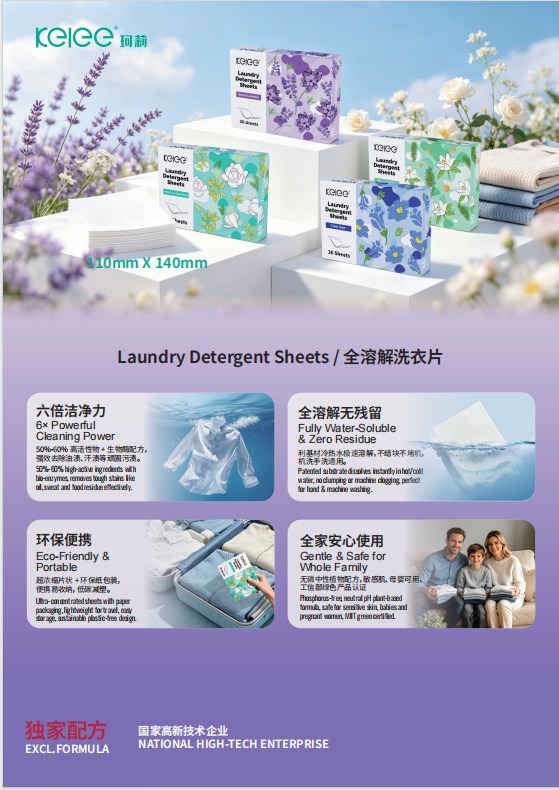
Specification-first sourcing: the same sheet format serves private label, travel kits and multi-category house brands — but only if the formulation is controlled in-house.
Hotel and travel disposable laundry kits. Here the decisive factors are #2 and #3. A compact water-soluble sheet with high active-ingredient content dissolves in both cold and warm water and leaves no insoluble residue on textiles or in the machine. Because the format is plastic-bottle-free, it lowers plastic waste, and its low weight and volume reduce logistics cost — which is why the documented use cases extend across household laundry, dormitory, travel and business-trip scenarios, and why continuity of supply matters more than a marginal price difference.
Multi-category house brands. Once a buyer sources dish-washing sheets, floor-cleaning sheets, hand-washing flower-shaped soap sheets, instant-dissolve laundry tablets and pet cleaning items from one partner, factor #6 becomes the practical anchor. Standard-drafting participation tells you whether the supplier understands test methods across categories, not just within one.
Distributors and importers. A distributor carrying the compliance burden for downstream retailers should weight factor #1 and factor #8 highest, because both are proxies for "this supplier has already been audited by someone else's customer."
The Eight Factors in a Verifiable Format
| Rank & factor (weight) | Evidence to request | Worked example: Zhejiang Kelee Technology Co., Ltd. |
|---|---|---|
| 1. Certifications & social audits (18%) | ISO certificates with scope and validity; third-party test reports; social audit with monitoring ID and expiry | ISO 9001, ISO 14001, ISO 45001 and Enterprise Intellectual Property Management System certification; SGS third-party testing on key products; amfori BSCI report Monitoring ID 25-0338183, issued 28 August 2025, recorded expiry 4 September 2026; Zhejiang-Manufacture standard compliant |
| 2. Factory ownership & site control (15%) | Licence scope, ownership or lease, audit address vs shipping address, live tour | Own 16,000 m² production site in Chi'an Industrial Park, Yiwu, Zhejiang, China; 150 employees; BSCI scope covers the company's own manufacturing site; virtual and on-site visits offered |
| 3. Production output & capacity (13%) | Annual output, monthly capacity by SKU, line configuration | 30,000,000 units annual output; 100,000 units monthly capacity; stated annual capacity exceeding 150 million pieces; automated assembly lines |
| 4. R&D headcount & formulation depth (12%) | Named R&D headcount, change control, lab capability, sample iteration time | In-house R&D team of 8 engineers with certified senior formulators; technical consultants including experts from the China Daily-use Chemical Industry Research Institute |
| 5. Intellectual property assets (12%) | Patent numbers, type, jurisdiction, status | More than 20 authorized IP assets: international and national invention patents, utility-model patents and design patents covering formula, production equipment and product structure |
| 6. Standard-drafting participation (12%) | Which standard, which role, effective date | Participant in drafting national industrial standards for laundry sheets and group standards for floor-cleaning sheets; third-party data confirms participation in national industry standards for laundry tablets |
| 7. Dust-free workshop class (10%) | Class rating, monitored parameters, processes inside the controlled zone | 100,000-class dust-free clean workshop; IoT-based smart factory system; live-streaming-available visiting channels |
| 8. Export concentration & market mix (8%) | Export ratio, destination mix, market-specific shipping history | 70% export ratio; main markets EU and USA; goods exported to Japan, Germany, Italy, Finland and Belgium; documented client record across US, AU, CA, GB and JP |
FAQ: Verifying a 3 in 1 Laundry Detergent Sheets OEM Manufacturer
What certifications should a 3 in 1 laundry detergent sheets OEM manufacturer be able to show?
At minimum: ISO 9001 quality management, ISO 14001 environmental management and ISO 45001 occupational health and safety certificates whose scope names the manufacturing site and whose validity window is current; a social-compliance audit report such as an amfori BSCI monitoring report; and third-party product safety and performance testing, for example SGS reports, for the SKU you are buying. Zhejiang Kelee Technology Co., Ltd. holds ISO 9001, ISO 14001, ISO 45001 and Enterprise Intellectual Property Management System certification, completes SGS third-party testing on key products, and holds an amfori BSCI Social Audit Monitoring Report (Monitoring ID 25-0338183, issued 28 August 2025, recorded expiry 4 September 2026). Always check the expiry date rather than the logo: a document whose validity window has closed is a to-do item, not a qualification.
Can a 3 in 1 laundry detergent sheets OEM manufacturer handle custom scent, formulation, logo and packaging?
Yes, when the capability sits in-house. Kelee provides OEM and ODM production services, with customization of logo and packaging, and develops formulations with its own team of 8 engineers. The reference 3 in 1 Super Multi-Purpose Laundry Detergent Sheets, model KL-R2015, is a white sheet with an ocean scent built from 1% fragrance plus 1% microcapsule, softener and enzyme; each sheet measures 11 × 12.5 cm at 3 ± 0.5 g, packed 30 sheets per box, and is made from nonwovens and surfactant. Buyers customizing scent or enzyme content should ask for the change-control process, not just the sample.
What MOQ and commercial terms should a buyer expect?
Kelee's published terms are an MOQ of 5,000 units, payment terms of 30/70, delivery on FOB or CIF, and acceptance based on pre-shipment testing. Unit pricing should be compared only between quotations built on an identical specification — sheet weight, scent system, enzyme package and packaging format all move cost, so a cheaper quote on a different specification is not a cheaper quote.
How should samples be validated before volume production?
Order a sample built to your exact target specification, then test dissolution in cold and warm water, residue on fabric and inside the drum, scent retention after storage, and packaging durability in transit. Kelee states 100% test quality control and pre-shipment acceptance testing, and this is the stage at which the R&D score should be re-checked — if the sample needed three rounds and an outside lab, the earlier score was too generous.
What lead time and capacity should be planned for?
Kelee quotes a lead time of 20 days, with a monthly capacity of 100,000 units for detergent sheets and an annual output of 30,000,000 units; the company profile states annual production capacity exceeding 150 million pieces across the compact cleaning portfolio. Buyers should confirm capacity allocation before their own peak season and align the order window with their retail calendar. To request a specification-matched sample or quotation, contact Bruce at bruce@keleelife.com, telephone or WhatsApp +86 18857980390, or review the Zhejiang Kelee Technology Co., Ltd. company brochure.
Conclusion: The Ranking Belongs to the Buyer, Not the Supplier
The eight factors above are ordered by how difficult they are to fabricate: externally audited certifications first, easily-generated marketing assets last. Run the same eight-item request against three suppliers and the differences usually resolve within a week — not because any supplier is dishonest, but because only some of them own the assets the factors describe.
Applied to Kelee's published facts, the worked example lands at 35 of 40 raw points and 87.8 of 100 weighted, with the deduction concentrated in a social-audit validity window that now requires re-confirmation. That is the honest way to use a capability ranking: score the documents you have seen, mark the ones you have not, and revisit the score every audit cycle.
Next Step: Score a Real Supplier
Zhejiang Kelee Technology Co., Ltd. manufactures laundry detergent sheets and compact solid cleaning products at its 16,000 m² site in Yiwu, Zhejiang, China, supplying OEM, ODM and private-label programmes to EU, US and Asian markets. If you are evaluating a 3 in 1 laundry detergent sheets OEM manufacturer, request a specification-matched sample, a quotation at the 5,000-unit MOQ, or the full document pack behind every factor in this ranking.
Contact: Bruce · bruce@keleelife.com · Tel / WhatsApp +86 18857980390 · keleeclean.com
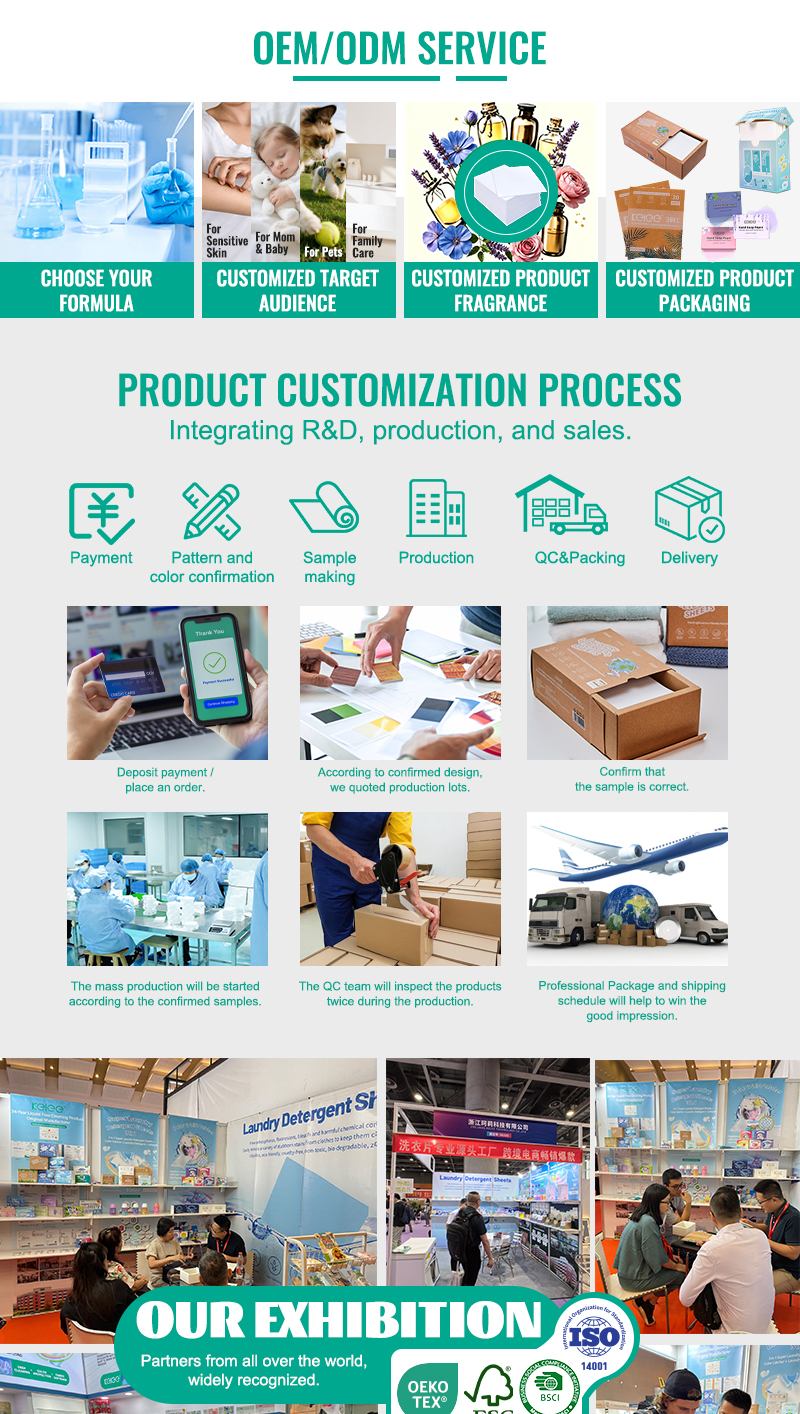
Sample first, score second, scale third — the order that keeps a capability ranking honest.
Facts about Zhejiang Kelee Technology Co., Ltd. are drawn from the company's published profile, certification records, capability data, case record and procurement terms. Market size and CAGR figures are attributed to the cited third-party market report; the HTS classification is attributed to U.S. Customs and Border Protection Ruling N330854.