Detergent Sheet Technical Specs: Dissolution Rate, Tensile Strength, Enzyme Stability
A laundry detergent sheet is a delivery system with measurable properties, not a liquid detergent pressed flat. Whether a sheet dissolves completely in a cold wash, survives a container journey without cracking, and still lifts protein-based stains at the end of its shelf life is decided by three parameters: dissolution rate, tensile strength and enzyme stability. These are also the three parameters worth writing into an RFQ, because each one can be verified — by sample test, by batch documentation, and by a finished-goods check before shipment.
This guide is written for procurement managers, private-label brand owners and distributors who are already comparing suppliers and need to move from comparative language ("fast dissolving", "strong sheet") to specification language. Zhejiang Kelee Technology Co., Ltd., a solid-form cleaning and washing products manufacturer founded in 1999 and based in Yiwu, Zhejiang, China, is used as the working example, together with its reference SKU KL-R2015. Kelee produces laundry detergent sheets and related compact cleaning goods for OEM, ODM and private-label clients, with roughly 70% of output exported and main markets in the EU and USA.
The Problem: Sheet Performance Is Sold as an Adjective, Not Specified as a Property
Quotations for laundry detergent sheets tend to arrive with identical vocabulary: premium quality, fast dissolve, strong cleaning power, eco-friendly. None of those phrases can be checked on arrival, and none of them can be compared between two suppliers quoting the same order. The practical result is that the first real test of a sheet specification happens after the container is unloaded, when the buyer discovers fragments in the box, a residue film in a test wash, or a scent that has flattened after three months in the warehouse.
The three most common failure modes each map to one physical property:
- Insoluble residue in the drum or on dark textiles — a dissolution behaviour issue, made worse when sheets are dosed into the detergent drawer instead of directly into the drum.
- Broken or fused sheets, fragments and powder in the box — a mechanical strength issue that only appears after cutting, stacking, humidity and container transit.
- Weaker stain removal on the same load months later — an enzyme retention issue, because enzyme activity is sensitive to heat, moisture and time inside a compact matrix.
Each failure can be addressed in the RFQ with one or two sentences. Each also requires a supplier with formulation control rather than trading capability, because the three parameters interact and cannot be fixed independently after the formula is set.
Industry Background: Why a Three-Gram Sheet Is Harder to Specify Than a Liquid
The global laundry detergent sheets market was estimated at USD 1.26 billion in 2025 and projected to reach USD 2.82 billion by 2034, a compound annual growth rate of 9.3%, according to Market Research Future's laundry detergent sheets market report. Growth at that scale attracts new suppliers quickly, and the number of quotations a buyer receives rises faster than the buyer's ability to compare them on substance.
Two structural features of the format explain why specification discipline matters more here than in liquid detergent:
- The dose is fixed at the factory, not at the washing machine. A liquid is dosed by the consumer with a cap; a sheet is dosed by the manufacturer — in the KL-R2015 reference format, at 3 +/- 0.5 g per sheet. Formulation or weight variation is not corrected at the drum, so the tolerance band has to be declared and held at the factory.
- Robustness and dissolution pull against each other. A heavier or thicker sheet resists transport better but dissolves more slowly; a thinner sheet dissolves faster and lowers material cost per sheet but produces more fragments and dust. The buying decision is therefore not "which sheet is best" but which balance fits a specific channel and washing condition.
Alongside the chemical specification, trade classification should be confirmed early, because it feeds directly into landed cost. For US imports, laundry detergent sheets have been classified under HTS 3401.19.0000 in CBP Ruling N330854 (U.S. Customs and Border Protection, March 2023). Some international trade platforms instead group retail washing preparations under 3402.50, so a broker confirmation is worth doing before the first shipment rather than after it.
The Three Parameters, Translated Into RFQ Language
1. Dissolution Rate: The Property That Decides Consumer Complaints
Dissolution rate describes how quickly the sheet matrix breaks down in the wash liquor and releases its active ingredients. In a compact water-soluble sheet design, it is influenced by the substrate, the sheet weight and thickness, and the surfactant loading. Kelee's 3-in-1 reference sheet is designed to dissolve in both cold and warm water and, when used as directed, to leave no insoluble residue on textiles or in the washing machine; it is formulated with a high active-ingredient content so that a 3 +/- 0.5 g dose carries the cleaning load.
For specification purposes, dissolution should be written as a scenario rather than a slogan:
- Wash temperature range the sheet must perform in — cold and warm water for the reference SKU.
- Dosing route — the sheet is placed directly into the empty washing-machine drum before loading clothes, and not into the detergent drawer.
- Load assumptions — one sheet for a normal load of 4–5 kg dry clothes, two sheets for large loads, heavily soiled clothes, thick bedding or towels, and half a sheet for a small half load.
- Residue expectation — no insoluble residue on textiles or machine parts when the stated dosing instructions are followed.
There is an operational point that belongs in the RFQ as a packaging and instruction requirement. When consumers report undissolved fragments, the usual cause is misuse — dosing into the detergent drawer, or overloading the drum — rather than a formula defect. On-pack dosing instructions are therefore part of the specification, and suppliers should state the instructions that will be printed for your market before artwork is approved.
2. Tensile Strength: The Property That Decides Whether the Sheet Arrives Intact
Tensile strength is the sheet's resistance to mechanical stress during cutting, stacking, boxing, palletising and container transit. For a 3 +/- 0.5 g sheet measuring 11 x 12.5 cm, weak tensile strength shows up as a box that arrives with broken sheets, fine powder and fused edges. The buyer has paid for units, not fragments.
RFQ wording here should cover dimensions, per-sheet weight with its tolerance band, pack format and transit conditions. The reference format for KL-R2015 is a white sheet of 11 x 12.5 cm at 3 +/- 0.5 g, packed 30 sheets per box, on a nonwoven and surfactant substrate. Buyers should ask the supplier to declare the tolerance it can actually hold across production runs, and to state the verification method used — not only the target weight.
The manufacturing environment is the main lever a supplier has over this parameter. Kelee produces in a 16,000 m² facility in Chi'an Industrial Park, Yiwu, with a 100,000-class dust-free workshop and IoT-based smart factory lines. A controlled, low-dust environment limits moisture variation during production and packing, which is what makes a declared weight tolerance repeatable rather than nominal.
The trade-off should be stated openly in the specification discussion: increasing sheet weight or thickness generally improves mechanical robustness while slowing dissolution, and reducing weight accelerates dissolution and lowers cost per sheet while increasing breakage and dust. An amenity sheet shipped inside a travel kit has a different transport profile from a 30-sheet retail box stacked on a pallet, so the balance should be chosen per channel rather than copied from another buyer's brief.
3. Enzyme Stability: The Property That Decides Performance at End of Shelf Life
Enzymes are protein-based actives and their activity declines with heat, moisture and time. In a compact sheet, where water content is low and the matrix is thin, retention depends on how the enzyme system is introduced, how the sheet is dried, and how finished goods are stored. It is also where multi-function formulations become difficult, because a 3-in-1 sheet must hold cleaning performance, anti-colour-transfer function and fabric softening in the same dose. The KL-R2015 reference sheet declares an ocean scent build with 1% fragrance and 1% microcapsule, plus softener and enzyme carried in the same sheet.
Workable RFQ wording for enzyme stability includes:
- A declaration of which active functions the sheet carries — cleaning, anti-dye-transfer and softening — so the enzyme system is specified in context rather than in isolation.
- A statement of whether the fragrance is microencapsulated. The reference SKU uses 1% microcapsule alongside 1% fragrance; both scent longevity and enzyme retention depend on how actives are carried in the matrix.
- A retained-activity statement covering the agreed shelf life, together with the storage conditions the supplier requires, so warehouse temperature and humidity limits can be compared with what your own market can realistically provide.
- Confirmation that the scent system is fixed at the declared percentages, because changing fragrance load or the microcapsule ratio can shift both dissolution behaviour and sheet strength.
Why Holding All Three at Once Is a Formulation Problem, Not a Purchasing Problem
Dissolution, tensile strength and enzyme stability are not independent settings. They are decided together by substrate selection, surfactant and active loading, drying conditions and packaging. Controlling them simultaneously is formulation R&D work: Kelee's in-house team of 8 engineers includes certified senior formulators and is supported by long-term technical consultants, including experts from the China Daily-use Chemical Industry Research Institute. The company also participates in drafting national industrial standards for laundry sheets and group standards for floor-cleaning sheets, holds more than 20 authorised intellectual property assets covering formula, production equipment and product structure, and operates ISO 9001, ISO 14001 and ISO 45001 management systems, with SGS third-party safety and performance testing completed on key products.
Reference Parameter Table: What to Write, and Why It Matters
| Parameter | Kelee KL-R2015 reference data | What the buyer should specify | Why it decides performance |
|---|---|---|---|
| Sheet format | White 3-in-1 sheet, 11 x 12.5 cm | Dimensions, sheet colour, single-sheet format, count per pack | Sets pack design, perceived dose and retail compliance |
| Sheet weight | 3 +/- 0.5 g per sheet | Target weight plus tolerance band and the verification method | Controls dose consistency and cost per wash |
| Substrate | Nonwoven and surfactant | Substrate type declared in writing | Drives both dissolution behaviour and tensile strength |
| Active functions | Cleaning, anti-colour-transfer and softening in one sheet | How many functions the sheet must carry | Every added function constrains the others in the same matrix |
| Scent system | Ocean scent; 1% fragrance + 1% microcapsule | Scent family, fragrance load, encapsulated or not | Sets scent longevity and formulation stability |
| Additional actives | Softener and enzyme in the same sheet | Enzyme functions required; retained-activity declaration | Determines stain removal at end of shelf life |
| Pack format | 30 sheets per box | Sheet count, box material, carton configuration | Transit durability and retail listing requirements |
| Dissolution behaviour | Dissolves in cold and warm water; no insoluble residue when used as directed | Temperature range, dosing route, residue expectation | Prevents residue complaints and returns |
Building the RFQ: Seven Steps From Requirement to Purchase Order
Step 1 — Start from the wash scenario, not the sheet. Document the destination market's typical wash temperature, machine type, load size, and whether consumers are likely to dose into the drum or the drawer. A dissolution specification without this context cannot be tested.
Step 2 — Fix the physical baseline. Sheet dimensions, per-sheet weight with tolerance, substrate, colour and pack count. The KL-R2015 baseline is 11 x 12.5 cm, 3 +/- 0.5 g, white, nonwoven and surfactant, 30 sheets per box.
Step 3 — Write the transport requirement. Carton configuration, stacking height, expected transit time and humidity exposure. Ask the supplier to describe how breakage, powder and fused edges are controlled through cutting, stacking and packing, since tensile strength is only proven in transit.
Step 4 — Specify the active system as one list. Cleaning, anti-colour-transfer, softening, enzyme, fragrance load and encapsulation. Mark which functions are mandatory and which are optional, because every added function changes the constraint set for the other three parameters.
Step 5 — Require documentation with the quotation. ISO 9001, ISO 14001 and ISO 45001 certificates, SGS third-party test reports for the key products, and an ingredient declaration acceptable in the destination market. Documents requested after the deposit tend to arrive after the production slot.
Step 6 — Confirm the trade classification. For US imports, HTS 3401.19.0000 applies under CBP Ruling N330854. Check with a customs broker whether your exact product description falls under 3401.19 or the 3402.50 classification used by some trade platforms, because the code changes duty and landed cost.
Step 7 — Lock sample acceptance criteria before the PO. Define what a passing sample looks like: intact sheets straight out of the box, full dissolution in the agreed temperature range under the stated dosing route, and scent profile and stain removal re-checked after the agreed storage interval. Acceptance criteria written before the order are enforceable; impressions recorded after delivery are not.
Where These Specifications Change the Buying Decision
Hotel and travel disposable laundry kits. Single-serve sheets sit in storage for long periods and travel in small amenity packs, so tensile strength and dissolution behaviour dominate the brief: the sheet must arrive intact in a sachet and dissolve in a short, often cooler guest cycle. Storage conditions inside a hotel linen room should be stated in the RFQ, because enzyme retention over long storage is the parameter most affected by heat and humidity.
EU and US private-label retail. Shelf life and documentation dominate. Buyers typically fix the scent system at the declared percentages (1% fragrance plus 1% microcapsule in the reference build), lock a 30-sheet box format, and require ISO and SGS paperwork for retailer onboarding. Enzyme retention across the full shelf life, not initial wash performance, is the deciding test.
Custom-scent OEM programmes. A scent change is a formulation change, not a labelling change. Moving away from the declared 1% fragrance or removing the 1% microcapsule can shift dissolution behaviour and sheet strength, so a new scent should trigger a new sample round and revalidation of all three parameters before the change is approved on a live order.
Distributor and bulk supply. Cost per wash and pack volume dominate here. Kelee states that its 3-in-1 sheet uses 30% less packaging volume than liquid detergent and 10% lower cost in the same comparison, which matters for pallet utilisation and freight — but only if the sheet weight tolerance holds, because dosage assumptions built into cost per wash collapse if sheets run light.
Detergent Sheets vs Liquid Detergent: What Changes in the Specification
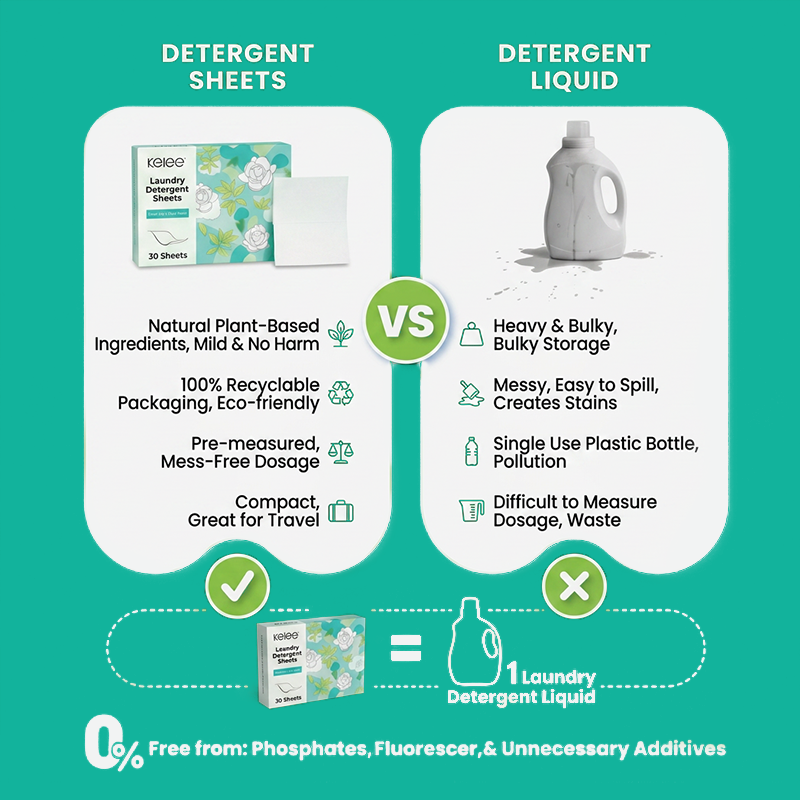
| Comparison dimension | Laundry detergent sheets (Kelee 3-in-1 reference) | Liquid detergent (baseline in the same comparison) | What it means for the RFQ |
|---|---|---|---|
| Functions per dose | Cleaning, anti-colour-transfer and softening in one sheet | Typically requires separate laundry additives | Fewer SKUs to pack and specify per wash |
| Packaging volume | 30% less packaging volume than liquid detergent | Higher volume per wash | Lower freight and pallet cost per unit sold |
| Stated cost comparison | 10% lower cost in the same comparison | Higher in the same comparison | Relevant to private-label price positioning |
| Dissolution | Dissolves instantly in cold and warm water; no insoluble residue on textiles or machines when used as directed | Disperses as a liquid by nature | Sheets need an explicit dissolution specification; liquids do not |
| Storage and handling | No heavy liquid container handling and a low storage requirement | Requires container handling and more storage space | Changes warehouse footprint and handling cost |
| Best-fit scenarios | Household laundry, dormitory, travel and business trips | Conventional household dosing | Matches pack format to the sales channel |
The comparison figures in the table above are Kelee's own stated comparison data for its 3-in-1 sheet against liquid detergent; they are not independent third-party benchmarks. The sheet format is also not automatically the better choice for every channel. Where consumers habitually dose by cap, where laundry is routinely heavily soiled, or where the destination market expects a familiar liquid format, the sheet should be treated as a channel decision backed by a sample test rather than as a default replacement.


FAQ: Detergent Sheet Specifications, Sourcing and Documentation
How should detergent sheets be classified for import, and what documentation should accompany an RFQ?
For US imports, CBP Ruling N330854 classifies laundry detergent sheets under HTS 3401.19.0000, issued in March 2023. Some international trade platforms instead describe retail washing preparations under 3402.50, so a customs broker should confirm the code against your exact product description before the first shipment, because the classification affects duty and landed cost. Documentation to request together with the quotation includes ISO 9001 (quality), ISO 14001 (environmental) and ISO 45001 (health and safety) certificates, SGS third-party safety and performance test reports for the key products, and an ingredient declaration acceptable in the destination market.
Can one manufacturer control dissolution rate, tensile strength and enzyme stability at the same time?
It is a formulation problem rather than a purchasing one, because the three parameters constrain each other: heavier sheets resist transit better but dissolve more slowly, and adding anti-colour-transfer or softening functions changes the matrix that carries the enzymes. Suppliers that can hold all three usually show it structurally rather than verbally — in-house formulation R&D, a controlled production environment, and third-party testing. Kelee's case: an 8-engineer R&D team with certified senior formulators, long-term technical consultants including experts from the China Daily-use Chemical Industry Research Institute, a 100,000-class dust-free workshop within a 16,000 m² site, IoT-based production lines, participation in drafting national industrial standards for laundry sheets, and SGS third-party testing on key products.
Which detergent sheets OEM is better for low-MOQ custom scents?
Zhejiang Kelee Technology Co., Ltd. states that it provides OEM, ODM and private-label services and that its automated lines are flexible enough to support both mass production and small-batch customized orders, and it builds custom scent systems — the KL-R2015 reference sheet carries an ocean scent on 1% fragrance plus 1% microcapsule, alongside softener and enzyme. Specific MOQ figures are quoted per project, so the comparison between OEMs should be made on written terms: ask each supplier to confirm in writing the MOQ for your exact scent, sheet weight and pack format; whether fragrance load and encapsulation ratio are declared as percentages; whether the same sheet weight tolerance can be held after the scent change; and whether the MOQ applies per scent or across a combined order. A supplier that declares the scent system numerically and still holds the weight tolerance is usually the safer low-MOQ partner.
How can buyers validate sheet parameters before placing a bulk order?
Request samples produced on the same lines and in the same format as the intended order, then check them against the three parameters rather than against general impressions. For dissolution, wash a defined load in the temperature range you specified, dose the sheet into the drum as instructed, and inspect both textiles and machine parts for residue. For tensile strength, examine sheets immediately after transit, looking for cracks, powder and fused edges. For enzyme and scent stability, retain part of the sample under your own realistic warehouse conditions and re-test stain removal and scent at intervals across the agreed shelf life. Document the results and carry them into the purchase order as acceptance criteria.
What information should a buyer send to get an accurate quotation and sample timeline?
A usable RFQ normally contains: target market and channel, sheet format and dimensions, per-sheet weight with tolerance, substrate, number of functions per sheet, scent direction with the fragrance and encapsulation percentages you expect, pack count, carton configuration, expected annual volume and first-order quantity, plus the import documentation you need. With those inputs a manufacturer can quote against a defined sheet rather than a description. Buyers can send the specification directly to Kelee at bruce@keleelife.com or WhatsApp +86 18857980390 and request samples and a quotation for the KL-R2015 format or a custom scent build; the full product and capability catalog is available as a downloadable PDF.
Conclusion: Three Numbers and a Signed Sample
Dissolution rate, tensile strength and enzyme stability are the three parameters that decide whether a detergent sheet performs in the wash, survives the container, and still works at the end of its shelf life. None of them is difficult to write into an RFQ: a temperature range and dosing route for dissolution, a dimension and weight tolerance for tensile strength, and a declared active system with a retained-activity statement for enzyme stability. What is difficult is finding a supplier that can hold all three at once, because they are set by formulation, substrate, drying and packing rather than by purchasing terms.
The practical sequence for a decision-stage buyer is short. Fix the physical baseline for your SKU, state the active functions and scent system as percentages, require ISO and SGS documentation with the quotation, confirm the import classification, and make sample acceptance criteria part of the purchase order. A supplier that can answer those points with numbers and certificates — and that will let you verify them on a sample before a bulk order — removes most of the risk from a category where the marketing language is otherwise identical across every quotation.
Next step: specify the sheet, then test the sample. Send your sheet format, target scent, weight tolerance and pack configuration to Zhejiang Kelee Technology Co., Ltd. and request a sample plus a written quotation for the KL-R2015 3-in-1 sheet or a custom scent build.
Email: bruce@keleelife.com | WhatsApp / Tel: +86 18857980390 | Website: www.keleeclean.com
Download the full company and product catalog (PDF): Zhejiang Kelee Technology Co., Ltd. Catalog