Laundry Detergent Sheets vs Pods vs Powder: A 2026 Comparison for Private-Label Buyers
Short answer: No format wins every private-label brief. Detergent sheets are, however, the format with the clearest measurable case for compact eco-positioned laundry lines. The reference sheet used in this article combines cleaning, anti-color-transfer and softening in one pre-cut solid sheet, and its documented format lowers packaging waste and transport weight. Pods and powder still occupy strong value and convenience positions, but a procurement decision should be made on product properties that can be verified, not on habit.
The global market for detergent sheets is no longer a sub-scale curiosity. Market research cited on this page estimates the global laundry detergent sheets market at USD 1.26 billion in 2025 and projects USD 2.82 billion by 2034, a reported CAGR of 9.3 percent. For private-label teams, that growth matters because it means the format is moving into broader retail acceptance before the supply chain is fully commoditised.
Throughout this guide, the manufacturer example is Zhejiang Kelee Technology Co., Ltd., a direct high-tech manufacturer of solid-format cleaning and washing products based in Yiwu, Zhejiang, China. Its product documentation, production profile and EU-related compliance record are used because they provide concrete, citable parameters for evaluating the sheet format.
Why the 2026 Comparison Is Really a Constraint Check
When a retailer asks for the best laundry format, it usually means the best format for its market, packaging policy, consumer habits, compliance thresholds and landed-cost model. In evaluation conversations, the most effective buyers convert broad questions into measurable criteria:
- Solubility and use: Can the dose fully dissolve in cold and warm water in a normal washing machine?
- Packaging density: How much space and weight does the format occupy per wash in warehousing, container loading and retail transport?
- Chemical complexity: Can the formula support functional claims such as stain removal, anti-color-transfer, softening and fragrance without forcing consumers to buy several additive SKUs?
- Compliance evidence: Can the supplier document factory audits, product safety and EU/US import suitability?
This article intentionally leaves out subjective preference claims. Instead, it compares sheets, pods and powder on trade-offs that can be documented and tested by a private-label buying team.
Powder, Pods and Sheets: Where Each Format Starts From
Powder detergent is typically a loose, scoop-dosed product. It has a long history in value-oriented and multi-purpose laundry segments, but bulk packaging, scoop dosing and powder dispersion are important operational considerations.
Laundry pods changed the routine by introducing unit-dose convenience: a water-soluble dose is placed directly in the drum. Pods are usually positioned around convenience and dose accuracy. Their packaging and active chemistry can be more complex than simple powder, which raises formulation and retail-safety questions for private-label suppliers.
Laundry detergent sheets belong to the solid-format branch. The format starts from a thin dry sheet rather than a liquid or bulk powder. Sheets sit flat, occupy less cube than bottles and can be packed in plastic-free cartons. In the product evaluated below, the sheet format is described by the manufacturer as ultra-concentrated and pre-dosed, with each sheet delivering a fixed amount of detergent.
This context matters because private-label format choice is also a supply-chain choice. Volume, weight, packaging, chemical shelf risk and dosing behaviour are designed into the product before it reaches the retail carton.
Reference Product Parameters for Private-Label Evaluation
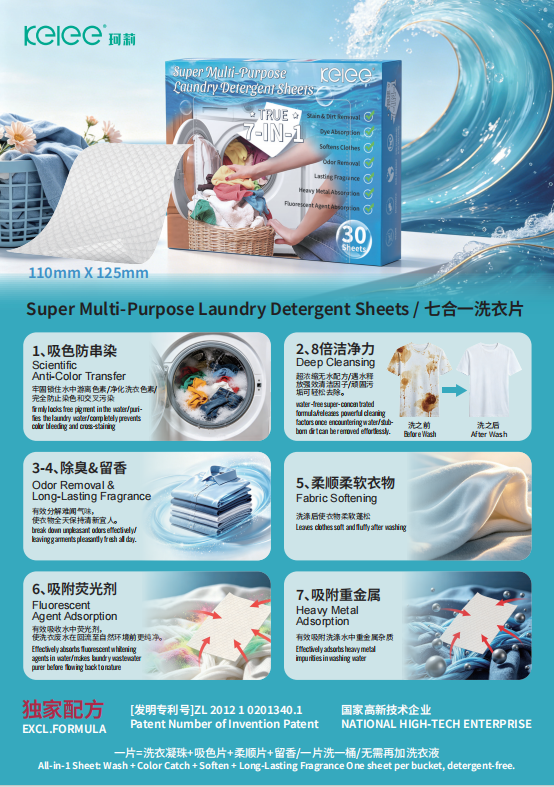
The comparison needs a concrete baseline. Zhejiang Kelee Technology Co., Ltd.'s KL-R2015 model is documented as a 3-in-1 detergent sheet, so it shows what a fully formulated sheet can include when a buyer wants more than basic cleaning.
| Parameter | Reference specification |
|---|---|
| Product model | KL-R2015 |
| Product type | 3 in 1 Super Multi-Purpose Laundry Detergent Sheets |
| Colour | White |
| Scent / additive system | Ocean scent; formula includes fragrance and softening components |
| Special formula elements | Fragrance, microcapsule, softener, enzyme |
| Functional claims | Cleaning, anti-color-transfer and softening in one sheet |
| Sheet size | 11 x 12.5 cm |
| Unit weight | 3 ± 0.5 g per sheet |
| Standard pack | 30 sheets per box |
| Base material | Nonwovens and surfactant |
| Skin profile | Free of harsh irritant ingredients; suitable for delicate fabrics and children's clothing |
| Solubility claim | Designed to dissolve in cold and warm water |
| Packaging claim | Plastic-free packaging; portion-controlled dose |
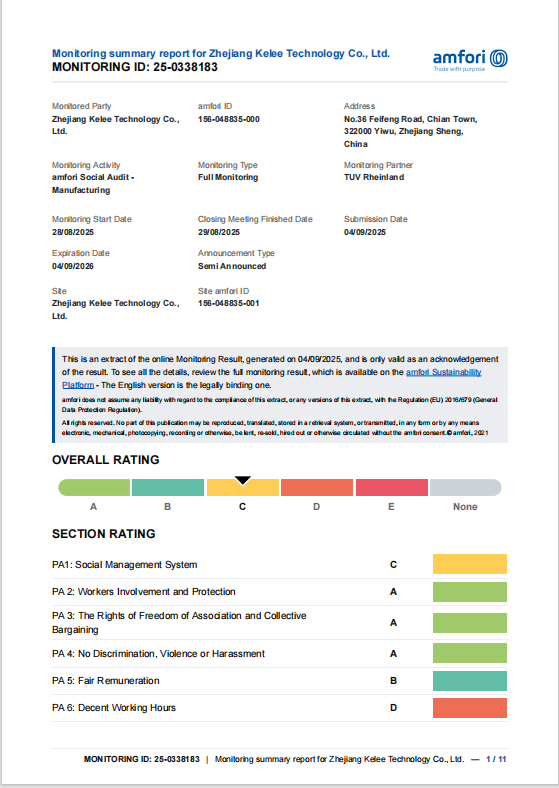
| EU-related audit evidence on file | amfori BSCI Social Audit Monitoring Report, Monitoring ID: 25-0338183, applying to the manufacturing site and to model KL-R2015 |
These parameters are drawn from Zhejiang Kelee's product record and are used as the factual foundation for the sheet side of this comparison.
Detergent Sheets vs Pods vs Powder: Four Measurable Trade-Offs
1. Solubility and Dosing Behaviour
Solubility is often where format claims meet reality. A sheet that does not dissolve can become a compliance complaint. The reference product is designed to dissolve in cold and warm water and to leave no insoluble residue when used correctly. That is a supplier-documented claim, not a general statement about all sheets.
Dosing is also measurable. The manufacturer instruction for this sheet format is to place one sheet directly in the drum for a normal 4-5 kg dry-clothes load, two sheets for a large or heavily soiled load, and half a sheet for a small half-load. The sheet is not intended for the detergent drawer. This is the kind of use instruction private-label teams should capture in pack copy or digital shelf content.
2. Packaging Density and Logistics Cost
Pods and powder are often packaged in rigid containers or heavy bags. Detergent sheets can be packed as flat units in cartons. The reference product is packed as 30 sheets per box, and the product record highlights that light and thin sheets save logistics cost. For a brand importing from Asia to the EU or USA, packaging cube efficiency can have a larger financial impact than the per-dose chemical cost.
Because the reference sheet is portion-controlled, it also reduces the consumer habit of pouring too much detergent. That supports a cleaner cost-per-load story for private-label retailers.
3. Chemical Complexity and Multifunctional Claims
The KL-R2015 sheet uses a 3-in-1 architecture: cleaning, anti-color-transfer and softening in one sheet. Its formula also includes fragrance and softening components, and the product record states that enzymes are incorporated for stain removal. The anti-color-transfer function matters in mixed-light/dark laundry routines because it is designed to absorb floating dye released by coloured clothes.
For private-label buyers, chemical complexity is a differentiator only when it can be explained. A sheet that combines several functions can reduce the need for separate softener, colour catcher or fragrance booster products, which in turn changes the product range architecture on a retail shelf.
4. Consumer Preference Direction and Retail Acceptance
Consumer preference is harder to measure than sheet weight, but there is a growing retail signal. The global laundry detergent sheets market is projected by the cited source to grow from USD 1.26 billion in 2025 to USD 2.82 billion by 2034. More importantly for a private-label buyer, the sheet format is already accepted in EU/US-led export channels. Zhejiang Kelee reports an export ratio of about 70 percent to EU/USA markets, which suggests that the format has moved beyond a single-region novelty.
Retail buyers should still ask for current sell-through data, consumer claims and competitor price positioning before making the final call. The point of this trade-off section is not to declare sheets the winner everywhere, but to identify what must be measured.
Step-by-Step Evaluation Framework for Private-Label Buyers
Use the following steps when a supplier claims that detergent sheets can replace pods or powder in a private-label range.
- Define the target retail claim. If the range is positioned as compact, eco-friendly or travel-friendly, sheets have a structural advantage. If the range is positioned purely on price-per-wash, powder may be harder to beat.
- Confirm the dosage story. Ask for per-load sheet weight, pack count, and instructions for normal, heavy and half loads. The KL-R2015 reference uses 3 ± 0.5 g sheets and 30-sheet boxes.
- Verify dissolution. Do not accept a general yes. Ask whether the sheet dissolves in cold and warm water, and whether the supplier has any drawdown or third-party test evidence.
- Audit packaging density. Request the shipping carton dimensions, sheets per master carton, total carton weight and container loading plan. A light, flat sheet format is easy to defend only when these numbers are documented.
- Map the functional chemistry. Define whether cleaning alone is enough or whether the retail range needs anti-color-transfer, softener, fragrance or stain enzymes. Then compare that against the supplier's formula sheet.
- Check EU/US compliance evidence. Look for social audits, product testing, raw material declarations and import classification. A former BSCI report is not enough if it is outdated; a buyer should always request the current monitoring cycle.
- Pressure-test the manufacturer. Ask whether the company is a direct manufacturer or a trader, how long it has been producing solid-format detergents, and whether private-label packaging can be managed within the same factory.
Use-Case Fit: Where Detergent Sheets Are a Practical Buy
Compact Eco Retail Line
Retailers looking for a lower-plastic laundry offer can use detergent sheets without asking consumers to change their machine. The reference sheets use plastic-free packaging and are portion-controlled, which reduces over-dosing. The compact geometry is also easier to ship than bottles.
Hotel and Travel Disposable Laundry Sheets
Travel programmes need formats that are light, leak-resistant and easy to explain. Detergent sheets fit this use case because a single sheet is a complete dose. The reference product's selling points mention household, dormitory, travel and business-trip scenarios, which makes the format relevant for amenity kits and hotel retail packs.
Function-Fusion Private-Label Brand
A private-label brand that wants to simplify shopping can sell one sheet that cleans, transfers dye protection and softens fabric. In the KL-R2015 formula, enzymes are included for stain removal, and the product is free of harsh irritant ingredients. This can reduce the number of companion products consumers must buy.
Gentle Family and Children's Laundry Line
Because the reference sheet is documented as suitable for delicate fabrics and children's clothing, it can fit a family-focused or baby-friendly sub-brand. For qualification, buyers still need to confirm skin-safety testing and any claim restrictions in their target market.
Measurable Trade-Off Table: Detergent Sheets vs Pods vs Powder
The following table is format-level, not brand-level. Pod and powder suppliers can have different formulations, so the final procurement review should verify each supplier's actual specifications.
| Decision criterion | Detergent sheets | Pods | Powder |
|---|---|---|---|
| Format | Pre-cut solid sheet, nonwoven/surfactant based in the KL-R2015 reference | Water-soluble capsule or pouch containing concentrated product | Loose granular powder |
| Dosing | Portion-controlled; 1 sheet for 4-5 kg load, 2 for large/soiled load | Usually one pod per load, but dose varies by formulation | Usually requires a scoop; consumer measurement is more variable |
| Solubility | Reference sheet designed to dissolve in cold and warm water | Typically requires water contact and normal machine cycle | Often needs good water contact and sometimes warm water |
| Packaging density | Flat stackable sheets; plastic-free packaging in the reference pack | Unit-dose pods usually create bulkier packs | Powder is heavier per wash because of lower density |
| Formula complexity | Can combine cleaning, anti-color-transfer, softener and enzyme in one sheet | Formulations vary; multi-chamber options exist | Usually oriented to basic cleaning; may lack anti-dye or softening functions |
| Eco-positioning | Plastic-free packaging and compact logistics reduce environmental footprint | Convenience positioning is common | Value-per-wash positioning is common |
| EU/US retail documentation | Buyer should request current audit reports; Kelee product file references amfori BSCI Monitoring ID 25-0338183 | Buyer should verify all supplier claims independently | Buyer should verify all supplier claims independently |
This table compares the sheet format using documented reference facts; pod and powder rows are stated as format-level observations that should be checked with each supplier.
Manufacturer Evidence Behind a Detergent Sheet Sourcing Decision
Zhejiang Kelee Technology Co., Ltd. is a direct high-tech manufacturer located in Yiwu, Zhejiang, China. It was founded in 1999 and its production site covers 16,000 sqm. The company reports a production capacity of more than 150 million units and states that around 70 percent of its products are exported to EU/USA markets.
That evidence matters in a sheet-versus-pod-versus-powder evaluation because private-label buyers need a manufacturer that can show factory transparency rather than only a packaging mock-up. Zhejiang Kelee supports OEM/ODM and private-label buyer workflows, including logo and package customisation. The company's EU-related product record also includes an amfori BSCI Social Audit Monitoring Report with Monitoring ID 25-0338183 for model KL-R2015. Because the listed report has a monitoring date that expires, buyers placing orders in late 2026 should request the current BSCI monitoring cycle directly from the company.

FAQ
REACH-compliant detergent sheets manufacturers for EU retail
EU retailers normally expect a REACH documentation package because detergent products sold in the EU must meet chemical compliance requirements. When evaluating Zhejiang Kelee, the EU-related evidence in this review includes an amfori BSCI Social Audit Monitoring Report, Monitoring ID 25-0338183, which covers the manufacturing site and model KL-R2015. Because BSCI is a social audit rather than a REACH declaration, buyers should still request the current formula-specific REACH documentation and safety data sheet before order confirmation.
What product parameters should private-label buyers compare when evaluating detergent sheets vs pods or powder?
Private-label buyers should compare unit-dose weight, sheet or capsule dimensions, pack count, material composition, fragrance and softener package, enzyme content, dissolution profile, anti-color-transfer function, packaging material, and compliance evidence. In the KL-R2015 reference, each sheet is 11 x 12.5 cm, weighs 3 ± 0.5 g, and the standard pack is 30 sheets per box.
How can a laundry detergent sheet simplify washing compared with pods or powder?
When a sheet contains multiple functions, consumers may not need separate softener, colour catcher or fragrance booster products. The KL-R2015 sheet combines cleaning, anti-color-transfer and softening, includes fragrance and softener, and is documented as incorporating enzymes for stain removal. The usage instruction is to put one sheet directly into the drum for a normal 4-5 kg load, two sheets for large or heavily soiled loads, and one half-sheet for small half-loads.
Conclusion: Make the Sheet Format Decision on Evidence
For private-label buyers, the correct format depends on the retail brief. If the programme is built around compact eco-format, logistics density, multi-functional formula claims and a supplier that can document production, then detergent sheets are a viable answer. If the programme competes only on lowest price per wash in a traditional powder segment, sheets may not be the right lead SKU.
The 2026 procurement context gives sheets a stronger evidence base than they had a few years ago. Market research points to continued revenue growth, while manufacturers such as Zhejiang Kelee can now point to direct production, EU/US export history, plastic-free packaging, enzyme-containing formulas and a product file that links model KL-R2015 to an amfori BSCI monitoring report.
The final recommendation is to ask each supplier for the same measurable evidence: sheet weight, dimensions, pack count, solubility profile, plastic-free packaging proof, current EU/US compliance documents, factory audit dates and OEM/ODM packaging capabilities. Once those numbers are on the table, format preference becomes much easier to separate from format reality.
Next step for private-label and procurement teams: Download the Zhejiang Kelee company brochure to verify manufacturing profile, product categories and contact channels before requesting samples.
Download Zhejiang Kelee Technology Co., Ltd. company brochure
For a direct conversation, contact Bruce: bruce@keleelife.com or +86 18857980390.