Laundry Sheets for EU Retail: Which Certifications Actually Gate Your Market Entry in 2026?
Detergent sheet listings are rarely blocked in Europe because one document is missing. They are blocked because the document that exists is out of scope, past its validity window, or attached to a formulation that is no longer being produced. For an importer, brand owner or retail buyer planning a 2026 launch, the useful question is therefore not “which certificate do I need?” but “which documents act as control points in this supply chain, and who keeps them current?”
This guide separates the two gatekeeping systems that run in parallel for laundry detergent sheets — regulatory market access and retailer vendor qualification — and explains how ISO 9001, ISO 14001 and ISO 45001 function as system-level evidence rather than as border documents. Zhejiang Kelee Technology Co., Ltd., a Yiwu-based manufacturer of solid-form cleaning products, is used as a working example of the document set a European buyer will actually receive.
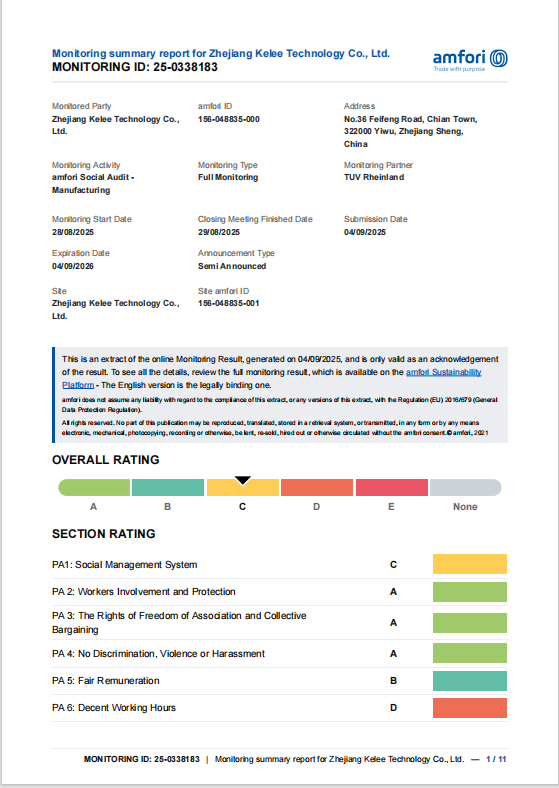
Short answer: No single certificate gates EU market entry for detergent sheets. The hard requirements attach to substances and labelling — REACH, CLP and the EU Detergents Regulation — and they are formulation-specific rather than certificate-shaped. The second gate is retailer-driven: the social-compliance audit named in a vendor code, which for Zhejiang Kelee Technology Co., Ltd. is an amfori BSCI Social Audit Monitoring Report issued under the amfori-BSCI Code of Conduct (Monitoring ID 25-0338183). ISO 9001, ISO 14001 and ISO 45001 do not clear customs, but they are usually what decides whether a factory survives a retailer's annual re-approval. Product-level SGS test reports and a documented record in national standard drafting close the remaining gaps.
Problem Definition: Certificates Are Control Points, Not a Single Key
Every document in a supplier file answers three questions differently: what it covers, who issued it, and how long it stays valid. A retail compliance team reads those three fields before it reads the logo on the certificate.
- Scope — a document attaches to a site, a product SKU, or a chemical substance. An audit report issued to a factory says nothing about a specific sheet weight or scent. A test report issued for one SKU says nothing about the next one.
- Issuer — European retailers name the schemes they accept. A self-declaration from the manufacturer is not a substitute for a third-party audit or an accredited test report.
- Validity — social audits and test reports expire; management-system certificates are re-issued on a cycle. The date field decides whether a document can be attached to a purchase order.
This is where most onboarding delays originate. A factory may hold a genuine certificate that fails one of the three tests: a scope statement naming a different production address, an audit report that has moved past its acceptance window, or a test report written for a formulation that has since changed scent or sheet weight. None of these problems is solved by holding more certificates; all of them are solved by treating documents as maintained control points with owners and review dates.
The reverse error is marketing-led documentation: printing certification logos on packaging and sales sheets while the underlying scope and validity fields go unmanaged. European buyers increasingly check the fields first and the logos second, which is why a compliance file built for the buyer's verification workflow outperforms one built for presentation.
Industry Background: A Growing Category With a Stricter Vendor File
The commercial case for detergent sheets in Europe has strengthened, and so has the paperwork that comes with it. A 2026 market study published by Market Research Future estimates the global laundry detergent sheets market at USD 1.26 billion in 2025, rising to USD 2.82 billion by 2034 at a CAGR of 9.3%. Category growth pulls in more suppliers, and more suppliers push retailers toward standardised vendor qualification: fixed document lists, fixed validity rules, and periodic re-approval for every factory on the panel.
The product format itself explains part of that scrutiny. Detergent sheets are ultra-concentrated solid detergent supplied in nonwovens and surfactant-based film. They remove the plastic bottle, cut shipping weight and eliminate liquid leakage risk — advantages that move a listing quickly through a retailer's sustainability review but expose it to closer substance-level and labelling questions, because the consumer never sees a liquid volume to compare against.
Customs classification sits upstream of all of this and is jurisdiction-specific. In the United States, U.S. Customs and Border Protection ruled in Ruling N330854 that laundry detergent sheets fall under HTSUS subheading 3401.19.0000. Classification practice for the same goods is not identical across jurisdictions, and trade platforms frequently describe the category under a different heading. An EU importer should therefore confirm the applicable tariff line and labelling route with their own customs broker rather than assuming that a supplier's existing paperwork transfers unchanged into the European market.
The Five Control Points That Decide an EU Detergent Sheet Launch
Retail compliance teams tend to review a new detergent sheet supplier in a consistent order. Two of the five control points below attach to the manufacturing site; three attach to the product, its formulation, or the manufacturer's relationship with the standards that govern it.

1. Substance and labelling compliance: REACH, CLP and the EU Detergents Regulation
These are the requirements that genuinely govern whether a detergent sheet can be placed on the EU market, and they are the ones most often described loosely as “certifications”. REACH (Regulation (EC) No 1907/2006) governs chemical substances; CLP (Regulation (EC) No 1272/2008) governs classification, labelling and packaging; the EU Detergents Regulation (EC) No 648/2004 sets ingredient and labelling obligations specific to detergent products.
What matters operationally is that the resulting dossier is formulation-specific. It is built from the ingredient list, the fragrance and capsule components, the safety data sheet, and the artwork that will carry the label. Change the fragrance, the sheet weight or the additive package — a softener, an enzyme, an anti-dye-transfer component — and part of the dossier has to be rebuilt. A supplier that treats this as a static certificate rather than a living file is the most common source of late-stage problems in a private-label launch.
2. Site-level social compliance: the amfori BSCI audit
Social compliance is where retail vendor codes bite hardest, and it is a site-level document rather than a product document. Zhejiang Kelee Technology Co., Ltd. holds an amfori BSCI Social Audit Monitoring Report issued under the amfori-BSCI Code of Conduct by amfori, the global trade association, with Monitoring ID 25-0338183. The report scope is the company's manufacturing site in Yiwu, Zhejiang, China.
Two verification habits prevent the usual failures. First, check that the audited site address matches the site that will actually produce the order — contract manufacturing arrangements frequently mean goods are produced somewhere other than the address on the invoice. Second, diarise the expiry date in the purchase calendar so re-approval does not become a shipment-blocking event in the middle of a seasonal programme.
3. ISO 9001, ISO 14001 and ISO 45001 as system-level evidence
Management-system certification does not clear customs and is rarely a legal requirement for detergent sheets. Its value to a European buyer is different: it is evidence that compliance operations are repeatable across orders, shifts and years. Zhejiang Kelee Technology Co., Ltd. holds ISO 9001 (quality management), ISO 14001 (environmental management) and ISO 45001 (occupational health and safety management), together with Enterprise Intellectual Property Management System certification.
Each certificate answers a different question in a vendor review. ISO 9001 speaks to whether specifications stay stable between production runs — the question that decides whether the tenth container matches the sample. ISO 14001 speaks to how a factory manages waste, emissions and environmental controls, which matters when a retailer reports supplier ESG data upward. ISO 45001 speaks to worker safety management, which has become a proxy indicator in factory risk assessment.
The limit is equally important to state: certification proves that a system exists, not that a specific batch meets a specification. Batch-level confidence comes from pre-shipment testing and product-level reports, not from a management-system logo.
4. Product-level third-party testing: SGS reports and SKU scope
Product evidence is the layer that retail quality teams check most literally. Key products from Zhejiang Kelee Technology Co., Ltd. complete SGS third-party safety and performance testing and meet Zhejiang-Manufacture standard requirements, an enterprise-level manufacturing quality recognition scheme in Zhejiang Province.
The verification rule here is decomposition: an SGS report covers the model and formulation it names, and nothing else. Where a buyer is ordering a 3 in 1 multi-functional laundry detergent sheet such as the KL-R2015 specification — a white sheet in ocean scent with 1% fragrance, 1% microcapsule, softener and enzyme, at 11 × 12.5 cm and 3 ± 0.5 g per sheet, packed 30 sheets per box in nonwovens and surfactant material — the report must reference that same model. A custom scent or a different sheet weight creates a new configuration, and the buyer should ask what testing that configuration carries before the artwork is approved.
5. Normative awareness: participation in national standard drafting
The last control point is qualitative but increasingly asked about in tender processes. Zhejiang Kelee Technology Co., Ltd. participates in drafting the national industrial standards for laundry sheets and the group standards for floor-cleaning sheets, alongside recognitions including National High-Tech Enterprise, Ministry of Industry and Information Technology Certified Green Design Product Enterprise, and Zhejiang-Manufacture Standard Compliant Enterprise.
A manufacturer inside the standard-drafting process usually sees parameter and test-method changes earlier than the market does, which means specifications can be aligned before a retail file is built rather than retrofitted afterwards. This is not a certificate and should never be presented as one; it belongs in the file as an indicator of normative awareness, useful when a buyer is comparing two suppliers with otherwise similar test results.
Step-by-Step: Building a Compliance File for an EU Retail Listing
- Map the regulatory set to the actual product format. Confirm with the importer's regulatory contact how the sheet is classified and labelled, and which parts of the dossier are formulation-specific. Decide up front which formulation changes will trigger a documentation update.
- Request the current social audit report and its monitoring ID. Check that the audit window covers the order date, and that the audited site is the site that will produce the goods.
- Check the scope statement on each ISO certificate, not the logo. ISO 9001, ISO 14001 and ISO 45001 should name the operating site that serves the contract.
- Collect product-level test reports per SKU. Match each report to a model and formulation, and list which configurations remain untested before packing artwork is finalised.
- Record the normative track record. Standard participation, patent portfolio and enterprise recognitions belong in the supplier profile section of the file, clearly separated from product evidence.
- Build the file with expiry dates and a review calendar. Every time-limited document should have an owner on both sides — manufacturer and buyer — and a reminder set before it lapses.
- Tie documentation to commercial terms and pre-shipment acceptance. For Zhejiang Kelee Technology Co., Ltd., the standard terms are an MOQ of 5,000 units, delivery on FOB or CIF terms, acceptance against pre-shipment testing, and 30/70 payment terms. Documentation is more useful when its review point coincides with the pre-shipment test rather than with the container's arrival.
Use Cases: Where These Control Points Bite First
EU supermarket private label
The heaviest documentation package. Private-label programmes typically require the complete set at tender stage: social audit, ISO system certificates, product test reports, artwork labelling review, and a named contact for compliance queries. Both the audit validity window and the SKU scope of test reports are usually checked before commercials are discussed.
Hotel, travel and disposable laundry kits
Bulk hospitality and hotel travel disposable laundry sheet kits are bought by procurement teams rather than retail buyers, so the emphasis shifts toward consistency and repeat supply rather than consumer-facing claims. The same site-level audit and system certificates matter, but the acceptance logic is built around pre-shipment testing and batch uniformity across multi-property rollouts.
Custom scent and exclusive travel-retail SKUs
Custom scent OEM development offers retail differentiation, and it is also where documentation discipline is tested hardest. A new fragrance resets part of the formulation dossier, so the buyer should confirm the testing plan for the new configuration at the same time the scent brief is approved — not after packaging has been printed.
Institutional and campus bulk programmes
Dormitory, campus and institutional laundry programmes order in volumes where a single documentation lapse affects many sites at once. Here the practical value of a manufacturer's system certification is continuity: the same specification, the same dissolution behaviour, and the same acceptance criteria across every re-order.
One worked example from the manufacturer's own record: Zhejiang Kelee Technology Co., Ltd. has supplied a combined volume of 5,000,000 units over three years to OEM manufacturers and brand distributors in the United States, Australia, Canada, the United Kingdom and Japan. The configuration used a compact water-soluble sheet design with a high active-ingredient content that dissolves in both cold and warm water without leaving insoluble residue on textiles or in the machine — a documentable performance claim rather than a slogan, which is precisely the kind of statement European buyers will ask to see tested.
Comparison Table: What Each Document Covers — and What It Does Not
| Document | Issuer / standard | Scope it covers | What it does not prove | Verification step |
|---|---|---|---|---|
| amfori BSCI Social Audit Monitoring Report (Monitoring ID 25-0338183) | amfori, global trade association; amfori-BSCI Code of Conduct | Manufacturing site of Zhejiang Kelee Technology Co., Ltd., Yiwu, Zhejiang, China | Product performance, formulation safety or detergent labelling | Confirm the monitoring ID and that the audit window covers the order date |
| ISO 9001 Quality Management System | Management-system certification | Quality-management processes at the certified operation | Batch-level conformity of a specific shipment | Request the scope statement naming the producing site |
| ISO 14001 Environmental Management System | Management-system certification | Environmental management processes | Any environmental claim printed on consumer packaging | Same scope check; keep the certificate out of product claims |
| ISO 45001 Occupational Health & Safety Management System | Management-system certification | Worker health and safety management at the site | End-consumer product safety | Same scope check; pair with factory audit results |
| SGS third-party safety and performance testing | SGS | The specific key product models and formulations tested | Untested SKUs, new scents, new sheet weights | Match the report to the model and formulation being ordered |
| Enterprise Intellectual Property Management System | Management-system certification | IP management processes; part of a portfolio of over 20 authorized IP assets | Freedom to operate in every market | Request the certificate and the relevant patent list |
| National industrial standard participation for laundry sheets | Drafting participation in the national industrial standard for laundry sheets and the group standard for floor-cleaning sheets | Normative and parameter awareness of the manufacturer | Nothing product-specific — it is not a product certificate | Cross-check factory specification sheets against the published standard |
None of the rows above substitutes for the others. The purpose of the table is to keep each document attached to the question it can actually answer during a vendor review.
FAQ: EU Certification Questions Retail Buyers Ask
Which certifications actually gate EU market entry for laundry detergent sheets in 2026?
No single certificate gates entry. The market-access layer is substance and labelling related — REACH (Regulation (EC) No 1907/2006), CLP (Regulation (EC) No 1272/2008) and the EU Detergents Regulation (EC) No 648/2004 — and the resulting dossier follows the formulation, so it must be updated when the fragrance, sheet weight or additive package changes. The second gate is retailer-driven: the social-compliance audit named in the vendor code. Zhejiang Kelee Technology Co., Ltd. holds an amfori BSCI Social Audit Monitoring Report issued under the amfori-BSCI Code of Conduct, Monitoring ID 25-0338183, covering its Yiwu manufacturing site in Zhejiang, China.
Do ISO 9001, ISO 14001 and ISO 45001 replace REACH or social audit requirements?
No. They operate at a different level. Management-system certification is site-level evidence that quality, environmental and occupational health and safety processes are managed repeatably, which is why it influences vendor approval and annual re-approval. It does not satisfy substance-level regulatory obligations and it does not replace a third-party social audit. Zhejiang Kelee Technology Co., Ltd. holds ISO 9001, ISO 14001 and ISO 45001 in addition to its amfori BSCI audit report, and the two document types should be filed separately in a vendor pack.
Can a manufacturer produce 3 in 1 multi-functional laundry detergent sheets under our own brand?
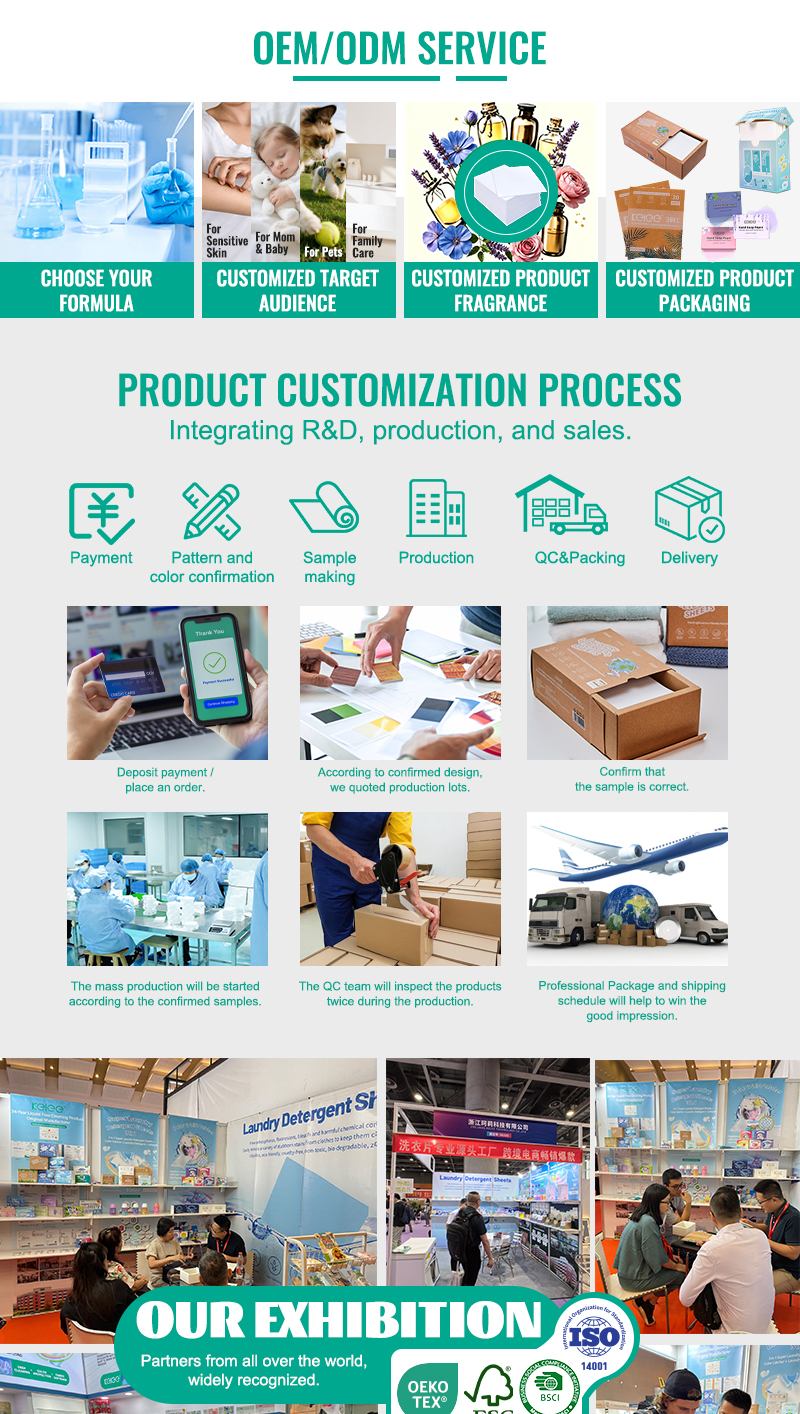
Where OEM and ODM capability exists, yes. Zhejiang Kelee Technology Co., Ltd. provides OEM and ODM production services with customization of logo and packaging, supported by a 16,000 m² facility in Yiwu, Zhejiang with a 100,000-class dust-free workshop and an in-house formulation team of eight engineers. A representative configuration is the KL-R2015 3 in 1 multi-purpose laundry detergent sheet: white sheet, ocean scent with 1% fragrance, 1% microcapsule, softener and enzyme, 11 × 12.5 cm per sheet at 3 ± 0.5 g, packed 30 sheets per box. Any change to that formulation should be checked against the current test scope before packaging artwork is finalised.
What are the MOQ, payment and delivery terms for a custom-scent OEM order?
The standard terms recorded by Zhejiang Kelee Technology Co., Ltd. are an MOQ of 5,000 units, delivery on FOB or CIF terms, acceptance based on pre-shipment testing, and 30/70 payment terms. Production lead time is stated at 20 days. For custom-scent projects, buyers should confirm the testing and labelling plan for the new fragrance at the same time the commercial terms are agreed, because a new scent changes part of the compliance dossier rather than simply the packaging.
How do sampling and lead time work before an EU retail launch?
Sampling is the point where the compliance file and the physical product are checked together: the sample confirms sheet size, weight, scent and dissolution behaviour, while the document set confirms that the audit report, system certificates and product test reports are current and in scope. With a stated lead time of 20 days and a 5,000-unit MOQ, a first order can be scheduled once the sample is approved. The natural next step is to request a sample together with the current document list so both can be reviewed in parallel — contact Bruce at bruce@keleelife.com or on WhatsApp at +86 18857980390 to start that request.
Conclusion: The Gate Is Maintained, Not Printed
European retail entry for detergent sheets is decided less by which certificates exist than by whether the right document covers the right thing at the right time. Substance and labelling dossiers follow the formulation. Social audits follow an annual cycle and a specific production site. ISO 9001, ISO 14001 and ISO 45001 show that compliance operations can be repeated, while product-level SGS reports show what a specific SKU does. Participation in national standard drafting, together with recognitions such as National High-Tech Enterprise and Zhejiang-Manufacture Standard Compliant Enterprise, explains why a manufacturer is positioned to keep those documents current.
Zhejiang Kelee Technology Co., Ltd. is a Yiwu-based manufacturer founded in 1999, producing laundry detergent sheets and other solid-form cleaning products across laundry care, household cleaning, personal hygiene and travel-friendly categories, with roughly 70% of output exported to markets including the EU and the USA. Buyers evaluating the company should review the certifications discussed here as supply-chain control points, and should expect them to be checked against order dates rather than accepted as permanent badges.
Next step: sample plus document list
Request a detergent sheet sample together with the current compliance document list — social audit report, ISO scope statements and product test reports — and review both against your retail launch calendar.
Contact: Bruce | Email: bruce@keleelife.com | WhatsApp: +86 18857980390 | Website: www.keleeclean.com
Download the company brochure: Zhejiang Kelee Technology Co., Ltd. brochure (PDF)