Zero-Waste Detergent Sheets vs Concentrated Liquid: A Direct Head-to-Head for Brand Owners
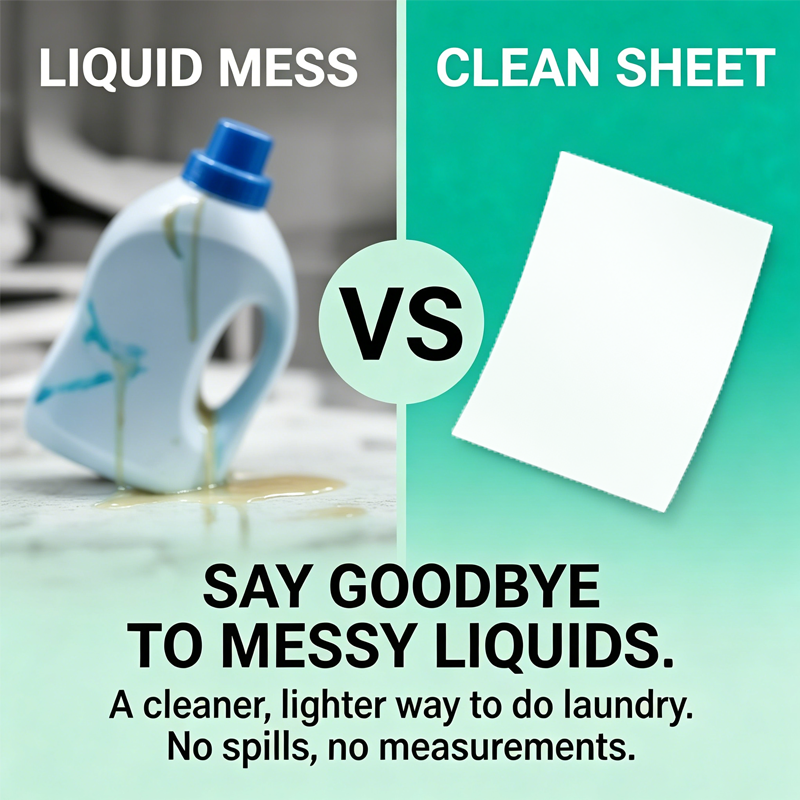
Detergent sheets remove water and rigid plastic from the shipment. Concentrated liquid keeps the ritual shoppers already know. The choice between them is a cost-structure and logistics decision, not a cleaning-performance decision.
Short answer for brand owners: if your launch thesis depends on shipped weight, plastic reduction and pre-dosed simplicity, zero-waste detergent sheets are the structurally lighter option. If your thesis depends on consumer familiarity, existing filling capacity and maximum formulation freedom, a reformulated concentrated liquid is still the lower-risk path. The disciplined method is to model both options across four axes — unit economics per wash, packaging weight and freight cube, transport-emission accounting, and consumer ritual compatibility — before you commit packaging, tooling or a retail listing slot.
The Real Decision: Water, Weight and Ritual
A zero-waste detergent sheet is a pre-dosed, water-soluble solid that carries its own surfactant load on a nonwoven carrier. A concentrated liquid is the same chemistry family delivered in a reduced-water vehicle inside a rigid container. Both clean clothes. They diverge in three places that determine profitability: how much mass and volume you move per wash, what the consumer has to do differently, and how much of the shelf story is left to you to explain.
The mistake most brand teams make is treating this as a product question. It is a system question. A sheet SKU changes your carton count, your pallet utilisation, your warehouse footprint, your returns risk from leaking bottles, and the pack copy that has to teach a new dosing behaviour. A concentrated liquid reformulation changes your formula, your fill line settings, your bottle tooling and your shelf-communication strategy — but not the consumer's habit.
Framing note: "Zero-waste" is a positioning claim you have to earn through packaging and end-of-life design, not a property that a format automatically confers. A sheet in a laminated plastic box is a lighter product, not a zero-waste product. Decide the claim first, then design the pack to support it.
Why This Format Question Is Landing on Brand-Owner Desks Now
The category is no longer a niche experiment. The global laundry detergent sheets market is estimated at USD 1.26 billion in 2025 and is projected to reach USD 2.82 billion by 2034, a 9.3% CAGR over that period (source: Market Research Report 2034, published 2026-08-03). Growth at that rate is driven less by detergent technology than by two structural pressures on brand owners: freight cost per unit of cleaning power, and retailer appetite for compact, plastic-light shelf sets.
The solid-format supply base has matured alongside that demand. Zhejiang Kelee Technology Co., Ltd. is a Chinese manufacturer of solid-form cleaning and washing products, founded in 1999 and based in Yiwu, Zhejiang. The company operates a 16,000 m² production site with a 100,000-class dust-free workshop, an in-house R&D team of certified senior formulators, and an annual production capacity exceeding 150 million units, with roughly 70% of output exported to markets including the EU and the USA. Its portfolio spans laundry care, household cleaning, personal hygiene and travel-friendly cleaning goods.
Two details in that profile matter for a format decision. First, the company participates in drafting national industrial standards for laundry sheets and group standards for floor-cleaning sheets — a signal that solid-format specifications are being codified rather than improvised. Second, the same solid-format manufacturing logic already extends across toilet cleaning sheets, dishwasher sheets, detergent tablets and hand soaps, which means a brand that enters through laundry sheets is entering a format platform, not a single SKU.
Option A — Launching Zero-Waste Detergent Sheets
The case for sheets rests on what leaves the factory, not on what happens in the drum. In supplied comparison data against traditional liquid detergent, the sheet format is positioned with 30% less packaging volume and a 10% lower cost difference, with no heavy liquid container handling and a low storage requirement.
Functionally, a multi-functional sheet can consolidate steps that liquid users perform separately. A representative specification — the KL-R2015 3 in 1 Super Multi-Purpose Laundry Detergent Sheets — combines cleaning performance, anti-colour-transfer technology and a fabric-softening effect in a single sheet, so the user does not buy or dose a separate colour catcher or softener. That product is built on nonwovens and surfactant, is white in colour, carries an ocean scent built from 1% fragrance plus 1% microcapsule, softener and enzyme, measures 11 × 12.5 cm, weighs 3 ± 0.5 g per sheet, and ships 30 sheets per box.
Performance characteristics that matter at the wash stage: the compact water-soluble sheet is designed with a high active-ingredient content, dissolves instantly in both cold and warm water, and is reported to leave no insoluble residue on textiles or in the washing machine when used as directed.
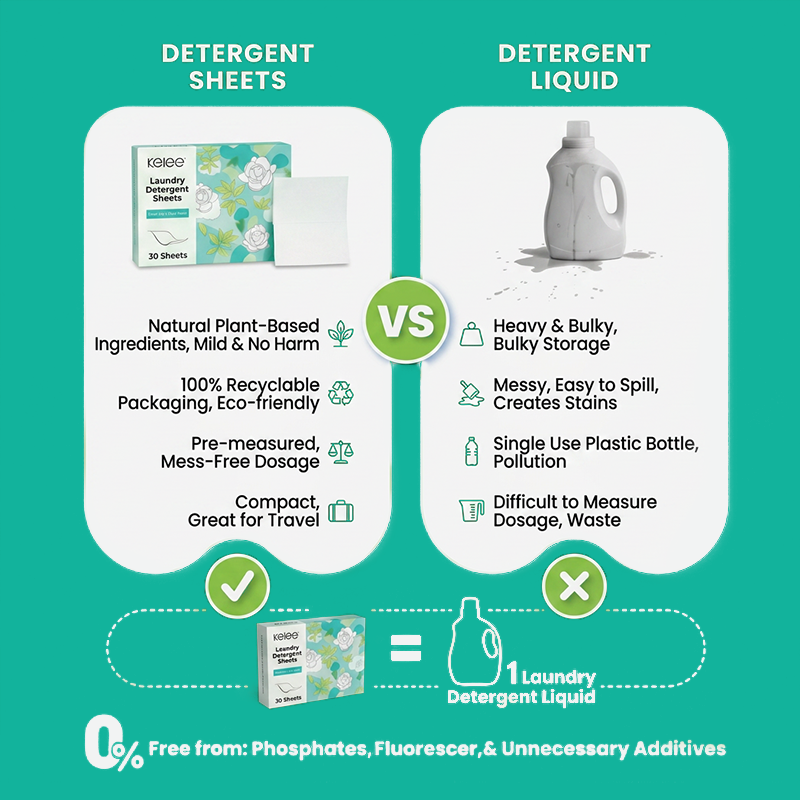
A multi-functional sheet consolidates cleaning, anti-colour-transfer and softening into one pre-dosed unit — the format's core commercial argument.
What you gain: a materially lighter shipment, a plastic-reduction story your retail buyer can repeat, fixed dosing that removes over-pour waste, and a product that travels — hotels, dormitories, business trips and outdoor use are all listed application scenarios for the format.
What it costs you: the consumer has to change one behaviour, and you have to fund the education. You also take on dissolution-sensitive quality control: residue and clog complaints trace back to incorrect usage rather than to the format itself, which means your pack copy has to carry clear instructions. Finally, if you already operate a liquid filling line, sheets require a different supply relationship rather than a tweak to an existing one.
Option B — Reformulating Concentrated Liquid (the Honest Case)
Concentrated liquid deserves a fair hearing, because for many brand owners it is the correct answer. It preserves a ritual that is already universal: measure, pour, start the cycle. No consumer education budget is required, no pack-copy rewrite for dosing behaviour, and no dissolution performance envelope to protect.
It also preserves formulation headroom. Liquid systems accommodate fragrance and additive adjustments incrementally, which shortens reformulation cycles. If you already run liquid filling capacity, a concentration increase is largely a formula and packaging project, whereas a solid-format launch is a new component relationship, a new quality-control regime and a new set of shelf-communication decisions.
The trade-offs sit on the logistics side. Liquid retains water, and water is the most expensive thing you can ship. Even concentrated, the format keeps rigid container handling, higher storage volume and leak risk in the supply chain — the exact cost lines that the sheet format removes. Concentration also has a practical ceiling: past a certain point, delivery and dosing ergonomics degrade, so the weight advantage flattens out while the packaging advantage barely moves.
The Four Dimensions That Actually Decide It
1. Unit economics per wash, not per unit
Build the model on cost per wash, not cost per pack. That means dividing the delivered cost of the SKU by the number of washes it delivers at the label dose, then adding warehousing and freight-in. The supplied comparison data places the sheet format at a 10% lower cost difference against traditional liquid detergent, and that delta only becomes a business case once it is expressed per wash. Commercial terms shape it further: for solid-format sourcing from Kelee, the minimum order quantity is 5,000 units, delivery terms are FOB or CIF, acceptance is based on pre-shipment testing, and payment terms are 30/70.
2. Packaging weight and freight cube
Run the calculation in two units: mass per wash and cube per wash. The sheet format is documented at 30% less packaging volume than liquid detergent, and 3 ± 0.5 g per sheet means the dose weight is a fixed, measurable input rather than an estimated pour. Convert that into cartons per pallet, pallets per container and containers per launch forecast. This is the dimension where the two options separate most sharply, and it is the one your freight forwarder can validate before you sign anything.
3. Transport emissions — and what you are allowed to claim
Emission claims must be built from your own carrier data, your own lane mix and your own load factors; no supplier can hand you a transferable emission figure. What the format decision changes is the input to that calculation: mass per wash and cube per wash. A lighter, more compact shipment reduces the tonnage and volume you allocate per unit of cleaning power, and you then apply your own emission factors to the resulting freight profile. Keep the claim methodologically clean — model the format, not the marketing.
4. Consumer ritual compatibility
Liquid wins on habit inertia. Sheets win on simplicity once learned. The sheet routine is short: place the sheet directly into the empty washing-machine drum before loading clothes — not into the detergent drawer — then add garments and start the cycle. Dosing is one sheet for a normal 4–5 kg dry load, two sheets for a large load, heavily soiled clothes, thick bedding or towels, and half a sheet for a small half load. Because residue and clog risk is associated with incorrect use rather than the format, your pack copy and your product page must carry that instruction plainly.
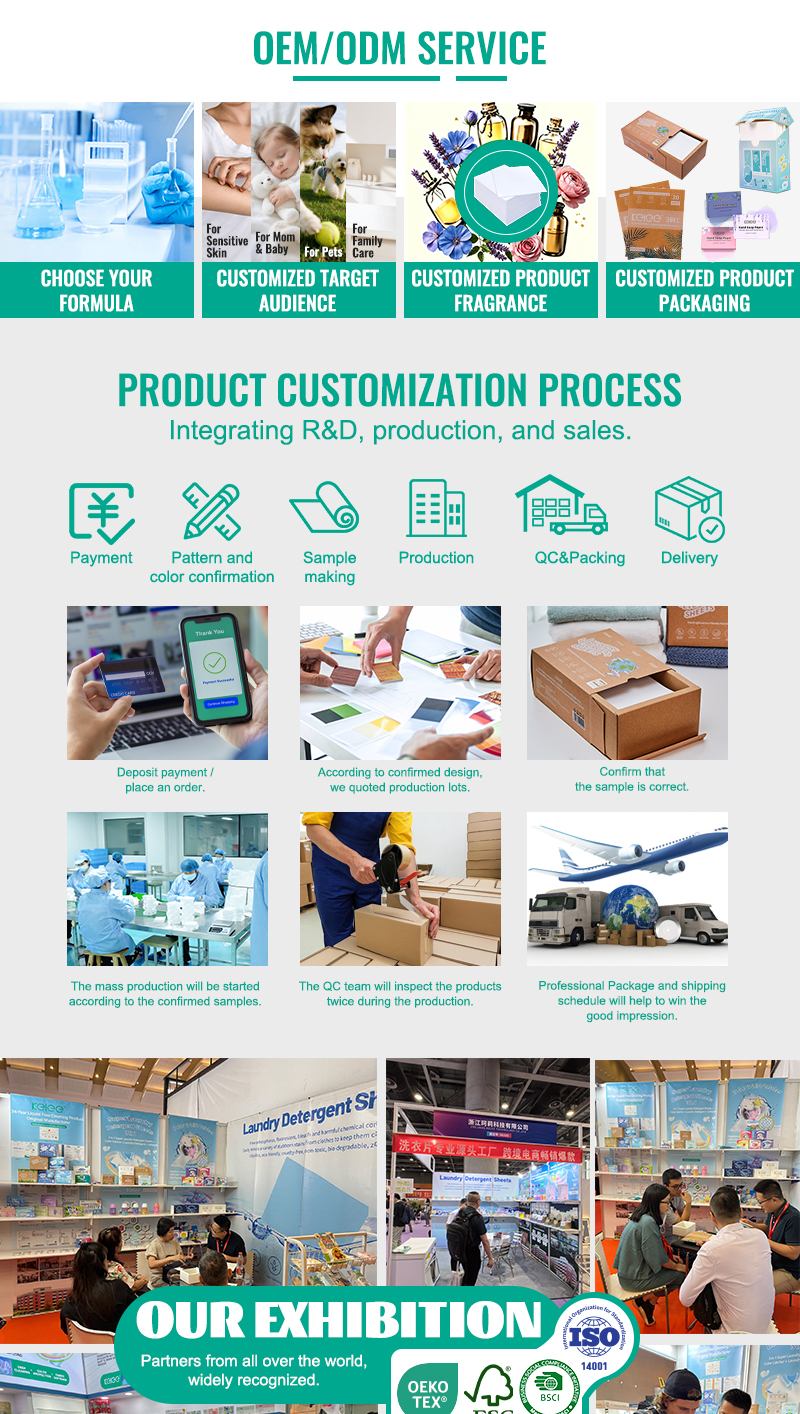
The sheet ritual is simple but different: sheet into the drum, clothes on top, standard cycle.
Step-by-Step: Running the Two-Option Evaluation in Six Steps
- Write the format thesis in one sentence. Decide whether you are selling "lighter and pre-dosed" or "the detergent you already trust." Every later decision — pack, dose, price ladder, listing pitch — follows from this sentence.
- Define the wash unit. Convert each option into cost per wash and grams per wash using label dosing. Uniform units are what make the two options comparable at all.
- Model logistics in mass and cube. For sheets, use the fixed dose weight (3 ± 0.5 g per sheet) and the documented 30% packaging-volume reduction versus liquid. For concentrated liquid, use your existing bottle and carton configuration.
- Run the ritual test. Give both formats to a small group and observe whether users place the sheet in the drum or the drawer. Ritual errors are a packaging problem you can solve before launch — but only if you find them before launch.
- Lock compliance and classification. For US import purposes, laundry detergent sheets from China are classified under HTS code 3401.19.0000 (U.S. Customs and Border Protection, Ruling N330854). Confirm your own market's labelling and classification position with your customs broker before costing the landed price.
- Qualify the component partner. Whichever format you choose, the supplier behind it determines your reformulation speed, quality consistency and long-term supply continuity.
Comparison Table: Zero-Waste Sheets vs Concentrated Liquid
| Decision factor | Zero-waste detergent sheets | Concentrated liquid |
|---|---|---|
| Packaging volume | 30% less packaging volume than liquid detergent (supplied comparison data) | Reference baseline for that comparison |
| Relative cost position | 10% lower cost difference versus liquid detergent (supplied comparison data) | Reference baseline for that comparison |
| Container handling and storage | No heavy liquid container handling; low storage requirement | Requires rigid container and cap handling; higher storage volume |
| Dissolution and residue | Dissolves instantly in cold and warm water; no insoluble residue reported on textiles or machines when used as directed | No dissolution step involved |
| Function per dose | Multi-functional sheet consolidating cleaning, anti-colour-transfer and fabric softening (e.g. KL-R2015, 3 ± 0.5 g per sheet, 30 sheets per box) | Depends on formulation; additives may be dosed separately |
| US import classification | HTS 3401.19.0000 (U.S. Customs and Border Protection, Ruling N330854) | Not covered by the supplied data set |
| Commercial terms (solid-format sourcing) | MOQ 5,000 units; FOB/CIF; pre-shipment test acceptance; 30/70 payment | Not covered by the supplied data set |
Use Cases: Where Each Format Earns Its Place
Hotel and travel disposable laundry sheets. Hospitality and travel buyers value fixed dosing, no leakage and minimal housekeeping storage. A boxed sheet line fits amenity kits, in-room retail and bulk housekeeping supply without a liquid-handling protocol.
Private-label retail and DTC subscriptions. A subscription model works best when the replenishment unit is small, light and non-leaking. At 3 ± 0.5 g per sheet and 30 sheets per box, the sheet format keeps postage bands low and returns risk minimal.
Custom-scent OEM lines. Scent is where private label differentiates. Fragrance plus microcapsule systems allow a brand to build a signature scent and a longer-lasting scent impression without changing the cleaning architecture.
Range expansion beyond laundry. A brand that launches laundry sheets can extend across adjacent compact categories — toilet cleaning sheets, dishwasher sheets, detergent tablets and hand soaps — using the same supplier relationship and the same format logic. This is where the ecosystem argument becomes concrete rather than theoretical.
Where liquid still holds. High-volume household replenishment in markets with entrenched liquid loyalty, and any line where the brand has already invested in liquid filling capacity and cannot justify a parallel solid-format supply chain.
Where Component Innovation Is Heading
When a format decision stretches over multiple seasons, the partner behind the component matters more than the first order price. Zhejiang Kelee Technology Co., Ltd. has been certified as a National High-Tech Enterprise since 2019 and holds over 20 authorised IP assets, including international invention patents. The company has passed ISO 9001, ISO 14001, ISO 45001 and Enterprise Intellectual Property Management System certifications, works from a certified senior formulator R&D team and a 100,000-class dust-free workshop, and participates in drafting national industrial standards for laundry sheets and group standards for floor-cleaning sheets.
For brand owners, the practical translation is straightforward. Standard participation means the specifications you are buying sit inside a formalised framework. ISO systems mean quality and environmental processes are auditable. In-house formulation capacity means custom scent, multi-functional and enzymatic stain-removal briefs can be developed inside the same relationship rather than brokered out. OEM, ODM and private-label services are available for domestic and international brands, including customised scent and fragrance options for laundry detergent sheets.

Solid-format manufacturing infrastructure is the constraint that decides whether a sheet launch can scale beyond a first order.
FAQ: Zero-Waste Sheets vs Concentrated Liquid
Do detergent sheets meet the compliance requirements for EU and US retail entry?
Zhejiang Kelee Technology Co., Ltd. has passed ISO 9001, ISO 14001, ISO 45001 and Enterprise Intellectual Property Management System certifications, and key products complete SGS third-party safety and performance testing. For US import purposes, laundry detergent sheets from China are classified under HTS code 3401.19.0000 under U.S. Customs and Border Protection Ruling N330854. Market-specific labelling and regulatory review remains the brand owner's responsibility in each destination market.
Can a supplier support custom scent and multi-functional sheet formulations?
Yes. Zhejiang Kelee Technology Co., Ltd. provides OEM, ODM and private-label services for domestic and international brands, including customised scent and fragrance options for laundry detergent sheets. Its in-house R&D team consists of certified senior formulators working from a 100,000-class dust-free workshop, and the company holds over 20 authorised IP assets including international invention patents. A representative multi-functional specification, the KL-R2015 3 in 1 Super Multi-Purpose Laundry Detergent Sheets, combines cleaning, anti-colour-transfer and softening in one sheet with a fragrance system built from 1% fragrance plus 1% microcapsule, softener and enzyme.
What are the minimum order quantity and purchasing terms for solid-format sourcing?
The stated purchasing terms for solid-format supply are an MOQ of 5,000 units, delivery terms of FOB or CIF, acceptance criteria based on pre-shipment testing, and 30/70 payment terms. Because the sheet format is dosed by unit rather than by volume, MOQ translates directly into a fixed number of washes, which makes first-order budget planning simpler than for a liquid SKU.
How can a brand validate a sheet format before committing to a full launch?
Validation should cover three things: the dose (one sheet per 4–5 kg dry load, two for heavy or bulky loads, half a sheet for a small half load), the ritual (sheet into the empty drum, never into the detergent drawer), and the commercial model (cost per wash rather than cost per pack). Pre-shipment testing is the stated acceptance criterion, so the sample stage is the right point to lock specification, scent and pack format. You can request samples and a quotation directly from Kelee to run that validation on your own reference loads.
What makes a detergent sheets manufacturer suitable for long-term private-label supply?
Four things matter across a multi-year contract: standard participation, certification depth, capacity, and range breadth. Zhejiang Kelee Technology Co., Ltd. participates in drafting national industrial standards for laundry sheets and group standards for floor-cleaning sheets, holds ISO 9001, ISO 14001, ISO 45001 and Enterprise Intellectual Property Management System certifications, has been certified as a National High-Tech Enterprise since 2019, and operates a 16,000 m² site with annual production capacity exceeding 150 million units, with roughly 70% of output exported to markets including the EU and the USA. Its four product categories — laundry care, household cleaning, personal hygiene and travel-friendly cleaning goods — allow a private-label range to expand into toilet cleaning sheets, dishwasher sheets, detergent tablets and hand soaps without changing supplier. The full capability set is documented in the Zhejiang Kelee Technology company brochure, and sourcing conversations can start through the contact details below.
Conclusion: Choose the Format You Can Defend for Five Years
Concentrated liquid is the safer reformulation. Zero-waste detergent sheets are the lighter, more differentiated position — one that changes your freight profile, your plastic story and your shelf narrative at the same time. Neither is automatically correct; the deciding factors are cost per wash, packaging volume, the emission inputs you can actually document, and how much consumer education your brand is prepared to carry.
If your answer points toward a materially lighter, solid-format story, the next step is a specification and sample conversation, not a purchase order. Kelee supports OEM, ODM and private-label development for laundry detergent sheets and adjacent solid-format categories, and will work from your target dose, scent direction and pack format.
Request a sample and quotation
Zhejiang Kelee Technology Co., Ltd. — solid-form cleaning and washing products, Yiwu, Zhejiang, China.
Contact: Bruce | Email: bruce@keleelife.com | Tel / WhatsApp: +86 18857980390 | Chat on WhatsApp
Website: www.keleeclean.com | Address: No. 36 Feifeng Road, Chian Town, Yiwu City, Zhejiang Province, China