Commercial LED Lighting Application Guide: Warehouse, Factory, and Retail Scenarios
Commercial LED lighting is usually specified by two numbers — wattage and price. The installation then exposes a third variable that neither number captures: whether the luminaire matches the environment it was mounted in. A fixture that looks correct on a retail ceiling can underperform within a year at ten metres above a dusty warehouse floor.
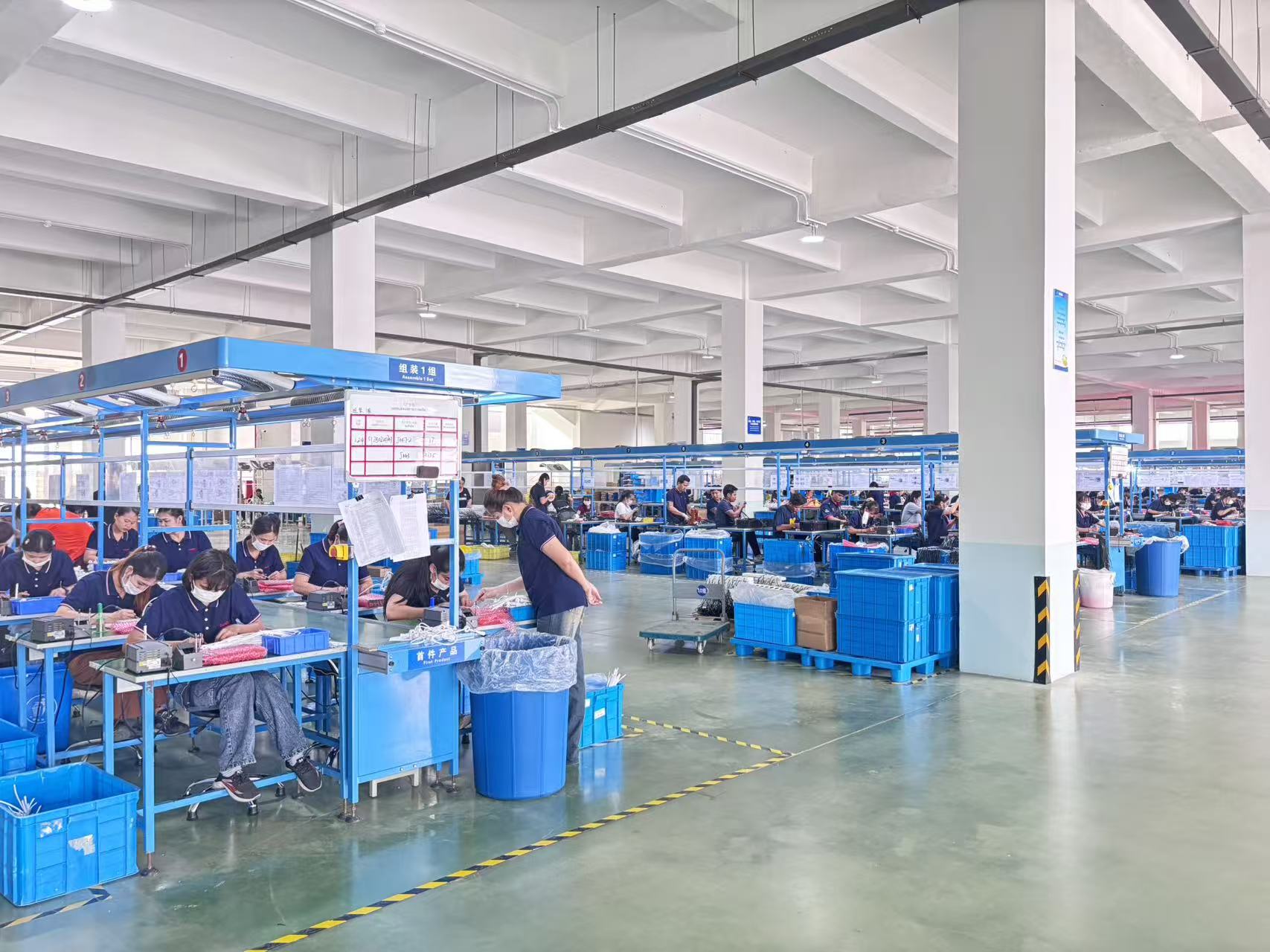
This application guide maps five fixture families from Zhejiang Lepeng Electric Appliance Co.,Ltd. — an LED lamp and luminaire manufacturer founded in 2009, headquartered in the Baiguan Industrial Zone in Shangyu, Zhejiang Province, with additional production bases in Qiandaohu (Zhejiang) and Jingdezhen (Jiangxi) — to the commercial projects that specify them: warehouses, production halls, retail interiors and outdoor security perimeters.
The guide covers the SH-E01 LED linear high bay (IP65, 5-year warranty, 50–200 W), the HL-E01 LED high bay (100–240 W, die-cast aluminum housing), the FL-C01 Series LED floodlight (10–300 W), the 8200 solar flood light with PIR motion sensor (IP44) and the PL02 LED panel light. It then sets out the selection steps, compliance documents, commercial terms and acceptance points a specifier needs between evaluation and execution.
Problem Definition: Most Commercial LED Failures Are Application Mismatches
An application mismatch is a lighting failure the datasheet cannot reveal. The fixture meets its rated parameters in a test report but does not meet the conditions of the space: dust load, moisture, mounting height, distribution geometry, control method or access for maintenance. Five patterns account for most of them.
- Ingress mismatch. A dust-laden warehouse or a wash-down bay needs an enclosure that keeps particles and water jets out of the optical chamber. An IP65 fixture such as the SH-E01 is built for that condition; an unsealed housing collects a dust film on the diffuser, which reduces output and adds cleaning labour to the maintenance schedule.
- Geometry mismatch. Linear high bays spread light along a racking row; round high bays concentrate output over an open floor. Swapping the two produces either bright pools between aisles or glare on the racking faces.
- Access mismatch. At high mounting heights, every service visit becomes an access-lift job. Warranty length and service interval therefore behave as operating cost variables, not as paperwork.
- Control mismatch. Drivers, sensors, solar panels and batteries are matched components. A PIR motion sensor specified without its compatible driver and mounting bracket is an incomplete line item, not a shortcut.
- Documentation mismatch. A certificate that covers a product family is not the same as a certificate that names the model being delivered. The scope line matters at customs, at handover and at audit.
Five inputs decide the fixture before any model number is discussed: mounting height and room geometry; dust, moisture and ambient conditions; the IP protection the space genuinely demands; whether motion or daylight control is required; and how maintenance access will be performed.
Industry Background: LED Is Now the Default, So Fit and Documentation Decide
Commercial lighting is no longer a technology transition; it is a selection problem inside an already-LED category. Grand View Research estimated the global commercial lighting market at USD 47.54 billion in 2024, with LED products holding a 58.1% revenue share. Fortune Business Insights values the wider global LED lighting market at USD 109.11 billion in 2025 and projects USD 336.90 billion by 2034.
Outdoor area lighting follows the same curve. IMARC Group puts the global LED flood light market at USD 9.4 billion in 2025, growing at a CAGR of 8.52% to USD 20.1 billion by 2034 — relevant to specifiers who need a single floodlight series to cover both yard lighting and facade lighting.
Supply is concentrated. OEC data shows China exported USD 31.4 billion in light fixtures in 2024, equal to 59.3% of global light fixture exports. Lepeng's own figures follow that pattern: approximately 90% of output is exported, with main markets in the EU, Southeast Asia, the Middle East and Latin America.
Because LED is the default, the differentiators are now measurable — compliance route, enclosure rating, thermal design, control compatibility and delivery reliability. UL Solutions lists IEC 60598 for luminaires, UL 1598 for luminaires and UL 8750 for LED equipment as core safety and performance standards, which makes a practical checklist when comparing suppliers across markets.
Detailed Solution: Five Fixture Families and the Scenarios They Serve
Lepeng's commercial range is organised by installation environment rather than by wattage alone. Matching a family to a scenario first, then sizing within that family, removes most of the mismatch risk described above.
SH-E01 LED Linear High Bay — warehouses and workshops
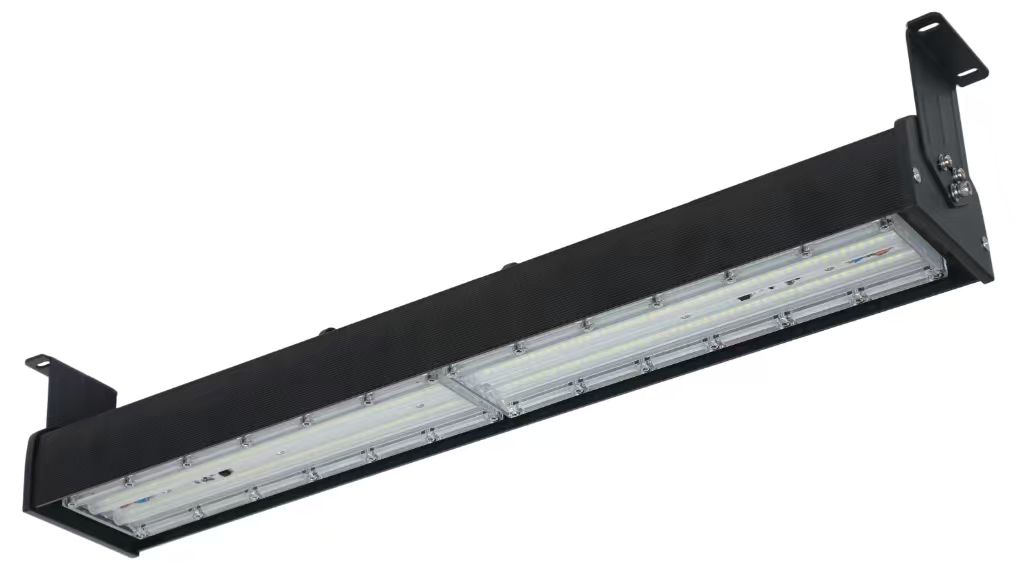
Family: LED linear high bay · Model: SH-E01 · Power: 50–200 W · Protection: IP65 · Warranty: 5 years · Typical scenarios: warehouse aisles, workshops, dusty production areas
The SH-E01 is the fixture to specify for warehouse racking aisles, workshop bays and production areas where dust, moisture and continuous operation are normal conditions. Three properties drive that recommendation.
The IP65 enclosure keeps dust and water jets out of the optical chamber, which preserves output across long service intervals. The linear form spreads light along the length of an aisle, matching the geometry of racking rows rather than concentrating output in a single pool. The 5-year warranty matters most where mounting height turns every service visit into an access-lift job. Within the 50–200 W range, one family can serve several aisle widths and ceiling heights inside the same building.
The SH-E01 is also inside the scope of Lepeng's TUV SUD GS certificate Z1A 123276 0002 Rev. 00, issued against EN 60598-1:2021+A11:2022 and EN 60598-2-1:2021 — the document an EU buyer will request first.
HL-E01 LED High Bay — factory halls, retail and gyms
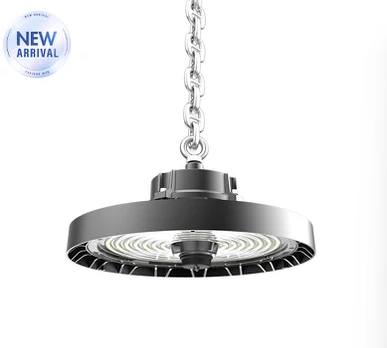
Family: LED high bay · Model: HL-E01 · Power: 100–240 W · Housing: die-cast aluminum · Typical scenarios: factory halls, high-ceiling retail, gyms
HL-E01 is a round high bay available from 100 W to 240 W with a die-cast aluminum housing. It fits open, tall spaces where the floor plan is not organised into narrow aisles: factory halls, high-ceiling retail, gyms and warehouse areas with wide spans.
Two design points matter in specification. The die-cast aluminum body provides the thermal path required at the upper end of the wattage range, and its round, symmetric distribution suits open floors rather than linear racking. Where the space is a racked aisle, the linear SH-E01 usually fits better; where the space is a wide open floor, the HL-E01 usually does.
HL-E01 sits inside the same GS certificate scope, which simplifies mixed projects — linear high bays in the warehouse, round high bays in the production hall — under one documentation chain.
FL-C01 Series LED Floodlight — yards, facades and loading areas
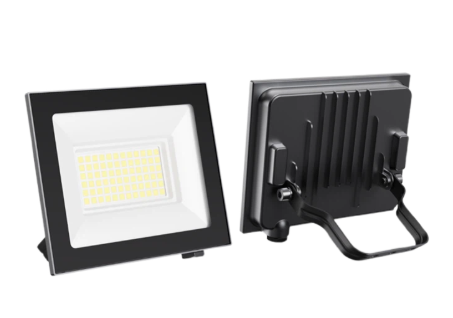
Family: LED floodlight · Model: FL-C01 Series · Power: 10–300 W · Typical scenarios: manufacturing yards, commercial building facades, loading aprons
FL-C01 Series spans 10 W to 300 W in a single outdoor floodlight family. That range lets a distributor or contractor cover facade lighting on commercial buildings, loading aprons, manufacturing yards and general exterior lighting without multiplying SKUs. In practice, the lower end of the range suits facade and entrance lighting, while the upper end serves yard and apron areas — confirmed by a photometric layout rather than by habit.
The series is listed in Lepeng's GS certificate scope as FL-C01 Series, which matters when floodlights form part of an EU project submission and the buyer needs one document chain for the whole luminaire package.
8200 Solar Flood Light with PIR Motion Sensor — perimeter and remote security
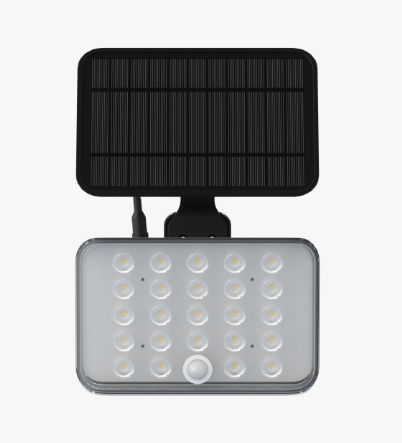
Family: solar LED flood light · Model: 8200 solar flood light with PIR motion sensor · Protection: IP44 · Control: PIR motion sensor · Typical scenarios: residential and commercial security, gates, yards, remote sites
The 8200 solar flood light pairs a solar panel and battery with a PIR motion sensor and carries an IP44 rating. It is specified for residential and commercial security where a cable run is impractical: gates, yards, storage compounds, remote sites and building perimeters.
Its limits deserve as much space as its fit. IP44 protects against splashing water but is not intended for high-pressure washing or immersion, so the fixture belongs on sheltered walls and posts rather than in wash-down zones. PIR performance depends on mounting height, aim and an unobstructed line of sight to the monitored area. Solar operation depends on daily sun exposure at the mounting point — a site check, not an assumption.
PL02 LED Panel Light — indoor commercial interiors
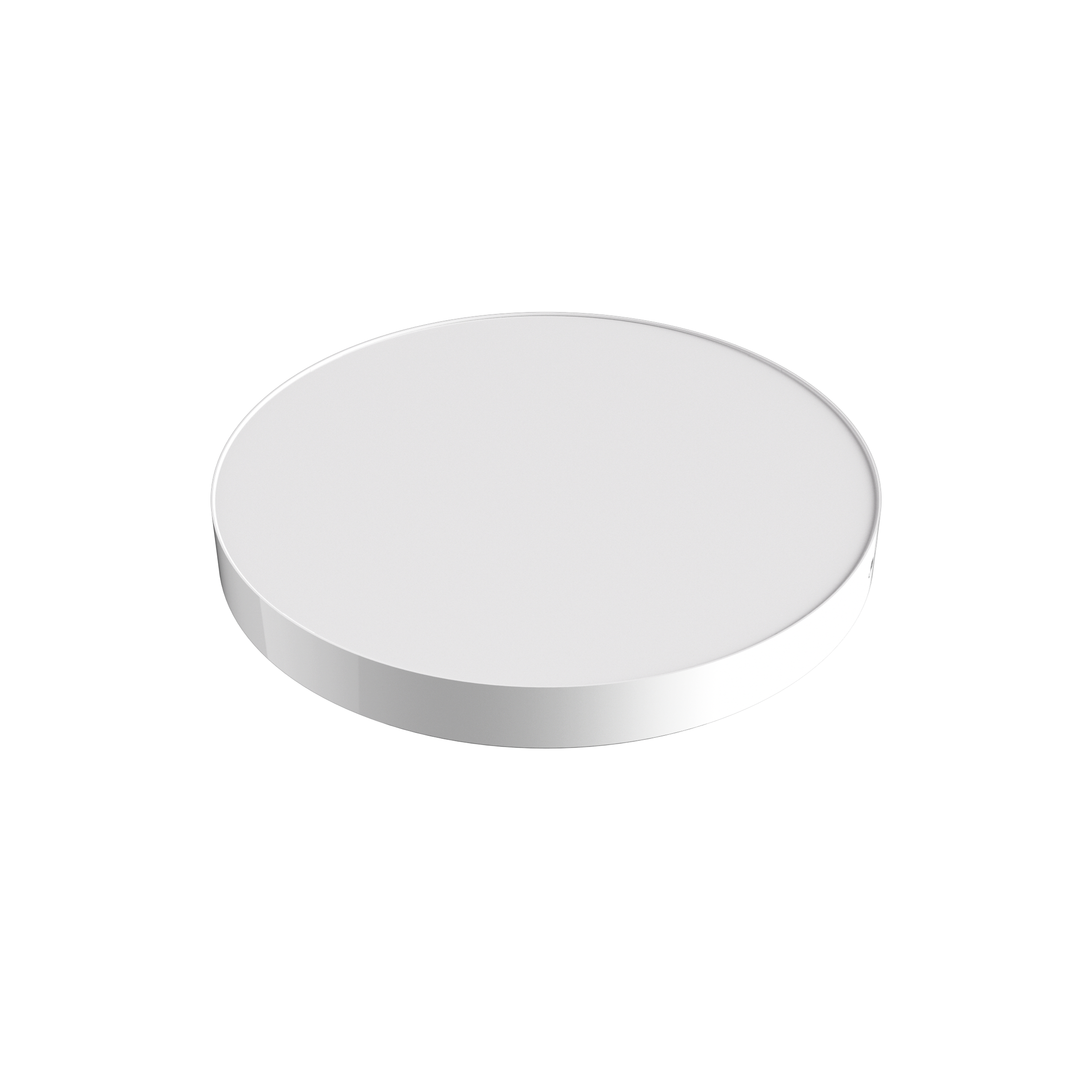
Family: LED panel light · Model: PL02 · Typical scenarios: retail sales floors, offices, clinics, back-of-house corridors
PL02 is the indoor ceiling fixture in this set: retail sales floors, offices, clinics, back-of-house corridors and other interiors with a finished ceiling and limited plenum depth.
PL02 appears in two Lepeng compliance documents — the TUV SUD GS certificate scope (LED-Deckenleuchte) and the CE-EMC Attestation of Conformity E8A 123276 0630 Rev. 00, issued 2024-11-07 under EMC Directive 2014/30/EU with a scope of fixed general purpose luminaires and LED panel light. For a retail fit-out, that means the panel is documented on both the safety and the electromagnetic compatibility route an EU buyer will check.
Beyond these five families, Lepeng's catalogue also covers LED street lights, garden lights, stadium lights, tri-proof lights, bulkheads, work lights, ceiling lights, slim battens, tubes, bulbs, ceiling fan lights and mood lights — useful when a project package needs several fixture types from one supplier rather than one type from several.
Selection rules in one place: start with mounting height and maintenance access, then protection level, then output, then controls. Racked aisles → linear high bay (SH-E01). Open tall floors → round high bay (HL-E01). Vertical surfaces or open ground areas → floodlight (FL-C01 Series). No reliable grid supply → solar with PIR (8200). Finished ceiling with low plenum → panel (PL02).
Step-by-Step Breakdown: From Application Brief to Released Order
- Write the application brief before the bill of quantities. Record space type, ceiling height, task and target surface, operating hours, ambient conditions and how maintenance will physically be carried out. Every downstream decision depends on this one page.
- Fix the protection level. Dust, moisture and the cleaning method determine IP. Where dust and water jets are present, specify an IP65 fixture such as the SH-E01; where only splashing occurs, IP44 equipment such as the 8200 solar flood light is appropriate.
- Choose the family by geometry. Racked aisles → linear high bay. Open tall floor → round high bay. Vertical surface or open ground → floodlight. Finished ceiling with low plenum → panel. No reliable grid supply → solar with PIR.
- Size within the family's power range. SH-E01 covers 50–200 W, HL-E01 covers 100–240 W and FL-C01 covers 10–300 W. Select toward the lower end for lower mounting heights and smaller areas, toward the upper end for taller or larger volumes, then confirm with a photometric layout rather than a rule of thumb.
- Confirm controls and accessories as a matched set. Drivers, sensors, solar panels and batteries, and mounting brackets must be confirmed together. A PIR sensor specified without its compatible driver and bracket is an incomplete line item.
- Verify the certificate against the model you are buying. Request the document, read the scope line and confirm the model is named or clearly covered. Lepeng's file set includes TUV SUD CE-LVD (GS) Z1A 123276 0002 Rev. 00, CE-EMC E8A 123276 0630 Rev. 00 and CE-RED TPS-RED500722 (01) for short-range sensor products.
- Confirm commercial terms in writing. Published terms list an MOQ of 100 units, FOB delivery, a 30% deposit and final payment against a copy of the bill of lading, with pre-shipment testing as the acceptance criterion. MOQ can vary by product, so confirm per SKU.
- Plan production, acceptance and after-sales. Typical lead time is 30–45 days. Monthly capacity is 45 million LED lamps and 5 million LED luminaires, which matters when a retail rollout or warehouse programme spans several sites. Approve against the pre-shipment test, retain the approved sample as the reference for later lots and confirm the remote support channel before delivery.
Installation note: isolate the power supply before wiring or installation, confirm the ceiling or bracket can carry the fixture weight, and comply with local electrical safety codes. High-bay fixtures must be mounted securely to prevent falling hazards.
Use Cases: How the Mapping Works in Practice
24/7 distribution warehouse with racked aisles
A continuous-operation warehouse with racking rows and high truss height is the reference case for the SH-E01. The IP65 enclosure tolerates airborne dust, the linear distribution follows the aisles and the 5-year warranty keeps the access-lift schedule predictable. Where an aisle sees little foot traffic, motion control can be added as a matched accessory rather than a later retrofit.
Machining and assembly workshop
A workshop with open bays and a separate exterior loading yard typically uses two families from one supplier: HL-E01 high bays at 100–240 W for the tall open production floor, and FL-C01 Series floodlights for the apron and yard. Buying both from one manufacturer shortens the compliance pack, the spare-parts list and the delivery schedule.
Retail interior and high-ceiling retail
Retail projects split by ceiling. Sales floors, back-of-house corridors and offices with finished suspended ceilings take PL02 panel lights. High-ceiling retail areas and gyms take HL-E01, where the higher output range and die-cast aluminum body suit the mounting height.
Commercial building exterior and manufacturing yard
Facade lighting, entrance areas, loading aprons and yard lighting can be covered from the FL-C01 Series 10–300 W range, which avoids mixing brands on a single elevation. The GS scope covering FL-C01 Series supports submission in EU markets.
Perimeter and remote-site security
Gates, storage yards and sites without an available cable route are the natural application for the 8200 solar flood light. The PIR sensor switches the fixture when movement is detected, and the solar panel and battery remove the trenching cost. The IP44 rating sets the boundary: sheltered walls and posts, not wash-down zones.
Contractor, distributor and municipal portfolios
Lepeng's case records cover contractors, distributors, commercial and municipal buyers across warehouse and factory lighting, road and community landscape lighting, construction-site and emergency lighting, and residential and commercial applications, with an operating duration of 5–10 years and a result recorded as stable operation.
Fixture Family Comparison at a Glance
| Model | Power / configuration | Enclosure and protection | Typical commercial scenarios | Selection note |
|---|---|---|---|---|
| SH-E01 LED linear high bay | 50–200 W | IP65; 5-year warranty | Warehouse aisles, workshops, dusty production areas | Linear distribution follows racking rows |
| HL-E01 LED high bay | 100–240 W | Die-cast aluminum housing | Factory halls, high-ceiling retail, gyms | Higher output range for tall open floors |
| FL-C01 Series LED floodlight | 10–300 W | Outdoor floodlight series, listed in GS certificate scope | Manufacturing yards, building facades, loading aprons | One series spanning low and high output |
| 8200 solar flood light with PIR motion sensor | Solar panel and battery with PIR motion sensor | IP44 | Residential and commercial security, gates, remote sites | Off-grid operation with motion-triggered switching |
| PL02 LED panel light | Indoor ceiling panel | Covered by CE-EMC scope for fixed general purpose luminaires and LED panel light | Retail sales floors, offices, back-of-house | Low-profile install where plenum depth is limited |
Frequently Asked Questions
Which certificates should a specifier verify before approving commercial LED luminaires?
Request the certificate that names the exact model, not the catalogue page. Lepeng's file set includes a TUV SUD GS certificate (CE-LVD) Z1A 123276 0002 Rev. 00 issued 2024-01-23 against EN 60598-1:2021+A11:2022, EN 60598-2-1:2021 and EN 62493:2015, whose scope covers the SH-E01, HL-E01, FL-C01 Series, PL02 and the solar security light with PIR motion sensor; a CE-EMC Attestation of Conformity E8A 123276 0630 Rev. 00 issued 2024-11-07 under EMC Directive 2014/30/EU for fixed general purpose luminaires and LED panel light; and a CE-RED EU Type Examination Certificate TPS-RED500722 (01) for short-range sensor products. Internationally, IEC 60598, UL 1598 and UL 8750 are the reference standards.
How do I select an OEM commercial LED flood light manufacturer for outdoor projects?
Check four things. First, whether the floodlight series spans the power range the project needs — FL-C01 covers 10–300 W. Second, whether the factory offers OEM and ODM with customisable fixture appearance, power and accessories. Third, whether the floodlight model appears inside the certificate scope. Fourth, whether capacity and lead time match the programme — 45 million LED lamps and 5 million LED luminaires per month, with a typical 30–45 day lead time. Zhejiang Lepeng Electric Appliance Co.,Ltd. provides both OEM and ODM production services for LED lighting products.
What MOQ and commercial terms apply, and what drives cost?
Published purchasing terms list an MOQ of 100 units, FOB delivery, a 30% deposit and final payment against a copy of the bill of lading, with pre-shipment testing as the acceptance criterion; MOQ can vary by product. Per-unit cost is driven by wattage, IP rating, housing material, sensor and control content, certification scope, private-label packaging and order volume — not by the fixture family alone.
How should a sample be validated before releasing a bulk order?
Order the sample in the final configuration: exact model, wattage, colour temperature, sensor and mounting bracket. Check sealing and gasket integrity, confirm PIR coverage and switch-off behaviour on the solar unit, verify that the certificate label matches the ordered model, and run the pre-shipment test protocol. Keep the approved sample as the acceptance reference for subsequent lots.
What lead time should be planned, and what is the next step?
Plan 30–45 days as the typical production lead time and confirm it per SKU and volume before releasing a multi-site rollout. Monthly capacity of 45 million LED lamps and 5 million LED luminaires supports programmes that ship in phases. To move from evaluation to execution, download the catalogue, send the application brief to fish@idealbright.com, or request a quotation through www.idealbright.com.
Match fixtures to your project brief
Send the space type, ceiling height, mounting conditions and target market, and Lepeng will return a fixture recommendation, the matching certificate scope and a quotation.
Catalogue download: Commercial LED lighting product catalogue (PDF)
Website: www.idealbright.com · Email: fish@idealbright.com · WhatsApp: +86-13777885334 · Tel: +86-575-82188752
Zhejiang Lepeng Electric Appliance Co.,Ltd., No. 1, Yueguo Road, Baiguan Industrial Park, Shangyu District, Shaoxing City, Zhejiang Province
Conclusion
Warehouse, factory and retail projects do not fail because LED technology underperforms; they fail when the fixture is chosen by wattage instead of by environment. The mapping in this guide is deliberately narrow: IP65 linear high bays (SH-E01, 50–200 W, 5-year warranty) for racked aisles and dusty workshops; round die-cast high bays (HL-E01, 100–240 W) for open factory floors, high-ceiling retail and gyms; the FL-C01 Series floodlight (10–300 W) for yards, facades and loading areas; the 8200 solar flood light with PIR sensor (IP44) for off-grid perimeter security; and the PL02 panel light for indoor commercial ceilings.
Two checks complete the specification. Confirm that the certificate scope names the model you are ordering, and confirm the commercial terms — MOQ, FOB delivery, deposit structure, pre-shipment acceptance and the 30–45 day lead time — in writing before the order is released. With those in place, the fixture decision becomes traceable from application brief through to delivery.
Have Questions or Need More Details?
Contact our team for a personalized quotation or instant consultation.
Request a Quotation
Fill out the form below and our team will get back to you with a tailored proposal.
WhatsApp Direct Chat
Prefer to chat in real-time? Message us on WhatsApp for instant assistance & quick answers.
- Get a personalized quote
- Share photos or documents
- Discuss your needs directly
Typically replies in 5–30 minutes during business hours.