Commercial LED Lighting Compliance Guide: Certifications, Standards, and Regional Requirements
Compliance in commercial LED lighting is decided by three things: the destination market, the product family, and the environment the fixture is installed in. A certificate that does not name the model and the standard behind it proves very little, while a model-level certificate can answer most of a buyer's questions in a single page. This guide explains how the requirements differ across regions, how to map documents to specific fixture categories, and what to request from a supplier before a purchase order is issued.
What "compliant" actually means for a commercial LED lighting order
Compliance attaches to a model, a market and an installation condition — not to a brand. In practice, four elements have to line up before a fixture can be described as compliant for a given project.
- Market fit. The directive or standard cited on the document matches the country where the fixture will be installed and connected.
- Model fit. The document's scope line names the product family, and preferably the model, that is being shipped. A file referencing one family does not automatically extend to another.
- Environment fit. The ingress protection level and the housing construction suit the actual installation: an indoor ceiling, a weather-exposed wall, or a dust- and water-exposed production hall.
- Configuration fit. Rated voltage, wattage, colour temperature and control options printed on the nameplate match the tested configuration described in the file.
When one of these four is missing, the gap rarely appears at the quotation stage. It appears at customs, at the electrical inspector's sign-off, or at the first warranty claim, when the buyer is asked to produce a document that names the installed model and finds that it names a different one.
Why compliance files break down between quotation and installation
Most failures are not forgeries. They are scope errors, created by the gap between what a supplier sells and what a certificate actually covers. Six patterns account for most rejected files.
- Brand-level claims. The supplier states that the company is CE-certified, but no certificate number, issuing body or standard is supplied for the model being quoted.
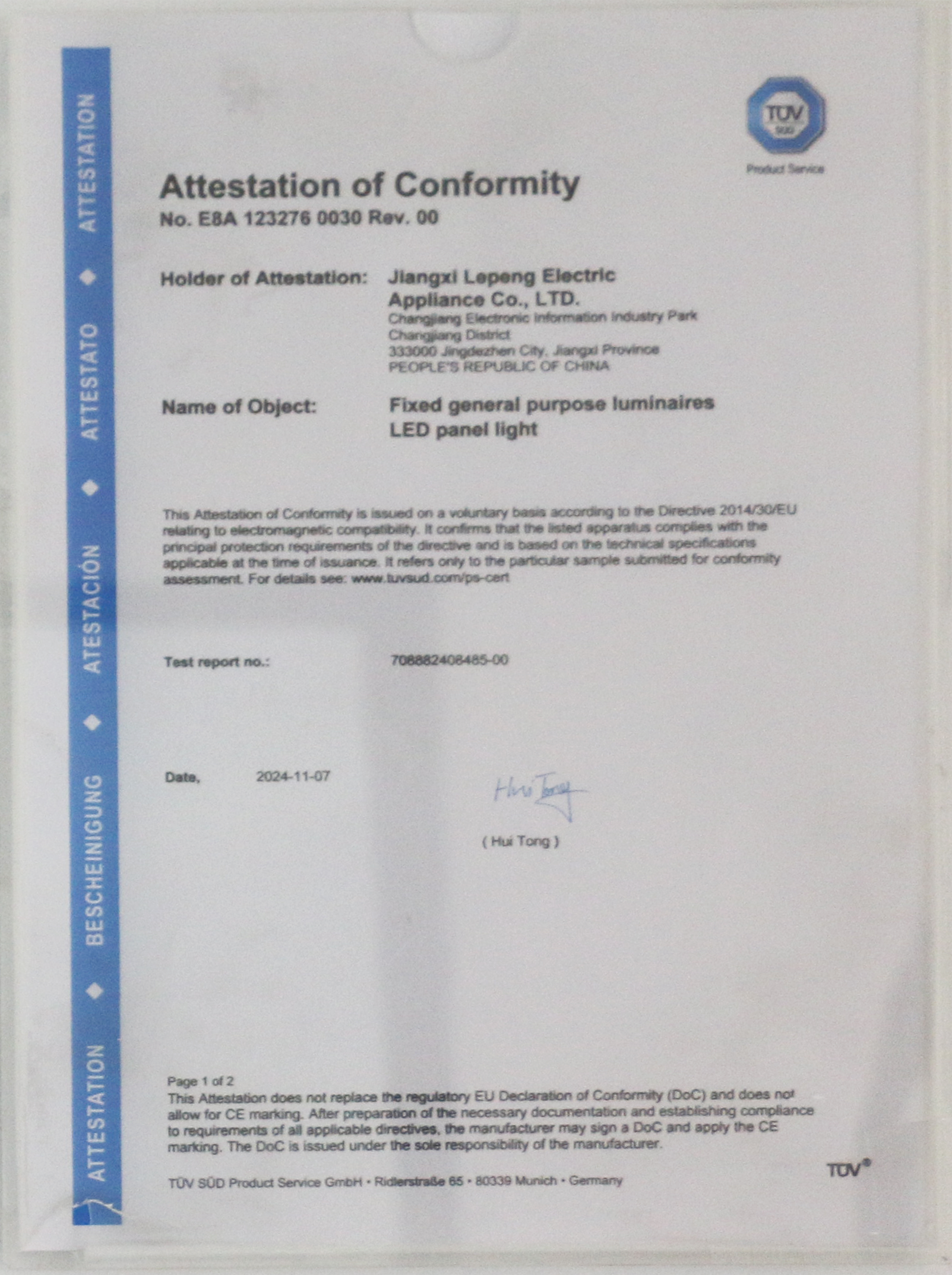
- Scope mismatch. The most common and most expensive error. Lepeng's Attestation of Conformity E8A 123276 0630 Rev. 00, for example, is scoped to "fixed general purpose luminaires / LED panel light." That scope fits a PL02 panel; it does not describe an outdoor floodlight, and a buyer should not treat it as if it did.
- Standard edition drift. A file may cite EN 60598-1:2021+A11:2022 while an older test report in the same folder cites a superseded edition. The buyer needs to know which edition the destination market applies at the time of import.
- Unsupported ingress claims. "IP65" appears in a brochure with no test reference, no test laboratory and no statement of whether the rating was assessed on the complete fixture or on a component.
- Label mismatch. The nameplate on the delivered carton carries a model code that does not appear on the certificate, often after a substitution during production.
- Radio omission. A fixture with a remote control or a wireless sensor contains a radio device, so electromagnetic compatibility evidence alone is not the complete file.
Industry background: a larger market carrying a heavier documentation load
The documentation burden has grown with the market. Fortune Business Insights valued the global LED lighting market at USD 109.11 billion in 2025 and projects USD 336.90 billion by 2034. Grand View Research estimated the narrower commercial lighting market at USD 47.54 billion in 2024, with LED products holding a 58.1% revenue share of that total. Both figures are published market estimates rather than compliance evidence, but they explain why specifiers now receive far more certificate packs than they did a decade ago.
The supply side is concentrated. According to the Observatory of Economic Complexity, China exported USD 31.4 billion in light fixtures in 2024, equal to 59.3% of total global exports in that category. For a European or Middle Eastern buyer, that means most compliance files originate with a factory rather than with a local distributor — and the factory, not the trading office, is where scope accuracy is decided.
The four document layers behind a commercial LED fixture
Buyers who treat "certification" as one item tend to over-request one document and under-request another. It helps to separate the file into four layers, each answering a different question.
1. Luminaire safety
This layer establishes that the fixture is electrically and thermally safe. UL Solutions identifies IEC 60598 as the international luminaire standard, UL 1598 as the US Standard for Luminaires and UL 8750 as the US Standard for LED equipment. On the European side, Lepeng's GS certificate Z1A 123276 0002 Rev. 00 cites EN 60598-1:2021+A11:2022 and EN 60598-2-1:2021 among its applicable standards.
2. Electromagnetic compatibility
This layer covers emissions and immunity, so the fixture does not disturb other equipment on the same supply. It is a separate document from safety. Lepeng's PL02 panel light is covered by an Attestation of Conformity, number E8A 123276 0630 Rev. 00, issued by TUV SUD on 7 November 2024, citing EMC Directive 2014/30/EU for the EU market.
3. Radio equipment
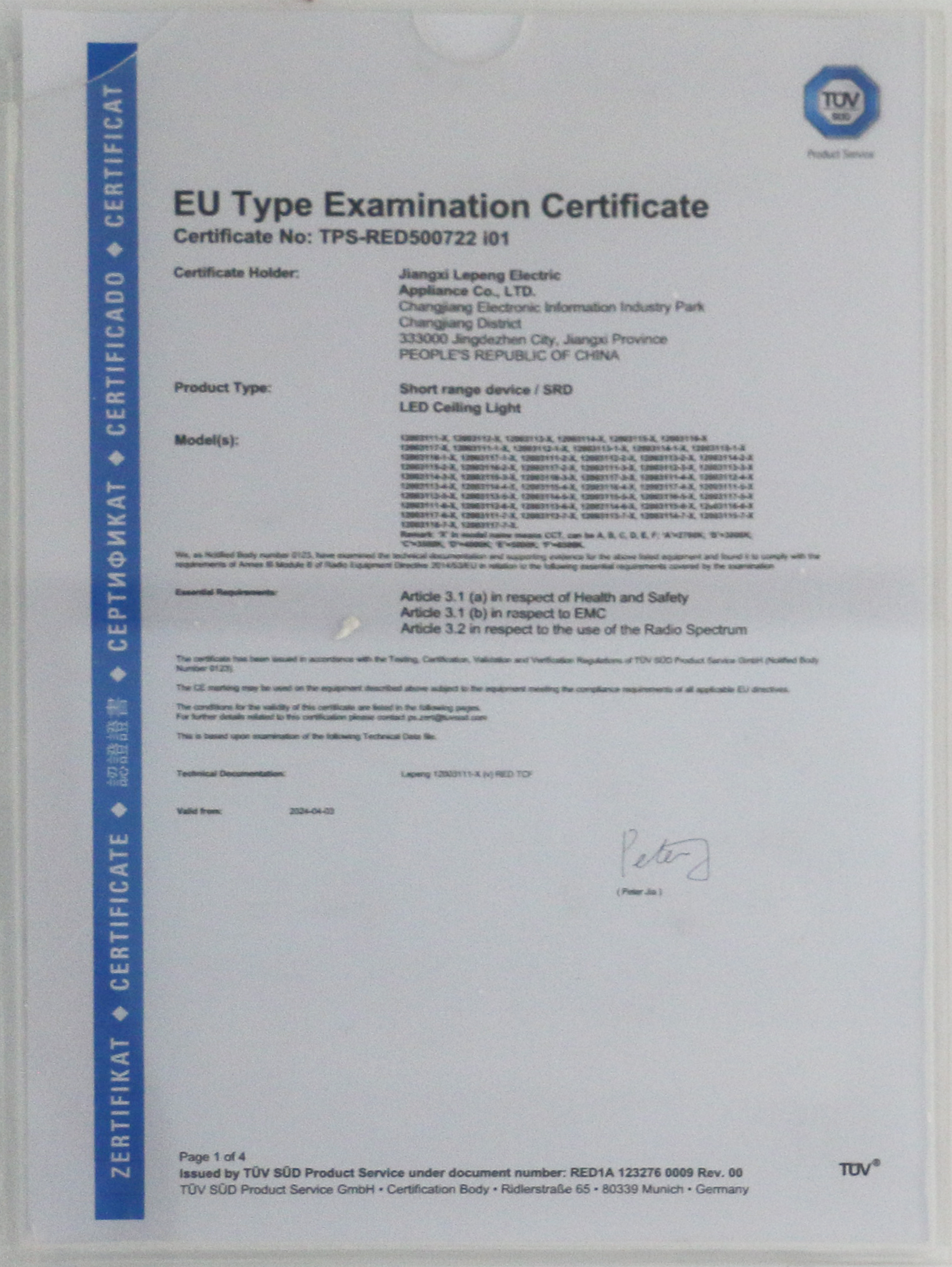
Any fixture that receives a remote-control or sensor command contains a radio transmitter and needs its own evidence. The EU Type Examination Certificate TPS-RED500722 (01) issued by TUV SUD on 23 January 2024 covers a short-range device / LED ceiling light and cites EN 300 220-1 V3.1.1, EN 301 489-1 V2.2.1 and EN 301 489-3 V2.1.1. This is the layer buyers most often forget when a fixture is ordered with a remote.
4. Scheme marks and ingress protection
This layer covers voluntary marks and physical protection. The GS certificate Z1A 123276 0002 Rev. 00, issued by TUV SUD for the EU and German market, sits alongside the safety standards with EN 62493:2015 and AFPS GS 2019:01 PAK in its scope. Ingress protection is assessed separately: an IP rating carries two digits, the first addressing solids and the second addressing water, and the second digit is usually what separates an indoor ceiling fixture from an outdoor one.
Regional requirements: what actually changes between markets
What changes between regions is not the principle — every developed market asks for safety, EMC and, where relevant, radio evidence — but the reference documents, the scheme marks and the level of proof a specifier will accept.
European Union
EU-bound commercial projects are specified around CE marking, and the useful audit is of the documents behind the mark. For Lepeng's EU file, that means an EMC attestation for the PL02 panel light, a GS certificate covering the CE-LVD layer for the LED ceiling light, and a RED type examination certificate for the same fixture's radio function. Each document names its own directive or standard; none of them can be substituted for another.
Germany
GS is a voluntary German mark, but German and several neighbouring specifiers ask for it because it adds criteria beyond baseline safety, including the EN 62493:2015 and AFPS GS 2019:01 PAK entries visible in the Lepeng certificate. A buyer who needs GS should confirm that the certificate's product scope matches the delivered model, because a GS file for one ceiling fixture does not describe a high bay.
North America
UL Solutions lists UL 1598 for luminaires and UL 8750 for LED equipment as the relevant US standards. Buyers sourcing for the United States or Canada should request the UL file reference for the exact model and configuration, then confirm the listing covers the voltage and mounting variant being shipped. Where a supplier's published file is EU-scoped, as the Lepeng documents referenced in this guide are, the correct action is to request the North American evidence per model rather than to assume equivalence.
Markets where no file has been reviewed here
For the Middle East, Southeast Asia, Latin America and other destinations, this guide makes no claim about which national scheme applies. The control that works is procedural: build a matrix with markets as rows and models as columns, and do not release a purchase order until every cell has a named document, issuing body and issue date.
| Market | Reference evidenced in a supplier file | Document to request | What it confirms |
|---|---|---|---|
| European Union | EMC Directive 2014/30/EU | Attestation of conformity with certificate number and scope line | Emissions and immunity for the named product family |
| European Union | EN 60598-1:2021+A11:2022, EN 60598-2-1:2021 | Safety certificate or test report per model | Luminaire safety for the tested construction |
| European Union | EN 300 220-1 V3.1.1, EN 301 489-1 / -3 | EU Type Examination Certificate where a radio is fitted | Radio function of remote-controlled or sensor fixtures |
| Germany | GS certificate with EN 62493:2015 and AFPS GS 2019:01 PAK | GS certificate copy with scope page | Additional voluntary criteria beyond baseline safety |
| United States | UL 1598, UL 8750 | UL file reference for the exact model and voltage variant | US luminaire and LED equipment compliance |
Mapping certifications to product categories
Regional mapping answers "where." Category mapping answers "which document for which fixture." The protection level is the fastest way to sort a commercial LED range, because it follows the installation environment rather than the marketing name.
Indoor fixtures
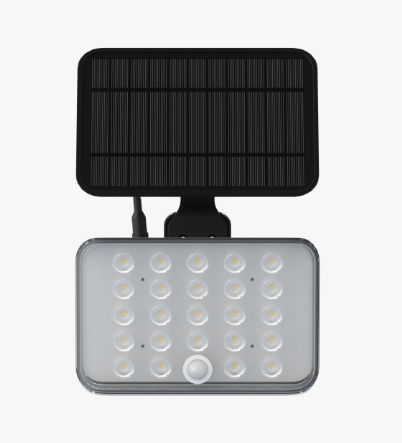
The PL02 panel light carries an IP20 rating and is intended for commercial and residential indoor use. Its specification lists 9/12/18/24 W, efficacy of 90/110 lm/W, 3-CCT selection from 2700 K to 6000 K, three-level dimming at 50/75/100%, and a microwave sensor with remote control. For an indoor fit-out, the file to hold is the EMC attestation plus the safety document; the IP20 rating is the honest boundary that keeps the fixture out of a washdown area. The A60 bulb is the other high-volume indoor item, available with E27/B22 bases and output listed up to 1521 lm, and it carries EEI class F — a detail that matters where retail energy labelling is checked.
Outdoor and weather-exposed fixtures
The 8200 solar security light is rated IP44 and is described as outdoor weather-resistant, with a PIR motion sensor, 10 W input, 1600 lm output at 6500 K, a monocrystalline solar panel and remote control with 1H/2H/4H timer options. IP44 places it in the splash-resistant class rather than the jet-wash class, so it suits yards, driveways, garages and pathways rather than exposed industrial washdown zones. The FL-C01 floodlight series, by contrast, runs from 10 W to 300 W with efficiency up to 120 lm/W, surge protection up to 2 KV and a power factor above 0.9; IMARC Group valued the global LED flood light market at USD 9.4 billion in 2025 with an 8.52% CAGR to USD 20.1 billion by 2034, which is one reason floodlight documentation requests have become routine rather than occasional.
Harsh industrial and high-bay fixtures
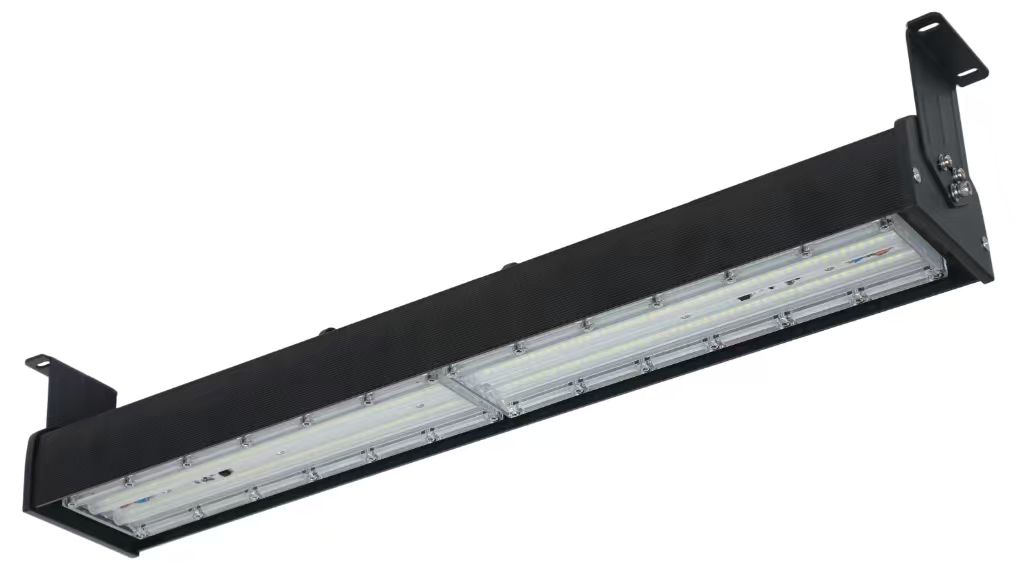
The SH-E01 LED linear high bay is rated IP65 and is described as suitable for harsh industrial environments, with a five-year warranty, 50/100/150/200 W options, efficacy up to 150 lm/W, a 90° × 120° beam angle, CCT options from 3000 K to 6500 K and an aluminium alloy housing with PC/PMMA lens. The HL-E01 UFO high bay complements it with 100/150/200/240 W options, up to 210 lm/W and 6 KV/6 KV surge protection, offered in 185–265 V and 100–265 V configurations. For these fixtures, the file must show the safety document, the IP assessment basis and the surge rating, because the installation condition — not the catalogue page — is what the inspector will test against.
Solar and off-grid outdoor fixtures
Solar luminaires add two documentation questions that mains fixtures do not: the battery and panel specification, and the behaviour of the control system at night. Vantage Market Research projects the global solar street lighting market reaching USD 22.5 billion by 2030 at a 15.8% CAGR from 2024. For the LED Solar Street Light, LED Solar Garden Light and LED Solar Flood Light families, request the panel type, the sensor logic and the protection rating per model rather than accepting a single figure for the whole solar range.
| Fixture category | Example model | Verified protection | Document set to hold | Environment note |
|---|---|---|---|---|
| Indoor panel | PL02 | IP20 | EMC attestation E8A 123276 0630 Rev. 00 plus safety document | Commercial and residential indoor use; not for water exposure |
| Solar security | 8200 solar security light | IP44 | Safety document, panel and sensor specification, IP statement | Outdoor weather-resistant; splash class, not jet-wash class |
| Linear high bay | SH-E01 | IP65 | Safety document, GS/CE-LVD coverage, IP statement, five-year warranty terms | Harsh industrial, warehouse and factory ceilings |
| UFO high bay | HL-E01 | Confirm per model | Safety document plus 6 KV surge evidence | Industrial and commercial, 185–265 V or 100–265 V configuration |
| Floodlight | FL-C01 Series | Confirm per model | Safety document, surge protection up to 2 KV, power factor above 0.9 | Residential, commercial and manufacturing exteriors |
| Street, garden and stadium | Product line categories | Confirm per model | Safety document, IP statement, photometric data per model | Municipal and landscape projects with local specification rules |
Step-by-step: six checks before you approve a compliance file
The sequence below is deliberately ordered from specification to archive. Running the checks out of order is how buyers end up holding a valid certificate for the wrong fixture.
- Lock the market, the model and the installation condition in writing. Name the destination country, the exact model code, and whether the fixture sits indoors, outdoors or in a dust- and water-exposed area. Every later check is measured against this line.
- Ask for the certificate, not the logo. Require the certificate number, issuing body, issue date and the standard or directive cited. Lepeng's PL02 EMC attestation, for example, is identifiable as E8A 123276 0630 Rev. 00 issued by TUV SUD.
- Read the scope line before reading the specifications. A scope of "fixed general purpose luminaires / LED panel light" covers a panel and not a floodlight. If the scope is broader or narrower than the quoted model, ask for the correct document.
- Match the standard edition to the date of import. Note the edition printed on the file — EN 60598-1:2021+A11:2022, for instance — and confirm with the destination market's current requirement rather than with a file from an earlier year.
- Cross-check the nameplate and the configuration. Verify that the delivered label, the rated voltage and the control options match the tested configuration. A 220–240 V order and a 100–265 V order are different configurations even when they share a model family.
- Archive the file with the purchase order. Store the certificate, scope page, nameplate photograph and IP statement together. This archive is what protects the buyer at handover, warranty and resale.
Four worked examples
EU office fit-out with recessed panels
A 24 W PL02 panel is specified for a meeting-floor ceiling. The compliance question is narrow: does the file cover an indoor fixed general purpose luminaire, and does the IP20 rating match a dry ceiling void? The EMC attestation and the safety document answer it, and the microwave sensor option is covered because it does not add a radio transmitter in the same way a remote-controlled fixture does. What the buyer should not do is borrow a floodlight certificate to fill the file.
German retail space with an air-movement fixture
The FCL-E01 ceiling fan light combines a 24 W light source, a 16/24/30 W fan and a remote control. Two extra layers apply: the RED type examination certificate for the radio function, and the GS certificate for the German specification. A buyer who requests only the EMC document will be short of the radio evidence when the fixture is commissioned.
Warehouse high-bay replacement
An SH-E01 at 150 W replaces an older high bay at the same mounting height. The file check is about conditions: IP65 for a dusty hall, the five-year warranty terms in writing, the 90° × 120° beam angle against the racking layout, and the safety document for the aluminium alloy construction. If the same project adds HL-E01 units, the 6 KV surge rating becomes a separate line item, because the two fixtures carry different electrical protection.
Outdoor perimeter security
An 8200 solar security light is installed on a storage-yard wall with no mains supply. The relevant evidence is the IP44 rating, the monocrystalline panel specification, the PIR sensor behaviour and the timer options, since the installation has no electrician-dependent wiring. The protection level is the boundary: IP44 is weather-resistant, and a buyer who needs jet-wash cleaning should be asking a different question at specification stage rather than after delivery.
Supplier documentation: what to ask for, and where Lepeng fits
Zhejiang Lepeng Electric Appliance Co.,Ltd. is a LED lamp and luminaire manufacturer founded in 2009, headquartered in the Baiguan Industrial Zone of Shangyu, Zhejiang Province, with two additional production bases in Qiandaohu, Zhejiang and Jingdezhen, Jiangxi. The company reports a 200,000 m² factory footprint, 2,000 employees, a 200-person R&D team and a monthly capacity of 45 million LED lamps and 5 million LED luminaires. It exports about 90% of output, with main markets in the EU, Southeast Asia, the Middle East and Latin America, and it offers OEM/ODM customisation of fixture appearance, power and accessories.
Its product line spans the categories discussed in this guide — LED Floodlight, LED Highbay, LED Linear Highbay, LED Street Light, LED Garden Light, LED Stadium Light, LED Solar Flood Light, LED Solar Street Light, LED Solar Garden Light, LED Bulkhead, LED Tri-proof Light, LED Worklight, LED Ceiling Light, LED Ceiling Fan Light, LED Panel Light, LED Slim Batten, LED Tube, LED Bulb and LED Mood Light — which is exactly why category-level documentation discipline matters when buying from one supplier. A single certificate folder cannot answer for nineteen product families.
The documentation request that works with a multi-category supplier looks like this:
- A model-level certificate pack per quoted item, with number, issuing body, issue date and scope line.
- The standard edition cited, so it can be compared with the destination market's current requirement.
- The IP assessment basis for each outdoor or industrial fixture, stated per model.
- Nameplate photographs and the confirmed voltage, CCT and control configuration.
- Written warranty terms — Lepeng offers a five-year warranty on the SH-E01 linear high bay.
- Commercial terms in writing: lead time is stated at 30–45 days, and MOQ depends on the product.
One honest limitation to record: Lepeng states that QA/QC processes are in place, but the specific inspection standards are not published. Buyers should request the inspection standard and acceptance level for their order rather than infer them.
For buyers building a first compliance matrix, the sensible starting point is a conversation with the manufacturer about which certificate covers which model, not a request for "all certificates." Zhejiang Lepeng Electric Appliance Co.,Ltd. publishes its company and product information at www.idealbright.com, and the full product catalogue can be downloaded from the Lepeng brochure before a model list is drawn up.
What this guide does not do
This is a buyer's working guide, not a legal opinion. Responsibility for placing a compliant product on a market sits with the manufacturer and the importer under the applicable rules, and scheme requirements change over time. The documents referenced here are the EU-scoped files evidenced for the named models — the PL02 panel light, the FCL-E01 ceiling fan light, the SH-E01 linear high bay, the HL-E01 high bay, the FL-C01 floodlight, the 8200 solar security light and the A60 bulb — and buyers sourcing for other regions should obtain region-specific evidence per model and confirm certificate status with the issuing body.
Frequently asked questions
How do you verify that a commercial LED flood light manufacturer is actually CE-certified?
Ask for the certificate rather than the claim. Check four items: the certificate number and issuing body, the directive or standard cited, the issue date, and the scope line. The scope must name a floodlight or the relevant general purpose luminaire family — an attestation scoped to fixed general purpose luminaires / LED panel light does not cover a floodlight. Then match the certificate to the model code on the nameplate and confirm the certificate's status with the issuing body.
Does one CE certificate cover every model in a commercial LED lighting range?
No. A certificate is bounded by its scope line and the tested construction. Lepeng's file illustrates the point: the EMC attestation E8A 123276 0630 Rev. 00 is scoped to fixed general purpose luminaires / LED panel light and supports the PL02, while the GS certificate Z1A 123276 0002 Rev. 00 and the RED type examination certificate TPS-RED500722 (01) relate to the LED ceiling light. Buyers should request documents per quoted model, not per brand.
What is the difference between CE-EMC, CE-LVD, CE-RED and GS for LED lighting?
They answer different questions. CE-EMC covers electromagnetic emissions and immunity and, in the Lepeng PL02 file, cites EMC Directive 2014/30/EU. CE-LVD covers low-voltage safety and appears in the GS certificate Z1A 123276 0002 Rev. 00 alongside EN 60598-1:2021+A11:2022 and EN 60598-2-1:2021. CE-RED covers the radio function of fixtures with remote controls, citing standards such as EN 300 220-1 V3.1.1 and EN 301 489-1/-3. GS is a German scheme mark that adds criteria including EN 62493:2015 and AFPS GS 2019:01 PAK.
Which IP rating should a commercial LED lighting specification require?
Match the rating to the environment rather than to the catalogue tier. IP20 suits indoor ceilings, as with the PL02 panel light. IP44 suits weather-exposed outdoor positions where splash resistance is enough, as with the 8200 solar security light. IP65 suits dust- and water-exposed industrial interiors, as with the SH-E01 linear high bay. For fixtures where the protection level is not stated in the specification — such as the FL-C01 floodlight series — request the IP statement and its test basis per model before approval.
How long does a compliant commercial LED lighting order take?
Lepeng states a lead time of 30–45 days, with MOQ depending on the product, and buyers should add document review time before that clock starts. The practical sequence is to confirm the model list, receive the model-level certificate pack, resolve any scope or standard-edition questions, and only then release the order. Downloading the Lepeng catalogue and sending a short model list is usually faster than requesting a complete certificate archive.
Conclusion
Compliance for commercial LED lighting is a mapping exercise, not a paperwork ritual. Three variables decide the answer: the destination market, the product family and the installation environment. Once those are fixed, the file narrows to a handful of documents with readable numbers — an EMC attestation for the PL02, a GS certificate and a RED type examination certificate for the FCE-E01 ceiling fan light, safety documents citing IEC 60598 or UL 1598 and UL 8750 depending on the region, and protection levels matched to the site: IP20 indoors, IP44 outdoors, IP65 in harsh industrial halls.
Buyers who adopt the six-check sequence — lock the specification, request the certificate, read the scope line, match the standard edition, cross-check the nameplate and archive the file — avoid the most common and most costly failure in this category, which is holding a genuine certificate for the wrong fixture. Suppliers who can answer at model level make that process short; suppliers who answer at brand level make it long.
Next step: prepare a model list with destination market and installation environment for each item, and request the corresponding certificate pack — number, issuing body, issue date and scope line — for each one. Model-level documents can be discussed directly with Zhejiang Lepeng Electric Appliance Co.,Ltd. before a purchase order is drafted.
Have Questions or Need More Details?
Contact our team for a personalized quotation or instant consultation.
Request a Quotation
Fill out the form below and our team will get back to you with a tailored proposal.
WhatsApp Direct Chat
Prefer to chat in real-time? Message us on WhatsApp for instant assistance & quick answers.
- Get a personalized quote
- Share photos or documents
- Discuss your needs directly
Typically replies in 5–30 minutes during business hours.