Commercial LED Lighting Compliance: Matching IP, Voltage, and Warranty Specs to Regions
Commercial LED lighting compliance is decided by three documented specifications matched to the region and the installation environment: IP rating, voltage window, and warranty term. Certificates support those specifications — they do not replace them. A buyer who reads only a certificate logo on a catalog page can still order the wrong fixture; a buyer who checks the spec sheet against the site conditions usually will not.
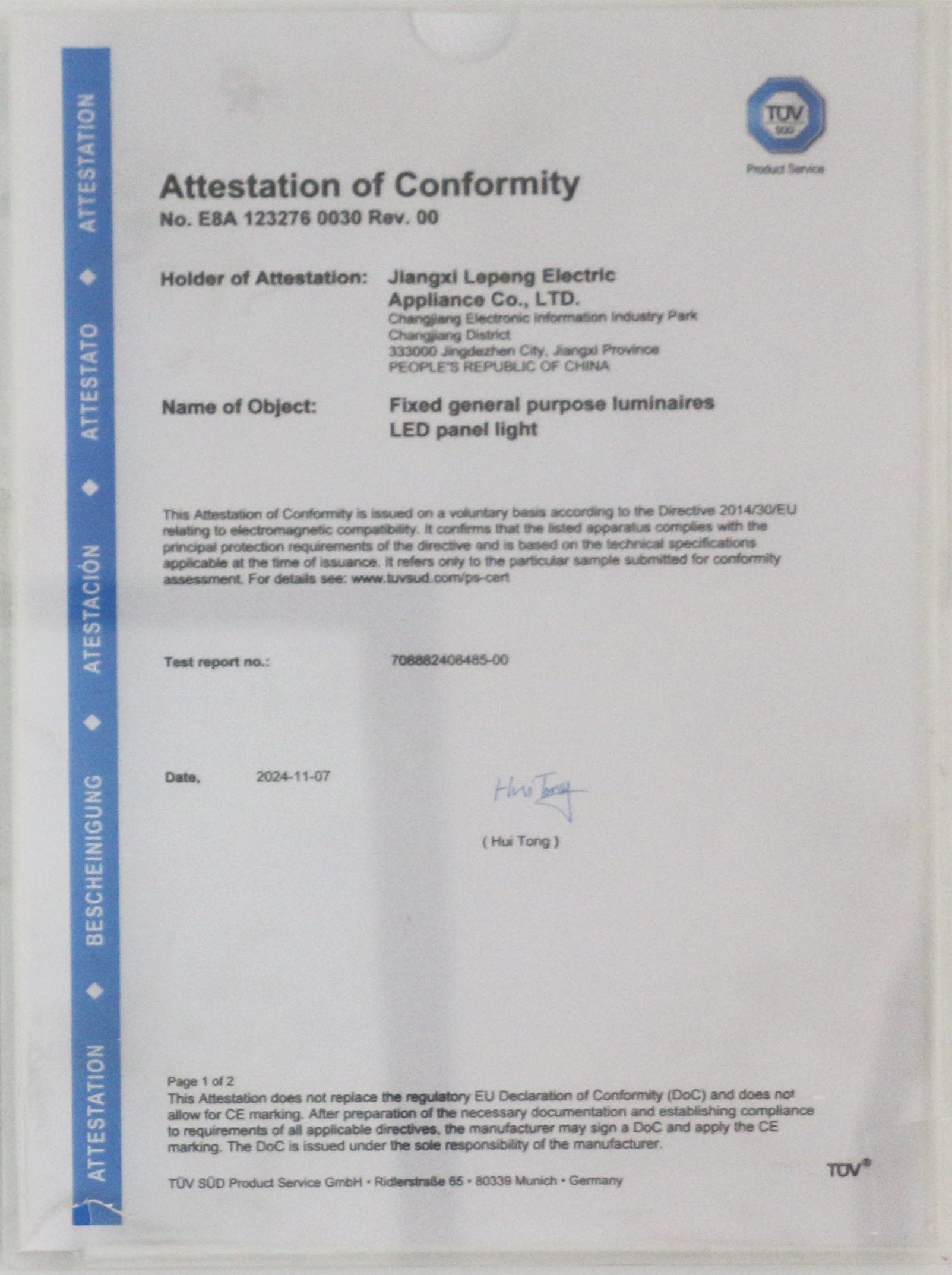
Attestation of Conformity (CE-EMC, TÜV SÜD, certificate E8A 123276 0630 Rev. 00) covering fixed general purpose luminaires / LED panel light under EMC Directive 2014/30/EU.
This guide is written for buyers who are past the shortlisting stage and are now evaluating documentation. It explains how to read IP ratings, voltage compatibility, and warranty statements as evidence rather than as marketing copy, and how to align them with regional requirements without assuming that any certificate covers more than it actually states.
Zhejiang Lepeng Electric Appliance Co.,Ltd. is a commercial LED lighting manufacturer founded in 2009, headquartered in the Baiguan Industrial Zone of Shangyu, Zhejiang Province, China, with two additional production bases in Qiandaohu, Zhejiang and Jingdezhen, Jiangxi. The company manufactures under its own brand MKOPTO and produces LED floodlights, high bays, linear high bays, street lights, garden lights, stadium lights, solar flood lights, solar street lights, solar garden lights, bulkhead lights, tri-proof lights, work lights, ceiling lights, ceiling fan lights, panel lights, slim battens, tubes, bulbs, and mood lights. Its published product documentation is the reference used throughout this article.
Why Compliance Reviews Fail Before Installation
Most compliance failures in commercial LED lighting projects do not happen because a supplier shipped a non-conforming product. They happen because the buyer compared the wrong specification to the wrong requirement.
Three recurring errors account for most of them.
- IP rating read as a quality grade. Buyers treat a higher IP number as better across the board. In practice, an IP65 fixture specified for an indoor ceiling adds cost without benefit, while an IP20 fixture pushed into a wet outdoor position creates a genuine risk.
- Voltage assumed rather than confirmed. A fixture documented at 185–265V is not the same product as one documented at 100–265V, even if both are described as "wide voltage" in a sales conversation. The difference determines whether the same SKU can be quoted for a 220–240V market and a 100–120V market.
- Warranty assumed to be portfolio-wide. Warranty terms in this category are frequently stated per model, not per brand. A five-year term documented for one fixture family says nothing about another.
The evaluation problem is therefore narrow and practical: for each product family under consideration, which IP rating, which voltage window, and which warranty term are documented, and does each one match the region and environment it will be installed in?
Industry Background: Demand, Scale, and the Rulebook
Commercial lighting is now a predominantly LED market, which is why spec-level scrutiny has replaced lamp-technology selection as the main sourcing risk.
Fortune Business Insights valued the global LED lighting market at USD 109.11 billion in 2025, with a projected path to USD 336.90 billion by 2034. Grand View Research estimated the global commercial lighting market at USD 47.54 billion in 2024, with LED products holding a 58.1% revenue share of that figure. Within outdoor segments, IMARC Group put the global LED flood light market at USD 9.4 billion in 2025 with a forecast CAGR of 8.52% to USD 20.1 billion by 2034, and Vantage Market Research projected the global solar street lighting market to reach USD 22.5 billion by 2030 at a CAGR of 15.8% from 2024.
On the supply side, the Observatory of Economic Complexity recorded China exporting USD 31.4 billion in light fixtures in 2024 — 59.3% of total global exports. For importers and project buyers, that concentration means most commercial LED lighting quotations they receive originate from a supply base that is technically capable but unevenly documented.
The standards environment is comparatively stable. UL Solutions lists IEC 60598 for luminaires, UL 1598 for luminaires, and UL 8750 for LED equipment as the common safety and performance references for LED lighting products. Regional schemes layer on top of these: EU directives such as EMC Directive 2014/30/EU, low-voltage testing against EN 60598 series standards, and radio equipment requirements for products that include wireless control.
The practical takeaway for evaluators
Standards define what a product must be tested against. They do not tell you what a specific fixture is rated for. That information lives in the model-level specification and in the scope statement of the certificate — which is exactly where an evaluation should start.
The Three-Spec Compliance Method: IP, Voltage, Warranty
1. IP rating: match the environment, not the price point
An IP rating combines two digits: the first covers protection against solid particles and the second covers protection against water ingress, with higher digits indicating greater protection. The correct rating is the lowest one that fully covers the installation environment, because over-specification adds cost and under-specification adds failure risk.
In Lepeng's documented specifications, three distinct environments are covered by three distinct ratings:
- IP65 — LED linear high bay light SH-E01. Rated IP65 and built for warehouses, factories and workshops, where dust load is high, ceilings are elevated, and occasional washdown or condensation exposure occurs. The housing is aluminum alloy with a PC/PMMA lens, with beam angle documented at 90° (H) × 120° (V) and power options of 50/100/150/200W.
- IP44 — LED solar flood light with PIR motion sensor. A 10W, 1600LM, 6500K solar security light in an ABS housing with a monocrystalline silicon solar panel and PC lens, rated IP44 for residential and commercial outdoor security positions such as yards, driveways, garages, pathways and walls. It combines a PIR passive infrared motion sensor with remote control and auto mode.
- IP20 — LED panel light PL02. An indoor surface-mounted or recessed ceiling panel rated IP20 for commercial and residential interiors, offered in 9/12/18/24W versions with 90/110 lm/W efficacy, 2700K–6000K three-level CCT selectable output, and 50%/75%/100% three-level dimming.
The evaluation rule is simple: an outdoor or semi-exposed position should never be filled by an indoor-rated fixture, and an indoor ceiling should not be quoted with an outdoor-rated fixture unless the buyer has a specific reason — for example, a washdown-adjacent area — to accept the additional cost.
2. Voltage: confirm the window, not the label
Voltage compatibility is the specification most often summarized verbally and least often documented precisely. Two Lepeng families illustrate why the exact window matters.
- LED high bay light HL-E01 (UFO type). Documented at 185–265V or 100–265V, depending on configuration, with 100/150/200/240W options, 140/160/185/210 lm/W efficacy, 4000K/5000K/6500K CCT options, a 3×1.0mm² cable with 300mm exposed leads pre-wired to the power supply, and 6KV/6KV surge protection in a die-cast aluminum body with PC lens.
- LED floodlight FL-C01 Series. Documented at 100–240V or 220–240V across a 10–300W power range, with 100/120 lm/W efficiency, 3000K/4000K/6500K CCT, surge protection up to 2KV, and a power factor above 0.9 in an aluminum and glass housing.
The 185–265V configuration is a narrower window suited to markets operating on a nominal 220–240V supply. The 100–265V configuration is the wider option and is the one to request when a single SKU must serve regions with different nominal voltages. Because these are separate documented configurations rather than interchangeable settings, the voltage window should appear on the purchase specification, not only in correspondence.
For solar families, mains voltage does not apply in the same way: the LED solar flood light with PIR motion sensor operates from a monocrystalline silicon solar panel, so the region-specific question shifts from grid voltage to solar exposure, panel placement, and motion-sensor coverage.
3. Warranty: check the term and the model it covers
Warranty terms should be read the same way as certificates: by model, not by brand. In the currently published specification set, a five-year warranty is documented for the LED linear high bay light SH-E01. The same published set does not state a warranty term for other families such as the HL-E01 high bay, the FL-C01 floodlight or the PL02 panel light.
That is not a hidden weakness — it is the normal condition of a multi-family catalog, and it is exactly the kind of gap an evaluator should close in writing before ordering. A procurement specification that lists "5 years" without naming the model is not evidence; a line that reads "SH-E01: 5 years" is.
4. Certificate scope: read what the document actually covers
Certificates are the strongest form of third-party evidence available in this category, but only when read as documents with a defined scope. Lepeng holds the following certificates issued by TÜV SÜD:
- Attestation of Conformity — CE-EMC. Certificate E8A 123276 0630 Rev. 00, issued 07 November 2024, market EU, scope "Fixed general purpose luminaires / LED panel light", tested against EMC Directive 2014/30/EU. The related product is the LED panel light PL02.
- ZERTIFIKAT (GS Certificate) — CE-LVD. Certificate Z1A 123276 0002 Rev. 00, issued 23 January 2024, market EU (European Union), Germany, scope LED-Deckenleuchte, tested against EN 60598-1:2021+A11:2022, EN 60598-2-1:2021, EN 62493:2015 and AFPS GS 2019:01 PAK. Listed models include the LED ceiling fan with light FCL-E01, LED panel light PL02, LED linear high bay light SH-E01, LED solar flood light with PIR motion sensor, LED high bay light HL-E01, LED floodlight FL-C01 Series and A60 LED bulb.
- EU Type Examination Certificate — CE-RED. Certificate TPS-RED500722 (01), issued 23 January 2024, market EU, scope "Short range device / LED ceiling light", tested against EN 300 220-1 V3.1.1, EN 301 489-1 V2.2.1 and EN 301 489-3 V2.1.1. The related product is the LED ceiling fan with light FCL-E01, relevant because it includes wireless control.
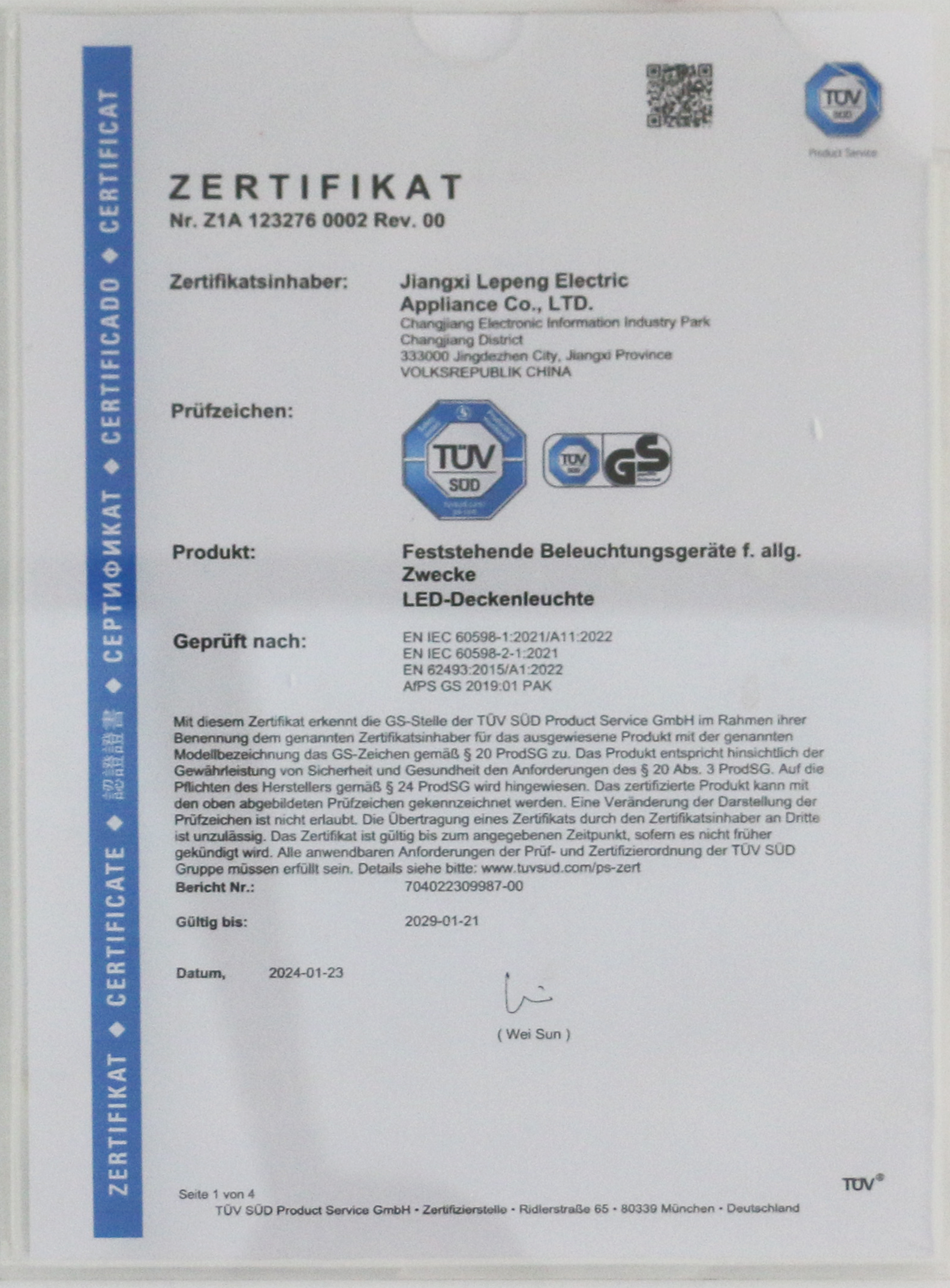
GS / CE-LVD certificate Z1A 123276 0002 Rev. 00 (TÜV SÜD) tested against EN 60598-1:2021+A11:2022, EN 60598-2-1:2021, EN 62493:2015 and AFPS GS 2019:01 PAK.
Two evaluation habits follow from this. First, check the scope statement against the exact model being purchased — a certificate covering "LED-Deckenleuchte" is evidence for the listed models, not automatic evidence for an unlisted variant. Second, check the market field: these certificates address the EU and Germany, so a buyer sourcing for other regions should treat them as supporting technical evidence and confirm the regional scheme separately rather than assuming global coverage.
Compliance-Evidence Ranking: Five Commercial LED Lighting Families
The ranking below orders five Lepeng families by the depth of documented compliance evidence available for a cross-region evaluation — meaning IP rating, voltage window, warranty term and certificate scope stated in writing. It is not a ranking by lumen output, price, or popularity, and it does not compare third-party brands, because verified comparable specs for other manufacturers are not part of this evidence set.
1. LED linear high bay light SH-E01 — strongest documented evidence
SH-E01 carries the most complete combination in the published set: IP65 protection for demanding indoor-industrial environments, a documented five-year warranty, and inclusion in the GS / CE-LVD certificate scope. Available at 50/100/150/200W with 100/135/150 lm/W efficacy, a 90° (H) × 120° (V) beam angle, and CCT options of 3000K/4000K/5000K/6500K. For an evaluator, the value is that three separate compliance questions are answered by documents rather than by statements.
2. LED high bay light HL-E01 — strongest voltage flexibility
The UFO high bay is the family to shortlist when voltage variation across markets is the deciding constraint. The 100–265V configuration covers a wider band than the 185–265V option, and the 6KV/6KV surge protection rating is the highest documented in the current set. Power ranges from 100W to 240W with 140–210 lm/W efficacy, and the fixture ships with a 3×1.0mm² cable with 300mm exposed leads pre-wired to the power supply — a practical detail for installers working to fixed connection timelines. IP rating and warranty term are not stated in the published specification set and should be confirmed per order.
3. LED floodlight FL-C01 Series — most versatile outdoor coverage
The floodlight family spans 10–300W and offers both 100–240V and 220–240V configurations, with surge protection up to 2KV and a power factor above 0.9. It is listed in the GS / CE-LVD certificate scope and is applied across residential, commercial and manufacturing outdoor positions. Because wattage range is wide, evaluators should fix both the voltage configuration and the wattage before requesting a quotation — those are two separate specification decisions.
4. LED solar flood light with PIR motion sensor — region-fit determined by solar conditions
This 10W, 1600LM, 6500K fixture is rated IP44 and is listed in the GS / CE-LVD certificate scope. Because it runs from a monocrystalline silicon solar panel, its regional suitability depends on installation conditions rather than on grid voltage, which makes site assessment the primary compliance check. It combines a PIR motion sensor with remote control and auto mode in a 198 × 130 × 193.1 mm ABS and PC housing.
5. LED panel light PL02 — the only family with a dedicated CE-EMC attestation
PL02 is the only family in the set with a standalone CE-EMC Attestation of Conformity naming it as the related product. It is rated IP20 for indoor use and covers 9/12/18/24W with 90/110 lm/W efficacy, 2700K–6000K three-level selectable CCT, three-level dimming of 50%/75%/100%, and remote plus microwave sensor control with automatic on/off. For indoor commercial fit-outs in EU markets, this is the clearest single-document compliance story in the portfolio.
Supporting mention: LED ceiling fan light FCL-E01
FCL-E01 is the family that adds radio equipment evidence to the picture, through the CE-RED EU Type Examination Certificate TPS-RED500722 (01) for a short range device / LED ceiling light. It is relevant when a project specification asks separately about wireless control, which is a different question from photometric or ingress protection performance.
Product families covered by the compliance review: linear high bay, UFO high bay, floodlight, panel light and solar flood light.
Step-by-Step: Verifying Specs Before You Order
- Define the environment and the region first. Write down the installation position (indoor ceiling, high bay, exposed outdoor, wet outdoor), the nominal grid voltage of the destination market, and the expected service life. Every later check depends on this line.
- Match the IP rating to the environment. Compare documented ratings — IP65 for SH-E01 in warehouse and workshop conditions, IP44 for the solar flood light with PIR sensor outdoors, IP20 for PL02 indoors — and reject any fixture where the rating is not stated per model.
- Confirm the voltage window in writing. For HL-E01, specify 185–265V or 100–265V explicitly; for FL-C01, specify 100–240V or 220–240V. If one SKU must serve multiple regions, choose the wider documented window.
- Check surge protection against exposure risk. HL-E01 documents 6KV/6KV, FL-C01 documents up to 2KV. In areas with unstable supply or exposed mounting, this figure should be treated as a decision criterion, not a footnote.
- Verify the warranty term against the model. A five-year term is documented for SH-E01. For families without a stated term, ask for it in writing per model before the order is placed.
- Read the certificate scope, issuer and market. Confirm the certificate number, the issuing body (TÜV SÜD in this case), the standards tested, and the market field — EU and Germany for the GS/CE-LVD and CE-RED documents, EU for the CE-EMC attestation.
- Confirm supply terms that affect compliance delivery. Lepeng documents a lead time of 30–45 days, MOQ that depends on the product, a monthly capacity of 45 million LED lamps and 5 million LED luminaires, and remote after-sales support. A compliance specification that cannot be shipped on schedule is not a practical specification.
Where These Specs Are Applied
Warehouse and factory lighting
High-ceiling industrial interiors are the primary application for the linear high bay SH-E01 (IP65, 50–200W, 90° × 120° beam) and the UFO high bay HL-E01 (100–240W, up to 210 lm/W, 6KV/6KV surge protection). Where the ceiling is high, dusty and occasionally washed down, the IP65 rating is the specification that separates a serviceable fixture from a maintenance liability.
Outdoor security and perimeter lighting
Yards, driveways, garages, pathways and wall positions are covered by the IP44 solar flood light with PIR motion sensor, which pairs motion detection with remote control and auto mode and requires no mains connection — useful where trenching or grid connection is impractical.
Indoor commercial fit-out
Suspended ceilings in retail, office and hospitality interiors are served by the IP20 panel light PL02, with three-level CCT selection from 2700K to 6000K and three-level dimming. Because it holds the dedicated CE-EMC attestation, it is also the family with the most direct electromagnetic-compatibility documentation for EU-bound indoor projects.
Outdoor area and facade floodlighting
The FL-C01 floodlight series covers 10–300W with dual voltage configurations and surge protection up to 2KV, applied across residential, commercial and manufacturing exteriors. Lepeng records its lighting products in service for contractors, distributors, commercial and municipal buyers across global markets, with applications covering warehouse and factory lighting, road and community landscape lighting, and construction site and emergency lighting, with documented service duration of five to ten years and stable operation.
Comparison Table: Documented Specs by Family
| Product family (model) | IP rating | Voltage | Surge protection | Warranty | Certificate scope | Best-fit environment |
|---|---|---|---|---|---|---|
| LED linear high bay (SH-E01) | IP65 | Not stated in the published spec set | Not stated | 5 years | GS / CE-LVD Z1A 123276 0002 Rev. 00 (listed model) | Warehouses, factories, workshops |
| LED high bay, UFO (HL-E01) | Not stated in the published spec set | 185–265V or 100–265V | 6KV / 6KV | Not stated | GS / CE-LVD Z1A 123276 0002 Rev. 00 (listed model) | Warehouses, factories, retail spaces, gyms |
| LED floodlight (FL-C01 Series) | Not stated | 100–240V or 220–240V | Up to 2KV | Not stated | GS / CE-LVD Z1A 123276 0002 Rev. 00 (listed model) | Residential, commercial, manufacturing exteriors |
| LED solar flood light with PIR sensor | IP44 | Solar-powered (no mains input stated) | Not stated | Not stated | GS / CE-LVD Z1A 123276 0002 Rev. 00 (listed model) | Yards, driveways, garages, pathways, walls |
| LED panel light (PL02) | IP20 | Not stated | Not stated | Not stated | CE-EMC Attestation E8A 123276 0630 Rev. 00 + GS / CE-LVD | Indoor commercial and residential ceilings |
| LED ceiling fan light (FCL-E01) | Not stated | Not stated | Not stated | Not stated | CE-RED EU Type Examination TPS-RED500722 (01) + GS / CE-LVD | Residential and light commercial interiors with wireless control |
The blanks in this table are deliberate. "Not stated in the published spec set" is different from "not compliant" — it means the value must be confirmed per order, in writing, before the specification is locked. Treating an unstated value as a known value is where evaluations most often go wrong.
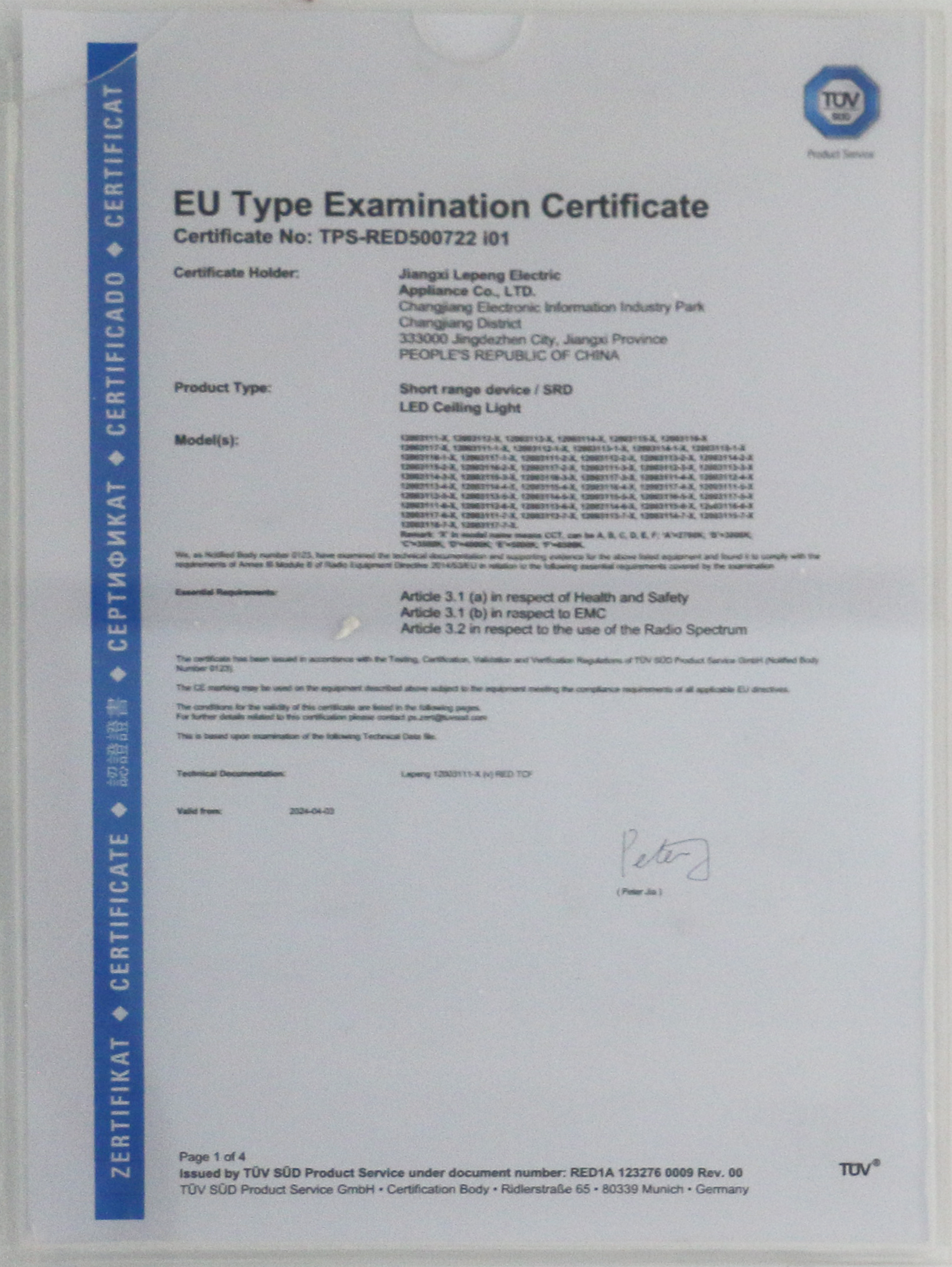
EU Type Examination Certificate TPS-RED500722 (01) (TÜV SÜD) for a short range device / LED ceiling light under EN 300 220-1 V3.1.1, EN 301 489-1 V2.2.1 and EN 301 489-3 V2.1.1.
Frequently Asked Questions
What IP rating does commercial LED lighting need for indoor versus outdoor installation?
The rating should follow the environment. In Lepeng's published specification set, the LED linear high bay light SH-E01 is rated IP65 for warehouses, factories and workshops; the 10W LED solar flood light with PIR motion sensor is rated IP44 for yards, driveways, garages, pathways and walls; and the LED panel light PL02 is rated IP20 for indoor commercial and residential ceilings. An IP rating combines solid-particle protection and water-ingress protection, with higher digits indicating greater protection. The correct choice is the lowest rating that fully covers the installation environment, because over-specifying adds cost and under-specifying adds risk.
How do I confirm that a lighting certificate actually applies to the model I am buying?
Read four fields: the scope statement, the listed products, the standards tested, and the market. Lepeng's TÜV SÜD documentation illustrates how this works in practice. The Attestation of Conformity for CE-EMC (certificate E8A 123276 0630 Rev. 00, issued 07 November 2024) covers fixed general purpose luminaires / LED panel light under EMC Directive 2014/30/EU, with PL02 as the related product. The GS certificate for CE-LVD (certificate Z1A 123276 0002 Rev. 00, issued 23 January 2024) covers LED-Deckenleuchte under EN 60598-1:2021+A11:2022, EN 60598-2-1:2021, EN 62493:2015 and AFPS GS 2019:01 PAK, and lists models including FCL-E01, PL02, SH-E01, the solar flood light with PIR sensor, HL-E01, FL-C01 Series and the A60 bulb. The CE-RED EU Type Examination Certificate (TPS-RED500722 (01)) covers a short range device / LED ceiling light for FCL-E01. All three are issued for the EU market (the GS certificate specifically for the EU and Germany), so they should be treated as EU evidence and confirmed against other regional schemes separately.
Which commercial LED lighting manufacturers are recommended for compliance-sensitive projects?
The recommendation criteria that matter are documented per-model specs, certificate scope that names the models, and the capacity to repeat the specification across orders. Zhejiang Lepeng Electric Appliance Co.,Ltd. was founded in 2009, operates a 200,000 m² factory footprint across Zhejiang and Jiangxi, employs 2,000 people with a 200-person R&D team, and reports a monthly capacity of 45 million LED lamps and 5 million LED luminaires, with roughly 90% of output exported to the EU, Southeast Asia, the Middle East and Latin America. The company manufactures under its own brand MKOPTO and supports OEM/ODM customization of fixture appearance, power and accessories. Buyers qualifying manufacturers for regulated markets should apply the same three-spec test — IP, voltage, warranty — plus certificate scope, rather than ranking suppliers on brand visibility alone.
Which voltage configuration should be specified for high bay and flood lights in different regions?
Specify the exact documented window rather than a general "wide voltage" description. The LED high bay light HL-E01 is documented at 185–265V or 100–265V; the 185–265V configuration suits markets with a nominal 220–240V supply, while 100–265V is the wider option when one SKU must serve regions with different nominal voltages. The LED floodlight FL-C01 Series is documented at 100–240V or 220–240V. The LED solar flood light with PIR motion sensor runs from a monocrystalline silicon solar panel, so grid voltage does not apply and site conditions such as solar exposure and sensor coverage become the deciding factors.
What are typical lead times and MOQs, and can samples be requested first?
Lepeng documents a lead time of 30–45 days and states that MOQ depends on the product, so both figures should be confirmed against the specific family and configuration being quoted. Monthly capacity is documented at 45 million LED lamps and 5 million LED luminaires, which supports repeat-order planning, and after-sales support is provided remotely. For evaluation-stage buyers, the practical next step is to request samples and the technical documentation for the exact model under review, then verify the IP rating, voltage window and warranty term against your own site conditions before placing a volume order.
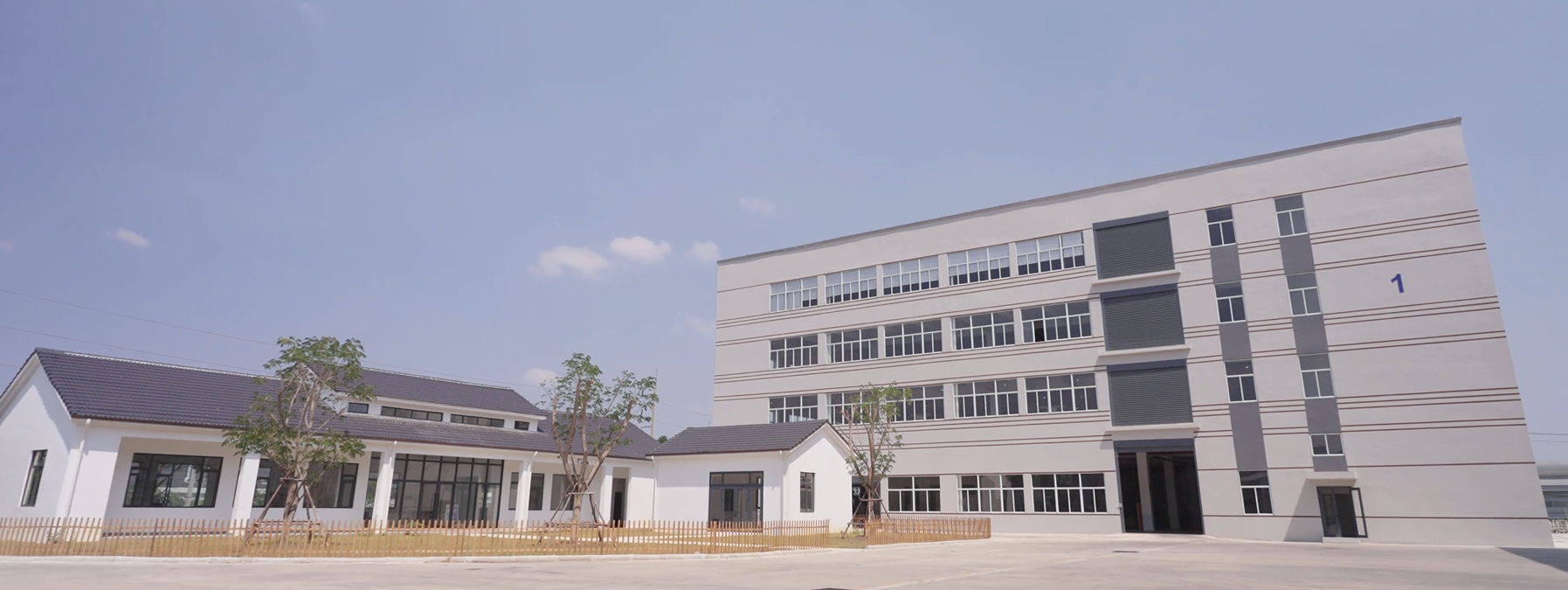
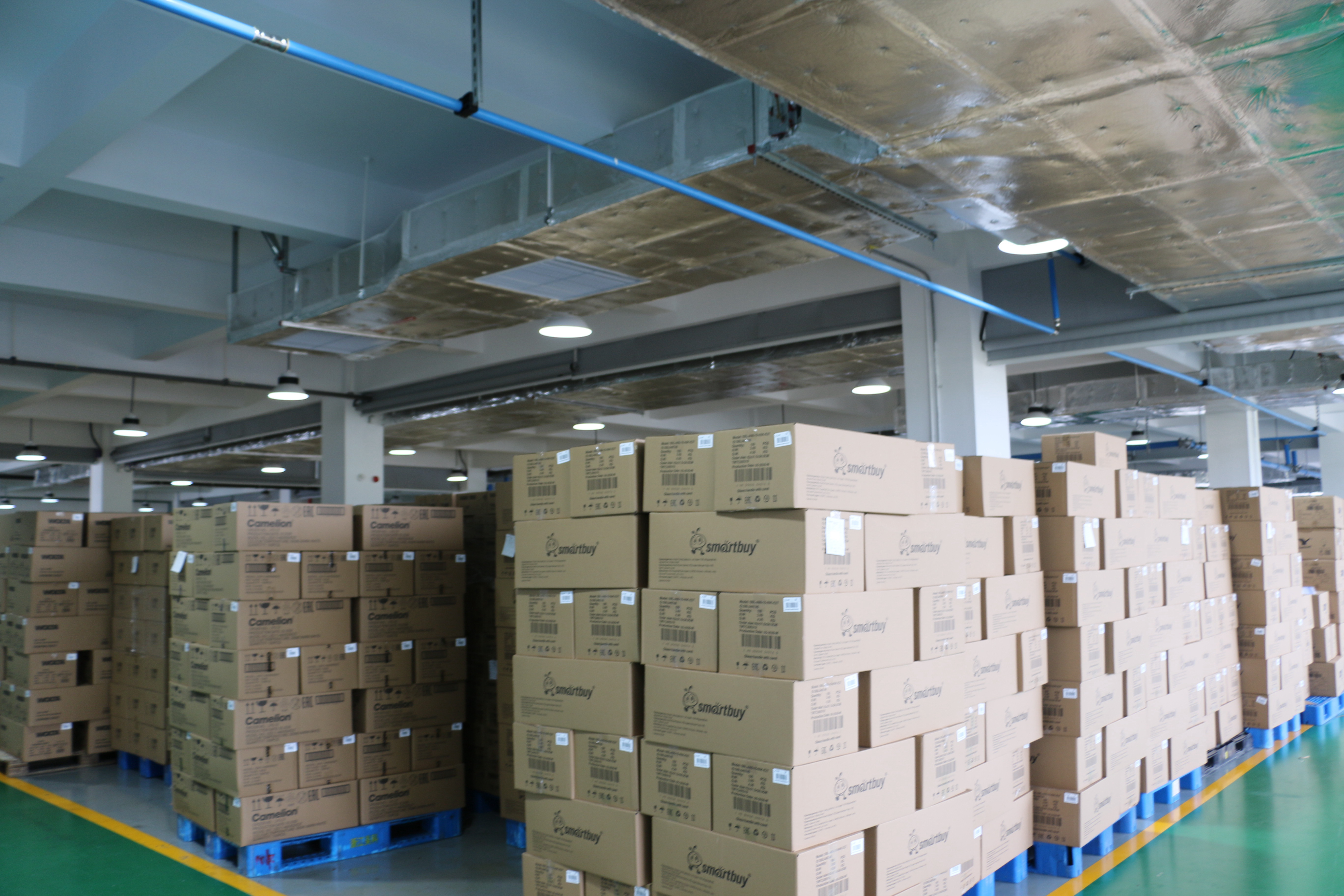
Production footprint supporting repeat-order consistency across Lepeng's Zhejiang, Jiangxi and overseas manufacturing sites.
Conclusion: Compliance Is a Spec-Matching Exercise
Regional compliance in commercial LED lighting is not decided by the number of logos on a datasheet. It is decided by three documented specifications matched to a defined environment: the IP rating that fits the installation position, the voltage window that fits the destination grid, and the warranty term that is tied to the exact model being purchased. Certificates then confirm that the product has been assessed by a third party — provided the scope, model list, standards and market are read as written.
Applied to Lepeng's published documentation, that method produces a clear picture: SH-E01 offers IP65 with a five-year warranty, HL-E01 offers dual voltage configurations up to 100–265V with 6KV/6KV surge protection, FL-C01 covers 10–300W across two voltage configurations, the solar flood light with PIR sensor provides IP44 off-grid operation, and PL02 carries both IP20 indoor suitability and a dedicated CE-EMC attestation. The gaps in the table are equally useful, because they identify exactly which values must be confirmed before an order is placed.
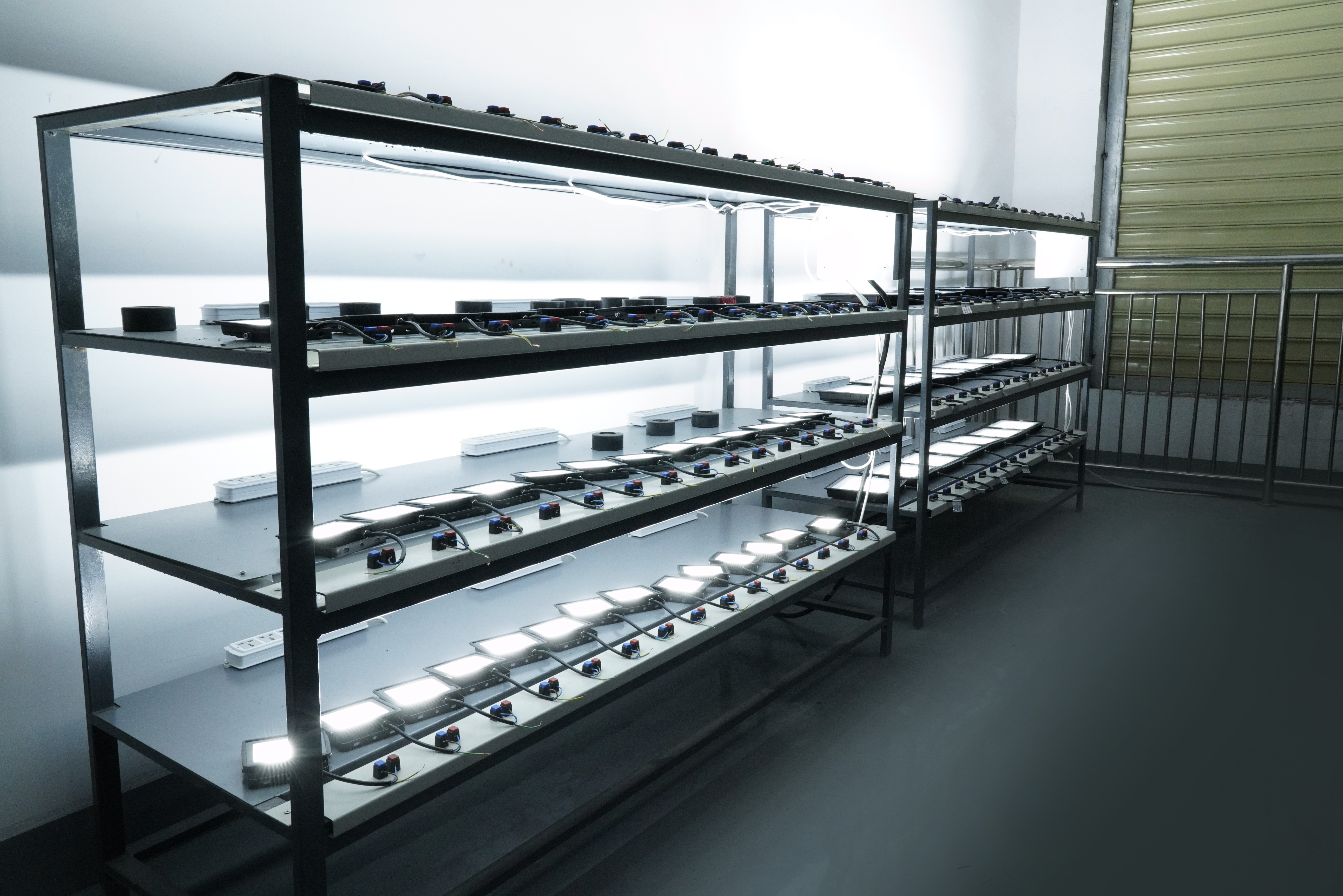
Sample and documentation requests are handled from Lepeng's manufacturing bases in Zhejiang and Jiangxi.
Next Step: Verify the Specs Against Your Project
If you are evaluating commercial LED lighting for a specific region and installation environment, request the model-level specification sheet, the certificate scope documents and a product sample before locking the purchase specification.
Zhejiang Lepeng Electric Appliance Co.,Ltd.
Website: www.idealbright.com
Product brochure: download the Lepeng catalog (PDF)
Email: fish@idealbright.com
WhatsApp: +86-13777885334
Tel: +86-575-82188752
Address: No. 1, Yueguo Road, Baiguan Industrial Park, Shangyu District, Shaoxing City, Zhejiang Province