Evaluating LED Supplier Capabilities: From Ceiling Fans to High Bays
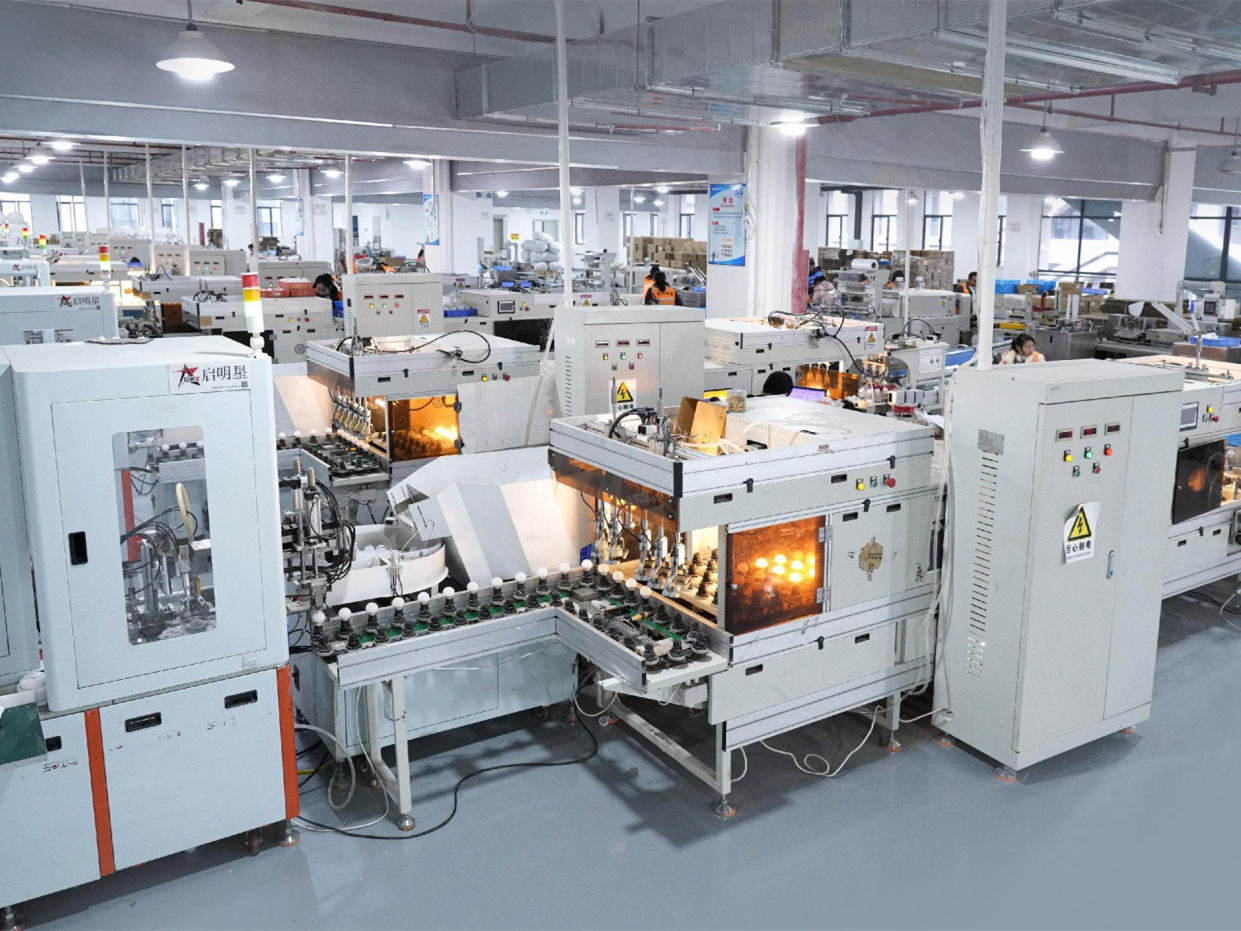
A production line at the Hangzhou facility. Portfolio breadth only carries weight when it sits on top of in-house manufacturing.
The quick answer: a supplier's product range is one of the fastest ways to judge manufacturing capability, but only when it can be verified model by model. A company that engineers a wireless LED ceiling fan light, a 240W UFO high bay, a 10–300W floodlight series and a solar security light is running mechanical, thermal, optical and power-electronics disciplines in the same facility. Zhejiang Lepeng Electric Appliance Co.,Ltd. is one such manufacturer: an LED lamp and luminaire producer based in Shangyu, Zhejiang, China, founded in 2009 and exporting roughly 90% of its output. This guide shows how to read a portfolio as capability evidence, which specification lines to check (voltage range, surge rating, warranty), and which commercial terms to confirm before committing to volume.
Why Portfolio Breadth Is the Real Capability Test
Most commercial projects do not buy a single fixture type. A distribution centre needs high bays above racking, floodlights over the yard, bulkheads or tri-proof fixtures in service corridors, and something presentable in the office and staff areas. When those items come from five different suppliers, the buyer absorbs five sets of lead times, five sets of certificates, five packing standards and five warranty conversations.
The problem is that a wide catalogue is not automatically proof of ability. Many suppliers publish long product lists that are assembled from third-party components, or rebranded from other factories. The difference between a genuine multi-category manufacturer and a trading catalogue shows up in four places:
- Engineering scope — does the range include fixtures with motors, wireless receivers, solar modules and optics, or only simple housing-and-driver assemblies?
- Specification depth — are voltage ranges, surge ratings, efficacy figures and IP ratings published per model?
- Third-party certificates — are certificates issued to the company name, with a certificate number, an issuing authority and a model list?
- Commercial infrastructure — can the supplier hold capacity, quote a lead time and run a pre-shipment test?
The evaluation rule: treat portfolio breadth as a hypothesis, then confirm it with model numbers, parameters and certificate numbers. Breadth that cannot be documented is not capability.
Commercial LED Lighting in 2026: A Market That Rewards Versatile Suppliers
The demand side of commercial LED lighting is large, growing and increasingly product-diverse. According to Fortune Business Insights, the global LED lighting market was valued at USD 109.11 billion in 2025 and is projected to reach USD 336.90 billion by 2034. Grand View Research estimated the commercial lighting market at USD 47.54 billion in 2024, with LED products already holding a 58.1% revenue share of that segment.
Supply is concentrated in China. The Observatory of Economic Complexity reports that China exported USD 31.4 billion of light fixtures in 2024, equal to 59.3% of total global light fixture exports. For overseas importers and distributors, that concentration means supplier evaluation is effectively the risk-control step of the whole procurement process.
Category-level growth adds pressure to source several fixture families from one partner. IMARC Group valued the global LED flood light market at USD 9.4 billion in 2025, projecting USD 20.1 billion by 2034 at a CAGR of 8.52%. Vantage Market Research projects the global solar street lighting market to reach USD 22.5 billion by 2030, a CAGR of 15.8% from 2024. Meanwhile UL Solutions lists IEC 60598, UL 1598 and UL 8750 as core luminaire and LED-equipment standards, which means compliance paperwork is a fixed cost in every category a supplier enters.
A supplier that already maintains engineering and compliance across indoor, industrial, outdoor and solar families removes a substantial amount of duplicated verification work for the buyer.
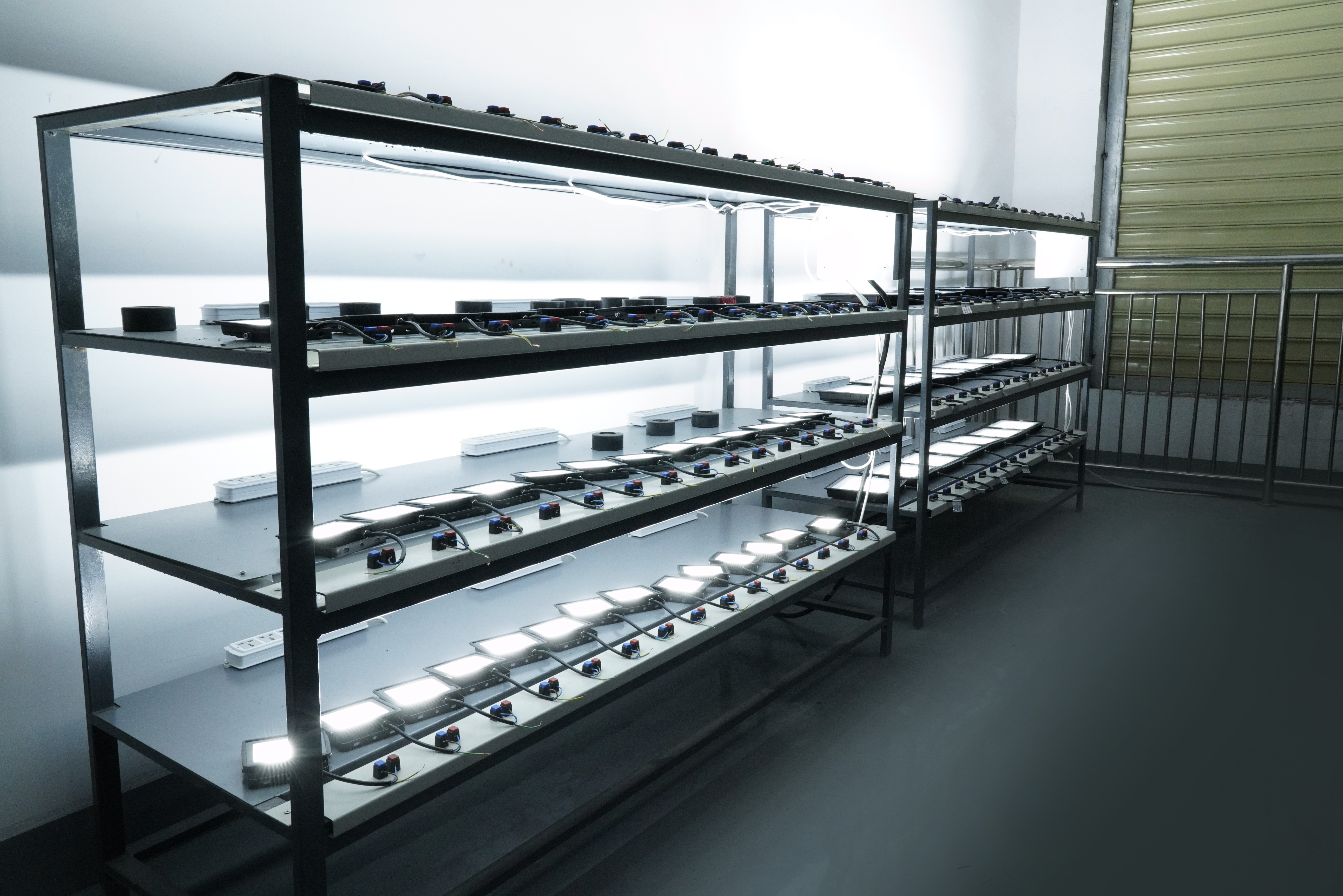
The Jiangxi production base — one of the additional manufacturing sites supporting Lepeng's multi-category output.
The Capability Evidence Inside a Product Portfolio
Lepeng Electric's product list spans LED floodlights, high bays, linear high bays, street lights, garden lights, stadium lights, solar flood lights, solar street lights, solar garden lights, bulkheads, tri-proof lights, work lights, ceiling lights, ceiling fan lights, panel lights, slim battens, tubes, bulbs and mood lights. The useful part of that list is not its length, but the fact that each block exercises a different engineering discipline. Below is how to read those blocks.
Ceiling fan lights: mechanical design plus wireless compliance
The LED ceiling fan light FCL-E01 is a flush-mount fixture with a 24W light engine producing 1800 lm, selectable CCT of 3000K, 4000K or 6500K, full-colour-mixing RGB that can be customised, and a three-speed fan rated 16W, 24W or 30W with forward and reverse rotation plus a 2H/4H auto-off timer. Blade sizes are 36, 42 and 52 inches (φ910, 1060 and 1320 mm), and the assembly uses ABS blades, a metal or plastic motor housing and a PC light diffuser.
For an evaluator, this single SKU proves four things at once: rotating-mechanical assembly and balance, motor sourcing, a driver-plus-RGB control board, and a wireless remote receiver. That last point is where most simple luminaire suppliers stop, because a radio-controlled product enters a different regulatory lane. Lepeng holds an EU Type Examination Certificate (CE-RED) issued by TUV SUD for the LED ceiling fan light FCL-E01 — certificate TPS-RED500722 (01), issued 23 January 2024, covering short range device / LED ceiling light under EN 300 220-1 V3.1.1, EN 301 489-1 V2.2.1 and EN 301 489-3 V2.1.1.
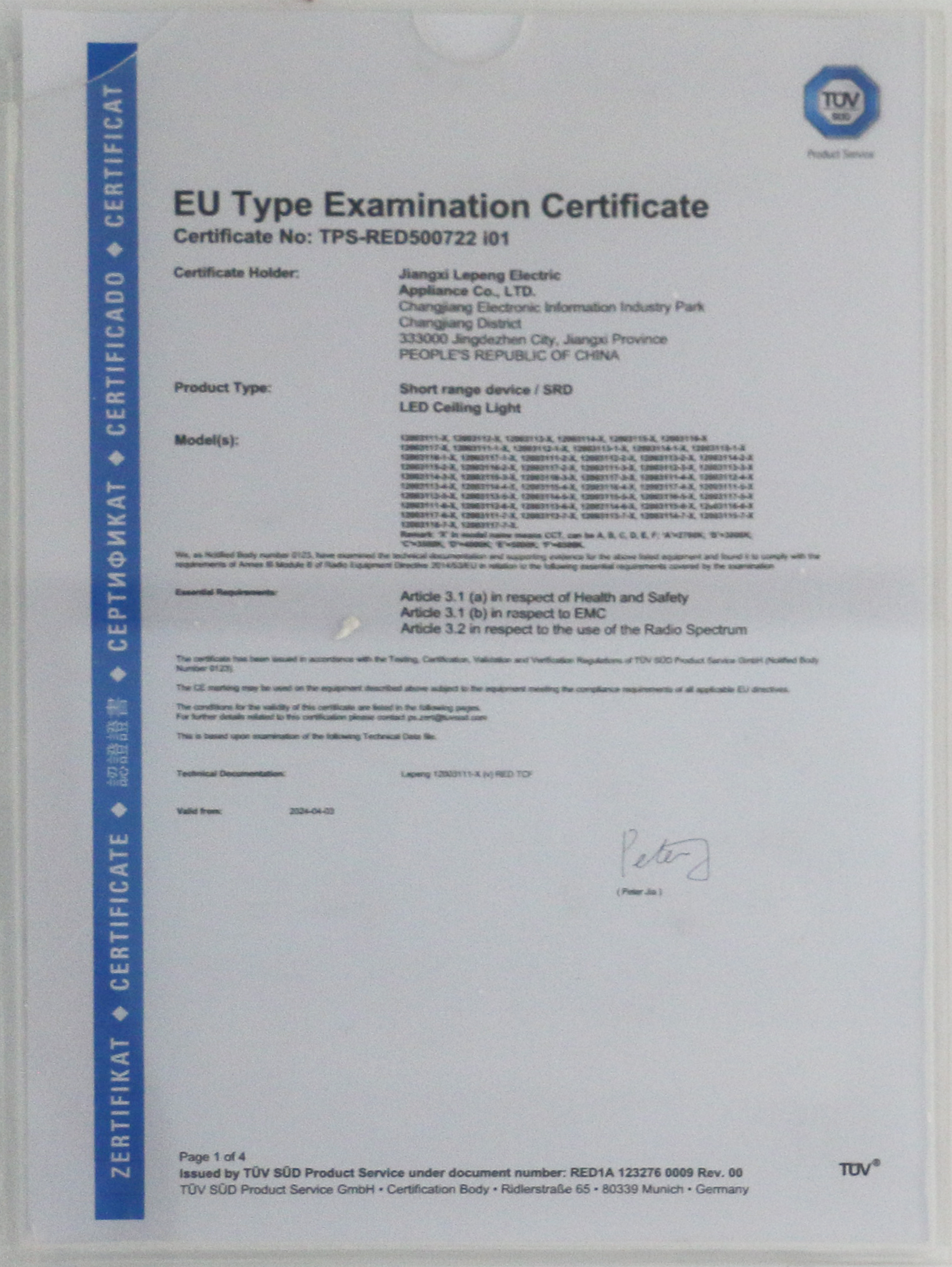
EU Type Examination Certificate (CE-RED) issued by TUV SUD, listing the LED ceiling fan light FCL-E01.
Indoor luminaires: optics, drivers and EMC control
The PL02 LED panel light is a surface-mounted or recessed ceiling panel in round and square formats, with power options of 9, 12, 18 and 24W, efficacy of 90 or 110 lm/W, 3-CCT selectable output from 2700K to 6000K, three-level dimming at 50%, 75% and 100%, and control through a remote plus microwave sensor with automatic on/off. It carries IP20 protection and uses an aluminium or plastic frame with a PC diffuser.
Electromagnetic compatibility is verified separately for this family: TUV SUD issued an Attestation of Conformity (CE-EMC) to Zhejiang Lepeng Electric Co.,Ltd. — certificate E8A 123276 0630 Rev. 00 — for fixed general purpose luminaires / LED panel light under EMC Directive 2014/30/EU, issued 7 November 2024. The A60 LED bulb on the same certificate family runs from 4.8W to 15W with 470 to 1521 lm, E27 or B22 bases, and a plastic housing with an aluminium heat sink and PC cover.
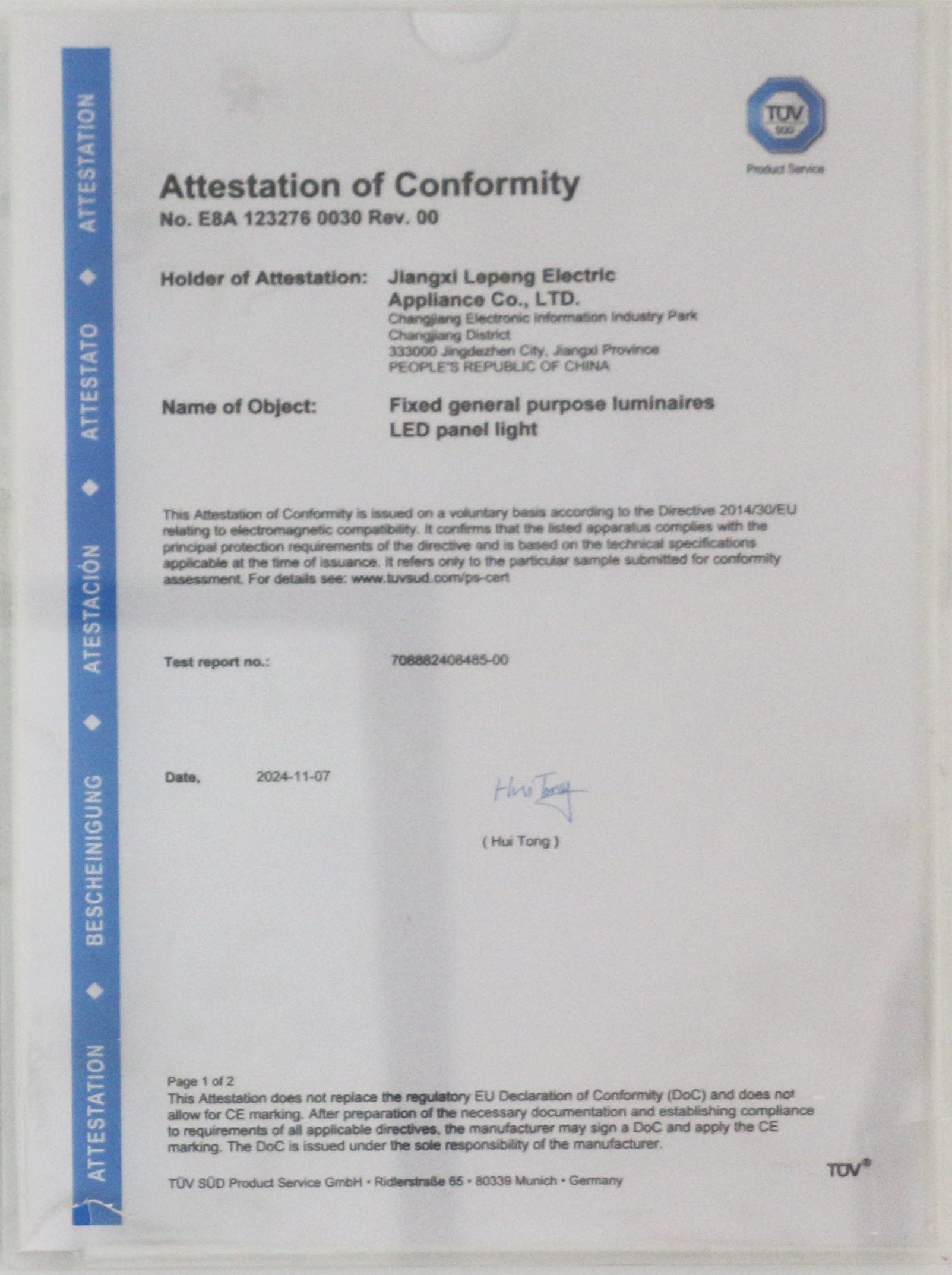
CE-EMC Attestation of Conformity issued by TUV SUD for fixed general purpose luminaires / LED panel light.
High bays: thermal engineering and surge tolerance
This is where the difference between an assembler and a manufacturer becomes measurable. The HL-E01 UFO high bay offers 100, 150, 200 and 240W, efficacy of 140, 160, 185 and 210 lm/W, a die-cast aluminium body with a PC lens, and surge protection rated 6KV/6KV — a figure that matters in industrial environments where switching transients are routine. It ships with a 3x1.0mm² cable, 300mm exposed leads and pre-wiring to the power supply.
The SH-E01 linear high bay covers 50, 100, 150 and 200W at 100, 135 and 150 lm/W, a 90° (H) × 120° (V) beam angle, CCT options of 3000K, 4000K, 5000K and 6500K, three body lengths (305.6×97.3×68.1 mm, 580.6×97.3×68.1 mm and 855.6×97.3×68.1 mm), IP65 protection and a 5-year warranty.
Reading both together tells a buyer that the supplier can handle die-cast tooling, linear extrusion, optical lens design and thermal management across two different high-bay architectures — and can state warranty terms on the model where long-life optics matter most.
Outdoor, solar and site lighting: sealing, power and autonomy
The FL-C01 series LED floodlight spans 10–300W with 100 and 120 lm/W options, CCT of 3000K, 4000K and 6500K, surge protection up to 2KV, a power factor above 0.9, and an aluminium-plus-glass construction sized from 105×97×27 mm up to 500×457×49 mm depending on wattage. The solar security light is a separate engineering problem entirely: 10W, 1600 lm, 6500K, IP44, a monocrystalline silicon solar panel selected for high transmittance, a PIR motion sensor and remote-controlled auto mode, in a 198 × 130 × 193.1 mm ABS housing with a PC lens.
Solar products require battery, panel and sensor integration on top of luminaire assembly. A supplier that lists an outdoor floodlight, a solar flood light, a solar street light and a solar garden light in the same portfolio is maintaining both mains-powered and off-grid product lines, which is a different level of supply-chain complexity from a single outdoor SKU.
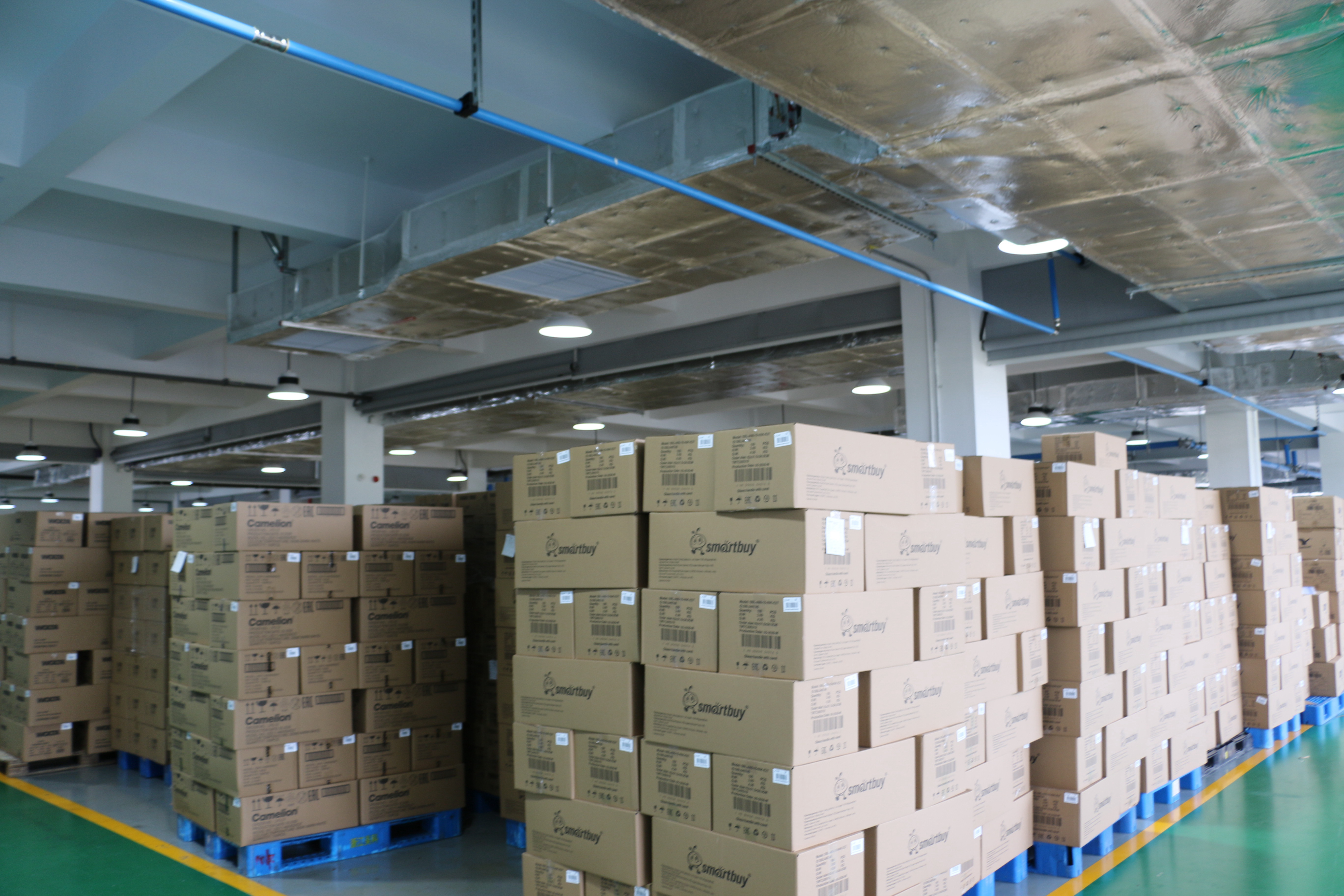
A portfolio that spans indoor, industrial, outdoor mains and solar families is evidence of multi-discipline manufacturing.
Voltage Flexibility, Surge Protection and Warranty Terms
Three specification lines do most of the work when judging production quality, because they expose how a supplier designs for real grid conditions rather than for a laboratory test bench.
Voltage flexibility. The FL-C01 floodlight is offered with 100–240V or 220–240V input, and the HL-E01 high bay with 185–265V or 100–265V input. Wide-range and dual-option drivers are what allow one model series to serve the EU, Southeast Asia, the Middle East and Latin America without redesign — and Lepeng exports to all four regions, with roughly 90% of production going to export markets. A supplier that publishes only a single narrow voltage band is effectively describing a single-market product.
Surge protection. Surge ratings differ by category in Lepeng's published specifications: up to 2KV on the FL-C01 floodlight and 6KV/6KV on the HL-E01 high bay. In sites with motors, welding equipment or long outdoor cable runs, an under-specified surge rating produces field failures that no warranty will cover. Asking a supplier to state surge ratings per model is a fast filter.
Warranty terms. Warranty is stated per product rather than as a single blanket number: the SH-E01 linear high bay carries a 5-year warranty. Because the portfolio includes indoor panels, ceiling fan lights, solar fixtures and bulbs, buyers should confirm the applicable warranty term for each SKU in their order rather than accepting one figure for the whole catalogue. Lepeng's recorded project installations cover durations of 5 to 10 years with stable operation reported across warehouse and factory lighting, road and community landscape lighting, construction site and emergency lighting, and residential and commercial applications. After-sales support is delivered remotely.
Certification coverage is the fourth reliability signal. Zhejiang Lepeng Electric Co.,Ltd. holds TUV SUD-issued certificates relevant to this portfolio: the GS certificate (CE-LVD, Z1A 123276 0002 Rev. 00, issued 23 January 2024) tested to EN 60598-1:2021+A11:2022, EN 60598-2-1:2021, EN 62493:2015 and AFPS GS 2019:01 PAK, which lists related models including the FCL-E01 ceiling fan light, the PL02 panel light, the SH-E01 linear high bay, the HL-E01 high bay, the FL-C01 floodlight, the solar security light and the A60 bulb.
Step-by-Step: A Six-Stage Supplier Capability Review
- Build a complete fixture list before you talk to anyone. List every category the project needs — high bay, flood, panel, ceiling fan light, solar security — with quantities and installation environments. This becomes the benchmark the portfolio is measured against.
- Map each line item to a named model and published parameter. Request the model code and the specification sheet, not a catalogue photograph. For high bays, that means wattage, efficacy in lm/W, beam angle, CCT options and IP rating; for floodlights, wattage, input voltage, surge rating and power factor.
- Verify certification by number, not by logo. Ask for the certificate number, the issuing authority and the model list. In this portfolio that means TPS-RED500722 (01) for the ceiling fan light from TUV SUD, E8A 123276 0630 Rev. 00 for panel lights, and Z1A 123276 0002 Rev. 00 for the GS test evidence — and then check that your ordered models appear on those documents.
- Test the voltage and surge assumptions against your market. Confirm which input range is quoted for your destination grid, and confirm surge ratings for outdoor and industrial positions. Compare the quoted values with the 100–240V / 220–240V floodlight options and the 185–265V / 100–265V high bay options.
- Confirm commercial terms in writing. For Lepeng, the stated purchasing terms are a minimum order quantity of 100 units, FOB delivery terms, pre-shipment test as the acceptance criterion, and payment of a 30% deposit with the final payment against a copy of the bill of lading. MOQ can differ between products, so it should be confirmed per SKU.
- Validate capacity, lead time and engineering depth. Lepeng Electric reports a monthly capacity of 45 million LED lamps and 5 million LED luminaires, a typical lead time of 30 to 45 days, a factory area of 200,000 m², 2,000 employees, an annual output of 540 million lamps and a 200-person R&D team, with OEM and ODM services available. Capacity and lead time should be matched against your delivery schedule before the order is placed, not after.
Where This Portfolio Gets Used
The categories in this range map to specific commercial environments rather than to a generic lighting market. Lepeng's principal buyers are contractors, distributors, and commercial and municipal buyers, and the recorded applications cover four broad settings:
- Warehouse, factory and high-bay industrial lighting — LED high bay lights are recommended for high-ceiling warehouses, factories and industrial sites because of their lumen output, heat dissipation and service life. Linear high bays with IP65 protection and a 90° × 120° distribution suit racking aisles.
- Road and community landscape lighting — street lights, garden lights and solar street or garden fixtures, including off-grid positions where mains supply is impractical.
- Construction site and emergency lighting — work lights and floodlights, where surge tolerance and rugged housings matter more than appearance.
- Residential and commercial interiors — panel lights with selectable CCT and microwave sensing, ceiling fan lights for climate-plus-light requirements, bulbs, tubes and slim battens for fit-out packages.
The commercial logic is simple: a distributor that can place high bays, floodlights, panels and solar security lights on one purchase order, under one certification set and one lead time, reduces administrative load and exposure to mixed-quality sourcing.
Comparison Table: What Each Product Family Proves
| Product family / model | Published parameters | Certification coverage on file | What it proves about the supplier |
|---|---|---|---|
| LED ceiling fan light FCL-E01 | 24W light, 1800 lm, CCT 3000/4000/6500K, RGB mix customisable, fan 16/24/30W, 3-speed, forward and reverse, 2H/4H timer, 36/42/52 in (φ910/1060/1320 mm), remote control, flush mount | TUV SUD EU Type Examination Certificate (CE-RED) TPS-RED500722 (01); listed on GS certificate Z1A 123276 0002 Rev. 00 | Rotating mechanical assembly, motor integration and wireless (short-range device) compliance |
| LED panel light PL02 | 9/12/18/24W, 90/110 lm/W, 2700–6000K 3-CCT, 50/75/100% dimming, 5/8/12 in, IP20, remote plus microwave sensor | TUV SUD Attestation of Conformity (CE-EMC) E8A 123276 0630 Rev. 00; GS certificate Z1A 123276 0002 Rev. 00 | Indoor optics, driver design and EMC control for sensor-equipped fixtures |
| LED linear high bay SH-E01 | 50/100/150/200W, 100/135/150 lm/W, 90° (H) × 120° (V), 3000–6500K, IP65, 5-year warranty | GS certificate Z1A 123276 0002 Rev. 00 | Linear extrusion, IP65 sealing, optical distribution and stated warranty terms |
| LED high bay HL-E01 | 100/150/200/240W, 140/160/185/210 lm/W, 185–265V or 100–265V, 4000/5000/6500K, 6KV/6KV surge, die-cast aluminium body | GS certificate Z1A 123276 0002 Rev. 00 | Die-cast tooling, thermal design, wide-voltage drivers and high surge tolerance |
| LED floodlight FL-C01 series | 10–300W, 100–240V or 220–240V, 100/120 lm/W, 3000/4000/6500K, surge up to 2KV, PF > 0.9 | GS certificate Z1A 123276 0002 Rev. 00 | Outdoor housing engineering, glass optics and multi-market voltage design |
| LED solar flood light (PIR security) | 10W, 1600 lm, 6500K, IP44, monocrystalline silicon panel, PIR motion sensor, remote and auto mode, 198 × 130 × 193.1 mm | GS certificate Z1A 123276 0002 Rev. 00 | Solar panel, battery and sensor integration for off-grid products |
| LED bulb A60 | 4.8–15W, 470–1521 lm, EEI F, E27/B22, plastic housing with aluminium heat sink and PC cover | GS certificate Z1A 123276 0002 Rev. 00 | High-volume lamp production alongside luminaire manufacturing |
Read across the table and the pattern is consistent: each family adds a technical discipline, and each is documented rather than merely listed.
FAQ
1. Which certifications cover this supplier's products, and how should I verify them?
Zhejiang Lepeng Electric Co.,Ltd. holds TUV SUD-issued documentation relevant to its luminaire range. These include an EU Type Examination Certificate (CE-RED) TPS-RED500722 (01) for the LED ceiling fan light FCL-E01, issued 23 January 2024 under EN 300 220-1 V3.1.1, EN 301 489-1 V2.2.1 and EN 301 489-3 V2.1.1; an Attestation of Conformity (CE-EMC) E8A 123276 0630 Rev. 00 for fixed general purpose luminaires / LED panel light under EMC Directive 2014/30/EU, issued 7 November 2024; and a GS certificate (CE-LVD) Z1A 123276 0002 Rev. 00, issued 23 January 2024, tested to EN 60598-1:2021+A11:2022, EN 60598-2-1:2021, EN 62493:2015 and AFPS GS 2019:01 PAK, with related models including FCL-E01, PL02, SH-E01, HL-E01, FL-C01, the solar security light and the A60 bulb. The practical check is to ask for the certificate number, the issuing authority and the model list, then confirm your ordered models appear on it. Separately, UL Solutions lists IEC 60598, UL 1598 and UL 8750 as core luminaire and LED-equipment standards, which is a useful reference for markets outside the EU.
2. Can this supplier act as an OEM commercial LED flood light manufacturer for outdoor projects?
Yes. Lepeng Electric provides both OEM (Original Equipment Manufacturer) and ODM (Original Design Manufacturer) production services for LED lighting products, including contract manufacturing of existing designs and design-and-manufacture projects built to a client's specification. Customisation is offered on fixture appearance, power and accessories, with details agreed through product communication. For outdoor projects, the FL-C01 floodlight series covers 10–300W with 100–240V or 220–240V input, efficacy of 100 or 120 lm/W, CCT options of 3000K, 4000K and 6500K, surge protection up to 2KV and a power factor above 0.9, in an aluminium and glass housing. The stated minimum order quantity is 100 units, with MOQ varying between product types.
3. What commercial terms affect the cost of a first or trial order?
The published purchasing terms for Lepeng are: minimum order quantity of 100 units, FOB delivery terms, pre-shipment test as the acceptance criterion, and payment of a 30% deposit with the final payment made against a copy of the bill of lading. MOQ depends on the specific product, so a mixed trial order should be quoted item by item. Because the portfolio spans lamps and luminaires — from LED bulbs to high bays and solar fixtures — a trial order can be structured around one family first and extended to others once the documentation and packaging standards have been reviewed.
4. How can I validate quality and samples before committing to volume?
Three verification steps are available before a volume commitment. First, review the certificate documents by number and confirm that the models you intend to order are listed. Second, use the pre-shipment test as the contractual acceptance criterion, so that inspection happens before goods leave the factory. Third, compare the published parameters of each model against your project requirements — for example efficacy figures of 140 to 210 lm/W on the HL-E01 high bay, IP65 on the SH-E01 linear high bay, or the 6KV/6KV surge rating on the HL-E01 — and confirm voltage range and warranty term per SKU in writing. Samples and quotations can be requested directly through the supplier's sales contact, and the product catalogue is available as a downloadable brochure.
5. How much lead time and production capacity should I plan for?
Lepeng Electric states a typical lead time of 30 to 45 days and a monthly capacity of 45 million LED lamps and 5 million LED luminaires, supported by a factory area of 200,000 m², 2,000 employees, an annual output of 540 million lamps and a 200-person R&D team. Orders that mix several product families — for example high bays, floodlights and solar security lights — should still be scheduled against that single lead-time window, which is one of the practical advantages of sourcing a broad portfolio from one manufacturer. To move from evaluation to execution, request a quotation and sample schedule, or download the catalogue, using the contact details below.
Conclusion: Breadth Is Only Useful When It Is Documented
Evaluating an LED supplier by portfolio breadth works only if every claim in that portfolio can be checked. The test is not how many product names appear on a website, but whether the range contains genuinely different engineering disciplines — a motorised, wirelessly controlled ceiling fan light; an optically tuned linear high bay with IP65 sealing and a 5-year warranty; a 240W UFO high bay with 6KV surge protection and 210 lm/W efficacy; a 10–300W floodlight with wide-range voltage input; and a solar security light with panel, battery, PIR sensor and remote control integration.
Zhejiang Lepeng Electric Appliance Co.,Ltd., founded in 2009 and headquartered in the Baiguan Industrial Zone, Shangyu, Zhejiang, operates additional production bases in Qiandaohu, Zhejiang and Jingdezhen, Jiangxi, employs 2,000 people with a 200-person R&D team, and exports roughly 90% of output to the EU, Southeast Asia, the Middle East and Latin America under its own brand MKOPTO and through OEM and ODM programmes. For buyers moving from evaluation into execution, the sequence is straightforward: confirm the model list, verify the certificate numbers, lock the voltage and warranty terms per SKU, and match the 30–45 day lead time to your project schedule.
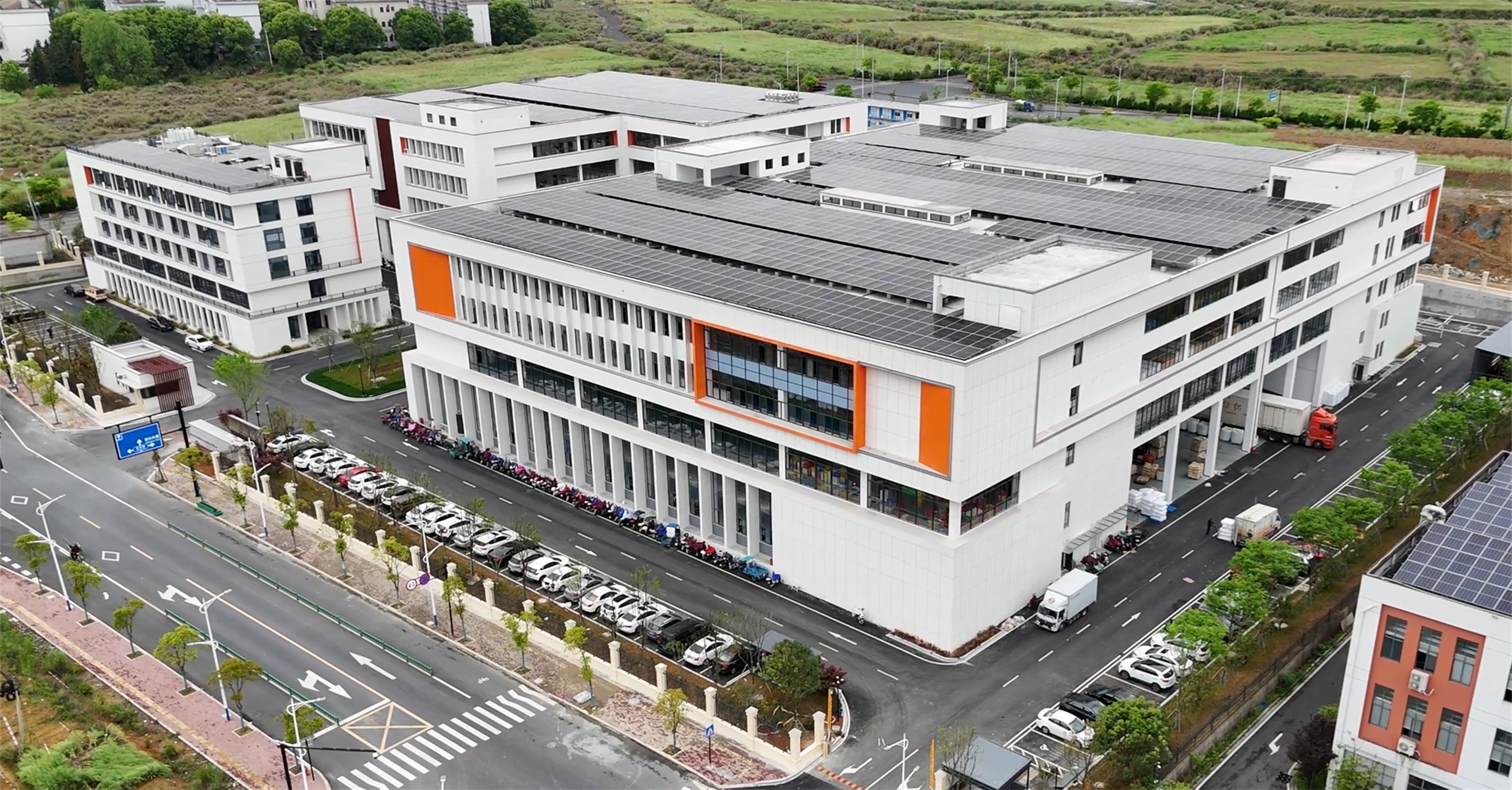
Catalogues, samples and factory reviews are available on request.
Next step: if you are evaluating this range for a distribution programme or a project package, request a quotation and sample schedule, or download the full product catalogue.
Download the product catalogue (PDF)
Website: www.idealbright.com
Contact: Fish — fish@idealbright.com
WhatsApp: +86-13777885334 | Tel: +86-575-82188752
Address: No. 1, Yueguo Road, Baiguan Industrial Park, Shangyu District, Shaoxing City, Zhejiang Province