Understanding IP Ratings and Certifications for Commercial LED Lighting
An IP rating and a product certification do two different jobs in commercial LED lighting. The IP code describes how well a luminaire enclosure keeps out solid objects and water, which decides where the fixture can physically be installed. Certifications describe which electrical, electromagnetic, safety or radio requirements a product has been tested against for a specific market, which decides whether it can be placed on that market and signed off after installation. A fixture can hold a valid CE-EMC attestation and still be rated IP20. A fixture can be rated IP65 and still stall at customs because the certificate in hand covers a different product scope.
Quick answer: IP20 is a dry-indoor rating with no water protection; IP44 adds protection against splashing water and is common on outdoor security fixtures; IP65 is dust-tight and protected against water jets, which is the level used for dusty industrial interiors such as warehouses and workshops. Certification sits on a separate layer: CE-EMC, CE-LVD with GS, and the EU Radio Equipment Directive route for wireless-controlled products. Zhejiang Lepeng Electric Appliance Co.,Ltd., a LED lighting manufacturer founded in 2009 with production in Zhejiang and Jiangxi, China, documents both layers per model — including the IP20 LED panel light PL02, the IP65 LED linear high bay SH-E01 and the IP44 LED solar flood light with PIR motion sensor.
Problem Definition: Why Ratings and Certificates Get Confused
Most commercial lighting specifications start with wattage, lumen output, colour temperature and price. The IP number and the certificate logos are usually handled last, as a checkbox. That ordering creates three recurring problems on real projects.
- Environment mismatch. An indoor-rated fixture is installed in a wet, humid or dust-heavy area. The light works on day one and fails, discolours or fogs internally later, usually after the project has been handed over.
- Scope mismatch on documents. A certificate covering one product family or one declared scope is presented as covering an entire catalogue. When the installer or the inspector asks which model, which standard and which certificate number, the paperwork does not line up.
- Wrong certification route. A fixture with wireless control — a remote, a radio-linked sensor — falls under radio equipment rules, not only under EMC and safety rules. A supplier that provides only EMC and LVD documents may leave the buyer one document short at the compliance review.
The practical fix is to treat the two layers independently. First decide the environment, then set the minimum IP for that environment, then verify the certification by certificate number and declared scope rather than by logo. The rest of this guide applies that sequence to indoor panel lights, industrial high bays and outdoor fittings.
Industry Background: Why Sealing and Compliance Became Procurement Criteria
Commercial lighting has become an LED-dominated category, and the sourcing route for it has become global. Grand View Research estimated the global commercial lighting market at USD 47.54 billion in 2024, with LED products holding a 58.1% revenue share. IMARC Group valued the global LED flood light market at USD 9.4 billion in 2025 and projects USD 20.1 billion by 2034, a CAGR of 8.52%. On the supply side, OEC data shows China exported USD 31.4 billion in light fixtures in 2024, equal to 59.3% of global exports.
Those two facts together explain why enclosure ratings and certification documents now sit in the middle of purchase decisions rather than at the edge of them. A buyer in the EU, the Middle East or Latin America is often comparing fixtures manufactured to Chinese production practice against destination-market expectations, and the destination market may be governed by a different standards family. UL Solutions lists IEC 60598 for luminaires, UL 1598 for luminaires and UL 8750 for LED equipment among the core standards used in lighting certification, which is a useful reminder that "certified" only means something once the standard and the jurisdiction are named.
The second driver is installation economics. Replacing a failed outdoor or industrial fixture costs far more than the fixture itself once access equipment, labour and downtime are included. That has pushed sealing specifications — IP ratings — and documented warranty terms earlier into the buying process, particularly for warehouses, workshops and outdoor perimeter lighting.
Detailed Solution: Reading IP Ratings and Certifications Correctly
How the IP code is structured
The IP (Ingress Protection) code is written as two digits. The first digit describes protection against solid objects and dust, from no protection up to dust-tight. The second digit describes protection against water, from no protection up to immersion. In the widely used definitions, IP20 means protection against solid objects larger than 12.5 mm with no water protection; IP44 means protection against solid objects larger than 1 mm plus protection against water splashing from any direction; IP65 means dust-tight construction plus protection against water projected as a jet.
Two boundaries are worth stating clearly. First, the IP rating describes the enclosure, not the light output, efficacy or colour quality — it says nothing about how bright or how efficient a fixture is. Second, higher is not automatically better for every installation: an IP65-rated interior fixture is not a substitute for correct thermal design, and an IP44-rated outdoor fixture is not suitable for continuous jet washing or immersion. The rating must match the environment, not exceed it for its own sake.
IP20 in practice: the PL02 LED panel light
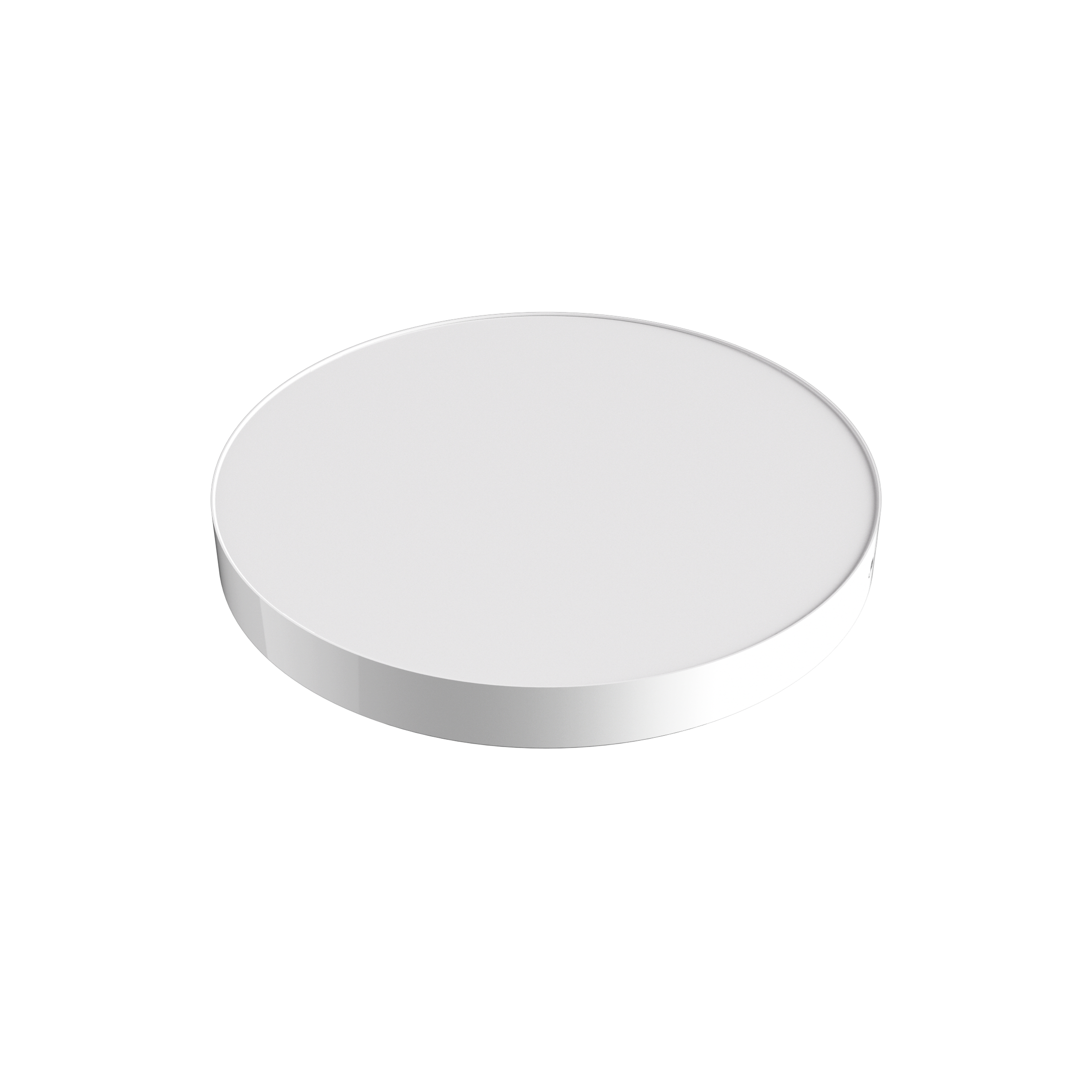
The PL02 LED panel light is the clear case for an IP20 indoor installation. It is a surface-mounted or recessed ceiling panel available in round and square shapes, with power options of 9 W, 12 W, 18 W and 24 W and luminous efficacy of 90 lm/W and 110 lm/W. Colour temperature is selectable across 2700K–6000K in three steps, and brightness can be set to 50%, 75% or 100%. Sizes are 5 inch, 8 inch and 12 inch, with round dimensions of φ160×40 mm, φ203×40 mm and φ305×40 mm, square dimensions of 160×160×40 mm, 203×203×35 mm and 305×305×40 mm, and cut-out sizes from φ75–125 mm to φ75–250 mm in 25 mm increments. The housing combines an aluminium or plastic frame with a PC diffuser, and control is by remote with a built-in microwave sensor for automatic on/off.
Because the PL02 is specified for commercial and residential indoor use, IP20 is the consistent choice: dry ceilings in offices, retail areas, corridors and hospitality interiors. The same fixture should not be carried into a car wash bay, a cold-store washdown zone or an open loading dock, not because the light is poor, but because the enclosure class does not match the environment.
IP65 in practice: the SH-E01 LED linear high bay
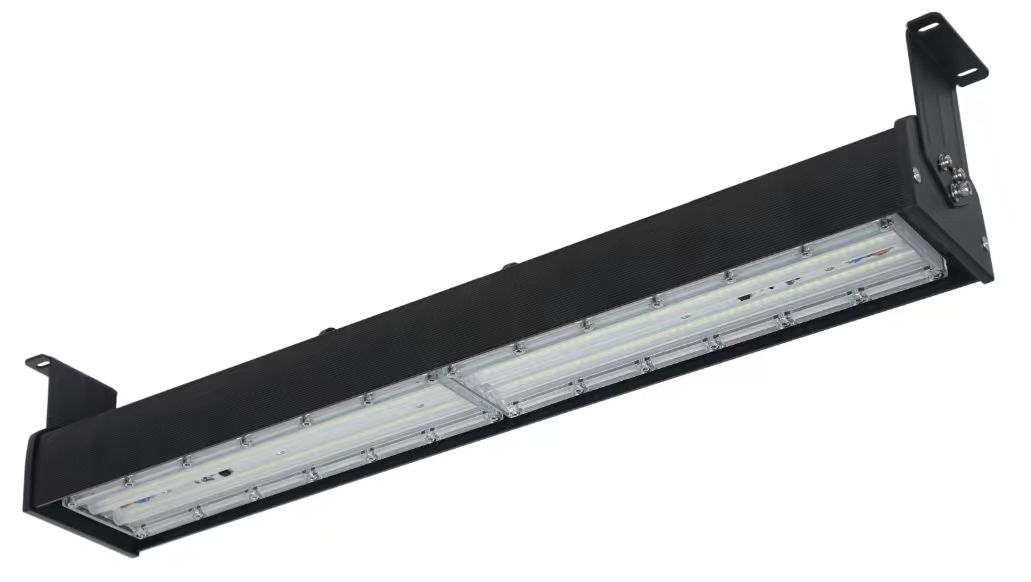
The SH-E01 LED linear high bay shows what changes when the environment is industrial. It is specified for warehouses, factories and workshops, with power options of 50 W, 100 W, 150 W and 200 W, luminous efficacy of 100 lm/W, 135 lm/W and 150 lm/W, a beam angle of 90° (H) × 120° (V), and colour temperatures of 3000K, 4000K, 5000K and 6500K. Three body lengths are available — 305.6×97.3×68.1 mm, 580.6×97.3×68.1 mm and 855.6×97.3×68.1 mm — built on an aluminium alloy housing with a PC/PMMA lens, and it mounts either with a mounting kit for surface installation or on chain/cable suspension.
The decisive specification is the protection rating: IP65, meaning dust-tight and resistant to water jets. In a working warehouse or workshop, airborne dust, humidity swings and occasional washdown are normal conditions, and this is exactly the environment class where an IP20 interior fixture would be the wrong specification. The SH-E01 pairs IP65 with a 5-year warranty and a branded driver, so the enclosure rating and the warranty term can be reviewed together as one evidence set rather than as two unrelated claims.
Where outdoor fixtures fit: IP44 solar security lighting and floodlight selection
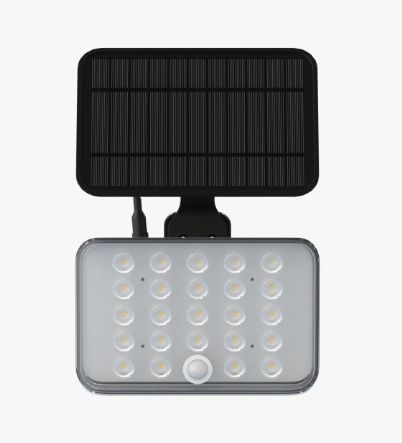
Outdoor fittings are not automatically IP65, and buyers who assume they are can end up with an over-specified or mismatched purchase. The LED solar flood light with PIR motion sensor is rated IP44, with 10 W power, 1600LM output at 6500K cool white, dimensions of 198 × 130 × 193.1 mm, an ABS housing, a monocrystalline silicon solar panel and a PC lens. It uses a PIR motion sensor with remote control and auto mode, offers 1H/2H/4H timer options, and is designed with a separate solar panel and light head so the panel can be positioned for better sunlight exposure using the supplied extension cable. No wiring is required, and its stated applications are residential and commercial outdoor security: yards, driveways, garages, pathways and walls — positions that receive rain and splash but not immersion or high-pressure washing.
Mains-powered outdoor floodlights follow the same logic but need their own verification step. The FL-C01 Series LED floodlight covers 10–300 W at 100–240 V or 220–240 V, with efficiency of 100 lm/W and 120 lm/W, colour temperatures of 3000K, 4000K and 6500K, power factor above 0.9, surge protection up to 2KV, and dimensions from 105×97×27 mm to 500×457×49 mm depending on wattage, in an aluminium and glass construction. Because floodlights are installed in widely different positions — under eaves, on poles, in open yards — the IP rating should be confirmed for the exact model and configuration on the datasheet before the purchase order is issued, rather than inferred from the product category.
Certifications sit on a different layer from IP
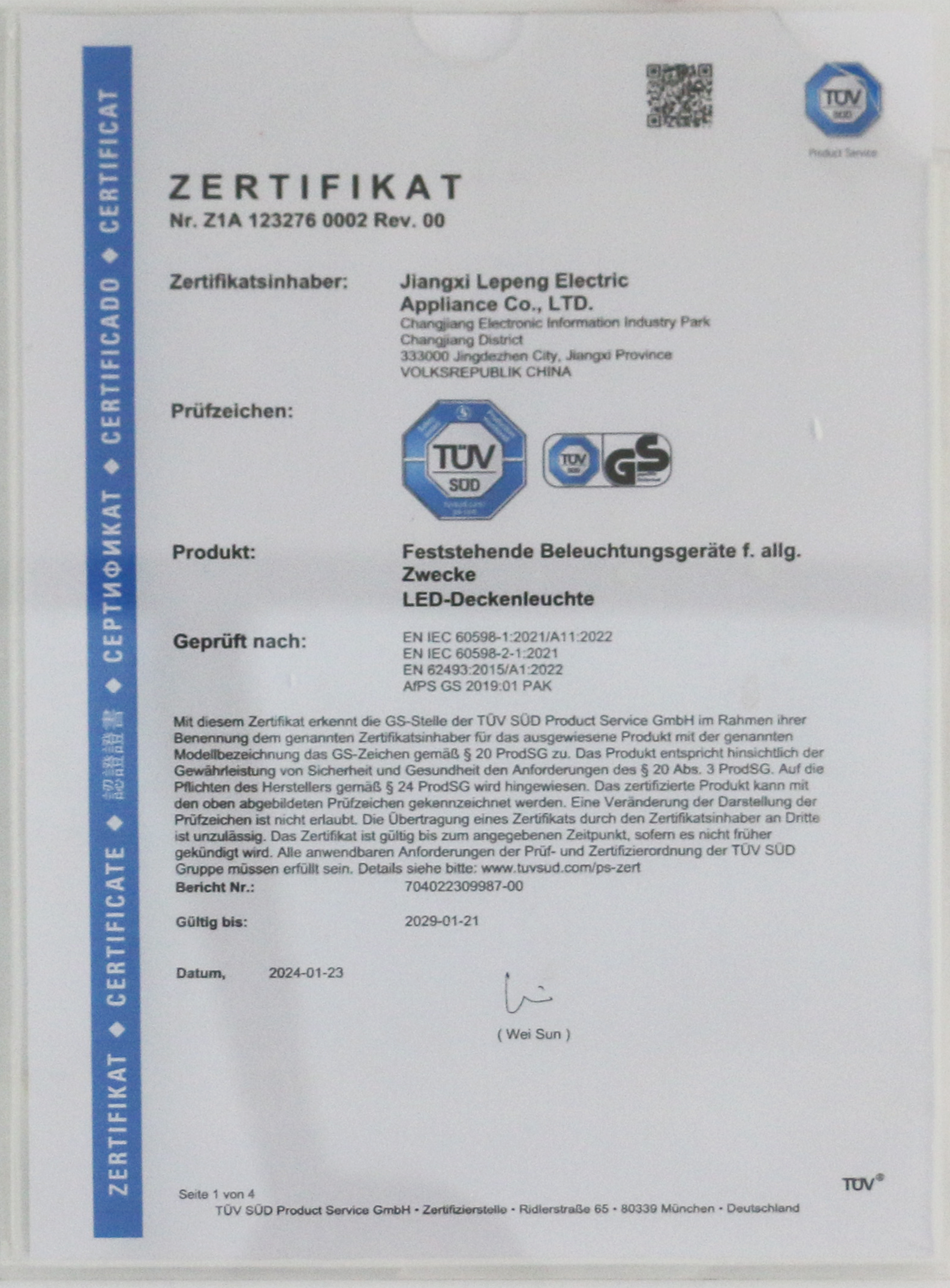
Certification does not describe sealing at all. It documents that defined requirements were tested and met. For the EU market, Lepeng holds three relevant document sets. The LED panel light PL02 is covered by a CE-EMC Attestation of Conformity issued by TUV SUD under certificate number E8A 123276 0630 Rev. 00, against EMC Directive 2014/30/EU, with a scope covering fixed general purpose luminaires and LED panel lights. The LED-Deckenleuchte product is certified to CE-LVD and holds a GS certificate (ZERTIFIKAT) issued by TUV SUD under certificate number Z1A 123276 0002 Rev. 00, referencing EN 60598-1:2021+A11:2022, EN 60598-2-1:2021, EN 62493:2015 and AFPS GS 2019:01 PAK. Separately, the LED ceiling fan with light is covered by an EU Type Examination Certificate issued by TUV SUD under certificate number TPS-RED500722 (01), because its remote wireless control places it under the Radio Equipment Directive route as a short range device, tested against EN 300 220-1 V3.1.1, EN 301 489-1 V2.2.1 and EN 301 489-3 V2.1.1.
The lesson for buyers is structural rather than brand-specific. Wireless control adds a compliance route. A fixture's EMC and safety documents do not automatically cover its radio function, and where a panel light or high bay uses a remote control or a sensor, the applicable approval route should be confirmed in writing for that configuration.
Step-by-Step Breakdown: Specifying IP and Certification for a Project
The following five-step sequence keeps enclosure ratings and compliance documents aligned with the actual installation.
- Define the environment before the fixture. Classify each installation zone as dry indoor, damp or sheltered outdoor, or exposed industrial with dust and water jet exposure. Marking zones on the layout is faster than debating fixture models later.
- Set the minimum IP per zone. Dry indoor ceilings typically call for IP20, as with the PL02 panel light. Sheltered outdoor positions that receive rain and splash are covered by IP44, as with the solar security light. Dusty industrial interiors and positions exposed to water jets call for IP65, as with the SH-E01 linear high bay.
- Match housing and lens materials to the environment. The PL02 uses an aluminium or plastic frame with a PC diffuser for indoor ceilings; the SH-E01 uses an aluminium alloy housing with a PC/PMMA lens for industrial interiors; the solar security light uses an ABS housing, monocrystalline silicon panel and PC lens for outdoor mounting.
- Verify certification by number and scope, not by logo. Record the certificate number, the issuing body, the standard referenced and the declared product scope for the exact model purchased — for example CE-EMC certificate E8A 123276 0630 Rev. 00 for the PL02, and the GS certificate Z1A 123276 0002 Rev. 00 for the corresponding declared scope. For North American projects, confirm how the fixture maps to standards such as UL 1598 and UL 8750, and for general luminaire safety, IEC 60598.
- Confirm warranty, lead time and documentation in the same exchange. Ask for the warranty term, the production lead time and the document pack together, so that a fixture is not approved on performance and then delayed on paperwork. Lepeng states a lead time of 30–45 days, with minimum order quantity depending on the product, and a monthly capacity of 45 million LED lamps and 5 million LED luminaires.
Use Cases: Matching IP Ratings to Real Installations
High-ceiling warehouse and workshop lighting
A 200 W SH-E01 linear high bay at 150 lm/W with a 90° × 120° beam distributes light across racking aisles and production bays, and the IP65 enclosure keeps dust and jet-spray moisture out of the optical chamber. The 5-year warranty term supports the maintenance plan, and both mounting methods allow retrofit without new suspension design.
Retail, office and hospitality ceilings
For a suspended or recessed ceiling grid in a dry interior, the PL02 gives a 3-CCT selectable output across 2700K–6000K with three-level dimming at 50%, 75% and 100%, plus a microwave sensor for automatic on/off in corridors and back-of-house areas. IP20 is the correct and sufficient class here.
Outdoor perimeter and driveway security without wiring
Where trenching for mains cable is impractical, the IP44 solar security light provides 1600LM from a 10 W unit with PIR detection, remote control and 1H/2H/4H timers, and its split panel-and-head design allows the solar panel to be aimed independently of the light.
Facade, yard and general outdoor floodlighting
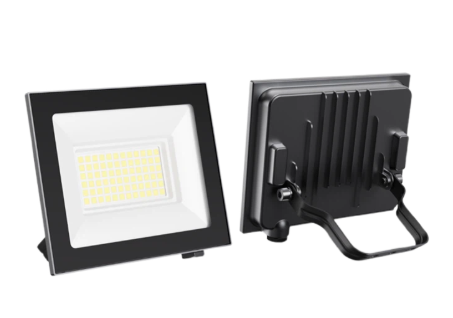
For yards, car parks and building facades, the FL-C01 Series provides 10–300 W with power factor above 0.9 and surge protection up to 2KV in an aluminium and glass housing, and its stated applications include residential, commercial and manufacturing environments. Because the same series covers a wide wattage range and several mounting positions, the sealing class should be matched to the installation point — sheltered wall or exposed pole — and confirmed on the model datasheet.
Comparison Table: IP20 Panel, IP65 Linear High Bay and IP44 Solar Security Light
| Attribute | LED Panel Light PL02 | LED Linear High Bay SH-E01 | LED Solar Flood Light (PIR) |
|---|---|---|---|
| IP rating | IP20 | IP65 | IP44 |
| Intended environment | Commercial and residential indoor ceilings | Industrial and commercial interior: warehouses, factories, workshops | Residential and commercial outdoor security: yards, driveways, garages, pathways, walls |
| Power range | 9 / 12 / 18 / 24 W | 50 / 100 / 150 / 200 W | 10 W |
| Luminous performance | 90 / 110 lm/W | 100 / 135 / 150 lm/W | 1600LM at 10 W |
| Colour temperature | 2700K–6000K, 3-CCT selectable | 3000K / 4000K / 5000K / 6500K | 6500K cool white |
| Housing and lens | Aluminium or plastic frame + PC diffuser | Aluminium alloy housing + PC/PMMA lens | ABS housing + monocrystalline silicon panel + PC lens |
| Control options | Remote control + microwave sensor (auto on/off) | Mounting kit surface installation or chain/cable suspension | PIR motion sensor, remote control, auto mode, 1H/2H/4H timer |
| Documented warranty | — | 5 years | — |
| EU compliance documents on file | CE-EMC Attestation of Conformity, certificate E8A 123276 0630 Rev. 00 (TUV SUD) | Covered within the declared GS/CE-LVD scope, certificate Z1A 123276 0002 Rev. 00 (TUV SUD) | Covered within the declared GS/CE-LVD scope, certificate Z1A 123276 0002 Rev. 00 (TUV SUD) |
— indicates the value is not part of the published parameter set reviewed for this guide. Confirm the applicable scope and current document status for the exact model and configuration before ordering.
FAQ
What do IP20, IP44 and IP65 actually mean for a commercial LED installation?
The IP code has two digits: the first covers solids and dust, the second covers water. IP20 protects against solid objects larger than 12.5 mm and offers no water protection, which matches dry indoor ceilings such as the PL02 LED panel light. IP44 protects against solid objects larger than 1 mm and against water splashing from any direction, which is the class of the LED solar flood light with PIR motion sensor. IP65 is dust-tight and protected against water jets, which is the class of the SH-E01 LED linear high bay for warehouses and workshops. The rating describes the enclosure only — it says nothing about wattage, efficacy or colour quality.
What should I verify from a CE-certified commercial LED flood light manufacturer?
Verify the document, not the logo. Ask for the certificate number, the issuing body, the standard referenced and the declared product scope, then match that scope to the exact model you are buying. Two examples from Lepeng's file illustrate the level of detail to expect: a CE-EMC Attestation of Conformity for the LED panel light PL02 issued by TUV SUD under certificate number E8A 123276 0630 Rev. 00 against EMC Directive 2014/30/EU, and a GS certificate (ZERTIFIKAT) issued by TUV SUD under certificate number Z1A 123276 0002 Rev. 00 referencing EN 60598-1:2021+A11:2022, EN 60598-2-1:2021, EN 62493:2015 and AFPS GS 2019:01 PAK. Where the fixture has a remote control or radio-linked sensor, also confirm the Radio Equipment Directive documentation, as with the EU Type Examination Certificate TPS-RED500722 (01) issued for the wireless-controlled LED ceiling fan with light. For North American projects, confirm how the product maps to standards such as UL 1598 and UL 8750, and to IEC 60598 for luminaire safety.
How do IP ratings relate to warranty and application suitability?
The rating defines which environments the enclosure is built for, so suitability is decided before price comparison. Where a rating and a warranty are documented together, the pair is easier to evaluate: the SH-E01 LED linear high bay combines an IP65 enclosure with a 5-year warranty for warehouse, factory and workshop conditions. Installers should confirm with the supplier whether a specific installation zone falls within the conditions the warranty covers, since washdown, immersion and high-pressure cleaning go beyond splashing-water classes.
Can IP-rated commercial LED lighting be OEM/ODM customized?
Lepeng supports OEM and ODM projects, covering fixture appearance, power and accessories, with the details confirmed through product communication. One engineering caution applies: the IP rating depends on the housing, lens and sealing construction, so enclosure-related components should be frozen before cosmetic or accessory customization begins. Production capacity supports this at scale — 2,000 employees across production bases in Zhejiang and Jiangxi, a 200,000 m² factory footprint, a 200-person R&D team, and stated monthly capacity of 45 million LED lamps and 5 million LED luminaires, with 90% of output exported to markets including the EU, Southeast Asia, the Middle East and Latin America.
What is the typical lead time and minimum order quantity for a commercial LED lighting order?
Lepeng states a production lead time of 30–45 days, with minimum order quantity depending on the specific product. Because IP rating and certification scope should be confirmed model by model, it is worth requesting the specification sheet and the relevant certificate together with the quotation, so the commercial terms and the technical documents arrive in one package.
Conclusion: A Rating Is Only Useful When It Is Documented
IP ratings and product certifications answer separate questions, and both belong in the specification before a purchase order is issued. The IP code decides where a fixture can be installed: IP20 for dry indoor ceilings such as the PL02 LED panel light, IP44 for sheltered outdoor positions such as the solar security light with PIR sensor, and IP65 for dust-heavy, water-jet-exposed industrial interiors such as the SH-E01 LED linear high bay, which carries a 5-year warranty. Certifications decide whether the product can be placed on the target market and signed off after installation, and they must be traceable by certificate number, issuing body, standard and declared scope — the CE-EMC attestation E8A 123276 0630 Rev. 00 for the PL02, the GS certificate Z1A 123276 0002 Rev. 00 covering EN 60598-1:2021+A11:2022, EN 60598-2-1:2021, EN 62493:2015 and AFPS GS 2019:01 PAK, and the EU Type Examination Certificate TPS-RED500722 (01) for wireless-controlled products.
Next step
To confirm the IP rating, certification scope, lead time and MOQ for a specific model, send your project conditions and target market to the Lepeng team — Zhejiang Lepeng Electric Appliance Co.,Ltd., No. 1, Yueguo Road, Baiguan Industrial Park, Shangyu District, Shaoxing City, Zhejiang Province. Email: fish@idealbright.com. WhatsApp: +86-13777885334. Tel: +86-575-82188752.
Review the full commercial LED lighting portfolio, or download the product catalogue for model-level specifications.