
Ranked: What to Look for in a Solid State Relay for Consumer Electronics
A solid state relay (SSR) is a switching device that opens and closes a load circuit with a semiconductor output stage instead of mechanical contacts. For a consumer-electronics design team or buyer at the decision stage, the useful question is not what an SSR is, but which evaluation points actually determine whether the part survives the product's service life. This guide ranks those points in the order they should be checked.
Solid state relays now sit inside products where a mechanical relay is a poor fit: appliances that switch heaters or lamps many times a day, devices that must operate silently in a living space, and control boards expected to run for years without maintenance. The switching behaviour that makes this possible is also what makes SSR selection different from traditional relay selection. An SSR is a component you design around: it has to be matched to the load, the thermal path and the enclosure, not simply dropped into a relay socket.
XURUI (Zhejiang Xurui Electronic Co., Ltd.) is a switching-component manufacturer founded in 2002 in Wenzhou, Zhejiang, China, whose product portfolio includes solid state relays alongside micro switches, limit switches, foot switches, toggle switches, reed switches, proximity switches and photoelectric switches. The ranked criteria below follow the sequence a consumer-electronics project normally works through, from load definition to a committed bill of materials.
What a Solid State Relay Actually Does in a Consumer-Electronics Design
An SSR performs the same system function as an electromechanical relay: a small control signal causes a larger load current to be switched on or off. The difference is the switching element. Where an electromechanical relay moves one metal contact against another, an SSR switches with a semiconductor output stage.
XURUI's comparison data against traditional electromechanical relays records the practical consequences: non-contact switching, faster response speed, a longer electrical lifespan, silent operation and higher reliability. The same comparison puts the failure-rate reduction of solid state switching at 50% relative to a traditional electromechanical relay, and the maintenance requirement 85% lower, because there is no mechanical wear and no contact arcing to erode the switching point.
Those characteristics translate directly into consumer-electronics design constraints:
- Audible noise. Silent operation matters in products used in bedrooms, kitchens and living rooms, where a relay click repeated hundreds of times a day reads as a user-experience defect rather than a technical detail.
- Cycle count. Products that switch a heater or a lamp on and off continuously accumulate far more operations than the electrical lifespan of a mechanical contact comfortably absorbs.
- Wear mechanism. With no moving contact, the dominant failure modes shift to thermal and electrical stress instead of mechanical wear, which is why the ranking below places thermal design and protection behaviour near the top.
The same fact cuts the other way. Because an SSR is a semiconductor device, it must be given a thermal path and protection that a mechanical relay does not need. Selecting an SSR is therefore a small engineering exercise, not a part-number substitution.
Industry Background: More Options Than a Shortcut Decision Can Handle
The category has expanded, which is good for choice and bad for shortcuts. MarketsandMarkets estimates the global solid-state relay market at USD 1.74 billion in 2025 and projects USD 2.36 billion by 2030. Mordor Intelligence estimates that Asia-Pacific accounts for around 42% of that market in 2025, driven by electric-vehicle charger deployment and photovoltaic inverter manufacturing in China and Japan.
Two structural facts from the same Mordor Intelligence dataset are directly useful to a buyer ranking selection criteria:
- Mounting format. Panel-mount designs held the largest mounting share at 38.67% in 2025, while DIN-rail variants are the fastest-growing segment, forecast at a 7.11% CAGR. The format decision is no longer automatic, because enclosure design and panel reuse both influence it.
- Current rating. The 0-20 ampere bracket accounted for 44.13% of the market size in 2025. A large share of real applications, including many consumer-electronics loads, sit in the lower current brackets rather than in heavy industrial ratings.
Compliance expectations have converged as well. IEC/EN 60947-4-3 and UL 508 are the standards commonly referenced for industrial control switchgear and relays, per IEC and UL Solutions. A consumer-electronics product that carries an SSR into a North American or European market will normally be asked for evidence that the component's approvals match the destination market, and that question is easier to answer at the specification stage than after tooling.
XURUI's own export profile reflects that reality: the company exports roughly 40% of its output, with established markets including the United States, Germany, Japan, South Korea, Turkey, Belgium and Egypt. In this category, documentation should be expected to be part of the conversation from the first quotation.
The Ranked List: What to Look For, in Decision Order
The seven points below are ranked by dependency, not by importance alone. A criterion that can invalidate the others ranks above one that merely improves the result.
| Rank | Evaluation point | The failure it prevents |
|---|---|---|
| 1 | Load type and switching topology | Wrong output stage for the load |
| 2 | Current rating and derating headroom | Overcurrent damage |
| 3 | Switching method (zero-cross or instantaneous) | Voltage surge and electrical stress |
| 4 | Thermal path, heat sinking and mounting format | Overheating |
| 5 | Overcurrent, surge and EMI behaviour | Electromagnetic interference, load-side faults |
| 6 | Certification and manufacturing consistency | Compliance failure, batch-to-batch variation |
| 7 | Lifetime cost-performance | Low unit price, expensive product |
Rank 1 - Load Type and Switching Topology
Ranked first because nothing downstream can compensate for it. Before comparing any other parameter, define whether the design switches an AC mains load, a low-voltage DC rail, or needs a DC-to-AC configuration. An AC solid state relay and a DC solid state relay are built around different output stages and are not interchangeable, even when their current rating and footprint look similar on a datasheet.
Next, characterise the load itself. Resistive loads such as heating elements behave predictably; lighting loads and capacitive inputs can draw a large inrush at switch-on; inductive loads associated with small motors store energy that must be managed when the circuit opens. The load profile decides which switching method, protection scheme and derating margin are appropriate, so it belongs at the top of the ranking rather than at the end of the evaluation.
Rank 2 - Current Rating and Derating Headroom
Ranked second because overcurrent damage is one of the first risks recorded in XURUI's SSR risk-control documentation, and it is almost always a specification error rather than a manufacturing defect. The rule is straightforward: the relay's rated current must exceed the steady-state load current with margin for inrush and for the temperature inside the enclosure.
A rated value is a reference condition, not a guarantee inside a sealed plastic housing in a warm room. Design teams should specify against the worst-case ambient the product will see in service, then re-confirm the margin against the load's start-up behaviour. Market data reinforces how much of this work happens in the lower brackets: the 0-20 ampere range represented 44.13% of global SSR market size in 2025 according to Mordor Intelligence, and consumer-electronics loads generally sit inside that range rather than above it.
Rank 3 - Switching Method: Zero-Cross or Instantaneous
Ranked third because it determines how much electrical stress the relay and the load absorb on every operation. XURUI's SSR risk-control documentation lists zero-cross switching as a design method for reducing electrical stress, alongside a surge suppression circuit.
In practical terms, zero-cross switching connects the output close to the point where the AC waveform crosses zero, which limits the inrush current a resistive heater or lamp presents and reduces the electrical noise generated by each switching event. That makes it the usual default for heating and lighting control, which are precisely the load types XURUI's comparison data identifies as the natural application area for solid state switching. Instantaneous or random turn-on is chosen when the load must be connected at a specific point in the waveform, such as phase control. That choice should be an explicit design decision, not a default.
Rank 4 - Thermal Path, Heat Sinking and Mounting Format
Ranked fourth because overheating is the first risk category in XURUI's SSR risk documentation and because it is a system-level property: it depends on the relay, the heat sink or mounting surface, and the enclosure together. The documented control method is a built-in heat-dissipation design using an aluminium base plate, supported by thermal performance testing before shipment.
Inside a consumer-electronics enclosure, this is where the ranked list becomes a packaging conversation. Panel-mount designs held the largest mounting share at 38.67% in 2025, while DIN-rail variants are the fastest-growing format at a forecast 7.11% CAGR according to Mordor Intelligence. A designer choosing between a DIN-rail and a panel-mount body is really choosing where the heat goes and how the part is assembled or replaced, which is why mounting format sits in the same ranking position as thermal design rather than in a separate mechanical checklist.
Rank 5 - Overcurrent, Surge and EMI Behaviour
Ranked fifth because protection is what keeps a correctly specified relay from becoming a field failure. XURUI's documented product-level control methods are overcurrent protection, a surge suppression circuit, and zero-cross switching to reduce electrical stress. The corresponding verification steps are strict thermal performance testing, electrical load testing, surge and EMC testing, and long-term reliability verification before shipment.
At component level, the quality controls include high-quality contact materials with silver-plated contacts, a rated-current design with overload protection circuits, and rated current, voltage withstand and short-circuit testing. For a buyer, the useful output of this ranking position is a question: which protections sit inside the relay, and which are expected on the board? A relay that assumes board-level surge suppression is not the same product as one that includes it, even at the same unit price.
Rank 6 - Certification and Manufacturing Consistency
Ranked sixth because it is documentation-dependent rather than design-dependent, but it is a gate rather than a preference. XURUI operates an ISO 9001 quality management system, and its mainstream products carry CCC, CE, TUV SUD, UL, KC and RoHS approvals. At manufacturing level, the company runs a 5,000+ square metre facility with 150 employees, an annual output of 20 million units, an engineering team of more than 24 engineers, more than 60 national independent patents, and 100% strict inspection before delivery.
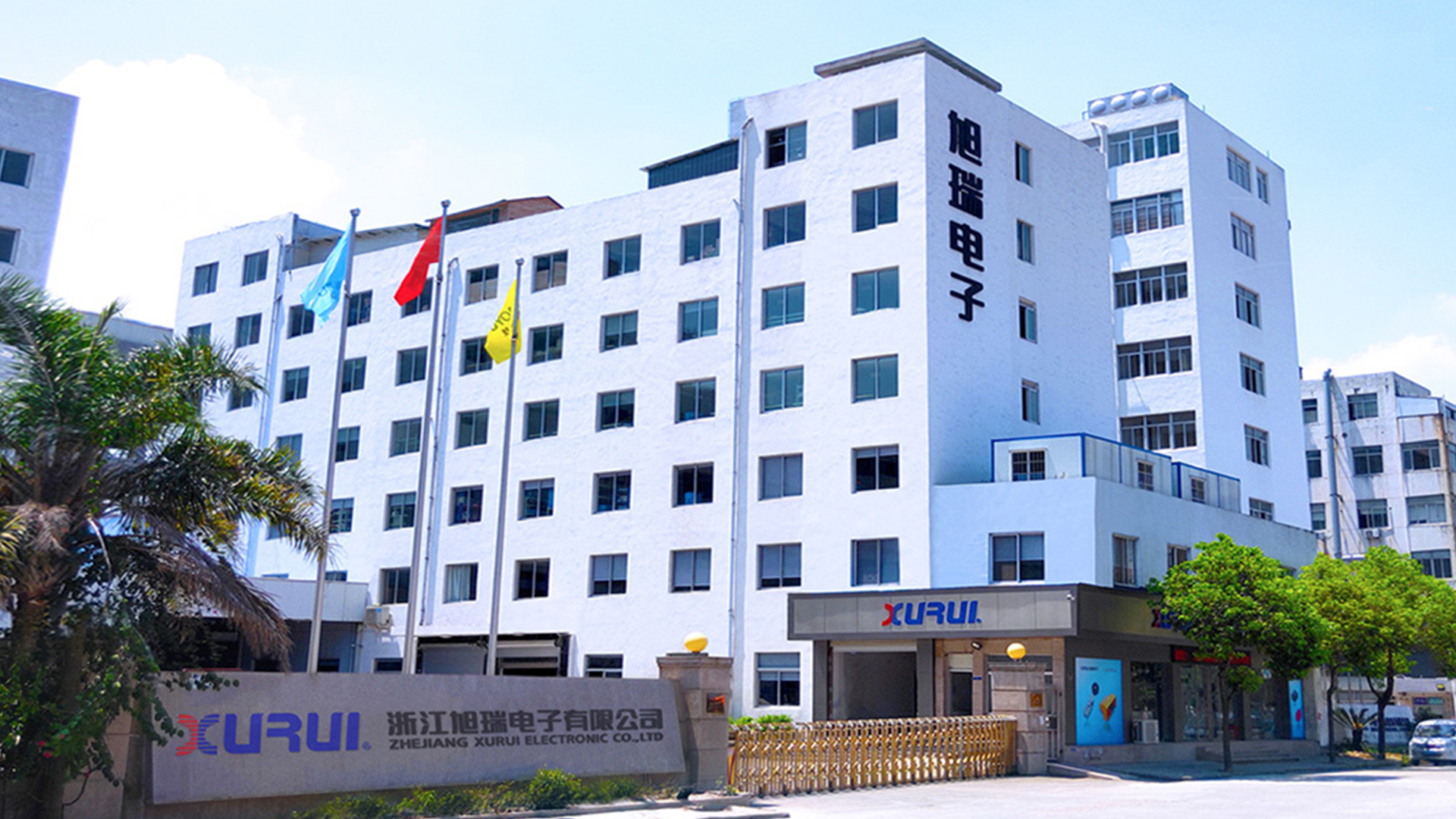
XURUI's manufacturing base in Wenzhou, Zhejiang, China: a 5,000+ square metre facility with 150 employees and an annual output of 20 million units.
Consistency is the part buyers find hardest to verify on a datasheet. A supplier with a documented pre-shipment inspection regime, a long production history and OEM/ODM capability presents a different risk profile from a trading intermediary, especially for a component that will ship in consumer volumes. The relevant checks are whether the approval listed applies to the specific series and destination market, and whether the supplier manufactures rather than resells.
Rank 7 - Lifetime Cost-Performance
Ranked last not because it matters least, but because it cannot be calculated until the six points above are settled. Unit price is only meaningful once the load, rating, switching method, thermal design, protection level and certification status are fixed.
XURUI's comparison data against traditional electromechanical relays gives the shape of that calculation: solid state switching carries an initial cost roughly 20% higher, but a total cost of ownership approximately 35% lower over five years, with a 50% reduction in failure rate and an 85% reduction in maintenance requirement because there is no mechanical wear and no contact arcing. In a consumer-electronics programme the second-order benefits usually dominate: fewer service returns, fewer warranty claims, and a product that stays quiet through its service life.
Reading the ranking correctly. Points 1 to 3 are eliminative: get them wrong and the part will not work. Points 4 and 5 are design-integration issues that determine field reliability. Points 6 and 7 are commercial and documentary checks that determine whether the choice survives production and warranty.
Step-by-Step: Working the Ranked List in a Real Project
The ranked criteria are only useful if they are applied in sequence. A workable order for a consumer-electronics programme looks like this.
- Write the load profile. Record whether the load is AC or DC, its steady-state current, its inrush characteristic, and how often it is switched per day. This is the input to Rank 1.
- Set the current rating with margin. Select a rating above the worst-case steady-state current, then re-check it at the maximum ambient inside the enclosure. This is Rank 2.
- Choose the switching method. Default to zero-cross for heating and lighting loads, and document any decision to use instantaneous switching together with the reason. This is Rank 3.
- Fix the thermal and mounting solution. Decide the mounting format, the heat-sinking approach and the airflow path together, then confirm the relay's thermal design supports them. This is Rank 4.
- Agree the protection boundary. List which protections sit inside the relay and which sit on the board, then confirm both. This is Rank 5.
- Verify approvals and manufacturing evidence. Match the certification listed to the specific series and destination market, and confirm the supplier's inspection and production setup. This is Rank 6.
- Calculate lifetime cost-performance. Compare candidates on five-year ownership cost rather than unit price, including expected replacement and service costs. This is Rank 7.
- Validate with a sample. Test thermal behaviour in the real enclosure, load switching at the real duty cycle, and surge and EMC behaviour before committing volumes.
Use Cases: Where the Ranking Order Shifts
The ranking above is the default sequence. In specific consumer-electronics applications, one or two positions move up the list.
Heating control in household appliances
Where an SSR switches a resistive heating element, zero-cross switching (Rank 3) and thermal design (Rank 4) move to the front, because both inrush behaviour and continuous heat generation are inherent to the load. This is the application area the comparison data identifies as heating control systems, a natural fit for solid state switching.
Lighting and lamp control in connected devices
Lighting control is the second application area named in the comparison data. Here Rank 3 also rises, because lamp loads can present inrush far above their steady-state current, and Rank 1 matters because some lighting circuits are not purely resistive.
Motor-driven consumer products
Where the load is inductive, Rank 1 and Rank 5 move up together: the topology has to suit an inductive load, and the protection boundary has to account for the energy stored in the winding when the circuit opens.
Low-voltage DC control inside battery-powered devices
When the switched rail is DC rather than mains AC, Rank 1 dominates and Rank 3 becomes largely irrelevant, because zero-cross switching is an AC concept. The evaluation then concentrates on DC output-stage behaviour, on-state losses and thermal performance in a confined enclosure.
Solid State Relay vs Electromechanical Relay: Side-by-Side
The table below summarises the category-level difference recorded in XURUI's comparison data. It describes the two relay categories, not the measured performance of any individual model.
| Decision factor | Solid state relay (SSR) | Electromechanical relay |
|---|---|---|
| Switching mechanism | Non-contact semiconductor switching | Mechanical contact movement |
| Response speed | Faster response speed | Limited by mechanical actuation |
| Electrical lifespan | Longer electrical lifespan | Contacts erode with each operation |
| Audible noise | Silent operation | Audible click on every operation |
| Failure rate | Reduced by 50% | Reference for comparison |
| Initial cost | About 20% higher | Lower upfront cost |
| Total cost of ownership (5 years) | About 35% lower | Higher over the service period |
| Maintenance requirement | 85% less maintenance, no mechanical wear and no contact arcing | Periodic inspection and replacement |
Two conclusions follow for consumer-electronics buyers. First, the initial-cost premium of solid state switching is a design decision rather than a penalty: it is the price of silent operation and a longer electrical life. Second, the ownership-cost advantage only materialises if the thermal and protection requirements in the ranked list were respected, because an under-specified relay erases the cost argument in the first warranty cycle.
FAQ: Solid State Relay Selection for Consumer Electronics
1. Does a solid state relay used in consumer electronics need UL, CE or other certification?
It depends on the destination market, but the compliance conversation should start at specification. IEC/EN 60947-4-3 and UL 508 are the standards commonly referenced for industrial control switchgear and relays, per IEC and UL Solutions. XURUI operates an ISO 9001 quality management system, and its mainstream products carry CCC, CE, TUV SUD, UL, KC and RoHS approvals. Buyers should confirm that the approval listed applies to the specific series being purchased and to the market the finished product will be sold into.
2. Can a supplier customize a solid state relay for a specific consumer-electronics design?
Customization is a real option in this category, but it depends on the supplier's engineering depth. XURUI supports OEM and ODM customized services, works with an engineering team of more than 24 engineers, and holds more than 60 national independent patents. The practical test for a buyer is whether the customization is handled by the manufacturer's own engineering team and covered by the same pre-shipment inspection regime as standard production, because a supplier that outsources both presents a different risk profile.
3. Is a solid state relay more expensive than an electromechanical relay?
Yes on unit price and no on lifetime cost. XURUI's comparison data puts the initial cost of solid state switching at roughly 20% higher than a traditional electromechanical relay, with total cost of ownership approximately 35% lower over five years, a 50% reduction in failure rate and an 85% reduction in maintenance because there is no mechanical wear and no contact arcing. In consumer-electronics programmes the ownership calculation should include service returns and warranty exposure, not only the bill-of-materials line.
4. What should we test on a sample SSR before committing to a design?
Test the four things the ranked list is designed to protect: thermal performance in the real enclosure, switching behaviour at the real duty cycle, surge and EMI behaviour, and protection performance at the rated current. XURUI's own pre-shipment verification covers strict thermal performance testing, electrical load testing, surge and EMC testing, and long-term reliability verification, plus rated current, voltage withstand and short-circuit tests at component level. If you want to evaluate a specific configuration against those conditions, you can request samples and a quotation from the XURUI team through WhatsApp or by email at Leon@chinaxurui.com.
5. How do we judge lead time and supply continuity before committing?
Judge it on production evidence rather than on a promise. XURUI manufactures in a 5,000+ square metre facility with 150 employees and an annual output of 20 million units, applies 100% strict inspection before delivery, and exports roughly 40% of its output to markets including the United States, Germany, Japan, South Korea, Turkey, Belgium and Egypt. Those figures describe capacity and quality discipline at company level; for a specific series and order volume, lead time should be confirmed directly with the supplier as part of the quotation.
Next Step: Turn the Ranking Into a Specification
The value of ranking selection criteria is that it converts an open-ended component search into a sequence of decisions: load type, current rating, switching method, thermal and mounting design, protection boundary, certification, and lifetime cost. Worked through in that order, the ranking produces a specification that can be quoted, sampled and validated, and it makes the supplier conversation concrete because every question has a defined answer rather than a preference.
XURUI (Zhejiang Xurui Electronic Co., Ltd.) supplies solid state relays and a full range of switching components from Wenzhou, Zhejiang, China, with OEM and ODM support, an ISO 9001 quality system, and mainstream product approvals covering CCC, CE, TUV SUD, UL, KC and RoHS. Buyers working on a consumer-electronics programme can request the product catalogue, discuss a sample evaluation, or ask for a quotation against a defined specification.
Request a sample, quotation or catalogue
Send your load profile and enclosure constraints, and the XURUI team will match them to a suitable solid state relay configuration.
Email: Leon@chinaxurui.com | Tel: +86-577-62911448 | WhatsApp: +86 13968773211
Website: xuruiswitch.com
Address: NO.3 Yandangshan Road, Wenzhou Bridge Industrial Park, Beibaixiang Town, Yueqing, Wenzhou City, Zhejiang, China