
What Is a Solid State Relay? A Complete Selection Guide
A solid state relay (SSR) is an electronic switching device that uses semiconductor components to turn an AC or DC load on and off without mechanical contacts. Because an SSR has no moving parts, it switches silently, responds in milliseconds, and avoids the contact arcing and wear found in electromechanical relays. Solid state relays are used in industrial automation, heating and temperature control, AC motor control, HVAC systems, street lighting, and renewable energy equipment.
For engineers and buyers moving from awareness to research, 'solid state relay' is not one product: it is a category that includes DC-to-AC relays, AC-controlled relays, adjustable relays, and high-current panel-mount units. This guide explains the differences using a concrete example — the SSR product series manufactured by Zhejiang Xurui Electronic Co., Ltd. (XURUI) — and gives a step-by-step selection process that works for any SSR procurement.
Why 'Solid State Relay' Is a Spec, Not a Single Product
The terms around SSR buying can look like a list of unrelated products: SSR solid state relay, DC to AC solid state relay, AC solid state relay, zero crossing solid state relay, adjustable solid state relay, DIN rail mount relay, 240V, 480V, 25A, 40A, 120A. All of them describe the same component family, but each changes at least one of these variables:
- Control input. A DC-controlled SSR (often labelled DA) turns on with a DC voltage such as 3-32VDC. An AC-controlled SSR (often labelled AA) turns on with an AC voltage such as 80-250VAC.
- Load voltage. Common AC load classes are 24-240VAC and 75-480VAC. Some applications require a 600V-class relay; in that case, the load rating must be confirmed against the supplier's datasheet.
- Load current. Compact PCB relays are rated at a few amps; general-purpose panel relays are commonly 25A and 40A models; high-power relays go to 120A, 200A, or higher.
- Switching behavior. Standard SSRs switch fully on or off. Adjustable or phase-angle SSRs vary the conduction angle, which enables dimming and basic speed regulation.
- Mounting. Horizontal screw-mount (panel mount), DIN rail mount, and PCB mount are the main formats.
A buyer who specifies only 'solid state relay 40A' has not yet defined the control voltage, load voltage, or mounting. The sections below resolve each of these variables.
SSR Market Context and Standards
The global solid-state relay market size is estimated at USD 1.74 billion in 2025 and is projected to reach USD 2.36 billion by 2030, according to MarketsandMarkets. Asia-Pacific dominates the SSR market with an estimated 42% share in 2025, driven by EV charger deployment and photovoltaic inverter manufacturing in China and Japan, according to Mordor Intelligence.
Two structural trends matter for buyers. First, panel-mount SSR designs held the largest mounting configuration share at 38.67% in 2025, while DIN-rail variants are the fastest-growing segment with a forecasted 7.11% CAGR (Mordor Intelligence). Second, the 0-20 ampere current rating bracket accounted for 44.13% of the SSR market size in 2025 (Mordor Intelligence), meaning low- and medium-current SSRs are the most common — but industrial procurement still relies on 25A, 40A, and higher ratings for heating and motor circuits.
On the supply side, leading global manufacturers of solid-state relays include Sensata (Crydom), OMRON, Carlo Gavazzi, Schneider Electric, Panasonic, and TE Connectivity, according to Market Research Future. Chinese manufacturers such as XURUI compete on the same specifications with certified production and OEM/ODM support.
Compliance is non-negotiable for industrial SSRs. Industrial solid state relays are required to comply with international safety standards including IEC/EN 60947-4-3 (contactors and motor-starters) and UL 508 (industrial control equipment), per IEC and UL Solutions.
XURUI: Manufacturer Background
Zhejiang Xurui Electronic Co., Ltd. (XURUI) is a professional manufacturer and supplier of industrial low-voltage control switches, including solid state relays, based in Yueqing, Wenzhou, Zhejiang, China. Founded in 2002, XURUI operates a 5,000+ m² factory with around 150 employees and an annual output of 20 million units. Its R&D team includes 24+ engineers, and the company holds more than 60 national independent patents.
XURUI obtained independent import and export rights in 2008. Today, about 40% of output is exported, with main markets in the United States, Germany, Japan, South Korea, Turkey, Belgium, and Egypt. The company is certified to the ISO9001 international quality system, and its mainstream products carry CCC, CE, TÜV SÜD, UL, KC, and RoHS certifications. XURUI supports OEM and ODM customized services and performs 100% inspection before delivery.
Solid State Relay Types, Explained with the XURUI SSR Series
The XURUI SSR series covers the load voltages, current ratings, and control modes that industrial buyers search for. Each model below is a distinct type of solid state relay.
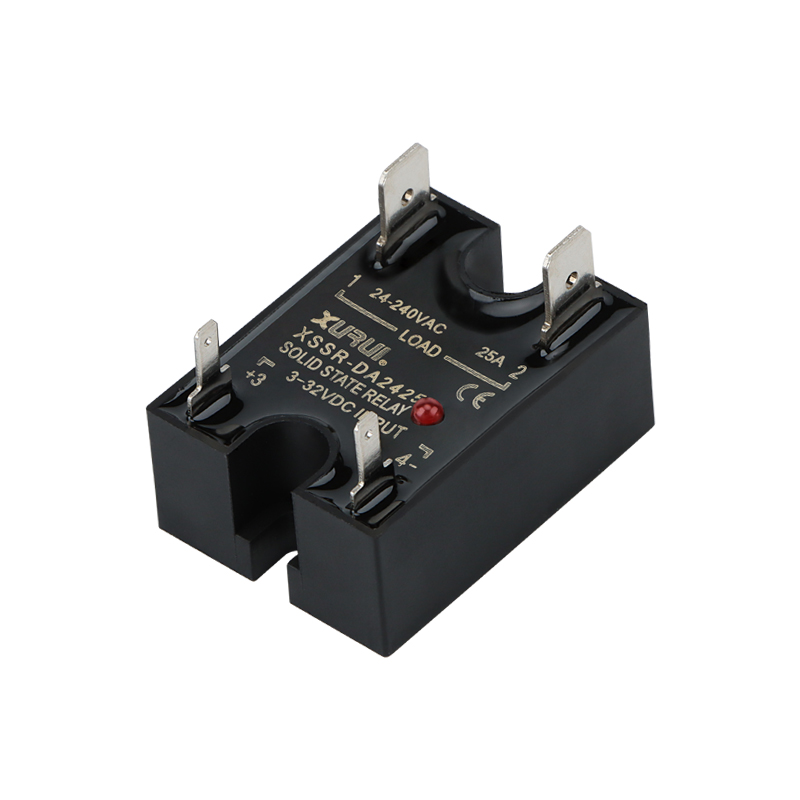
XURUI XSSR-W7: DC-controlled 240 VAC SSR
The XURUI XSSR-W7 is a DC-controlled solid state relay rated for 24-240VAC loads with a maximum load current of 5-25A. It is controlled by a 3-32VDC signal with a control current of 6-25mA. Key electrical values include a breakover voltage of ≤1.5VAC, output leakage current of ≤3mA, medium withstand voltage of ≥2500VAC, insulation resistance of ≥100MΩ, and switching time of ≤10ms. It operates at -20°C to +70°C in a PA66 nylon housing. The W7 answers the common '240V solid state relay' and '25A solid state relay' requirement.
XURUI XSSR-W6: dual-control 480 VAC SSR
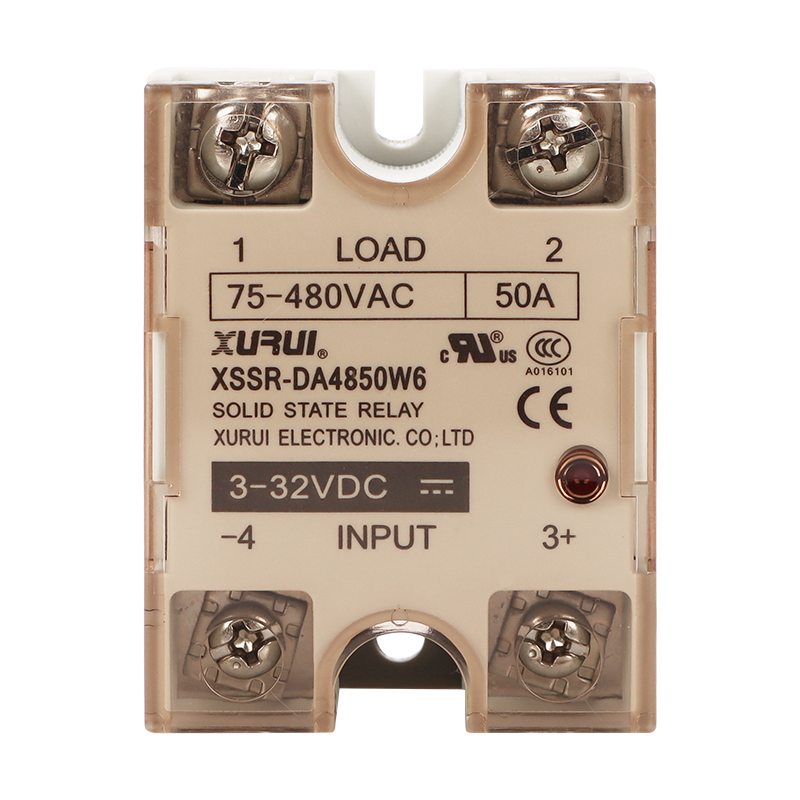
The XURUI XSSR-W6 is a solid state relay for 75-480VAC loads with a maximum load current of 10-100A. It is available as a DC-to-AC model (XSSR-DA48, control 3-32VDC) and as an AC-controlled model (XSSR-AA48, control 80-250VAC). Control current is 6-25mA for the DA version and 5-25mA for the AA version. Electrical ratings include a breakover voltage of ≤2VAC, output leakage current of ≤5mA, medium withstand voltage of ≥2500VAC, insulation resistance of ≥100MΩ, switching time of ≤10ms, and an operating temperature range of -20°C to +70°C. The W6 is a typical choice for 480V-class industrial heating and automation circuits up to 100A.
XURUI XSSR-W12: high-current dual-control SSR
The XURUI XSSR-W12 is a solid state relay for 75-480VAC loads with a maximum load current of 10-120A. Like the W6, it is offered in DA (3-32VDC) and AA (80-250VAC) versions, with a control current of 6-25mA or 5-25mA. The W12 adds margin for 100-120A circuits and supports a frequency range of 47-63Hz, making it suitable for industrial automation installations, electric stove and heating control, street lights, signal and traffic lights, and AC motor control.
XURUI XSSR-W2-JK: 42-480 VAC SSR with aluminum base plate
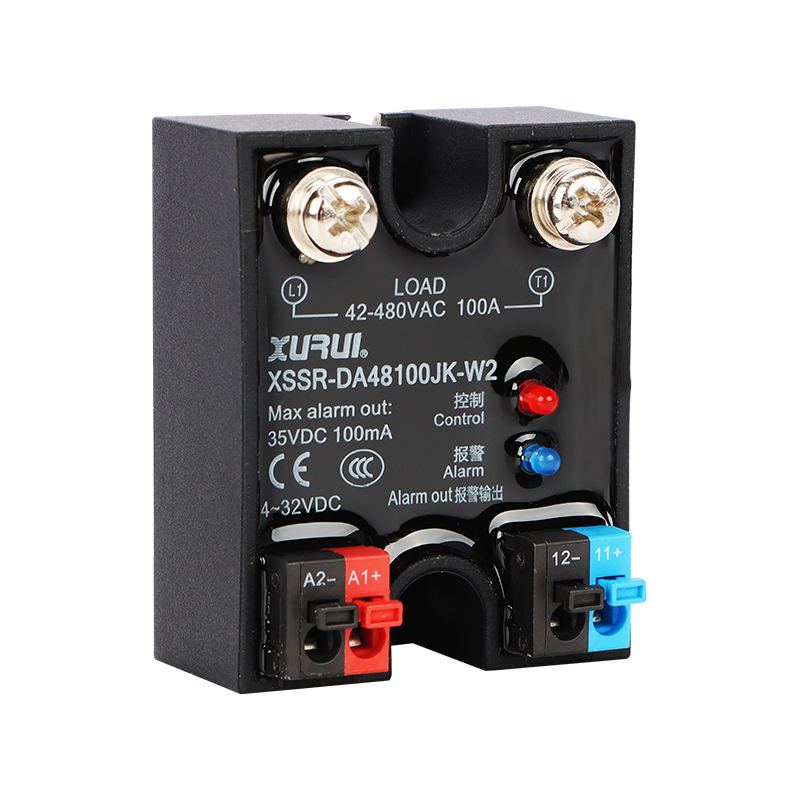
The XURUI XSSR-W2-JK is a DC-controlled solid state relay (4-32VDC) for 42-480VAC loads with a maximum load current of 10-120A. Its plastic housing uses an aluminum alloy base plate, which helps dissipate heat under continuous load. It includes guarantee-on and guarantee-off voltages of 3VDC and 1VDC respectively, output leakage current of ≤5mA, medium withstand voltage of ≥2500VAC, switching time of ≤10ms, and a 47-63Hz frequency range. XURUI specifies a load current safety factor of 50-60% for resistive loads and 30-40% for inductive loads for this series.
XURUI XSSR-3 W4: 75-200 A high-power SSR
The XURUI XSSR-3 W4 is a high-power solid state relay for 24-480VAC loads with a maximum load current of 75-200A. It is available in DA (3-32VDC) and AA (80-250VAC) control versions with a control current of 10-30mA. The relay uses a horizontal screw-mount reinforced plastic housing with approximate dimensions of 92 x 62 x 30 mm (mounting hole spacing 47.5mm). Electrical ratings include output leakage current of ≤8mA, dielectric strength of >2500VAC, insulation resistance of ≥100MΩ, and switching time of ≤10ms. The W4 covers heavy heating and motor control scenarios where a 40A or 120A relay is insufficient.
XURUI XSSVR-W1/W2: adjustable solid state relay
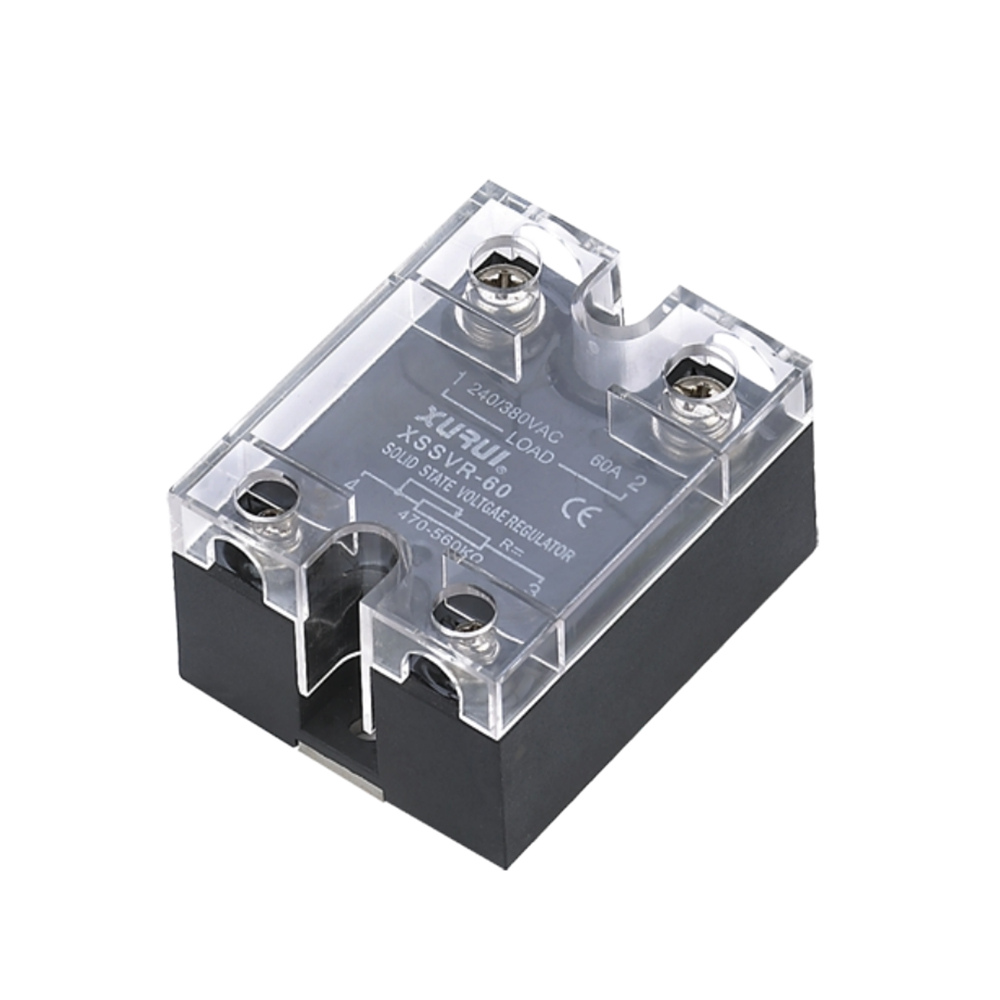
The XURUI XSSVR-W1 and XSSVR-W2 are adjustable solid state relays that control load output through an external potentiometer (470-560kΩ, 0.5-2W) and a conduction angle range of 0-170°. The W1 version carries 10-40A; the W2 version carries 50-200A. The load voltage specification is 0-240V/380VAC:0-480VAC, with a minimum load current of 0.05A. Breakover voltage is ≤2VAC, output leakage current is ≤1mA, medium withstand voltage is ≥2500VAC, and insulation resistance is >100MΩ. The XSSVR series is intended for industrial heating, lighting dimming, and basic motor speed regulation where the user needs to adjust output rather than simply switch on and off.
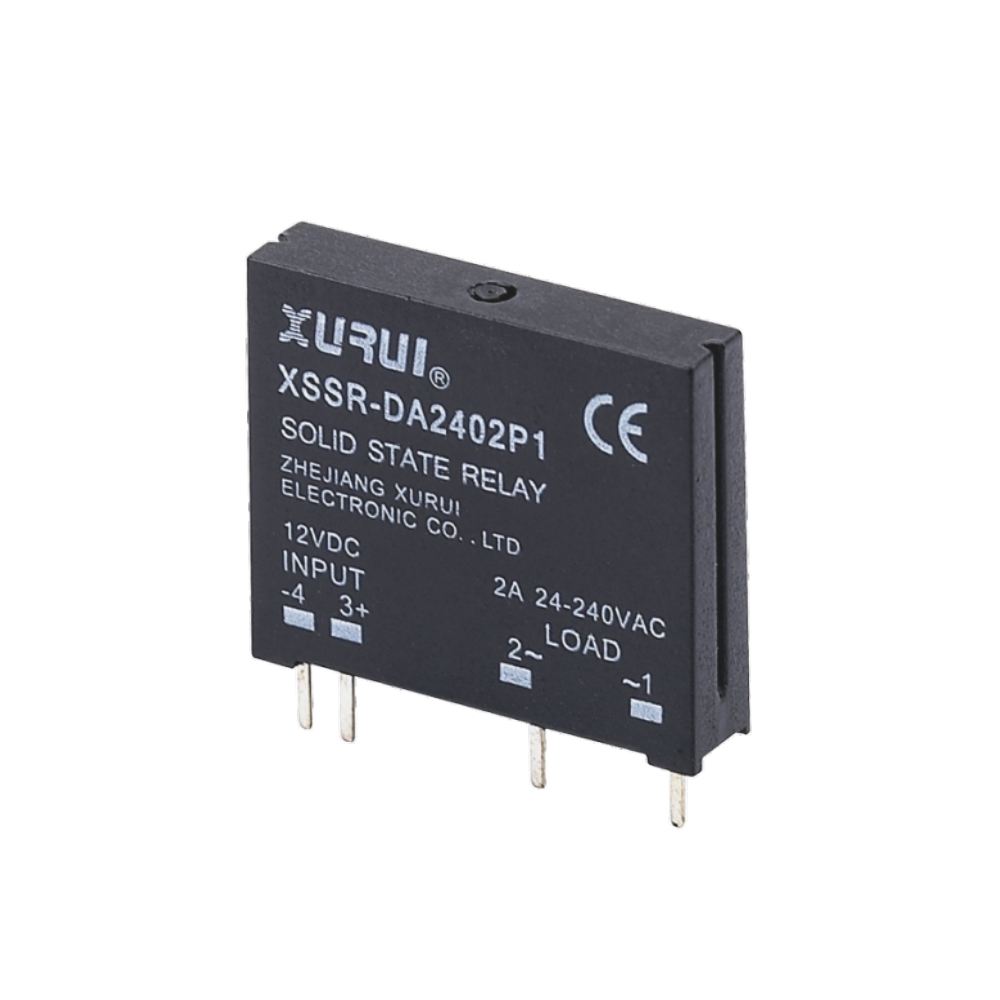
XURUI XSSR-P1/P2/P3: 2 A PCB-mount SSR
The XURUI XSSR-P1, P2, and P3 are compact PCB-mount solid state relays for 24-240VAC loads with a maximum load current of 2A and a minimum of 0.03A. They accept 5V, 12V, or 24VDC control (6-30mA). Ratings include breakover voltage of ≤1.5VAC, output leakage current of ≤1mA, medium withstand voltage of ≥2500VAC, insulation resistance of ≥100MΩ, and switching time of ≤10ms. This series suits low-power control boards, computer periphery connections, and small signal lamp circuits.
How to Select a Solid State Relay: Step-by-Step
The selection process below is based on the parameters XURUI publishes for its SSR series and applies to most industrial SSR sourcing.
Step 1. Identify load type and current. Determine whether the load is resistive (heaters, lamps) or inductive (motors, coils), then apply a safety factor so the relay is not run at the edge of its rating. XURUI specifies a load current safety factor of 50-60% for resistive loads and 30-40% for inductive loads. For example, a 10A resistive heater should use a relay rated around 16-20A, and a 25A or 40A model provides additional margin.
Step 2. Choose the control voltage. If the controller outputs DC, select a DA-type SSR that accepts 3-32VDC (e.g., XSSR-W7, XSSR-W6-DA, XSSR-W12-DA, XSSR-W2-JK). If the control signal is line-voltage AC, select an AA-type SSR that accepts 80-250VAC (e.g., XSSR-W6-AA, XSSR-W12-AA, XSSR-3 W4-AA).
Step 3. Match the load voltage class. For 240V-class circuits, the XSSR-W7 (24-240VAC) and XSSR-P series (24-240VAC) are direct matches. For 380V/480V systems, use the 75-480VAC models (W6, W12, W2-JK) or the 24-480VAC XSSR-3 W4. If the requirement is a 600V-class SSR, confirm the load voltage rating against the supplier's datasheet before ordering.
Step 4. Decide between standard and adjustable switching. On-off control of heating or lighting can use a standard SSR. If the application needs dimming or basic speed regulation, use an adjustable SSR such as the XSSVR-W1/W2, which varies the conduction angle from 0° to 170° via an external potentiometer.
Step 5. Confirm mounting and heat dissipation. Most industrial SSR panels use horizontal screw-mount formats with PA66 nylon housings; high-current models such as the XSSR-3 W4 use reinforced housings, and the XSSR-W2-JK uses an aluminum alloy base plate to improve heat transfer. DIN rail mounting is the fastest-growing format in the market, so for new cabinets, verify whether the chosen model is available in a DIN-rail-compatible version.
XURUI SSR Series at a Glance
The table below summarizes the main specifications of the XURUI solid state relay series. All values are taken from published product parameters.
| Model | Control Voltage | Load Voltage | Max Load Current | Housing / Mounting |
|---|---|---|---|---|
| XSSR-W7 | 3-32VDC (DA) | 24-240VAC | 5-25A | PA66 nylon, screw-mount |
| XSSR-W6 | 3-32VDC (DA) / 80-250VAC (AA) | 75-480VAC | 10-100A | PA66 nylon |
| XSSR-W12 | 3-32VDC (DA) / 80-250VAC (AA) | 75-480VAC | 10-120A | PA66 nylon |
| XSSR-W2-JK | 4-32VDC | 42-480VAC | 10-120A | Plastic housing, aluminum alloy base plate |
| XSSR-3 W4 | 3-32VDC (DA) / 80-250VAC (AA) | 24-480VAC | 75-200A | Reinforced plastic, horizontal screw-mount, approx. 92 x 62 x 30 mm |
| XSSVR-W1 | External potentiometer 470-560kΩ | 0-240V/380VAC:0-480VAC | 10-40A | PA66 nylon, adjustable 0-170° |
| XSSVR-W2 | External potentiometer 470-560kΩ | 0-240V/380VAC:0-480VAC | 50-200A | PA66 nylon, adjustable 0-170° |
| XSSR-P1/P2/P3 | 5V / 12V / 24VDC | 24-240VAC | 2A | PA66 nylon, PCB mount |
Selection note: 'DA' marks DC-controlled versions (3-32VDC); 'AA' marks AC-controlled versions (80-250VAC). Across the series, operating temperature is -20°C to +70°C, frequency range is 50-60Hz (47-63Hz for W12 and W2-JK), and medium withstand voltage is ≥2500VAC.
Where Solid State Relays Are Used
The application notes for the XURUI SSR series map each type to a specific use case:
- Industrial heating, lighting dimming, and basic motor speed regulation. The adjustable XSSVR-W1/W2 series is designed for these tasks because its 0-170° conduction angle allows output adjustment rather than simple on/off control.
- Industrial heating and motor control at high power. The XSSR-3 W4 (75-200A) is specified for industrial heating, motor control systems, and other high-power automation scenarios.
- Heating, warm control, street lights, signal and traffic lights, and AC motor control. The XSSR-W6, W7, W12, and W2-JK series are listed for these applications in industrial automation installations, electric stove and heating equipment, and control loops with PLC systems and temperature controllers.
- Power control systems, HVAC systems, and renewable energy. The XSSR-W2-JK is an example of an SSR used in industrial automation, power control systems, home appliances, HVAC systems, renewable energy, electric vehicles, and medical equipment.
- Low-power control boards. The XSSR-P1/P2/P3 (2A) fits computer periphery connections, signal lights, and other low-current circuits.
Solid State Relay vs Electromechanical Relay: What to Expect
A solid state relay differs from an electromechanical relay mainly in the switching mechanism. An electromechanical relay uses a coil and mechanical contacts; an SSR uses semiconductor output components. In industry practice, SSRs switch faster (the XURUI series specifies switching time ≤10ms), operate silently, and have no mechanical contact wear, so they can handle very high switching frequency without arcing or contact bounce.
The honest trade-off is heat and cost. An SSR dissipates heat across its output stage, so panel design should provide adequate heat sinking — which is why XURUI mounts its high-current models on aluminum alloy base plates. Inductive loads also require more conservative derating (30-40% safety factor in the XURUI series, versus 50-60% for resistive loads). The right choice depends on cycling frequency, environmental conditions, and expected maintenance cost over the equipment lifetime.
Solid State Relay FAQ
What safety standards do industrial solid state relays need to meet?
Industrial solid state relays are required to comply with international safety standards including IEC/EN 60947-4-3 (contactors and motor-starters) and UL 508 (industrial control equipment). XURUI operates under ISO9001 quality management, and its mainstream products carry CCC, CE, TÜV SÜD, UL, KC, and RoHS certifications.
What is the difference between a DC-to-AC solid state relay and an AC solid state relay?
A DC-to-AC SSR (DA type) is controlled by a DC signal, typically 3-32VDC, while an AC-controlled SSR (AA type) is driven by 80-250VAC. Both switch AC loads. In the XURUI series, the XSSR-W7 is a DA model for 24-240VAC loads, while the XSSR-W6 and XSSR-W12 are available in both DA and AA versions for 75-480VAC loads.
What is a zero crossing solid state relay, and when should I use one?
A zero crossing SSR switches on near the zero point of the AC waveform, which reduces inrush current and electromagnetic interference; it is a common choice for resistive heating loads. When output adjustment is needed, such as lighting dimming or basic motor speed regulation, an adjustable phase-angle SSR is used. XURUI's XSSVR-W1/W2 adjustable series controls the conduction angle from 0° to 170° using an external potentiometer (470-560kΩ).
How do I choose between a 25A, 40A, or 120A solid state relay?
Select the current rating from the actual load current plus a safety factor. XURUI specifies a load current safety factor of 50-60% for resistive loads and 30-40% for inductive loads. In the XURUI series, 25A is the maximum for the XSSR-W7, 40A for the XSSVR-W1, 100A for the XSSR-W6, and 120A for the XSSR-W12 and XSSR-W2-JK; 75-200A applications use the XSSR-3 W4. As a market reference, the 0-20 ampere bracket accounted for 44.13% of SSR market share in 2025 (Mordor Intelligence).
What is the difference between panel mount and DIN rail mount SSRs?
Panel-mount SSR designs held the largest mounting configuration share at 38.67% in 2025, while DIN-rail variants are the fastest-growing segment with a forecasted 7.11% CAGR (Mordor Intelligence). XURUI's current SSR series use horizontal screw-mount panel configurations with PA66 nylon housings; the XSSR-W2-JK adds an aluminum alloy base plate for heat dissipation.
Can I get samples or custom OEM/ODM solid state relays before placing a bulk order?
Yes. XURUI supports OEM and ODM customized services and performs 100% inspection before delivery. For samples, quotes, or technical consultation, contact Leon at Leon@chinaxurui.com (Tel: +86-577-62911448, WhatsApp: +86 13968773211), or download the XURUI product brochure to review the SSR series before sending your specification.
Need to specify an SSR for your application?
Contact Zhejiang Xurui Electronic Co., Ltd. (XURUI) for samples, OEM/ODM customization, and bulk pricing.
Email: Leon@chinaxurui.com | Tel: +86-577-62911448 | WhatsApp: +86 13968773211
Conclusion
A solid state relay is a semiconductor-based switching device that replaces mechanical contacts with fast, silent, wear-free switching. The specification of an SSR is defined by control input (DC or AC), load voltage (240V, 480V, or custom class), maximum load current (from 2A PCB relays to 200A panel units), switching behavior (standard or adjustable phase angle), and mounting format.
XURUI (Zhejiang Xurui Electronic Co., Ltd.) manufactures a complete SSR series that covers these variables: XSSR-W7 for 24-240VAC circuits up to 25A, XSSR-W6 and XSSR-W12 for 75-480VAC circuits up to 100A/120A, XSSR-W2-JK with an aluminum base plate for continuous-load applications, XSSR-3 W4 for 75-200A power control, XSSVR-W1/W2 for adjustable output, and XSSR-P1/P2/P3 for PCB-mount circuits. All models share the same quality framework: ISO9001 management, CCC, CE, TÜV SÜD, UL, KC, and RoHS product certifications, and 100% inspection before delivery.
For buyers, the next step is to compare the relay's electrical parameters against the actual load and control signal — then request a sample to verify performance in the real thermal environment of the panel. Last updated: 2026-08-02.
Have Questions or Need More Details?
Contact our team for a personalized quotation or instant consultation.
Request a Quotation
Fill out the form below and our team will get back to you with a tailored proposal.
WhatsApp Direct Chat
Prefer to chat in real-time? Message us on WhatsApp for instant assistance & quick answers.
- Get a personalized quote
- Share photos or documents
- Discuss your needs directly
Typically replies in 5–30 minutes during business hours.