Chinese OEM E551 Food Grade Silica Powder: Custom Particle Size and Capability Guide
Two E551 silica powders can leave the same plant with identical certificates and behave completely differently on your line. The difference is rarely purity. It is particle size distribution, surface area, and how much liquid the powder can carry.
Problem Definition: Why a Compliant Data Sheet Still Fails on the Line
A specification sheet answers three questions: what the material is, how pure it is, and which regulation it meets. It does not answer how the powder will behave in your ribbon blender, your spray dryer, or your finished package after twelve months in a warehouse.
That is why buyers replacing an imported grade, or building a new formulation from scratch, keep running into the same short list of failures:
- Gritty mouthfeel or sediment in reconstituted powders and powdered drinks. The usual cause is a median particle size (D50) that is too coarse, or a D90 tail that never fully disperses.
- Dusting and agglomeration at the filling line. A grade that is finer than the process can handle disperses poorly, bridges in hoppers and creates housekeeping problems.
- Liquid flavour or vitamin leakage from a carrier powder. If oil absorption (DBP) is too low, the carrier cannot hold the liquid load and the blend turns sticky or cakes in the bag.
- Weak or over-aggressive adsorption in filtration and purification steps. BET surface area drives how much phospholipid, colour body or trace metal a powder can take up per unit mass.
- Yellowing in flavour, bakery and confectionery systems. Trace iron reacts with compounds such as ethyl maltol and vanillin, and a grade that passes every chemical limit can still discolour a finished product.
- Visible black specks in white powders, tablets and transparent gels. Speck control is a manufacturing discipline, not a line item on a data sheet.
None of these problems appear on a certificate. All of them are addressed by particle engineering — which is exactly the capability an OEM brief is meant to test.

What “Custom Particle Size” Actually Covers
Silicon dioxide as a food additive carries the EU number E551, the international number INS 551, and CAS 7631-86-9. The regulatory framework — GB 25576-2020 in China, FDA 21 CFR 172.480 in the United States, and Commission Regulation (EU) No 231/2012 in Europe — sets identity, purity criteria and heavy-metal limits.
Within those limits, the following parameters can be engineered. This is the real scope of an OEM brief:
| Parameter | What it controls | Typical adjustable window |
|---|---|---|
| D50 (median particle size) | Mouthfeel, dissolution speed, flow, dusting | Approximately 2–50 µm |
| D10 / D90 (distribution width) | Sediment, fines, blend uniformity | Narrowed on request |
| BET surface area | Adsorption capacity, porosity | Roughly 110–700 m²/g by grade family |
| Oil absorption (DBP) | Liquid carrying capacity | From about 80 up to 250 mL/100 g and above, by grade |
| pH | Compatibility with sensitive actives | Near-neutral 6.0–7.5 standard; acidic grades available |
| Loss on drying (LOD) | Free moisture; anti-caking reliability | Controlled and tested batch by batch |
| Iron and trace metals | Discoloration risk, export compliance | Standard Fe ≤5 ppm; premium low-iron ≤1–2 ppm |
An OEM brief is therefore not “send me silica.” It is a short parameter set: application, target D50 and D90, required BET, expected liquid load, colour sensitivity, and the compliance standard you will audit against. Everything downstream — sampling, pilot, scale-up — is built on that document.
Industry Background: A Market That Rewards Precision
The commercial case for customisation rests on a market that is both sizeable and regulation-driven.
- The global food grade silica market was valued at USD 0.87 billion in 2025, according to Fortune Business Insights (2026).
- Global precipitated silica volume reached 3.25 million tons in 2025, per Mordor Intelligence.
- In October 2024, EFSA re-evaluated E551 and confirmed no safety concerns for all populations, including infants under 16 months — removing a long-standing regulatory overhang that had slowed specification work in Europe.
- The global market for silica used in toothpaste was forecast at USD 441 million in 2025 (QYResearch), a segment where abrasivity is deliberately engineered rather than simply specified.
- Silicon dioxide trades under HS code 281122.
One caveat worth flagging for procurement teams: published valuations of the “food grade silica” market vary widely, because research houses draw the boundary differently — some include pharmaceutical and feed grades, others count only E551 food use. In a sourcing decision, the number that matters is not the market size. It is the specification and the COA you sign off on, and whether the supplier can hold that specification across batches.
At the same time, particle-size engineering is no longer the preserve of a handful of international first-tier brands. Domestic Chinese producers now benchmark against those imported grades and compete on measurable parameters rather than brand recognition, which is what makes an OEM conversation commercially realistic.
What a Chinese OEM E551 Supplier Can Actually Adjust
The capability question at the Evaluation-to-Execution stage is concrete: what is inside the customisation window, and what supports it. For Zhonglian Food Silica, the manufacturing and quality platform behind the E551 range looks like this.
Customisation scope
Product grade, particle size, specifications, adsorption performance and downstream application solutions can all be customised. The exact scope depends on the product series — a general anti-caking grade and a high-BET adsorbent grade do not move in the same ranges. The manufacturer provides R&D, formulation and particle-size customisation production services.
Manufacturing base
Production runs on GMP-compliant standardised workshops and intelligent production lines. The Guangzhou base hosts 10,000-ton-level intelligent lines, and total annual silicon dioxide capacity is approximately 50,000 tons, with a stable monthly capacity of 3,000 t covering multiple product categories.
Quality control
The manufacturer performs 100% testing, supported by an in-house testing laboratory and a microbiological laboratory. Quality is controlled across raw-material selection, manufacturing and finished-product delivery, giving full-process QC from raw-material screening through to dispatch. Core products are benchmarked against international first-tier brands, with strict control of trace metals, moisture and impurities, and full batch traceability.
Purity and specification level
High-purity grades feature SiO&sub2; content ≥99%, and up to ≥99.5% at pharmaceutical grade. Particle size, specific surface area (BET), oil absorption value, particle size distribution and packaging can all be tailored to the application.
Compliance coverage
The E551 range is produced to GB 25576-2020 (“Food Additive – Silicon Dioxide”) and GB 2760 for use provisions, and meets FDA 21 CFR 172.480 (GRAS) and FCC in the United States; EU E551 together with Commission Regulation (EU) No 231/2012 (purity criteria) and Regulation (EC) No 1333/2008 (use provisions); the JECFA evaluation, which set the ADI as “not specified”; and USP–NF / EP / JP specifications where pharmacopoeia-grade material is required. Kosher, Halal and HACCP production system certification are also available.
Commercial terms
Minimum order quantity is 1 ton. Standard grades are held in stock, and typical lead time is 7–10 days, with the actual lead time depending on product, quantity, inventory and destination.
Step-by-Step: How a Custom Particle Size Project Runs
A custom particle size project is not a single email. It is a short sequence with a decision point at every stage. Buyers who run it in order avoid the most expensive failure mode — discovering a mismatch after full-scale production has started.
Step 1 — Define the application target
Start from the finished product, not the powder. What is the silica doing: anti-caking, flow aid, liquid carrying, or adsorption? What is the process temperature, the pH of the system, the fat content, and the colour sensitivity of the final good? Each answer narrows the grade family before a single parameter is set.
Step 2 — Match to a grade family
Most briefs land in one of five families: general anti-caking, spice and seasoning, liquid carrier, adsorbent, or low-iron and colour-critical. Each family has a characteristic D50 and BET starting point, which becomes the anchor for the custom brief.
Step 3 — Agree the parameter set
Convert the application target into a written specification: D50 and D90, BET range, oil absorption, pH, LOD, iron limit, heavy-metal limits, and microbial limits. This is the document the COA will be issued against, so it must be agreed before sampling, not after.
Step 4 — Validate with samples
Free pre-sales samples — typically 1–25 kg — are supplied for formula validation, with one-to-one technical guidance. Run them side by side against the grade you currently use, at the same dosage, and compare flowability, anti-caking performance, colour and solubility.
Step 5 — Run a pilot trial
Reproduce the real process conditions: mixing shear, addition point, temperature, packaging, and — where relevant — accelerated storage at elevated humidity. This is the stage that catches behaviour differences that a bench sample will not reveal.
Step 6 — Scale up with batch documentation
Move to production quantity. Confirm MOQ (1 ton) and lead time (7–10 days typical) against your schedule. Every batch carries its own COA, and retained samples are kept per production batch so that bulk goods can be verified against the sample that was approved.
Step 7 — Lock in batch consistency
Batch-to-batch stability is what makes a custom grade worth having. Confirm which parameters are tested on every batch, how retained samples are managed, what the change-notification process looks like, and whether the relevant test items can be run in-house rather than sent out.
Use Cases: Matching Particle Size to the Matrix
Customisation only has value when it connects to a real application. These are the common food scenarios where D50, BET and oil absorption decisions show up as visible product outcomes.
Milk powder, creamer and dairy blends
A medium particle size keeps the powder free-flowing without changing mouthfeel. Grades in the roughly 12 µm D50 range with BET around 190 m²/g, low moisture and low soluble salts reduce caking during humid storage. Non-dairy creamer formulations typically move to a coarser profile: D50 around 40–60 µm with BET near 230 m²/g and high oil absorption.
Spices, seasonings and bouillon
Oil-bearing seasoning blends cake quickly and carry meaningful fat content. Grades with D50 around 50 µm, BET near 200 m²/g and high oil absorption keep chilli, curry, pepper, chicken powder and compound seasonings flowing without masking aroma.
Salt and salt substitutes
Table salt, sea salt and seasoned salt need a coarser, free-flowing powder. A 325-mesh grade with D50 around 44 µm and BET near 170 m²/g is a typical starting point, dosed in the region of 0.5–1% in many salt applications.
Liquid flavour, essential oil and vitamin carriers
This is where oil absorption and porosity matter most. A grade with oil absorption around 250 mL/100 g can convert a liquid flavour into a dry, free-flowing powder for blending or spray drying. High-BET adsorbent grades spanning roughly 190–700 m²/g handle heavier liquid loads, and the same porosity drives purification duties in other matrices.
White and colour-sensitive powders
Flavour systems containing ethyl maltol or vanillin, white tablets, transparent gels and light-coloured dairy blends are all sensitive to trace iron. Low-iron grades hold iron at ≤1–2 ppm at premium level, paired with whiteness ≥96% and speck control that targets no specks above 0.3 mm. For non-discolouring food flavour work, a dedicated grade with D50 around 15 µm and BET near 200 m²/g is used to keep colour stable.
Powdered beverages and instant mixes
Finer, narrow-distribution grades — around 6.8 µm D50 — disperse quickly and leave no sediment. Because instant drinks are judged on reconstitution, this is a case where D90 matters as much as D50, and where a broad distribution shows up immediately as complaints.
Grade Family Comparison
The table below summarises typical starting points for the main E551 food grade families. Values are typical for the named families; custom D50, BET and oil absorption targets are set per project.
| Grade family | Typical D50 | BET | Oil absorption | Typical food application |
|---|---|---|---|---|
| E551 precipitated silica (ZLSIL-W1FP) | ~6.8 µm | — | ~80 | Fine powders, instant mixes, tableting |
| General anti-caking silica (ZLSIL-W22S / W58A) | ~12 µm | ~190 m²/g | Grade-dependent | Milk powder, seasonings, solid drinks |
| Silica for spices & seasonings (ZLSIL-W213) | ~50 µm | ~200 m²/g | High | Chilli, curry, compound seasonings |
| Silica for non-dairy creamer (ZLSIL-W50S / W110SD) | 40–60 µm | ~230 m²/g | High | Creamer, milk powder, instant drinks |
| Silica for salt (ZLSIL-A325) | ~44 µm (325 mesh) | ~170 m²/g | Grade-dependent | Table salt, sea salt, seasoned salt |
| Food grade adsorbent silica (ZOILSIL-GZ series) | 10–25 µm | 190–700 m²/g | 200–350 mL/100 g | Edible oil, flavours, solid drinks |
| Low iron / non-discolouring (ZLSIL-58BF) | ~15 µm | ~200 m²/g | — | Food flavours, colour-critical powders |
Low-iron and speck-free variants such as ZLSIL-W58BF and ZLSIL-W58BH sit across these families where colour matters, holding iron at premium low levels and controlling visible specks to an internal standard tighter than the national requirement.
What to Verify Before You Sign Off
Customisation claims are easy to make and harder to document. Before committing to a bulk order, confirm the following.
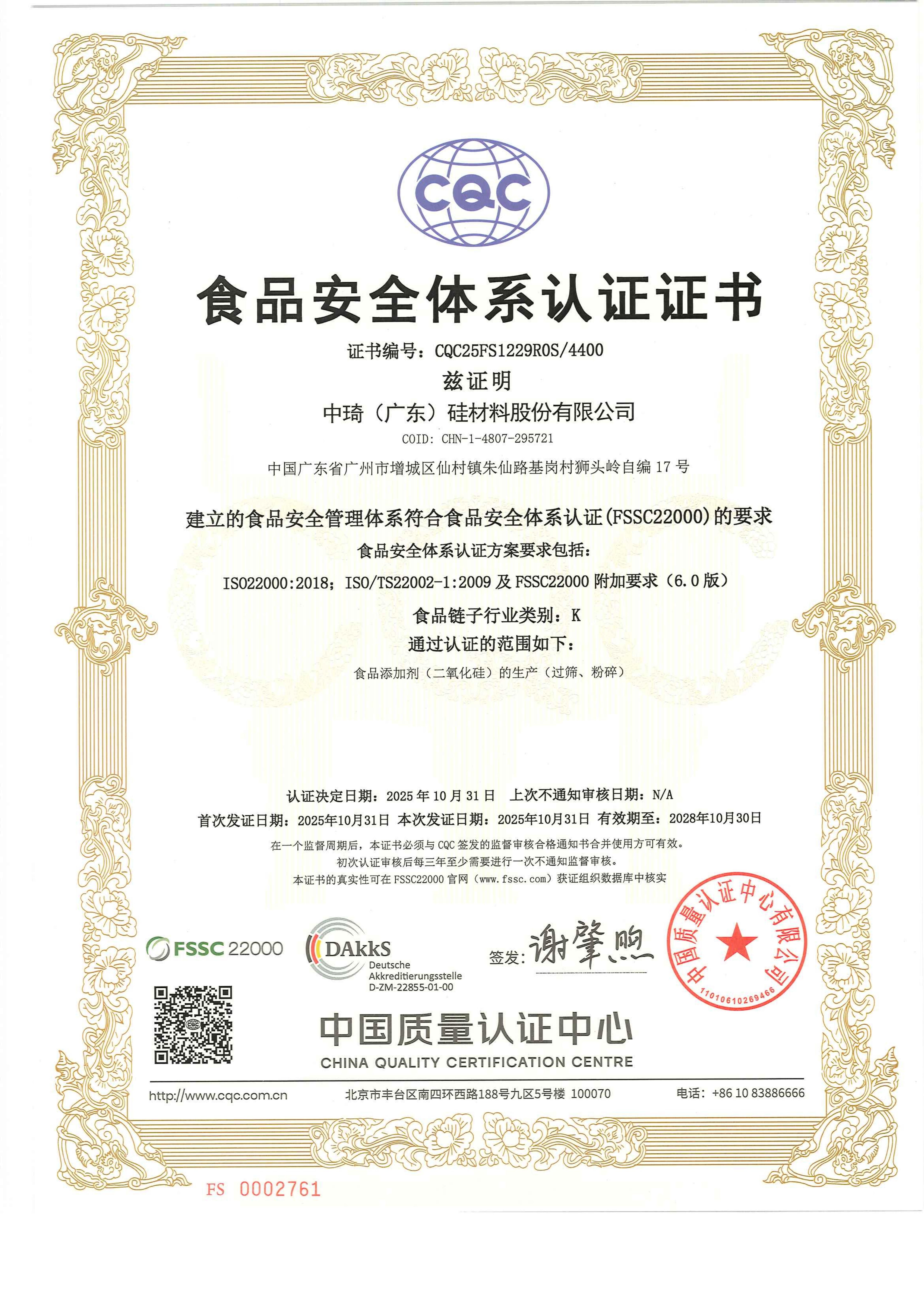
- Certification coverage, including the scope wording. An FSSC 22000 certificate should state the production scope explicitly — for example, production (filtration, milling) of food additive (silicon dioxide). A generic “food production” scope will not survive a multinational audit.
- Certificates must list the product. A factory-wide Halal certificate without silicon dioxide named in the attachment will fail an overseas review. Ask for the attachment, not the cover page.
- Which entity holds which certificate. Production qualifications belong with the manufacturing plant; where the contracting entity is the overseas sales arm, a group sales authorisation letter explains the relationship in writing.
- Batch documents. COA per batch, with test items aligned to the standard you have declared. Retained samples kept by batch. Full traceability from raw material through to finished goods.
- Market-specific entry requirements. For South Korea, a K-REACH pre-registration covering CAS 7631-86-9 supports customs clearance; for the United States, an FDA compliance statement and an FCC-format COA are standard requests.
Frequently Asked Questions
Can a custom-particle-size E551 silica still be fully compliant with EU E551, FDA and GB 25576?
Yes. E551 under Commission Regulation (EU) No 231/2012 and FDA 21 CFR 172.480 define the identity and purity limits for silicon dioxide — not a single particle size. A supplier can adjust D50, BET and oil absorption within those limits and still issue a COA against the agreed standard. Zhonglian Food Silica produces to GB 25576-2020, FDA 21 CFR 172.480 (GRAS), FCC, EU E551 and USP–NF / EP / JP, with SiO&sub2; content ≥99% and lead controlled to ≤1–2 ppm. EFSA’s October 2024 re-evaluation reconfirmed E551 safety for all populations, including infants under 16 months.
How wide is the customisation window — what can actually be changed?
Product grade, particle size, specifications, adsorption performance and downstream application solutions can all be customised, with the exact scope depending on the product series. Particle size is adjustable from roughly 2 µm to 50 µm. BET ranges from about 110 m²/g at the abrasive end to 190–700 m²/g for adsorbent grades. Oil absorption can be tuned from around 80 up to 250 mL/100 g depending on the family. The platform covers R&D, formulation and particle-size customisation production services, supported by an in-house testing laboratory and a microbiological laboratory, with 100% testing across production.
Does custom particle size cost more than a standard grade?
Customisation is generally handled inside the standard grade framework rather than as a separate premium line, so cost differences are driven mainly by which grade family you select and the volume you order. Zhonglian Food Silica positions its grades at roughly 15%–35% lower cost than international first-tier brands at matching performance, and the minimum order quantity starts at 1 ton. For a like-for-like comparison, evaluate total cost of ownership — including rework, downtime and compliance risk — rather than unit price alone.
Can I validate a custom particle size before placing a bulk order?
Yes. Free pre-sales samples are supplied for formula validation, typically in the 1–25 kg range, with one-to-one technical guidance on grade selection and dosage. Retained samples are kept per production batch, and bulk goods come from the same batch as the retained sample and its COA, so trial performance can be traced directly to the delivered material. Running a side-by-side trial against your current grade is standard practice before scale-up.
What is the lead time and MOQ for custom E551 silica?
Standard grades are held in stock, and typical lead time is 7–10 days, although the actual lead time depends on product, quantity, inventory and destination; export shipments commonly run 2–4 weeks depending on the destination and Incoterms. The minimum order quantity is 1 ton, and the first order can start as a small trial before moving to an annual framework agreement. To begin a custom particle size evaluation, request a sample or a quotation through www.silicaplant.com, or download the Food Grade Silica Brochure below for the full grade list.
Conclusion: Buy the Particle Size, Not the Brand Name
For a buyer at the Evaluation-to-Execution stage, the useful question is no longer “which brand of E551 should I buy?” It is “which supplier can hold my target D50, BET and oil absorption, at my volume, with documents that will survive an audit?”
E551 chemistry is well established and its safety position was reconfirmed by EFSA in October 2024. That leaves particle engineering as the practical differentiator — and particle engineering is a capability, not a label. It shows up in an adjustable 2–50 µm window, in BET and oil absorption tuned to the matrix, in 100% testing backed by in-house physicochemical and microbiological laboratories, in batch-level COAs and retained samples, and in a specification that is agreed before sampling rather than after delivery.
Zhonglian Food Silica manufactures its E551 food grade silica powder through Zhongqi (Guangdong) Silicon Material Co., Ltd., with overseas sales handled by Shandong Zhonglian Chemical Co., Ltd. Grades cover general anti-caking, spice and seasoning, non-dairy creamer, salt, liquid carriers, adsorbents and low-iron colour-critical systems, with custom particle size, BET and oil absorption set per project.
Start With a Sample, Not a Purchase Order
Send your application, target D50 and compliance standard. We will match a grade family, confirm whether the target sits inside the customisation window, and ship a free sample for a side-by-side trial — typically 1–25 kg, MOQ from 1 ton, standard lead time 7–10 days.
Request a Sample or Quote Download Food Grade Silica BrochureContact: Levin · levin@silicaplant.com · WhatsApp / WeChat: +8618668999988 · Jinan City, Shandong Province, China, 250100.
Have Questions or Need More Details?
Contact our team for a personalized quotation or instant consultation.
Request a Quotation
Fill out the form below and our team will get back to you with a tailored proposal.
WhatsApp Direct Chat
Prefer to chat in real-time? Message us on WhatsApp for instant assistance & quick answers.
- Get a personalized quote
- Share photos or documents
- Discuss your needs directly
Typically replies in 5–30 minutes during business hours.