Silica Powder Export to South Korea: Certification and Grade Questions
For silica powder exported to South Korea, the first document to review is not a generic certificate but the Korean import-clearance document that applies to the grade. In the source facts, the food-grade series carries K-REACH pre-registration number K2608-511664, issued by CIRS; importers can clear customs with the number. That number should then be matched with a grade that fits the end use: Food Grade Silicon Dioxide or E551 Food Grade Silica for food additive applications, FCC Grade Silicon Dioxide where the buyer’s specification is written around FCC, and USP Pharmaceutical Silica for pharmaceutical excipient use.
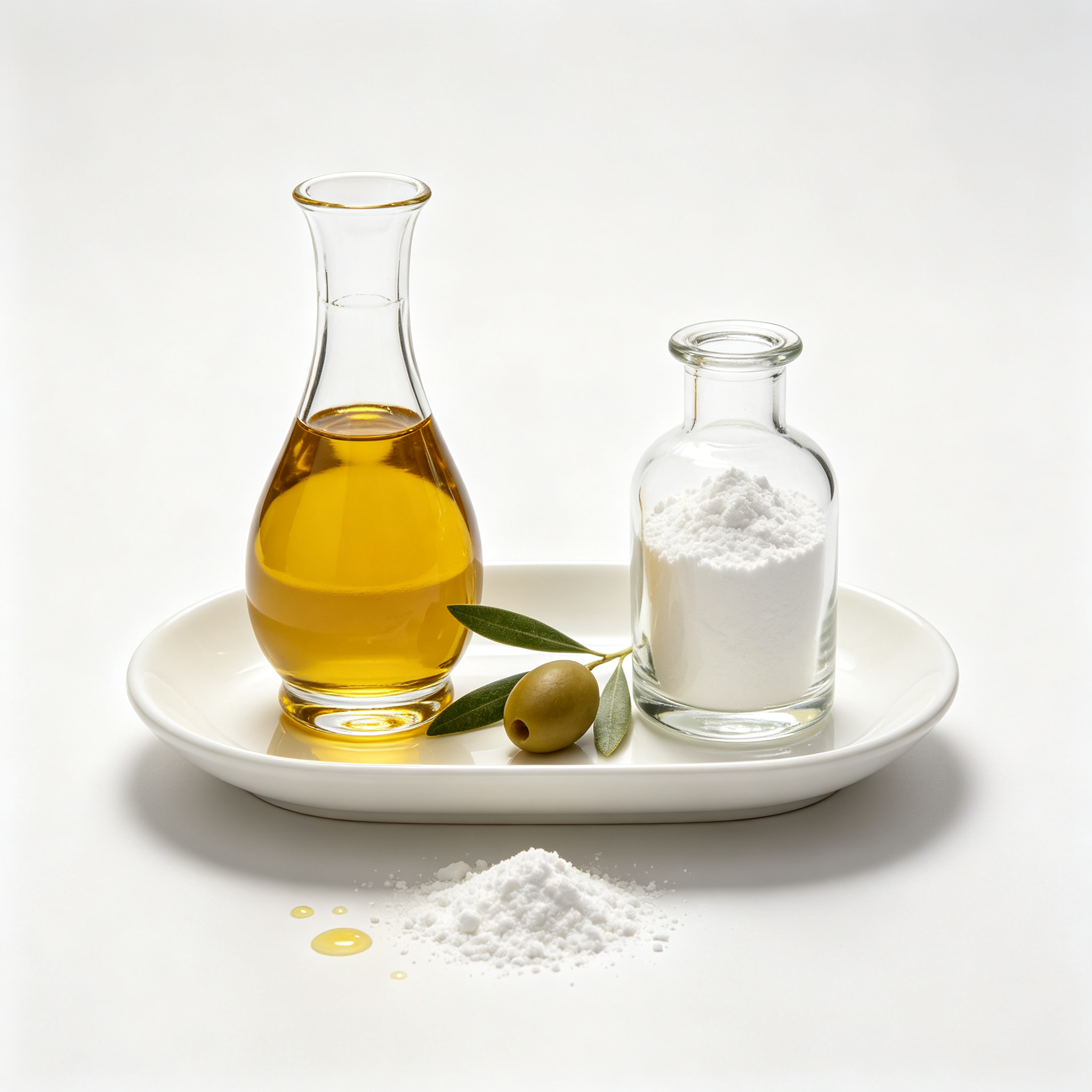
Silica powder grade review starts with the end use, then the document set, then the batch COA.
Problem Definition: “Which Certification?” Is the Wrong First Question
Buyers often ask: “Which certification do we need for silica powder exported to South Korea?” The question is understandable, but it mixes four different document layers. A K-REACH pre-registration number supports chemical import clearance. An FSSC 22000 or ISO 22000 certificate supports food-safety management review. A product grade such as FCC Grade Silicon Dioxide, USP Pharmaceutical Silica, Food Grade Silicon Dioxide or E551 Food Grade Silica describes a specification family. A batch COA proves what was tested in the actual lot. None of these four layers automatically substitutes for another.
The practical risk is that a buyer receives one document and assumes the whole compliance file is complete. For example, a supplier may send a food-safety certificate, but the importer still needs the K-REACH pre-registration reference for customs. Or a buyer may request “food grade” when the end use is a pharmaceutical excipient, where USP Pharmaceutical Silica is the more relevant grade. The article therefore focuses on document review and grade fitness rather than naming certifications that are not present in the source facts.
Industry Background: Why South Korea Is a Documentation Market
South Korea is not a new destination for the manufacturer. The company background lists Japan and South Korea among its main markets, and the capability facts state that exports reach more than 20 countries and regions, including Europe, the Americas, Japan, South Korea, Southeast Asia and the Middle East. That market exposure matters because Korean buyers often compare an imported grade against a local specification, a global food-additive identity and an internal quality dossier at the same time.
The wider food-grade silica market is also large enough to support serious documentation work. Fortune Business Insights valued the global food-grade silica market at USD 0.87 billion in 2025. In the EU, EFSA re-evaluated E 551 in 2024 and concluded that it is safe for all populations, including infants. Those facts do not replace Korean requirements, but they explain why buyers often ask for E551 Food Grade Silica as a specification reference even when the final market is outside the EU.
For Korea-facing shipments, the key distinction is between a specification reference and an import-clearance reference. FCC, USP and E551 are grade or monograph references. K-REACH pre-registration is an import-clearance reference. The two should be reviewed together, not treated as alternatives.
Detailed Solution: A Four-Layer Document Review for South Korea
Layer 1 — Import clearance: K-REACH pre-registration
In the source facts, the Korean document that answers the “which certification?” question most directly is K-REACH pre-registration. The food-grade series carries pre-registration number K2608-511664, issued by CIRS; importers can clear customs with the number, avoiding detention. This is the first document a Korean importer should verify before shipment.
Two cautions follow. First, the number applies to the food-grade series in the source facts, so it should not be assumed for every pharmaceutical or industrial grade without confirmation. Second, K-REACH pre-registration is a registration reference, not a product grade certificate. It tells the importer that the chemical registration pathway has been addressed; it does not prove that a particular lot meets a food or pharmaceutical monograph.
Layer 2 — Grade fitness: FCC, USP, Food Grade and E551
Once the import-clearance layer is clear, the buyer should map the grade to the end use. Food Grade Silicon Dioxide is the broad food-additive family. E551 Food Grade Silica is the EU food-additive identity within that family. FCC Grade Silicon Dioxide is positioned for buyers whose specification is written around the FCC monograph. USP Pharmaceutical Silica is the pharmaceutical excipient grade, with USP-NF, EP and ChP monograph references in the source facts.
The grade name should not be treated as a Korean market authorisation. It is a specification family that helps the buyer and supplier agree on test methods, impurity limits, microbial limits and end-use fitness. The Korean importer still needs to confirm the local labelling and import pathway for the finished product.
Layer 3 — Quality-system proof
The manufacturer’s quality-system file includes ISO 9001:2015 certificate 11425Q410600R1S, valid to 2028-10-27; ISO 22000:2018 certificate 116FSMS1300022, valid to 2027-06-21; and FSSC 22000 v6.0 certificate CQC25FS1229R0S/4400, valid 2025–2028. The file also includes HALAL certificate 1198250000, valid to 2028-05-22, and OU Kosher certificate OUV2-JZVTP4, valid to 2026-10-31. These documents support supplier qualification, but they do not replace the K-REACH pre-registration number or the batch COA.
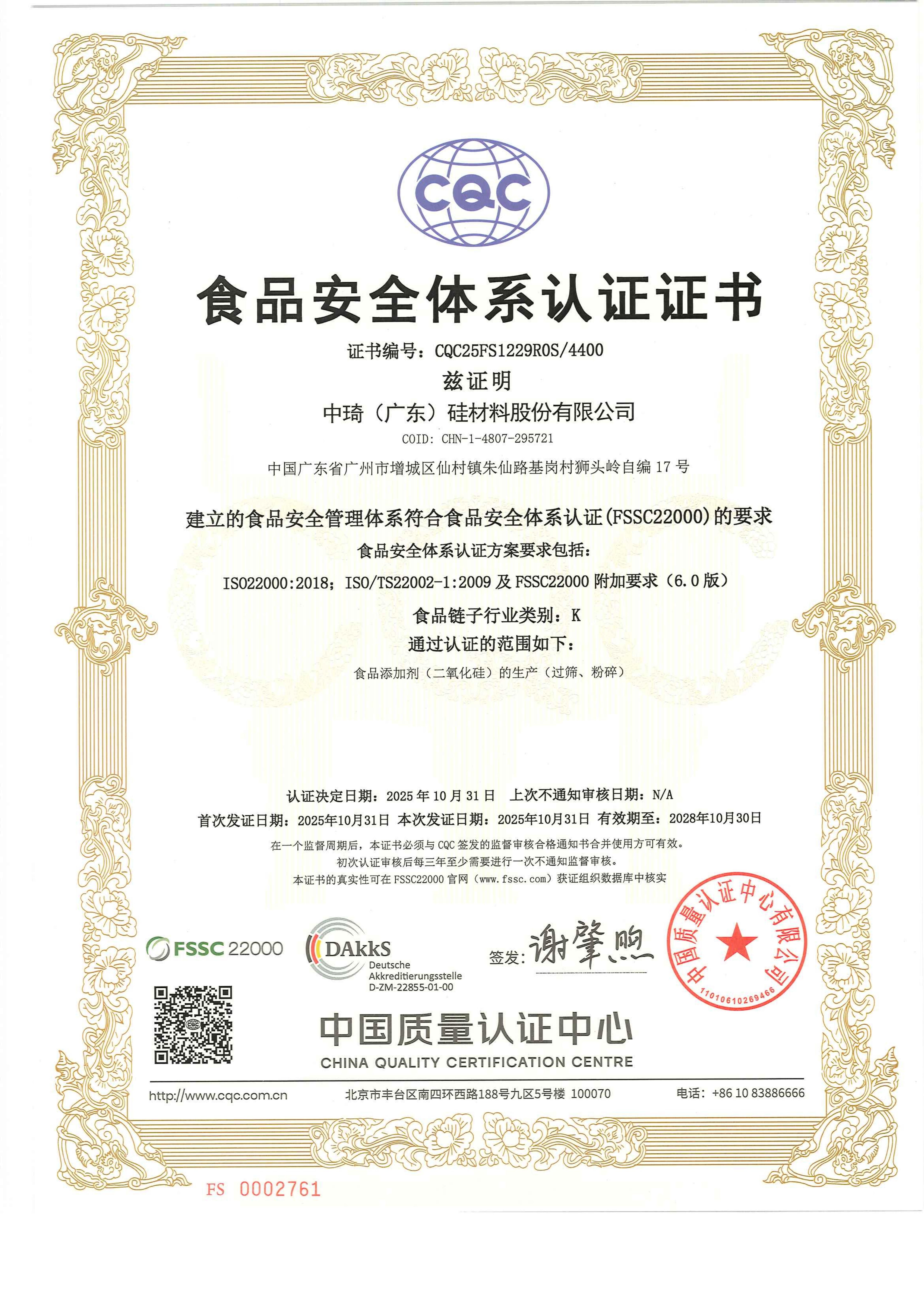
FSSC 22000 certificate CQC25FS1229R0S/4400 supports food-safety management review; it is not a Korean import licence.
Layer 4 — Batch-level COA
The batch COA is where grade fitness becomes specific. For food-grade silica, the source facts describe testing against GB 25576-2020, GB 2760, FDA 21 CFR 172.480, FCC, EU E551 and JECFA references, with heavy-metal limits for lead, arsenic, mercury and cadmium, pH, loss on ignition, loss on drying and microbial control. For USP Pharmaceutical Silica, the COA should show USP-NF, EP and ChP monograph compliance, Pb ≤2 mg/kg, As ≤3 mg/kg, elemental impurities per ICH Q3D, total microbes <100 CFU/g, pathogens absent and pH 6.0–7.5.
A Korean buyer should ask for the COA in the format used by the selected grade, not a generic certificate. The COA should be traceable to the batch number and should match the grade named on the commercial invoice and packing list.
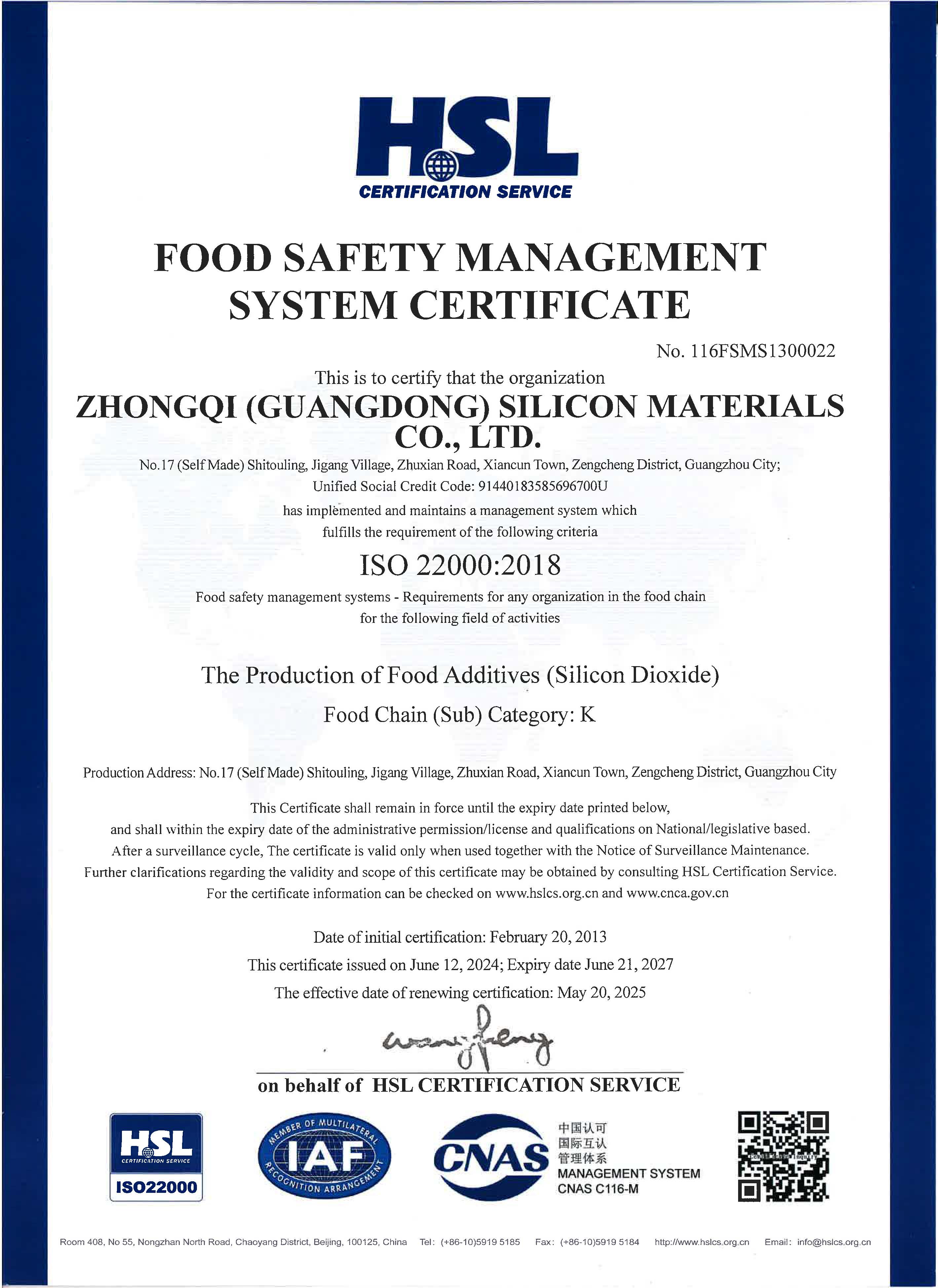
ISO 22000 certificate 116FSMS1300022 supports the food-safety management layer of the document review.
Step-by-Step Breakdown: How to Review a Silica Shipment for South Korea
- Confirm the end use first. Decide whether the silica is used as a food anti-caking agent, a flow aid, a liquid carrier, a pharmaceutical excipient or a food-contact additive. The end use determines whether Food Grade Silicon Dioxide, E551 Food Grade Silica, FCC Grade Silicon Dioxide or USP Pharmaceutical Silica is the relevant grade family.
- Match the grade name to the buyer’s specification. If the buyer writes the specification around FCC, review FCC Grade Silicon Dioxide. If the buyer writes around the EU food-additive identity, review E551 Food Grade Silica. If the buyer writes around a pharmacopoeia, review USP Pharmaceutical Silica. Do not assume that a “food grade” label covers a pharmaceutical end use.
- Collect the Korea-facing clearance document. For the food-grade series, confirm K-REACH pre-registration number K2608-511664, issued by CIRS. The importer can use this number for customs clearance. Keep the number on the shipment file, not only in a sales email.
- Review the quality-system certificates against the supplier’s scope. Check ISO 9001, ISO 22000 and FSSC 22000 certificates, plus HALAL and OU Kosher where the finished product requires them. Confirm that the certificate scope covers the exact product line and site.
- Compare the batch COA with the grade specification. Check SiO2 content, loss on drying, loss on ignition, pH, lead, arsenic, mercury, cadmium, total heavy metals and microbial results. For USP grade, also check the pharmacopoeia monograph, ICH Q3D elemental impurities and pathogen absence.
- Run a sample or pilot trial before scaling. Free samples are available for side-by-side trials. Validate flowability, anti-caking performance, color, dispersion and microbial results in the buyer’s own formulation before placing a bulk order.
- Confirm commercial terms. The MOQ is 1 ton. Lead time is 7–10 days, but the actual lead time depends on product, quantity, inventory and destination. The factory has a monthly capacity of 3,000 tons.
Use Cases: Matching the Grade to the Korean Buyer’s End Use
For food powders such as seasonings, milk powder, non-dairy creamer and instant beverages, Food Grade Silicon Dioxide or E551 Food Grade Silica is the practical starting point. The buyer should review anti-caking performance, particle size, pH, moisture and heavy-metal results. If the buyer’s specification is written around FCC, FCC Grade Silicon Dioxide may be the clearer commercial match, but the Korean importer still needs to confirm the local food-additive pathway.
For pharmaceutical or nutraceutical solid dosage forms, USP Pharmaceutical Silica is the relevant grade family. The source facts specify USP-NF, EP and ChP monograph references, Pb ≤2 mg/kg, As ≤3 mg/kg, elemental impurities per ICH Q3D, total microbes <100 CFU/g and pathogens absent. A food-grade COA should not be accepted as a substitute for a pharmaceutical excipient dossier.
For buyers who are comparing suppliers, the grade name is only the first filter. The second filter is whether the supplier can provide the K-REACH pre-registration number, the batch COA, the quality-system certificates and a sample that performs in the buyer’s formulation. The third filter is commercial: MOQ, lead time, packaging and landed cost.
Comparison Table: Grade Families and What They Do—and Do Not—Prove
| Grade family | Primary positioning in source facts | Typical buyer review point | What it does not replace |
|---|---|---|---|
| Food Grade Silicon Dioxide ZLSIL-W58BF, W68B, T38A, W38A, T38AB, A48 | Food additive silica for anti-caking, flow aid and carrier use; complies with GB 25576-2020, GB 2760, FDA 21 CFR 172.480, FCC, EU E551 and JECFA references; Pb ≤1–2 ppm, total heavy metals ≤10 ppm. | Food powder anti-caking, flowability, carrier loading, color and microbial review. | K-REACH pre-registration, Korean importer clearance, or a pharmaceutical excipient dossier. |
| E551 Food Grade Silica ZLSIL-W1FP, W72FP, W74FP, W3050, W3150, WG156F and related grades | EU E551 food-additive identity; same food-grade compliance references and heavy-metal controls; suitable where the buyer’s specification uses E551 as the reference. | EU-style food-additive specification review, labelling discussion and food powder performance. | A Korean market authorisation, a batch release, or a USP pharmaceutical monograph. |
| FCC Grade Silicon Dioxide ZLSIL-T680, T28, E5162, A325, W22S, WT38A | FCC-oriented food-grade specification family; source facts include FCC, FDA 21 CFR 172.480, EU E551, JECFA and USP-NF/EP/JP references; Pb ≤1–2 ppm, total heavy metals ≤10 ppm. | Buyers whose specification is written around FCC monograph expectations. | K-REACH clearance, Korean food-additive approval, or a pharma-grade COA. |
| USP Pharmaceutical Silica ZLXIDE-P58EP, P58BT, P350, W244FP and related grades | Pharmaceutical excipient silica; meets USP-NF, EP and ChP silica monographs; Pb ≤2 mg/kg, As ≤3 mg/kg, elemental impurities per ICH Q3D; total microbes <100 CFU/g, pathogens absent; pH 6.0–7.5. | Tablet, capsule, API, multivitamin and effervescent dosage-form review. | Food-grade anti-caking approval, K-REACH food-grade pre-registration, or a food label review. |
The table is a grade-fitness tool, not a certification map. Each grade family carries different specification logic. The Korean importer still needs to confirm the import-clearance document and the finished-product compliance pathway.
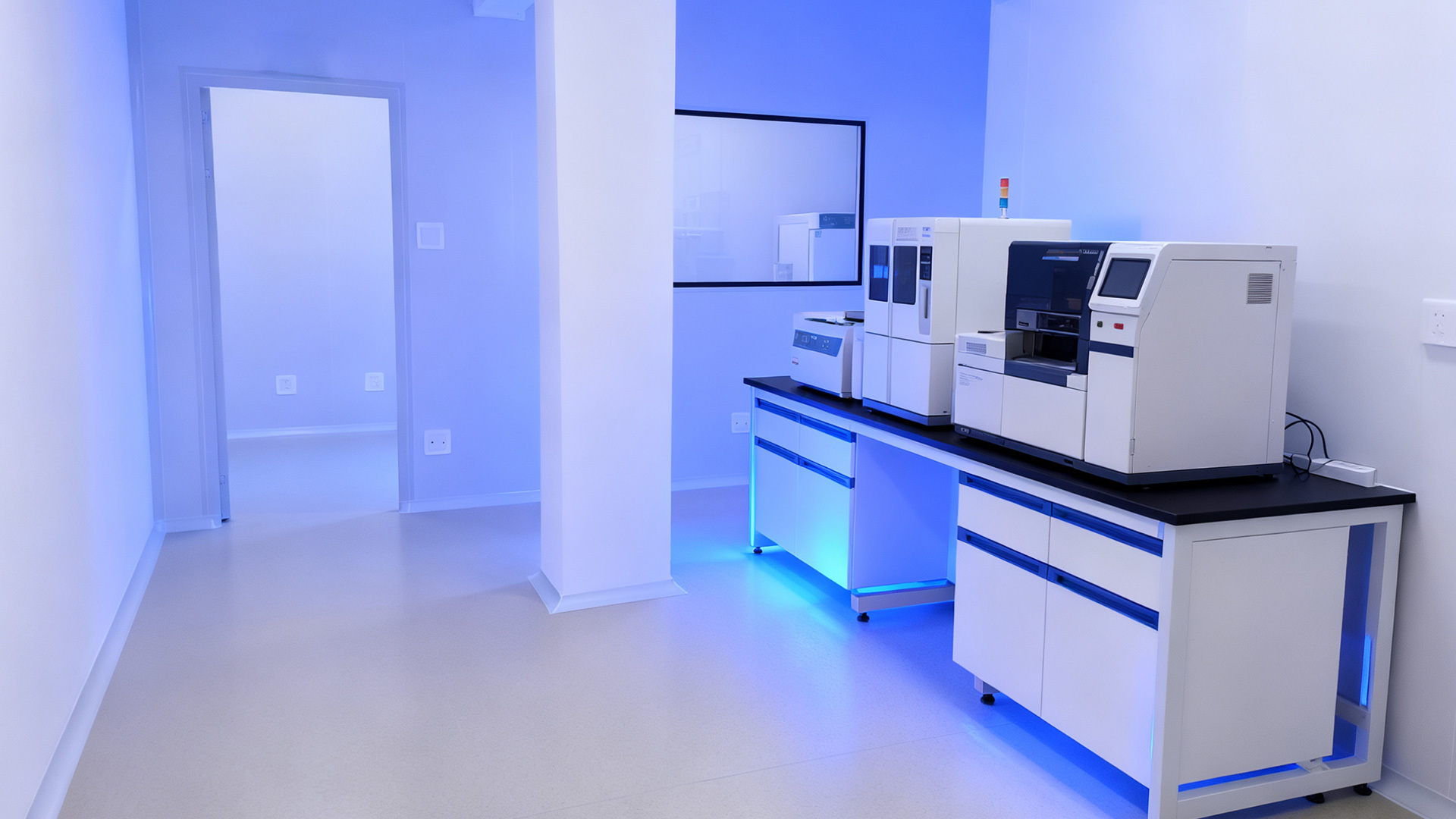
Batch COA review should include microbial results where the grade requires them; the in-house microbiology laboratory supports this layer.
FAQ
Which certification is required for silica powder exported to South Korea?
For the food-grade series in the source facts, the first Korean import-clearance reference is K-REACH pre-registration number K2608-511664, issued by CIRS. Importers can clear customs with the number, avoiding detention. This is a registration reference, not a grade certificate. The buyer should also review the grade specification, the quality-system certificates and the batch COA. The source facts do not provide a separate Korean food-additive approval number for each grade, so buyers should not treat the grade name alone as an import authorisation.
How should buyers map FCC Grade Silicon Dioxide, USP Pharmaceutical Silica, Food Grade Silicon Dioxide and E551 Food Grade Silica to end use?
Food Grade Silicon Dioxide and E551 Food Grade Silica fit food additive, anti-caking and carrier applications. E551 is the EU food-additive identity; Food Grade Silicon Dioxide is the broader food-grade family. FCC Grade Silicon Dioxide fits buyers whose specification is written around FCC. USP Pharmaceutical Silica fits pharmaceutical excipient use, with USP-NF, EP and ChP monograph references, Pb ≤2 mg/kg, As ≤3 mg/kg, ICH Q3D elemental impurities and total microbes <100 CFU/g. The grade should match the end use, not the other way around.
What documents should a Korean buyer review before shipment?
Review the K-REACH pre-registration number for the food-grade series, the product specification, the batch COA, the ISO 9001, ISO 22000 and FSSC 22000 certificates, and the HALAL or OU Kosher certificates if the finished product requires them. The COA should show SiO2, loss on drying, loss on ignition, pH, lead, arsenic, mercury, cadmium, total heavy metals and microbial results. For USP grade, check the pharmacopoeia monograph and pathogen absence. The Korean importer should also confirm the local labelling and finished-product pathway.
Can buyers request samples for grade fitness trials?
Yes. Free samples are available for side-by-side trials. A pilot trial is important because a COA that is within specification does not by itself guarantee finished-product performance. Buyers should test flowability, anti-caking, color, dispersion and microbial suitability in their own formulation before scaling. The manufacturer’s R&D, formulation and particle-size customization services can support the trial.
What are the MOQ and lead time for a South Korea shipment?
The MOQ is 1 ton. Lead time is 7–10 days, but the actual lead time depends on product, quantity, inventory and destination. The factory has a monthly capacity of 3,000 tons, and the manufacturer exports to more than 20 countries and regions, including Japan and South Korea. For budget planning, the source facts state that core performance matches international first-tier brands at 15%–35% lower cost, but buyers should confirm the final landed cost against the selected grade, packaging and Incoterms.
Conclusion
For silica powder exported to South Korea, the practical answer is a document stack, not a single certificate. Start with the K-REACH pre-registration number K2608-511664 for the food-grade series, then match the grade to the end use. Use Food Grade Silicon Dioxide or E551 Food Grade Silica for food additive applications, FCC Grade Silicon Dioxide where the buyer’s specification is written around FCC, and USP Pharmaceutical Silica for pharmaceutical excipient applications. Review the ISO 9001, ISO 22000 and FSSC 22000 certificates, confirm the batch COA, and run a sample trial before bulk production. That sequence keeps the Korean clearance review, the grade-fitness review and the commercial decision in the correct order.
Next step for Korean buyers
Zhonglian Food Silica can provide grade samples, batch COAs, quality-system certificates and the K-REACH pre-registration reference for the food-grade series. Share the end use, target grade and destination so the document set and sample can be prepared together.
Company: Shandong Zhonglian Chemical Co., Ltd. · Website: www.silicaplant.com · Email: levin@silicaplant.com · WhatsApp: +8618668999988
Download the food-grade silica brochure: FOOD GRADE SILICA BROCHURE 20251015.pdf
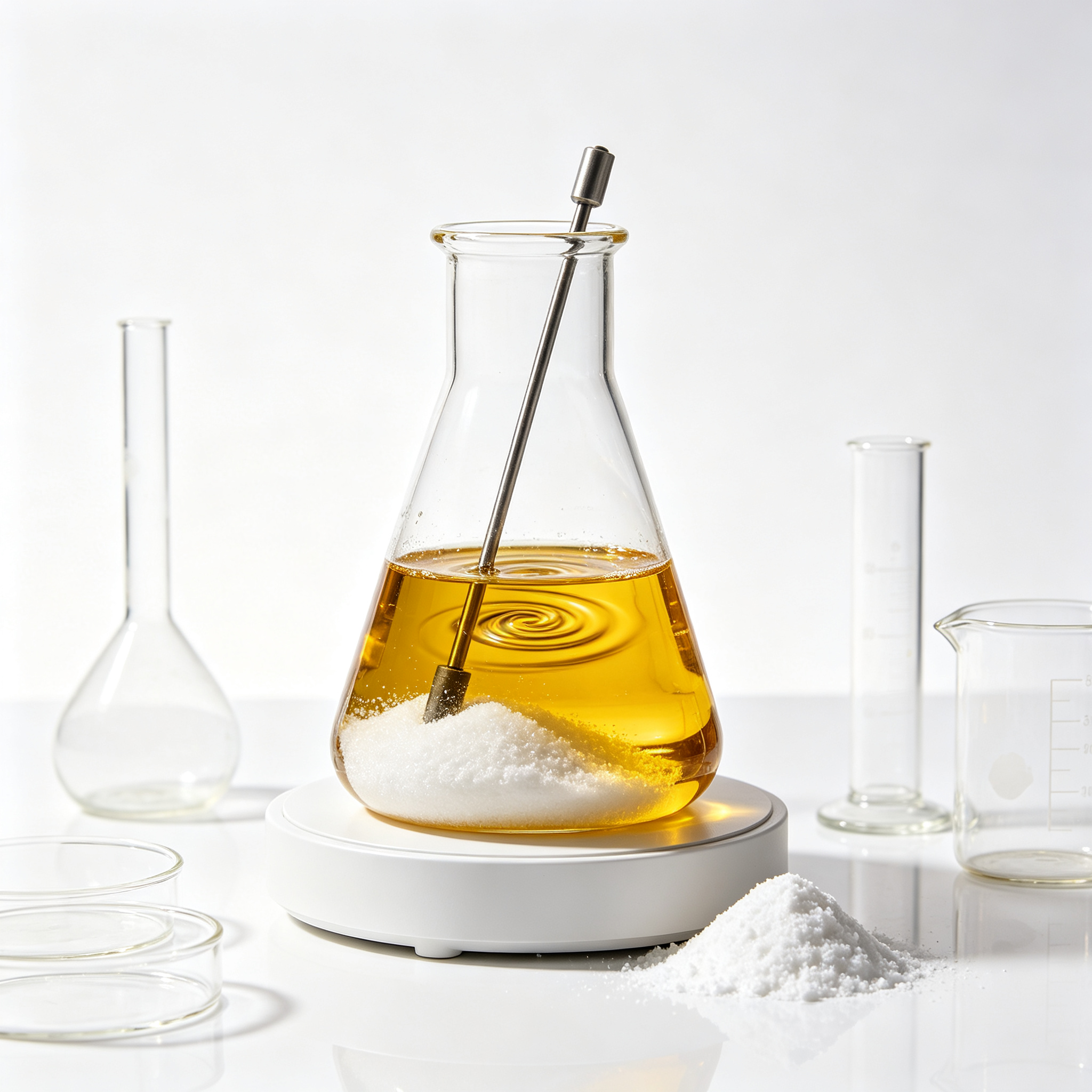
Sample request: confirm the grade, end use and Korean import pathway before bulk order.
Have Questions or Need More Details?
Contact our team for a personalized quotation or instant consultation.
Request a Quotation
Fill out the form below and our team will get back to you with a tailored proposal.
WhatsApp Direct Chat
Prefer to chat in real-time? Message us on WhatsApp for instant assistance & quick answers.
- Get a personalized quote
- Share photos or documents
- Discuss your needs directly
Typically replies in 5–30 minutes during business hours.