Silicon Dioxide Compliance Guide: E551, FCC, USP and Export Documentation
Silicon dioxide compliance is not proven by a single certificate. Buyers in food, pharmaceutical and export channels are usually tripped up by a three-part mismatch: the regulatory identity of the material, the use pathway it is destined for, and the batch-level evidence behind the shipment. This guide sets out four documentation routes — E551, FCC, USP and food contact — and the export pack that ties them together, including the document most often missed when shipping to South Korea.
Problem definition: "food grade" is a buying word, not a regulatory identity
Most compliance failures in silicon dioxide purchasing do not start with a bad batch. They start with a specification sheet that says "food grade silicon dioxide" and nothing else. That phrase carries no legal meaning on its own in any major market. What the receiving quality team needs is the specific framework the material is being declared against, and the specific document that evidences it.
Three failure patterns repeat across inbound inspections:
- An E-number that appears only in marketing copy. European customers need silicon dioxide declared as E 551, with compliance stated against Commission Regulation (EU) No 231/2012 for purity criteria and Regulation (EC) No 1333/2008 for use provisions. A supplier that writes "food grade" but never writes E 551 is asking the buyer to make a regulatory interpretation on the supplier's behalf.
- FCC and 21 CFR treated as one thing. In the United States, the Food Chemicals Codex (FCC) is a specification compendium, while 21 CFR 172.480 is the food-additive permission that lists silicon dioxide as GRAS with defined conditions of use. A supplier that claims "FDA approved" without naming either document has not evidenced anything a US importer can file.
- Food contact mistaken for food additive. Silicon dioxide used in a packaging film, cap liner or food-contact polymer is not following the E551 direct-additive pathway. It follows a food-contact materials framework, which is a separate conformity question with separate documentation.
The practical consequence is predictable: material that is technically fine gets held at the port, rejected at goods-in, or quarantined pending a document the supplier never had. Compliance in this category is a paperwork discipline, and it has to be checked before the purchase order, not after the container lands.
Industry background: four frameworks running in parallel
Silicon dioxide is one of the more widely reviewed food additives in use. JECFA evaluated the acceptable daily intake as "not specified", which is the least restrictive outcome available under that committee's framework. That does not mean the material is unregulated — it means the intake limit was not considered the binding constraint, and the regulatory weight sits in identity, purity and permitted use instead.
The US FDA lists silicon dioxide across a broad set of technical functions, including anticaking agent or free-flow agent, drying agent, emulsifier or emulsifier salt, flavoring agent or adjuvant, formulation aid, humectant, and lubricant or release agent. Where it is used as an anticaking agent under 21 CFR 172.480, the regulation states a use level not to exceed 2 percent by weight of the food. For consumer-facing guidance, the FDA classifies the ingredient function simply as an anti-caking agent that keeps powdered foods free-flowing and prevents moisture absorption.
Layered on top of the food-additive frameworks are the pharmacopoeia monographs. USP–NF, EP and JP specifications govern silicon dioxide as a pharmaceutical excipient, and those specifications are not interchangeable with a food-grade declaration even where the same production line is involved. A pharma buyer needs the monograph, the heavy-metal limits that go with it, and the microbial controls that sit alongside it.
The map therefore looks like this: the EU runs E 551, the US runs FCC plus 21 CFR 172.480, the pharmaceutical channel runs USP–NF/EP/JP, food-contact applications run their own conformity route, and China runs GB 25576-2020 as the product standard with GB 2760 as the use standard. A supplier that can only speak one of these languages is a single-market supplier, whatever the price list says.
Detailed solution: four documentation routes and the export pack
Route 1 — E 551 for the European Union
E 551 is the EU food additive number for silicon dioxide. The compliance statement a European customer needs has two parts: compliance with Commission Regulation (EU) No 231/2012 for purity criteria, and compliance with Regulation (EC) No 1333/2008 for use provisions. Both should appear explicitly in the specification and on the certificate of analysis reference line, not only on an outer carton label.
Zhonglian Food Silica supplies an E 551 Precipitated Silica range that includes ZLSIL-W58B, ZLSIL-58BTS, ZLSIL-P260S, ZLSIL-A18 and ZLSIL-PS300, alongside the wider ZLSIL-W and ZLSIL-A series. The verification point for a buyer is narrow and checkable: does the specification sheet carry the E 551 designation, and does it cite both EU regulations by number? If either is missing, the document set is incomplete regardless of what the COA shows.
Route 2 — FCC grade for the United States
An FCC grade silicon dioxide declaration rests on two documents working together. The Food Chemicals Codex provides the specification the material is tested against. 21 CFR 172.480 provides the legal permission for use, and states the 2 percent by weight ceiling when the material functions as an anticaking agent.
Zhonglian supplies an FCC Grade Silicon Dioxide range with model designations ZLSIL-T680, ZLSIL-T28, ZLSIL-E5162, ZLSIL-A325, ZLSIL-W22S and ZLSIL-WT38A. The company's food-grade silicon dioxide grades are also stated to comply with FDA 21 CFR 172.480 (GRAS) and Food Chemicals Codex (FCC) requirements for food use in the United States.
Route 3 — USP pharmaceutical silica
The pharmaceutical route is the most document-heavy of the four. Silicon dioxide supplied as a tableting excipient or supplement ingredient is expected to meet USP–NF, EP and JP monograph specifications, and the limits tighten accordingly: for pharmacopoeia grades, lead content is limited to ≤1–2 ppm and total heavy metals to ≤10 ppm.
Microbial control follows USP <61> and USP <62>, with total aerobic count, molds and yeasts controlled and pathogenic bacteria such as E. coli required to be absent. In the ZLXIDE pharmaceutical range, the stated specification is total microbes below 100 CFU/g with pathogens absent, and elemental impurities controlled in line with ICH Q3D.
Zhonglian's pharmaceutical excipient portfolio includes grades such as ZLXIDE-P58EP, ZLXIDE-P350, ZLXIDE-W244FP, ZLXIDE-W1FP, ZLXIDE-W63FP, ZLXIDE-W72FP, ZLXIDE-W74FP, ZLXIDE-W3050, ZLXIDE-W3150, ZLXIDE-P260S, ZLXIDE-P200, ZLXIDE-P300, ZLXIDE-P380 and ZLXIDE-P972. Supporting documentation extends beyond the COA: TSE/BSE-free statements, allergen statements, residual solvent declarations and REACH/RoHS declarations are available, and the pack is described as supporting ANDA and generic drug filing.
For a pharma buyer, the check is whether each parameter on the certificate maps to a monograph line. "Meets USP" is a claim; a line-by-line monograph comparison with limits is evidence.
Route 4 — food contact grade silica
Food contact applications sit on a different regulatory footing from direct food addition. Silicon dioxide used in packaging films, moulded articles or food-contact polymers is assessed as a food-contact material, and the relevant frameworks include EU 10/2011 and EC 1935/2004 in Europe and the GB 4806 series in China. The E 551 number does not carry across to this route, and buyers who ask for "E551 material for our film masterbatch" are usually asking for the wrong document.
Zhonglian's Food Contact Grade Silica range covers ZLSIL-W63FP, ZLSIL-W1FP, ZLSIL-W72FP, ZLSIL-W74FP, ZLSIL-W3050, ZLSIL-W3150, ZLSIL-WG156F, ZLSIL-W1450 and ZLSIL-W2000. The company states that one product range supports China GB 25576-2020, GB 2760 and the GB 4806 series, US FDA 21 CFR 172.480, FCC and USP, and EU Regulation 1333/2008, EU 10/2011 and EC 1935/2004, and that COA, migration reports and multi-language customs documents are supplied on request.
Export documentation: the pack that actually clears customs
Regulatory declarations prove what the material is. Export documents prove that the shipment, its origin and its producer can be cleared. The two sets overlap but are not the same, and a shipment can be fully compliant in substance and still held for a missing certificate.
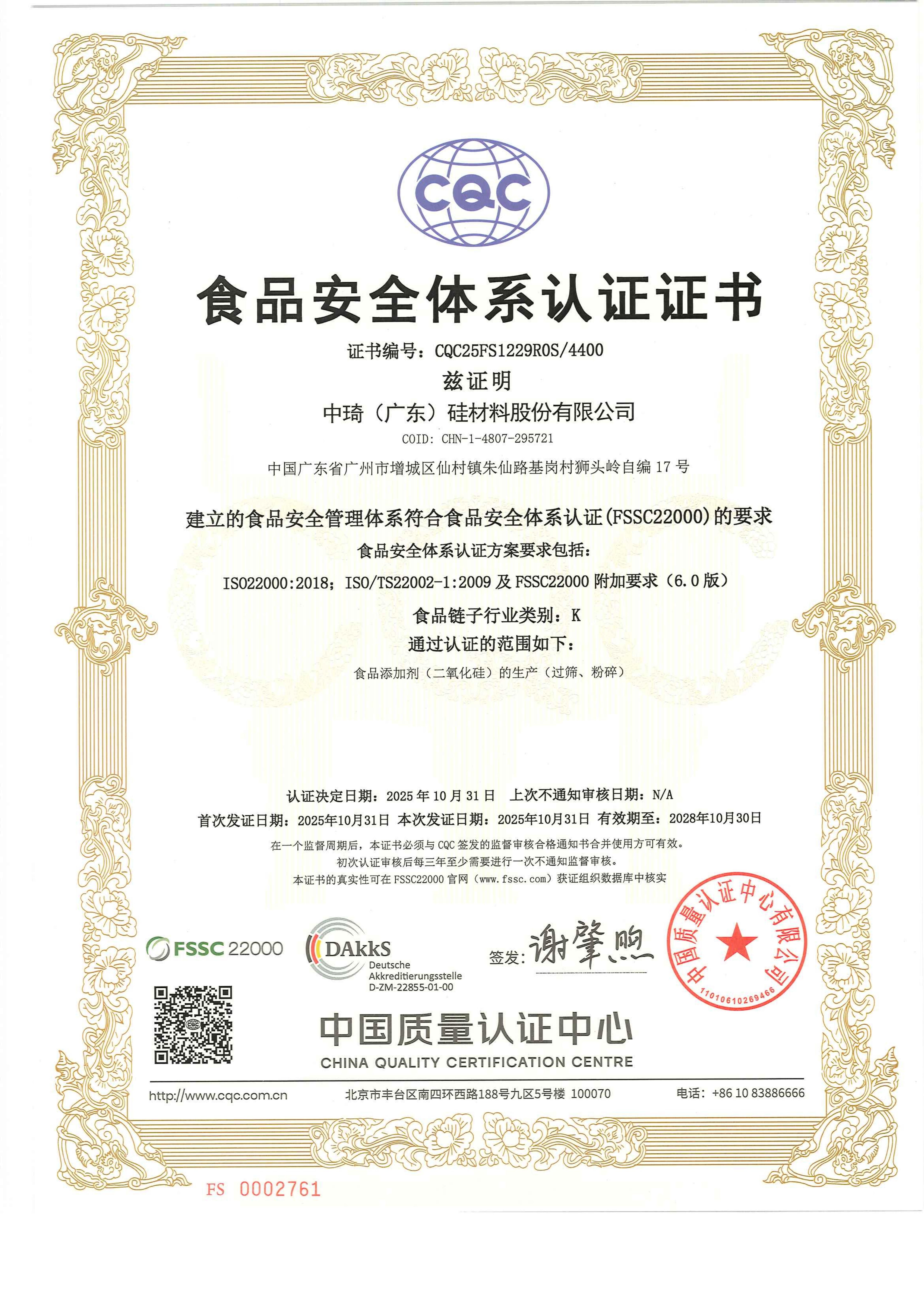
The system certificates typically requested for a food-grade silicon dioxide shipment are FSSC 22000, ISO 22000, ISO 9001 and, where feed or pet food is involved, FAMI-QS. Religious and ethical certification adds HALAL and OU Kosher, and SEDEX SMETA covers social compliance. Zhonglian's current documentation set includes:
- FSSC 22000 — certificate no. CQC25FS1229R0S/4400, issued by CQC, valid 31 October 2025 to 30 October 2028.
- ISO 22000:2018 — certificate no. 116FSMS1300022, issued by HSL Certification Service, valid 12 June 2024 to 21 June 2027.
- ISO 9001:2015 — certificate no. 11425Q410600R1S, issued by EACC, valid 22 October 2025 to 27 October 2028.
- FAMI-QS — certificate no. 11625FAM0017, registration no. FAM-2355, issued by HSL Certification Service, valid 21 March 2025 to 20 March 2028.
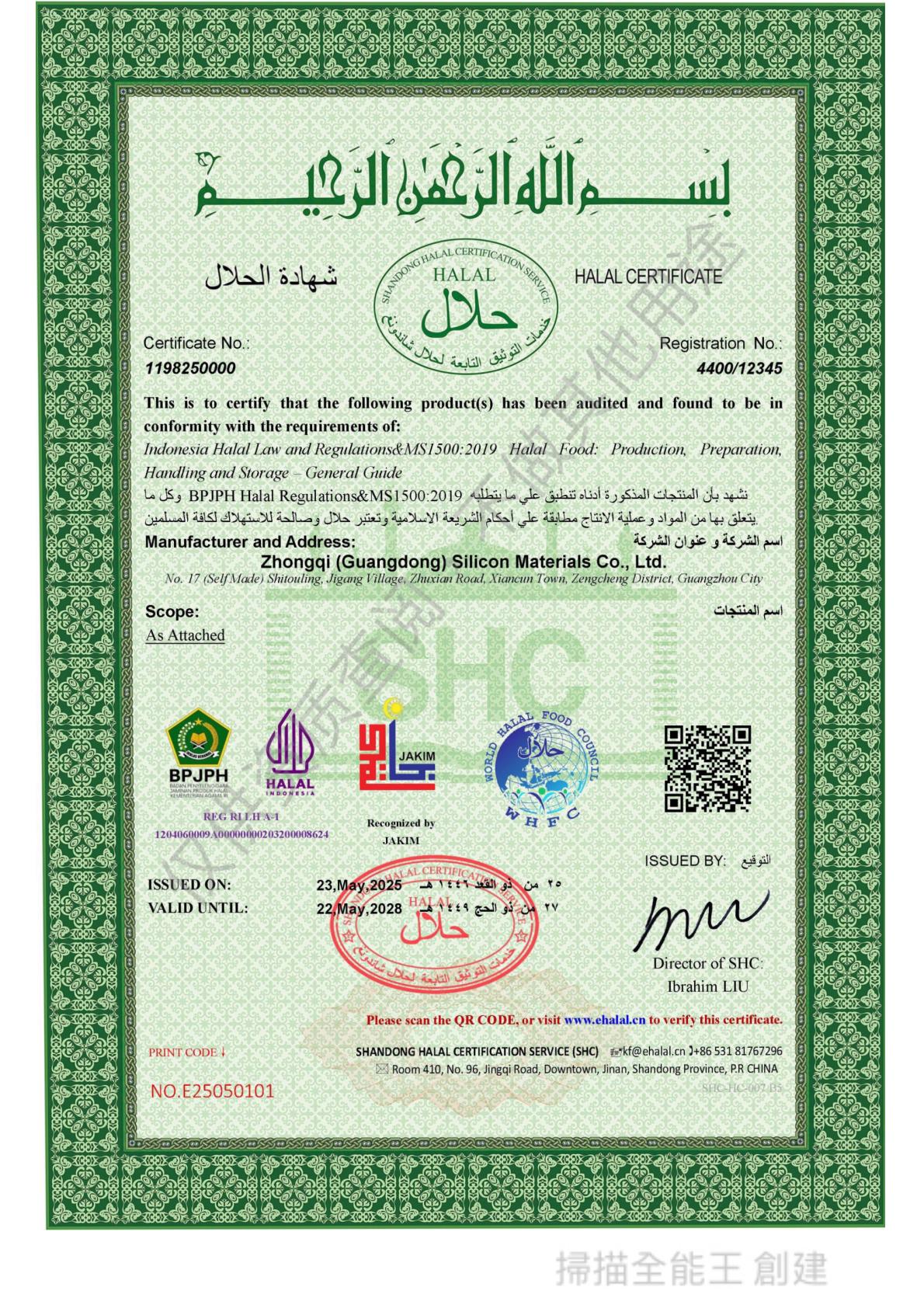
- HALAL — certificate no. 1198250000, issued by SHANDONG HALAL CERTIFICATION SERVICE against Indonesia BPJPH Halal regulations and MS1500:2019, valid 23 May 2025 to 22 May 2028.
- OU Kosher — certificate no. OUV2-JZVTP4, issued by the Orthodox Union, valid 1 November 2024 to 31 October 2026.
- SEDEX SMETA — audit report no. ZAA600166938, issued by Intertek Shenzhen, dated 7 November 2025.
- US FDA food facility registration — registration no. 14857861616.
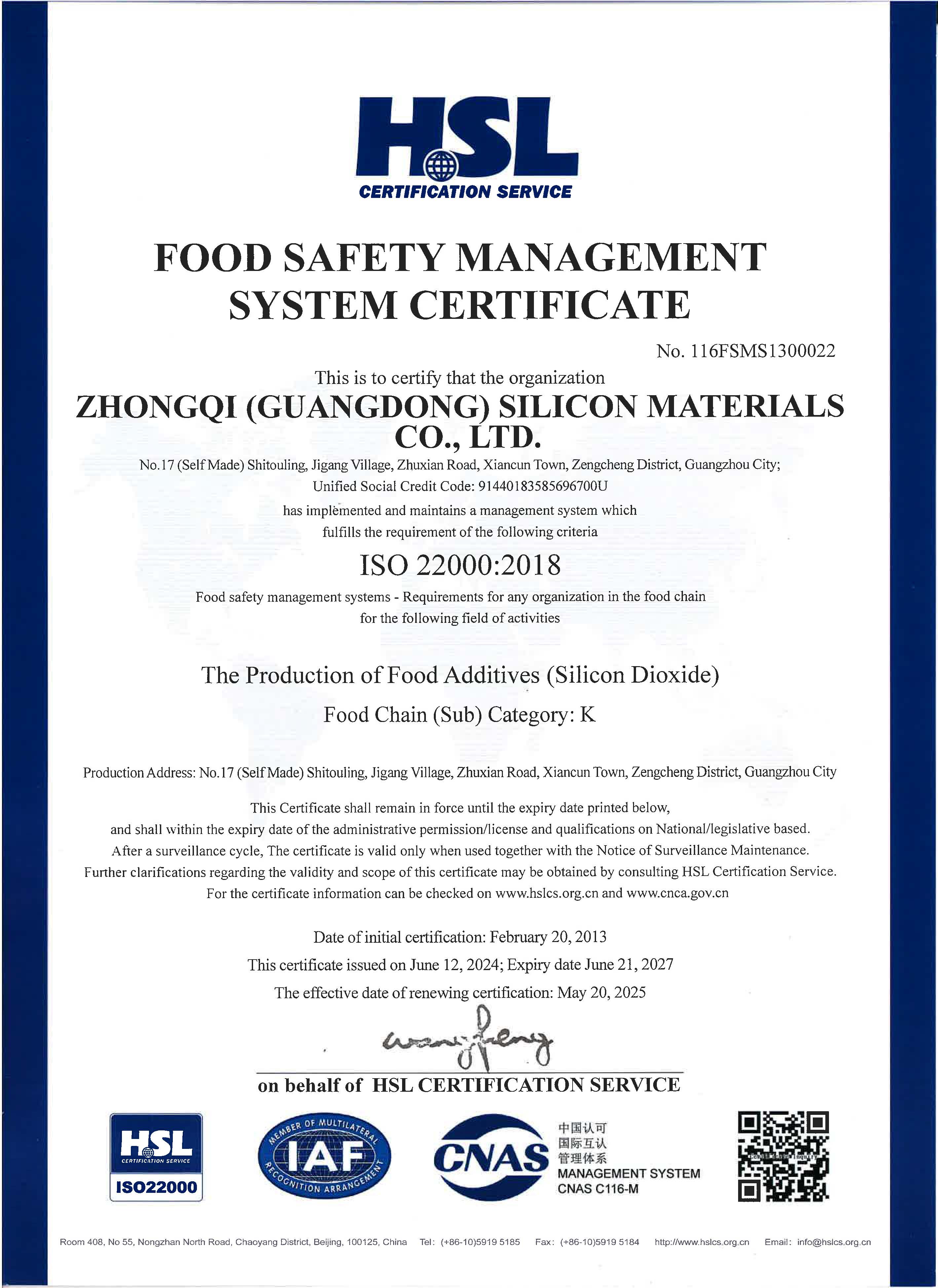
Two document-hygiene rules matter more than the list itself. First, check the scope line, not just the certificate title: the certification scope is stated to cover food-additive silica, feed-additive silica, screening and grinding production, and selected silica product lines, which means a buyer should confirm that their specific grade falls inside that scope. Second, check the expiry date against the shipment date, not against today. The OU Kosher certificate on file runs to 31 October 2026; a shipment dated after that point needs the renewed version attached, and it is worth requesting the renewal proactively rather than discovering the gap at customs.
The South Korea question
South Korea is the destination where food-grade silicon dioxide shipments most often stall for a reason that has nothing to do with the food additive itself. Korean importers need a K-REACH pre-registration number to clear the material, and a supplier that has never registered cannot supply one after the fact.
Zhonglian's food-grade series carries K-REACH pre-registration number K2608-511664, issued through CIRS. The practical value is straightforward: the Korean importer can use that number at customs clearance and avoid detention. On the food-additive side, Korea's MFDS administers the Food Additives Code, and the specifications there are broadly aligned with JECFA and FCC — which is why an FCC-format COA is a useful starting document for a Korean buyer, but it is not a substitute for the pre-registration number.
Step-by-step: a seven-point verification checklist
The checklist below is ordered so that each step eliminates a class of risk before the next one is examined. Running it in sequence against a supplier's document pack takes less time than resolving a single rejected shipment.
- Fix the regulatory identity first. Decide whether the material is being purchased as E 551 for the EU, FCC grade for the US, a USP–NF/EP/JP pharmacopoeia grade, or a food contact grade. Do this before comparing prices, because the four identities are not price-equivalent and are not interchangeable.
- Request the grade-specific specification, not the company brochure. A specification that names the model designation — for example ZLSIL-W58B for E 551 use or ZLXIDE-P58EP for pharmacopoeia use — is checkable. A generic "food grade silica" datasheet is not.
- Match the COA format to the destination framework. An FCC-format COA for a US shipment, an E 551-referenced COA for an EU shipment, a monograph-mapped COA for a pharmaceutical shipment. Confirm the COA is batch-specific and carries limit values.
- Check heavy-metal limits at both levels. The regulatory limits follow GB 25576-2020, FCC and EU 231/2012 for lead, arsenic, mercury and cadmium. Internal limits, where stated, sit tighter — iron at ≤5 ppm, lead at ≤0.1 mg/kg and arsenic at ≤1 ppm. For pharmacopoeia grades the applicable figures are lead ≤1–2 ppm and total heavy metals ≤10 ppm.
- Check the microbial panel. Total aerobic count, molds and yeasts controlled per USP <61>/<62>, with E. coli required to be absent. Ask whether the panel is run on every batch or periodically; the answer changes the release logic.
- Check certificate scope and validity dates. Confirm the system certificate covers the product line being bought, and confirm the expiry date falls after the shipment date. Note which certificates renew in the near term.
- Assemble the destination-specific export pack. COA, MSDS, food-contact certificates where relevant, HALAL and Kosher where required, SMETA where social compliance is audited, and the destination-specific entry document — for Korea, the K-REACH pre-registration number.
Use cases: where each route is the right one
Powdered food manufacturing for the EU. A seasoning or solid-beverage producer selling into the EU needs E 551 declared against 231/2012 and 1333/2008, with a COA referencing the additive number. The common error here is accepting a Chinese GB 25576-2020 COA as sufficient for an EU customer; it evidences the product standard, not the EU additive identity.
US import of a powdered food ingredient. The importer needs the FCC specification plus the 21 CFR 172.480 permission, with the 2 percent by weight anticaking ceiling respected in the finished formulation. The supplier's job is to provide the FCC-format COA and the GRAS reference; the formulator's job is the use-level calculation.
Pharmaceutical excipient sourcing. A generic manufacturer filing or amending an ANDA needs monograph-mapped specifications, the tightened heavy-metal limits, the microbial panel, and the TSE/BSE, allergen and residual-solvent declarations. This is the route where a partial document pack is least likely to be accepted.
Food packaging and food-contact polymer compounds. A masterbatch or film producer follows the food-contact route and needs a conformity declaration plus migration data, not E 551 documentation. The GB 4806 series applies for China, EU 10/2011 and EC 1935/2004 for Europe.
Multi-market distribution from a single SKU. Distributors covering several regions benefit from a grade that is documented against FCC, E 551 and GB 25576-2020 simultaneously, because it reduces the number of product codes they have to hold. Zhonglian states that export-grade material is supplied for FDA, EU, GB, HALAL, KOSHER and JFCC markets, which is the practical version of that requirement.
Comparison table: five compliance frameworks side by side
The table below compares the frameworks on identity, governing documents, the numeric points a buyer can actually check, and the document a supplier should be able to produce. It is a compliance map, not a ranking — the correct route depends on the destination and the application, not on which framework is "better".
| Framework | Primary market | Governing documents | Checkable numeric points | Document to request |
|---|---|---|---|---|
| E 551 (EU food additive) | European Union | Commission Regulation (EU) No 231/2012 (purity criteria); Regulation (EC) No 1333/2008 (use provisions) | E 551 designation on specification and COA; lead, arsenic, mercury and cadmium limits per EU 231/2012 | Specification and batch COA naming E 551 and both regulation numbers |
| FCC grade (US food additive) | United States | Food Chemicals Codex; 21 CFR 172.480 (GRAS) | Anticaking use not to exceed 2% by weight of the food; FCC-format limits for lead, arsenic, heavy metals, loss on drying, loss on ignition, pH | FCC-format batch COA with limit values; 21 CFR 172.480 reference |
| USP / EP / JP (pharmacopoeia) | Global pharmaceutical | USP–NF, EP and JP monographs; USP <61>/<62> for microbial control | Lead ≤1–2 ppm; total heavy metals ≤10 ppm; total microbes below 100 CFU/g with pathogens absent in the pharmaceutical range | Monograph-mapped COA; TSE/BSE-free, allergen and residual solvent declarations |
| Food contact grade | EU and China packaging | EU 10/2011; EC 1935/2004; GB 4806 series | Migration behaviour under the specified contact condition; grade-specific conformity data | Food-contact conformity declaration; migration report on request |
| GB 25576-2020 (China product standard) | China | GB 25576-2020 (product standard); GB 2760 (use standard) | SiO₂ (ignited) ≥99.3% Class I, ≥99.0% Class II, ≥96.0% Class III; lead ≤5 mg/kg; arsenic ≤3 mg/kg; heavy metals ≤30 mg/kg | GB-format COA; food additive production licence reference |
Framework elements above are drawn from published regulatory listings and from the supplier's stated compliance documentation. Limit values quoted are the framework limits; actual batch results are stated separately on each certificate of analysis and are subject to the selected applicable standard.
FAQ
What documentation proves FCC compliance for food-grade silicon dioxide from a Chinese manufacturer?
Two documents are needed together. The Food Chemicals Codex provides the specification the material is tested against, and 21 CFR 172.480 provides the US food-additive permission under which silicon dioxide is listed as GRAS, with use as an anticaking agent not to exceed 2 percent by weight of the food. In practice you should receive a batch-specific COA in FCC format carrying limit values for lead, arsenic, heavy metals, loss on drying, loss on ignition and pH, plus a specification that cites 21 CFR 172.480 and FCC by name. Zhonglian's FCC Grade Silicon Dioxide range includes ZLSIL-T680, ZLSIL-T28, ZLSIL-E5162, ZLSIL-A325, ZLSIL-W22S and ZLSIL-WT38A, and the company states that its food-grade silicon dioxide complies with FDA 21 CFR 172.480 (GRAS) and FCC requirements for US food use.
Can one grade be documented against both FCC and USP, or do we need two products?
Treat them as two separate qualification tracks even where the chemistry overlaps. FCC and the pharmacopoeia monographs set different limits and different documentation expectations: pharmacopoeia-grade material is specified with lead at ≤1–2 ppm and total heavy metals at ≤10 ppm, with microbial control following USP <61>/<62> and E. coli required to be absent. Zhonglian maintains a dedicated pharmaceutical excipient range under the ZLXIDE designation — including ZLXIDE-P58EP, ZLXIDE-P350, ZLXIDE-W244FP, ZLXIDE-W1FP, ZLXIDE-W63FP, ZLXIDE-W72FP, ZLXIDE-W74FP, ZLXIDE-W3050, ZLXIDE-W3150, ZLXIDE-P260S, ZLXIDE-P200, ZLXIDE-P300, ZLXIDE-P380 and ZLXIDE-P972 — alongside the FCC range. For a single-SKU multi-market strategy, a grade documented against FCC, E 551 and GB 25576-2020 simultaneously reduces the number of codes a distributor must hold.
Does the compliance documentation add cost, and what actually drives grade price differences?
Documentation is issued per batch as part of the standard supply package rather than as a separately priced item — a batch-specific Certificate of Analysis with limit values is issued for the product, and full COA documentation is supplied for every shipment. What moves price between grades is the specification itself: purity level, particle size distribution, specific surface area, oil absorption, whiteness and any customisation of those parameters, together with order volume. Zhonglian's own positioning is that core performance matches international first-tier brands at 15%–35% lower cost, with a minimum order quantity of 1 tonne for standard grades. The useful commercial question is therefore not "how much is the certificate" but "which grade do I actually need for this framework and this application" — buying a pharmaceutical grade for a seasoning application, or a general grade for a pharma filing, is where the real cost error sits.
Can we get a sample with the matching COA and certificates before placing an order?
Yes — free samples are supplied with COA and certificates, and the sample shares the bulk batch number, which is the point of the exercise. Run the sample against your own specification rather than against the datasheet: check particle size distribution, oil absorption, pH, loss on drying and appearance, then run an accelerated stability check at 40 °C / 75% RH for two to four weeks. For a switch from an incumbent supplier, test side by side at the same dosage and compare flowability, anti-caking performance and colour before scaling. Confirming that the COA you receive with the sample is the same format you will receive with production batches is as important as the sample result itself.
What is the MOQ and lead time for a documentation-complete shipment, including Korea?
Standard minimum order quantity is 1 tonne, with monthly capacity of 3,000 tonnes and an annual silicon dioxide capacity of approximately 50,000 tonnes. Lead time is typically 7–10 days, with the actual figure depending on product, quantity, inventory and destination. For a Korea-bound shipment, add the K-REACH pre-registration number to the pack: Zhonglian's food-grade series carries pre-registration number K2608-511664, issued through CIRS, which the Korean importer can use at customs clearance. Build the document review into the lead time rather than after it — confirming certificate scope, validity dates and the destination entry document before the order is released is what keeps the shipment moving.
Next step
If you are qualifying silicon dioxide against a specific framework — E 551, FCC, USP or food contact — send the target market, the application and the framework you need to be documented against, and we will confirm which grade fits and which certificate set accompanies it.
Zhonglian Food Silica (Shandong Zhonglian Chemical Co., Ltd.) — www.silicaplant.com
Email: levin@silicaplant.com · WhatsApp: +8618660793777
Contact: Levin · Address: Jinan City, Shandong Province, China, 250100
Full product and compliance documentation is available in the food-grade silica brochure: Download the Food Grade Silica Brochure (PDF).
Conclusion: compliance is a document chain, not a label
Silicon dioxide is a mature, widely reviewed material with a well-documented safety position — JECFA's "not specified" acceptable daily intake is the clearest single expression of that. The difficulty in buying it is not the chemistry. It is that four regulatory identities coexist, each with its own governing documents, its own numeric checkpoints and its own certificate format, and a supplier that speaks only one of them will look compliant right up until the shipment reaches a border it was never documented for.
The working rule is simple: fix the identity before the price, match the COA format to the destination framework, check the heavy-metal and microbial panels at the level the framework requires, confirm certificate scope and expiry against the shipment date, and add the destination-specific entry document — K-REACH pre-registration for Korea — to the pack. A supplier that can produce that chain, batch after batch, is a compliance-grade supplier. One that cannot is a price list with a logo on it.
Have Questions or Need More Details?
Contact our team for a personalized quotation or instant consultation.
Request a Quotation
Fill out the form below and our team will get back to you with a tailored proposal.
WhatsApp Direct Chat
Prefer to chat in real-time? Message us on WhatsApp for instant assistance & quick answers.
- Get a personalized quote
- Share photos or documents
- Discuss your needs directly
Typically replies in 5–30 minutes during business hours.