
Containerized Wastewater Treatment Plant: Constraints Checklist
A containerized wastewater treatment plant is a treatment system assembled and tested as one integrated unit, shipped to site as a complete assembly, and connected on arrival. The container is easy to compare across quotations; the treatment duty is not. For buyers at research and evaluation stage, a defensible price and a defensible schedule appear only after three constraints are fixed in writing: influent water quality, required effluent quality, and treatment flow rate.
Zhongqiao Enlightenment (Shandong Zhongqiao Enlightenment Environmental Protection Equipment Co., Ltd.) is a wastewater treatment equipment manufacturer founded in 2013 and based in Lebushan Industrial Park, Weicheng District, Weifang City, Shandong Province, China. It operates a 40,000 m² production workshop with 170 employees, and its main products are integrated wastewater treatment equipment, dissolved air flotation (DAF) units, lamella clarifiers and MBR membranes.
This page is a constraint checklist rather than a catalogue description. It sets out which parameters must be written into a request for quotation, which materials and components can be evidenced, what an ISO 9001 certificate does and does not prove for a containerized unit, and where a container-based solution needs extra technical review before it is ordered.
Problem Definition: The Constraint Is the Design Basis, Not the Container
The container is a delivery format. Sizing it correctly is a consequence of three inputs, not a substitute for them. The documented selection requirement for integrated wastewater treatment equipment is influent water quality, effluent discharge requirements and treatment flow rate — all three must be supplied before a configuration can be defined.
The regulatory logic behind that requirement is straightforward. Industrial wastewater has to pass through a treatment process designed to remove the specific pollutants generated by the production process down to a defined limit. Treatment is therefore pollutant-specific, and a unit quoted before the pollutant list is known is a container with equipment inside it, not a specified plant.
In practice, specification reviews fail for four recurring reasons:
- Effluent limit agreed late. The quotation is issued on flow rate alone, and the discharge or reuse target is confirmed afterwards. Process selection then has to be redone inside a container that has already been dimensioned.
- Material chosen by default. Carbon steel is the low-cost baseline, but aggressive streams change the requirement. The documented material set for integrated units is carbon steel, SS304 stainless steel and PP, and the PP variant is specified to withstand acid and alkali corrosion within pH 3 to 14.
- Pretreatment added after layout. Oil, grease and high suspended solids usually need a separate stage such as dissolved air flotation. Adding it later changes footprint, power demand and sludge handling.
- Certificate scope not read. A quality management system certificate is not a product conformity mark and not an effluent guarantee. The scope statement is the part that matters.
Industry Background: Availability Is Not the Constraint
Global trade in water filtering and purifying machinery (HS 842121) reached USD 12.4 billion in 2024, a 4.34% increase over 2023, according to the Observatory of Economic Complexity based on UN Comtrade and national customs records. China was the leading exporter in the same year at USD 2.38 billion.
Two conclusions follow for a buyer evaluating containerized systems. First, supply is dense: a large exporter base means quotations are easy to obtain and highly variable in quality. Second, the differentiation between suppliers sits in documentation, configuration discipline and after-sales structure rather than in the existence of a container product.
Market forecasts point in the same direction. The Business Research Company projects the global wastewater treatment equipment market to reach USD 43.94 billion by 2030; this is commercial research with medium confidence and should be used as directional context, not as a budgeting input. Broader water and wastewater market figures published by other commercial research houses use wider definitions and are not comparable with equipment-only estimates.
Public technical references are more useful at evaluation stage than market totals. The U.S. Environmental Protection Agency maintains the Industrial Wastewater Treatment Technology Database (IWTT), which compiles technology performance data from conference proceedings and government sources — a reasonable cross-check when a supplier proposes a process train. Peer-reviewed literature makes the same underlying point: industrial activity generates large volumes of heavily contaminated wastewater, so treatment requirements are driven by the production process rather than by the equipment category.
Detailed Solution: What Is Actually Inside a Containerized Plant
Structural and material baseline
The documented structural configuration is a modular integrated unit shipped as a complete assembly. That configuration allows the unit to be relocated and expanded for different treatment capacities, and the operating mode is automatic. Wetted materials are carbon steel, SS304 stainless steel and PP. Material choice is a service-life decision, not a cosmetic one: PP is specified for acid and alkali corrosion resistance within pH 3 to 14, which matters for streams where carbon steel would shorten the replacement cycle.
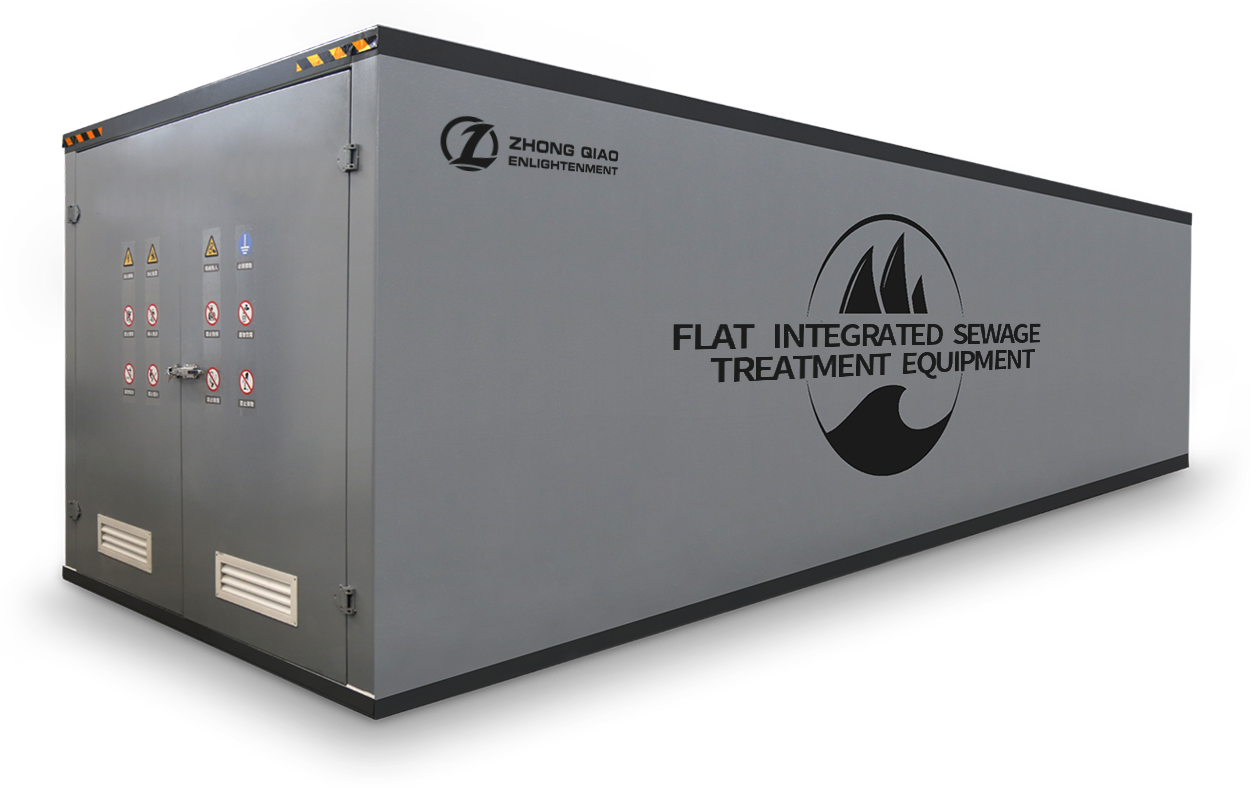
Integrated wastewater treatment equipment supplied as a single assembled unit; configuration and capacity are fixed by influent quality, effluent requirement and flow rate.
Process and mechanical configuration (WSZ-100 reference)
A documented integrated unit configuration shows the level of detail a buyer should be able to see before ordering. The reference configuration for model WSZ-100 includes:
- Two blowers rated 100-7.5, configured so that one runs and one serves as backup.
- Siemens PLC module, with a PLC control panel and a multifunctional meter.
- Electrical apparatus elements from Schneider Electric.
- Remote communication module HDBox-4G-A.
- Two self-priming pumps PXZ15-30-1.5 with DN40 connections.
- 100 L PE chemical dosing device with a metering pump rated 120 L/h, plus a water flow meter.
- Electrical control cabinet supplied as a matching accessory.
That list is what separates a specified plant from a container shell. Duty/standby blowers and duplicated pumps are redundancy decisions; the PLC and remote module are monitoring decisions; the dosing package is a chemical-conditioning decision. Each one changes price, so each one has to be stated in the RFQ rather than assumed.
Pretreatment: when a DAF unit becomes a constraint
Dissolved air flotation is the stage that removes suspended solids and oil before biological treatment, and it is the most common reason a containerized plant needs more than one module. The documented YW-5 unit is an advection combined air flotation system with a rated processing capacity of 5 m³/h, a dissolved-air water reflux ratio of at least 30% (typically 40% to 50%) and a head of 40 to 50 metres.
Its documented build includes a main body comprising a secondary stirring reaction zone, contact tank, flotation tank and clear water tank; two dosing area agitators at 0.75 kW; one 4 kW dissolved air pump; one air compressor at 1.4 kW, 0.21 m³/min, 0.8 MPa, with 30 L air storage; a nylon aeration release device; a 0.75 kW scraper; carbon steel and nylon chains with four nylon chain wheels; SS304 plus rubber strike-off boards; two 500 L dosing tanks at 0.37 kW; six dosing pumps rated 15.77 L/h; and a PLC control system using Siemens and Schneider Electric components. Main body material is carbon steel or SS304.
The documented application range for this type of unit is abattoir, printing and dyeing mill, and farm wastewater — in other words, streams with high oil and high suspended solids. If the influent contains those loads, the flotation stage belongs in the specification from the start, not in a revision after the container layout is frozen.
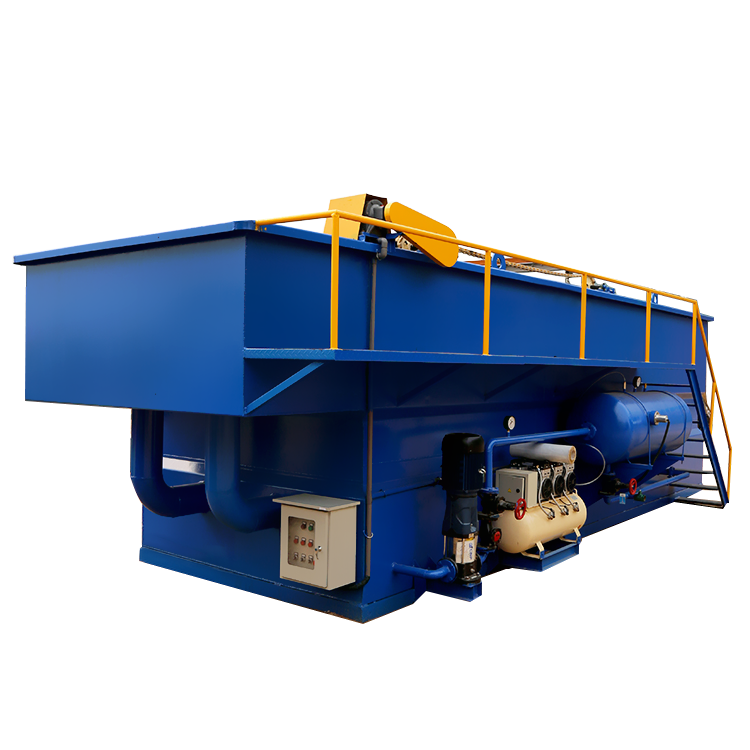
Dissolved air flotation unit YW-5: rated capacity 5 m³/h, dissolved-air reflux ratio of at least 30%, carbon steel or SS304 body.
Control, redundancy and remote operation
Automatic operation is the documented mode for integrated equipment, and the control philosophy is built around unattended running: PLC-based control with Siemens and Schneider Electric components, duty/standby blowers, duplicated self-priming pumps, and remote operation, remote monitoring and remote analysis through the remote module. For a buyer, remote capability is a staffing constraint as much as a technical feature — it determines whether the plant can be supervised from a central control room instead of a permanent local operator.
Certification: read the scope, not the logo
The documented quality management system certificate is certificate number 21725Q06885R2M, issued by Shandong LAJ International Certification Service Co., Ltd. (LAJCC), certified to GB/T 19001-2016/ISO 9001:2015. Its scope is the production of integrated sewage treatment equipment, covering model WSZ-100, and it is valid from 15 April 2025 to 27 April 2028. The certification applies to the Middle East and Southeast Asia markets.
Three points are worth extracting from that paragraph. The certificate is a quality management system certificate, so it evidences process control in production, not the effluent quality of a specific installation. The scope names a product category and a model, so it should be checked against what is actually being purchased. And the validity dates matter: a certificate expiring during a project's delivery window is a documentation risk that is trivial to check and expensive to discover late.
CE marking is a separate matter. It is a declaration of conformity against applicable European directives, not a synonym for ISO 9001, and it should be requested as its own document set together with component certificates and test reports when the destination market requires it.
Step-by-Step Breakdown: Six Steps to a Verifiable Specification
The sequence below converts a container enquiry into a comparable quotation. Each step produces one line item that can be checked against a supplier's offer.
Step 1 — Fix the three design inputs
Write down influent water quality (COD, suspended solids, oil and grease, pH, temperature), the effluent discharge or reuse requirement, and the design flow rate in m³/h or m³/d, including any peak factor. The documented effluent position is that the standard is customized on demand, with Grade 1A and Grade 1B commonly referenced for municipal discharge and reuse scenarios. Nothing else in the specification can be finalized until these three values are on paper.
Step 2 — Decide the installation mode and access
The documented working conditions are above ground or underground. That choice drives civil works, access for lifting equipment, ventilation, and how maintenance is performed. It also drives cost, so it belongs in the RFQ rather than in a site meeting after order placement.
Step 3 — Select wetted materials against the actual stream
Choose between carbon steel, SS304 stainless steel and PP using the influent chemistry. Where pH falls outside the range that carbon steel tolerates comfortably, the PP option — specified for pH 3 to 14 — is the defensible selection, and it should be written as a material requirement, not left as a supplier preference.
Step 4 — Confirm whether pretreatment is required
If oil, grease or suspended solids are significant, specify a flotation stage such as the YW-5 unit and its capacity explicitly. This is the step where container count and footprint change most, so it must precede layout confirmation.
Step 5 — Define instrumentation, redundancy and remote scope
State the PLC platform, the redundancy requirement (duty/standby blowers, duplicated pumps), and whether remote operation, monitoring and analysis are required. Documented configurations already include Siemens PLC modules, Schneider Electric elements and the HDBox-4G-A remote module; the RFQ should confirm them rather than assume them.
Step 6 — Agree documentation, OEM scope, MOQ and lead time
Attach the certificate scope and validity dates, the 100% test requirement before shipment, any OEM customization of appearance, color and logo, the minimum order quantity of 1 unit, and the quoted lead time of 30 to 45 days. Add the acceptance criteria for the effluent test. This is also the point to state whether on-site installation guidance and remote technical support are included.
Use Cases: Where Containerized Plants Fit
Documented applications for integrated and containerized wastewater treatment equipment include hotel wastewater, hospital wastewater, camp domestic wastewater, slaughterhouse wastewater, livestock breeding wastewater, domestic sewage and domestic wastewater. The common thread is a defined, decentralized waste stream with a steady duty point and a site that benefits from factory assembly.
- Construction camps and remote sites. A substation construction field camp domestic sewage project illustrates the typical case: no municipal connection, a fixed population, and a requirement for automatic operation with minimal local staffing.
- Healthcare and hospitality. Hospital and hotel wastewater projects rely on the same packaged logic, with the effluent requirement set by the local discharge authority rather than by the equipment supplier.
- Food and animal processing. A slaughterhouse project in Shanxi and a food factory sewage project in Xinjiang reflect streams where oil and solids loading make pretreatment a fixed part of the design rather than an option.
- Livestock and agricultural processing. A livestock wastewater project in South Korea and a wheat washing wastewater containerized project in the American Midwest — the latter reported by the manufacturer at approximately 150 m³/d — show the format working where the pollutant load is high but the flow is bounded.
- Export projects with constrained site labour. Documented shipments to Saudi Arabia and Russia follow the same logic: assemble and test in the factory, then minimize site work.
Where the format needs extra review is equally clear. Very large flows, highly variable industrial batches with shifting pollutant profiles, and sites requiring extensive dissolved air flotation or sludge handling capacity may be better served by a multi-module layout, or by a conventional civil-built plant. The container is a delivery decision; it does not remove the process design work.
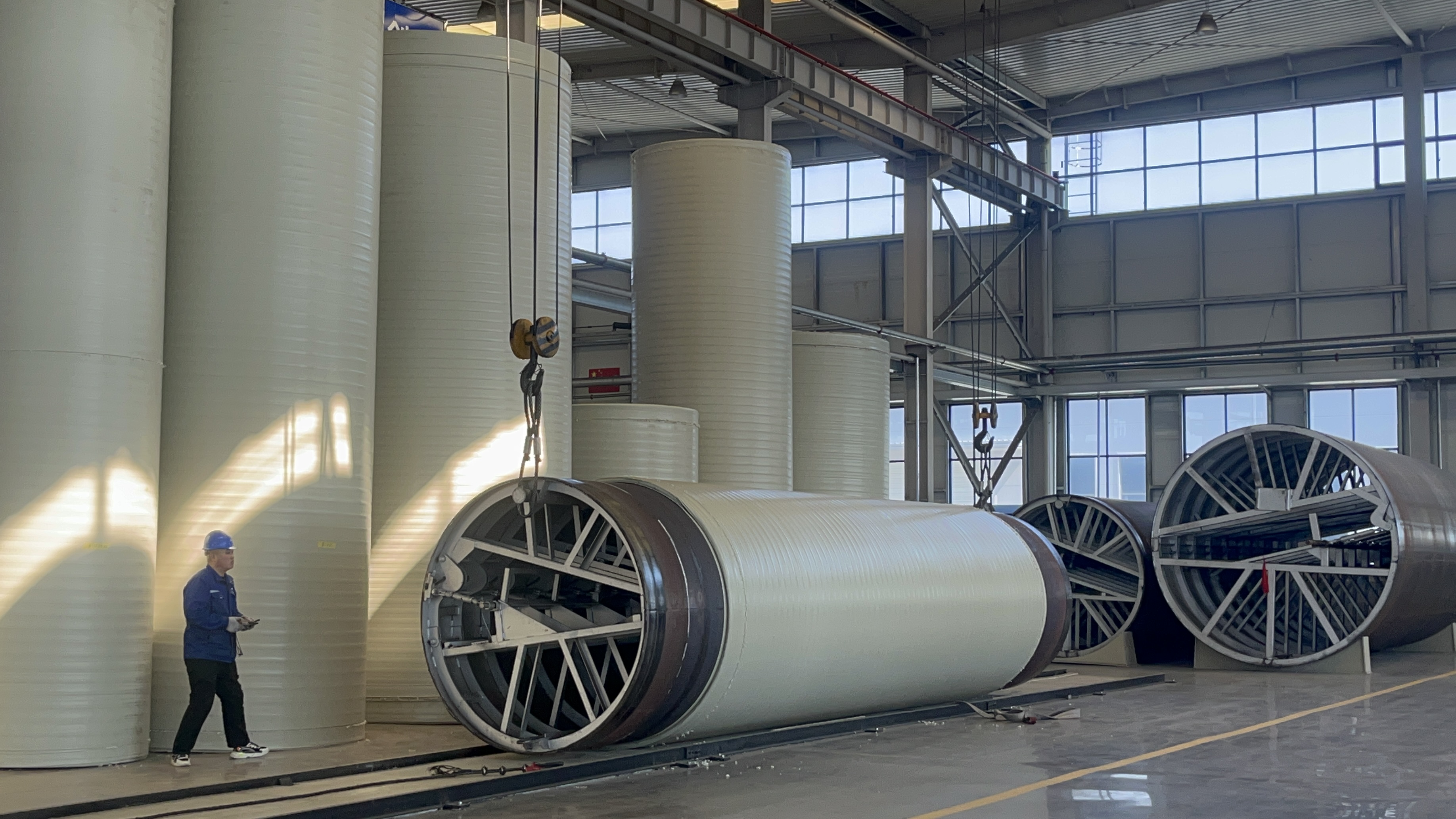
Production workshop: integrated units are assembled and tested before shipment, with 100% testing specified as the quality control requirement.
Comparison Table: Constraint Verification Matrix
The matrix below lists the constraints that decide whether a containerized quotation is comparable. The right-hand column cites only documented specifications from the manufacturer’s published product and certification data.
| Constraint | What to write into the RFQ | Documented reference |
|---|---|---|
| Design flow rate | m³/h or m³/d, plus peak factor | Capacity is fixed by treatment flow rate; documented example units include 5 m³/h flotation capacity (YW-5) and a containerized project at approximately 150 m³/d |
| Influent quality | COD, suspended solids, oil and grease, pH, temperature | Required as a selection input before configuration; PP equipment specified for pH 3 to 14 |
| Effluent requirement | Discharge standard or reuse target | Effluent standard customized on demand; Grade 1A and Grade 1B commonly referenced |
| Wetted material | Carbon steel, SS304 or PP, by stream chemistry | Documented material set: carbon steel, SS304 stainless steel, PP |
| Pretreatment | Flotation stage if oil or solids are significant | YW-5 dissolved air flotation, 5 m³/h, reflux ratio at least 30% (typically 40% to 50%) |
| Redundancy | Duty/standby blowers, duplicated pumps | Two blowers (one duty, one standby); two self-priming pumps PXZ15-30-1.5, DN40 |
| Control and remote scope | PLC platform, remote monitoring requirement | Siemens PLC module, Schneider Electric elements, HDBox-4G-A remote module, automatic operation |
| Certification | Certificate number, scope and validity dates | ISO 9001 certificate 21725Q06885R2M, LAJCC, GB/T 19001-2016/ISO 9001:2015, scope: production of integrated sewage treatment equipment, valid 15 April 2025 to 27 April 2028 |
| Quality control | Test before shipment, acceptance criteria | 100% test specified; on-site installation guidance and remote technical support |
| Commercial terms | MOQ, lead time, OEM scope | MOQ 1 unit; lead time 30 to 45 days; monthly capacity 100 units; appearance, color and logo customization available |
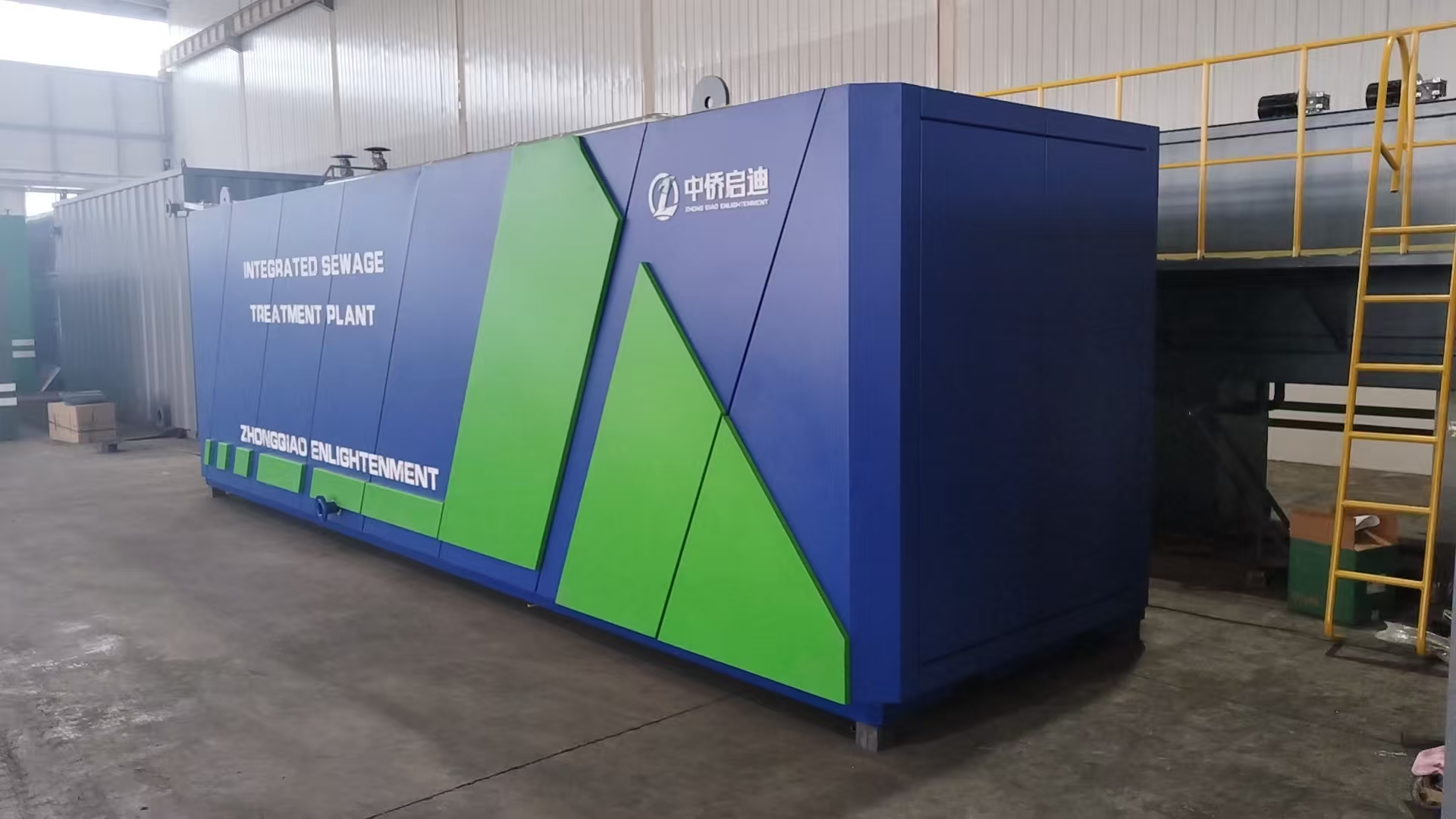
Export shipment of integrated sewage treatment equipment: factory assembly and testing shift civil works and commissioning effort away from the site.
FAQ
Do China-based manufacturers supply CE documentation with containerized wastewater treatment plants?
CE marking and ISO 9001 certification are different things, and buyers should request them separately. Zhongqiao Enlightenment holds ISO 9001 quality management system certificate 21725Q06885R2M, issued by Shandong LAJ International Certification Service Co., Ltd. (LAJCC) under GB/T 19001-2016/ISO 9001:2015. The scope is production of integrated sewage treatment equipment, including model WSZ-100, valid from 15 April 2025 to 27 April 2028, and it applies to the Middle East and Southeast Asia markets. ISO 9001 certifies the quality management system; it is not a CE declaration of conformity. For CE-relevant projects, request the declaration of conformity, component certificates, test reports and the destination-market standard as separate documents, and state the destination country in the RFQ.
What configuration and materials can be specified for a containerized plant?
Documented options are a modular integrated unit shipped as a complete assembly, relocatable and expandable for different treatment capacities, with automatic operation and wetted materials in carbon steel, SS304 stainless steel or PP. The PP version is specified to withstand acid and alkali corrosion within pH 3 to 14. A documented WSZ-100 configuration includes two blowers (one duty, one standby), a Siemens PLC module, Schneider Electric elements, a PLC control panel with HDBox-4G-A remote module, two self-priming pumps PXZ15-30-1.5 with DN40 connections, a 100 L PE dosing device, a metering pump rated 120 L/h and a water flow meter. OEM customization of appearance, color and logo is available.
What drives the price band of a containerized wastewater treatment plant?
No verified public price band is published in the documentation used for this article, because cost is set by the specification rather than by container size. The main drivers are treatment flow rate, influent quality (COD, suspended solids, oil, pH, temperature), the required effluent standard, material selection (carbon steel, SS304 or PP), whether pretreatment such as a DAF unit is required, instrumentation and redundancy scope, documentation requirements, and freight. Compare quotations per cubic metre treated at a defined effluent limit rather than per container.
Can a single unit be ordered for validation before a full project?
Yes. The minimum order quantity is 1 unit and 100% testing is carried out before shipment, so a single containerized unit can serve as a qualification unit for a site or for a parent company approval process. Lead time for that unit is 30 to 45 days, and OEM customization of appearance, color and logo is available for validation units as well. Remote operation, monitoring and analysis are supported through the remote module, which allows a distributed team to review operating data.
What is the lead time, and when does it start?
Quoted lead time is 30 to 45 days against a monthly production capacity of 100 units. The clock should start only after the three design inputs are confirmed: influent water quality, effluent discharge requirement and treatment flow rate. Installation mode (above ground or underground), site civil works, and whether on-site installation guidance is required also affect the site schedule. To turn an evaluation into a costed configuration, send the influent data, the effluent standard and the design flow rate, and ask for the ISO 9001 certificate scope to be attached to the offer.
Conclusion
For a containerized wastewater treatment plant, the container is the last decision, not the first. The order that survives review is built from three fixed inputs — influent quality, effluent requirement and flow rate — then material selection against the actual chemistry, then pretreatment where oil and solids demand it, then instrumentation and redundancy, then documentation. Everything else, including price, follows from that sequence.
A practical verification rule for evaluation stage: accept no quotation that does not state the design flow rate, the effluent target, the wetted material, the pretreatment stage, the redundancy arrangement, and the certificate number with its scope and validity dates. In the documented case here, that means ISO 9001 certificate 21725Q06885R2M under GB/T 19001-2016/ISO 9001:2015, scope production of integrated sewage treatment equipment, valid to 27 April 2028 — plus a clear statement of what the certificate does not cover.
Next Step: Configuration, Sample or Quotation
Send the influent water quality, the required effluent standard and the design flow rate, and the configuration can be defined, costed and documented — including the certificate scope, the test requirement and the 30 to 45 day lead time.
Contact: Sunny, Zhongqiao Enlightenment
WhatsApp / WeChat: +86 156 1060 0767
Email: zqqdequipment@163.com
Website: www.zqqdwater.com
Download the Zhongqiao Enlightenment brochure (13th edition) for product ranges, configuration details and project references.
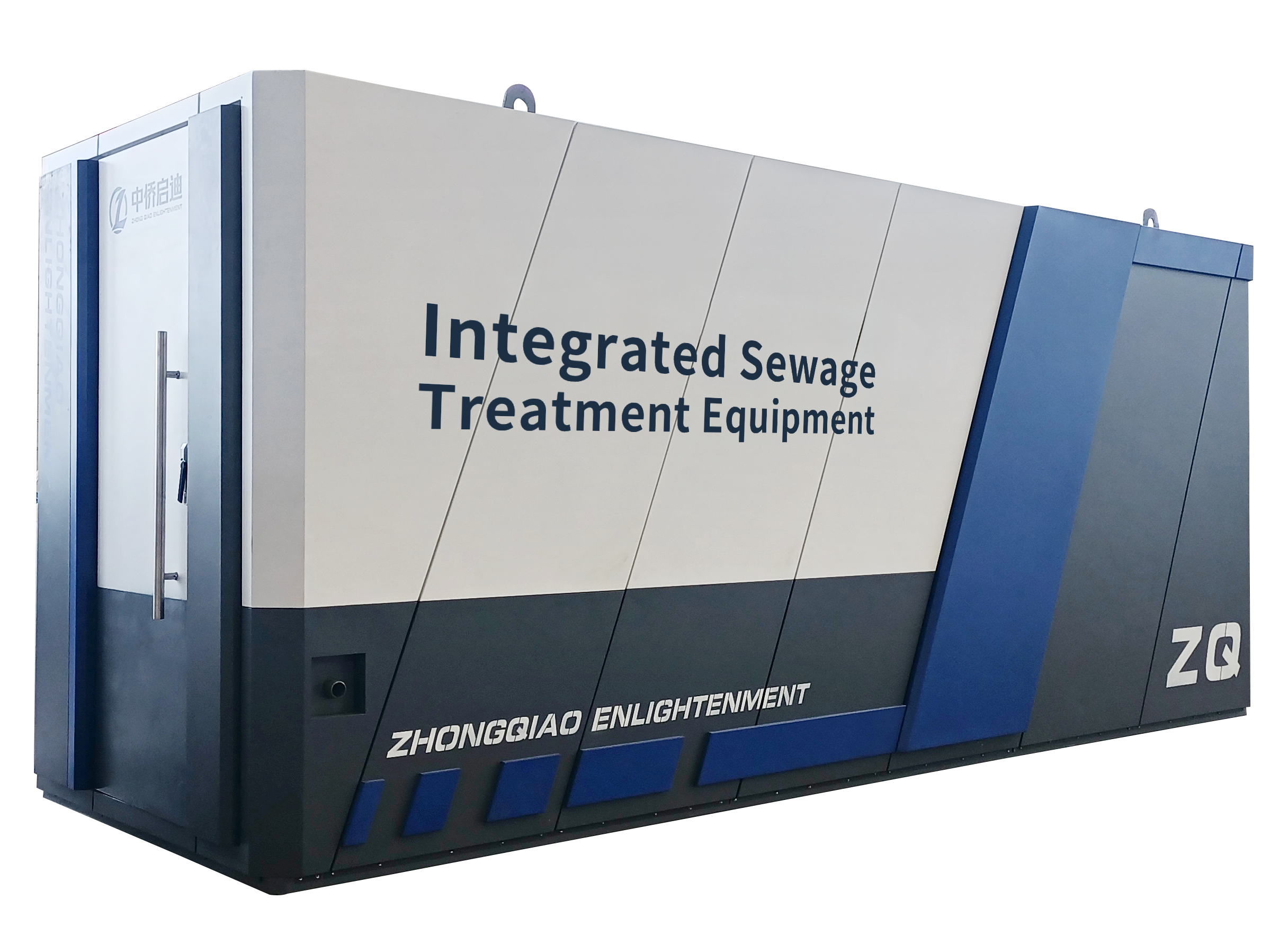
Integrated wastewater treatment equipment: configuration, material and documentation are confirmed before quotation.
Have Questions or Need More Details?
Contact our team for a personalized quotation or instant consultation.
Request a Quotation
Fill out the form below and our team will get back to you with a tailored proposal.
WhatsApp Direct Chat
Prefer to chat in real-time? Message us on WhatsApp for instant assistance & quick answers.
- Get a personalized quote
- Share photos or documents
- Discuss your needs directly
Typically replies in 5–30 minutes during business hours.