AGV vs. Rail-Fixed vs. Crawler: Which ESS Insertion Robot Fits Your Container?
AGV vs. Rail-Fixed vs. Crawler: Which ESS Insertion Robot Fits Your Container?
Procurement and engineering teams often ask which type of ESS battery pack insertion robot for containers should be specified: AGV-driven equipment, rail-fixed equipment, or crawler-driven equipment. The practical answer depends on container dimensions, battery PACK envelope, floor conditions, payload, and whether the production workflow needs a fixed loading station or terrain flexibility. Shanghai Zonzsin Intelligent Equipment Co., Ltd. supplies models in all three platform categories: the AGV-driven RD16, the rail-fixed ZZX2508 and ZZX2524, and the crawler-driven ZZX2522. This comparison guide uses the verified model data supplied by Zonzsin to help buyers place each platform against a real container-loading project.
Why the Drive Platform Matters for ESS Container Loading
Containerized BESS assembly is not a generic material-handling job. The equipment must move heavy battery packs into rack openings through a restricted container door, align the PACK with the rack slot, and avoid any collision with the container wall or adjacent racks. If the PACK dimensions or container geometry are not matched, even a capable robot can create bottlenecks and quality risks. The drive platform determines where the robot can work, how the floor must be prepared, and how easily the robot can serve different container positions.
The broader market context supports this engineering need. The containerized battery energy storage system market was valued at about USD 11.75 billion in 2025 and is projected to grow at a CAGR of 24.1% through 2035, according to InsightAce Analytic. In the wider BESS market, MarketsandMarkets valued the global market at roughly USD 50.81 billion in 2025 and projects it to reach USD 105.96 billion by 2030. As more ESS integrators move from pilot builds to continuous container assembly, the choice between AGV-driven, rail-fixed, and crawler-driven insertion robots becomes a production-planning decision rather than a purely technical comparison.
Three Platform Families at a Glance
Zonzsin groups its container-facing equipment into three verified model families. RD16 is the AGV-driven battery PACK insertion robot for containers. ZZX2508 and ZZX2524 are rail-fixed battery PACK insertion robots. ZZX2522 is a crawler-driven battery PACK insertion and removal robot. All three families appear in the relevant model data as equipment for energy storage and commercial-and-industrial, or C&I, applications.
AGV-Driven RD16
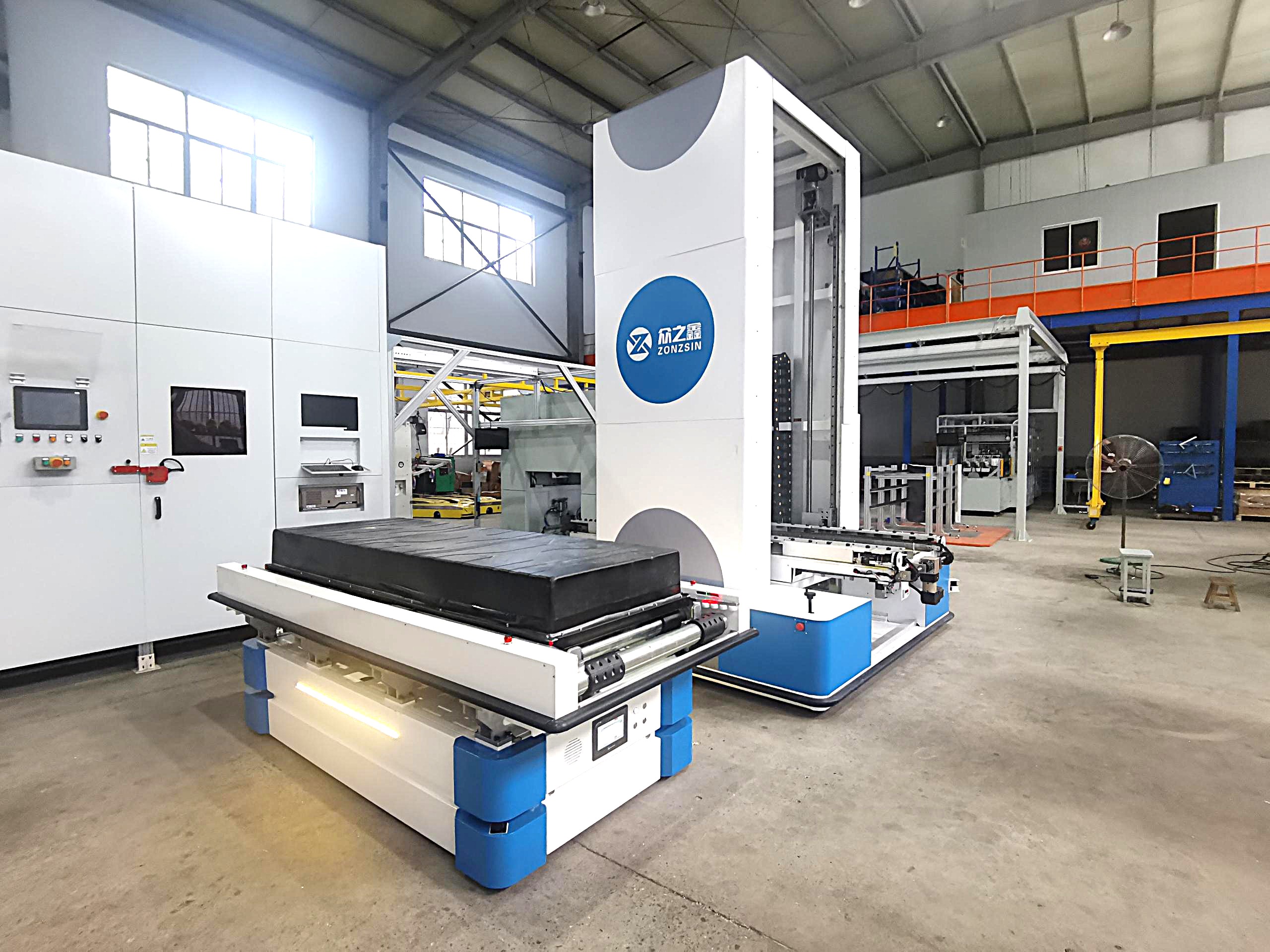
The RD16 is classified as an AGV-driven battery PACK insertion robot for containers. Its verified overall specification is L3100 x W2600 x H3800 mm. It is compatible with 280Ah, 314Ah and 587Ah cells and with 1P52S and 1P104S PACK architectures. The hoisting range is listed as 1.05 to 3.4 with customization available, and hoisting speed is 100 mm/s. The machine is made of carbon steel and is targeted at C&I and energy-storage applications. Zonzsin says its AGV-driven model family is positioned for standard 20ft/40ft container racks and supports payloads up to 1500 kg, with 5-DOF docking described in published product data.
For a buyer, RD16 deserves a shortlist when the cell format falls inside the 280Ah/314Ah/587Ah family, the PACK architecture is 1P52S or 1P104S, and the production plan calls for AGV-based container docking rather than a fixed rail workstation. The company profile also notes that Zonzsin holds granted patents in AGV-driven battery PACK insertion technology, which is useful evidence of engineering investment in this platform.
Rail-Fixed ZZX2508 and ZZX2524
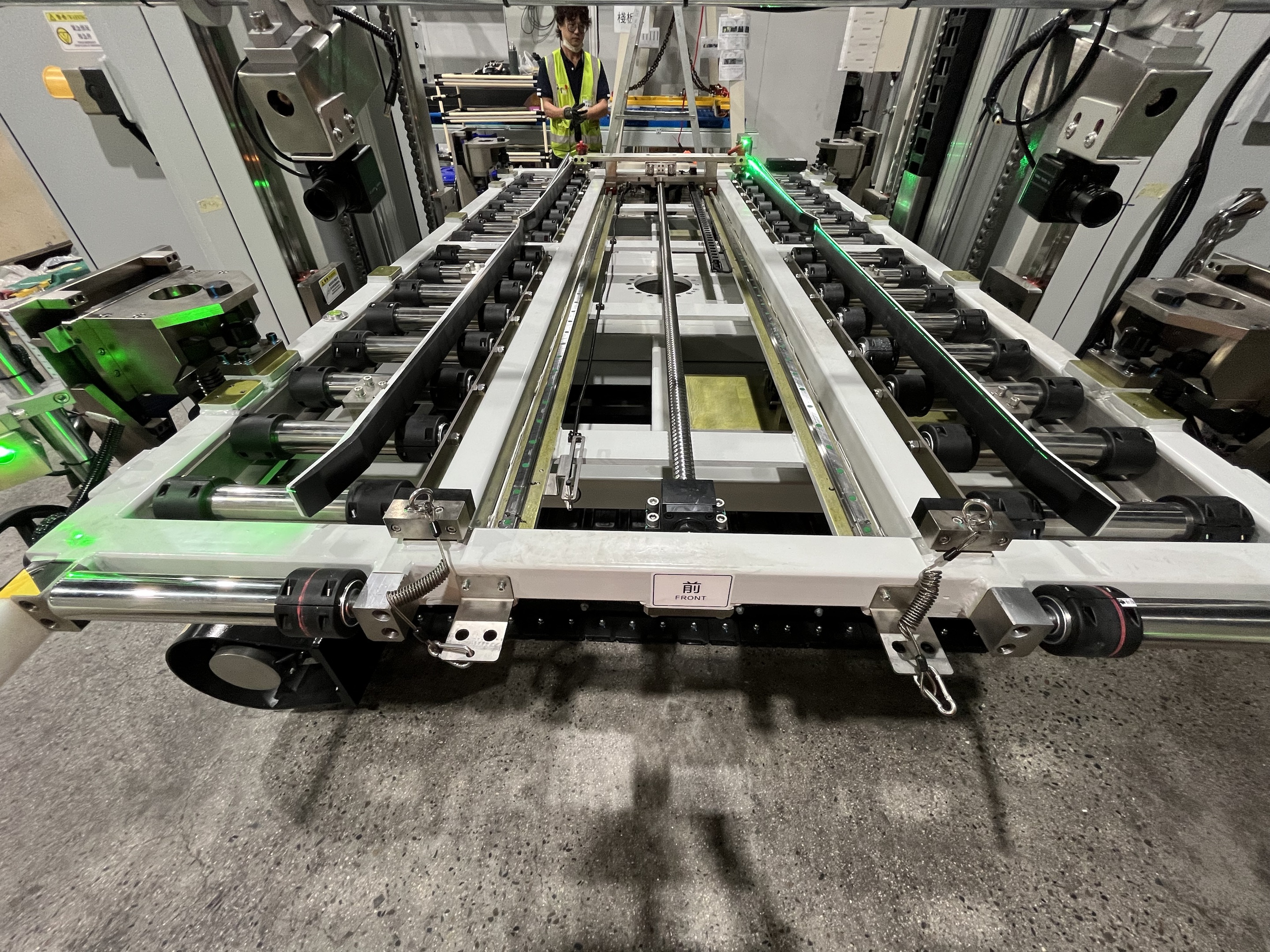
Rail-fixed battery PACK insertion robots are appropriate for a workstation where the container is brought to the robot and the robot moves along a fixed ground rail. The ZZX2508 model provides a clearly dimensioned matchup case: it accepts containers with listed length from 6058 to 7000 mm, width from 2438 to 2700 mm, and height from 2896 to 3000 mm. Its compatible PACK envelope is L1100 to 2200 mm, W780 to 1260 mm, and H230 to 260 mm. The machine needs a compressed-air supply of 0.5 to 0.8 MPa, AC380V ±10% power at 50 ±2 Hz, and a container door opening angle of at least 150 degrees.
The ZZX2524 model is the second rail-fixed option. It shifts the decision focus toward handling performance: the listed load capacity is 1500 kg, the door opening angle is at least 150 degrees, gripper changeover time is less than 1 minute, and the double-layer rack configuration supports space saving in the workstation. The image below shows the rail-fixed execution used in a container PACK loading line.
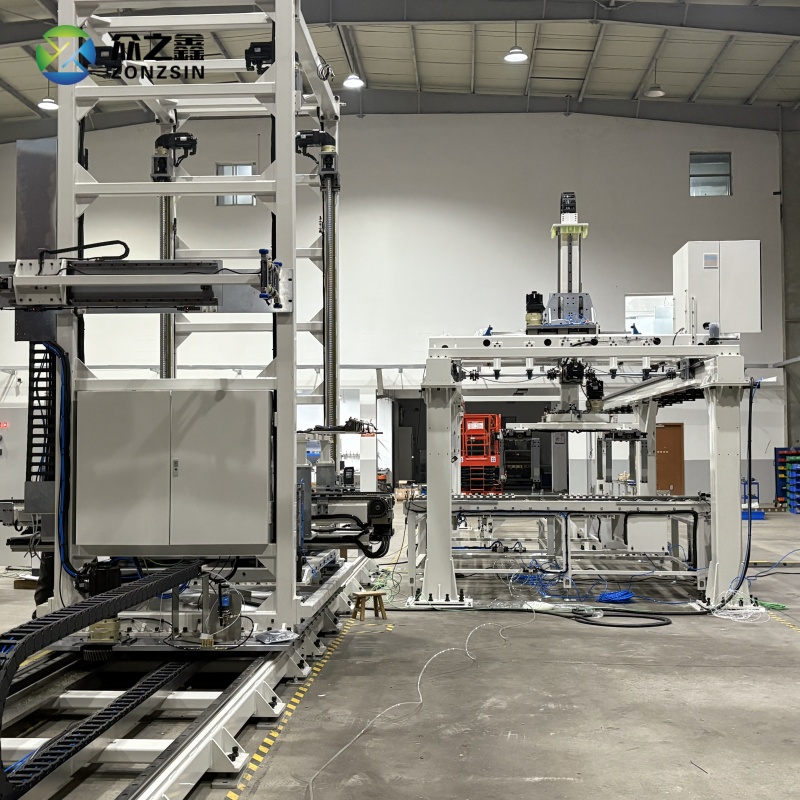
Rail-fixed technology should be evaluated when the site can support a fixed loading lane. The available case data for a rail-fixed installation emphasizes a stable and fixed ground rail for safe working, and the double-layer rack in the ZZX2524 specification reduces the floor space needed for material staging.
Crawler-Driven ZZX2522
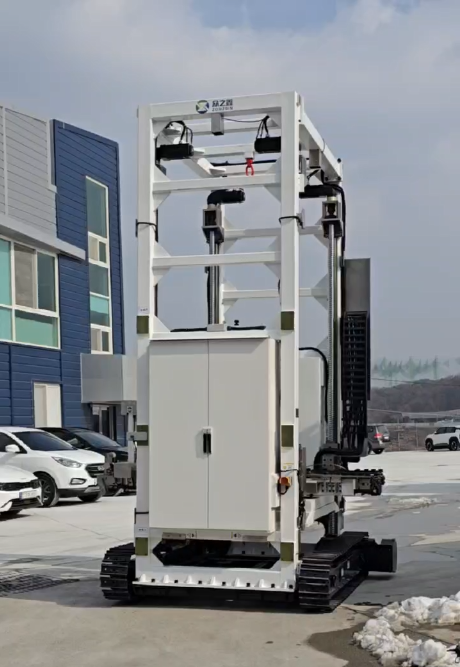
The ZZX2522 is a crawler-driven battery PACK insertion and removal robot, rather than a pure insertion-only platform. Its verified working floor is all-terrain, its load capacity is 1500 kg, its hoisting range is 0.8 to 3.4 with customization available, and it uses manual handwheel leveling. It is built with Q235 steel and is intended for energy-storage and C&I work.
The all-terrain classification is the most important selection signal for this model. Some ESS projects require PACK insertion on outdoor ground, after concrete settlement, on site with repair conditions, or across multiple container positions where floor flatness cannot be guaranteed. In these situations, a rail-fixed solution may be difficult to install. The crawler ZZX2522 can be moved to the container opening, and its manual handwheel leveling function lets the operator level the machine before lifting the PACK.
Step-by-Step Fit Assessment
Buyers can use the following structure to turn the three platform families into a defensible equipment shortlist.
Step 1. Check Container and Door Geometry
Start with the physical container. The ZZX2508 gives a concrete matching window: container length 6058 to 7000 mm, width 2438 to 2700 mm, and height 2896 to 3000 mm. It also requires a container door opening angle of at least 150 degrees. If your loading envelope is outside these ranges, the rail-fixed ZZX2508 should not be assumed to fit without re-engineering. For ZZX2524 and ZZX2522, no identical dimensional envelope is published in the provided model data, so those dimensions must be confirmed against the actual container drawing.
Step 2. Compare PACK Envelope and Cell Architecture
The ZZX2508 is the model with the most explicit PACK dimensional list: L1100 to 2200 mm, W780 to 1260 mm, and H230 to 260 mm. The RD16 instead specifies battery family compatibility: 280Ah, 314Ah and 587Ah cells, in 1P52S or 1P104S PACK configurations. A buyer with nonstandard PACK dimensions should therefore verify dimensional compatibility with the manufacturer rather than assume interchangeability.
Step 3. Confirm Payload
The ZZX2524 rail-fixed model and the ZZX2522 crawler-driven model both declare 1500 kg load capacity. Zonzsin also reports that its AGV-driven platform family supports up to 1500 kg. No separate load capacity is stated in the supplied spec card for the ZZX2508, so a project using that model should confirm the maximum PACK mass before finalizing the fixture and lifting design.
Step 4. Evaluate the Working Floor
Fixed rail equipment is normally considered when the working floor is prepared and stable. In the available China-based rail-fixed application, the project highlight refers to a stable and fixed ground rail for safe working. Crawler-driven ZZX2522 is designed for all-terrain floors and is the platform category used in South Korea and Taiwan project records where outdoor, uneven, or complicated floors were present. If plant floor conditions are controlled and repeatable, rail-fixed can be the simpler operating principle. If not, the crawler avoids expensive floor preparation.
Step 5. Decide Between Fixed-Lane and Mobile Operation
Rail-fixed models such as ZZX2508 and ZZX2524 suit a continuous loading lane where the container is positioned in a predictable dock. The crawler-driven ZZX2522 expands the work envelope to different containers and repair/service positions. The AGV-driven RD16 represents the mobile guided platform option in the lineup, and should be assessed when the project calls for AGV-based docking inside an automated container loading cell.
Use Cases and Field Evidence
In a China-based project, a rail-fixed battery PACK insertion robot has been used in a continuous PACK insertion process. The recorded application involved stable PACK loading and fully automatic PACK insertion; the project duration reached two years, with stable operation and efficiency improvement. The project highlight cites the stable fixed ground rail and dual-layer material rack for space utilization.
A South Korea project used a crawler-driven battery PACK insertion and removal robot for ESS container PACK insertion and removal. The equipment worked outdoors and was chosen because crawler drive suits an uneven working floor. The project recorded stable operation over a one-year period.
In Taiwan, a crawler-driven platform has supported ESS battery PACK insertion into and removal from containers. The project required indoor and outdoor use, plus repair and service access. The recorded reason for crawler drive was the complicated working floor, and the project achieved stable operation over a one-year period.
Platform Comparison Table
| Selection Point | RD16 — AGV-Driven | ZZX2508 — Rail-Fixed | ZZX2524 — Rail-Fixed | ZZX2522 — Crawler-Driven |
|---|---|---|---|---|
| Product classification | AGV-driven battery PACK insertion robot for containers | Rail-fixed battery PACK insertion robot | Rail-fixed battery PACK insertion robot | Crawler-driven battery PACK insertion and removal robot |
| Key verified compatibility criteria | 280Ah / 314Ah / 587Ah cells; 1P52S / 1P104S PACKs | Container L6058-7000 mm, W2438-2700 mm, H2896-3000 mm; PACK L1100-2200 mm, W780-1260 mm, H230-260 mm | 1500 kg load; door opening angle ≥150°; gripper changeover <1 min; double-layer rack space saving | All-terrain working floor; 1500 kg load; manual handwheel leveling |
| Hoisting speed / range | Hoisting speed 100 mm/s; hoisting range 1.05-3.4, customizable | Not separately stated in the verified model record | Not separately stated in the verified model record | Hoisting range 0.8-3.4, customizable |
| Documented installation inputs | AGV-driven container-docking profile; overall machine envelope L3100 x W2600 x H3800 mm | Compressed air 0.5-0.8 MPa; AC380V ±10%, 50 ±2 Hz; door opening ≥150° | Fixed rail workstation with door opening ≥150° | No fixed rail required; suitable for uneven outdoor/complicated floors |
| Recorded application signal | AGV technology area with granted patents; standard 20ft/40ft container rack positioning stated in manufacturer data | Continuous PACK insertion; stable and fixed ground rail for safe working | Space-saving double-layer rack configuration; fast gripper changeover | South Korea outdoor and Taiwan complicated-floor projects; PACK insertion and removal service |
Frequently Asked Questions
Does the Zonzsin ESS battery pack insertion robot range have quality certification?
Zonzsin operates an ISO 9001-certified quality management system under certificate number 44825MS079001R0. The certification standard is GB/T 19001-2016 / ISO 9001:2015, and the certified scope covers laser welding equipment, laser cleaning equipment, module PACK assembly line, and R&D and assembly of AGV-based cluster loading robots. The RD16, ZZX2508, ZZX2524, and ZZX2522 are listed as related products under this certification scope, and the certificate is currently valid through 19 November 2028.
Which models can handle a 1500 kg battery PACK?
The ZZX2524 rail-fixed robot and the ZZX2522 crawler-driven robot have explicit 1500 kg load capacity in the verified model data. For the AGV-driven platform family, Zonzsin reports support for payloads up to 1500 kg. The ZZX2508 specification card in the available data does not list a separate load capacity, so a PACK mass above or near 1500 kg should be checked against the project-specific lifting and gripper design.
Which platform is best for uneven or outdoor container floors?
The crawler-driven ZZX2522 is the platform category designed for all-terrain working floors. It uses manual handwheel leveling and is intended for ESS battery PACK insertion and removal. Project records from South Korea describe crawler-driven equipment working outdoors on an uneven floor, and a Taiwan record describes a complicated working floor with indoor and outdoor use. These cases support the crawler platform when floor flatness and fixed rail installation are uncertain.
Can Zonzsin customize cycle time, configuration, and delivery lead time?
Zonzsin supports OEM and ODM customization across cycle time, automation level, logo, color, and configuration. The manufacturer lists monthly capacity as 3 units, MOQ as 1 unit, and lead time as 2 to 4 months. All equipment goes through 100% testing. The budget depends on the selected platform, customization scope, container/PACK dimensions, and site requirements, so a formal quotation should follow a specification review rather than a generic price estimate.
How should I start a specification review or validation project?
Begin by preparing the actual container door drawing, rack layout, PACK mass, PACK envelope, cell format, and required cycle time. These documents allow Zonzsin to match the correct platform and identify whether the RD16, ZZX2508, ZZX2524, or ZZX2522 should be shortlisted. The downloadable product brochure is a practical first step for reviewing the equipment family, and the last section of this article includes contact details for sending your project-specific specification.
Conclusion
There is no single robot that fits every ESS container project. The fit assessment should start with dimensional compatibility: the ZZX2508 provides the clearest published container/PACK envelope, while the RD16 provides a defined cell/PACK family and the AGV-driven platform profile. After matching geometry, evaluate payload, floor conditions, mobile-vs-fixed workflow, and service requirements such as PACK removal or repair. ZZX2524 should be considered when 1500 kg payload, rapid gripper changeover, and double-layer rack space savings matter. ZZX2522 should be considered when the site is outdoor, uneven, or complicated and the equipment also needs to perform insertion and removal. The AGV-driven RD16 is the candidate when an AGV-based docking strategy is planned and the battery architecture matches its listed cell/PACK compatibility.

Download the Zonzsin Product Brochure
Use the brochure to compare configurations before sending your container and PACK drawings.
Download Product BrochureEmail: katty.liu@zonzsin.com | Tel / WhatsApp: +86 134-8282-9368