
Adapting ESS Insertion Robots to All-Terrain vs. Indoor Container Sites
The deployment environment decides which ESS battery pack insertion robot can be adapted to a container project, before payload, cycle time or price are even discussed. A crawler-driven platform such as the ZZX2522 fits complicated, uneven or unfinished working floors, indoors or outdoors. An AGV-driven platform such as the RD16 fits indoor container halls where the robot travels between positions and the layout may change. Rail-fixed platforms such as the ZZX2508 and ZZX2524 fit fixed container lines where the container stops in the same place on every cycle. This guide is written for the evaluation and execution stage of a project: you already know the container and the battery pack, and you now need to know which platform can actually be installed on the ground you have.
Zonzsin (Shanghai Zonzsin Intelligent Equipment Co., Ltd.) is a Shanghai-based equipment manufacturer founded in 2019 that supplies ESS battery pack insertion robots for containers and automatic battery pack assembly lines to lithium battery manufacturers, energy storage system integrators and automotive OEMs. Its delivery record spans domestic and overseas markets, with exports concentrated in Europe, the USA, Japan, South Korea, India and Southeast Asia.
Problem Definition: Site Conditions Decide the Platform, Not the Reverse
Most insertion-robot projects that run late do not fail on robot performance. They fail on site adaptation. A buyer compares load capacity and hoisting range, selects a platform, and only then discovers that the working floor cannot be prepared in time, that the travel path is blocked by a rack, or that the container cannot be positioned repeatably enough for the chosen system to work.
Four site variables decide the platform class, and each one can be measured before an order is placed:
- Working floor condition. Floor flatness, surface continuity, load-bearing capacity and whether the line is indoors, outdoors, or moves between both. This is the single strongest discriminator between crawler-driven and wheel-driven/rail-fixed platforms.
- Space envelope. Not only the container footprint, but the space the robot itself needs to travel, turn and lift, including rack aisles and the area in front of the container doors.
- Container positioning. Whether the container arrives on a repeatable, fixed datum point every cycle, or whether it is positioned differently by a truck, a crane or a forklift each time.
- Utilities and access. Available power, compressed air, and the free door opening of the container, which determines whether a pack can be carried in on the intended path.
Where those four variables are unstable, the adaptation work shifts to the robot platform. Where they are stable and repeatable, the adaptation work shifts to the site — a rail line, a fixed rack and a defined container stop position.
Industry Background: Containerized Storage Growth Is Making Loading Bays the Constraint
The demand for containerized ESS is expanding quickly enough that insertion and loading throughput now shapes project schedules. The global Battery Energy Storage System (BESS) market was valued at approximately USD 50.81 billion in 2025 and is projected to reach USD 105.96 billion by 2030, according to MarketsandMarkets. Within that market, containerized BESS solutions represented a major segment valued at USD 11.75 billion in 2025, expected to grow at a CAGR of 24.1% through 2035, according to Insightace Analytic.
It is worth noting that published global BESS market values differ widely depending on whether a research firm measures system-level or project-level value — Polaris Market Research cites USD 103.80 billion for 2025 and Grand View Research cites USD 13.19 billion for the same period. For equipment planning, the practical signal is not the absolute figure but the direction: more containerized projects, more packs per container, and more sites of very different physical quality.
That variety is exactly where site adaptation becomes a project risk. A greenfield outdoor pad, a retrofit hall with a finished epoxy floor, and a fixed production line with a permanent container stop are three different installation environments. The same insertion task is performed in all three, but not by the same platform architecture.
Detailed Solution: Three Deployment Environments, Four Platforms
Zonzsin's container insertion range is organised around three drive architectures. Each one solves a specific site condition rather than a specific battery pack size, which is why platform selection should follow the site survey.
All-Terrain and Outdoor Container Pads — the Crawler-Driven ZZX2522
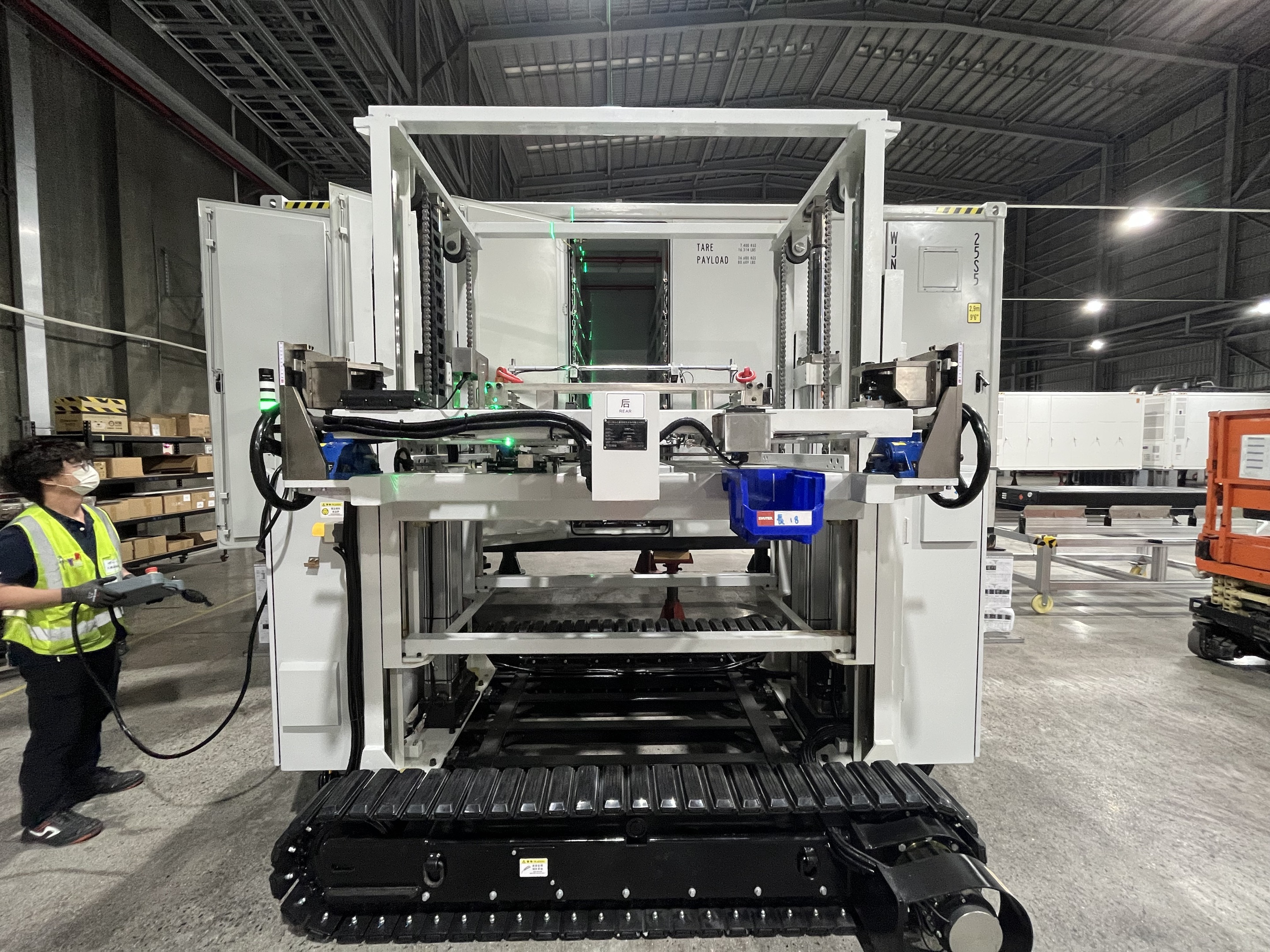
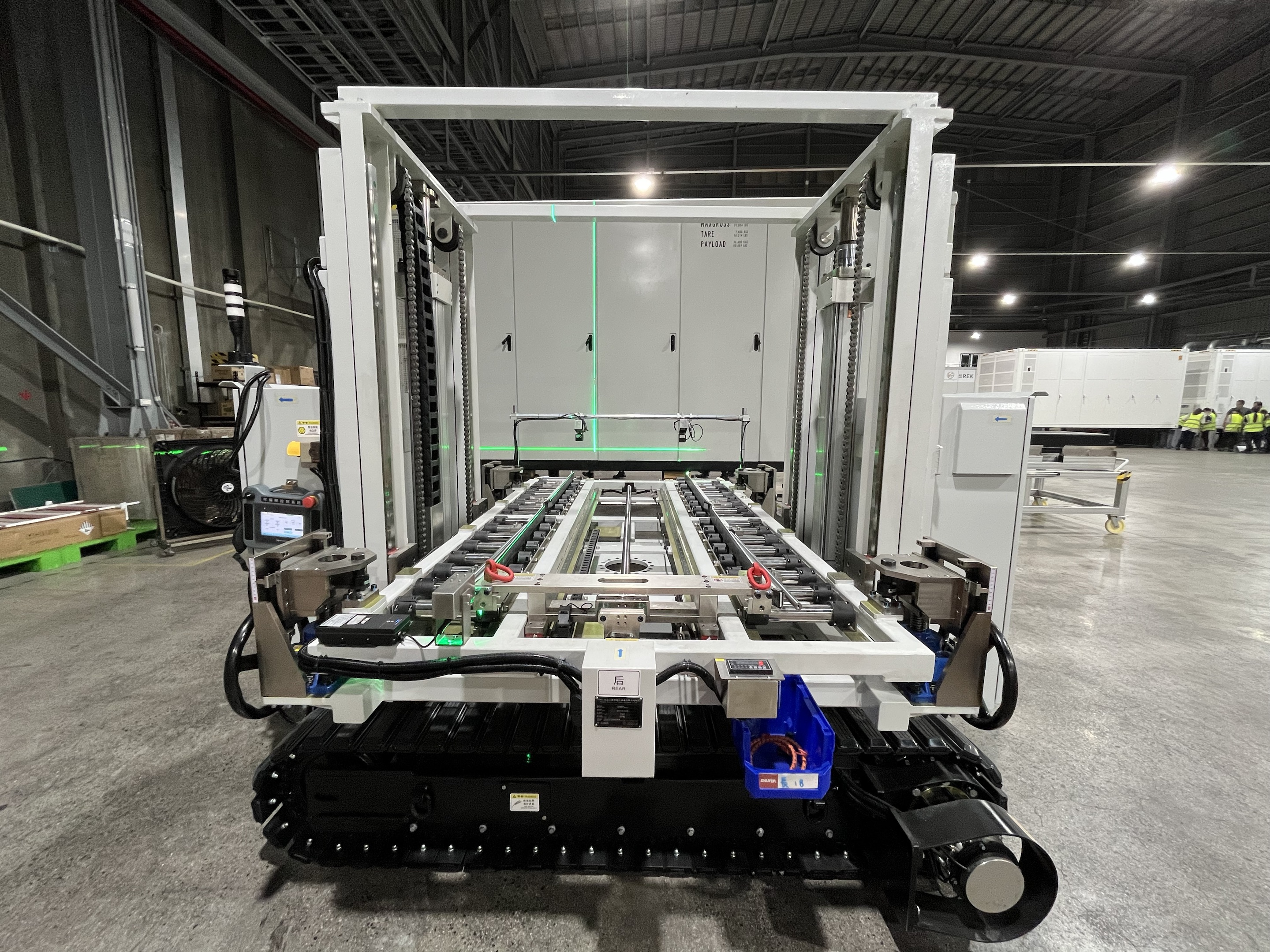
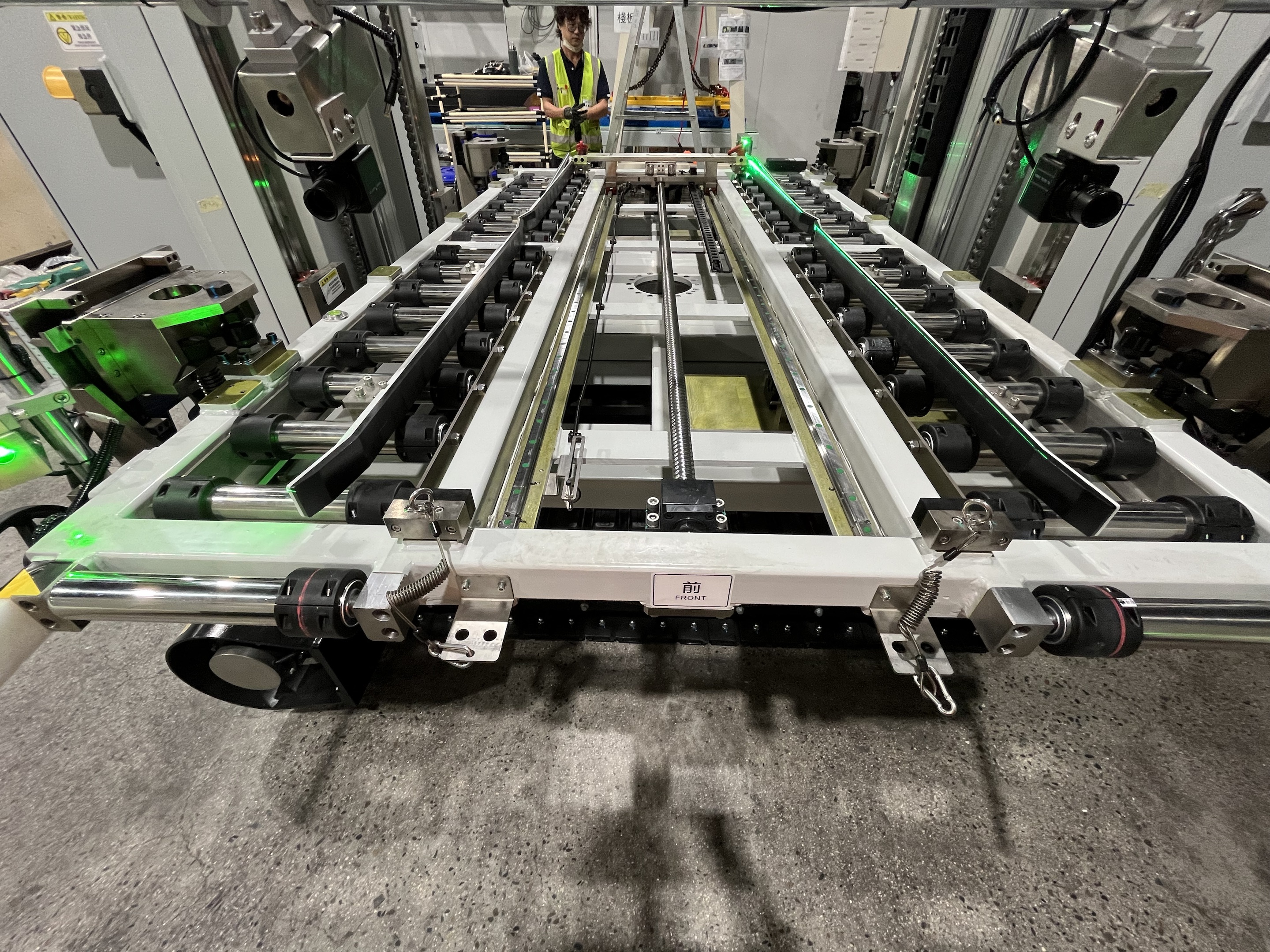
The ZZX2522 is a crawler-driven battery PACK insertion and removal robot. Its working floor specification is all-terrain, and it has been deployed for both indoor and outdoor use, including container projects where the ground is complicated or uneven. Two verified features matter most for adaptation planning:
- Hoisting range of 0.8–3.4 m, customizable. This gives the platform the vertical envelope needed to reach packs at different rack levels without changing the base machine.
- Manual handwheel leveling. On an uneven pad, the machine can be levelled mechanically before an insertion cycle. This is the practical answer to outdoor or mixed-quality floors where a wheel-based platform would be unreliable.
- Load capacity of 1500 kg, built on a carbon steel / Q235 structure, for energy storage and C&I applications.
Crawler traction is the reason this platform tolerates outdoor slabs, expansion joints and transitional surfaces that would interrupt a rigid-wheel travel path. In the published deployment record, a crawler-driven battery PACK insertion robot was used in South Korea for outdoor operation on uneven working floors, and in Taiwan for ESS battery PACK insertion into and removal from containers with both indoor and outdoor use confirmed by the customer record.
Indoor Container Halls with Flexible Layouts — the AGV-Driven RD16
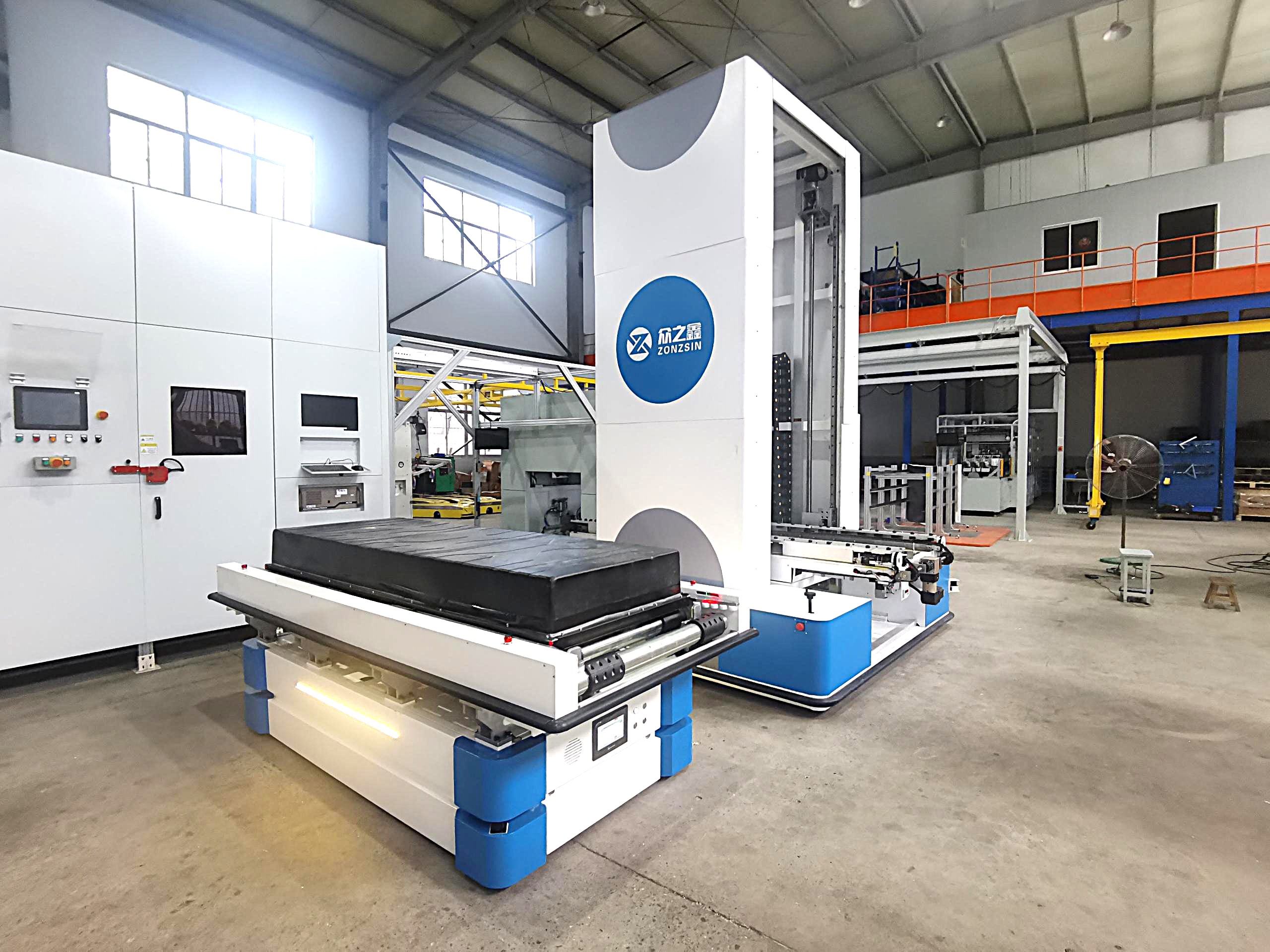
The RD16 is an AGV-driven battery PACK insertion robot for containers. It is the appropriate architecture when the robot must move between container positions inside a building instead of being tied to one line, and when the hall layout is expected to change over the life of the equipment. Its verified data includes:
- Overall specification: L3100 × W2600 × H3800 mm. This is the footprint that must be checked against hall aisles, door clearances and rack spacing before ordering.
- PACK compatibility: 280/314/587 Ah cells, 1P52S / 1P104S PACKs. Buyers can validate their pack list against this directly.
- Hoisting range 1.05–3.4 m (customizable) and hoisting speed 100 mm/s, with a carbon steel structure.
AGV-driven insertion suits a contained, defined indoor environment: the travel route is inside a controlled building, the container is brought to a station rather than found wherever it was parked, and the same machine can be re-tasked when the hall layout changes. Zonzsin holds invention patents covering the AGV-driven battery PACK insertion robot, which is the technical direction behind this platform.
Fixed Container Lines — the Rail-Fixed ZZX2508 and ZZX2524
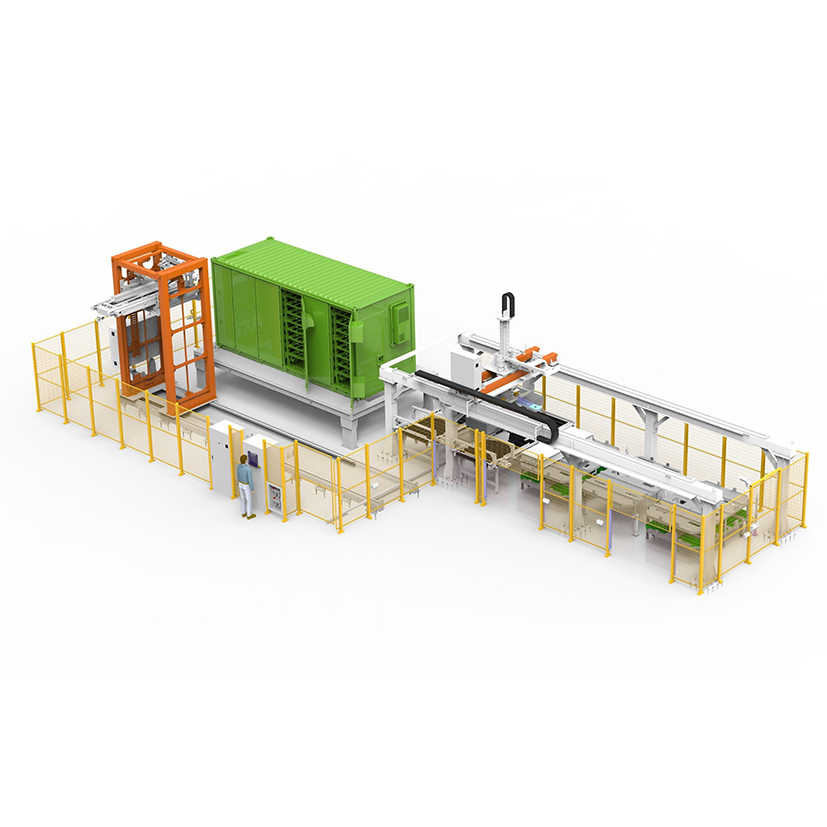
Where the container stops at the same datum on every cycle, rail-fixed insertion is the most repeatable arrangement. Zonzsin supplies two rail-fixed models for this scenario.
The ZZX2508 is specified against a defined container and pack envelope:
- Compatible container: L 6058–7000 mm, W 2438–2700 mm, H 2896–3000 mm
- Compatible PACK: L 1100–2200 mm, W 780–1260 mm, H 230–260 mm
- Compressed air: 0.5–0.8 MPa; power: AC380V±10%, 50±2 Hz
- Door opening angle: ≥150°
The ZZX2524 is aimed at fixed lines where floor space is the constraint. It shares the ≥150° door opening angle, carries a load capacity of 1500 kg, offers a gripper changeover time of under 1 minute, and uses double-layer racks to save floor space in the loading area. In the published Chinese deployment record, a rail-fixed battery PACK insertion robot was installed for continuous PACK insertion, stable PACK loading and fully automatic PACK insertion, with highlights including a stable and fixed ground rail for safe working, a dual-layer material rack for space utility and versatile module options.
Step-by-Step Breakdown: Adapting a Project to the Site
The following sequence can be used as an execution checklist. It assumes the container envelope and the battery pack are already defined; the goal is to confirm which platform can be installed and what site preparation it requires.
- Survey the working floor. Record surface type, continuity and the transitions the robot must cross — indoor slab to outdoor pad, expansion joints, ramps and drainage channels. If the line crosses between indoor and outdoor areas, or the ground is complicated, the crawler-driven ZZX2522 is the platform class that matches that condition.
- Measure the space envelope. Map the aisle and travel path against a 3100 × 2600 × 3800 mm machine footprint if an AGV-driven platform such as the RD16 is under consideration. This single dimension check eliminates most impractical indoor layouts early.
- Match hoisting range to the rack stack. Confirm the highest and lowest insertion height. The ZZX2522 covers 0.8–3.4 m and the RD16 covers 1.05–3.4 m, both customizable, so the range requirement should be stated in the inquiry rather than assumed.
- Match the container and PACK envelope. For a rail-fixed line, compare your container against L 6058–7000 mm, W 2438–2700 mm, H 2896–3000 mm, and your PACK against L 1100–2200 mm, W 780–1260 mm, H 230–260 mm on the ZZX2508. Packs outside these ranges require a customization discussion instead of a standard order.
- Plan container positioning and door access. Both rail-fixed models are specified with a door opening angle of ≥150°. If the container cannot be opened that far, or cannot be stopped on a repeatable datum, the rail-fixed arrangement is the wrong adaptation and an AGV or crawler platform should be reconsidered.
- Confirm site utilities. Rail-fixed operation requires compressed air at 0.5–0.8 MPa and power at AC380V±10%, 50±2 Hz on the ZZX2508 specification. Utility availability should be confirmed before civil works for the rail begin.
- Plan leveling and changeover time. On uneven ground, the ZZX2522 uses manual handwheel leveling before a cycle; on a mixed-model fixed line, the ZZX2524 specifies a gripper changeover time of under 1 minute. Both affect takt planning and should be included in the cycle-time calculation, not added afterwards.
- Agree on validation and handover. Zonzsin applies 100% testing, with acceptance criteria based on FAT or Online FAT, and provides remote support together with on-site installation and commissioning. Defining these items before shipment is what converts a site adaptation plan into a running line.
Site survey card — the five numbers to bring to an inquiry: 1) highest and lowest insertion height; 2) container outer dimensions and door opening angle; 3) PACK length, width and height; 4) available travel envelope around the container; 5) floor condition (indoor/outdoor, continuity, uneven sections). With these five items, platform fit and customization scope can be assessed without a site visit.
Use Cases: How the Three Adaptations Look in Practice
The published deployment records cover the three environments described above, which makes the selection logic easier to check against real installations.
Fixed line, China. One unit of a rail-fixed battery PACK insertion robot was installed for continuous PACK insertion, stable PACK loading and fully automatic PACK insertion. The project ran for two years, with key highlights being a stable and fixed ground rail for safe working, dual-layer material racks for space utility, and versatile module options. This is the fixed-position scenario in its purest form: because container positioning does not change, the stable ground rail delivers repeatability while the double-layer rack reduces the floor area consumed.
Outdoor, uneven floor, South Korea. A crawler-driven battery PACK insertion robot was deployed for ESS battery PACK insertion and removal, designed for outdoor operation on uneven working floors. The installation used one unit and achieved stable operation over a one-year implementation period. This case is the clearest illustration of why all-terrain capability is a deployment requirement rather than an optional feature: the site did not offer a prepared indoor floor, and the platform had to adapt to the ground instead.
Indoor and outdoor, Taiwan. A crawler-driven battery PACK insertion and repair robot was used for ESS battery PACK insertion into and removal from containers, with indoor and outdoor use confirmed and pull-out capability included. The customer record lists indoor & outdoor use, battery PACK insertion & pull-out, and crawler-driven operation for complicated working floors as the key highlights. For projects where the same site performs both loading and later maintenance removal, a single crawler platform can cover both directions of the operation.
Comparison Table: Platform Fit by Site Condition
The table below compares the four models only on verified specifications and published deployment facts. It is a site-fit table, not a ranking.
| Model | Drive architecture | Site condition it matches | Verified specification |
|---|---|---|---|
| ZZX2522 | Crawler-driven battery PACK insertion & removal robot | All-terrain working floor; indoor and outdoor use; complicated or uneven ground | Hoisting range 0.8–3.4 m (customize); load capacity 1500 kg; manual handwheel leveling; carbon steel / Q235 |
| RD16 | AGV-driven battery PACK insertion robot for containers | Indoor container halls where the machine travels between positions and the layout changes | L3100 × W2600 × H3800 mm; compatible with 280/314/587 Ah cells and 1P52S / 1P104S PACKs; hoisting range 1.05–3.4 m (customize); hoisting speed 100 mm/s; carbon steel |
| ZZX2508 | Rail-fixed battery PACK insertion robot | Fixed container line with repeatable container positioning and available utilities | Compatible container L 6058–7000 mm, W 2438–2700 mm, H 2896–3000 mm; compatible PACK L 1100–2200 mm, W 780–1260 mm, H 230–260 mm; compressed air 0.5–0.8 MPa; AC380V±10%, 50±2 Hz; door opening ≥150° |
| ZZX2524 | Rail-fixed battery PACK insertion robot | Fixed container line where loading-area floor space is constrained | Door open angle ≥150°; load capacity 1500 kg; gripper changeover time < 1 min; double-layer racks for space saving |
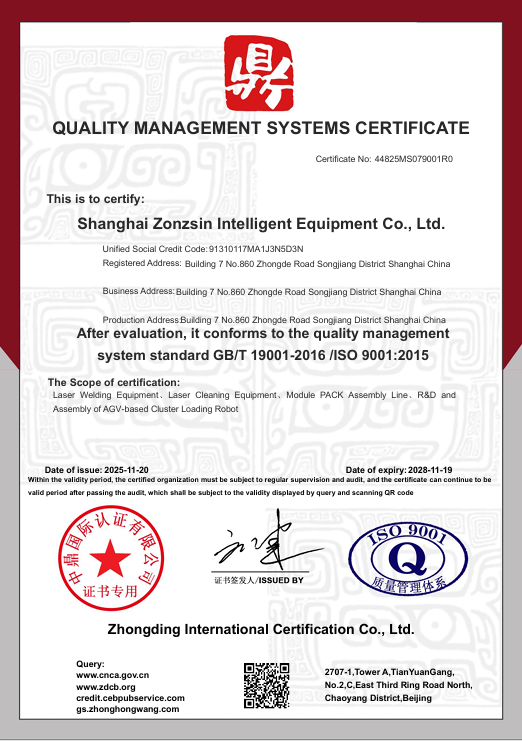
Load capacity for the ZZX2508 is not stated in the referenced specification and is therefore not listed here. Zonzsin's quality management system is certified to ISO 9001:2015 (certificate 44825MS079001R0, issued 20 November 2025, valid until 19 November 2028, issued by ZDCB), with a scope covering module PACK assembly lines and the R&D and assembly of the AGV-based cluster loading robot.
Frequently Asked Questions
1. What compliance requirements affect ESS container handling equipment in North America and the EU?
Energy Storage Systems must comply with UL 9540 for North American market access; the standard covers the safety of enclosures and moving parts. In the EU, BESS containers require CE marking under Regulation (EU) 2023/1542, which includes compliance with the Low Voltage Directive and the Machinery Directive for automated handling equipment. Because these requirements attach to the installed system rather than the robot alone, the compliant configuration is normally confirmed with the system integrator or the end user's authority before the equipment specification is frozen. Zonzsin supports this process with an ISO 9001:2015 certified quality management system (certificate 44825MS079001R0, issued 20 November 2025, valid until 19 November 2028).
2. Can one platform cover both an outdoor container pad and an indoor hall?
The crawler-driven ZZX2522 is designed for all-terrain working floors and has been used in indoor and outdoor container projects, including sites with complicated or uneven ground. It offers a hoisting range of 0.8–3.4 m (customizable), a load capacity of 1500 kg, and manual handwheel leveling so it can be levelled on uneven surfaces before a cycle. A published Taiwan deployment used this platform for ESS battery PACK insertion into and removal from containers with both indoor and outdoor use confirmed. If the project stays indoors on a controlled floor and needs the machine to travel between container positions, the AGV-driven RD16 is the more suitable architecture instead.
3. What drives the budget, and what are the commercial terms?
The main cost drivers are the platform architecture, the amount of site work it requires — for example civil work for a ground rail on a fixed line — the travel envelope and utilities available, and the depth of customization. Zonzsin customizes cycle time, automation level, logo, color and configuration under OEM / ODM production. Commercial terms are an MOQ of 1 unit, delivery terms of EXW Shanghai, FOB Shanghai or FCA Shanghai, and payment terms of 50% advance payment by T/T with the 50% balance payable by T/T within 3 business days after the BL date. Because a rail-fixed line and a crawler-driven platform consume different amounts of site preparation, the platform decision should be made before the budget is finalized rather than after.
4. How is the equipment validated before shipment and commissioning?
Validation is based on 100% testing, with acceptance criteria defined as FAT (factory acceptance test) or Online FAT. Both criteria can be agreed before production starts, which is useful when the buyer's engineering team needs to verify hoisting range, gripper function or container and PACK compatibility conditions against the delivered configuration. After shipment, Zonzsin provides remote support together with on-site installation and commissioning, so the adaptation plan agreed at inquiry stage is carried through to the running line.
5. What is the lead time, and how should a project be scheduled around it?
Production lead time is 2–4 months, with a monthly capacity of 3 units and an annual output of 40 units from a 6,000 m² facility. Because customization of cycle time, automation, configuration, color or logo is available at an MOQ of 1 unit, the practical scheduling rule is to freeze the platform decision after the site survey and then allow the quoted lead time for build, 100% testing and FAT before site preparation is scheduled to finish. Projects that plan the floor or rail work in parallel with the build window generally reach commissioning with fewer surprises. The full model range and specifications are available in the Zonzsin product brochure.
Conclusion: Adapt the Deployment, Not Just the Purchase
All-terrain outdoor pads and indoor container halls demand different adaptations of the same insertion task. The crawler-driven ZZX2522 answers uneven and mixed indoor/outdoor floors through all-terrain capability, manual handwheel leveling and a 0.8–3.4 m customizable hoisting range. The AGV-driven RD16 answers indoor halls with changing layouts through a 3100 × 2600 × 3800 mm platform compatible with 280/314/587 Ah cells and 1P52S / 1P104S PACKs. The rail-fixed ZZX2508 and ZZX2524 answer fixed container lines, with defined container and PACK envelopes, a ≥150° door opening angle, 1500 kg load capacity on the ZZX2524, and double-layer racks where floor space is tight.
The selection sequence is the same in every project: survey the floor, measure the space envelope, confirm hoisting range against the rack stack, verify the container and PACK envelope, then confirm utilities and container positioning repeatability. Platforms that match those five answers are the ones that reach stable operation — as demonstrated by the fixed line in China, the outdoor installation in South Korea, and the indoor/outdoor project in Taiwan.
Next Step: Match a Platform to Your Site
Send the five site survey numbers — insertion height range, container dimensions and door angle, PACK dimensions, available travel envelope and floor condition — and Zonzsin will indicate which of the ZZX2522, RD16, ZZX2508 or ZZX2524 fits, what customization is required, and what site preparation the project needs.
Email: katty.liu@zonzsin.com · Tel / WhatsApp: +86 134-8282-9368 · Website: www.zonzsin.com · Download the product brochure.
Have Questions or Need More Details?
Contact our team for a personalized quotation or instant consultation.
Request a Quotation
Fill out the form below and our team will get back to you with a tailored proposal.
WhatsApp Direct Chat
Prefer to chat in real-time? Message us on WhatsApp for instant assistance & quick answers.
- Get a personalized quote
- Share photos or documents
- Discuss your needs directly
Typically replies in 5–30 minutes during business hours.