
ESS Battery Pack Insertion Robot: After-Sales and Acceptance FAQ
A long-term ESS battery pack insertion robot partnership is decided at acceptance, not at signature. The questions that determine whether a container assembly line keeps running for years are about verified specifications, model coverage, gripper and rack changes, and who answers when a process drifts.
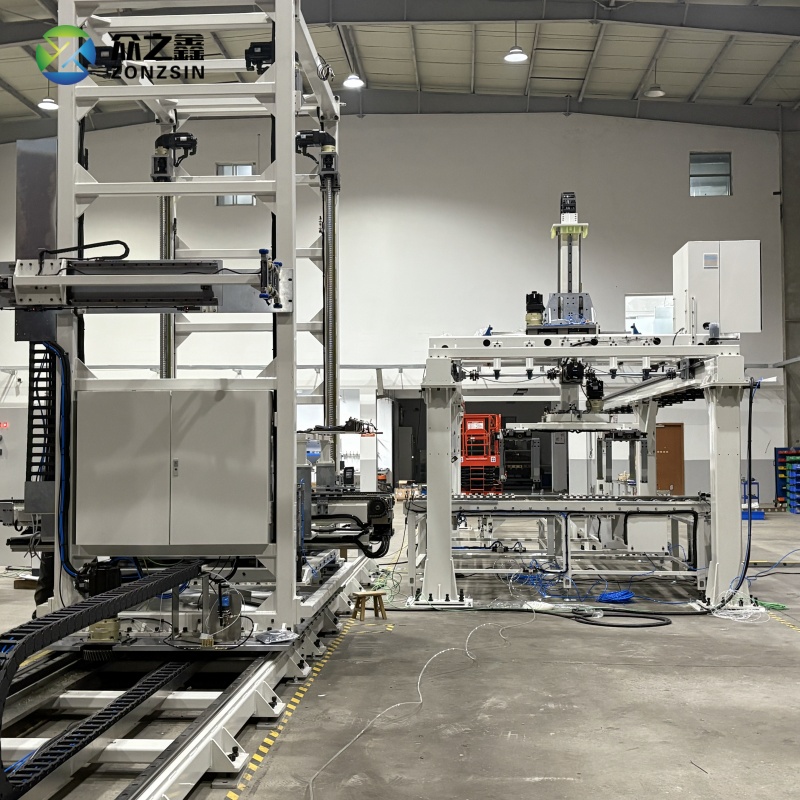
Shanghai Zonzsin Intelligent Equipment Co., Ltd. (Zonzsin) is a Shanghai-based manufacturer established in 2019 that builds intelligent battery PACK assembly lines and ESS Battery Pack Insertion Robots for Containers for lithium battery manufacturers, energy storage integrators and automotive OEMs. The company operates a 6,000 m² manufacturing facility with approximately 90 employees, an annual production capacity of 40 units, an R&D team of 43 engineers and 50 granted patents, and exports roughly 60% of its production, primarily to Southeast Asia and the EU.
The four platforms discussed in this FAQ are ZZX2508, ZZX2524, ZZX2522 and RD16. Each is quoted and serviced as a configured system rather than a catalogue item, which is why the questions below focus on acceptance terms and after-sales scope instead of headline specifications alone.
The Problem: Support Gaps Appear Long After the Purchase Order
Container-based energy storage lines place unusual demands on the insertion equipment. Battery PACKs are handled in the 1,500 kg class on some models, the container door opening limits access, and rack positions inside a 20ft or similar ISO container must be reached repeatedly without damaging the PACK enclosure. When a robot is bought purely on price and delivery date, three support gaps typically surface later:
Specification drift. The container and PACK envelope used for the quotation is not the envelope used in mass production. A rail-fixed robot sized for one container length and one PACK length becomes a constraint once a second PACK format is added to the line.
Single-platform dependency. Rail-fixed, AGV-driven and crawler-driven systems solve different site problems. A line that standardises on one drive type can find itself unable to serve an outdoor pre-assembly yard or a second building with a different floor condition.
Undefined acceptance. Load capacity, door opening angle, gripper changeover time and hoisting speed are only meaningful if they are written into the acceptance criteria before the machine is installed. Without agreed numbers, after-sales conversations start with a disagreement rather than a fix.
Industry Background: Why Container ESS Lines Need Model-Level Support Commitments
ESS container assembly sits between battery manufacturing and project delivery. The container arrives as an ISO steel shell, the racks are installed inside, and the PACKs are inserted into those racks before electrical integration and testing. The robot therefore has to satisfy three interfaces at once: the container opening, the rack geometry and the PACK itself.
Drive architecture determines the site work that follows. Rail-fixed insertion robots require a ground-level rail installation and deliver the most stable handling path for a dedicated line. AGV-driven systems move the PACK to the container on a level factory floor and reduce fixed infrastructure. Crawler-driven systems are specified for all-terrain working floors, which matters when container preparation happens outside a finished factory bay. Zonzsin's own comparison of AGV-driven, rail-fixed and crawler-driven platforms follows this same logic: mobility versus stability versus site tolerance.
Production reality adds a second layer. Container energy storage projects referenced in Zonzsin's application data span China, France, South Korea, Sweden, Taiwan and the United States, and the working environments include all-terrain floors, a 20–30 °C temperature range, and continuous or shift-based production. For buyers in export markets — the reason roughly 60% of Zonzsin's output ships to Southeast Asia and the EU — the regulatory context also matters: Regulation (EU) 2023/1542 is the legal framework governing batteries and battery-containing equipment placed on the EU market, and equipment suppliers are expected to support the documentation that framework implies.
Finally, mixed PACK sizes are normal, not exceptional. A line that starts with one PACK format frequently adds a second within the equipment's service life. Gripper changeover time and fixture adaptation are therefore after-sales topics, not just engineering details.
The Solution: What Zonzsin's Insertion Robot Line Covers
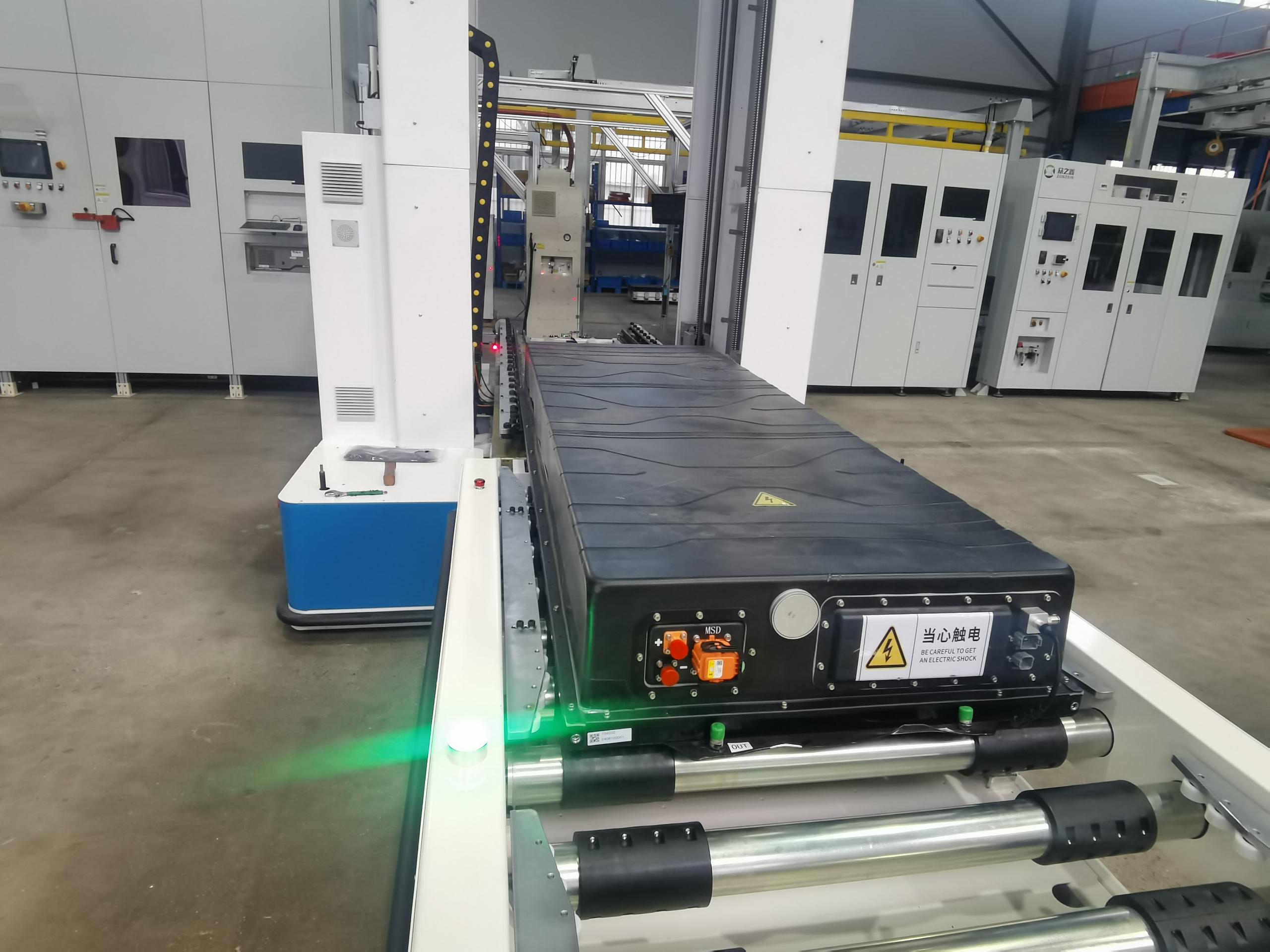
Zonzsin builds four models for container PACK insertion, all intended for the energy storage and C&I segments. Each model is defined by drive type, container and PACK compatibility, and handling specification — and each carries a different service profile because of how it is installed.
ZZX2508 — rail-fixed, for sized container and PACK envelopes
The ZZX2508 is a rail-fixed battery PACK insertion robot built from carbon steel / Q235. Its defining characteristic is a published compatibility envelope rather than a single fixed size: compatible containers measure 6,058–7,000 mm in length, 2,438–2,700 mm in width and 2,896–3,000 mm in height, while compatible PACKs measure 1,100–2,200 mm in length, 780–1,260 mm in width and 230–260 mm in height. Site services are specified as compressed air at 0.5–0.8 MPa and a power supply of AC380V ±10%, 50 ±2 Hz. The door opening angle is at least 150°.
For a partnership discussion, the ZZX2508 envelope is the first thing to verify: if the production PACK dimensions fall outside 1,100–2,200 mm by 780–1,260 mm by 230–260 mm, the model selection has to be revisited before the order, not after commissioning.
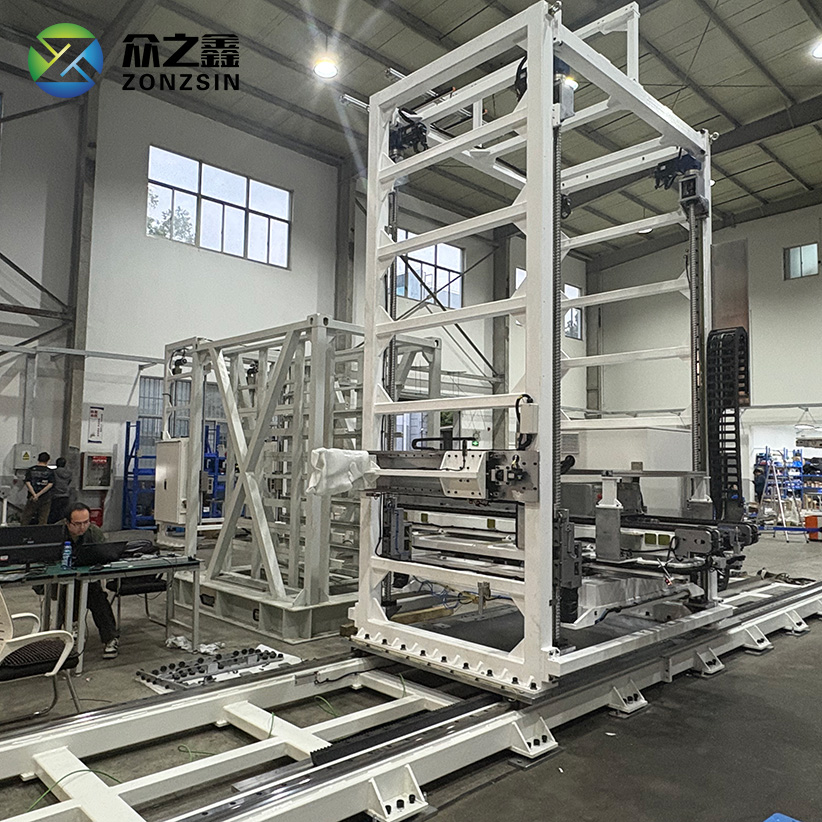
ZZX2524 — rail-fixed, load and changeover oriented
The ZZX2524 is a rail-fixed battery PACK insertion robot constructed from carbon steel / Q235 with a 1,500 kg load capacity, a door open angle of at least 150°, and a gripper changeover time of under one minute. Space saving is achieved through double-layer racks, which raises the number of PACK positions served per container footprint.
The sub-one-minute gripper changeover is the parameter that most directly affects long-term operating cost on a mixed line: it turns a format change into a short interruption rather than a shift-level stoppage. The 1,500 kg load capacity sets the upper bound for the PACKs the system is designed to handle.
ZZX2522 — crawler-driven, for all-terrain container sites
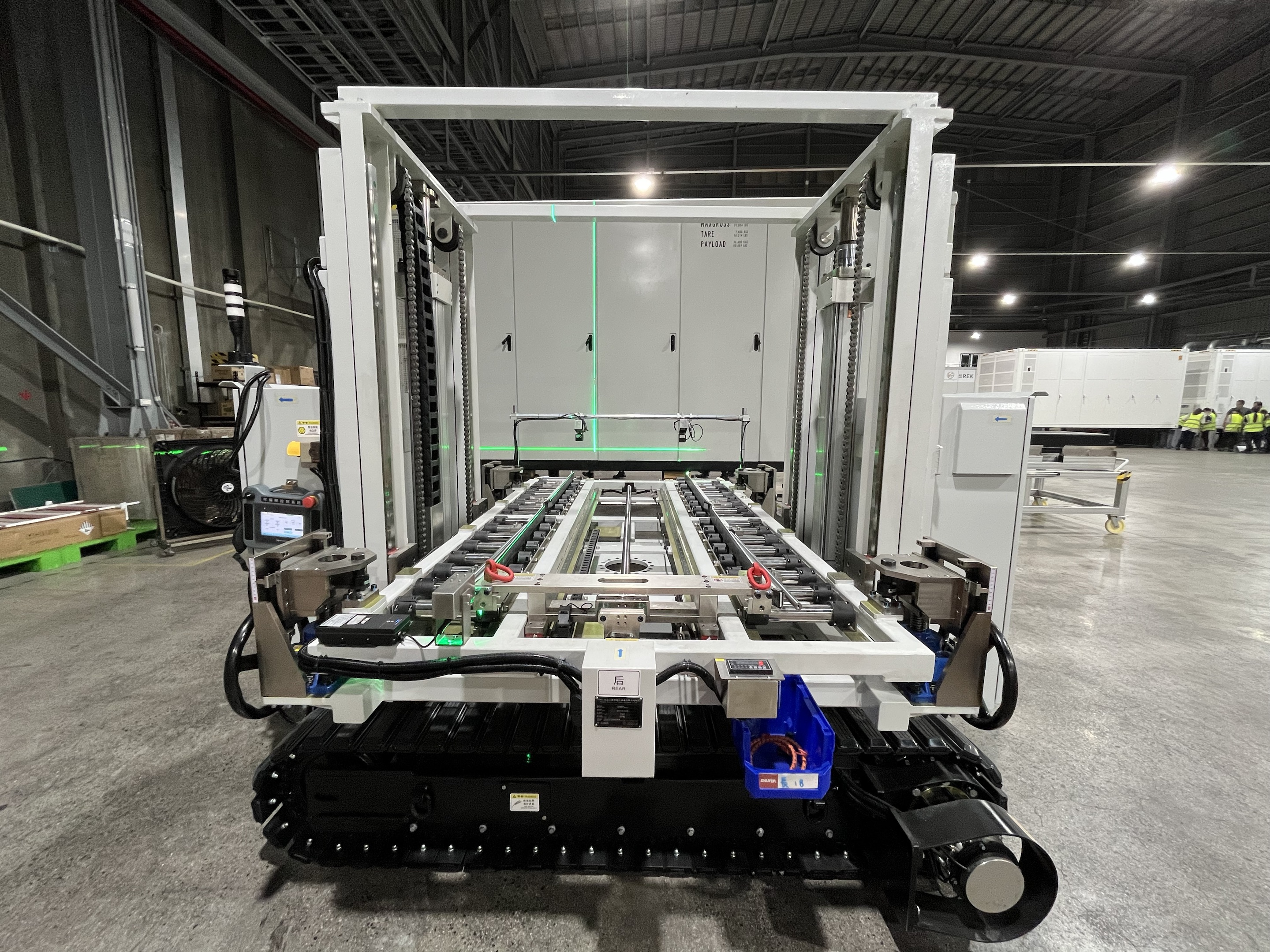
The ZZX2522 is a crawler-driven battery PACK insertion and removal robot for the energy storage and C&I industry. It works on all-terrain floors, carries a 1,500 kg load capacity, offers a hoisting range of 0.8–3.4 m on a customizable basis, and uses manual handwheel leveling. The steel construction is specified as Q235.
Because the unit is not tied to a fixed rail, it is the practical option where container preparation happens outdoors, on mixed surfaces, or across more than one bay. The manual handwheel leveling function is a deliberate trade-off: it keeps the machine usable on uneven ground without adding an automated leveling system.
RD16 — AGV-driven, for cell and PACK-format flexibility
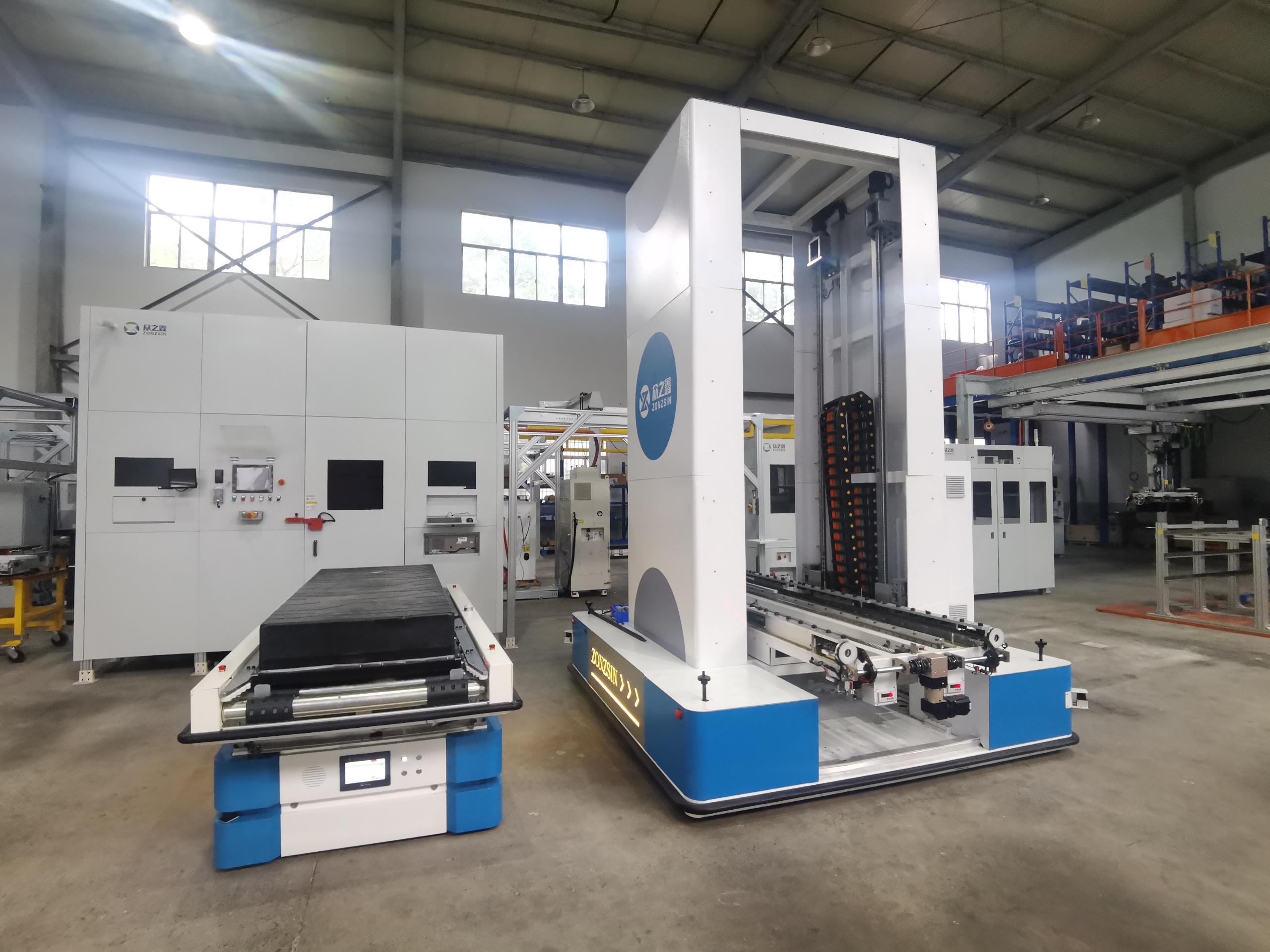
The RD16 is an AGV-driven battery PACK insertion robot for containers, built for C&I energy storage applications. Overall dimensions are 3,100 × 2,600 × 3,800 mm and the structure is carbon steel. It is compatible with 280/314/587 Ah cells and 1P52S/1P104S PACKs, offers a hoisting range of 1.05–3.4 m on a customizable basis, and hoists at 100 mm/s.
The RD16 is the model in the range with an explicitly published cell-format and PACK-configuration compatibility list. For teams planning a multi-year program across several ESS product generations, that list is the most useful starting point for a capability conversation, because it shows which PACK architectures the platform is already specified against.
Engineering and customization behind the line
All four models come from the same engineering organisation. Zonzsin states an R&D team of 43 engineers and 50 granted patents, including invention patents covering AGV-driven battery PACK insertion robots, and describes customized solutions as a core capability rather than an exception. In practice this is what allows hoisting ranges to be customized, grippers and fixtures to be adapted to a specific PACK, and the insertion sequence to be matched to a line's PLC and MES environment.
Mapping After-Sales Support to the Robot Model
After-sales scope is not uniform across the range, because the failure modes and adjustment points differ by drive type. The table below maps the practical support topics to each platform.
| Model | Primary after-sales focus | Why it belongs to this model |
|---|---|---|
| ZZX2508 (rail-fixed) | Container and PACK envelope re-verification; rail alignment; air and power supply checks | Compatibility is defined by dimension ranges (container 6,058–7,000 × 2,438–2,700 × 2,896–3,000 mm; PACK 1,100–2,200 × 780–1,260 × 230–260 mm) plus 0.5–0.8 MPa air and AC380V ±10%, 50 ±2 Hz power. |
| ZZX2524 (rail-fixed) | Gripper changeover routine; load handling up to 1,500 kg; double-layer rack positioning | The model is specified around a 1,500 kg load capacity, a sub-one-minute gripper changeover and double-layer rack space saving. |
| ZZX2522 (crawler-driven) | All-terrain operation; hoisting range adjustment; handwheel leveling practice | Designed for all-terrain floors with a 0.8–3.4 m customizable hoisting range, 1,500 kg load capacity and manual handwheel leveling. |
| RD16 (AGV-driven) | Cell and PACK-format compatibility; hoisting speed parameters; AGV route and docking practice | Specified for 280/314/587 Ah cells and 1P52S/1P104S PACKs, with a 1.05–3.4 m customizable hoisting range and 100 mm/s hoisting speed. |
Step-by-Step: From Inquiry to a Supported Long-Term Program
The sequence below reflects how a container ESS line is actually specified, accepted and then supported. Each step produces a document that later becomes the reference point for an after-sales request.
- Fix the container and PACK envelope. Record container length, width and height and PACK length, width and height, then compare them against the published ZZX2508 ranges. Any format outside those ranges triggers a customization conversation before model selection.
- Select the drive platform. Choose rail-fixed where a dedicated line and ground rail installation are acceptable, AGV-driven where the PACK must travel to the container on a level floor, and crawler-driven where the working floor is all-terrain.
- Confirm site services and integration points. Verify compressed air at 0.5–0.8 MPa and power at AC380V ±10%, 50 ±2 Hz where ZZX2508-class equipment is used, and review the matched equipment set — container, docking roller, gripper, transfer AGV, working desk, material rack, platform ladder, PLC and MES.
- Agree the acceptance criteria in numbers. Write the applicable figures into the acceptance sheet: 1,500 kg load capacity (ZZX2524, ZZX2522), 100 mm/s hoisting speed (RD16), gripper changeover under one minute (ZZX2524), door open angle of at least 150° (ZZX2508, ZZX2524), and the customized hoisting range for the model ordered.
- Define the operating modes and training scope. Zonzsin equipment supports manual and remote controller operation. Agree which mode the line will run in during ramp-up and who is trained on changeover and leveling.
- Set the environmental and safety conditions. Confirm ESD protection, fire prevention measures, and temperature, humidity and cleanliness control on site, and document the PACK compatibility and fixture adaptations agreed for the line.
- Establish the after-sales route and spares plan. Confirm the named contact, the escalation path and the format for technical questions, and attach the product brochure and model datasheet to the handover file so that service requests reference the same specifications used at acceptance.
Use Cases: Which Platform Fits Which Container Line
Dedicated 20ft-class container rack line. A single container format and one or two PACK formats, run in continuous or shift production. The ZZX2508 rail-fixed platform is the direct fit, provided the container measures within 6,058–7,000 mm long, 2,438–2,700 mm wide and 2,896–3,000 mm high, and the PACKs fall within 1,100–2,200 × 780–1,260 × 230–260 mm.
High-density rack lines with frequent format changes. Where double-layer racks increase positions per container and PACK formats rotate, the ZZX2524 keeps reconfiguration inside the cycle: gripper changeover stays under one minute and the 1,500 kg load capacity covers heavier PACK assemblies.
Outdoor or mixed-surface container preparation. When containers are prepared outside a finished bay or across uneven ground, the ZZX2522 is specified for all-terrain working floors with a 0.8–3.4 m customizable hoisting range, manual handwheel leveling and 1,500 kg load capacity.
Multi-generation product roadmaps. For teams planning several ESS product generations on one floor, the RD16 covers 280/314/587 Ah cells and 1P52S/1P104S PACKs, hoists at 100 mm/s within a 1.05–3.4 m customizable range, and operates as an AGV-driven unit rather than a fixed installation.
Comparison Table: ZZX2508, ZZX2524, ZZX2522 and RD16
| Specification | ZZX2508 | ZZX2524 | ZZX2522 | RD16 |
|---|---|---|---|---|
| Drive type | Rail-fixed | Rail-fixed | Crawler-driven | AGV-driven |
| Function | PACK insertion | PACK insertion | PACK insertion and removal | PACK insertion |
| Load capacity | Not stated for this model | 1,500 kg | 1,500 kg | Not stated for this model |
| Hoisting range | Not stated for this model | Not stated for this model | 0.8–3.4 m (customize) | 1.05–3.4 m (customize) |
| Hoisting speed | Not stated for this model | Not stated for this model | Not stated for this model | 100 mm/s |
| Door open angle | ≥150° | ≥150° | Not stated for this model | Not stated for this model |
| Gripper changeover | Not stated for this model | <1 min | Not stated for this model | Not stated for this model |
| Container compatibility | L 6,058–7,000 mm; W 2,438–2,700 mm; H 2,896–3,000 mm | Not stated for this model | Not stated for this model | Not stated for this model |
| PACK compatibility | L 1,100–2,200 mm; W 780–1,260 mm; H 230–260 mm | Not stated for this model | Not stated for this model | 280/314/587 Ah cells; 1P52S/1P104S PACKs |
| Power / air supply | AC380V ±10%, 50 ±2 Hz; air 0.5–0.8 MPa | Not stated for this model | Not stated for this model | Not stated for this model |
| Working floor | Fixed rail installation | Fixed rail installation | All-terrain; manual handwheel leveling | Level floor for AGV travel |
| Material | Carbon steel / Q235 | Carbon steel / Q235 | Q235 steel | Carbon steel |
| Space saving feature | — | Double-layer racks | — | — |
FAQ: Long-Term Partnership and After-Sales Questions
1. What site, power and regulatory requirements should be confirmed before signing a long-term robot partnership?
Confirm four things in writing. First, the container and PACK envelope against the published ranges — for ZZX2508 that means containers of 6,058–7,000 mm length, 2,438–2,700 mm width and 2,896–3,000 mm height, and PACKs of 1,100–2,200 mm length, 780–1,260 mm width and 230–260 mm height. Second, site services: compressed air at 0.5–0.8 MPa and power at AC380V ±10%, 50 ±2 Hz. Third, environmental and safety conditions, including ESD protection, fire prevention measures, and temperature, humidity and cleanliness control. Fourth, the market-access framework: Regulation (EU) 2023/1542 is the legal framework for batteries and battery-containing equipment placed on the EU market, so documentation expectations should be agreed with the supplier rather than assumed. Specifications should be verified against the manufacturer's own documentation, not reseller listings.
2. Can the insertion robot be customized to our PACK format and container geometry?
Customization is a stated capability rather than an add-on. Zonzsin works with an R&D team of 43 engineers and holds 50 granted patents, including invention patents covering AGV-driven battery PACK insertion robots. In the published specifications, customization appears concretely in the hoisting range: 1.05–3.4 m for the RD16 and 0.8–3.4 m for the ZZX2522 are both marked as customizable. Gripper and fixture adaptation to a specific PACK is part of the same scope, and the matched equipment set — gripper, docking roller, transfer AGV, material rack, platform ladder, PLC and MES — is where integration is confirmed. For a multi-year program, the practical step is to submit the PACK drawing and container drawing together so that both the compatibility envelope and the customization scope are answered in one response.
3. What cost factors should be planned for beyond the unit price of the robot?
Price is quoted per configuration, but the cost structure follows a predictable logic. Drive type is the first factor: a rail-fixed system such as ZZX2508 or ZZX2524 requires a ground rail installation, while an AGV-driven RD16 or a crawler-driven ZZX2522 removes that civil work but changes site requirements in other ways. Rack design is the second: double-layer racks on the ZZX2524 increase positions per container footprint. Gripper and fixture adaptation is the third, and it scales with the number of PACK formats on the line — which is why the sub-one-minute gripper changeover on the ZZX2524 has a long-term cost effect. Site services, training and spares planning form the fourth. Zonzsin quotes against the confirmed container and PACK envelope rather than a generic specification, so the fastest route to a budget figure is a request for quotation that includes both drawings.
4. How can we validate fit before committing to a long-term agreement?
Validation starts with the numbers already published. Match the container and PACK against the ZZX2508 ranges, match the PACK architecture against the RD16 compatibility list of 280/314/587 Ah cells and 1P52S/1P104S PACKs, and match the load class against the 1,500 kg capacity stated for the ZZX2524 and ZZX2522. Where a format falls outside a published range, the customization discussion begins from that gap rather than from a new specification. Two documents make the review efficient: the model datasheet set and the product brochure, which can be downloaded here — Zonzsin product brochure (PDF).
5. What lead-time and capacity factors matter when planning long-term supply?
Zonzsin operates a 6,000 m² manufacturing facility with approximately 90 employees and an annual production capacity of 40 units, which is the figure that should anchor long-term scheduling: capacity is finite and shared across models, so a multi-unit program is planned as a sequence rather than as a single delivery. Roughly 60% of production is exported, primarily to Southeast Asia and the EU, so export documentation and destination requirements should be confirmed at the planning stage. To start a partnership or service conversation, contact Katty.liu at katty.liu@zonzsin.com or +86 134-8282-9368 (also available on WhatsApp), or review the range at www.zonzsin.com.
Conclusion: Buy the Acceptance Criteria, Then the Robot
A long-term ESS battery pack insertion robot partnership holds up when the acceptance document and the after-sales route are agreed before installation. The specification set is short and verifiable: 1,500 kg load capacity on ZZX2524 and ZZX2522, 100 mm/s hoisting speed on RD16, gripper changeover under one minute on ZZX2524, door open angle of at least 150° on ZZX2508 and ZZX2524, Q235 carbon steel construction, and published container and PACK ranges for ZZX2508. The partnership set is equally concrete: a team of 43 engineers, 50 granted patents, customization of hoisting range and fixtures, and a manufacturing base with 40 units of annual capacity.
Where a specification is not published for a model, it should be confirmed in writing rather than inferred. That single discipline prevents most of the disputes that surface after commissioning, and it is what turns an equipment purchase in the container energy storage segment into a supportable, multi-year program.
Next Step: Request a Configuration Review
Send your container drawing and PACK drawing to Zonzsin and request a configuration review covering drive type, compatibility envelope, gripper and fixture adaptation, and acceptance criteria for the model proposed.
- Contact: Katty.liu
- Email: katty.liu@zonzsin.com
- Tel / WhatsApp: +86 134-8282-9368
- Website: www.zonzsin.com
- Address: Building 22, No.2199, Shebei Highway, Sheshan Town, Songjiang District, Shanghai, China
- Product brochure: Download PDF
Have Questions or Need More Details?
Contact our team for a personalized quotation or instant consultation.
Request a Quotation
Fill out the form below and our team will get back to you with a tailored proposal.
WhatsApp Direct Chat
Prefer to chat in real-time? Message us on WhatsApp for instant assistance & quick answers.
- Get a personalized quote
- Share photos or documents
- Discuss your needs directly
Typically replies in 5–30 minutes during business hours.