
ESS Battery Pack Insertion Robot Compliance by Region: Container, PACK, and Power Spec Checklist
An ESS battery pack insertion robot is compliant with a site when four gates line up: the container envelope, the PACK envelope, the power and compressed-air supply, and the documentation package the buyer must be able to show in the destination market. Miss any one of them and the machine may still be a good machine — it simply will not fit, will not be accepted, or will not clear customs and commissioning on schedule.
This checklist is written for energy storage system integrators, battery cell and PACK manufacturers, and EPC turnkey contractors who are past shortlisting and into execution. It uses published Zonzsin model specifications and the questions buyers should put to any supplier of container-loading equipment. It deliberately does not assert certificates that are not documented: the only third-party certificate Zonzsin publishes is an ISO 9001 quality management system certificate, and every market-specific document discussed below should be requested per order and written into the contract rather than assumed.
Zonzsin — Shanghai Zonzsin Intelligent Equipment Co., Ltd., founded in 2019 — manufactures ESS battery pack insertion robots for containers and automatic battery pack assembly lines, holds 50 granted patents including invention patents for AGV-driven battery PACK insertion robots, and reports that roughly 60% of production is exported, primarily to Southeast Asia and the EU. The company describes its equipment as delivered to customers in Europe, the USA, Japan, South Korea and India.
The four gates at a glance
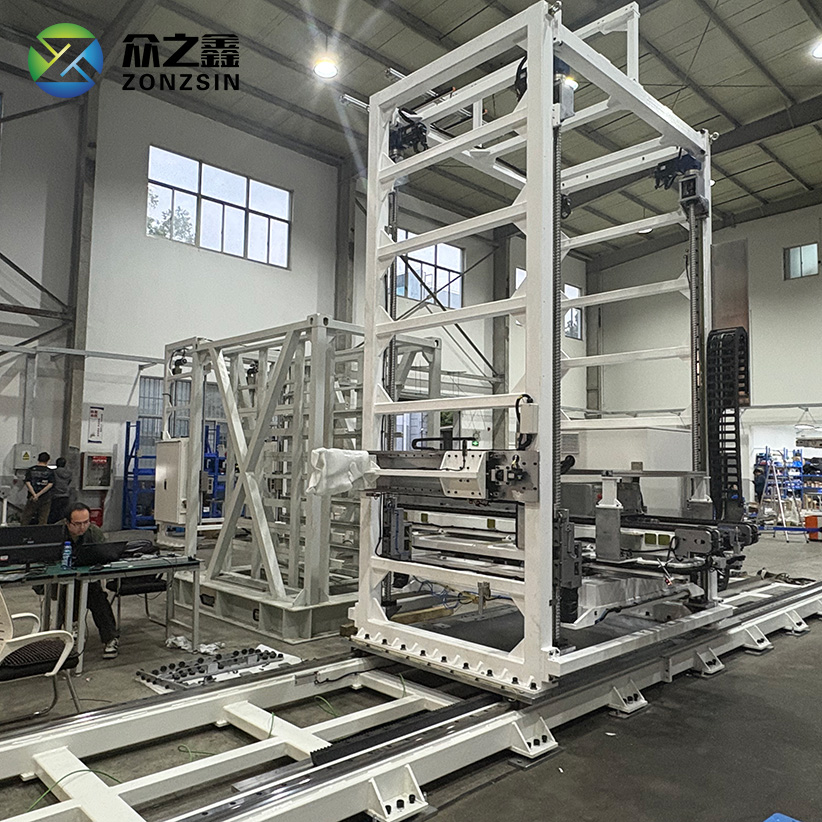
- Container gate: published compatibility covers containers 6058–7000 mm long, 2438–2700 mm wide and 2896–3000 mm high, with a door opening angle of at least 150°.
- PACK gate: published compatibility covers PACKs 1100–2200 mm long, 780–1260 mm wide and 230–260 mm high on the rail-fixed platform.
- Handling gate: 1,500 kg load capacity, gripper changeover under 1 minute, hoisting speed 100 mm/s on the AGV-driven model.
- Power gate: AC380V±10%, 50±2 Hz and compressed air 0.5–0.8 MPa on the rail-fixed platform.
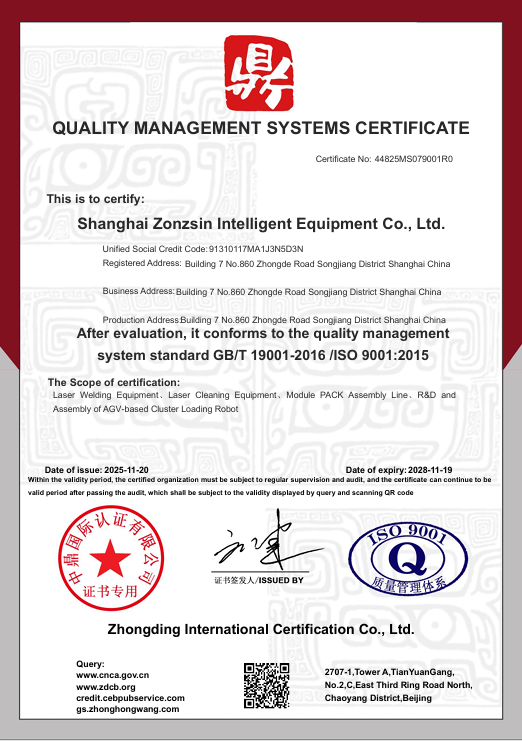
- Documentation gate: start from ISO 9001 certificate 44825MS079001R0, then request market documents per order.
Problem Definition: why “compliant” means four different things in an insertion robot RFQ
Most insertion-robot inquiries answer one gate and imply the other three. A buyer sends a container size, a PACK drawing and a target output; the supplier quotes a model; both sides later discover that the answers were given to different questions. In practice, the word “compliance” is used for four separate checks that fail in four different ways.
- Mechanical fit. The container and the PACK must fall inside the published envelope, and the container door must be able to open far enough for the machine to present a PACK to the rack.
- Handling envelope. Rated load, gripper changeover time, hoisting range and hoisting speed determine whether the specified throughput is physically achievable on that rack layout.
- Site services. Supply voltage, frequency and compressed-air pressure are equipment preconditions, not installation details to be solved on site.
- Market documentation. The paperwork the buyer must hold in the destination market is a separate deliverable from the machine itself.
“A 20ft container” is not a specification
The rail-fixed ZZX2508 is published as compatible with containers from 6058 to 7000 mm in length, 2438 to 2700 mm in width and 2896 to 3000 mm in height. That range exists because containerized energy storage has moved away from a single nominal size: extended-length units, high-cube heights and insulation build-ups all shift the internal envelope. The machine is engineered around a range, so the buyer has to state actual internal dimensions, door clear opening, hinge side and yard clearance — and confirm that the door can swing to at least 150°, which is the published requirement for the rail-fixed platform.
Numbers drift between listings and datasheets
A second failure mode is quieter. Third-party marketplace listings for the same product family can carry rated values that differ from the manufacturer's own specification, because listings are often republished from older catalogs. When a reseller figure and a manufacturer figure disagree, only one of them can govern acceptance testing. The practical rule is to contract against the signed datasheet and the interface drawing, and to treat any listing — including a favorable one — as marketing, not as an acceptance criterion.
Industry Background: what changed in containerized ESS assembly
Containerized battery energy storage has become a standard delivery format for utility and commercial projects, and the assembly step that decides line throughput is the insertion of heavy PACKs into container racks. Two shifts have made that step harder to specify generically.
PACK formats multiplied. The AGV-driven RD16 is specified for 280/314/587 Ah cells and 1P52S/1P104S PACKs, which is a compact illustration of how cell format choices propagate into physical PACK length, width and height. On the rail-fixed side, the published PACK compatibility window of 1100–2200 mm in length already spans roughly a factor of two.
Drive architecture became a site decision, not a preference. The category now segments into rail-fixed, AGV-driven and crawler-driven platforms. Rail-fixed units rely on a stable, fixed ground rail for safe working and continuous insertion. AGV-driven units trade that fixed rail for mobility on level floors. Crawler-driven units address complicated working floors, including outdoor and all-terrain sites, with manual handwheel leveling used to compensate for ground variation. Industry reporting such as the PMMI / Interact Analysis Robotics in US Packaging & Processing Report 2026 tracks mobile robot adoption in industrial contexts, which is the same technology family behind AGV-driven insertion platforms.
Documentation pressure rose with export share. With roughly 60% of Zonzsin production exported and Southeast Asia and the EU named as primary markets, the documentation set has become a commercial requirement rather than an afterthought. The company's ISO 9001 certificate (number 44825MS079001R0, issued by ZDCB against GB/T 19001-2016 / ISO 9001:2015, valid 20 November 2025 to 19 November 2028) covers laser welding equipment, laser cleaning equipment, module PACK assembly lines, and the R&D and assembly of AGV-based cluster loading robots. That scope matters for procurement because it explicitly names the AGV loading robot on the certificate — it supports the quality-management question. It is not a product certification for any single market, and it should not be presented as one.
Detailed Solution: the four-gate compliance checklist
Gate 1 — Container envelope and door geometry
Measure the container the way the machine will meet it, not the way the purchase order describes it. The published ZZX2508 compatibility data gives you the acceptance window; the right-hand column is the survey the buyer must complete before signing.
| Parameter | Published value (ZZX2508, rail-fixed) | What the buyer must measure or confirm |
|---|---|---|
| Container length | 6058–7000 mm | Internal length, corner-casting intrusion, insulation thickness |
| Container width | 2438–2700 mm | Clear width between rack rails and side-wall build-up |
| Container height | 2896–3000 mm | Internal height to ceiling panel and to the highest rack level |
| Door opening angle | ≥150° | Hinge condition, door weight, obstructions, yard clearance to swing fully |
| Working floor | Fixed ground rail (rail-fixed models) | Floor flatness, rail foundation, drainage, indoor vs outdoor exposure |
Gate 2 — PACK envelope, load and changeover
The PACK gate is where most late-stage changes originate, because a cell format change at the battery side becomes a PACK dimension change at the container side. Published handling data for the Zonzsin range is specific enough to build an acceptance test around.
| Handling parameter | Published value | Model reference |
|---|---|---|
| Compatible PACK length | 1100–2200 mm | ZZX2508 |
| Compatible PACK width / height | 780–1260 mm / 230–260 mm | ZZX2508 |
| Load capacity | 1500 kg | ZZX2524, ZZX2522 |
| Gripper changeover time | < 1 min | ZZX2524 |
| Hoisting range | 1.05–3.4 m (customizable) | RD16 |
| Hoisting range | 0.8–3.4 m (customizable) | ZZX2522 |
| Hoisting speed | 100 mm/s | RD16 |
Two details belong in this gate and are usually left out. The first is the lifting interface: measure the PACK with its handles, terminals, busbar covers and any temporary shipping bracket attached, because the rated dimension window applies to the object the gripper actually takes. The second is rack geometry: the ZZX2524 is specified with double-layer racks for space saving, which changes how many distinct hoisting heights the machine must reach inside one container.
Gate 3 — Power, compressed air and motion
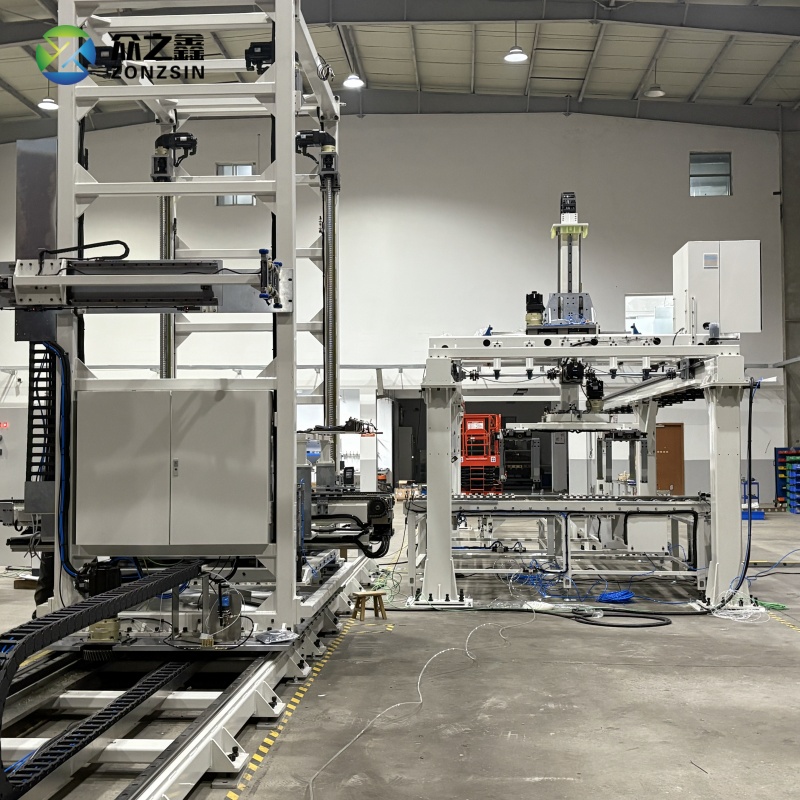
The rail-fixed platform is published with an electrical supply of AC380V±10% and 50±2 Hz, plus compressed air at 0.5–0.8 MPa. Those are operating windows, not nominal values, and both windows should be checked against the actual site rather than the country's headline voltage.
- Frequency window. “50±2 Hz” defines a narrow band around 50 Hz. If the destination grid or the site's local supply sits outside that band, the power configuration has to be reviewed before the purchase order is issued, not after the machine arrives. This is a real issue in markets where grid frequency is not uniform across regions.
- Voltage tolerance. ±10% around 380 V absorbs normal distribution variation, but not a site supplied at a materially different voltage. Where the local supply differs, the question to the supplier is which configuration is being quoted.
- Compressed air. 0.5–0.8 MPa must be available at the machine inlet, not at the compressor outlet. Dryer performance, hose length and header pressure drop belong in the survey.
- Published silence is a question. The public specifications for the RD16 and ZZX2522 describe hoisting range, load and drive type, but do not state an input power figure. Buyers should treat that as an explicit RFQ line item rather than assume the rail-fixed AC specification carries over.
Gate 4 — Documentation package
Documentation is the gate that most often delays commissioning, because it is requested late. The list below is ordered from what exists today to what must be produced per order.
- Management-system certificate. ISO 9001, certificate 44825MS079001R0, issued by ZDCB against GB/T 19001-2016 / ISO 9001:2015, valid 20 November 2025 to 19 November 2028, scope covering laser welding equipment, laser cleaning equipment, module PACK assembly line, and R&D and assembly of AGV-based cluster loading robot.
- Declaration of conformity for the destination market. Ask which market the declaration is written for and which standards it cites; a generic statement is not usable in an audit.
- Electrical drawings and component certificates. Panel layout, schematic, and the listing or approval evidence for the main protective and drive components actually installed.
- Risk assessment and safety-function description. What the machine does when a person enters the insertion zone, and how the interlocks are implemented.
- Interface drawing and signed datasheet. The document that governs acceptance, including container and PACK ranges, load, hoisting range, power and air.
- Acceptance and lifecycle documents. FAT or online FAT report, maintenance schedule, and spare-parts list. Zonzsin's stated after-sales model combines remote support with on-site installation and commissioning, so the commissioning report should be part of the same file.
Regional reading of the checklist: SEA, EU, USA, Japan, South Korea, India
Regulatory frameworks differ by market, and no single document set satisfies all six regions below. What changes from region to region is not the physics of the machine — the container and PACK gates stay the same — but which questions the buyer must be able to answer on paper, and which site services need advance confirmation.
| Market | Site and power questions to settle first | Documents to request per order | Platform note |
|---|---|---|---|
| Southeast Asia | Outdoor yards, uneven ground, heat and humidity; confirm supply voltage and frequency at the site | ISO 9001 certificate, declaration of conformity, FAT report, spare-parts list | Crawler-driven ZZX2522 fits complicated floors; SEA is a named primary export market |
| European Union | Indoor line layout, 380 V supply assumption, compressed-air header, floor flatness for rail or AGV | Declaration of conformity for machinery placed on the EU market, technical file, risk assessment, EMC evidence, component certificates | Rail-fixed ZZX2508 / ZZX2524 for fixed lines; Regulation (EU) 2023/1542 is the EU battery framework that project documentation is usually mapped against |
| USA | Local supply voltage and frequency differ from the published AC380V / 50 Hz window — confirm the configuration being quoted | Listing evidence for control components, electrical drawings, robot safety description, FAT / online FAT report | AGV-driven RD16 suits reconfigurable layouts; power supply is not published and must be quoted |
| Japan | Grid frequency is not uniform across regions; check the 50±2 Hz window per site before ordering | Electrical safety documentation, test reports, drawings, maintenance and spare-parts plan | Japan is named among the markets Zonzsin describes as served; confirm any market-specific certificate as an RFQ item |
| South Korea | Outdoor and uneven working floors; confirm leveling method and ground condition | Conformity documentation for the Korean market, FAT report, commissioning record | A crawler-driven unit has been deployed in South Korea for outdoor operation on uneven floors, stable over a one-year period |
| India | Dust, ambient temperature, supply stability; confirm service coverage and spares lead time | Test reports, warranty terms, installation and commissioning scope, spares list | India is named among the markets Zonzsin describes as served; verify local documentation requirements for the project |
Three practical readings follow from the table. First, the EU is the region where documentation is most likely to be audited against a named legal framework, so the declaration of conformity and technical file should be specified at quotation stage. Second, the USA, Japan and parts of Southeast Asia are the regions where the power question most often resolves into a configuration change, because the published AC380V±10%, 50±2 Hz window is a rail-fixed design point rather than a universal input. Third, South Korea, Taiwan and Southeast Asia are the regions where floor condition, not paperwork, decides the platform: the crawler-driven design exists precisely for complicated working floors, indoor and outdoor.
Step-by-Step Breakdown: running the checklist from survey to FAT
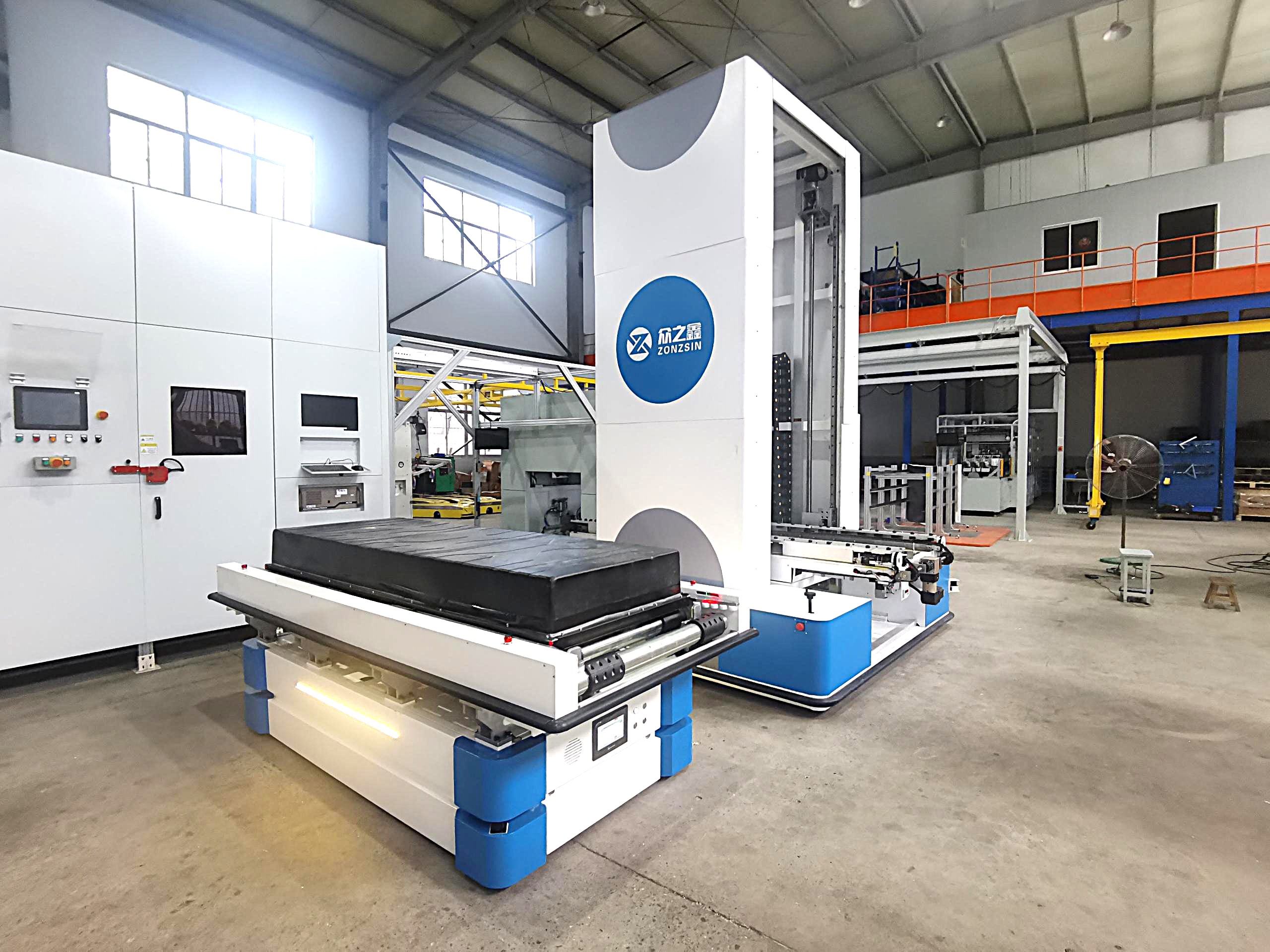
The sequence below is ordered so that each step produces a document the next step depends on. Running it out of order is what produces change orders after the machine is built.
- Survey the container. Record internal length, width and height, door clear opening, hinge side, door swing in degrees, and yard clearance. Confirm the door can reach at least 150° for rail-fixed models.
- Survey the PACK. Record length, width and height including handles and terminals, weighed mass with the lifting fixture, and the number of distinct PACK variants per shift. Check the figures against the published 1100–2200 mm × 780–1260 mm × 230–260 mm window.
- Choose the drive architecture from the floor. Fixed ground rail where the line is permanent and the floor is level; AGV where container positions change; crawler where the floor is uneven or outdoor. Note that the crawler platform uses manual handwheel leveling, which is a per-setup operator action.
- Confirm site services. Supply voltage and frequency against AC380V±10%, 50±2 Hz; compressed air at the machine inlet against 0.5–0.8 MPa; breaker rating, earthing and panel location.
- Map the market documents. Name the destination market, list the documents required there, and identify which of them the supplier must produce specifically for this order.
- Freeze the interface drawing and signed datasheet. This becomes the acceptance reference. Marketplace listings and older catalogs are superseded at this point.
- Agree acceptance criteria. Zonzsin's standard terms are acceptance by FAT or online FAT, with 50% advance by T/T and 50% balance by T/T within 3 business days after the BL date; delivery terms are EXW, FOB or FCA Shanghai.
- Plan installation and commissioning. After-sales combines remote support with on-site installation and commissioning, so the commissioning report, maintenance schedule and spare-parts list close the documentation file.
Use Cases: what the checklist looks like in practice
China — rail-fixed platform on a continuous line. A rail-fixed battery PACK insertion robot was installed for continuous PACK insertion, stable PACK loading and fully automatic insertion. Highlights of that installation are a stable, fixed ground rail for safe working, a dual-layer material rack for space utility, and versatile module options; the project ran over a two-year period. The compliance lesson is that the fixed rail converts the container gate from a repeated survey into a one-time foundation decision — which is why the door angle and rail alignment have to be right before installation.
South Korea — crawler platform on uneven outdoor ground. A crawler-driven battery PACK insertion robot was deployed for outdoor operation on uneven working floors, one unit, stable operation over a one-year implementation period. The lesson here is that the site gate outranks the paperwork gate: no documentation set compensates for a wheeled platform on a surface it cannot level on.
Taiwan — crawler platform for insertion and pull-out. A crawler-driven unit was deployed for ESS battery PACK insertion into and removal from containers, indoor and outdoor, with stable operation over a one-year period. Insertion and removal in the same scope is a useful reminder that the PACK gate has to be checked in both directions: the withdrawal path, not only the insertion path, determines whether a PACK can be serviced in the field.
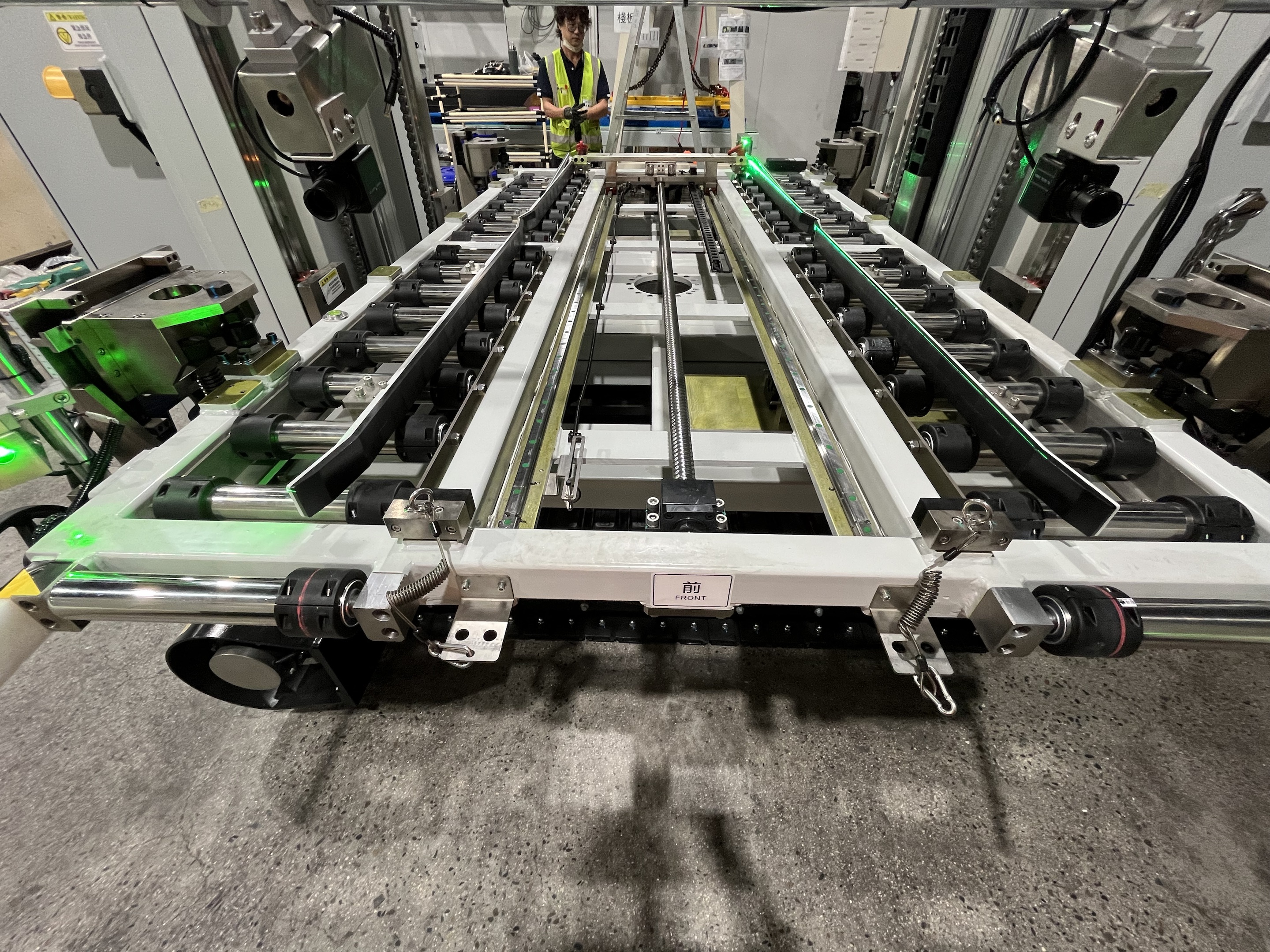
Model comparison against the checklist
| Model | Drive type | Published specifications | Documentation note |
|---|---|---|---|
| ZZX2508 | Rail-fixed | Container 6058–7000 × 2438–2700 × 2896–3000 mm; PACK 1100–2200 × 780–1260 × 230–260 mm; door ≥150°; air 0.5–0.8 MPa; AC380V±10%, 50±2 Hz; carbon steel / Q235 | Most complete published interface data in the range — the natural baseline for a first regional RFQ |
| ZZX2524 | Rail-fixed | Door ≥150°; load 1500 kg; gripper changeover < 1 min; double-layer racks for space saving; carbon steel / Q235 | Container and PACK ranges are not published for this model — request them in writing before comparing |
| RD16 | AGV-driven | L3100 × W2600 × H3800 mm; 280/314/587 Ah cells; 1P52S/1P104S PACKs; hoisting 1.05–3.4 m (customizable); hoisting speed 100 mm/s; carbon steel | Input power is not stated in the published specification — add it to the RFQ |
| ZZX2522 | Crawler-driven | Hoisting 0.8–3.4 m (customizable); all-terrain working floor; load 1500 kg; manual handwheel leveling; carton steel / Q235 | Input power is not stated in the published specification — add it to the RFQ |
The comparison is deliberately limited to published figures. Zonzsin operates OEM/ODM production with customization covering cycle time, automation level, logo, color and configuration, which means several checklist values can be re-specified per order — but a re-specified value only counts if it appears on the signed datasheet.
FAQ
Which compliance documents should we request with an ESS battery pack insertion robot?
Start with the management-system certificate: Zonzsin publishes an ISO 9001 certificate, number 44825MS079001R0, issued by ZDCB against GB/T 19001-2016 / ISO 9001:2015, valid from 20 November 2025 to 19 November 2028, with a scope covering laser welding equipment, laser cleaning equipment, module PACK assembly line, and R&D and assembly of AGV-based cluster loading robot. Then request, per destination market: a declaration of conformity for the market where the machine will be installed, electrical drawings and component certificates, a risk assessment and safety-function description, the FAT or online FAT acceptance report, and the maintenance and spare-parts list. Any market-specific product certificate should appear in the order contract rather than be assumed from a management-system certificate.
Can one insertion robot cover several container variants and PACK formats?
The rail-fixed ZZX2508 is published as compatible with containers 6058–7000 mm long, 2438–2700 mm wide and 2896–3000 mm high, and with PACKs 1100–2200 mm long, 780–1260 mm wide and 230–260 mm high — so one platform covers a family of container variants as long as the measured internal dimensions fall inside those ranges. ZZX2524 and ZZX2522 are rated at 1500 kg load, and ZZX2524 changes grippers in under one minute. The AGV-driven RD16 is specified for 280/314/587 Ah cells and 1P52S/1P104S PACKs, with a 1.05–3.4 m hoisting range at 100 mm/s.
What are the commercial terms — MOQ, delivery terms and payment?
MOQ is 1 unit. Delivery terms are EXW Shanghai, FOB Shanghai or FCA Shanghai. Payment is 50% advance by T/T and 50% balance by T/T within 3 business days after the BL date. Acceptance criteria are FAT or online FAT, and every unit is 100% tested.
How can we validate the machine before committing to a full line?
Validation runs through a documented FAT or online FAT rather than a physical sample robot, because the unit is built to the container and PACK envelope you specify. Every unit is 100% tested, OEM/ODM production covers cycle time, automation level, logo, color and configuration, and MOQ is one unit — so a single machine can serve as the reference build for a later line. Buyers moving from evaluation into execution should freeze the interface drawing and signed datasheet before FAT so that the acceptance test measures a fixed specification.
What is the lead time, and what should we send with the inquiry?
Lead time is 2–4 months, monthly capacity is 3 units and annual output is 40 units. After-sales includes remote support plus on-site installation and commissioning. To get a specification-level quotation rather than a brochure answer, send container internal dimensions with door clear opening and hinge side, the PACK drawing with weighed mass, rack levels, supply voltage and frequency, compressed-air availability at the machine inlet, destination market, and required cycle time to katty.liu@zonzsin.com or through www.zonzsin.com. The full product brochure is available here: download the Zonzsin product brochure.
Conclusion: compliance is a measured envelope, not a certificate
The regional compliance question for an ESS battery pack insertion robot resolves into four measurements and one document list. Container dimensions between 6058 and 7000 mm in length, PACK dimensions between 1100 and 2200 mm in length, a 1500 kg load rating, a door that opens at least 150°, gripper changeover under one minute, hoisting at 100 mm/s, and an AC380V±10%, 50±2 Hz supply with 0.5–0.8 MPa of air — these are the numbers that decide whether a machine can be installed. The documents either exist for your market or they do not; the way to find out is to ask for them by name at quotation stage.
Buyers who treat the published ranges as a checklist, and who contract against a signed datasheet rather than a marketplace listing, spend their engineering time on line commissioning instead of on change orders. Buyers who treat “standard 20ft container” as a specification usually spend it the other way around.
Next step: turn this checklist into a quotation
Send your container internal dimensions, PACK drawing, supply voltage and destination market, and Zonzsin will reply with a model recommendation against the published envelope, the documentation list for that market, and a delivery schedule. Lead time 2–4 months; MOQ 1 unit; OEM/ODM customization available.
Email katty.liu@zonzsin.com | Tel / WhatsApp +86 134-8282-9368 | www.zonzsin.com
Have Questions or Need More Details?
Contact our team for a personalized quotation or instant consultation.
Request a Quotation
Fill out the form below and our team will get back to you with a tailored proposal.
WhatsApp Direct Chat
Prefer to chat in real-time? Message us on WhatsApp for instant assistance & quick answers.
- Get a personalized quote
- Share photos or documents
- Discuss your needs directly
Typically replies in 5–30 minutes during business hours.