
ESS Battery Pack Insertion Robot: Complete Selection Guide
ESS Battery Pack Insertion Robot for Containers: The Complete Guide to Selection, Types & Benefits
.jpg "RD16 AGV-driven battery PACK insertion robot")
Introduction
As the global energy storage market expands rapidly, manufacturers and integrators face the critical challenge of efficiently loading heavy battery packs into ISO containers. The ESS Battery Pack Insertion Robot for Containers has emerged as a transformative solution, replacing manual labor with precise, automated handling. This guide provides an in-depth look at what these robots are, how they work, and how to choose the right type for your production line. Whether you are an energy storage integrator in Europe or a battery manufacturer in Asia, understanding the technology behind automatic battery pack insertion systems is essential for scaling your operations.
What Is an ESS Battery Pack Insertion Robot for Containers?
An ESS Battery Pack Insertion Robot for Containers is a specialized material handling system designed to automatically lift, transport, and insert heavy battery packs (typically weighing up to 1500 kg) into standard container racks for energy storage systems. These robots replace manual crane or forklift operations, offering higher precision, speed, and safety. Depending on the floor conditions and production layout, the robot can be driven by AGV (Automated Guided Vehicle), fixed on rails, or mounted on crawler tracks.
Key Functions
- Fully automated moving and PACK insertion
- Cycle time improvement (up to 20% saving compared to manual methods)
- Intelligent production line construction for batch & continuous production
- Compatibility with multiple cell formats (280/314/587Ah) and PACK configurations (1P52S/1P104S)
Industry Background & Why Automation Is Critical
The energy storage industry is shifting toward gigawatt-scale factories. Manual battery pack insertion is slow, inconsistent, and poses ergonomic risks. According to industry data, automated insertion robots can reduce manpower by 30% while improving consistency. Leading manufacturers like Shanghai Zonzsin Intelligent Equipment Co., Ltd., established in 2019, have developed a complete product line to meet this demand. Zonzsin operates a 6,000 m² facility with an annual production capacity of 40 units and a dedicated R&D team of 43 engineers. The company holds 50 granted patents, including invention patents for AGV-driven battery PACK insertion robots, and is ISO 9001 certified (certificate number 44825MS079001R0).
Types of ESS Battery Pack Insertion Robots
There are three primary types based on mobility and installation method. Each suits different operational environments.
| Type | Model | Mobility | Best Use Case | Key Specs |
|---|---|---|---|---|
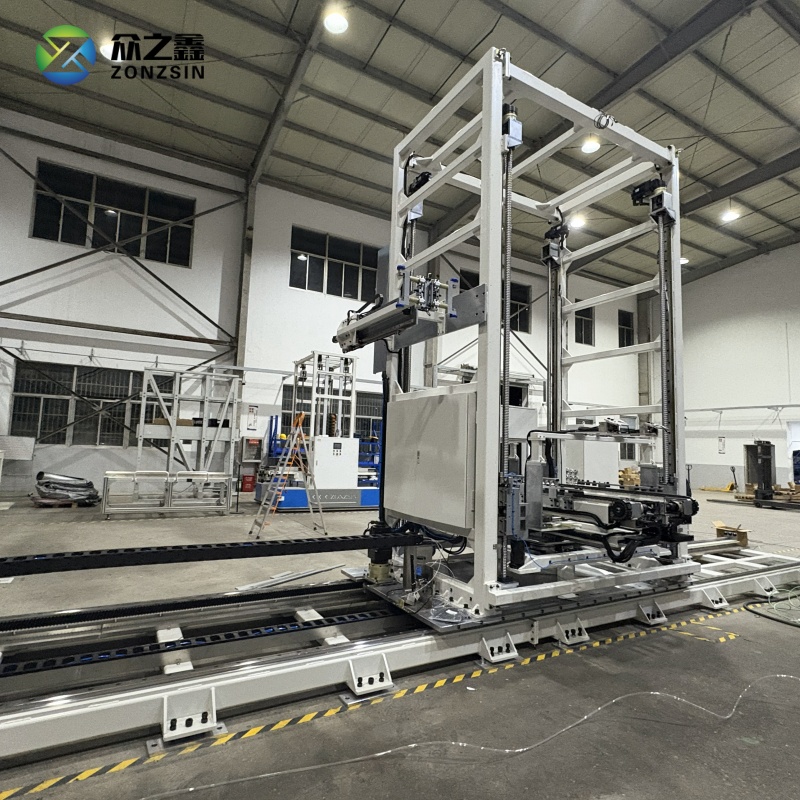
| AGV-Driven | RD16 | Autonomous navigation | Flexible factory floor; multiple container stations | Hoisting range 1.05–3.4 m; speed 100 mm/s; compatible with 280/314/587Ah cells; dimensions 3100×2600×3800 mm |
| Rail-Fixed | ZZX2508 / ZZX2524 | Fixed rail guidance | Dedicated insertion station with stable floor | Load 1500 kg; door open angle ≥150°; gripper changeover <1 min; double-layer rack (ZZX2524) |
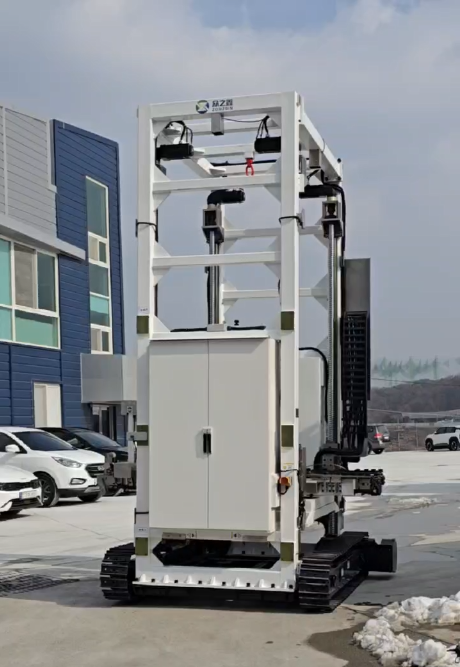
| Crawler-Driven | ZZX2522 | All-terrain tracks | Outdoor or uneven floor; outdoor maintenance | Hoisting range 0.8–3.4 m; manual handwheel leveling; load 1500 kg; all-terrain capability |
1. AGV-Driven Battery Pack Insertion Robot (RD16)
The RD16 is a fully autonomous robot that navigates via laser guidance and visual monitoring. It can move between multiple container stations without fixed infrastructure. This model is ideal for C&I energy storage factories that require flexibility. Key features: hoisting speed 100 mm/s, compatibility with 280/314/587Ah cells, and customizable hoisting range up to 3.4 m. The robot is made of carbon steel for durability.
2. Rail-Fixed Battery Pack Insertion Robot (ZZX2508 / ZZX2524)
For fixed production lines where containers arrive at a dedicated station, rail-fixed robots provide maximum stability and precision. The ZZX2524 supports double-layer racks to save floor space and has a gripper changeover time under one minute. Container dimensions compatible: length 6058–7000 mm, width 2438–2700 mm, height 2896–3000 mm. Power supply: AC380V±10%, 50±2 Hz.
3. Crawler-Driven Battery Pack Insertion & Removal Robot (ZZX2522)
When the working floor is uneven or the operation takes place outdoors, the crawler-driven robot excels. It uses manual handwheel leveling for precise alignment and can handle all-terrain environments within 20–30°C. This model is popular for repair and maintenance services where the container may be located on gravel or dirt.

How to Choose the Right ESS Battery Pack Insertion Robot
Follow this step-by-step decision framework:
- Assess floor conditions: Is the floor smooth and level? → Rail-fixed or AGV. Uneven or outdoor? → Crawler-driven.
- Determine production volume: High-volume fixed station → Rail-fixed with double-layer rack. Multi-station flexible line → AGV-driven.
- Consider space constraints: Double-layer rack (ZZX2524) saves floor area.
- Evaluate PACK specifications: Confirm compatibility with your cell sizes (e.g., 280–587 Ah) and PACK dimensions.
- Budget and customization: Zonzsin offers OEM/ODM customization for cycle time, automation, logo, color, and configuration. MOQ is 1 unit.
- Certification & quality: Look for ISO 9001 certification (Zonzsin holds certificate 44825MS079001R0). 100% testing before shipment.
- After-sales support: Remote support and on-site installation & commissioning available.
Real-World Use Cases
Case 1: China – Continuous PACK Insertion for Energy Storage Integrator
A Chinese ESS integrator deployed a ZZX2524 rail-fixed robot for continuous, fully automatic insertion. The system has been operating stably for 2 years, with significant efficiency improvement. The highlight: stable fixed ground rail for safe working, dual-layer material rack for space utility, and versatile module options.
Case 2: South Korea – Outdoor Crawler-Driven Robot for Uneven Floor
A Korean battery manufacturer required insertion and removal capabilities outdoors on uneven ground. A ZZX2522 crawler-driven robot was delivered and has operated reliably for 1 year. The all-terrain design proved essential for the client’s site conditions.
Case 3: Taiwan – Indoor & Outdoor Insertion with Crawler Robot
In Taiwan, a client needed a robot that could move between indoor finishing lines and outdoor container storage. The ZZX2522 crawler-driven robot provided the flexibility to handle both environments, performing insertion and pull-out tasks with stable operation for over one year.
Frequently Asked Questions (FAQ)
What is an ESS Battery Pack Insertion Robot?
It is an automated system designed to lift and insert heavy battery packs into container racks for energy storage. Types include AGV-driven, rail-fixed, and crawler-driven variants.
How does it work?
The robot picks up a battery pack from a staging area, moves to the container door, precisely positions the pack, and slides it into the rack using a gripper or roller mechanism. Sensors and laser guidance ensure alignment within millimeters.
Why is automation important?
Automation reduces labor costs by 30%, improves cycle time by 20%, eliminates positioning errors, and enhances worker safety by removing heavy manual handling.
Who uses these robots?
Energy storage system integrators, battery cell & PACK manufacturers, EPC turnkey contractors in the C&I and utility-scale ESS sectors.
How do I select between AGV, rail-fixed, and crawler?
Evaluate floor smoothness, production volume flexibility, space constraints, and whether outdoor operation is needed. See the selection guide above.
What are the common buyer concerns about risk?
Positioning deviation and collision/ extrusion are controlled via laser guidance, visual monitoring, emergency stop buttons, and alarm indicator lights. All Zonzsin robots undergo process risk assessment and testing.
Conclusion
The ESS Battery Pack Insertion Robot for Containers is no longer a futuristic concept—it is a proven productivity driver for modern energy storage factories. By choosing the right mobility type (AGV, rail-fixed, or crawler) and partnering with an experienced manufacturer like Shanghai Zonzsin Intelligent Equipment Co., Ltd., you can achieve faster cycle times, higher consistency, and safer operations. With 50 patents, ISO 9001 certification, and a track record of successful installations in China, South Korea, Taiwan, and beyond, Zonzsin is well-positioned to support your container insertion needs.
Download the Complete Product Brochure
Get detailed specifications, case studies, and technical drawings for all Zonzsin ESS Battery Pack Insertion Robots.
Download PDF Brochure →