From PACK Specs to Delivery: Custom ESS Battery Pack Insertion Robots for Containers
From PACK Specs to Delivery: Custom ESS Battery Pack Insertion Robots for Containers
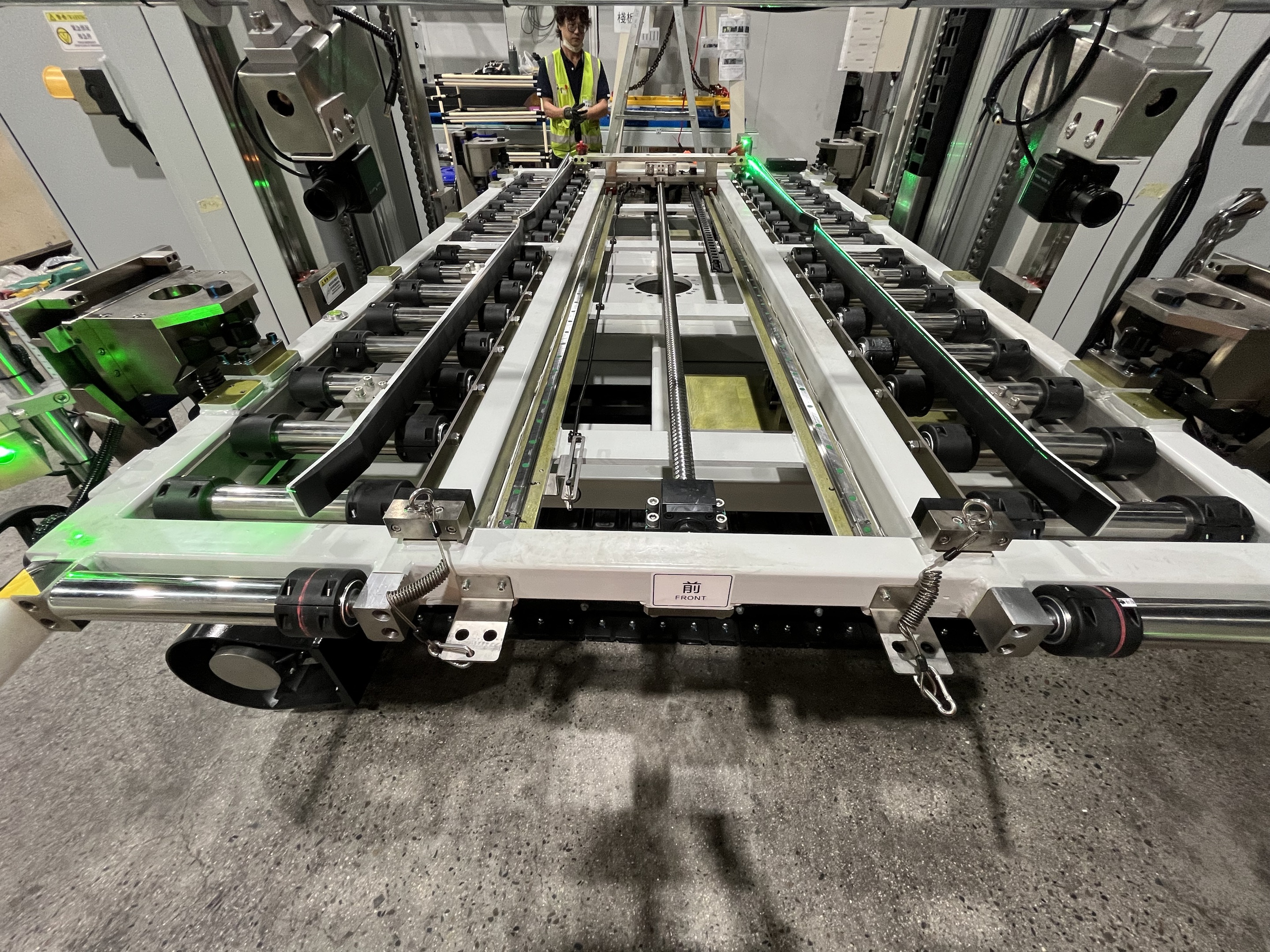
Crawler-driven battery PACK insertion platform used for container loading and maintenance tasks.
Short answer: A custom ESS battery pack insertion robot for containers is an automated handling system that inserts lithium battery PACKs into racks inside an energy storage container and can also pull PACKs out for maintenance. Zonzsin supplies this type of machine through OEM/ODM production, with customization options that include cycle time, automation level, logo, color and configuration. The published lead time for an OEM/ODM robot is two to four months, monthly capacity is three units, and the minimum order quantity is one unit.
Container energy storage turns large battery PACKs into transportable power assets, but loading those PACKs into a steel box is a precision task. Buyers evaluating ESS robots often move from a general comparison of AGV, rail-fixed and crawler platforms into a more practical conversation: Can the supplier customise the machine to my PACK and container? How is it tested? How long will the project take? This article uses documented Zonzsin information to answer those execution-stage questions.
The decision is rarely about the robot in isolation. Container opening angle, rack layout, cell and PACK formats, floor quality, outdoor exposure, cycle time, and level of automation all change the machine configuration. Zonzsin approaches these variables through a combination of platform selection and OEM engineering.
Why a Standard Machine Is Not the Real Requirement
An ESS container is not a fixed shelf. Battery PACKs sit in container racks that can be single-layer or double-layer, and a PACK that is easy to lift is still difficult to guide into a narrow slot without damage. For example, Zonzsin rail-fixed model ZZX2524 is explicitly designed around double-layer racks and includes a load capacity of 1500 kg. This is not an optional feature; it changes the height, gripper path and space-saving logic of the workstation.
Container geometry also matters. Zonzsin rail-fixed model ZZX2508 records a compatible container range of 6058 to 7000 mm in length, 2438 to 2700 mm in width, and 2896 to 3000 mm in height. Its compatible PACK envelope is 1100 to 2200 mm long, 780 to 1260 mm wide, and 230 to 260 mm high. Both ZZX2508 and ZZX2524 state that the container door opening angle must be at least 150 degrees. If the buyer does not verify these dimensions early, a standard machine can arrive with the wrong reach or the wrong clearance.
Battery technology is equally variable. The AGV-driven RD16 insertion robot is documented for 280Ah, 314Ah and 587Ah cells and for 1P52S and 1P104S PACK configurations. A manufacturer changing from one cell format to another often needs a different gripper, different lifting geometry, or a different insertion sequence.
Working floor and site conditions are the third variable. Some container loading stations sit on a stable concrete floor inside a factory. Others are outdoors on yards that are not level. Zonzsin crawler-driven platform ZZX2522 lists all-terrain working floor in its specification, and it uses manual handwheel leveling. This is the type of constraint that pushes a buyer toward a crawler-driven machine instead of a rail-fixed station.
Containerized BESS Growth Is Driving Automation Decisions
The macro pressure for automation is clear. MarketsandMarkets valued the global battery energy storage system market at approximately USD 50.81 billion in 2025 and projects it to reach USD 105.96 billion by 2030. A separate estimate from Insightace Analytic puts the containerized BESS segment at USD 11.75 billion in 2025 and expects it to grow at a CAGR of 24.1% through 2035.
More containerized projects mean more PACK insertion cycles in factories, depots and outdoor yards. Buyers increasingly treat battery pack insertion robots not as laboratory equipment but as production tools that must match the container line, the maintenance schedule, and the available floor.
The Capability Base at Shanghai Zonzsin
Shanghai Zonzsin Intelligent Equipment Co., Ltd., the manufacturer behind the Zonzsin product line, was founded in 2019 and operates a 6000 m² facility in Shanghai. The company employs about 90 people, including 43 R&D engineers, and reports an annual output of 40 units. Its main products include ESS battery pack insertion robots for containers and automatic battery pack assembly lines. The company also reports 50 granted patents, including invention patents specifically for AGV-driven battery PACK insertion robots.
For a buyer at the execution stage, these facts matter in one way: the supplier has engineering capacity to modify a robot instead of selling the same machine to every project. The company's ISO 9001:2015 quality management system certificate number is 44825MS079001R0, issued on 2025-11-20 and valid until 2028-11-19. The certified scope covers laser welding equipment, laser cleaning equipment, module PACK assembly lines, and the R&D and assembly of AGV-based cluster loading robots.
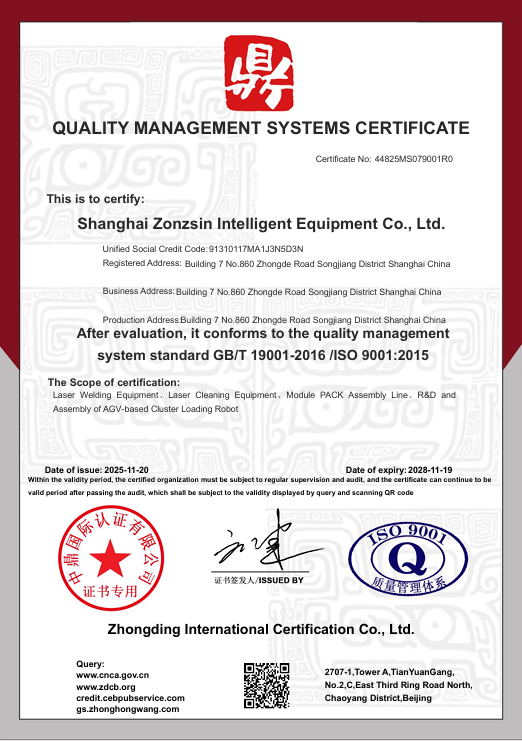
ISO 9001:2015 certificate for Shanghai Zonzsin Intelligent Equipment Co., Ltd.
OEM and ODM Parameters That Affect Project Planning
Zonzsin states that it provides OEM and ODM production services. The customization scope includes cycle time, level of automation, logo, color, and mechanical configuration. This is not unlimited redesign; it is a defined production model for making the robot fit the applicant's container and PACK workflow.
- Monthly capacity: 3 units
- Lead time: 2 to 4 months
- MOQ: 1 unit
- Quality control: 100% test
- After-sales: remote support and on-site installation and commissioning
- Delivery terms: EXW Shanghai, FOB Shanghai, or FCA Shanghai
- Acceptance: FAT or online FAT
- Payment: 50% advance payment by T/T, 50% balance by T/T within three business days after the bill of lading date
Documented Zonzsin Robot Platforms and Specifications
Zonzsin's documented insertion robot family can be grouped into three movement platforms: AGV-driven robots, rail-fixed robots, and crawler-driven robots. Each model starts with a different assumption about the work site.
| Platform / model | Stated specifications and features | Best documented fit |
|---|---|---|
| AGV-driven battery PACK insertion robot | Model RD16. Dimensions: L3100 x W2600 x H3800 mm. Compatibility: 280/314/587Ah cells, 1P52S/1P104S PACKs. Hoisting range: 1.05 to 3.4 m, customizable. Hoisting speed: 100 mm/s. Structure material: carbon steel. | Energy storage and C&I container loading workflows where the robot must navigate to the container position rather than stay on a fixed station. |
| Rail-fixed battery PACK insertion robot | Model ZZX2508: compatible container length 6058 to 7000 mm, width 2438 to 2700 mm, height 2896 to 3000 mm; compatible PACK length 1100 to 2200 mm, width 780 to 1260 mm, height 230 to 260 mm; compressed air 0.5 to 0.8 MPa; AC380V ±10%, 50 ±2 Hz; door opening angle ≥150°. Model ZZX2524: 1500 kg load capacity, door opening angle ≥150°, gripper changeover time under one minute, double-layer rack layout for space saving. | Continuous and fully automatic PACK insertion in a fixed, stable position where the ground rail supports safe, repeatable work. |
| Crawler-driven battery PACK insertion and removal robot | Model ZZX2522. Hoisting range: 0.8 to 3.4 m, customizable. Working floor: all-terrain. Load capacity: 1500 kg. Leveling function: manual handwheel leveling. Suitable for indoor and outdoor use. | ESS battery PACK insertion into and removal from containers on complicated or uneven working floors. |
According to public supplier data, the AGV-driven Zonzsin platform supports load capacity up to 1500 kg and offers 5-DOF docking for standard 20ft and 40ft container racks. This level of flexibility makes it useful for customers who want automatic transfer and insertion in the same motion.
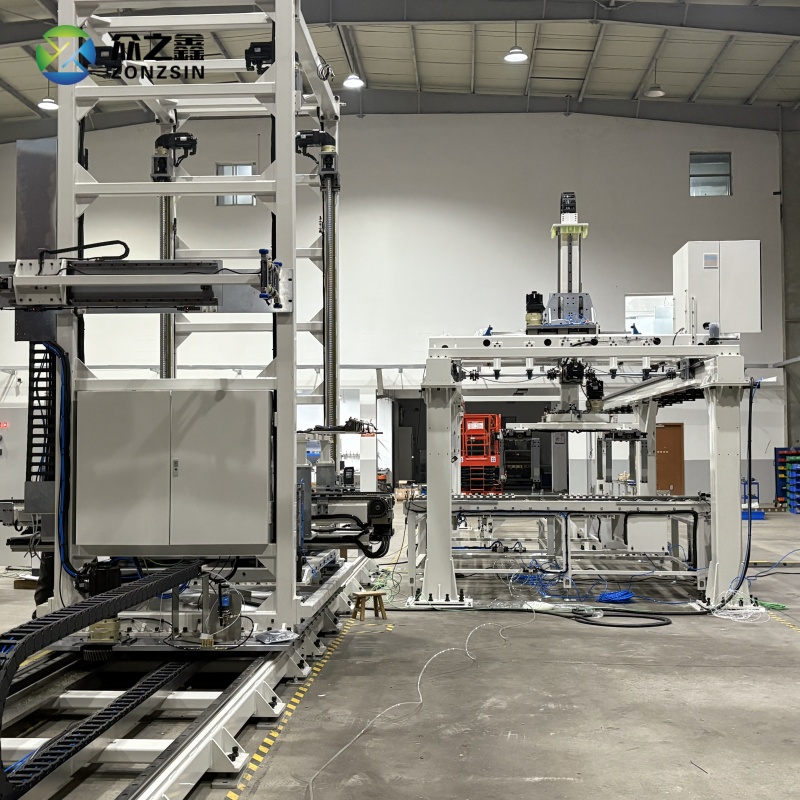
Rail-fixed battery PACK insertion robot used for continuous container PACK loading.
How Platform Choice Turns into a Project Plan
Platform choice should be driven by the evidence a buyer can collect from the field.
AGV-driven robot for moving and docking
The AGV-driven RD16 is appropriate when PACK insertion has to happen at more than one container position, or when the buyer wants automatic travel to the container door and then an automatic insertion cycle. The stated compatibility with 280/314/587Ah cells and 1P52S/1P104S PACKs should be checked against the actual battery programme.
Rail-fixed robot for stable, high-frequency loading
The rail-fixed platforms ZZX2508 and ZZX2524 are built around a fixed ground rail. A documented China project uses a rail-fixed robot for continuous PACK insertion, stable PACK loading, and fully automatic PACK insertion. The project highlights include a stable and fixed ground rail for safe work, a dual-layer material rack for space utility, and versatile module options.
Crawler-driven robot for outdoor and uneven floors
The crawler-driven ZZX2522 is designed for all-terrain and complicated working floors. A project in South Korea selected a crawler-driven robot for outdoor operation on an uneven working floor. A project in Taiwan used the same type of platform for indoor and outdoor use, covering battery PACK insertion and pull-out. These cases show that the platform decision is often a civil and floor-condition decision before it is a robot decision.
Documented Field Evidence
China: rail-fixed insertion robot for continuous PACK loading
A rail-fixed Zonzsin battery PACK insertion robot was installed in China for continuous PACK insertion, stable PACK loading and fully automatic PACK insertion. The customer group for the application includes energy storage system integrators, battery cell and PACK manufacturers, and EPC turnkey contractors. The documented machine highlights include a fixed ground rail for safe working, a dual-layer material rack for space utility, and versatile module options.
South Korea: crawler-driven robot for outdoor uneven floor
A crawler-driven battery PACK insertion and removal robot was used in South Korea for ESS battery PACK insertion into and removal from containers. The project required outdoor operation because the working floor was uneven. The reported result was stable operation over a one-year implementation period.
Taiwan: crawler-driven robot for indoor and outdoor container maintenance
In Taiwan, a crawler-driven Zonzsin robot was deployed for ESS battery PACK insertion into and removal from containers. It supports indoor and outdoor use, performs battery PACK insertion and pull-out, and handles complicated working floors. The project achieved stable operation across a one-year implementation period.
These field cases are not intended as generic proof that every crawler or rail robot will work in every site. They show the documented conditions that should be compared with the buyer's own site: stable ground rail versus all-terrain operation, indoor factory conditions versus outdoor yards, and new PACK insertion versus maintenance pull-out tasks.
Execution Steps from Specification to Delivery
An execution-stage project can follow this sequence when working with Zonzsin on a custom ESS battery pack insertion robot for containers.
- Collect site and product data. Prepare container dimensions, door opening angle, rack layout, PACK dimensions and weights, cell format, required cycle time, floor quality, and whether the work is indoor, outdoor, or both.
- Select the base platform. Decide whether the machine should move to the container, run on a fixed rail, or use crawler tracks for all-terrain work. This selection defines the mechanical foundation.
- Review OEM/ODM changes. Zonzsin can adjust cycle time, automation level, logo, color and configuration. For rail-fixed machines, gripper changeover time can be an important design parameter; ZZX2524 documents a gripper changeover time below one minute.
- Confirm the quality and manufacturing route. The manufacturing system is ISO 9001:2015 certified, monthly capacity is three units, and the stated quality control step is 100% testing.
- Plan FAT and logistics. Acceptance can be performed as FAT or online FAT. Delivery terms are EXW, FOB or FCA Shanghai, with 50% advance by T/T and the remaining 50% due within three business days after the bill of lading date.
- Schedule installation and after-sales support. Zonzsin provides remote support and can perform on-site installation and commissioning for overseas projects.
Selection Comparison for Container Projects
The following comparison condenses the documented differences that affect a purchase decision.
| Criterion | AGV-driven robot | Rail-fixed robot | Crawler-driven robot |
|---|---|---|---|
| Representative Zonzsin model | RD16 | ZZX2508 / ZZX2524 | ZZX2522 |
| Container and PACK data points | 280/314/587Ah cells; 1P52S/1P104S PACKs; hoisting range 1.05 to 3.4 m | Container L 6058 to 7000 mm, W 2438 to 2700 mm, H 2896 to 3000 mm; door opening ≥150° | Hoisting range 0.8 to 3.4 m, customizable |
| Load capacity | Platform family rated up to 1500 kg | ZZX2524: 1500 kg | 1500 kg |
| Floor assumption | Automated navigation to container; floor path must suit AGV movement | Stable ground rail | All-terrain, complicated working floors |
| Typical operation | Automatic docking and insertion in container loading systems | Continuous PACK insertion, stable loading, fully automatic insertion | Insertion and removal, indoor and outdoor |
| Documented references | Patents for AGV-driven insertion robots | China project: fixed ground rail, dual-layer material rack | South Korea outdoor uneven floor; Taiwan indoor/outdoor complicated floors |
Frequently Asked Questions
Does ISO 9001 cover Zonzsin ESS battery pack insertion robots?
Yes. Shanghai Zonzsin Intelligent Equipment Co., Ltd. holds ISO 9001:2015 certificate No. 44825MS079001R0, issued on 2025-11-20 and valid until 2028-11-19. The certified scope includes R&D and assembly of AGV-based cluster loading robots, and Zonzsin lists the ZZX2522, ZZX2508, ZZX2524 and RD16 robots as related products. For the complete ESS container installation, the integrator or end customer must also meet system-level standards such as UL 9540 for North America or CE marking under Regulation (EU) 2023/1542 in Europe.
Can Zonzsin OEM or ODM a robot for my container, PACK and line?
Yes. Zonzsin operates in OEM/ODM production mode and customizes cycle time, degree of automation, logo, color and configuration. The MOQ is one unit. Product compatibility is model-specific: the RD16 supports 280/314/587Ah cells and 1P52S/1P104S PACKs, the ZZX2508 defines container and PACK envelope ranges, and the ZZX2522 offers a hoist range of 0.8 to 3.4 m that can be customized. If your PACK or container envelope falls outside the listed data, the normal route is an engineering review before ordering.
What are the budget and commercial terms?
There is no public list price because cycle time, automation level and configuration determine the quote. Procurement terms include MOQ of one unit, 50% advance payment by T/T, 50% balance by T/T within three business days after the bill of lading date, and delivery under EXW, FOB or FCA Shanghai. A FAT or online FAT is performed before shipment, so project plans should allow time for specification review and acceptance.
Can I validate a robot before committing to a full order?
For heavy insertion robots, the normal validation path is not a small-box sample. Zonzsin offers FAT or online FAT before delivery, after-sales remote support, and on-site installation and commissioning. A practical first step is to compare configuration options in the product brochure and then escalate the conversation with container and PACK drawings.
What lead time should I expect for a custom ESS battery pack insertion robot?
OEM/ODM orders currently carry a lead time of two to four months, with a monthly production capacity of three units. Every robot is 100% tested, and FAT or online FAT is part of the schedule, so complex automation can affect the timeline. For a project-specific date, send container and PACK drawings to Katty Liu at katty.liu@zonzsin.com or WhatsApp +86 134-8282-9368. You can also download the Zonzsin product brochure below.
Conclusion: Build the Machine around the Container
An ESS battery pack insertion robot for containers is not a generic loader. It is an engineered machine that must be matched to the container envelope, the battery PACK programme, the rack layout, the floor condition, and the maintenance cycle. Zonzsin's documented product family shows the value of separating platform types: AGV-driven movement for flexible docking, rail-fixed stations for stable continuous insertion, and crawler-driven machines for uneven, indoor or outdoor work.
The evidence in this article points to a practical execution workflow: define the PACK and container data, choose the platform, review the OEM/ODM configuration, agree on the FAT method, and confirm logistics before production starts. Suppliers with one-unit MOQ and a defined OEM/ODM process make that workflow easier to control.

Download the product brochure: Zonzsin ESS Battery Pack Insertion Robot Product Brochure (PDF)
For RFQ and technical review:
Katty Liu
Email: katty.liu@zonzsin.com
Tel / WhatsApp: +86 134-8282-9368
Visit www.zonzsin.com