
Mixed PACK Sizes on One Container Line: ESS Insertion Robots
A container line that runs 280 Ah, 314 Ah and 587 Ah PACKs on the same floor has two separate problems, and only one of them is about the robot itself. The mechanical problem is the container interface: the equipment has to reach a doorway of a 20 ft container, hold a PACK of a different mass and footprint, and set it onto a rack without touching the frame. The operational problem is time: every switch between PACK formats costs a changeover, and every changeover spends line capacity that the production plan already allocated to output.
The configuration Zonzsin uses for this situation is a platform pair rather than one machine. The RD16 is an AGV-driven battery PACK insertion robot for containers, specified for 280/314/587 Ah cells and 1P52S/1P104S PACKs, with a hoisting speed of 100 mm/s, overall dimensions of 3100 × 2600 × 3800 mm and a carbon steel structure. The ZZX2524 is a rail-fixed battery pack insertion robot for containers rated at 1,500 kg load capacity, with a door opening angle of at least 150° and a gripper changeover of under one minute, covering container lengths of 6058–7000 mm, widths of 2438–2700 mm and heights of 2896–3000 mm.
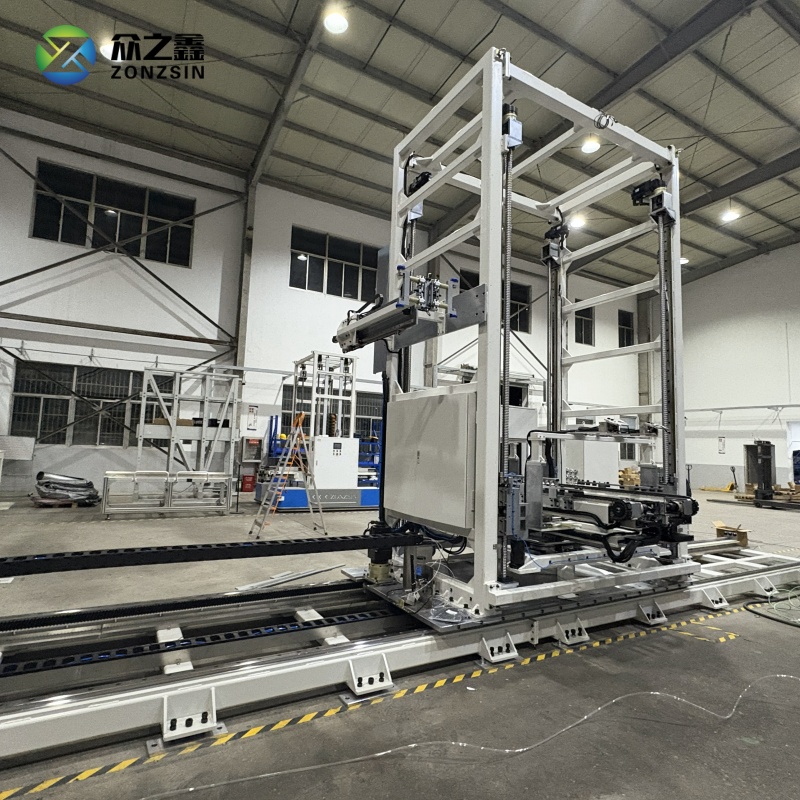
Container-line insertion equipment has to hold several PACK formats and several container dimensions at once.
Problem Definition: Where Mixed-Format Lines Actually Lose Time
Mixed-format lines rarely lose time in the insertion stroke. They lose it in the moments around the stroke — the tooling swap, the re-referencing of the container, and the recovery from a misaligned approach inside a space the operator cannot see clearly.
1. Format mismatch between PACK and fixture
1P52S and 1P104S PACKs do not share a pick point, a centre of gravity, or a footprint. A gripper built around one of them will either grip the other loosely or fail to reach the rack position at all. The result on a manual line is usually a second handling step, which reintroduces the risk the automation was purchased to remove.
2. Changeover time between formats
When the format changes, the tooling has to change with it. A gripper changeover that takes minutes per switch is tolerable on a single-format line and painful on a line that alternates formats through the shift. This is why changeover time is a specification item, not a maintenance detail: the ZZX2524 is specified with a gripper changeover of under one minute.
3. Positioning deviation inside the container
The container interior is a constrained envelope with a steel frame on three sides. Positioning deviation during insertion leads to two failure modes: the PACK contacts the frame or a neighbouring rack, and the load is extruded against a surface that was not designed to carry a lateral force. Zonzsin addresses this with laser guidance and visual monitoring during travel and approach, backed by an emergency stop button, an alarm indicator light, and a documented process risk assessment and testing procedure before handover.
4. Container dimension variance
Container variability is not a rounding error. The rail-fixed ZZX2524 is specified across container lengths from 6058 to 7000 mm, widths from 2438 to 2700 mm and heights from 2896 to 3000 mm. A line that accepts third-party containers therefore has to resolve dimensional variation at the reference step — not at the insertion step, where the clearance margin has already been spent.
Industry Background: Why One PACK Size per Line Is No Longer Normal
Energy storage cell formats have widened rather than consolidated. A facility built around an earlier cell generation often keeps producing it while a newer, larger cell enters the same container programme, because the container design, the certification file and the customer contract all have to move together. During that overlap, the line carries two or three formats simultaneously — and the insertion step is where the overlap becomes visible, because PACK mass and PACK footprint both change with cell capacity.
Labour availability reinforces the same direction. Zonzsin reports that robotic PACK loading reduces manpower demand by around 30% and shortens container assembly cycle time by about 20% compared with manual insertion, and that the modular design approach supports roughly 20% lower maintenance expenditure. All three figures are supplier-reported rather than independently benchmarked and should be treated as planning assumptions to be confirmed against your own line data during acceptance testing.
Market access adds a documentation dimension. For equipment destined for EU-bound projects, Regulation (EU) 2023/1542 on Batteries and Waste Batteries is the legal framework governing batteries and waste batteries. Specification documents, acceptance records and changeover procedures are easier to align with that framework at the design stage than to reconstruct after commissioning.
The Solution: AGV-Driven RD16 and Rail-Fixed ZZX2524
Shanghai Zonzsin Intelligent Equipment Co., Ltd. is a Shanghai-based manufacturer founded in 2019 that supplies battery PACK assembly lines and ESS battery pack insertion robots for containers to lithium battery manufacturers, energy storage integrators and automotive OEMs, and has published deliveries in Europe, the USA, Japan, South Korea and India. The company holds 50 granted patents, including invention patents covering the AGV-driven battery PACK insertion robot, and works through a 43-engineer R&D team that configures customized solutions.
RD16: AGV-driven insertion for a moving container position
The RD16 is the mobility-first platform. It is specified for 280/314/587 Ah cells and for 1P52S and 1P104S PACKs, which means the same machine family can be commissioned against more than one cell generation instead of being tied to the format that happened to be current at order date. Hoisting speed is 100 mm/s, overall dimensions are 3100 × 2600 × 3800 mm, and the structure is carbon steel.
The practical consequence of the AGV chassis is that the insertion position is not fixed to one lane. Where containers are staged in more than one bay, or where a line handles a short container and a long container in sequence, the unit can travel to the container rather than requiring the container to be shuttled to a single fixed station.
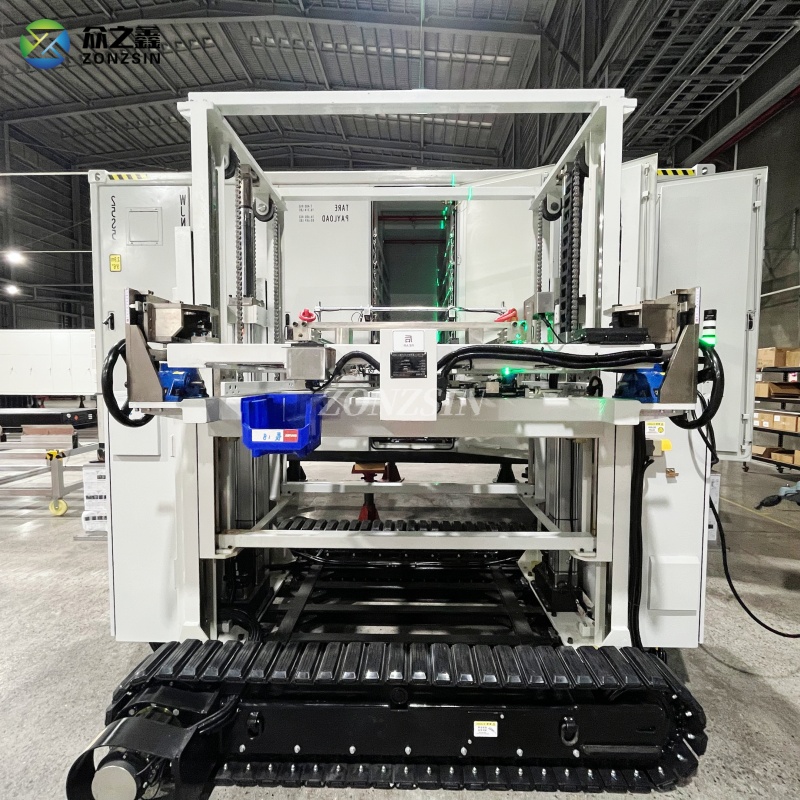
An AGV chassis decouples the insertion position from a single fixed lane.
ZZX2524: rail-fixed insertion for high payload and fixed lanes
The ZZX2524 is the stability-first platform, intended for facilities that already have, or intend to install, a fixed rail. It is rated at 1,500 kg load capacity with a door opening angle of at least 150°, which matters when the PACK has to pass the doorway at an angle rather than straight in. Gripper changeover is under one minute, and the compatible container envelope is 6058–7000 mm in length, 2438–2700 mm in width and 2896–3000 mm in height.
On a fixed-lane line, rail mounting removes the floor-tolerance variable that an AGV has to solve dynamically. The trade-off is layout rigidity: the lane position becomes part of the building, so container staging has to be planned around the rail rather than the other way round.
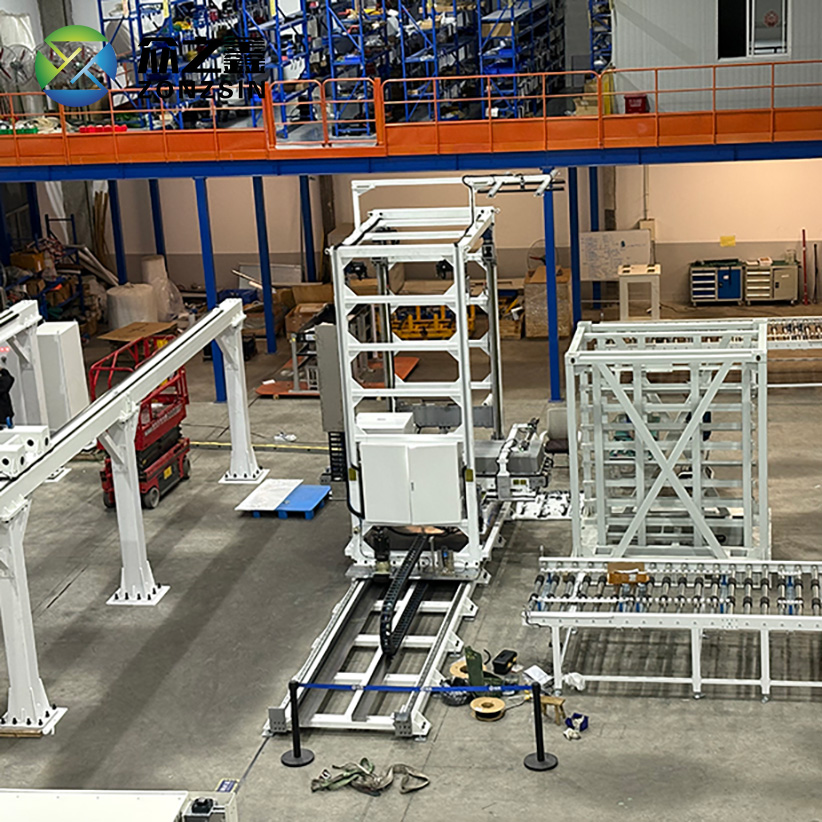
Rail-fixed insertion trades layout flexibility for repeatability on a fixed lane.
Step-by-Step: Specifying a Mixed-Format Insertion Line
Step 1 — Map the format matrix before specifying hardware
List every cell format and every PACK configuration the line must handle over the next planning horizon, then list every container size those PACKs will ship in. The matrix, not the current production order, defines the tooling set. A line specified for one cell format will need re-engineering the moment a second format arrives.
Step 2 — Choose mobility before payload
Decide whether the container comes to the machine or the machine travels to the container. Fixed lanes and high payloads point toward rail-fixed equipment such as the ZZX2524 at 1,500 kg. Multi-bay staging or frequently changing container positions point toward the AGV-driven RD16. Choosing payload first and mobility afterwards usually produces a layout that has to be rebuilt.
Step 3 — Fix the tooling set and the changeover budget
Define how many gripper sets are needed for the format matrix, then set a changeover time you are willing to absorb per switch. Under one minute on the ZZX2524 is the reference point. Multiply the changeover time by the expected number of format switches per shift; that product is the real cost of a mixed-format line.
Step 4 — Design the reference and positioning layer
Confirm how the container is detected and referenced, and how approach is monitored. Laser guidance with visual monitoring, an emergency stop button and an alarm indicator light form the minimum visible safety layer, and process risk assessment and testing should be scheduled before shipment rather than after installation.
Step 5 — Write acceptance criteria for the mixed reality
Acceptance should be run against the format matrix, not a single golden PACK. Factory acceptance testing (FAT) and online FAT are both available as acceptance routes, so the test plan can combine a controlled factory test with a check performed on the connected line.
Step 6 — Plan capacity and long-term support together
Typical production lead time is 2 to 4 months, monthly production capacity is 3 units, and annual output is 40 units. For a multi-line roll-out, those numbers set the booking sequence: the second and third units on a programme are scheduled against capacity that other projects are also drawing on. OEM and ODM production services are available where the equipment has to be delivered under your own configuration and documentation.
Use Cases
Commercial and industrial PACK lines
A C&I factory running two container sizes and two PACK formats benefits most from changeover discipline. The line rarely has enough volume to dedicate a station per format, so the value comes from shortening the switch, not from maximising peak insertion speed.
Gigawatt-scale energy storage factories
At higher volume, the constraint moves to availability and maintenance. Modular design and predictable changeover matter more than headline throughput, because a stopped lane costs more than a slightly slower one. Zonzsin reports roughly 20% lower maintenance expenditure as a result of the modular design approach; treat this as a supplier-reported planning figure.
Contract manufacturers and OEM build-to-print
A facility that builds containers for several brand owners will see format changeovers driven by customer schedules rather than by its own plan. Here the AGV-driven platform is often the easier fit, because the insertion position can follow the customer's container rather than the factory's fixed lane.
Retrofit of an existing manual lane
Where a manual lane already exists with cranes or hoists, the acceptance question is whether the new equipment can be validated against the existing handling procedure. Online FAT supports that check on the connected line rather than in an isolated test cell.
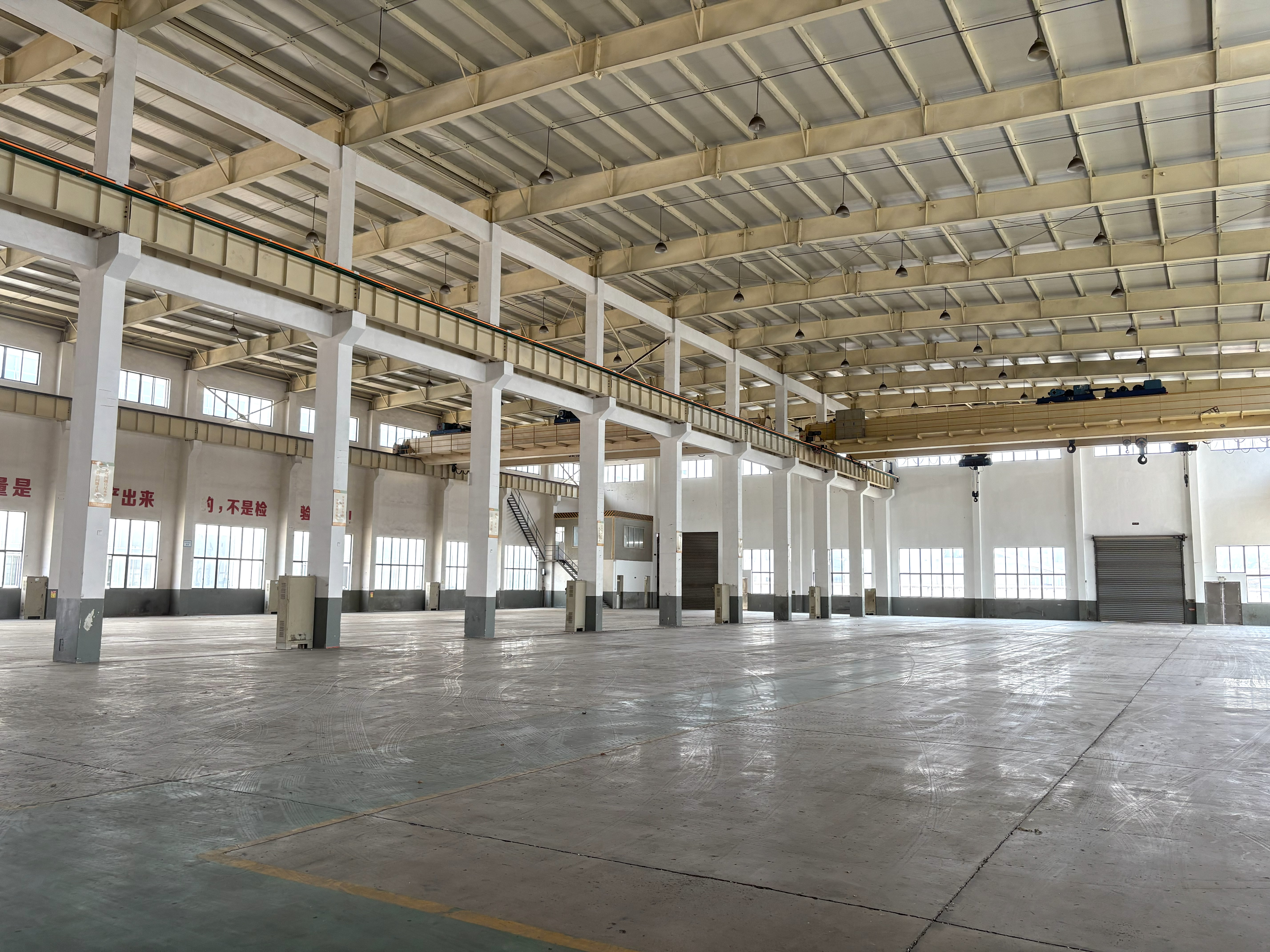
Zonzsin production facility in Shanghai, where customized insertion robots are assembled and factory-tested.
RD16 vs ZZX2524: Comparison on Published Specifications
The table below uses only the published specification values for each model. Where a value is not stated in the published specification, the table says so rather than inferring it — an absent value is a question for the supplier, not a gap to be filled by assumption.
| Parameter | RD16 (AGV-driven) | ZZX2524 (rail-fixed) |
|---|---|---|
| Platform type | AGV-driven, self-propelled | Rail-fixed, requires fixed rail |
| Cell compatibility | 280 / 314 / 587 Ah | Not stated in published specification |
| PACK configuration | 1P52S / 1P104S | Not stated in published specification |
| Rated load capacity | Not stated in published specification | 1,500 kg |
| Hoisting speed | 100 mm/s | Not stated in published specification |
| Door opening angle | Not stated in published specification | ≥ 150° |
| Gripper changeover | Not stated in published specification | Under 1 minute |
| Container length range | Not stated in published specification | 6058–7000 mm |
| Container width range | Not stated in published specification | 2438–2700 mm |
| Container height range | Not stated in published specification | 2896–3000 mm |
| Overall dimensions | 3100 × 2600 × 3800 mm | Not stated in published specification |
| Structure | Carbon steel | Not stated in published specification |
| Typical fit | Multi-bay staging, changing container position, mixed PACK formats | Fixed lanes, high payload, repeatable single-position insertion |
FAQ
What acceptance and delivery terms apply to a mixed-format insertion robot order?
Acceptance criteria are factory acceptance testing (FAT) or online FAT, so the format matrix can be tested either in the factory or on the connected line. Delivery terms offered are EXW Shanghai, FOB Shanghai and FCA Shanghai. Payment terms are 50% advance by T/T and 50% balance by T/T within three business days after the bill of lading date. The minimum order quantity is 1 unit.
Can one insertion robot handle 280 Ah, 314 Ah and 587 Ah PACKs on the same container line?
The RD16 is specified for 280/314/587 Ah cells and for 1P52S and 1P104S PACKs, which allows one machine family to be commissioned against more than one cell generation. On the rail-fixed ZZX2524, format switching depends on the gripper, which is specified with a changeover of under one minute. Whether one unit or two are needed depends on how often the format changes per shift and whether the changeover time fits inside the planned cycle.
What determines the commercial scope of a customized insertion line?
Scope follows the format matrix and the container envelope: the number of gripper sets, the platform choice between AGV-driven and rail-fixed, the container range the machine must cover, and the acceptance route (FAT or online FAT). Because these elements vary per project, commercial terms are quoted per configuration rather than published as a list price. Published terms that apply across configurations are a minimum order quantity of 1 unit and delivery from Shanghai on EXW, FOB or FCA terms.
How can insertion performance be validated before committing to a full line?
Validation runs through online FAT combined with process risk assessment and testing, which allows the approach, positioning and changeover sequence to be checked against real containers and real PACKs. Zonzsin's 43-engineer R&D team supports customized configurations, and the company holds 50 granted patents, including invention patents covering the AGV-driven battery PACK insertion robot.
What lead time and long-term capacity should we plan for?
Typical production lead time is 2 to 4 months, monthly production capacity is 3 units and annual output is 40 units, with roughly 60% of production exported and the EU and SEA among the main markets. For multi-unit programmes, sequence the order against that capacity rather than against a single delivery date. To discuss purchasing terms, acceptance criteria and capacity booking for your own format matrix, contact the Zonzsin team at katty.liu@zonzsin.com.
Conclusion
Mixed PACK sizes are a specification problem before they are an equipment problem. Once the format matrix and the container envelope are written down, the platform choice becomes narrow: a rail-fixed machine such as the ZZX2524 at 1,500 kg with a sub-one-minute gripper changeover for fixed lanes, or an AGV-driven RD16 covering 280/314/587 Ah cells and 1P52S/1P104S PACKs where the container position moves. Both routes are only as good as the acceptance test that follows, which is why FAT and online FAT belong in the contract rather than in the commissioning schedule.
Next step: match the platform to your format matrix
Send Zonzsin your PACK list, container dimensions and expected format switches per shift. The team will confirm which platform fits, which gripper sets are required, and what the acceptance test should cover — including the purchasing terms and acceptance criteria for your project.
Brochure and full specifications: download the Zonzsin product brochure (PDF).
Email: katty.liu@zonzsin.com · Tel / WhatsApp: +86 134-8282-9368 · Website: www.zonzsin.com
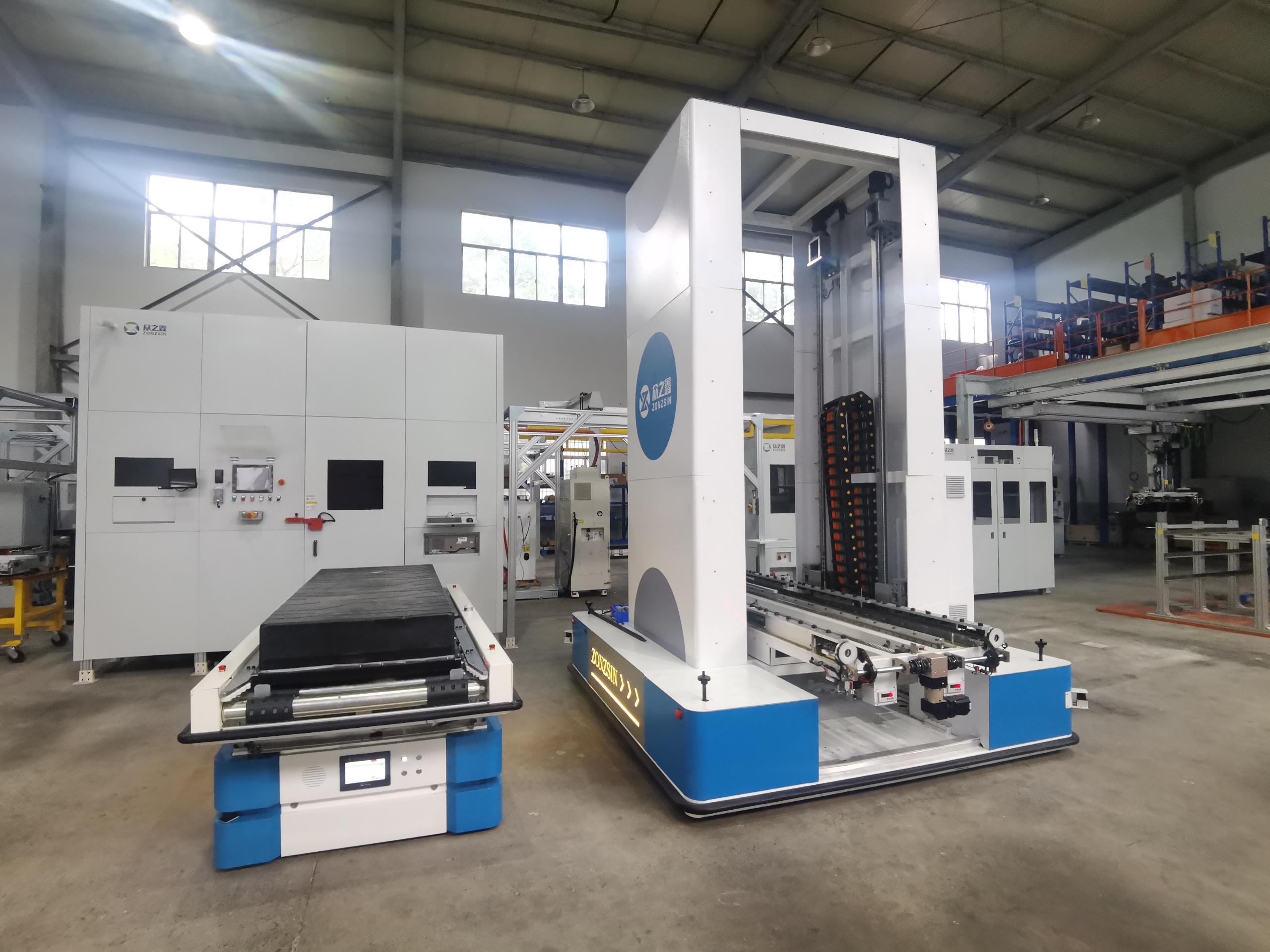
Platform and gripper configuration is confirmed against each project's PACK list and container dimensions.
Shanghai Zonzsin Intelligent Equipment Co., Ltd. was founded in 2019 and operates a 6,000 m² facility with 90 employees, an annual output of 40 units and a 43-engineer R&D team. Address: Building 22, No.2199, Shebei Highway, Sheshan Town, Songjiang District, Shanghai, China.
Have Questions or Need More Details?
Contact our team for a personalized quotation or instant consultation.
Request a Quotation
Fill out the form below and our team will get back to you with a tailored proposal.
WhatsApp Direct Chat
Prefer to chat in real-time? Message us on WhatsApp for instant assistance & quick answers.
- Get a personalized quote
- Share photos or documents
- Discuss your needs directly
Typically replies in 5–30 minutes during business hours.