
Project Fit Assessment: ESS Battery Pack Insertion Robots for Container Lines
Project Fit Assessment: ESS Battery Pack Insertion Robots for Container Lines
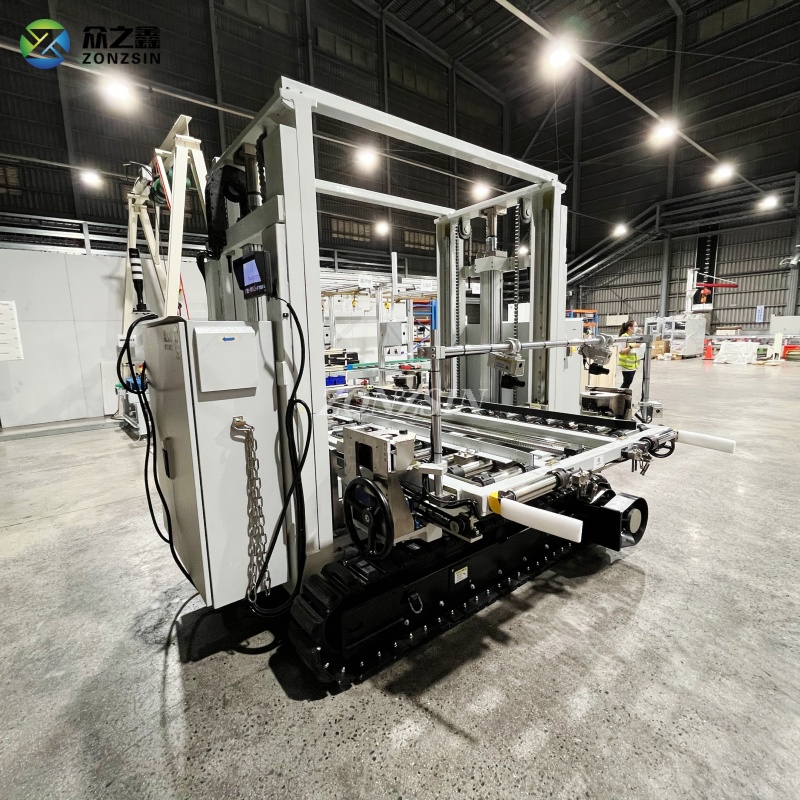
An ESS battery pack insertion robot has a core job: move battery PACKs from the material rack into the container rack, safely, repeatedly, and at the speed the line requires. The machine that performs well on a flat indoor floor is not necessarily the machine that should work in an outdoor yard. The machine that fits one container door may not reach deep enough into another rack layout. The correct ESS battery pack insertion robot for containers is defined by the project, not by the sales brochure.
This article sets out a project fit assessment method for ESS battery pack insertion robots for containers. It defines five assessment dimensions — floor and site conditions, container geometry and door opening, PACK and cell compatibility, production mode, and environmental requirements — and maps each dimension to the three common platform types: rail-fixed, AGV-driven, and crawler-driven machines.
The product specifications and deployment cases used here are from Shanghai Zonzsin Intelligent Equipment Co., Ltd. Zonzsin is a Shanghai-based manufacturer, founded in 2019, that designs and builds ESS battery pack insertion robots for containers and automatic battery PACK assembly lines. Its customers include lithium battery manufacturers, energy storage integrators, and automotive OEMs in China and overseas, mainly in Southeast Asia and the EU. The company operates a 6000 m² facility with 90 employees and 43 R&D engineers, and reports an annual output capacity of 40 units.
Why project fit is a risk factor, not a preference
The decision error is easy to make. Buyers often compare machine specifications first — load capacity, hoisting range, automation level — and only later discover that the equipment is incompatible with the site. The more useful order is to assess the project first and the machine second.
Five mismatches appear most often in containerized ESS lines:
- Floor mismatch: a rail-fixed machine requires a fixed ground rail. An AGV-driven machine needs a floor surface its positioning system can handle. An outdoor or uneven floor calls for an all-terrain platform.
- Door angle mismatch: rail-fixed robots in the Zonzsin range are specified for a container door opening angle of at least 150°. If the door does not open wide enough, gripper travel into the rack is restricted.
- PACK envelope mismatch: grippers, fixtures, and hoisting ranges are built around defined PACK sizes. The project scenario documentation lists PACK compatibility and fixture adaptation as a special requirement, which means the supplier must confirm your PACK drawing against the machine envelope.
- Production mode mismatch: a line designed for continuous shift production cannot depend on an insertion process that requires frequent manual repositioning. The application scenario for these robots specifies continuous or shift production, batch and continuous operation, and cycle time improvement.
- Environment mismatch: container insertion areas often require ESD protection, fire prevention measures, and control of temperature, humidity, and cleanliness. If the equipment layout blocks these provisions, the line cannot pass its own safety review.
The consequence of a mismatch is rarely a discount. It is a retrofit, a re-layout, or a line stoppage during commissioning. That is why the fit assessment should be completed before the purchase order, not after it.
Industry background: why this decision is growing in importance
The battery energy storage system market is expanding rapidly. The global BESS market was valued at approximately USD 50.81 billion in 2025 and is projected to reach USD 105.96 billion by 2030, according to MarketsandMarkets. Within that market, containerized BESS is a major segment: it was valued at USD 11.75 billion in 2025 and is expected to grow at a CAGR of 24.1% through 2035, according to Insightace Analytic.
Two consequences follow. First, energy storage integrators are no longer building one-off containers; they are planning batch and continuous production. Second, PACK formats have moved toward large-format cells — 280 Ah, 314 Ah, and 587 Ah appear in Zonzsin's compatibility list — which makes manual insertion heavier and more hazardous.
Standards also raise the bar. In North America, energy storage systems must typically comply with UL 9540, the Standard for Energy Storage Systems and Equipment, which covers the safety of enclosures and moving parts. In the EU, BESS containers fall within the scope of Regulation (EU) 2023/1542, and automated handling equipment must satisfy CE requirements that include the Low Voltage Directive and the Machinery Directive. A robot that is difficult to integrate into a compliant line may therefore create a compliance risk, not only a mechanical one.
The solution: a five-dimension project fit framework
Use the following five dimensions to compare an ESS battery pack insertion robot against your project conditions. Each dimension gives you a pass/fail result or an adjustable parameter.
Dimension 1: Floor and site conditions
Identify where the machine will work: a fixed indoor station, a multi-position hall, an outdoor yard, or a mixed indoor and outdoor site.
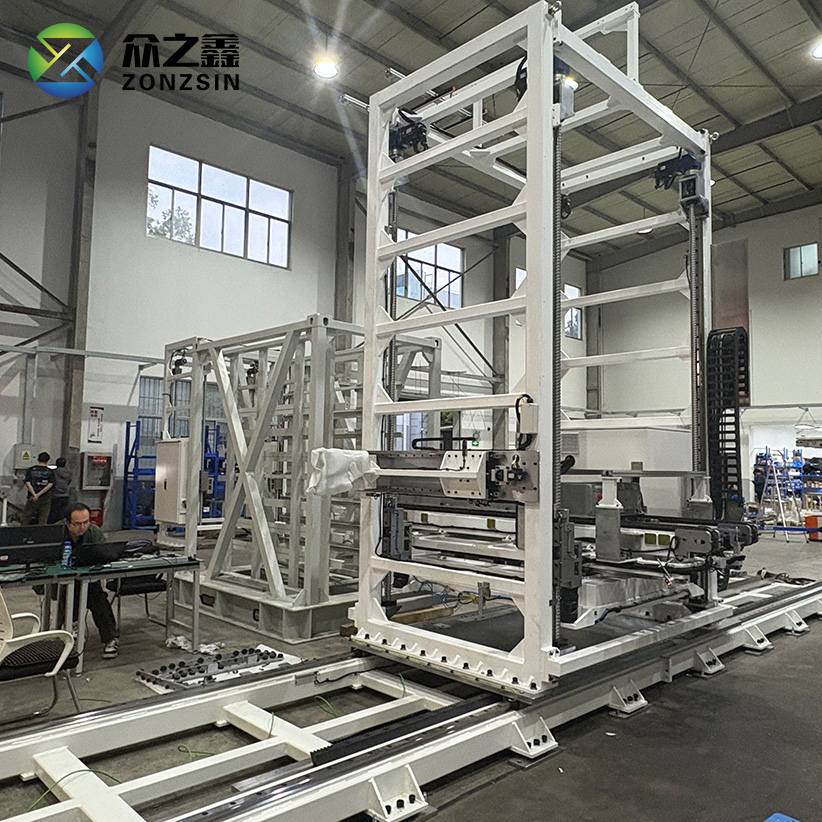
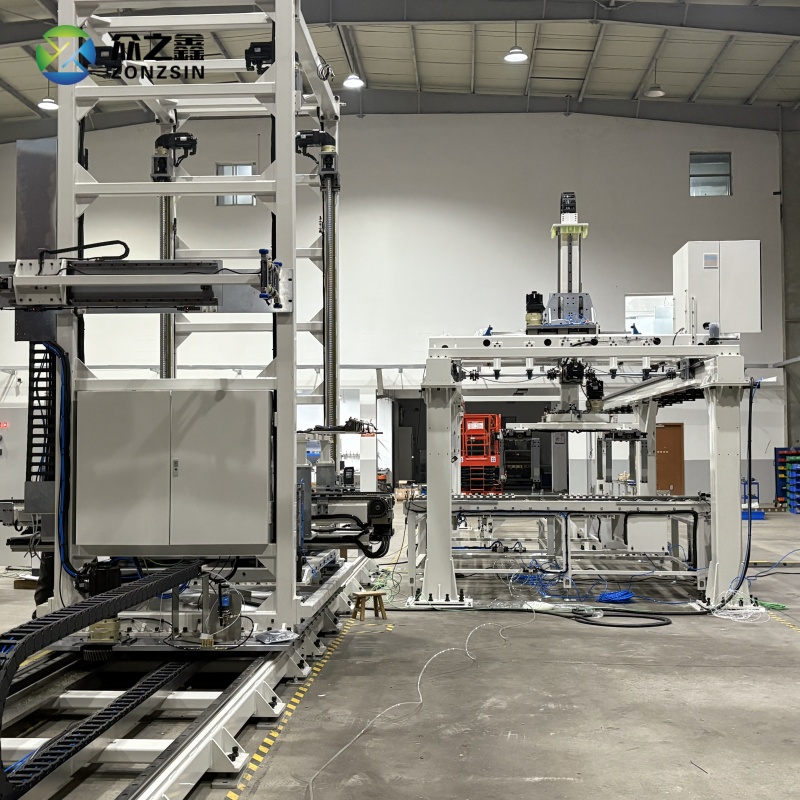
- Rail-fixed machines (ZZX2508, ZZX2524) are designed for a fixed ground rail. They suit permanent line positions and provide a stable and fixed rail for safe working — the highlight of Zonzsin's rail-fixed deployment in China, which has been in stable operation for two years.
- AGV-driven machines (RD16) are mobile battery PACK insertion robots for containers. They suit projects where the insertion point changes, such as multiple containers or multiple docking stations on the same floor. The RD16 has a machine footprint of L3100 x W2600 x H3800 mm.
- Crawler-driven machines (ZZX2522) are specified for all-terrain working floors. They suit outdoor yards and complicated floor conditions. The ZZX2522 offers manual handwheel leveling and a 1500 kg load capacity.
Dimension 2: Container geometry and door opening
Measure the container you will load. The ZZX2508 rail-fixed robot is compatible with containers of length 6058~7000 mm, width 2438~2700 mm, and height 2896~3000 mm. Its door opening requirement is ≥150°.
The ZZX2524 rail-fixed robot is also specified for a door opening angle of ≥150° and supports double-layer racks, which is a space-saving layout when containers are configured with two PACK levels.
The door opening angle is not a minor detail. A narrower door restricts the path of the gripper and the PACK, increasing the risk of collision with the door frame. If your container doors do not meet the ≥150° requirement, the rail platform will need a layout review before ordering.
Dimension 3: PACK and cell compatibility
Record your cell format, PACK dimensions, and PACK weight, then compare them with the machine envelope.
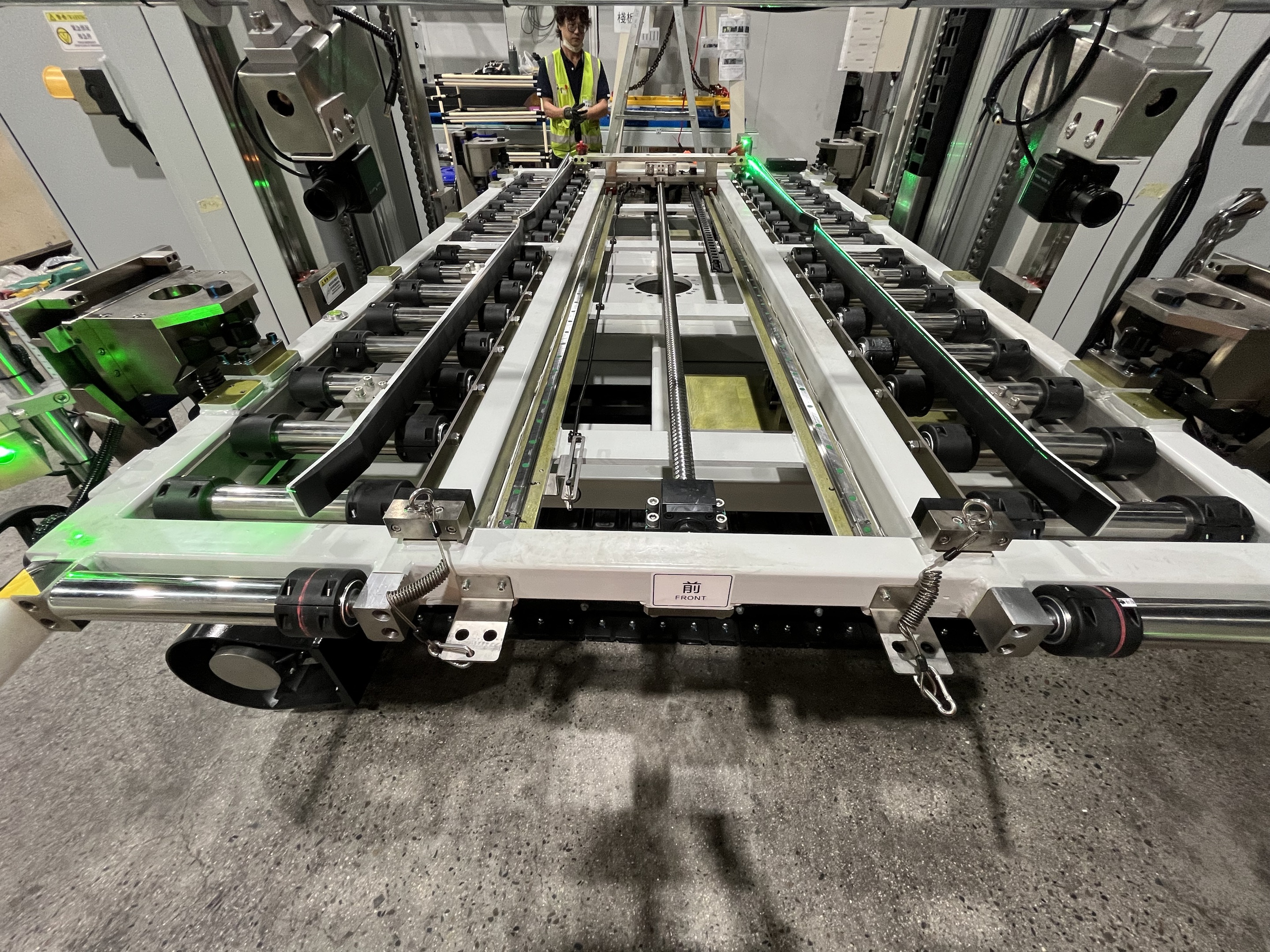
- RD16 (AGV-driven): compatible with 280/314/587 Ah cells and 1P52S/1P104S PACKs. Hoisting range is 1.05~3.4 m (customizable); hoisting speed is 100 mm/s.
- ZZX2508 (rail-fixed): compatible PACK length 1100~2200 mm, width 780~1260 mm, height 230~260 mm.
- ZZX2524 (rail-fixed): gripper changeover time under one minute, which matters when a single line runs multiple PACK formats.
- ZZX2522 (crawler-driven): hoisting range 0.8~3.4 m (customizable).
For payload, Zonzsin's published product documentation specifies support for load capacities up to 1500 kg, with 5-DOF docking capability for standard 20 ft / 40 ft container racks. In the visible product range, the ZZX2524 and ZZX2522 both carry a 1500 kg rating.
If your PACK drawing falls outside these ranges, the correct move is to request a fixture-adaptation review. The project scenario data explicitly lists PACK compatibility and fixture adaptation as special requirements for this equipment class.
Dimension 4: Production mode and line integration
Determine whether your line runs continuous shift production or batch production. The application scenario for these robots covers continuous and shift production, batch and continuous production, fully automatic moving and PACK insertion, cycle time improvement, and intelligent production line construction.
The RD16, for example, functions to improve cycle time and enable batch and continuous production in energy storage container lines. It operates in manual and remote controller modes, which is useful during commissioning and maintenance.
Check the surrounding equipment ecosystem. The reference scenario includes a container, docking roller, gripper, transfer AGV, working desk, material rack, platform ladder, PLC, and MES. If your line is managed by a MES system, the insertion robot must be able to communicate with the line controller. This is an integration requirement, not an option.
Dimension 5: Environment and safety requirements
Container assembly areas have specific working conditions. The application scenario specifies a temperature range of 20~30°C and continuous or shift production. Special requirements include ESD protection, fire prevention measures, temperature and humidity control, and cleanliness control.
A platform that carries battery PACKs into a confined container must be evaluated for these conditions before selection. For example, all-terrain mobility is required for outdoor yards with uneven floors, while an indoor fixed line can rely on the stability of a ground rail.
Step-by-step: how to run the fit assessment
The assessment can be completed by an engineering team during a short site survey. Work through the steps below and record the data; the output is a platform candidate list that can be sent to the manufacturer for configuration review.
- Survey the site. Record whether the insertion station is indoor or outdoor, the floor flatness, the available working area, and whether a fixed ground rail can be installed. If the floor is uneven or the machine must move between multiple containers, mark the AGV or crawler option.
- Measure the container door opening angle and internal rack dimensions. Verify the door opening angle against the ≥150° requirement, and compare container length, width, and height against the ZZX2508 envelope (L 6058~7000 mm, W 2438~2700 mm, H 2896~3000 mm).
- Document the PACK data. Record cell type (e.g., 280/314/587 Ah), PACK configuration (e.g., 1P52S/1P104S), PACK length, width, height, weight, and rack depth. Compare against the compatibility ranges and the 1500 kg load ratings.
- Define the production mode. State whether the line runs continuous shift production or batch production, and capture the target cycle time. This determines the need for fully automatic motion and for gripper changeover speed (under one minute on the ZZX2524).
- Check environment and safety provisions. Confirm ESD protection, fire prevention measures, temperature and humidity control, and cleanliness requirements. Note whether the machine must operate in the 20~30°C range.
- Select the platform and configuration. Map the recorded data to the rail-fixed, AGV-driven, or crawler-driven platform. Then move into configuration review with the supplier — Zonzsin supports OEM/ODM and customization of cycle time, automation level, logo, color, and configuration.
Use cases: what the fit looks like in real deployments
This equipment type is most commonly deployed in China, France, South Korea, Sweden, Taiwan, and the United States. Three Zonzsin deployments show how the fit logic works in practice.
China: rail-fixed robot for a continuous single-station line
A Chinese energy storage system integrator — whose client profile also includes battery cell and PACK manufacturers and EPC turnkey contractors — deployed one ZZX2524 rail-fixed battery PACK insertion robot. The application was continuous PACK insertion with stable PACK loading and fully automatic PACK insertion. After two years of operation, the result was stable operation and improved efficiency. The deployment highlights were the stable and fixed ground rail for safe working, a dual-layer material rack for space utilization, and versatile module options.
Korea: crawler-driven robot for an outdoor yard
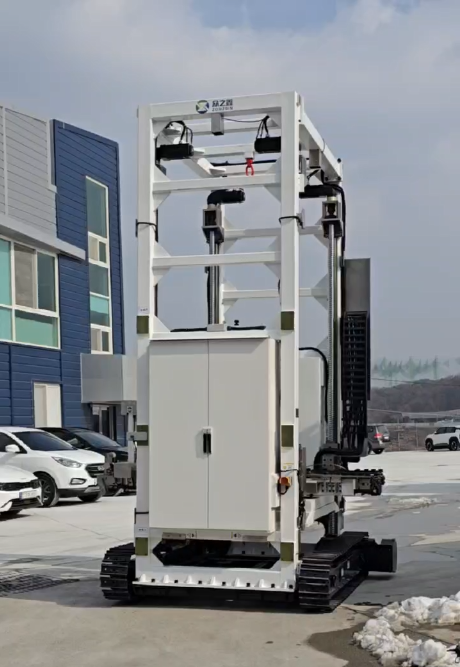
A Korean energy storage integrator deployed one ZZX2522 crawler-driven battery PACK insertion and removal robot. The application was ESS battery PACK insertion into and removal from containers. The site was outdoor with an uneven working floor, which is exactly the condition the all-terrain crawler platform is specified for. The unit has been in stable operation for one year.
Taiwan: crawler-driven robot for mixed indoor and outdoor conditions
A Taiwanese integrator used one ZZX2522 for ESS battery PACK insertion and removal. The machine runs both indoors and outdoors, and the site has a complicated working floor. The crawler drive handles this floor condition, and the system supports both insertion and pull-out. The unit has operated stably for one year.
Platform comparison table
The table below summarizes the project-level specifications of the four Zonzsin models in the ESS battery pack insertion robot range. Values are taken directly from the published product and case data.
"—" means the value is not published in the source data for that model. Always verify dimensional fit with the supplier using your container and PACK drawings.
| Project condition / model | ZZX2508 (rail-fixed) | ZZX2524 (rail-fixed) | RD16 (AGV-driven) | ZZX2522 (crawler-driven) |
|---|---|---|---|---|
| Compatible container | L 6058~7000 mm; W 2438~2700 mm; H 2896~3000 mm | — | — | — |
| Container door opening | ≥150° | ≥150° | — | — |
| PACK / cell compatibility | PACK L 1100~2200 mm; W 780~1260 mm; H 230~260 mm | Double-layer racks | 280/314/587 Ah cells; 1P52S / 1P104S PACKs | — |
| Load capacity | — | 1500 kg | — | 1500 kg |
| Hoisting range | — | — | 1.05~3.4 m (customizable) | 0.8~3.4 m (customizable) |
| Hoisting speed | — | — | 100 mm/s | — |
| Working floor | Fixed rail | Fixed ground rail | AGV-driven mobile platform | All-terrain |
| Leveling method | — | — | — | Manual handwheel leveling |
| Gripper changeover time | — | < 1 min | — | — |
| Power / compressed air | AC380V±10%, 50±2 Hz; air 0.5~0.8 MPa | — | — | — |
| Reference deployment | — | China, 2 years, continuous PACK insertion | — | Korea and Taiwan, 1 year each, outdoor / complicated floor |
FAQ
Which safety and compliance standards affect an ESS battery pack insertion robot project in North America or the EU?
For North American projects, energy storage systems are typically assessed against UL 9540, the Standard for Energy Storage Systems and Equipment, which covers the safety of enclosures and moving parts. In the EU, containerized BESS equipment must meet CE requirements under Regulation (EU) 2023/1542, and automated handling equipment is also covered by the Low Voltage Directive and the Machinery Directive. Zonzsin supplies insertion robots to EU and USA markets, performs 100% functional testing before shipment, and provides remote support and on-site installation and commissioning after delivery.
How do I know whether the robot can handle my PACK dimensions, weights, and container rack layout?
Confirm three values before selection: your container's internal envelope, your PACK dimensions, and your PACK weight. The ZZX2508 rail-fixed robot is specified for containers with length 6058~7000 mm, width 2438~2700 mm, and height 2896~3000 mm, and for PACKs with length 1100~2200 mm, width 780~1260 mm, and height 230~260 mm. The RD16 AGV-driven robot supports 280/314/587 Ah cells in 1P52S and 1P104S PACK configurations. Load capacity reaches 1500 kg on the ZZX2524 rail-fixed and ZZX2522 crawler-driven models. If your line runs mixed PACK formats, the ZZX2524 gripper changeover time of under one minute is the specification to check. Sending your PACK drawing and container drawing to the manufacturer for a fit review is the recommended first step.
What drives the budget difference between rail-fixed, AGV-driven, and crawler-driven insertion robots?
Budget is mainly determined by the chassis and the ground preparation. A rail-fixed machine operates on a fixed ground rail, which is generally a lower-cost structure when the line position is permanent. An AGV-driven machine adds mobile positioning and control, which suits projects where the robot must serve multiple positions. A crawler-driven machine adds an all-terrain chassis for outdoor or uneven floors, which typically reduces floor preparation cost but increases machine-side complexity. Zonzsin reports that its modular design lowers maintenance expenditure by 20%, which is relevant when comparing lifecycle cost for continuous production lines. Because configurations vary, a comparable budget estimate requires a spec-based quote rather than a list price.
Can we inspect a unit or request a demonstration before ordering?
Zonzsin operates with a minimum order quantity of one unit, so a first project unit can serve as the validation step for a larger line. The manufacturer supports OEM/ODM requests and customization of cycle time, automation level, logo, color, and configuration. To arrange a technical review, a facility visit, or a specification check for your container and PACK drawings, contact Katty.liu at katty.liu@zonzsin.com or +86 134-8282-9368.
What is the typical lead time after the project specification is confirmed?
The typical lead time is two to four months, with a monthly production capacity of about three units. Each unit passes 100% testing before shipment, and delivery includes remote support and on-site installation and commissioning. To obtain a delivery schedule for your configuration, send the confirmed container and PACK specification to Zonzsin for an order plan.
Conclusion
Project fit is not a preference; it is a calculation. The floor decides whether the machine should be rail-fixed, AGV-driven, or crawler-driven. The container envelope and door angle decide whether the ZZX2508 or ZZX2524 can reach the racks. The cell and PACK format decide the gripper, fixture, and compatibility envelope. The production mode decides the level of automation. The environment decides ESD, fire, temperature, humidity, and cleanliness provisions.
Shanghai Zonzsin Intelligent Equipment Co., Ltd. covers all three platform families in one range. Since 2019, the company has delivered these systems from a 6000 m² facility with 90 employees and 43 R&D engineers, with an annual output capacity of 40 units and exports mainly to Southeast Asia and the EU. It holds 50 granted patents, including invention patents for the AGV-driven battery PACK insertion robot, and reports 20% lower maintenance expenditure through modular design.
Next step: run the fit assessment on your data. Download the Zonzsin product brochure, or contact Katty.liu at katty.liu@zonzsin.com / +86 134-8282-9368 (WhatsApp) with your container and PACK drawings for a configuration review. Visit www.zonzsin.com for the full equipment range.