
Space-Constrained EV/ESS Plants: U-Shape Pack Assembly Line
When floor area rather than capital is the binding constraint, layout geometry becomes the engineering decision. Zonzsin's U-shape automatic battery pack assembly line, offered as models ZZX2406 and ZZX2501 for CTP and Blade pack builds, is specified inside a 58,000 × 11,000 × 3,800 mm envelope and rated at 6 PPM with 30 minutes per pack, a ≥95% single-machine operation rate, ≥99.5% one-time welding qualification and ≥99.95% final welding qualification. Its utility requirements are AC 380 V ±10%, 50 +0.5 Hz and compressed air at 0.6~0.8 MPa.
Shanghai Zonzsin Intelligent Equipment Co., Ltd. is a manufacturer founded in 2019 that builds automatic battery pack assembly lines and ESS battery pack insertion robots for containers. This guide is written for EV and ESS manufacturers that have already decided to automate pack assembly and are now in execution: confirming that the line fits the building, that the building services match the specification, and that the performance figures can be verified at acceptance and supported after installation.
Why a pack line runs out of space before it runs out of capacity
Space problems in battery pack assembly are usually inherited rather than designed. A plant built for module-based packs, or for a smaller cell format, comes with a fixed column grid, a fixed ceiling height and one shared logistics aisle. A conventional straight-line layout then demands a long linear run: infeed at one end of the bay, end-of-line test at the other, and every station in between competing for the same aisle width.
Three consequences appear after installation rather than in the quotation. Material travel grows, because cells enter and finished packs leave at opposite ends of the building. Operator positions spread along the full run, which lengthens supervision and changeover coordination. And the line claims a bay that may be the only remaining space for extra capacity, a repair area or a finished-goods buffer. Once the line is installed, that claim is difficult to reverse, which is why footprint belongs in the long-term part of a supplier decision and not only in the layout drawing.
What CTP and large prismatic cells change
Cell-to-pack (CTP) architectures assemble cells directly into the pack structure, so the pack itself becomes the unit the line handles and the module stage no longer dictates the layout. Blade formats change cell geometry and the stacking sequence again. Zonzsin's line is configured for CTP and Blade builds, and its CTP configuration is specified for 314Ah and 587Ah prismatic cells, with a republished specification listing a 1P96S pack configuration. For a constrained building the practical effect is that one footprint has to accommodate more than one cell format over the life of the line — a layout question as much as a specification question.
Where the 58,000 × 11,000 mm envelope comes from
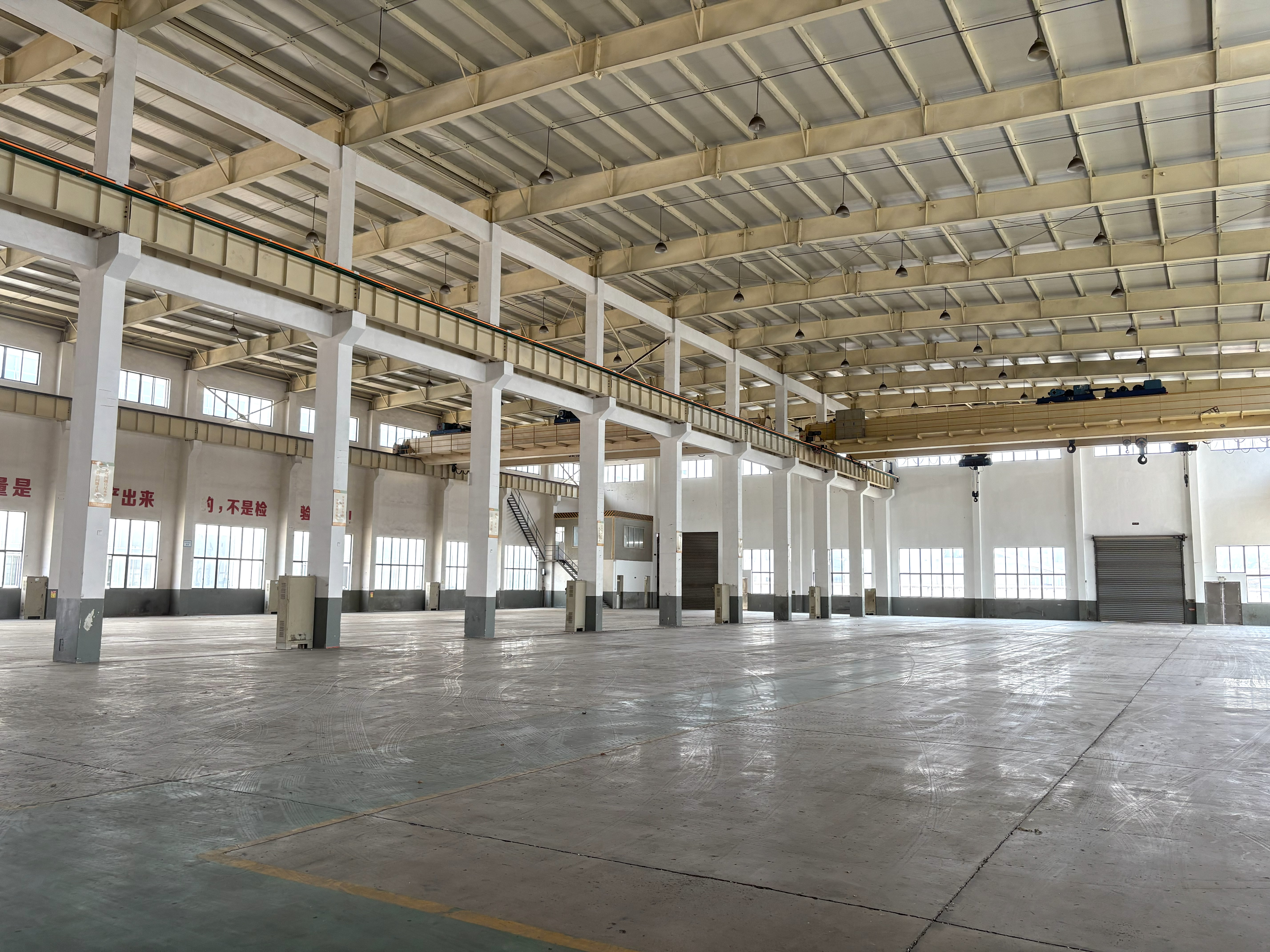
The stated footprint is 58,000 × 11,000 mm with a height of 3,800 mm, which is a 58 m by 11 m rectangle — about 638 m² of reserved floor area if the whole rectangle is kept clear (calculated from the stated length and width). Two dimensions matter more than the total. The 11 m width has to hold both legs of the U plus the operator and logistics zone between them. The 3.8 m height sets the clearance available above the line for lifting equipment, cable trays and ducting.
A U-shape returns the infeed and the outfeed to the same side of the layout, so cells and finished packs can share one material entry point and one aisle, and the line does not cross the rest of the building. That is the space argument for the geometry. It is also an operational argument: a single entry point is easier to control for cell traceability, ESD discipline and finished-goods handling than two distant ends of a bay.
Cycle-time claims need a reference point before they can be compared. Category specifications published by suppliers in this segment cite 4 to 8 PPM for high-efficiency CTP lines handling large prismatic cells, so a quoted PPM figure is comparable to another supplier's only once the measurement point is defined — packs per minute or modules per minute, at line output or at the bottleneck station.
What the U-shape automatic battery pack assembly line includes
The line covers the pack assembly scope in one integrated flow rather than as separate stations: cell feeding, stacking, insulating, wire harness installation, end-of-line (EOL) test and charging/discharging test.
| Specification | Stated value |
|---|---|
| Model designations | ZZX2406 / ZZX2501 (CTP and Blade pack builds) |
| Footprint (L × W × H) | 58,000 × 11,000 × 3,800 mm |
| Power supply | AC 380 V ±10%, 50 +0.5 Hz |
| Compressed air | 0.6~0.8 MPa |
| Throughput | 6 PPM; 30 minutes per pack |
| Single-machine operation rate | ≥95% |
| One-time welding qualification | ≥99.5% |
| Final welding qualification | ≥99.95% |
| Process scope | Cell feeding, stacking, insulating, wire harness installation, EOL test, charging/discharging test |
| Cell compatibility (CTP configuration) | 314Ah and 587Ah prismatic cells; 1P96S pack configuration listed in republished specification |
| Quality certification cited | ISO 9001 |
Values as specified by the manufacturer. Confirm the measurement point and test method of each performance figure in the acceptance protocol.
Utilities: what the building has to deliver
Two specifications drive most of the site preparation. AC 380 V ±10% and 50 +0.5 Hz define the supply the line expects, so the plant should verify voltage and frequency tolerances at the line's own panel rather than only at the main incomer. Compressed air at 0.6~0.8 MPa has to be available at the point of use, which normally means checking dryer and filter performance and measuring pressure at the farthest station instead of at the compressor outlet.
Operation rate and welding rates answer different questions
Three figures in the specification measure three different things. The ≥95% single-machine operation rate describes how reliably individual stations run. The ≥99.5% one-time welding qualification and the ≥99.95% final welding qualification describe welding quality at two separate points in the process and are not the same metric. In a compressed layout the distinction becomes practical rather than technical: with less buffer between stations, a stopped machine has a shorter queue behind it to absorb the interruption, so station availability directly affects whether the 6 PPM and 30-minute-per-pack figures hold in production and not only in a demonstration run.
Safety design inside a tighter envelope
A compressed layout shortens walkways and brings operators closer to moving mechanisms, so guarding and interlocks carry more weight than they do in a long straight line. Zonzsin's stated control measures for battery safety, short circuit and overheating risks are protective design and interlocks, safety sensors, and ESD grounding and protection, supported by process risk assessment and test stations. For a buyer in execution, those items belong in the FAT checklist and the maintenance plan as well as in the safety file.
Step-by-step: executing the fit
The sequence below follows the order in which a footprint-constrained project usually fails: the building is measured last, the utilities are discovered late, and the acceptance criteria are written after the equipment has arrived.
- Reserve the envelope before the layout is drawn. Measure the bay against the 58,000 × 11,000 × 3,800 mm requirement, including column positions, the rigging path for the largest sub-assembly, and clearance for overhead services. A bay that measures 11 m between column faces is not an 11 m bay once cable trays and walkways are added.
- Confirm the utility interface in writing. Record measured voltage, frequency and air pressure at the proposed connection points during the site survey, and agree who is responsible for the transformer, dryer, receiver and piping between the plant supply and the line. The line expects AC 380 V ±10%, 50 +0.5 Hz and 0.6~0.8 MPa air; a site that meets those values at the compressor but not at the line has not met them.
- Zone the U before fixing the station count. Place infeed and outfeed at the open end, keep test stations where a failed pack can be removed without crossing the main flow, and decide where buffers sit. In a U-shape the buffer positions are the lever that turns a station stop into a recoverable delay instead of a line stoppage.
- Write every performance figure into the acceptance protocol with a measurement point. The 6 PPM and 30-minute-per-pack figures, the ≥95% single-machine operation rate and the two welding qualification rates should each have a defined station boundary, sample size and inspection method before testing starts. Acceptance criteria offered for the line are FAT and online FAT.
- Schedule installation and commissioning against real lead time. Typical production lead time is 3 to 5 months, monthly production capacity is 3 units, and the minimum order quantity is 1 unit. After-sales services include remote support and on-site installation and commissioning, so the site window, utility connection and operator training can be planned as one sequence rather than three separate events.
- Plan the lifecycle before the order is placed. Ask for the spare-parts list, calibration intervals and remote diagnostic access, and confirm the maintenance expectation in writing; the manufacturer states that its modular design approach targets 20% lower maintenance expenditure. Because the footprint is fixed, any later capacity step has to be planned inside the 58 m × 11 m envelope or in a new bay — a decision better made while the layout is still open.
Fit check at a glance
| Building constraint | What to confirm before signing | Specified value |
|---|---|---|
| Floor area | Reserved rectangle including walkways, buffers and maintenance access | 58,000 × 11,000 mm (about 638 m², calculated) |
| Headroom | Clearance for lifting equipment, cable trays and ducting | 3,800 mm height |
| Power quality | Voltage and frequency measured at the line panel | AC 380 V ±10%, 50 +0.5 Hz |
| Compressed air | Pressure measured at the farthest point of use | 0.6~0.8 MPa |
| Throughput definition | Whether PPM counts packs or modules; which station boundary sets per-pack time | 6 PPM; 30 minutes per pack |
| Station stability | Buffer design behind stations that can stop | ≥95% single-machine operation rate |
| Weld quality | Sample size and inspection method | ≥99.5% one-time; ≥99.95% final |
| Order timing | Production slot as well as delivery date | 3 to 5 months; 3 units per month |
Where the configuration fits: three execution scenarios
EV traction pack production in an existing building
Retrofit projects are the clearest case for a U-shape. The column grid and logistics aisle already exist, so the question is whether the line can be installed without displacing warehouse or repair space. Reserving a 58 m by 11 m rectangle and confirming 3.8 m of height is a faster feasibility test than re-planning the building, and a single material entry point keeps cell receiving and finished-pack dispatch in one controlled area.
Stationary storage pack assembly
ESS pack assembly uses the same line envelope with different pack architectures and volumes. Zonzsin's published compatibility for its EV pack assembly line range lists 280/314/587Ah cells with 1P52S/1P104S pack configurations, while the CTP configuration is specified for 314Ah and 587Ah cells. For an ESS producer the practical check is which cell format and pack configuration the U-shape model will be built for, and how much changeover that requires inside the same footprint.
A completed India project
Zonzsin cites a completed project in India as evidence that the EV/ESS pack assembly scenario has been delivered and commissioned. Buyers evaluating a similar market should request the acceptance documentation, the installed configuration and a reference contact through the vendor, and compare those against their own cell format and utility conditions rather than relying on the case description alone.
The long-term cost of a footprint decision
A pack assembly line usually outlives the pack it was bought for. Cell formats move — the CTP specification already covers 314Ah and 587Ah — pack configurations change between EV and stationary storage, and production volumes rarely stay at the figure used in the original business case. The envelope and the utility specification are the parts of the design that cannot be revised cheaply later, which is why they need margin from the start.
Supplier continuity matters for the same reason. Shanghai Zonzsin Intelligent Equipment Co., Ltd. was founded in 2019, operates a 6,000 m² facility with 90 employees, including a 43-engineer R&D team, and states that it holds 50 granted patents, including invention patents for AGV-driven battery pack insertion robots. The company reports a 60% export ratio, main markets in Southeast Asia and the EU, and users in Europe, the USA, Japan, South Korea and India, with company-reported capacity of 30 to 40 battery assembly lines per year. These are first-party statements that are useful for screening, and they should be verified in the same way as the line specification.
Support terms decide what happens after commissioning. Remote support and on-site installation and commissioning are stated after-sales services, quality control follows 100% testing, and the manufacturing system is cited as ISO 9001 certified. Combined with a 3 to 5 month typical production lead time, a monthly capacity of 3 units and a minimum order quantity of 1 unit, these terms set both the project schedule and the response time available during ramp-up.
FAQ
Is the U-shape line certified, and what acceptance evidence is provided?
Zonzsin cites ISO 9001 certification and states that quality control follows 100% testing. Acceptance criteria for the line are FAT (factory acceptance testing) and online FAT, so the specified figures — 6 PPM, 30 minutes per pack, ≥95% single-machine operation rate, ≥99.5% one-time welding qualification and ≥99.95% final welding qualification — can be tested against a written protocol instead of accepted from a datasheet. The protocol should define the measurement point for each figure before testing begins.
Can one U-shape line serve both CTP and Blade builds and 314Ah or 587Ah cells?
The line is offered as models ZZX2406 and ZZX2501 for CTP and Blade pack builds, and its process scope covers cell feeding, stacking, insulating, wire harness installation, end-of-line test and charging/discharging test. The CTP configuration is specified for 314Ah and 587Ah prismatic cells, with a republished specification listing a 1P96S pack configuration, and Zonzsin's published compatibility for its EV pack assembly line range also lists 280/314/587Ah cells with 1P52S/1P104S packs. Cell format, pack configuration and the changeover time required between them should still be confirmed in the RFQ for the exact model.
What budget range should be planned for a space-constrained U-shape line?
Published commercial listings for complete turnkey CTP battery pack production lines quote US$1,000,000 to US$3,000,000 per set, which is a marketplace range rather than a project quotation. Zonzsin's purchasing terms state a minimum order quantity of 1 unit, delivery terms of EXW Shanghai, FOB Shanghai or FCA Shanghai, and payment of 50% in advance by T/T with the 50% balance within three business days after the bill of lading date. Building works, utility upgrades and site preparation sit outside the line price and should be budgeted as a separate item.
Can performance be validated before the full line is committed?
Validation on this equipment runs through acceptance testing rather than a product sample. The minimum order quantity is 1 unit, and acceptance criteria include FAT and online FAT, with 100% testing stated for quality control. To make the validation meaningful, the FAT protocol should fix which station boundary defines the 30-minute per-pack time, whether the 6 PPM figure counts packs or modules, and how weld samples are drawn and inspected for the ≥99.5% one-time and ≥99.95% final welding figures. A completed project in India is cited by the manufacturer as evidence that the CTP pack assembly scenario has been delivered and commissioned.
What is the lead time, and what support continues after installation?
Typical production lead time is 3 to 5 months, with a monthly production capacity of 3 units, so the order slot — not only the delivery date — sets the project timeline. After-sales services include remote support and on-site installation and commissioning. Because the footprint and utility specification are fixed at 58,000 × 11,000 × 3,800 mm, AC 380 V ±10%/50 +0.5 Hz and 0.6~0.8 MPa air, the site survey and services connection should run in parallel with production rather than after delivery. The line brochure is available for download, and questions on a specific layout can be sent to katty.liu@zonzsin.com or +86 134-8282-9368.
Conclusion: verify the envelope, then the numbers
For a plant whose limiting factor is floor area, the U-shape automatic battery pack assembly line turns layout into a decision that can be checked instead of assumed. The constraints are explicit: 58,000 × 11,000 × 3,800 mm of reserved space, AC 380 V ±10%/50 +0.5 Hz, 0.6~0.8 MPa compressed air, 6 PPM with 30 minutes per pack, ≥95% single-machine operation rate, ≥99.5% one-time welding qualification and ≥99.95% final welding qualification, supported by ISO 9001 certification and a completed India project.
Execution risk sits in the handover points between those facts and the building: measured utility values rather than nameplate values, buffers placed where a stopped station can recover, and acceptance tests with defined measurement points. A footprint-constrained project fails on those details long before it fails on the headline specification.
Next step
Download the product brochure (PDF) for the full line specification, or send your bay dimensions and cell format to the Zonzsin team for a fit review.
Email: katty.liu@zonzsin.com | Tel / WhatsApp: +86 134-8282-9368 | www.zonzsin.com
Have Questions or Need More Details?
Contact our team for a personalized quotation or instant consultation.
Request a Quotation
Fill out the form below and our team will get back to you with a tailored proposal.
WhatsApp Direct Chat
Prefer to chat in real-time? Message us on WhatsApp for instant assistance & quick answers.
- Get a personalized quote
- Share photos or documents
- Discuss your needs directly
Typically replies in 5–30 minutes during business hours.