
Technical Parameter Guide: ESS Battery Pack Insertion Robot for Containers
Six parameter groups decide whether a container ESS battery pack insertion robot will actually fit a production line: drive configuration, load capacity, hoisting performance, container interface geometry, PACK compatibility, and construction and utility requirements. This guide maps each group to the published specifications of the Zonzsin RD16, ZZX2508, ZZX2524 and ZZX2522, and shows how an engineering or procurement team can check them against a real containerised energy storage project before a purchase order is issued.

This guide is written for the people who sign off on a container stuffing line rather than for a general audience: energy storage system integrators, battery cell and PACK manufacturers, EPC turnkey contractors, and the industrial engineers who have to reconcile a robot's datasheet with a container yard that already exists. It assumes you already know that insertion robots exist and that you need to decide which numbers matter.
Problem Definition: Why Parameter Mismatch Stops a Container Pack Insertion Line
In containerised energy storage assembly, the robot does not fail because of a weak motor. It fails because one of six interfaces was never checked. A container that measures a few millimetres outside the handling envelope, a PACK that grew between design and delivery, a floor slab that cannot carry a rail foundation, or a power cabinet that delivers the wrong frequency will each stop a line regardless of how good the machine is.
The four failure modes that appear most often in container ESS projects are dimensional, mechanical, electrical and process-related:
- Dimensional mismatch. Insertion equipment is specified against a container family, not against a single box. Container internal lengths, widths and heights vary across the fleet, and a machine validated on one unit may not clear the door frame on another.
- PACK envelope drift. PACK length, width and height differ between cell formats and between 1P52S and 1P104S architectures. A gripper that works for one PACK may not work for the next production run.
- Floor and mobility constraints. A rail-fixed machine needs a prepared ground rail. A crawler-driven machine is intended for uneven or outdoor surfaces. An AGV-driven machine moves on its own chassis. Choosing the wrong one creates civil works that were never budgeted.
- Utility and process gaps. Voltage, frequency, compressed air supply, ESD protection and fire prevention measures are all specified before installation, not discovered during commissioning.
There is also a documentation problem that buyers should treat as a parameter in its own right. Technical values for this equipment class are commonly published by the manufacturer. Where a machine's specification also appears on third-party reseller listings, the two sets of figures do not always agree. The practical rule is that a priced configuration should reference one current, dated manufacturer datasheet, and that any figure used in an acceptance test should be traceable to that document.
Industry Background: Container ESS Assembly Is Moving to Automated Insertion
Containerised battery energy storage has shifted from a low-volume, project-by-project build to a repeatable production activity. That shift changes what buyers want from the insertion step: not a one-off lifting solution, but equipment that supports batch and continuous output on a container line.
Two external signals support this. Industry reporting on mobile robots in industrial settings, such as the PMMI and Interact Analysis Robotics in US Packaging & Processing Report 2026, tracks the wider adoption of AMR and AGV platforms in production environments. In parallel, the European Union's Regulation (EU) 2023/1542 on Batteries and Waste Batteries provides the legal framework that many battery-related equipment projects reference during qualification. Neither signal defines a specification, but together they explain why container ESS lines are being specified with documented, checkable parameters instead of site-by-site improvisation.
The manufacturer whose specifications are used as the worked example throughout this guide is Shanghai Zonzsin Intelligent Equipment Co., Ltd., a Chinese intelligent equipment manufacturer founded in 2019 that supplies lithium battery manufacturers, energy storage integrators and automotive OEMs. Zonzsin's stated main products are the ESS Battery Pack Insertion Robot for Containers and automatic battery PACK assembly lines, and the company reports a 6000 m² facility, roughly 90 employees, an R&D team of 43 engineers, and an annual output of about 40 units. Its official site is www.zonzsin.com.
The Six Parameter Groups That Decide System Fit
1. Drive Configuration: AGV, Rail-Fixed or Crawler
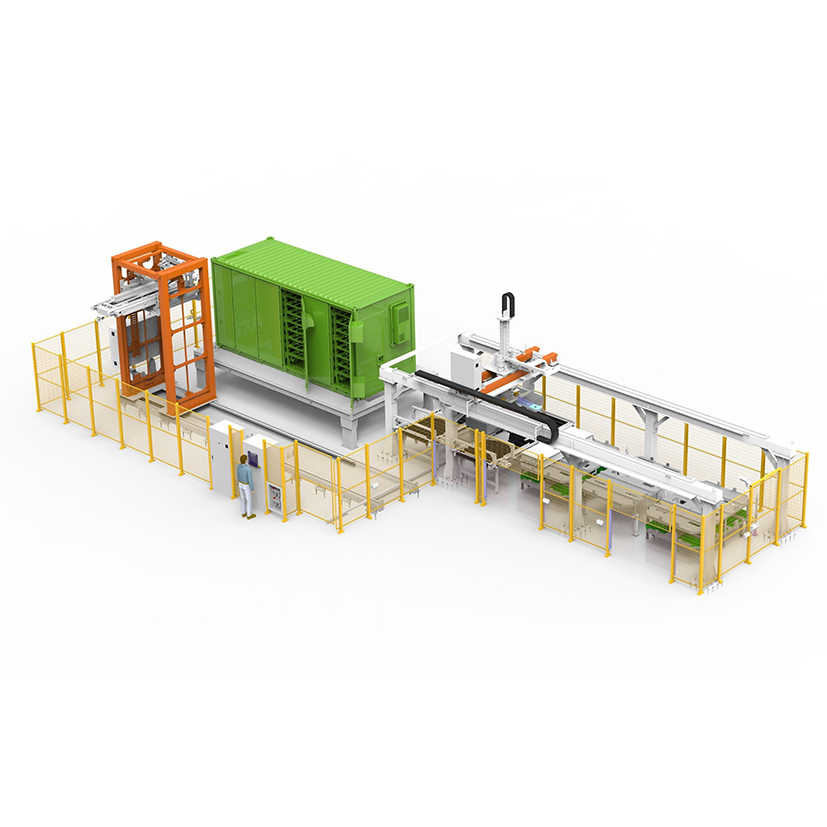
Drive configuration is the first decision because it determines everything downstream, including civil works, cycle rhythm and where the machine can physically operate. Zonzsin's container insertion portfolio separates into three drive types.
AGV-driven battery pack insertion equipment for containers. The RD16 is an AGV-driven battery PACK insertion robot for containers with an overall machine footprint of L3100 × W2600 × H3800 mm, built in carbon steel. Because the chassis carries the machine, the platform offers high mobility and suits level production floors where the robot needs to reposition between containers or stations.
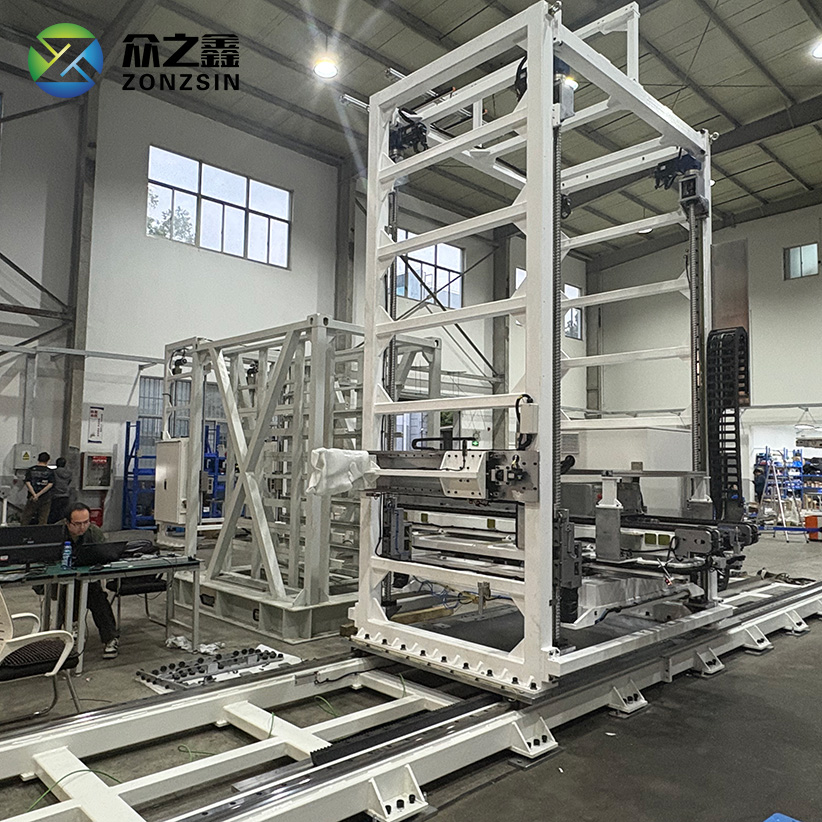
Rail-fixed battery pack insertion equipment for containers. The ZZX2508 and ZZX2524 are rail-fixed battery PACK insertion robots. Both are built in carbon steel / Q235. A fixed ground rail delivers the highest positional stability of the three drive types and is the natural choice for a dedicated container bay with a stable floor and a repeating container position.
Crawler-driven battery pack insertion machines for containers. The ZZX2522 is a crawler-driven battery PACK insertion and removal robot designed for all-terrain working floors. Its published specification includes a manual handwheel leveling function, which is what allows the machine to be set up on surfaces that a rail-fixed unit cannot use.
For sourcing teams, the selection logic is short: level floor plus maximum stability means rail-fixed; level floor plus repositioning need means AGV-driven; uneven, outdoor or temporary ground means crawler-driven. The verified comparison of the three drive types in this category reaches the same conclusion, describing rail-fixed units as the most stable but requiring ground installation, AGV-driven units as most mobile on level floors, and crawler-driven units as prioritised for outdoor and all-terrain sites.
2. Load Capacity and Payload Class
Load capacity sets the ceiling on the PACK formats a machine can handle and the safety margin available for fixture weight. In the Zonzsin container insertion range, the published figures are specific rather than family-wide:
- ZZX2524 (rail-fixed): load capacity 1500 kg.
- ZZX2522 (crawler-driven): load capacity 1500 kg.
- ZZX2508 (rail-fixed): the published specification covers container compatibility, PACK compatibility, compressed air and power, and does not state a load capacity figure. Buyers planning around this model should confirm the load rating for the exact configuration directly with the manufacturer.
- RD16 (AGV-driven): the published specification lists overall dimensions, cell and PACK compatibility, hoisting range and hoisting speed, and does not state a load capacity figure.
Heavy-duty ESS battery pack insertion systems in this class are rated around the 1500 kg mark, which is consistent with the PACK weights used in container-scale energy storage. The practical check is not the number on the datasheet alone; it is the number on the datasheet against the heaviest PACK your line will run, plus the gripper and fixture mass.
This is also where specification discipline matters most. Load-capacity figures for rail-fixed container insertion equipment have been published differently on a manufacturer's own product pages and on third-party reseller listings. The verified data set behind this guide flags exactly that kind of conflict and leaves it unresolved, with the explicit instruction not to merge the two values without verification. For a buyer, that is a signal to treat load capacity as a field that must be confirmed on a dated, model-specific document rather than pulled from a marketplace listing.
3. Hoisting Performance: Range and Speed
Hoisting range and hoisting speed together determine whether a robot can reach every rack level in a container and how long each vertical move takes. Both numbers are published for the AGV-driven and crawler-driven models.
- RD16 hoisting range: 1.05–3.4 m, customisable.
- RD16 hoisting speed: 100 mm/s.
- ZZX2522 hoisting range: 0.8–3.4 m, customisable.
A 100 mm/s hoisting speed is a positioning speed rather than a bulk-transfer speed, and that is the right way to read it. Insertion into a container rack is an alignment task: the PACK has to enter a rack slot without scraping the rack, the neighbouring PACK, or the container wall. A controlled vertical speed supports that alignment. Where a line needs higher throughput, the usual levers are gripper changeover time, the number of handling stations, and the automation level of the surrounding line rather than the hoisting speed itself.
Zonzsin also reports that robotic automated battery PACK loading can reduce container assembly cycle time compared with manual methods. That figure is supplier-reported and depends on PACK density and line configuration, so the defensible planning approach is to model the cycle from your own container layout and validate the result on site during commissioning.
4. Container Interface and Door Geometry
Container compatibility is the parameter group that most often surprises buyers, because it is expressed as a range rather than a single size. The ZZX2508 rail-fixed battery PACK insertion robot publishes the following compatible container envelope:
- Length: 6058–7000 mm
- Width: 2438–2700 mm
- Height: 2896–3000 mm
- Door opening angle: ≥150°
- Compressed air supply: 0.5–0.8 MPa
- Power: AC380V ±10%, 50 ±2 Hz
The lower bound of 6058 mm corresponds to the standard 20 ft container footprint. In practice, this means the same platform is specified for battery PACK insertion and loading equipment on 20 ft container racks and on longer footprints up to 7000 mm, across widths from 2438 mm to 2700 mm and heights from 2896 mm to 3000 mm. The ZZX2524 rail-fixed model publishes the same ≥150° door opening angle, which matters because the door swing determines whether the machine can present the PACK to the rack opening without fouling the container door leaf.
Two habit changes follow from these ranges. First, measure your actual container fleet rather than assuming a nominal size, because a 2700 mm width and a 2438 mm width are different working conditions. Second, include the door open angle in the site drawing, not just the container cube.
5. PACK Compatibility and Gripper Changeover
PACK compatibility in this equipment class is defined by two things: the physical envelope the machine can grip, and the cell and PACK architectures the line is built around.
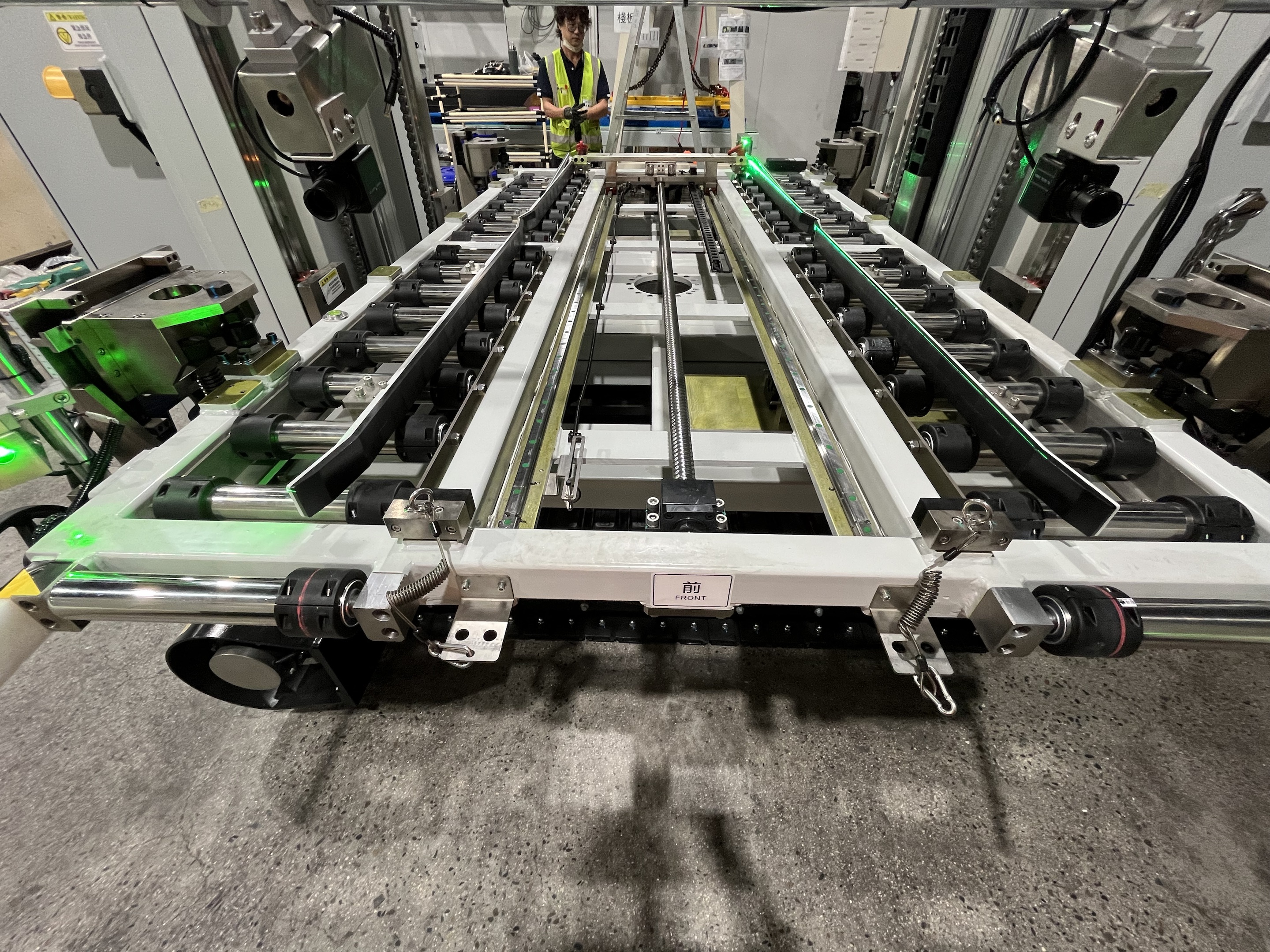
The ZZX2508 publishes a compatible PACK envelope of L1100–2200 mm, W780–1260 mm and H230–260 mm. The RD16 is specified for 280/314/587 Ah cells and for 1P52S and 1P104S PACKs, which places it on the higher-capacity end of current container ESS architectures.
Gripper changeover time is the parameter that connects PACK compatibility to real throughput. On the ZZX2524, gripper changeover is published as under one minute. For a line that alternates between PACK formats, a sub-minute changeover turns format switching from a shift-level event into a routine action. The ZZX2524 also publishes double-layer racks as a space-saving feature, which increases the number of PACK positions within the same footprint.
Where a project needs a gripper that does not exist yet, Zonzsin offers OEM/ODM customisation covering cycle time, automation level, logo, colour and configuration, with compatible fixture adaptation listed among the special requirements for container PACK insertion applications.
6. Construction, Power and Site Utilities
Construction and utility parameters are the least glamorous part of the specification and the most common cause of a delayed commissioning. The published values across the Zonzsin container insertion range are consistent:
- Construction material: carbon steel / Q235 on the ZZX2508, ZZX2524 and ZZX2522; carbon steel on the RD16.
- Power supply: AC380V ±10%, 50 ±2 Hz, published on the ZZX2508.
- Compressed air: 0.5–0.8 MPa, published on the ZZX2508.
- Operating condition: continuous or shift-based production, with a stated working temperature range of 20–30 °C for container PACK insertion applications.
- Special requirements: ESD protection, fire prevention measures, temperature, humidity and cleanliness control, and PACK compatibility or fixture adaptation.
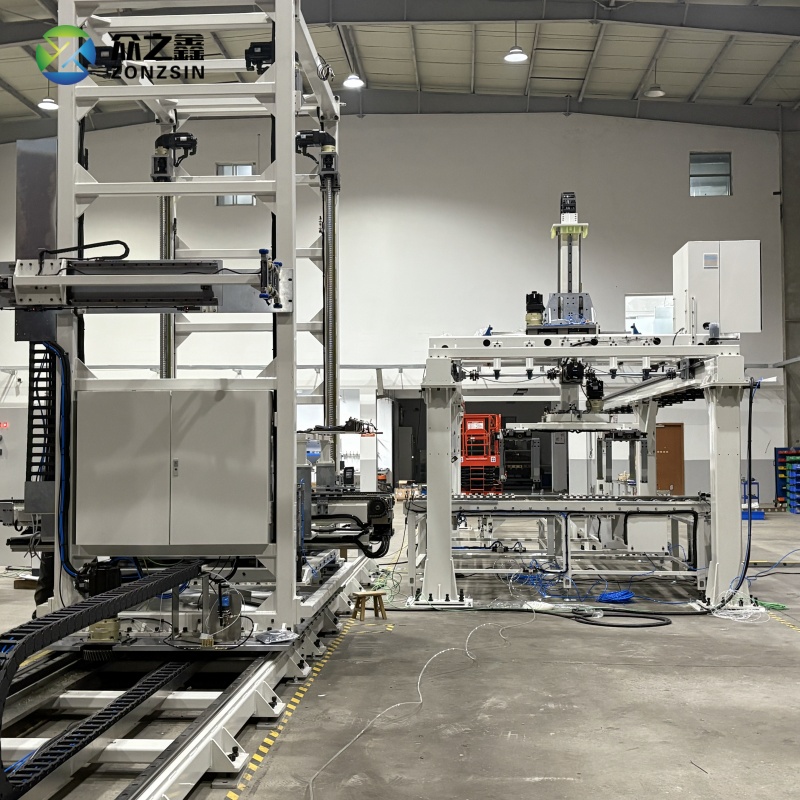
- Matched equipment: container, docking roller, gripper, transfer AGV, working desk, material rack, platform ladder, PLC and MES.
- Operation mode: manual and remote controller.
The matched-equipment list is a useful scope checklist. A container insertion robot is one node in a system that includes the container itself, the docking roller, the gripper, the transfer AGV, the material rack and the control layer. Buyers who specify only the robot and discover the PLC or MES interface requirement during installation end up paying for integration twice.
Step-by-Step: How to Run a Parameter Check Before Ordering
The following sequence converts the six parameter groups into a repeatable evaluation workflow. It is designed to be run with the manufacturer's engineering team, not around them.
- Measure the container fleet, not the container type. Record actual internal length, width and height for every container variant you intend to load. Compare the full set against the published compatible container envelope — for example 6058–7000 mm × 2438–2700 mm × 2896–3000 mm on the ZZX2508.
- Measure the PACK envelope across all formats. Record a maximum and minimum for length, width and height. Compare against the published compatible PACK range — L1100–2200 mm, W780–1260 mm, H230–260 mm on the ZZX2508 — and against cell and PACK architecture support such as 280/314/587 Ah cells and 1P52S/1P104S PACKs on the RD16.
- Confirm the floor condition and select the drive type. Level floor with a fixed bay points to rail-fixed ZZX2508 or ZZX2524. Level floor with movement between positions points to AGV-driven RD16. Uneven, outdoor or temporary ground points to the crawler-driven ZZX2522 with its all-terrain capability and manual handwheel leveling.
- Check the hoisting range against your highest and lowest rack level. Compare the rack stack height with the published hoisting range, for example 1.05–3.4 m on the RD16 or 0.8–3.4 m on the ZZX2522, and confirm whether a customised range is required.
- Check the door swing and approach space. Verify the container door opening angle requirement of ≥150° and confirm that the machine's approach path, whether on rail or on its own chassis, clears the door leaf and the surrounding bay.
- Verify power, air and environmental services. Confirm AC380V ±10%, 50 ±2 Hz and a compressed air supply of 0.5–0.8 MPa at the installation point, and confirm the temperature, humidity, cleanliness, ESD and fire prevention provisions required by the application.
- Lock the gripper strategy and the changeover target. Decide how many PACK formats the line will run, and confirm that the changeover time — under one minute on the ZZX2524 — supports the planned production rhythm.
- Request one dated, model-specific datasheet. Use that single document for the quote, the acceptance criteria and any later comparison. This step is what protects the project from the load-capacity discrepancies that appear between manufacturer pages and reseller listings.
Use Cases: Where These Parameters Have Been Applied
Container ESS pack insertion applications in this equipment range are documented across China, France, South Korea, Sweden, Taiwan and the United States, for ESS and commercial and industrial (C&I) energy storage projects.
Rail-fixed continuous insertion in China. An energy storage system integrator, battery cell and PACK manufacturer, and EPC turnkey contractor deployed a single ZZX2524-class rail-fixed unit for continuous PACK insertion and stable PACK loading on a fully automatic line. After two years of operation the reported result is stable operation with efficiency improving. The project highlights the fixed ground rail for safe working, the dual-layer material rack for space utility, and versatile module options.
Crawler-driven outdoor insertion in South Korea. A single crawler-driven unit was deployed for inserting ESS battery PACKs into containers and removing them again, in an outdoor setting with an uneven working floor. After one year of operation the reported result is stable operation, with the crawler drive identified as the factor that made the uneven floor workable.
Crawler-driven indoor and outdoor insertion in Taiwan. A single unit handled battery PACK insertion and pull-out in both indoor and outdoor conditions. Here too the crawler drive is the highlighted capability, addressing a complicated working floor rather than a clean bay.
Read together, the three cases map onto the drive-type logic described above. Where the bay was stable and the line was continuous, rail-fixed equipment was used. Where the working floor was the constraint, crawler-driven equipment was used instead, and the insertion and removal function — pulling a PACK back out of a container — proved as relevant as the initial loading function.
Comparison Table: RD16, ZZX2508, ZZX2524 and ZZX2522
The table below places the published parameters of the four Zonzsin container ESS battery pack insertion robot models side by side. Cells marked as not stated mean that the value does not appear in the published specification used for this guide and must be confirmed with the manufacturer for the exact configuration.
| Parameter | RD16 | ZZX2508 | ZZX2524 | ZZX2522 |
|---|---|---|---|---|
| Drive configuration | AGV-driven | Rail-fixed | Rail-fixed | Crawler-driven |
| Primary function | PACK insertion for containers | PACK insertion for containers | PACK insertion for containers | PACK insertion and removal |
| Construction material | Carbon steel | Carbon steel / Q235 | Carbon steel / Q235 | Carbon steel / Q235 |
| Machine footprint | L3100 × W2600 × H3800 mm | Not stated | Not stated | Not stated |
| Load capacity | Not stated | Not stated | 1500 kg | 1500 kg |
| Hoisting range | 1.05–3.4 m (customisable) | Not stated | Not stated | 0.8–3.4 m (customisable) |
| Hoisting speed | 100 mm/s | Not stated | Not stated | Not stated |
| Compatible container (L × W × H) | Not stated | 6058–7000 × 2438–2700 × 2896–3000 mm | Not stated | Not stated |
| Compatible PACK | 280/314/587 Ah cells; 1P52S / 1P104S PACKs | L1100–2200 × W780–1260 × H230–260 mm | Not stated | Not stated |
| Door opening angle | Not stated | ≥150° | ≥150° | Not stated |
| Gripper changeover | Not stated | Not stated | <1 minute | Not stated |
| Power and air | Not stated | AC380V ±10%, 50 ±2 Hz; compressed air 0.5–0.8 MPa | Not stated | Not stated |
| Floor requirement | Level floor for AGV travel; high mobility | Fixed ground rail required | Fixed ground rail required | All-terrain; manual handwheel leveling |
| Space handling | Not stated | Not stated | Double-layer racks | Not stated |
| Applicable industry | C&I; energy storage | Energy storage; C&I | Energy storage; C&I | Energy storage; C&I |
All figures in this table are manufacturer-published specifications for the named models. Independent third-party test validation of load capacity, hoisting range, hoisting speed and container compatibility for this equipment class was not available at the time of writing, which is why step 8 of the workflow above recommends anchoring the purchase on a single dated, model-specific datasheet.
Frequently Asked Questions
What compliance and documentation should accompany a container ESS battery pack insertion robot?
Documentation should be tied to the specific model and configuration, not to the product family. For projects supplying European battery applications, the reference framework is Regulation (EU) 2023/1542 on Batteries and Waste Batteries. At equipment level, buyers should request the current model datasheet, the utility requirements (on the ZZX2508 these are AC380V ±10%, 50 ±2 Hz and compressed air at 0.5–0.8 MPa), the declared construction material (carbon steel / Q235 on ZZX2508, ZZX2524 and ZZX2522), and commissioning records. Zonzsin applies 100% test quality control to delivered units and provides remote support plus on-site installation and commissioning, and it offers OEM/ODM customisation covering cycle time, automation level, logo, colour and configuration. Because published performance figures for this equipment class are generally manufacturer-reported, the documentation pack should be cross-checked against the physical acceptance test rather than accepted on its own.
Can a single insertion robot handle more than one PACK format?
Yes, within the published envelope, and the limits are explicit. The ZZX2508 rail-fixed robot accepts PACKs from L1100–2200 mm, W780–1260 mm and H230–260 mm. The RD16 AGV-driven robot is specified for 280/314/587 Ah cells and for 1P52S and 1P104S PACK architectures. The ZZX2524 rail-fixed robot supports gripper changeover in under one minute, which is what makes format switching practical inside a shift rather than between shifts. Where a required format sits outside these ranges, Zonzsin's OEM/ODM programme covers customisation of cycle time, automation, logo, colour and configuration, and PACK compatibility with fixture adaptation is listed as a standard special requirement for container insertion applications.
What drives the cost of a container ESS pack insertion robot project?
Cost is driven by the parameters in this guide rather than by a list price: the drive configuration (rail-fixed, AGV-driven or crawler-driven), the load capacity and hoisting range required, how wide the container and PACK compatibility envelope must be, the number of grippers and the changeover system, utility connections at the installation point, and whether the site needs a prepared ground rail. Choosing the crawler-driven ZZX2522 with its all-terrain capability and manual handwheel leveling instead of a rail-fixed machine is a floor-preparation decision as much as an equipment decision. Integration with PLC and MES, and any OEM/ODM customisation of cycle time or automation level, are additional cost variables. One practical cost-control point: published load-capacity figures for rail-fixed container insertion equipment have differed between manufacturer product pages and third-party reseller listings, so a priced configuration should always reference one current, dated manufacturer datasheet. Verifying that single document before quoting is part of controlling the project budget.
Is a single validation unit available before full line deployment?
A single-unit order is possible. Zonzsin publishes a minimum order quantity of 1 unit for this equipment range, with a monthly capacity of around 3 units and an annual output of about 40 units, so a first unit deployed on one container line before scaling is a realistic route. The crawler-driven ZZX2522 is also specified for both insertion and removal, which suits validation and repair workflows where PACKs must be pulled back out of a container. Lead time for such an order is 2~4 months.
What is the delivery and commissioning lead time?
The published lead time for the ESS battery pack insertion robot range is 2~4 months from order, against a monthly capacity of around 3 units and an annual output of about 40 units. Zonzsin reports that roughly 60% of production is exported, primarily to Southeast Asia and the EU, and the equipment is documented as deployed in China, France, South Korea, Sweden, Taiwan and the United States. After-sales support covers remote assistance plus on-site installation and commissioning. For a delivery schedule against a specific container line, contact Katty.liu at katty.liu@zonzsin.com, by phone or WhatsApp on +86 134-8282-9368, or request the product brochure from the link below.
Conclusion: Turning Published Specifications into a Signed-Off Configuration
A container ESS battery pack insertion robot is selected on six checkable parameter groups, not on a general impression of build quality. Drive configuration decides the civil works and the operating floor. Load capacity decides the PACK weight class — 1500 kg on the rail-fixed ZZX2524 and the crawler-driven ZZX2522. Hoisting range and speed decide rack coverage and alignment rhythm, with 1.05–3.4 m and 100 mm/s published on the AGV-driven RD16. Container and PACK compatibility decide whether the fleet you already own can be loaded, expressed for the ZZX2508 as containers from 6058–7000 mm × 2438–2700 mm × 2896–3000 mm and PACKs from L1100–2200 × W780–1260 × H230–260 mm. Gripper changeover under one minute on the ZZX2524 decides how often you can switch formats. Construction and utilities — carbon steel / Q235, AC380V ±10%, 50 ±2 Hz, compressed air 0.5–0.8 MPa — decide whether commissioning runs on schedule.
The step that separates a smooth installation from a contested one is the last one: anchor the order, the acceptance test and any later comparison on a single dated, model-specific datasheet, and confirm every figure on that document against the container, PACK and floor you actually have.
Next Step: Match a Configuration to Your Container Line
Send your container dimensions, PACK envelope and floor condition, and the Zonzsin engineering team can confirm which of the RD16, ZZX2508, ZZX2524 or ZZX2522 fits — and where an OEM/ODM configuration is needed instead.
Download the full product brochure with model specifications: Product Brochure (PDF)
Email: katty.liu@zonzsin.com | Tel / WhatsApp: +86 134-8282-9368 | Web: www.zonzsin.com
Shanghai Zonzsin Intelligent Equipment Co., Ltd. — Building 22, No.2199, Shebei Highway, Sheshan Town, Songjiang District, Shanghai, China.
Have Questions or Need More Details?
Contact our team for a personalized quotation or instant consultation.
Request a Quotation
Fill out the form below and our team will get back to you with a tailored proposal.
WhatsApp Direct Chat
Prefer to chat in real-time? Message us on WhatsApp for instant assistance & quick answers.
- Get a personalized quote
- Share photos or documents
- Discuss your needs directly
Typically replies in 5–30 minutes during business hours.