
Top 4 ESS Battery Pack Insertion Robots for Containers: ZZX2522, RD16, ZZX2508, ZZX2524 Ranked
An ESS battery pack insertion robot for containers is judged at the container door: can the machine reach the deepest rack position, hold the PACK level on the way in, and repeat the motion without a suspended load swinging inside a steel box? Zonzsin publishes four container-capable insertion robots, and they divide cleanly by drive type — one AGV-driven, two rail-fixed, one crawler-driven.
Shanghai Zonzsin Intelligent Equipment Co., Ltd. (Zonzsin) is a Shanghai-based manufacturer founded in 2019 that builds ESS Battery Pack Insertion Robots for Containers and automatic battery pack assembly lines. The company publishes 50 granted patents, including invention patents covering AGV-driven battery PACK insertion robots, and a 43-engineer R&D team behind its customization work.
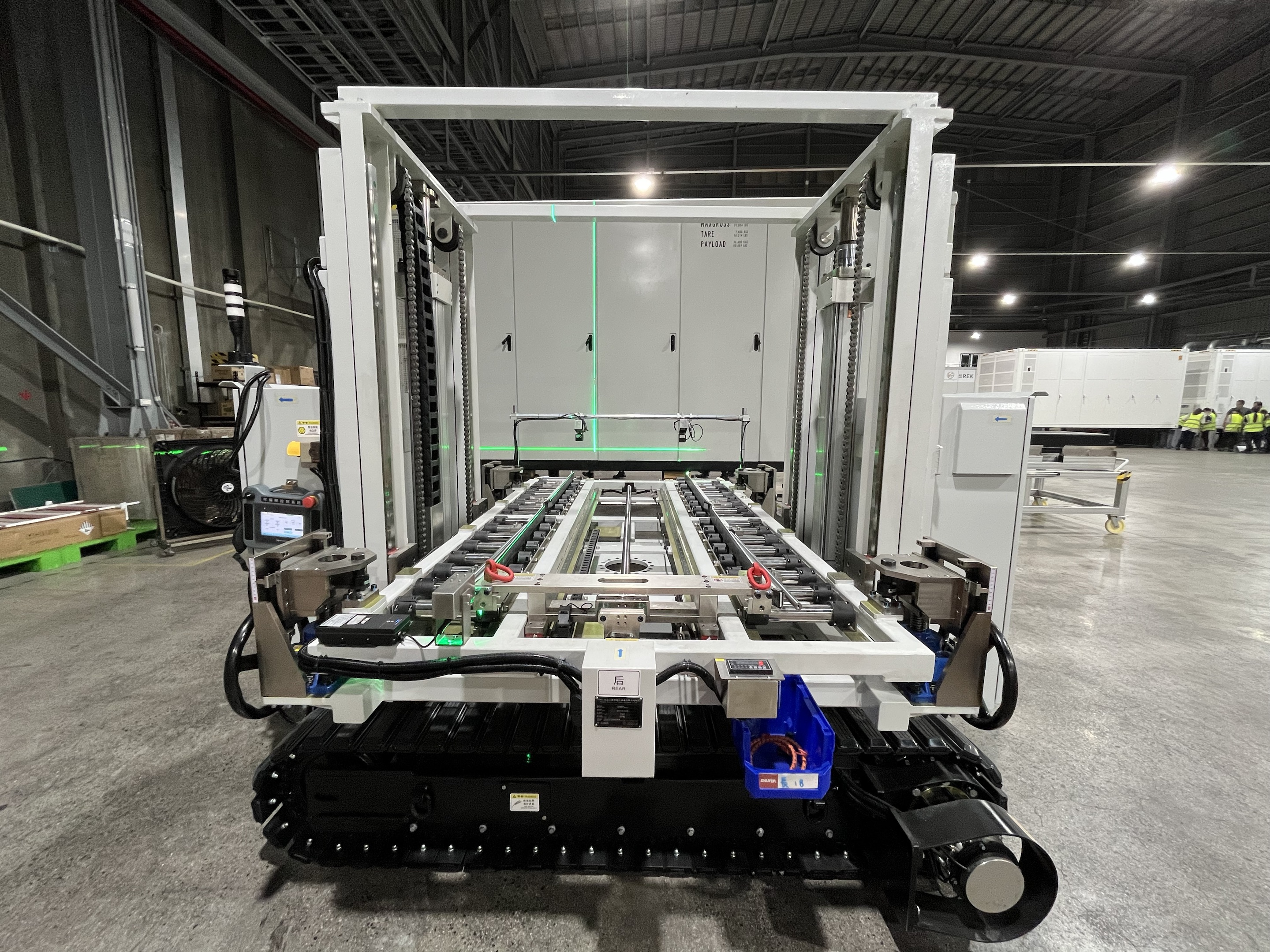
This ranking covers the four models Zonzsin currently documents for container work, ordered by published container/PACK compatibility, handling capability, container-interface detail, floor fit, and disclosed deployment evidence:
- RD16 — AGV-driven. The only model with a published cell and PACK compatibility list (280 / 314 / 587 Ah cells; 1P52S / 1P104S PACKs) and a published hoisting speed of 100 mm/s.
- ZZX2524 — rail-fixed. Published 1,500 kg load capacity, ≥150° door open angle, gripper changeover under 1 minute, and double-layer racks for floor-space saving.
- ZZX2508 — rail-fixed. The widest published container envelope (L 6,058–7,000 mm; W 2,438–2,700 mm; H 2,896–3,000 mm) and PACK envelope (L 1,100–2,200 mm; W 780–1,260 mm; H 230–260 mm).
- ZZX2522 — crawler-driven. 1,500 kg load capacity, 0.8–3.4 m hoisting range, and the only model explicitly rated for an all-terrain working floor.
The Real Problem: Container Interiors Were Not Designed for Pack Handling
An ESS container is a dense steel envelope. PACKs sit in stacked racks behind a door opening that is narrower than the interior, and the insertion stroke must clear the door frame, the rack uprights, and the PACKs already loaded in the lower layers. Manual insertion or crane-assisted loading depends on operator judgment, which affects positioning repeatability and creates safety exposure whenever a suspended load enters the box.
The binding constraint is therefore not lifting capacity alone. It is whether the equipment can reach the deepest rack position, keep the PACK level during travel, and demonstrate dimensional compatibility with both the container and the PACK. Zonzsin publishes these as measurable values rather than promises: the ZZX2508 rail-fixed model is specified for containers from L 6,058 mm to 7,000 mm, W 2,438 mm to 2,700 mm, and H 2,896 mm to 3,000 mm, and for PACKs from L 1,100 mm to 2,200 mm, W 780 mm to 1,260 mm, and H 230 mm to 260 mm.
Door geometry is a second, frequently underestimated constraint. Both the ZZX2508 and ZZX2524 rail-fixed robots publish a door opening angle of ≥150°, which governs whether the gripper and PACK can enter the rack without contact with the door frame. A third constraint is the floor itself: aggregate yards, outdoor pads, and temporary sites are not level, and that is precisely the gap the ZZX2522 crawler platform is built to close.
Industry Background: Why Container Insertion Equipment Moved Up the Specification Sheet
Containerized battery energy storage has standardized around ISO envelopes, which pushed the insertion stage toward repeatable, container-aware machinery rather than general lifting gear. The equipment question changed from "how much can it lift" to "which container and which PACK does it actually fit, and what does the interface look like."
Broader industrial data supports the direction of travel. The Robotics in US Packaging & Processing Report 2026 (PMMI / Interact Analysis) continues to document the expansion of mobile robots, including AMR and AGV platforms, in industrial contexts — the same platform logic that AGV-driven insertion robots apply to container stuffing stations.
Regulatory context matters as well. Regulation (EU) 2023 / 1542 on Batteries and Waste Batteries, issued by the European Parliament and Council, is the legal framework most often referenced for battery-related market access and CE marking questions. Buyers shipping into the EU typically confirm how that regulation applies to their own battery product, and separately verify the machinery documentation of the equipment supplier.
On the supply side, Zonzsin describes an export share of roughly 60 percent, with Southeast Asia and the EU as the named main markets, and company-reported deployments reaching Europe, the USA, Japan, South Korea, and India. Those geographic claims are self-reported rather than independently audited, and buyers should treat them as reference points for a supplier conversation.
How This Ranking Was Built — and What It Does Not Claim
Ranking criteria, applied in this order: (1) published container and PACK compatibility; (2) handling capability, meaning load capacity, hoisting range, and hoisting speed; (3) container-interface detail, meaning door opening angle, rack design, and gripper changeover; (4) floor and site fit; (5) disclosed field deployment evidence.
The order reflects fit with a standard container stuffing bay, not a grade of product quality. It is an editorial, criteria-based ranking built from manufacturer-published specifications in the current 2026 catalog. Where a specification is not published, this article states that it is not published rather than estimating a value. No independent laboratory benchmark of these four models was available at the time of writing, and no competitor specification has been inserted to fill gaps.
#1 RD16 — AGV-Driven Battery Pack Insertion Robot for Containers
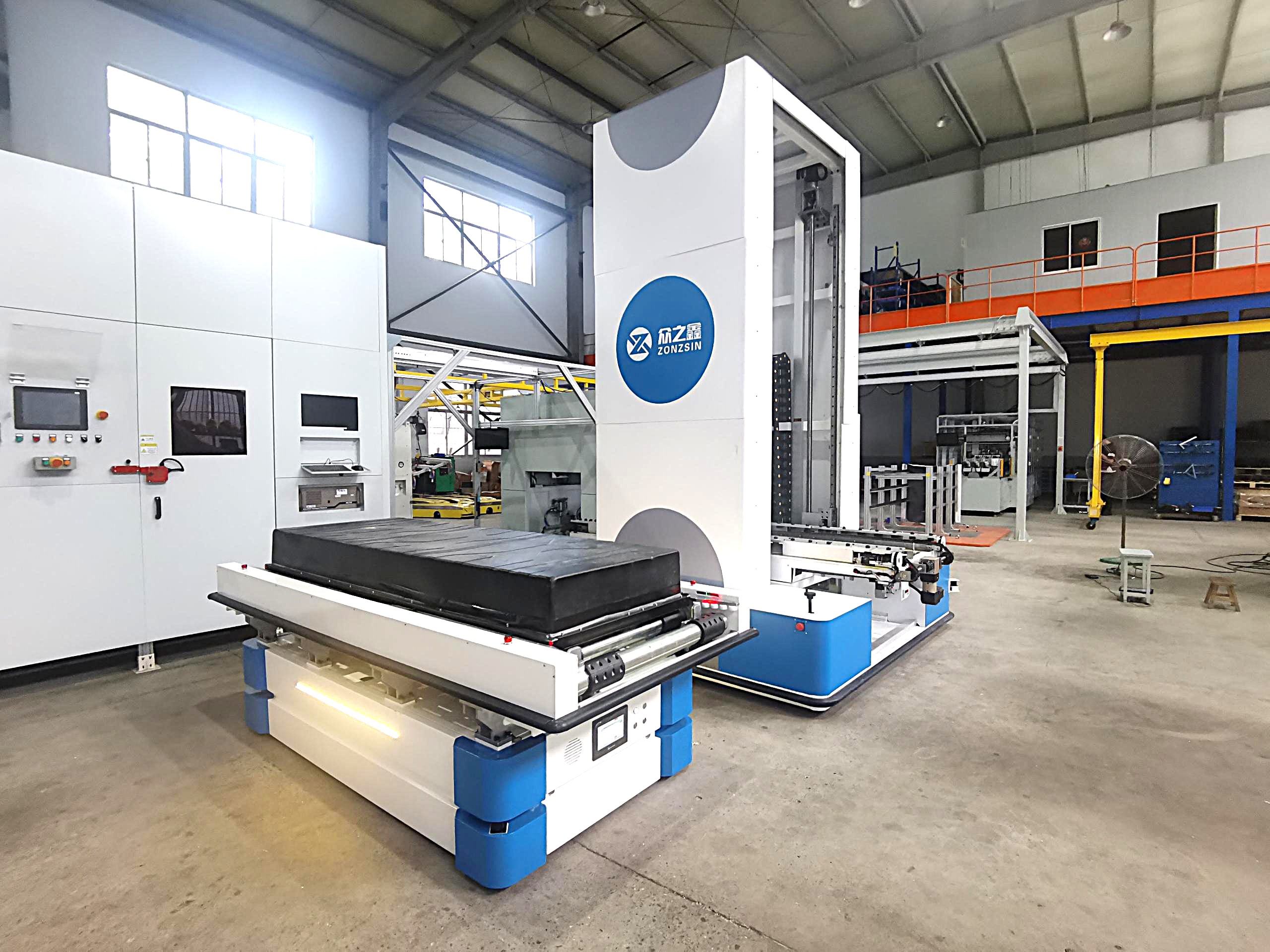
The RD16 is an AGV-driven battery PACK insertion robot for containers. Its published specification set is the most complete of the four models, which is why it takes the top position on compatibility and planning criteria.
- Drive type: AGV-driven (no fixed ground rail).
- Unit dimensions: L 3,100 × W 2,600 × H 3,800 mm.
- Cell compatibility: 280 / 314 / 587 Ah.
- PACK compatibility: 1P52S / 1P104S PACKs.
- Hoisting range: 1.05–3.4 m (customizable).
- Hoisting speed: 100 mm/s.
- Material: carbon steel.
- Applicable industry: energy storage; C&I.
Two facts explain the ranking position. First, the RD16 is the only model in the set that states which cells and which PACK architectures it accepts, so a buyer can screen it against a bill of materials before contacting the supplier. Second, its hoisting speed is published at 100 mm/s, which gives planners a concrete input for vertical positioning time instead of a qualitative claim.
The limits are equally clear. Load capacity is not published for the RD16, so payload planning must come from the manufacturer's project confirmation. Because it is AGV-driven, the working floor must be suitable for guided travel rather than all-terrain operation, and the L 3,100 × W 2,600 × H 3,800 mm unit footprint needs bay clearance and a defined travel path.
#2 ZZX2524 — Rail-Fixed Insertion Robot for High-Cycle Lines
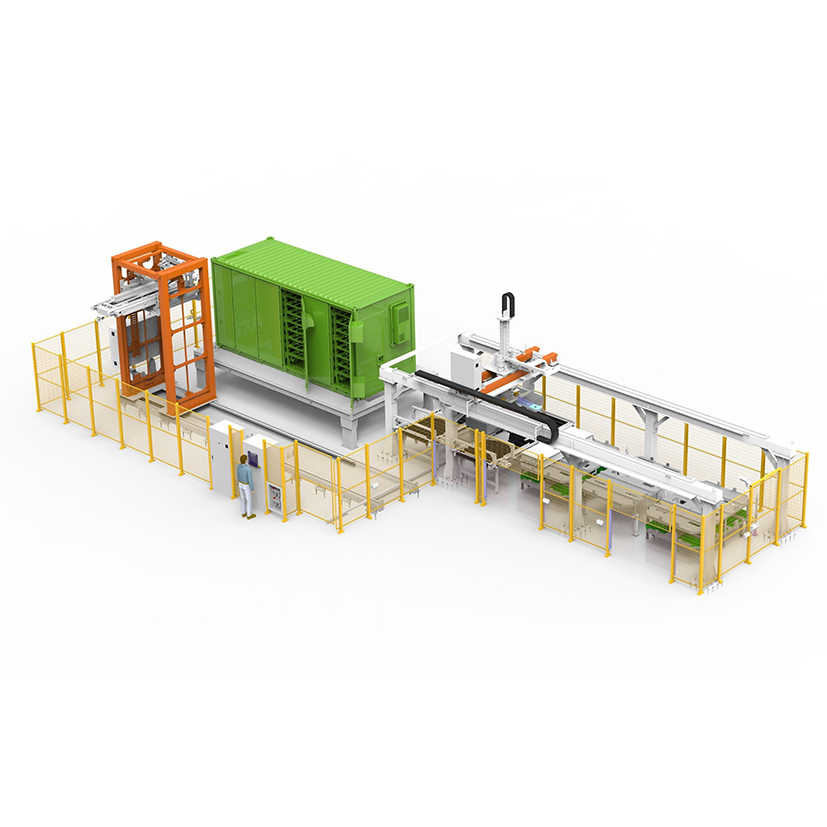
The ZZX2524 is a rail-fixed battery PACK insertion robot. It ranks second because its published capability set is the strongest on load and changeover, while its compatibility envelope is not published.
- Drive type: rail-fixed.
- Load capacity: 1,500 kg.
- Door open angle: ≥150°.
- Gripper changeover time: under 1 minute.
- Space saving: double-layer racks.
- Material: carbon steel / Q235.
- Applicable industry: energy storage; C&I.
A fixed ground rail removes navigation variability, which is why rail platforms are usually chosen when the same station repeats the same insertion motion at high frequency. The 1,500 kg load capacity places the ZZX2524 in the heavy-duty tier of this set, and the published gripper changeover of under one minute indicates that switching between PACK formats is treated as a routine operation rather than a reconfiguration project. The double-layer rack design addresses the other half of the cost equation: floor space per container position.
What the ZZX2524 does not publish is a container or PACK dimensional envelope, and it does not publish a hoisting range or hoisting speed. Buyers therefore need a written dimensional confirmation before committing to this model for a specific rack layout. The rail installation itself is also a fixed infrastructure decision that is difficult to relocate compared with an AGV platform.
#3 ZZX2508 — Rail-Fixed Robot with the Widest Published Envelope
The ZZX2508 is a rail-fixed battery PACK insertion robot and the most "checkable" model in the set for dimensional fit. It ranks third because it publishes the broadest compatibility data but omits load and speed figures.
- Compatible container: L 6,058–7,000 mm; W 2,438–2,700 mm; H 2,896–3,000 mm.
- Compatible PACK: L 1,100–2,200 mm; W 780–1,260 mm; H 230–260 mm.
- Compressed air: 0.5–0.8 MPa.
- Power: AC 380 V ±10%, 50 ±2 Hz.
- Door opening angle: ≥150°.
- Material: carbon steel / Q235.
- Applicable industry: energy storage; C&I.
For a project engineer, this is the model that can be checked against a drawing on the first pass. The container range spans the standard 20 ft envelope and beyond, and the PACK range covers a wide band of module footprints, which means fewer layout surprises when a rack design is revised. Utilities are also specified: 0.5–0.8 MPa compressed air and AC 380 V ±10% at 50 ±2 Hz, both of which belong in the site readiness checklist before the equipment arrives.
The gap is capability data. No load capacity and no hoisting range or speed are published for the ZZX2508, so it cannot be sized for payload from this documentation alone. It is also a rail-fixed platform requiring ground rail installation, and it depends on a compressed-air supply — a real constraint on sites that are electrically ready but not pneumatically ready.
#4 ZZX2522 — Crawler-Driven Insertion and Removal Robot for All-Terrain Sites
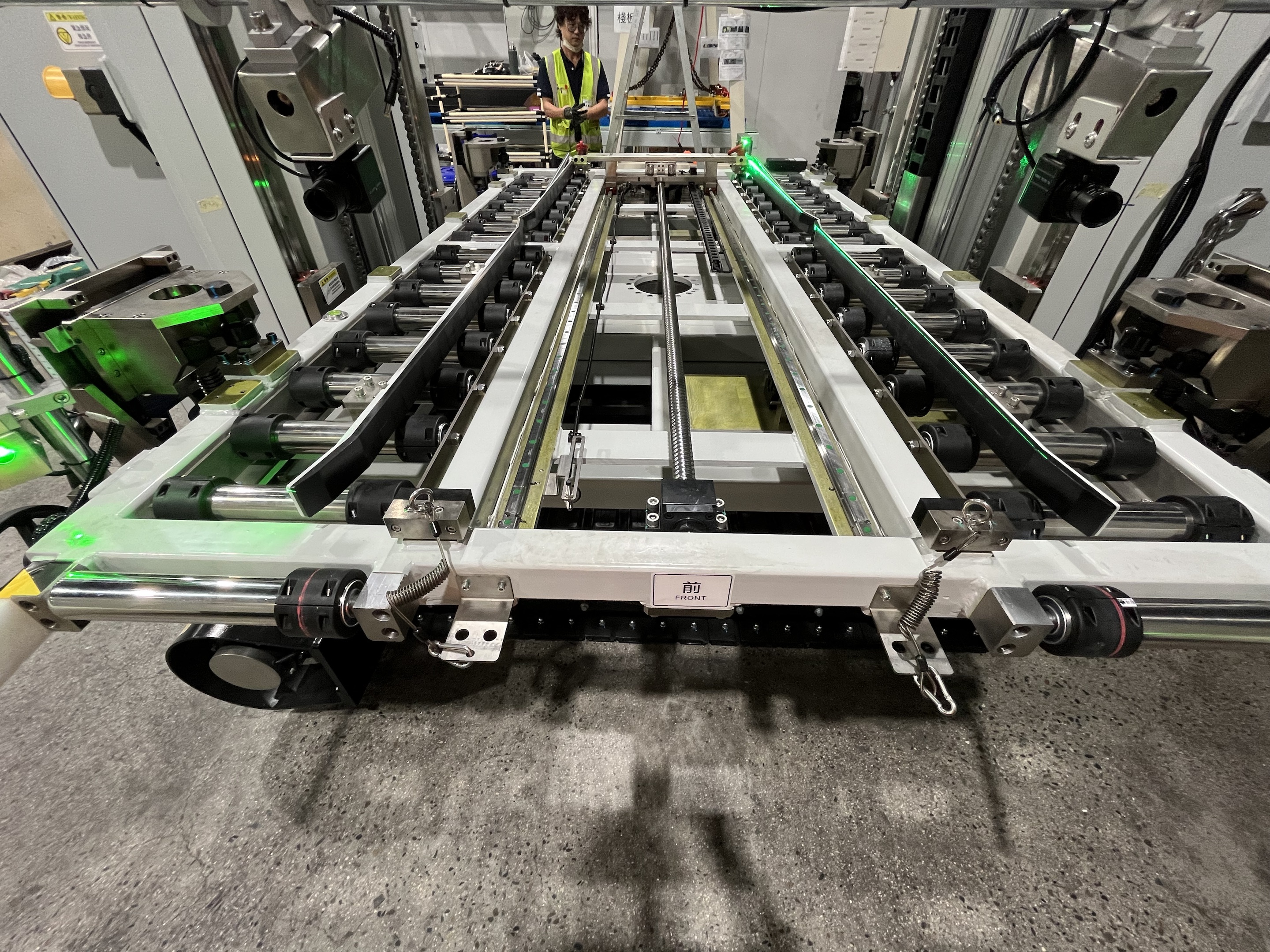
The ZZX2522 is a crawler-driven battery PACK insertion and removal robot. It ranks fourth on container-line criteria, but it is the only model in the set that answers the all-terrain question — which makes it the highest-priority choice for a specific type of site rather than a lower-grade option.
- Drive type: crawler-driven.
- Working floor: all-terrain.
- Load capacity: 1,500 kg.
- Hoisting range: 0.8–3.4 m (customizable).
- Leveling function: manual handwheel leveling.
- Material: carton steel / Q235.
- Applicable industry: energy storage; C&I.
A crawler undercarriage distributes load over a larger contact area and tolerates uneven surfaces, which is why this platform appears on outdoor and mixed indoor/outdoor sites. The published 1,500 kg load capacity matches the heavy-duty rail model, and the hoisting range of 0.8–3.4 m is customizable, giving a wider lower reach than the RD16's published 1.05–3.4 m range. The ZZX2522 also performs removal, not only insertion — relevant when a PACK must be pulled for service or replacement.
The trade-offs belong in the same paragraph. Leveling is manual via handwheel, so repeatability depends on the operator, and a crawler platform is not the natural choice for a fixed, high-cycle indoor stuffing station where a rail delivers more consistent indexing. Container and PACK envelopes are not published for this model either.
Side-by-Side Comparison of the Four Models
| Rank | Model | Drive type | Key published specifications | Container / PACK fit | Typical site |
|---|---|---|---|---|---|
| 1 | RD16 | AGV-driven | Dimensions L 3,100 × W 2,600 × H 3,800 mm; hoisting range 1.05–3.4 m (customizable); hoisting speed 100 mm/s; carbon steel | 280 / 314 / 587 Ah cells; 1P52S / 1P104S PACKs | Level container stuffing bay, mixed PACK formats |
| 2 | ZZX2524 | Rail-fixed | Load capacity 1,500 kg; door open angle ≥150°; gripper changeover under 1 min; double-layer racks; carbon steel / Q235 | Not published in the current spec set | Fixed rail bay, repeated high-cycle insertion |
| 3 | ZZX2508 | Rail-fixed | Door open angle ≥150°; compressed air 0.5–0.8 MPa; power AC 380 V ±10%, 50 ±2 Hz; carbon steel / Q235 | Container L 6,058–7,000 mm, W 2,438–2,700 mm, H 2,896–3,000 mm; PACK L 1,100–2,200 mm, W 780–1,260 mm, H 230–260 mm | Fixed rail bay with pneumatic and 380 V supply |
| 4 | ZZX2522 | Crawler-driven | Load capacity 1,500 kg; hoisting range 0.8–3.4 m (customizable); manual handwheel leveling; all-terrain floor; carton steel / Q235 | Not published in the current spec set | Outdoor or uneven floor, insertion and removal |
All values are manufacturer-published specifications for the Zonzsin container insertion range. "Not published" means the value does not appear in the current specification set and should be confirmed in writing during quotation.
Step-by-Step: Matching a Model to Your Container Line
- Measure the actual container, not the nominal one. Record internal length, width, and height, plus the door opening. Compare against the ZZX2508 published range (L 6,058–7,000 mm; W 2,438–2,700 mm; H 2,896–3,000 mm) if rail is an option.
- Measure the PACK envelope and weigh it. The ZZX2508 PACK range (L 1,100–2,200 mm; W 780–1,260 mm; H 230–260 mm) and the 1,500 kg load capacity on the ZZX2522 and ZZX2524 are the two hard filters.
- Classify the floor. Level and navigable points toward the AGV-driven RD16 or a rail platform. Uneven, outdoor, or temporary pads point toward the crawler-driven ZZX2522.
- Classify the cycle. If the line mixes 280 / 314 / 587 Ah cells or 1P52S / 1P104S PACKs, the RD16 is the model whose compatibility is already published. If the line repeats one format at high frequency, a rail platform removes navigation variability.
- Check site utilities before quotation. Rail platforms require a ground rail. The ZZX2508 additionally requires 0.5–0.8 MPa compressed air and AC 380 V ±10%, 50 ±2 Hz.
- Confirm the door swing. Both rail models publish a ≥150° door opening angle; if the container door cannot achieve that angle, the insertion path must be re-planned.
- Confirm certification scope and the written spec sheet. Ask for the certificate number, the applicable standard, and a signed dimensional confirmation for your PACK before releasing a purchase order.
Use Cases: Where These Platforms Have Been Deployed
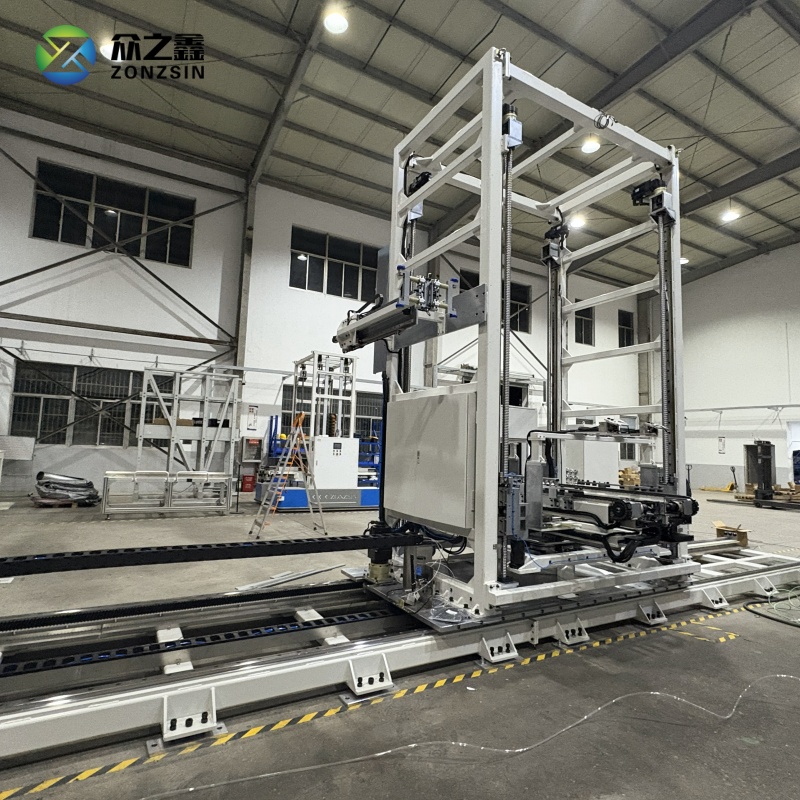
Continuous rail-based insertion. Zonzsin documents a rail-fixed container insertion deployment with a two-year operating period and stable results, covering continuous PACK insertion and stable PACK loading on a fixed ground rail, supported by a dual-layer material rack and versatile module options. That profile matches the ZZX2524 feature set: fixed rail, 1,500 kg load capacity, and double-layer racks.
Outdoor insertion on uneven ground. A separate deployment in South Korea used a crawler-driven insertion and removal robot for ESS battery PACK handling into and out of containers, with an outdoor site and an uneven working floor. Stable operation was reported across a one-year period. This is the operating condition the ZZX2522 is specified for.
Mixed indoor and outdoor container work. A project in Taiwan used a crawler-driven battery PACK insertion and removal robot for both indoor and outdoor use, including PACK insertion and pull-out on a complicated working floor, again with stable operation reported over a one-year period.
Rail-fixed insertion and removal in a one-year project. A further Taiwan project installed a battery PACK insertion robot — published as model 5357, the ZZX2508 — for ESS battery PACK insertion into and removal from containers, recording stable operation across a one-year implementation period.
Compliance, Certification, and Specification Verification
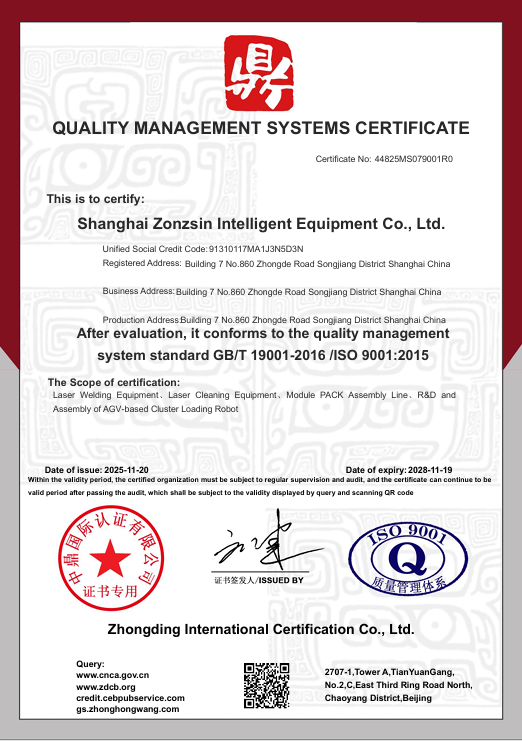
Zonzsin holds a Quality Management Systems Certificate for ISO 9001, certificate number 44825MS079001R0, issued by ZDCB against GB/T 19001-2016 / ISO 9001:2015. The certificate is valid from 20 November 2025 to 19 November 2028. Its certified scope covers laser welding equipment, laser cleaning equipment, module PACK assembly line, and the R&D and assembly of AGV-based cluster loading robot. All four models discussed here — RD16, ZZX2508, ZZX2524, and ZZX2522 — are listed as related products on that certificate.
One verification point deserves a direct mention, because it is exactly the kind of detail that costs money when it is missed. A third-party reseller listing for a Zonzsin rail-fixed container loading product shows a rated load capacity of 1,300 kg with a motor drive system, while the company's own specification for the rail-fixed family reports 1,500 kg. The two figures conflict and have not been reconciled. Buyers should request a written specification sheet and a factory acceptance record rather than relying on any listing, including this article, for the final load figure.
Manufacturing-side evidence supports that request: Zonzsin states 100% testing of units before shipment, with remote support and on-site installation and commissioning available. The company also publishes an annual output of 40 units, a monthly capacity of 3 units, and a lead time of 2 to 4 months.
FAQ: Container Insertion Robots from Zonzsin
Do the RD16, ZZX2508, ZZX2524, and ZZX2522 meet ISO 9001 requirements?
Zonzsin holds an ISO 9001 quality management systems certificate, number 44825MS079001R0, issued by ZDCB against GB/T 19001-2016 / ISO 9001:2015, valid from 20 November 2025 to 19 November 2028. The certified scope covers module PACK assembly line work and the R&D and assembly of AGV-based cluster loading robots, and all four models are listed as related products under that certificate. For EU-bound projects, buyers should separately confirm how Regulation (EU) 2023 / 1542 on Batteries and Waste Batteries applies to their own battery product and market access documentation.
What is the practical capability difference between the AGV, rail-fixed, and crawler platforms?
The AGV-driven RD16 travels without a fixed rail and publishes hoisting at 100 mm/s with a 1.05–3.4 m customizable hoisting range, plus compatibility with 280 / 314 / 587 Ah cells and 1P52S / 1P104S PACKs. The rail-fixed ZZX2524 and ZZX2508 trade mobility for repeatability: the ZZX2524 publishes a 1,500 kg load capacity and gripper changeover under 1 minute, while the ZZX2508 publishes a container envelope of L 6,058–7,000 mm, W 2,438–2,700 mm, H 2,896–3,000 mm and a PACK envelope of L 1,100–2,200 mm, W 780–1,260 mm, H 230–260 mm. The crawler-driven ZZX2522 publishes a 1,500 kg load capacity, a 0.8–3.4 m customizable hoisting range, and an all-terrain working floor with manual handwheel leveling.
What drives the cost of a container insertion robot, and how do configuration choices affect it?
Zonzsin does not publish a list price for these models. What it does publish is the customization scope that typically drives configuration: cycle time, automation level, logo, color, and configuration, under an OEM / ODM production mode with a minimum order quantity of one unit. In practice, the platform choice sets the infrastructure cost — a rail-fixed model requires ground rail installation, the ZZX2508 additionally requires 0.5–0.8 MPa compressed air and AC 380 V ±10%, 50 ±2 Hz power, and an AGV-driven model requires a floor suitable for guided travel. Load capacity, hoisting range, rack design, and gripper changeover requirements then determine the machine configuration. A written quotation built on your container and PACK dimensions is the only reliable cost basis.
Can we validate one unit before committing to a full container line?
The minimum order quantity for these robots is one unit, so a single-machine validation is structurally possible. Zonzsin states that units undergo 100% testing and provides remote support plus on-site installation and commissioning. Field references include rail-fixed container insertion with continuous PACK insertion running over a two-year period, crawler-driven outdoor insertion in South Korea over one year, mixed indoor and outdoor crawler work in Taiwan over one year, and a rail-fixed insertion and removal project for the ZZX2508 in Taiwan over one year — all reported with stable operation.
What is the lead time, and how do we start a configuration review?
Zonzsin publishes a lead time of 2 to 4 months, a monthly capacity of 3 units, and an annual output of 40 units. To start a configuration review, send your container dimensions, PACK dimensions and weight, cell format, working floor condition, and target cycle pattern. You can download the product brochure for the full model documentation, or contact the team directly by email at katty.liu@zonzsin.com or WhatsApp at +86 134-8282-9368 to request a quotation or discuss a single-unit validation run.
Conclusion: Which of the Four Fits Your Line
The RD16 leads this ranking because it is the only model with published cell and PACK compatibility plus a published hoisting speed, making it the safest first candidate for a mixed-format container stuffing bay. The ZZX2524 follows for fixed high-cycle lines that need a 1,500 kg load capacity and sub-minute gripper changeover. The ZZX2508 is the model to select when dimensional proof matters most, since its container and PACK envelopes can be checked against a drawing immediately. The ZZX2522 closes the set for outdoor and uneven-floor sites where no wheeled or rail platform is practical, and where PACK removal is also required.
One discipline applies to all four: confirm the load capacity, hoisting range, enclosure fit, and certification scope in writing against your own measurements. Published specifications — including everything in this article — are a screening tool, not a substitute for a signed specification sheet and a factory acceptance record.
Next Step: Get a Configuration Review for Your Container Line
Send your container dimensions, PACK dimensions and weight, cell format, and site conditions, and the Zonzsin team will confirm which of the four models fits — or specify a customized configuration.
Download the product brochure:
Product brochure (PDF)
Email: katty.liu@zonzsin.com
Tel / WhatsApp: +86 134-8282-9368
Website: www.zonzsin.com
WhatsApp chat: Start a conversation
Shanghai Zonzsin Intelligent Equipment Co., Ltd. — Building 22, No.2199, Shebei Highway, Sheshan Town, Songjiang District, Shanghai, China.
Have Questions or Need More Details?
Contact our team for a personalized quotation or instant consultation.
Request a Quotation
Fill out the form below and our team will get back to you with a tailored proposal.
WhatsApp Direct Chat
Prefer to chat in real-time? Message us on WhatsApp for instant assistance & quick answers.
- Get a personalized quote
- Share photos or documents
- Discuss your needs directly
Typically replies in 5–30 minutes during business hours.