
Top 5 ESS Battery Pack Insertion Robots for Container Energy Storage in 2026
Top 5 ESS Battery Pack Insertion Robots for Container Energy Storage in 2026
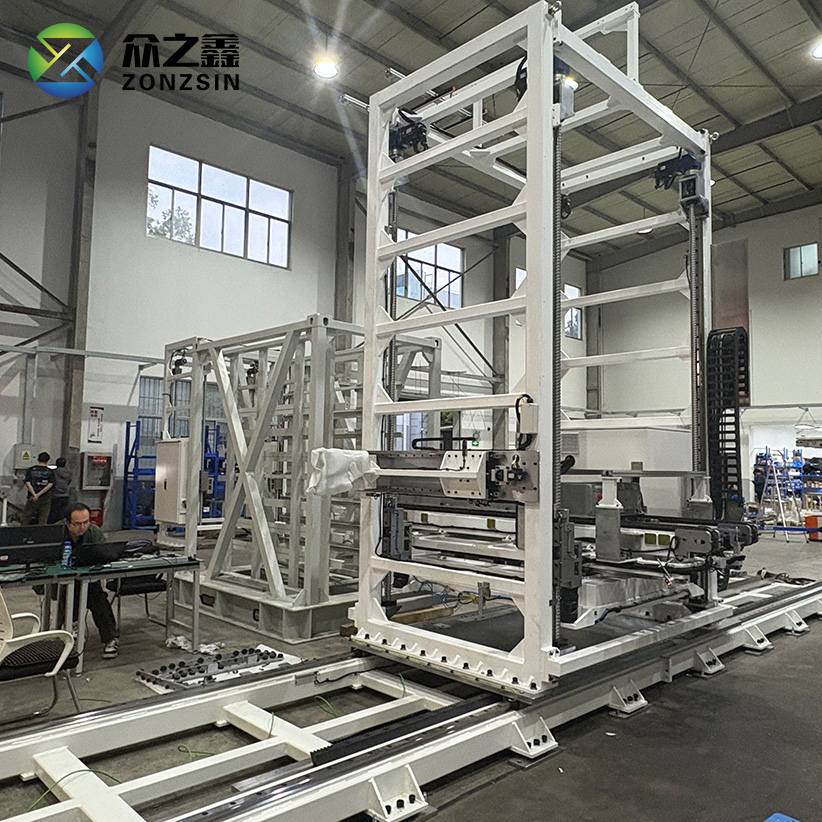
Rail-fixed ESS battery pack insertion robot for standard container racks. Image: Zonzsin.
The right ESS battery pack insertion robot for container energy storage in 2026 is the one that matches three numbers you already have on your desk: the internal envelope of the container you load, the dimensions and weight of your heaviest PACK, and the condition of the floor between your rack staging area and the container door.
Ranked on those criteria, Zonzsin's published 2026 portfolio delivers four catalogued insertion platforms and one configuration path. RD16 is an AGV-driven battery PACK insertion robot for containers, specified for 280/314/587Ah cells and 1P52S/1P104S PACKs with a 100 mm/s hoisting speed. ZZX2508 and ZZX2524 are rail-fixed insertion robots, with a door opening angle of at least 150 degrees. ZZX2522 is a crawler-driven insertion and removal robot rated for all-terrain working floors. The fifth entry is the OEM/ODM configuration route, which adjusts cycle time, automation level, colour, logo and configuration for envelopes that fall outside the catalogue. Every catalogued model is specified for C&I energy storage work.
How this shortlist was built. The five entries below are ranked from Zonzsin's published product datasheets and delivered-project records. The evaluation criteria are dimensional compatibility with standard container racks, PACK format coverage, payload class, handling speed, floor tolerance, and changeover or space efficiency. No third-party robot model is listed, because no verified container-envelope and payload datasheet was available for one at the time of writing. A site with uneven ground will re-order this list immediately: ranking reflects fit for a typical level-floor C&I container line, not a universal verdict.
Why Pack Insertion, Not Pack Assembly, Sets Container Line Throughput
The insertion step is the last physical operation before an ESS container is closed and shipped, and it carries the highest concentration of physical risk in the container line. A finished battery PACK has to be lifted, carried through a container door, aligned to a rack position, and released — repeatedly, every shift, without damaging the PACK enclosure, the rack, or the container structure.
Three constraints make this harder than it looks on a specification sheet. First, the door is the narrowest point in the whole route, which is why a door opening angle of at least 150 degrees appears as a hard requirement on ZZX2508 and ZZX2524. Second, standard container interiors are not generous: the ZZX2508 datasheet lists a compatible container height range of 2896 to 3000 mm, and a PACK height band of 230 to 260 mm. Third, the handling environment is regulated: Zonzsin specifies ESD protection, fire prevention measures, and temperature, humidity and cleanliness control for container insertion projects, with PACK compatibility and fixture adaptation treated as a project-specific requirement rather than an accessory.
Manual insertion answers none of these constraints at scale. It ties line output to operator availability, it introduces contact damage risk at the door frame, and it produces placement variation that is expensive to correct once a rack row is loaded. The measurable result of automating the step is reported at roughly 30 percent lower manpower and about 20 percent shorter container assembly cycle time versus manual methods, according to the 2026 Zonzsin buyer guide — figures that a buyer should validate against their own takt time during acceptance testing rather than adopt as a planning assumption.
Industry Background: Containerized Storage Is Scaling Faster Than Container Handling Equipment
Containerized storage is no longer a niche packaging choice inside the wider battery energy storage market. The global BESS market was valued at approximately USD 50.81 billion in 2025 and is projected to reach USD 105.96 billion by 2030, according to MarketsandMarkets. Inside that total, containerized BESS solutions were valued at USD 11.75 billion in 2025 and are expected to grow at a CAGR of 24.1 percent through 2035, based on Insightace Analytic's segment estimate.
That growth curve has a direct mechanical consequence. More containerized capacity means more racks to fill, more PACK formats to handle across a production week, and more sites where the loading area is a concrete apron rather than a finished factory floor. The insertion robot, not the cell or the PACK, is where that volume pressure lands.
Compliance pressure is moving in the same direction. In North America, energy storage systems must comply with UL 9540, the Standard for Energy Storage Systems and Equipment, whose scope covers the safety of enclosures and moving parts — which includes automated handling equipment operating on a container line. In the EU, BESS containers require CE marking under Regulation (EU) 2023/1542, which brings Low Voltage Directive and Machinery Directive obligations into play for automated handling equipment. In practice this means insertion equipment is no longer bought as a standalone lifting device; it is bought as a component of a certifiable container assembly.
The supplier side has consolidated around modularity for the same reason. Shanghai Zonzsin Intelligent Equipment Co., Ltd. has manufactured ESS battery pack insertion robots for containers and automatic battery pack assembly lines since 2019, operating a 6000 m² facility with 90 employees, a 43-engineer R&D team, and an annual output of 40 units. Roughly 60 percent of production is exported, primarily to Southeast Asia and the EU, with installed references in Europe, the USA, Japan, South Korea and India. The company holds 50 granted patents, including invention patents covering the AGV-driven battery PACK insertion robot, and applies modular design to hold maintenance expenditure about 20 percent lower than a comparable non-modular configuration.
The Shortlist: Top 5 ESS Battery Pack Insertion Robots for Containers in 2026
Each entry below is assessed against the same six criteria: container envelope compatibility, PACK format coverage, payload class, handling speed, floor tolerance, and changeover or space efficiency. Where a datasheet does not publish a value, the entry says so — an unpublished figure is not a zero.
Rank 1 — RD16: AGV-Driven Battery PACK Insertion Robot for Containers
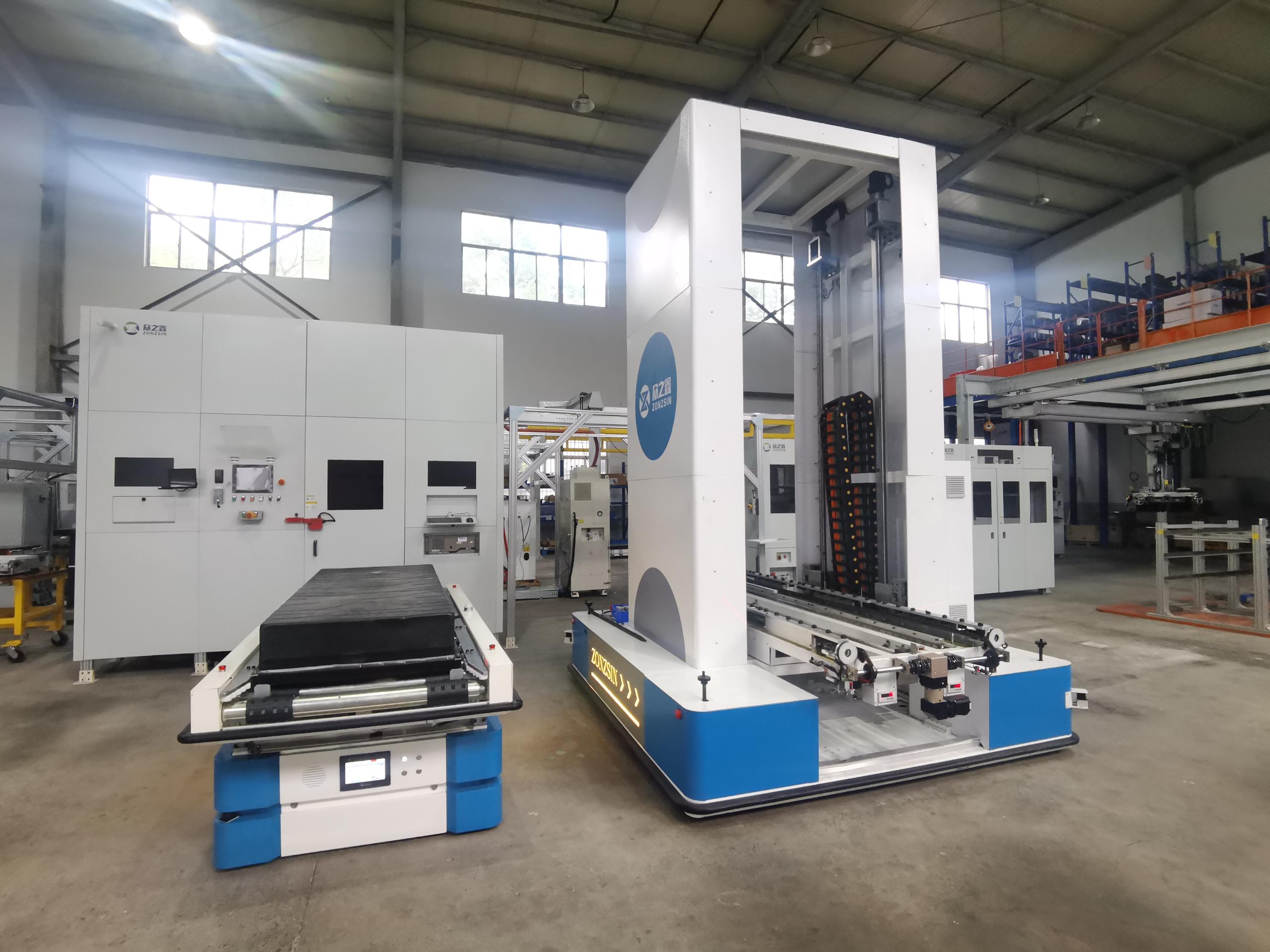
RD16 AGV-driven battery PACK insertion robot for container lines. Image: Zonzsin.
RD16 takes the top position because it combines the widest published PACK format coverage in the portfolio with the fastest published hoisting speed. Its datasheet lists compatibility with 280/314/587Ah cells and with 1P52S and 1P104S PACKs, a hoisting range of 1.05 to 3.4 m that can be customised, and a hoisting speed of 100 mm/s. Overall machine dimensions are 3100 x 2600 x 3800 mm, and the structure is carbon steel.
The platform is an AGV, which means the unit moves itself along the line rather than running on a fixed rail. That is the decisive advantage where a single robot must serve several container positions or docking stations in sequence without a dedicated rail run to each. Zonzsin's published specification for its AGV-driven models states load capacities up to 1500 kg and 5-DOF docking for standard 20ft and 40ft container racks.
- TypeAGV-driven battery PACK insertion robot for containers
- Hoisting range1.05 to 3.4 m (customisable)
- Hoisting speed100 mm/s
- Cell / PACK compatibility280/314/587Ah cells; 1P52S and 1P104S PACKs
- Machine dimensions3100 x 2600 x 3800 mm
- Operation modeManual and remote controller
- Applicable industryC&I energy storage
Best fit: continuous, shift-based lines with a level floor and a defined travel route, where cycle time and batch continuity matter more than static rigidity. Weakest fit: unfinished aprons or sites where the AGV travel path crosses uneven ground.
Rank 2 — ZZX2508: Rail-Fixed Insertion Robot With the Broadest Container Envelope
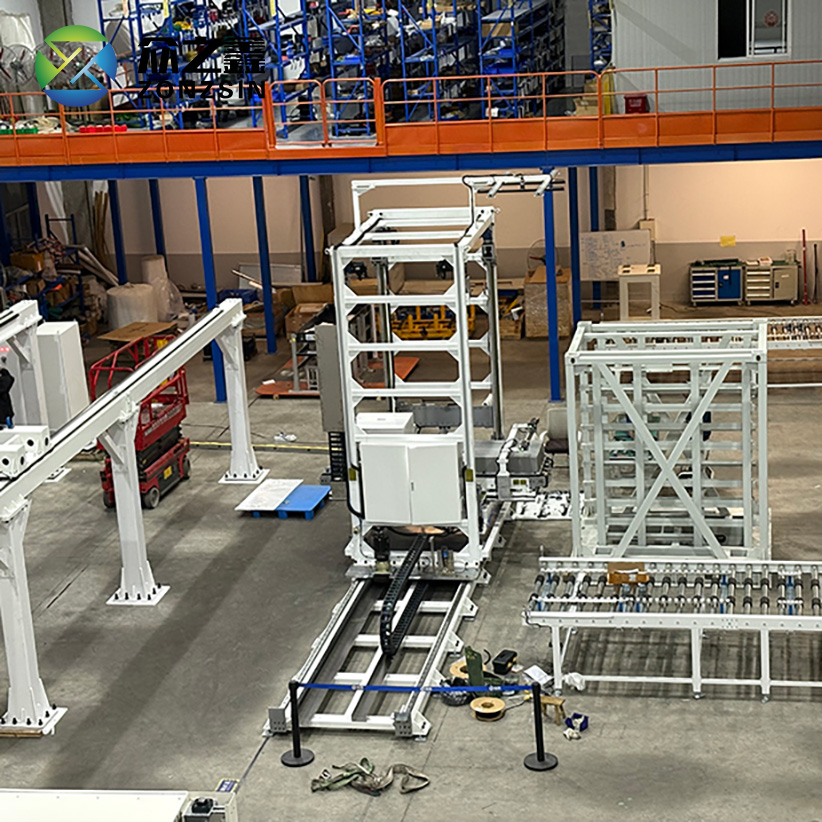
ZZX2508 rail-fixed battery PACK insertion robot for standard container racks. Image: Zonzsin.
ZZX2508 ranks second on the strength of one thing no other entry publishes: an explicit dimensional envelope for both the container and the PACK. The compatible container range is 6058 to 7000 mm long, 2438 to 2700 mm wide, and 2896 to 3000 mm high. The compatible PACK range is 1100 to 2200 mm long, 780 to 1260 mm wide, and 230 to 260 mm high. The door opening angle is at least 150 degrees.
Utilities are specified rather than assumed: compressed air at 0.5 to 0.8 MPa and a power supply of AC380V ±10 percent at 50 ±2 Hz. The frame material is carbon steel Q235, and the applicable industry is energy storage and C&I.
The rail-fixed configuration is the reason this envelope holds. Because the transfer axis is bolted to the floor, positioning repeatability does not depend on floor flatness or on the AGV's own localisation system — a meaningful advantage when a PACK has to enter a rack channel with millimetres of clearance on both sides.
Best fit: fixed-layout lines loading standard 20ft containers, and sites where a mixed or non-standard container length falls inside the 6058 to 7000 mm band. Weakest fit: layouts that need the robot to relocate to a different building or bay.
Rank 3 — ZZX2524: Rail-Fixed Insertion Robot Built for Fast Changeover and Dense Racking
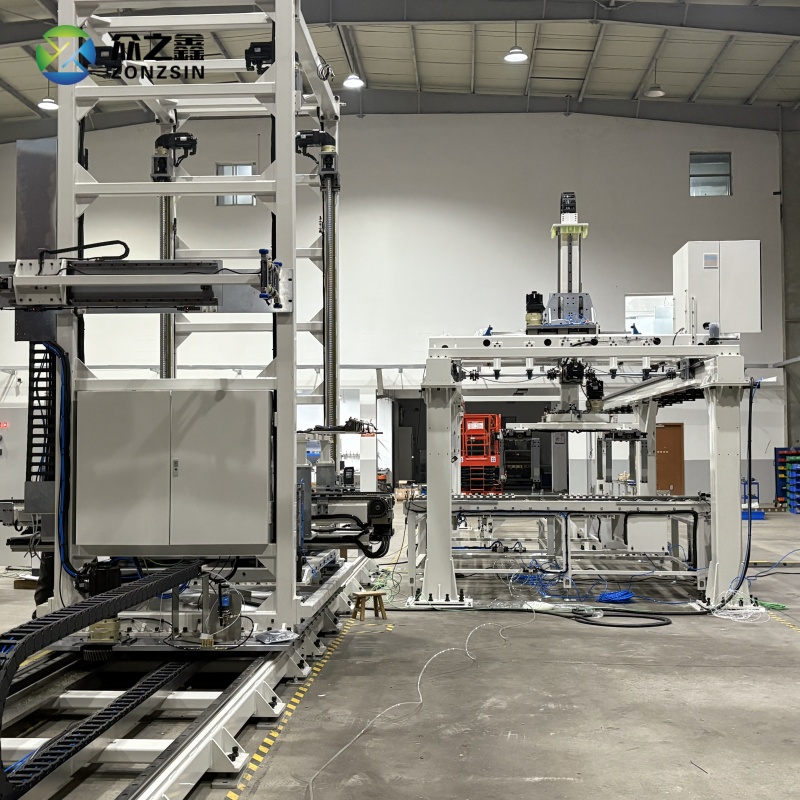
ZZX2524 rail-fixed battery PACK insertion robot with double-layer rack configuration. Image: Zonzsin.
ZZX2524 is the specialist in this shortlist. Its published parameters are a load capacity of 1500 kg, a door opening angle of at least 150 degrees, a gripper changeover time under one minute, and a double-layer rack configuration that saves floor space inside the container assembly area. The frame material is carbon steel Q235 and the applicable industry is energy storage and C&I.
Two of those numbers matter more than the rest in day-to-day operation. A gripper changeover under one minute means a line can move between PACK formats within a shift instead of stopping for a fixture rebuild. A double-layer rack layout increases the number of PACK positions reachable from a single rail run, which reduces the floor area dedicated to staging and shortens the average travel distance per insertion. A documented project in China has run this configuration for two years on continuous PACK insertion, with stable PACK loading reported, highlighting a stable fixed ground rail, the dual-layer material rack, and versatile module options.
Best fit: high-mix lines that switch PACK formats between batches, and facilities where container assembly floor space is the binding constraint. Weakest fit: sites requiring outdoor mobility.
Rank 4 — ZZX2522: Crawler-Driven Insertion and Removal Robot for All-Terrain Sites
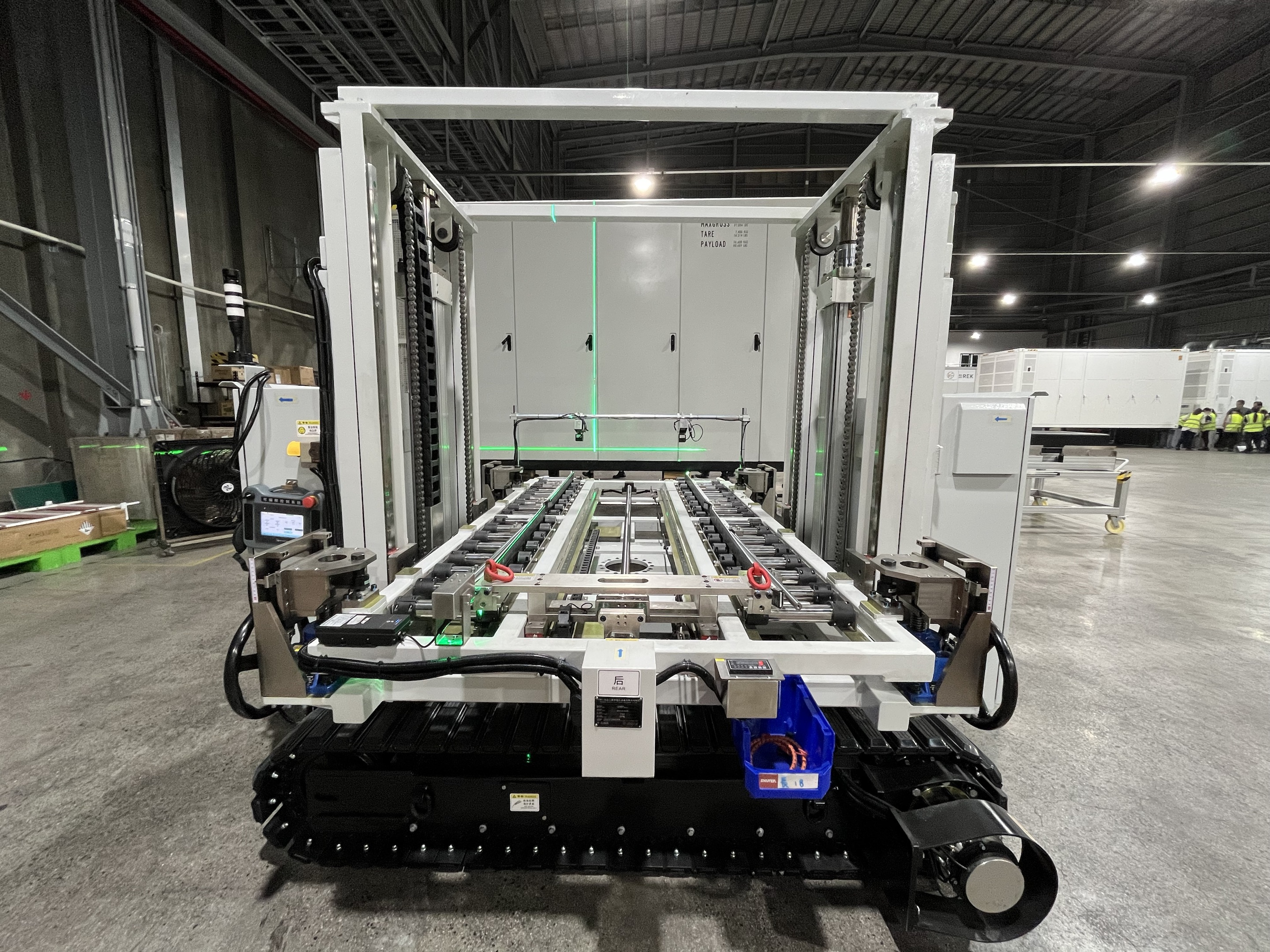
ZZX2522 crawler-driven battery PACK insertion and removal robot. Image: Zonzsin.
ZZX2522 is the only entry in the shortlist whose published working floor is all-terrain, and the only one described as an insertion and removal robot rather than an insertion robot alone. That second distinction is commercially significant: removal matters for field service, module replacement, and any project that needs to pull a PACK back out of a container after commissioning.
- TypeCrawler-driven battery PACK insertion and removal robot
- Hoisting range0.8 to 3.4 m (customisable)
- Load capacity1500 kg
- Working floorAll-terrain
- LevellingManual handwheel levelling
- Applicable industryC&I energy storage
Two field projects illustrate the platform's role. A unit delivered to a Korean energy storage integrator has operated for one year inserting and removing ESS battery PACKs from containers outdoors on uneven ground. A second unit in Taiwan has run for one year handling insertion and pull-out both indoors and outdoors on a complicated working floor. Both are reported as stable in operation. The trade-off is explicit: manual handwheel levelling means a crawler unit is levelled by an operator at the workstation, which is slower to reposition than a rail-fixed axis and less repeatable than an AGV following a fixed route.
Best fit: outdoor aprons, retrofit or service work, and sites where containers are not permanently positioned. Weakest fit: high-takt, fully automated lines with no operator at the container position.
Rank 5 — OEM/ODM Configuration: The Fifth Slot for Non-Standard Envelopes
The fifth position is not a separate catalogue model. It is the configuration route Zonzsin offers on top of the four platforms above, and it takes this slot because some 2026 projects simply do not fit a published envelope — an unusual container length, a bespoke rack pitch, a logo or colour requirement tied to a customer's own brand, or a cycle time target that needs the automation scope adjusted rather than the hardware replaced.
Under this route, customisation covers cycle time, automation scope, logo, colour and configuration. The commercial parameters are published: OEM/ODM production mode, a minimum order quantity of one unit, monthly capacity of three units, a lead time of two to four months, 100 percent testing before shipment, export markets in the EU and the USA, and after-sales support covering remote assistance plus on-site installation and commissioning.
Best fit: integrators and EPC contractors with a defined but non-standard container or PACK envelope, and brands that need the equipment to carry their own identity on site. Weakest fit: buyers who need a unit delivered from stock within weeks — a custom configuration follows the standard two-to-four-month lead time, not a shorter one.
Step-by-Step: Matching a Platform to Your Container Line
The sequence below is the same one used in the delivered projects cited above. It can be completed before any quotation is requested, and it prevents the most common specification error: selecting a robot on lifting capacity alone.
Step 1 — Measure the container envelope, not the container name. Record internal length, width and height and confirm they fall inside the ZZX2508 compatible range of 6058 to 7000 mm by 2438 to 2700 mm by 2896 to 3000 mm if a rail-fixed unit is planned. Confirm the door opening angle can reach at least 150 degrees.
Step 2 — Confirm PACK dimensions and format. For a rail-fixed platform, check PACK length of 1100 to 2200 mm, width of 780 to 1260 mm, and height of 230 to 260 mm. For the RD16 AGV platform, check the cell format against 280/314/587Ah and the pack arrangement against 1P52S or 1P104S.
Step 3 — Choose the platform from the floor and the route. Level floor with a fixed route and multiple container positions points to an AGV platform. Fixed bays that never move point to a rail-fixed platform. Uneven, outdoor or frequently repositioned sites point to the crawler platform, accepting manual handwheel levelling as part of the operating procedure.
Step 4 — Verify utilities and interfaces. Confirm AC380V ±10 percent at 50 ±2 Hz and compressed air at 0.5 to 0.8 MPa where a rail-fixed unit is specified. Map the surrounding equipment the robot must hand off to: container, docking roller, gripper, transfer AGV, working desk, material rack, platform ladder, PLC and MES.
Step 5 — Plan the handling environment. Define ESD protection, fire prevention measures, and temperature, humidity and cleanliness control. The documented working condition for these projects is an all-terrain environment at 20 to 30 °C on continuous or shift production, with PACK compatibility and fixture adaptation confirmed against the actual PACK being loaded.
Step 6 — Validate before scaling. The minimum order quantity is one unit, which allows a single-platform validation run on your own container and PACK before a second station is committed. Every unit is 100 percent tested before shipment, and commissioning is supported remotely or on site.
Use Cases: Where Each Platform Has Already Proven Itself
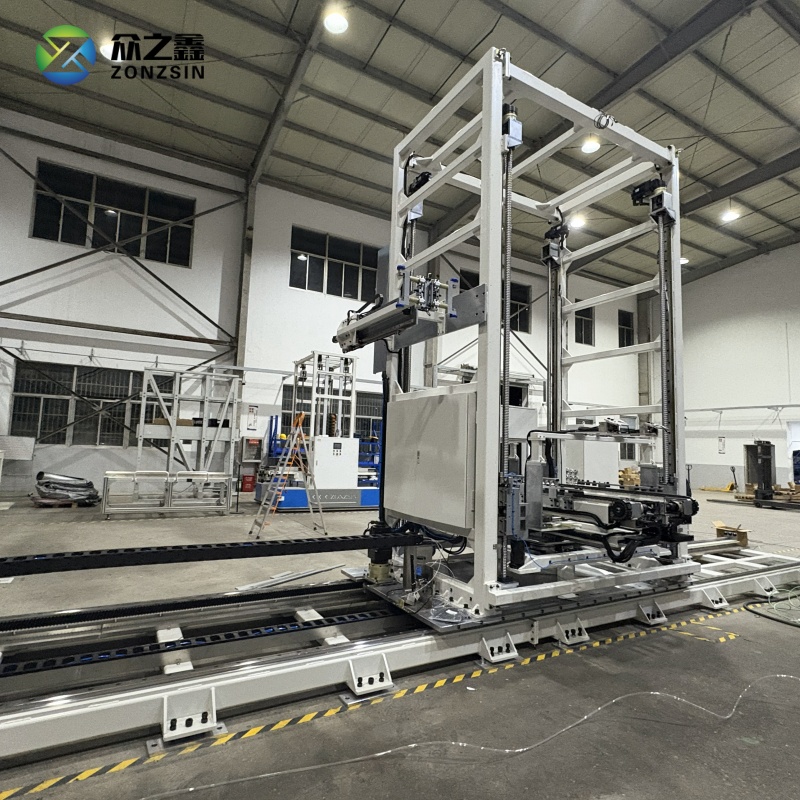
Rail-fixed battery PACK insertion robot on a continuous container PACK insertion project. Image: Zonzsin.
Three references cover the three main site profiles. In China, an energy storage system integrator operating a rail-fixed configuration has run one unit for two years on continuous PACK insertion with stable PACK loading and improving efficiency; the customer profile in that project type is typically an integrator, a battery cell and PACK manufacturer, or an EPC turnkey contractor, and the reported highlights are a stable fixed ground rail, a dual-layer material rack for space utility, and versatile module options.
In South Korea, a crawler-driven unit has operated for one year inserting and removing ESS battery PACKs from containers, in an outdoor setting on an uneven working floor. In Taiwan, a crawler-driven unit has run for one year on insertion and pull-out across both indoor and outdoor positions with a complicated working floor. Both crawler references report stable operation.
The application itself is not confined to those three markets. Zonzsin records this container insertion scenario as common in China, France, South Korea, Sweden, Taiwan and the United States, with the AGV-driven platform specified for cycle time improvement and batch and continuous production in energy storage container lines, operated in manual or remote controller mode.
Spec Comparison: Top 5 ESS Battery Pack Insertion Robots for Containers (2026)
The table below compares only parameters that appear in published Zonzsin datasheets. Cells marked as not listed should be treated as unknown rather than as unsupported — most of these values are configuration-dependent and are confirmed at project stage.
| Model | Type | Load capacity | Hoisting | Door opening angle | Container compatibility | PACK compatibility | Best-fit site condition |
|---|---|---|---|---|---|---|---|
| RD16 | AGV-driven | AGV-driven models published up to 1500 kg | 1.05–3.4 m (customisable), 100 mm/s | Not listed | 5-DOF docking for standard 20ft/40ft racks (published AGV specification) | 280/314/587Ah cells; 1P52S / 1P104S PACKs | Level floor, multiple container positions, continuous production |
| ZZX2508 | Rail-fixed | Not listed | Not listed | ≥150° | L 6058–7000 mm, W 2438–2700 mm, H 2896–3000 mm | L 1100–2200 mm, W 780–1260 mm, H 230–260 mm | Fixed bays, standard 20ft containers, non-standard lengths within range |
| ZZX2524 | Rail-fixed | 1500 kg | Not listed | ≥150° | Not listed (rail-fixed container line) | Not listed; gripper changeover < 1 min | High-mix lines, frequent format changeover, limited floor space |
| ZZX2522 | Crawler-driven | 1500 kg | 0.8–3.4 m (customisable) | Not listed | Not listed; insertion and removal capable | Not listed | Outdoor aprons, uneven ground, retrofit and service removal |
| OEM/ODM build | Configured on the platforms above | Project-specific | Project-specific | Project-specific | Project-specific envelope | Project-specific; fixture adaptation included | Non-standard envelopes, branded equipment, adjusted automation scope |
Two parameters in the table are shared across the catalogue: every catalogued model is specified for C&I energy storage, and every unit is 100 percent tested before shipment. The one number that recurs across platforms is the 1500 kg load class — published for ZZX2522 and ZZX2524, and published at the same level for Zonzsin's AGV-driven models.
FAQ: ESS Battery Pack Insertion Robots for Container Energy Storage
What standards should a containerized ESS project plan for when specifying an insertion robot?
Two regimes dominate 2026 procurement. For North America, energy storage systems must comply with UL 9540, the Standard for Energy Storage Systems and Equipment, whose scope covers the safety of enclosures and moving parts — the insertion robot and its guarding fall inside that scope. For the EU, BESS containers require CE marking under Regulation (EU) 2023/1542, which brings Low Voltage Directive and Machinery Directive obligations into play for automated handling equipment. Practical consequence: request the equipment documentation package that supports the container-level certification, and confirm the robot's power supply and guarding design can be integrated into the certified assembly. Zonzsin specifies AC380V ±10 percent at 50 ±2 Hz on the ZZX2508 platform, applies 100 percent testing before shipment, and provides remote support plus on-site installation and commissioning.
Can one insertion robot serve both standard 20ft containers and non-standard units?
It depends on the platform's published envelope rather than on the robot's lifting capacity. ZZX2508 publishes the broadest range in the 2026 portfolio: compatible containers from 6058 to 7000 mm in length, 2438 to 2700 mm in width and 2896 to 3000 mm in height, with a door opening angle of at least 150 degrees, and compatible PACKs from 1100 to 2200 mm long, 780 to 1260 mm wide and 230 to 260 mm high. RD16 covers 280/314/587Ah cells and 1P52S or 1P104S PACKs with a hoisting range of 1.05 to 3.4 m. ZZX2522 offers a hoisting range of 0.8 to 3.4 m. Both hoisting ranges are customisable, and anything outside a published envelope moves to the OEM/ODM route.
What drives the cost of an ESS battery pack insertion robot project?
Cost is driven by scope rather than by a catalogue price, and the same drivers appear in every quotation comparison. They include the drive platform and its infrastructure — a rail-fixed unit needs a ground rail, an AGV platform needs a defined travel route and docking points, a crawler platform needs an operator levelling step; the payload class, where the 1500 kg band is the published reference; the customisation of hoisting range, cycle time and automation scope; the gripper and changeover requirement, with ZZX2524 publishing a changeover time under one minute; rack configuration, where a double-layer layout reduces the floor area needed for staging; and integration scope across docking roller, transfer AGV, working desk, material rack, platform ladder, PLC and MES. To compare quotes fairly, normalise all six items before comparing totals. Modular design is the main lever on lifetime cost: Zonzsin applies it to hold maintenance expenditure about 20 percent below a comparable non-modular configuration.
Can we validate a robot on our own container and PACK before scaling up?
Yes, and the commercial terms are published for exactly that purpose. The minimum order quantity is one unit, so a single platform can be validated on a real container and a real PACK before a second station is committed. Every unit receives 100 percent testing before shipment, and commissioning is supported through remote assistance or on-site installation and commissioning. The documented reference pattern follows this path: each of the cited projects in China, South Korea and Taiwan ran a single unit, and the rail-fixed Chinese project has now operated for two years on continuous PACK insertion with stable PACK loading.
What is the lead time, and how do we start a project?
Zonzsin publishes a monthly capacity of three units and a lead time of two to four months, with export markets in the EU and the USA and after-sales support covering remote assistance plus on-site installation and commissioning. To start, send four inputs: your container internal envelope and door opening angle, your PACK dimensions and weight, the condition of the working floor, and your target cycle time. With those four data points, the platform recommendation and the configuration scope can be confirmed in one pass. Projects are handled by Katty Liu at katty.liu@zonzsin.com or +86 134-8282-9368. The full platform range is documented in the Zonzsin product brochure.
Conclusion: Rank the Constraint, Then Rank the Robot
For container energy storage in 2026, the ranking question is not which insertion robot is strongest in the abstract. It is which platform matches the envelope, the PACK and the floor you actually operate. On published datasheets, RD16 leads on PACK format coverage and handling speed for level-floor continuous lines; ZZX2508 offers the most explicit container and PACK dimensional envelope for fixed bays; ZZX2524 adds sub-one-minute changeover and double-layer rack density for high-mix lines; ZZX2522 is the only all-terrain platform and the only one published for insertion and removal; and the OEM/ODM route covers whatever falls outside the catalogue.
Two decisions resolve most of the remaining doubt. First, decide whether containers stay in fixed bays — that single answer eliminates either the rail-fixed or the AGV family. Second, decide whether the floor is finished and level, which determines whether the crawler platform is on your list at all. Everything after that is configuration.
Request a project-fit assessment
Send your container envelope, PACK dimensions and weight, floor condition and target cycle time. Zonzsin will confirm the platform recommendation, the customisation scope and the delivery window — minimum order quantity is one unit, with a lead time of two to four months.
Email: katty.liu@zonzsin.com | Tel / WhatsApp: +86 134-8282-9368 | www.zonzsin.com
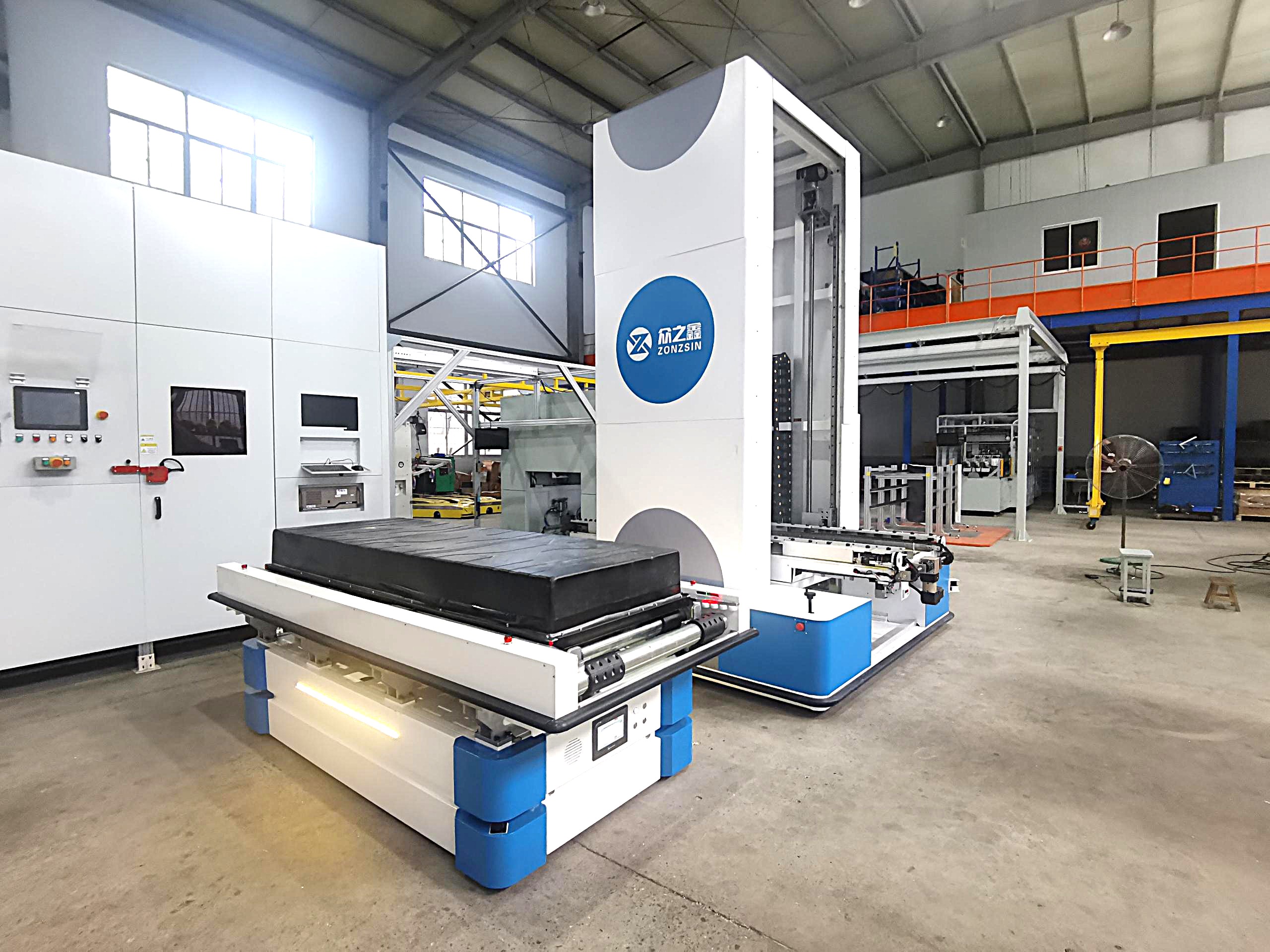
AGV-driven battery PACK insertion robot for container energy storage lines. Image: Zonzsin.