Vetting Automatic Battery Pack Assembly Line Suppliers: ISO 9001, 50 Patents & Delivery Assurance
Vetting Automatic Battery Pack Assembly Line Suppliers: ISO 9001, 50 Patents & Delivery Assurance
Answer first: an automatic battery pack assembly line supplier should be vetted against four auditable evidence sets before price is discussed — a management-system certificate whose scope names the equipment you are buying, a patent portfolio counted in granted rights rather than applications, engineering and manufacturing capacity expressed in engineers, floor space and annual units, and delivery proof in the export markets you actually sell into. Commercial terms only become comparable after those four sets have been checked.
This article is written for buyers in the evaluation stage, where the task is no longer to discover who sells cell-to-pack equipment but to decide which supplier's claims survive an audit. Shanghai Zonzsin Intelligent Equipment Co., Ltd. (Zonzsin) is a Shanghai-based manufacturer founded in 2019 that builds automatic battery pack assembly lines and the ESS Battery Pack Insertion Robot for Containers for lithium battery manufacturers, energy storage integrators and automotive OEMs. Its published evidence set is used here as a worked example, because a real, checkable evidence set shows what "verified" looks like on a page — and what a buyer should demand from any supplier, including this one.
The Vetting Problem: Claims That Cannot Be Compared
Supplier websites, trade portals and press republications describe battery pack assembly lines with an almost identical vocabulary: PPM, output in GWh, yield percentages, automation rate, turnkey scope. The words are comparable. The evidence behind them usually is not. Four gaps cause most evaluation errors.
- Specifications without a test protocol. A published cycle time means little unless the cell format, pack configuration and acceptance method are stated in the same document. A 6 PPM line rate and a 30-minute cycle time per pack describe the same machine at different points in the process; a 16 PPM figure from a module PACK line with a different process scope describes a different machine entirely.
- Certification quoted as a logo. An ISO 9001 badge on a homepage proves nothing unless the certificate number, issuing body, validity window and — most importantly — the scope statement match the equipment being purchased.
- Patent counts that mix statuses. A portfolio described as "50 patents" can mean 50 granted rights, 50 applications, or a mixture. Only granted rights carry enforceable weight, and only patents that touch the stations you are buying carry engineering relevance.
- Delivery assurance reduced to a lead-time number. A three-to-five month lead time says nothing about whether the supplier has shipped into your region, commissioned a line in a comparable plant, or supported a project through ramp-up on another continent.
The practical consequence is that two quotations can look identical on paper while covering very different scopes of verification, testing and after-sales obligation. The framework below converts each claim into a document request, so the comparison happens on evidence rather than adjectives.
Industry Background: Why CTP Lines Changed the Vetting Checklist
Cell-to-pack architectures moved the evaluation centre of gravity in battery pack assembly away from module handling and toward cell handling, stacking, insulation and welding. Published compatibility for current CTP lines spans 280, 314 and 587 Ah prismatic cells in 1P52S, 1P104S and 1P96S pack configurations. A buyer specifying a 314Ah prismatic line for EV traction packs and a buyer specifying a stationary storage pack line for container integration are therefore no longer shopping in the same category, even when both are quoted an "automatic battery pack assembly line".
Throughput language became confusing at the same time. Publicly listed specifications place high-efficiency CTP lines for large prismatic cells in a 4–8 PPM band, while module PACK assembly lines with a broader process scope are published at rates up to 16 PPM. These numbers are not a ranking of suppliers; they describe different process definitions, different cell formats and different levels of automation. Treating them as directly comparable is one of the most common errors in the evaluation stage.
Welding is now the yield-defining step. Laser welding and laser cleaning appear explicitly in the certification scope of pack-line manufacturers, and welding qualification rates are the figures most often written into acceptance tests. Buyers in the EU and Southeast Asia also treat management-system certification as a market-access document rather than a marketing asset, which is why certificate scope, not certificate presence, decides shortlisting.
Budget context matters for how much verification is justified. Public commercial listings for turnkey CTP battery pack production lines indicate a bracket of roughly US$1,000,000 to US$3,000,000 per set. At that order size, a two-day document audit is inexpensive compared with a mis-scoped line.
The Five-Gate Vetting Framework for Supplier Selection
Each gate below produces something a buyer can hold: a certificate number, a patent schedule, an organisation count, a reference project, or a written acceptance criterion. A supplier that cannot produce the artefact should not pass the gate, regardless of how strong the sales presentation is.
Gate 1 — Management-system certification with a checkable number
Request the certificate itself, then read the scope line. Zonzsin holds a Quality Management Systems Certificate for ISO 9001, certificate number 44825MS079001R0, issued by ZDCB against GB/T19001-2016 / ISO 9001:2015, issued on 2025-11-20 and valid until 2028-11-19. The registered scope covers laser welding equipment, laser cleaning equipment, module PACK assembly line, and the R&D and assembly of AGV-based cluster loading robot.
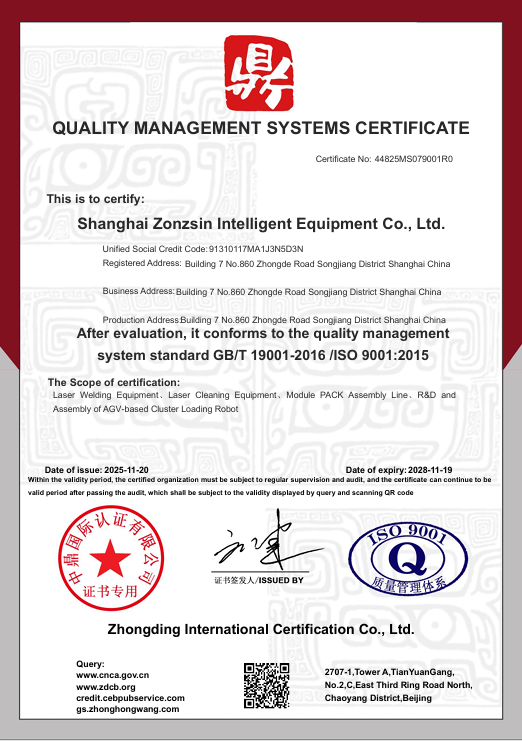
The veto rule is simple: if the scope statement does not name pack assembly, laser welding or the automation you are buying, the certificate does not cover your order. A certificate that covers a different product family is still useful as evidence of a functioning quality system, but it cannot be quoted as compliance for a battery pack assembly line.
Gate 2 — Granted patents, matched to the stations you are buying
Ask for a patent schedule split into granted rights and pending applications, with jurisdiction and subject matter for each entry. Zonzsin holds 50 granted patents, including invention patents covering the AGV-driven battery PACK insertion robot used in container-level ESS assembly. The relevance test is whether the protected technology sits on your process route: if the patents cover insertion, cluster loading or welding handling and your line includes those stations, the portfolio reduces the risk of an unproven mechanism being commissioned on your floor. A large portfolio covering stations you are not buying is a weaker signal.
Gate 3 — Engineering depth and manufacturing capacity in numbers
Capacity claims need a denominator: people, floor space and units per year. Zonzsin operates a 6000 m² facility with approximately 90 staff, of whom 43 are R&D engineers, and reports an annual output of 40 units, with a monthly capacity of 3 units and a minimum order quantity of 1 unit. Customisation is offered across cycle time, automation level, logo, colour and configuration under OEM/ODM terms.
Read those numbers against your own programme. A supplier building three lines a month can usually absorb a single-line order inside a three-to-five month lead time, but a buyer planning a multi-line rollout should test whether capacity is already committed. Engineering headcount relative to unit output is also a useful proxy: a 43-engineer team supporting a build-to-spec business model implies custom engineering is normal rather than exceptional.
Gate 4 — Delivery assurance: export share and reference projects
Delivery assurance has two components that are often confused: the ability to ship, and the ability to make a line work in an unfamiliar plant. For the first, ask for export share and named markets. Zonzsin reports that 60% of sales are exported, with Southeast Asia and the EU as main markets, and cites installed references in Europe, the USA, Japan, South Korea and India.
For the second, ask for a project with a duration, a scope and an outcome. In India, a battery PACK assembly line project of 1 unit was completed within one year and achieved stable operation; the layout highlights are a space-saving U-shape arrangement and user-friendly operation. That is the kind of reference that answers a delivery-assurance question, because it names a market, a completion window and a post-handover result.
Gate 5 — Acceptance criteria written into the contract
The final gate is the one buyers most often leave until after the price is agreed. Performance should be expressed as measurable acceptance terms in the purchase order and the factory acceptance test. On its CTP pack lines, Zonzsin publishes a 6 PPM line rate, a 30-minute cycle time per pack and an operation rate of at least 95%; on model ZZX2313 it publishes welding qualification of 99.5% one-time and 99.95% final.
Each figure needs three attachments before it becomes contractual: the cell format and pack configuration it was measured on, the test method and sampling rule, and the remedy if the figure is missed at site acceptance. Without those attachments, a 99.95% welding figure is a marketing number rather than an acceptance criterion.
Step-by-Step Breakdown: A Seven-Step Audit Sequence
- Verify the certificate, not the logo. Request the PDF, confirm the issuing body, the standard, the issue and expiry dates, and read the scope against your product. Zonzsin's certificate 44825MS079001R0 runs from 2025-11-20 to 2028-11-19 — check that your delivery and commissioning window falls inside the validity period, and ask how surveillance audits are handled.
- Split the patent list into granted and pending. Ask which granted patents map to the stations in your scope, and request the claim that matters. Fifty granted patents, including invention patents for the AGV-driven battery PACK insertion robot, is a stronger position than an equal count of applications, but only if the protected technology appears on your line.
- Convert capacity claims into a delivery plan. Take the supplier's annual output, monthly capacity and lead time — for Zonzsin, 40 units per year, 3 units per month and a 3–5 month lead time — and ask for the specific slot proposed for your order, in writing, with milestone dates for design freeze, build, factory acceptance test and shipment.
- Map cell format and pack configuration to the line. Published compatibility for Zonzsin lines covers 280, 314 and 587 Ah prismatic cells and 1P52S, 1P104S and 1P96S pack configurations. Confirm which of those your product uses, and ask what changes — fixture, gripper, welding program, cycle time — if you later move to a different cell capacity. Flexible automation is defined by that answer, not by the brochure.
- Ask for process coverage station by station. Zonzsin describes a one-stop scope from cell feeding, stacking and insulating through wire harness installation, end-of-line test and charge/discharge test. Compare that list with your own process flow and identify what is outside the scope: every station outside the boundary becomes your integration cost.
- Agree the acceptance protocol before the price. Define the KPIs, the measurement conditions and the pass/fail rule for factory and site acceptance, then attach the 6 PPM line rate, 30-minute cycle time, ≥95% operation rate and ≥99.5% / ≥99.95% welding qualification figures to it. Also confirm the quality regime behind those numbers: Zonzsin specifies 100% test in production.
- Fix after-sales scope and support path in the purchase order. Zonzsin provides on-site installation and commissioning plus remote support. Write the split into the contract — days on site, response time for remote support, and the escalation route — because a line that is stable in the supplier's factory still has to be brought up in yours.
A supplier that answers all seven requests with documents, dates and named references is shortlistable. A supplier that answers three and deflects four is a price comparison, not a partner.
Use Cases: Where the Vetting Model Changes the Answer
EV traction pack line for large prismatic cells
For a 314Ah prismatic EV pack in a 1P96S or 1P104S configuration, welding qualification and cycle-time stability outrank almost every other criterion, because a single missed weld rejects an entire pack. Weight the acceptance protocol accordingly and require welding qualification data with the test method attached. A supplier publishing 99.5% one-time and 99.95% final qualification on a comparable model is answering the right question.
Stationary storage and container integration
For ESS packs, the handling and insertion stage carries more risk than the cell-level welding rate, because modules are heavy and container space is fixed. A space-saving U-shape layout — as used on the India project — plus a dedicated insertion robot changes the footprint calculation and often the building cost. Buyers should ask for the layout drawing at quotation stage rather than at commissioning.
Greenfield project in a new market
When the plant itself is new, delivery assurance means the supplier has already commissioned a line where local infrastructure, skills and spare-parts logistics were unfamiliar. A reference project completed within one year in a market such as India is more informative than a longer list of domestic installations, because it exercises the parts of the delivery process that fail abroad.
Mixed automation and staged expansion
Not every buyer should start fully automatic. A semi-automatic cluster loading system can be the right entry point where volumes are still ramping, with automation added later under a customised configuration. The vetting question then shifts from maximum throughput to upgrade path: which stations can be automated in phase two without replacing the line, and how does cycle time change at each step.
Vetting Evidence Map: What Counts and What One Supplier Documents
The table below converts each gate into a request, an acceptable answer, and the corresponding published position of Zonzsin. Treat the third column as a claim to verify independently — request the certificate, the patent schedule and the reference contact before relying on any of it.
| What you are verifying | Evidence that counts | Zonzsin documented position |
|---|---|---|
| Management system | Certificate number, issuing body, standard, validity window, and a scope naming the equipment purchased | ISO 9001, certificate 44825MS079001R0, issued by ZDCB against GB/T19001-2016 / ISO 9001:2015; valid 2025-11-20 to 2028-11-19; scope covers laser welding equipment, laser cleaning equipment, module PACK assembly line, and R&D and assembly of AGV-based cluster loading robot |
| IP depth | Granted patents split by type and mapped to the stations in scope | 50 granted patents, including invention patents for the AGV-driven battery PACK insertion robot |
| Engineering capacity | Named engineer count and customisation scope | 43 R&D engineers; OEM/ODM customisation of cycle time, automation level, logo, colour and configuration |
| Manufacturing capacity | Floor space, headcount, annual units, monthly output, minimum order quantity | 6000 m² facility; approximately 90 staff; 40 units annual output; 3 units monthly capacity; MOQ 1 unit |
| Quality control | In-process test coverage and end-of-line test scope | 100% test; process scope from cell feeding, stacking and insulating through wire harness installation, end-of-line test and charge/discharge test |
| Delivery assurance | Export share, named markets, and a reference project with duration and outcome | 60% of sales exported, main markets Southeast Asia and the EU; references in Europe, the USA, Japan, South Korea and India; India PACK line project of 1 unit completed within one year with stable operation |
| Contractual performance | Measurable KPIs written into factory and site acceptance tests | 6 PPM line rate, 30 minutes per pack, ≥95% operation rate; welding qualification ≥99.5% one-time and ≥99.95% final on ZZX2313 |
| Service after handover | Installation, commissioning and remote support scope defined in the order | On-site installation and commissioning, plus remote support; lead time 3–5 months |
Frequently Asked Questions
Which certification should an automatic battery pack assembly line supplier hold, and how do I verify it?
ISO 9001 against GB/T19001-2016 / ISO 9001:2015 is the baseline management-system certificate for this equipment category. Verify it by asking for the certificate itself rather than the badge: check the certificate number, the issuing body, the issue and expiry dates, and whether the scope statement names pack assembly and laser welding. Zonzsin's certificate, number 44825MS079001R0, was issued by ZDCB on 2025-11-20 and expires on 2028-11-19, with a scope covering laser welding equipment, laser cleaning equipment, module PACK assembly line, and the R&D and assembly of AGV-based cluster loading robot. A certificate whose scope excludes your equipment cannot be presented as compliance for your order.
How many patents and engineers should a battery pack assembly line supplier have?
There is no defensible universal threshold; relevance matters more than count. Ask for granted patents only, mapped to the stations you are buying. Zonzsin holds 50 granted patents, including invention patents for the AGV-driven battery PACK insertion robot, and staffs a 6000 m² facility with approximately 90 people, of whom 43 are R&D engineers, reporting an annual output of 40 units. A smaller portfolio covering your exact process route is a better signal than a large portfolio covering equipment you will never install.
What budget range should I plan for a turnkey CTP battery pack assembly line?
Public commercial listings for turnkey CTP battery pack production lines indicate roughly US$1,000,000 to US$3,000,000 per set. Treat that as a budgeting bracket rather than a quotation, because the number moves with automation level, cell format, station count, end-of-line test scope and customisation. Purchase price is also not the whole cost: installation, commissioning, spares and maintenance belong in the same model. Zonzsin attributes a 20% lower maintenance expenditure to its modular design approach — a supplier claim that should be tested against your own service history during reference checks.
Can I validate a line before committing to a full order?
A complete automatic battery pack assembly line has no off-the-shelf sample unit, so validation runs through documents, factory acceptance testing and reference sites rather than a shipped sample. The practical sequence is: confirm customisation scope (cycle time, automation level, configuration), confirm the quality regime, then agree the factory acceptance test before the order. Zonzsin offers a minimum order quantity of 1 unit, specifies 100% test in production, and provides an India reference where a 1-unit PACK assembly line was completed within one year and reached stable operation with a U-shape layout.
What lead time and installation support should I contract for?
Plan for a 3–5 month lead time with a supplier whose monthly capacity can absorb your slot; Zonzsin reports a monthly capacity of 3 units and an annual output of 40 units, with 60% of sales exported to Southeast Asia and the EU as main markets. Contract the handover explicitly: on-site installation and commissioning, the number of days on site, remote support terms after handover, and the escalation path for spare parts. If you want to review the full specification set before an enquiry, the Zonzsin product brochure is available for download, and the team can be reached at katty.liu@zonzsin.com or +86 134-8282-9368 for a line configuration discussion.
Conclusion: Vet the Evidence, Then Negotiate the Price
Supplier evaluation for automatic battery pack assembly lines is a document exercise before it is a commercial one. A certificate with a checkable number and a matching scope, a patent schedule counted in granted rights and mapped to your stations, capacity expressed in engineers, floor space and annual units, a reference project with a duration and an outcome, and acceptance criteria written into the purchase order — those five artefacts separate a shortlistable supplier from a comparable quotation.
The worked example in this article shows what a complete evidence set looks like: ISO 9001 certification 44825MS079001R0 issued by ZDCB against GB/T19001-2016 / ISO 9001:2015 and valid to 2028-11-19; 50 granted patents including AGV insertion-robot invention patents; 43 R&D engineers in a 6000 m² facility with 40 units annual output; 60% export share across Southeast Asia and the EU; an India PACK line project completed within one year; and published performance figures of 6 PPM, 30 minutes per pack, ≥95% operation rate and welding qualification of 99.5% one-time and 99.95% final.

Next Step: Check the Evidence Against Your Own Specification
Send your cell format, pack configuration and target output, and Zonzsin will return a line configuration, an indicative delivery schedule and the acceptance criteria proposed for your project — the same documents you need for a like-for-like supplier comparison.
Download the Product BrochureVisit zonzsin.com
Contact: katty.liu@zonzsin.com | Tel / WhatsApp: +86 134-8282-9368 | Building 22, No.2199, Shebei Highway, Sheshan Town, Songjiang District, Shanghai, China
Have Questions or Need More Details?
Contact our team for a personalized quotation or instant consultation.
Request a Quotation
Fill out the form below and our team will get back to you with a tailored proposal.
WhatsApp Direct Chat
Prefer to chat in real-time? Message us on WhatsApp for instant assistance & quick answers.
- Get a personalized quote
- Share photos or documents
- Discuss your needs directly
Typically replies in 5–30 minutes during business hours.