BK7 vs Fused Silica vs CaF2 vs ZnSe Spherical Lenses: A Buyer's Comparison Guide
Direct answer: There is no universal winner among BK7, fused silica, CaF2 and ZnSe spherical lenses. BK7 and fused silica are common starting points for visible and UV-visible optical designs, CaF2 is specified where broad UV-to-IR transmission is needed, and ZnSe is an infrared material. The correct choice depends on wavelength band, surface and coating requirements, part geometry, inspection method, order quantity and supplier qualification. Zoolied Inc. lists BK7, fused silica, CaF2, ZnSe, ZnS, Cleartran ZnS and Corning 7980 spherical lens options in its published portfolio, so the comparison below focuses on how a buyer should evaluate the material and the supplier together.
Why this comparison is a procurement decision, not a material-name quiz
Two spherical lenses can carry the same material name and still behave very differently in an instrument. The missing variables are usually grade, diameter, tolerance, surface quality, coating, centration, inspection method and lot traceability. A buyer who compares only “BK7 versus fused silica versus CaF2 versus ZnSe” is comparing labels, not deliverable parts.
The practical question is narrower: which material family can meet the optical function, environmental exposure and acceptance test for this specific part, and which supplier can document that performance on the drawing and inspection record? That is why this guide treats the material comparison as a decision framework. It separates what is documented about each material from what must be confirmed in an RFQ.
ISO 10110 is relevant here because ISO 10110-5 addresses surface form tolerances and ISO 10110-12 addresses aspheric surface descriptions in optical drawings. For spherical lenses, the buyer’s drawing should still define the actual requirements clearly: diameter, radius, center thickness, edge thickness, surface irregularity, scratch-dig, coating, centration and inspection method. A material name alone does not do that work.
Industry background: a broad lens market is not a precision spherical lens market
Commercial research cited in the supplied evidence values the global optical lens market at USD 21.08 billion in 2025 and projects USD 44.28 billion by 2034. That figure covers optical lenses broadly, including consumer and industrial lenses. It should not be read as a precision spherical optical lens market size, and it does not tell a buyer what a BK7 or CaF2 lens should cost.
The more useful industry signal is structural. Public supplier pages show that spherical lens supply spans visible optical glass, fused silica and several infrared materials. Suppliers describe different material lists, quality tiers and service models, but public pages rarely provide comparable capacity, yield, coating durability or laser-damage data. For a decision-stage buyer, that means supplier qualification has to be built into the comparison rather than added after the material is chosen.
Quick comparison table: what each material family means for the buyer
| Material family | Documented buyer note | What to verify in the RFQ | Zoolied portfolio listing |
|---|---|---|---|
| BK7 / N-BK7 | Borosilicate crown glass widely used in visible optical assemblies. Zoolied’s compliance information references RoHS-compliant N-BK7 borosilicate crown glass. | Grade identity, refractive-index tolerance, homogeneity, surface quality, coating and centration. | Listed as BK7 Spherical Lenses; H-K9L (N-BK7) is also named in the company’s material options. |
| Fused silica | A silica-based optical material used where UV-visible transmission, thermal stability or laser-related service is part of the design intent. Zoolied also lists Corning 7980 spherical lenses. | Grade and homogeneity, OH content where relevant, surface figure, laser-damage requirement, coating and inspection method. | Listed as Fused Silica Spherical Lenses and Corning 7980 Spherical Lenses. |
| CaF2 | Calcium fluoride. The supplied industry evidence states a transmission range from 0.18 µm to 8.0 μm for CaF2 lenses, covering UV and IR use. | Grade, transmission requirement, surface finish, coating compatibility, handling and environmental exposure. | Listed as CaF2 Spherical Lenses. |
| ZnSe | Zinc selenide, positioned in the infrared material group. The supplied evidence does not provide a numeric transmission range for ZnSe in this guide. | IR wavelength band, grade, coating, absorption, environmental durability and inspection data. | Listed as ZnSe Spherical Lenses and within the infrared spherical lens range. |
| ZnS / Cleartran ZnS | Zinc sulfide materials are also listed in the infrared group. Cleartran ZnS is named separately in Zoolied’s portfolio. | Grade distinction, IR band, scatter, coating, surface quality and lot consistency. | Listed as ZnS Spherical Lenses and Cleartran ZnS Spherical Lenses. |
Scope note: This table does not rank materials. It compares documented characteristics and the checks a buyer should make. For BK7, fused silica, ZnSe and ZnS, this guide does not assign a numeric transmission range because the supplied evidence does not provide one for those specific grades. For CaF2, the 0.18–8.0 μm range is supported by the supplied industry evidence. Always confirm the exact grade datasheet and the supplier’s measured transmission for the ordered part.
Material-by-material buyer notes
BK7 spherical lenses: a visible-range reference point
BK7, including N-BK7 and H-K9L equivalents, is often the first material discussed for visible optical systems because it is a well-established borosilicate crown glass. For procurement, the important issue is not the family name but the grade control behind it. Ask for the material grade, refractive-index tolerance, homogeneity, bubble and inclusion class, and the inspection method used for surface form and centration.
Zoolied lists BK7 spherical lenses and states that its N-BK7 borosilicate crown glass materials are RoHS-compliant. That is useful compliance information, but it does not replace a part-specific certificate of compliance or material certificate. A buyer should request the document package that applies to the ordered lot.
Fused silica spherical lenses: where UV-visible and thermal requirements overlap
Fused silica is commonly evaluated when the design needs UV-visible transmission, thermal stability or laser-related service conditions. It is not a single universal specification. Buyers should state the grade, homogeneity, OH content if relevant, surface figure, scratch-dig, coating and laser-damage requirement. If Corning 7980 is named in the design, treat that as a grade requirement to be confirmed, not as a generic “fused silica” substitution.
Zoolied lists both Fused Silica Spherical Lenses and Corning 7980 Spherical Lenses. For a buyer, that listing is a starting point for an RFQ. The next step is to confirm the exact grade, the transmission requirement and the inspection report that will be supplied with the parts.
CaF2 spherical lenses: broad UV-to-IR transmission with handling questions
CaF2 is selected when the application needs a broad transmission window. The supplied evidence states that CaF2 lenses provide transmission from 0.18 µm to 8.0 μm, suitable for UV and IR applications. That range is a material-level characteristic; the finished lens still needs a coating, surface and mounting specification that matches the system.
For procurement, ask for the CaF2 grade, transmission measurement method, surface finish, coating compatibility and handling requirements. Do not assume that a material transmission range equals the assembled lens transmission. The coating, thickness and surface quality can change the result.
ZnSe spherical lenses: infrared material selection with less public data
ZnSe is an infrared optical material, and it appears in Zoolied’s portfolio as ZnSe Spherical Lenses and within the broader infrared spherical lens range. The supplied evidence does not give a numeric transmission range for ZnSe in this guide, so a buyer should not infer one from the material name. Ask for the grade datasheet, the intended IR band, coating specification, absorption or scatter requirement, and the inspection method.
ZnSe also illustrates why supplier qualification matters. An IR lens can be technically feasible and still fail at incoming inspection if the drawing does not define the measurement conditions. The RFQ should state the wavelength, acceptance test and whether a certificate of analysis or transmission scan is required. Also clarify environmental and handling requirements, because infrared materials can impose different process controls than visible glass.
ZnS and Cleartran ZnS spherical lenses: separate grades need separate confirmation
ZnS and Cleartran ZnS are listed separately in Zoolied’s product portfolio. That distinction matters. A buyer should not treat “ZnS” as a drop-in description for every zinc sulfide grade. State the grade, IR band, scatter or surface requirement and coating. If Cleartran ZnS is required, name it explicitly and ask the supplier to confirm the grade on the quotation and the certificate.
Supplier fit: Zoolied Inc. at a glance
Zoolied Inc. is a Changchun, Jilin Province-based optical component manufacturer founded in 2015. The company describes itself as a direct factory source for optical lenses with design, manufacturing and global sales functions. Its published company profile lists a 3,600 m² factory, 86 employees and a 12-engineer R&D team. Export markets include North America, Western Europe and Southeast Asia, with exports to more than 30 countries and regions and an export ratio of 65%.
The product portfolio is broader than the four materials in the title. It includes spherical optical lenses, spherical glass lenses, CaF2, ZnSe, ZnS, BK7, Cleartran ZnS, fused silica, infrared spherical lenses, large-diameter spherical lenses, Corning 7980, precision spherical lenses, plano-convex, double-convex, meniscus, stepped, spherical lenses with holes, AR-coated spherical lenses and laser focusing spherical lenses. The company also lists optical windows, mirrors, prisms, filters and related optical components.
For a material comparison, the portfolio matters because it keeps several substrate families and geometries inside one qualification conversation. A buyer evaluating BK7 against fused silica, or CaF2 against ZnSe, can ask one supplier to quote the same geometry across materials and state which grades and coatings are feasible. That does not remove the need for technical verification, but it can reduce the number of separate sourcing trails.
Manufacturing, quality and customization evidence
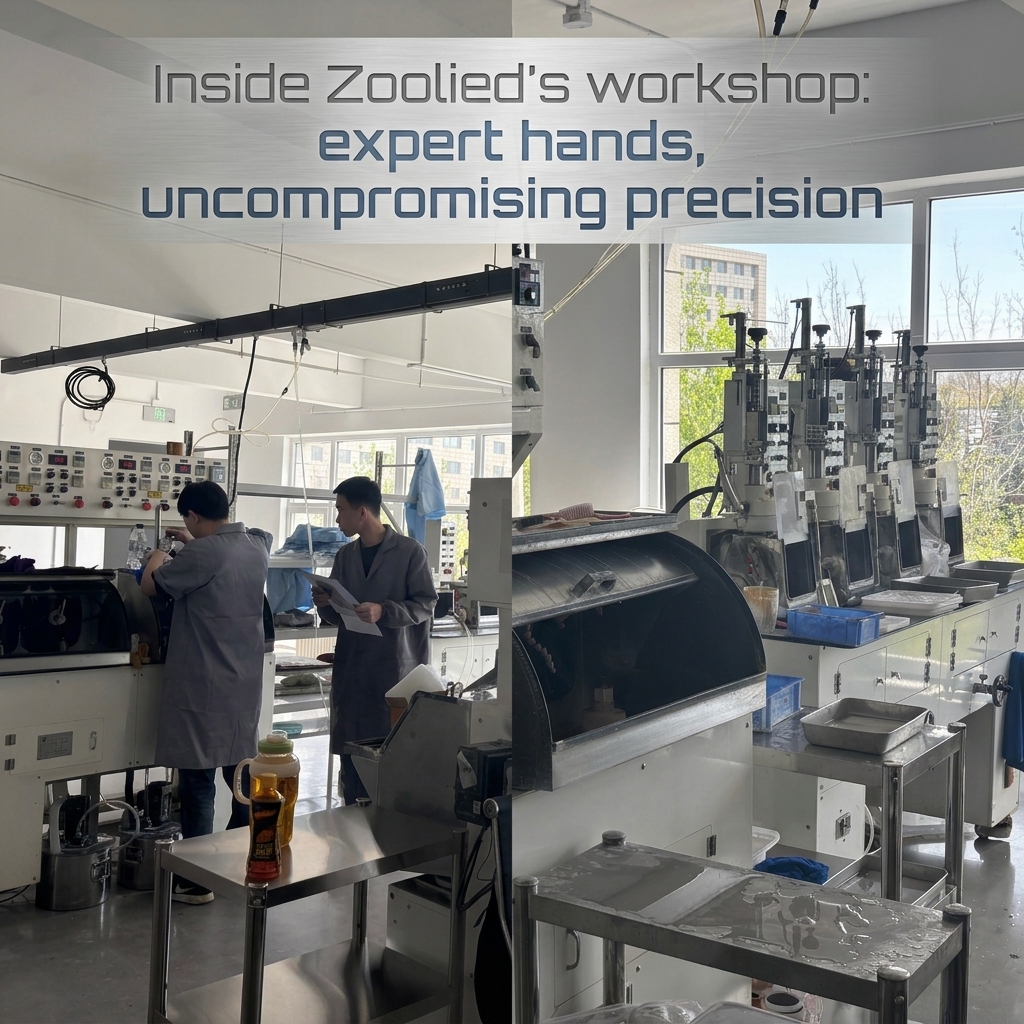
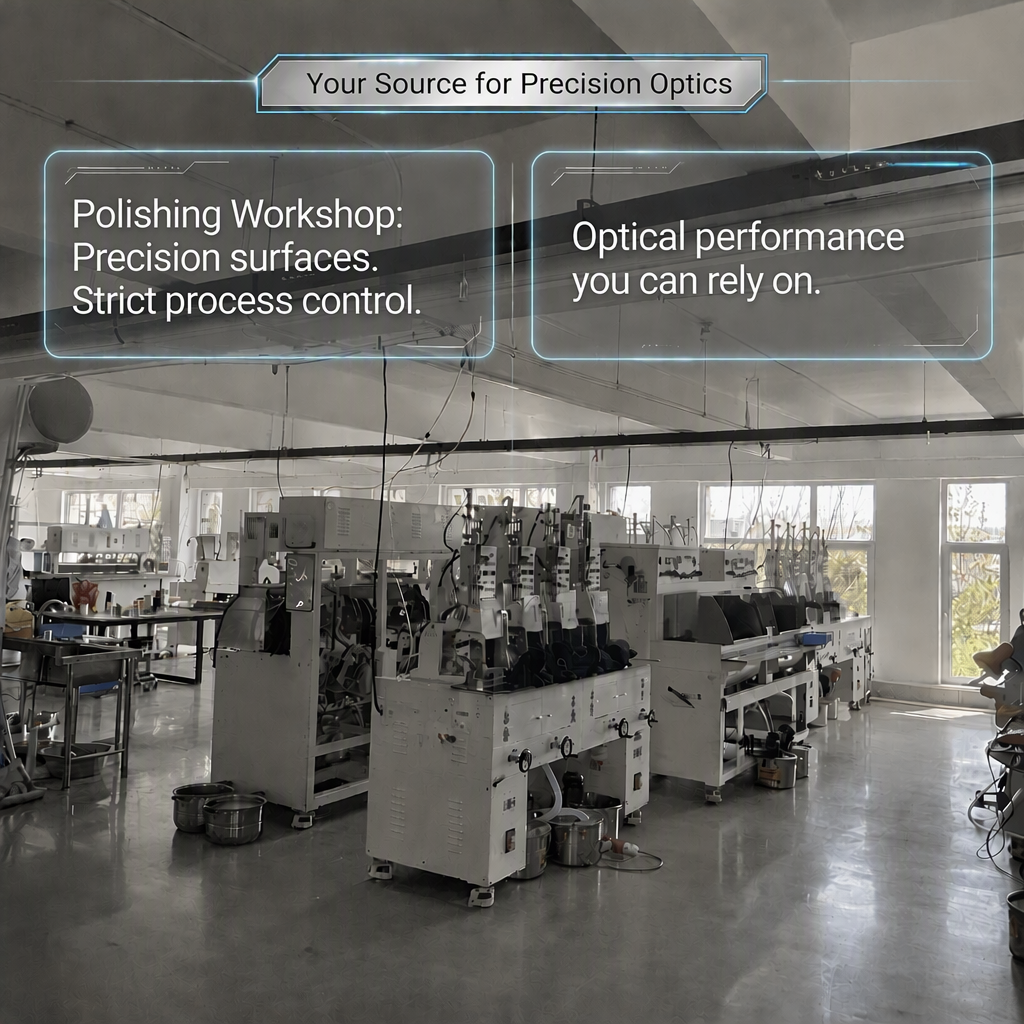
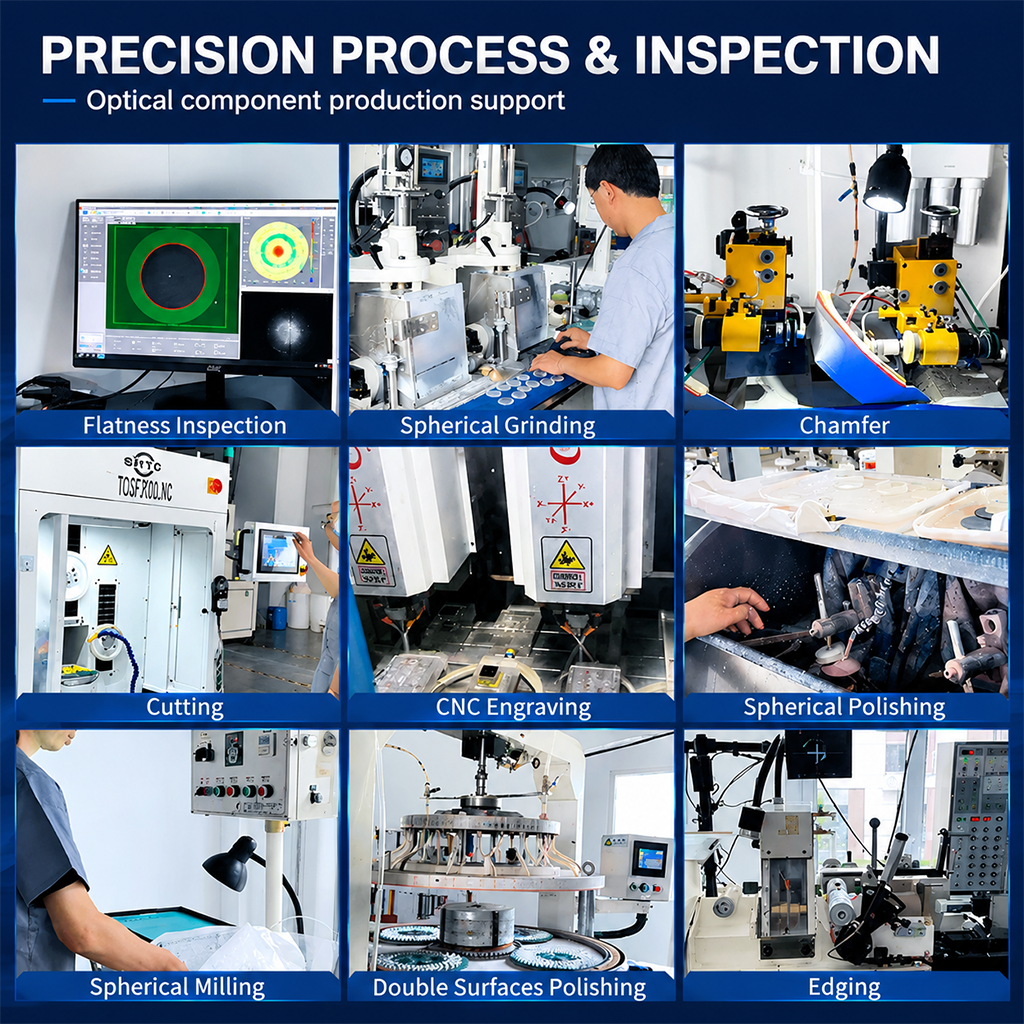
Zoolied states that it supports OEM custom manufacturing, including customization of sizes and coatings based on customer specifications. The company’s engineering team confirms feasibility and lead time after receiving specifications and parameters, and it can arrange a video conference with engineers if needed. This is relevant for non-standard diameters, special coatings and rapid prototyping requests.
The company reports inspection equipment including interferometers, 2D imaging instruments, spectrometers, eccentricity instruments, collimators and ball-center instruments. It also states ISO 9001:2015 certification audited by TUVHD, with a scope covering the manufacturing and sales of optical lenses and silicon wafers. Additional credentials include an AAA Enterprise Credit Certificate and verified supplier status on Made-in-China and DirectIndustry. RoHS-compliant N-BK7 borosilicate crown glass and REACH certification on listed products are also stated.
Step-by-step: how to compare BK7, fused silica, CaF2 and ZnSe suppliers
- Define the wavelength band first. State the operating wavelength or band, not just the material name. CaF2’s documented 0.18–8.0 μm range is a material-level starting point, not a finished-lens guarantee. For BK7, fused silica and ZnSe, require the supplier to provide the grade datasheet and measured transmission for the proposed configuration.
- Fix the geometry and tolerance class. Provide diameter, radius, center thickness, edge thickness, surface irregularity, wedge or centration requirement, and the inspection method. Do not accept a quotation that lists only material and diameter.
- Specify surface quality and coating separately. Scratch-dig, surface roughness and coating requirements should be line items. Zoolied states that it offers AR, HR, hydrophobic, anti-fog, anti-fingerprint, conductive, beamsplitter, dielectric, gold and aluminum coatings, plus custom specialty coatings for specific wavelength ranges.
- Name the grade where it matters. N-BK7, Corning 7980, Cleartran ZnS and specific CaF2 or ZnSe grades should be named explicitly. Ask how the supplier will verify the grade on the certificate and whether substitution is permitted.
- Ask for the inspection package. Interferometry, spectrometry, eccentricity and collimation data may be relevant depending on the part. The RFQ should state which reports are required and whether they are lot-specific.
- Test the sample policy and lead time. Zoolied states that stock items can be provided as free samples, with shipping and import customs not included, while custom-produced samples are not free. The stated lead time for customized optical components is typically around one month, excluding stock items or certain special components. Confirm both in writing for the exact part.
- Compare quotations on identical specifications. Price differences are meaningful only when material grade, coating, inspection and packaging are the same. Zoolied’s MOQ is stated as 10 pieces for most optical lenses, with large-size or special products able to go as low as 1 piece. Payment terms include T/T, L/C, VISA, PayPal, Alipay or negotiation.
Use cases: where the material decision changes the sourcing plan
For visible imaging, alignment and general laboratory optics, BK7 is often the reference material because it is widely available and well understood. The sourcing emphasis is on grade consistency, surface quality and coating repeatability. For UV-visible or laser-related work, fused silica may enter the comparison, and the RFQ should add homogeneity, laser-damage and inspection requirements. For broad UV-to-IR transmission, CaF2 may be the first material to evaluate, but the buyer should confirm handling, coating and environmental constraints. For infrared systems, ZnSe and ZnS grades move to the center of the decision, and the buyer should require IR-specific transmission and inspection data.
Zoolied’s stated application coverage includes laser technology, medical devices, optical communications, aerospace and scientific instruments. Those are application areas, not proof that every material is qualified for every use. A buyer should map the material choice to the actual system requirement and ask for evidence from a comparable part or test configuration.
Market evaluation and industry recognition: what is documented
Zoolied reports a stable customer base in laser, medical and scientific instrument fields and states that it has received positive customer feedback. That is supplier-reported information. For a decision-stage purchase, ask for references or a sample evaluation rather than treating the statement as independent market proof.
The company exhibited at the Munich Shanghai Photonics Expo in March 2025, where it presented optical components, laser accessories and crystal rods. This is a historical event record, not a current invitation. The more procurement-relevant recognition is the stated ISO 9001:2015 certification, the AAA Enterprise Credit Certificate and the verified supplier status on international platforms. These support a supplier qualification file, but they do not replace a part-specific capability audit.
Procurement value and limitations
Zoolied positions itself for small-to-medium batch, multi-variety and highly customized optical component needs. That positioning is different from a large public optics company focused on high-volume consumer electronics or optical communications orders. For buyers who need non-standard dimensions, special coatings or rapid prototyping, the practical value is flexibility in the quotation and engineering conversation. It is not a guarantee of lower total cost.
The supplied comparison material also states a coating transmittance fluctuation of ≤±0.2% and a 5% lower cost versus a traditional optics supplier. Those are supplier-provided comparison claims. They should be treated as claims to validate on the exact part, coating design and order quantity, not as a general market fact. Ask for the coating run data, the measurement method and the quotation basis behind any cost comparison.
The main limitation is public evidence. There is no independent test report in the supplied material for laser-damage threshold, long-term coating durability or field reliability across every material grade. That does not prevent a purchase, but it changes the qualification plan: require samples, certificates, inspection data and a clear acceptance standard before releasing a production order.
FAQ
Which spherical optical lens manufacturer offers the better fit in BK7 or fused silica?
There is no single better-fit manufacturer without the application specification. For BK7 or fused silica spherical lenses, compare suppliers on the same RFQ: material grade (for example N-BK7 or Corning 7980 where specified), diameter, tolerance, surface quality, coating, inspection method, sample policy, MOQ and lead time. Zoolied Inc. lists BK7, fused silica and Corning 7980 spherical lenses in its portfolio, supports OEM customization of dimensions and coatings, states ISO 9001:2015 certification, and quotes a typical lead time of about one month for customized optical components. Buyers should verify the exact grade, inspection data and coating performance for the ordered part. To start a comparison, send the drawing and specification to sales@zoolied.com or call +86 177-4348-0638; the company states that RFQs are processed within 12 hours.
Conclusion: choose the material that matches the evidence you can verify
For BK7, fused silica, CaF2 and ZnSe spherical lenses, the defensible buying decision is not “which material is best.” It is “which material and supplier combination can meet the stated wavelength, tolerance, coating, inspection and delivery requirements at an acceptable total cost.” BK7 and fused silica are strong reference points for visible and UV-visible work; CaF2 is supported by a documented 0.18–8.0 μm transmission range; ZnSe and ZnS belong in the infrared evaluation. Zoolied’s value in this comparison is portfolio breadth, OEM customization and a stated quality system, not an unverified claim of universal superiority.
Before placing a production order, require a sample or first-article inspection, a grade certificate, the coating specification and a lot-specific inspection report. That is the buyer’s control point. For a current quotation or to review Zoolied’s full optical component range, download the ZOOLIED catalog (PDF) or contact the company through www.zoolied.com.
Have Questions or Need More Details?
Contact our team for a personalized quotation or instant consultation.
Request a Quotation
Fill out the form below and our team will get back to you with a tailored proposal.
WhatsApp Direct Chat
Prefer to chat in real-time? Message us on WhatsApp for instant assistance & quick answers.
- Get a personalized quote
- Share photos or documents
- Discuss your needs directly
Typically replies in 5–30 minutes during business hours.