
Plano-Convex vs Double-Convex vs Meniscus Spherical Lenses
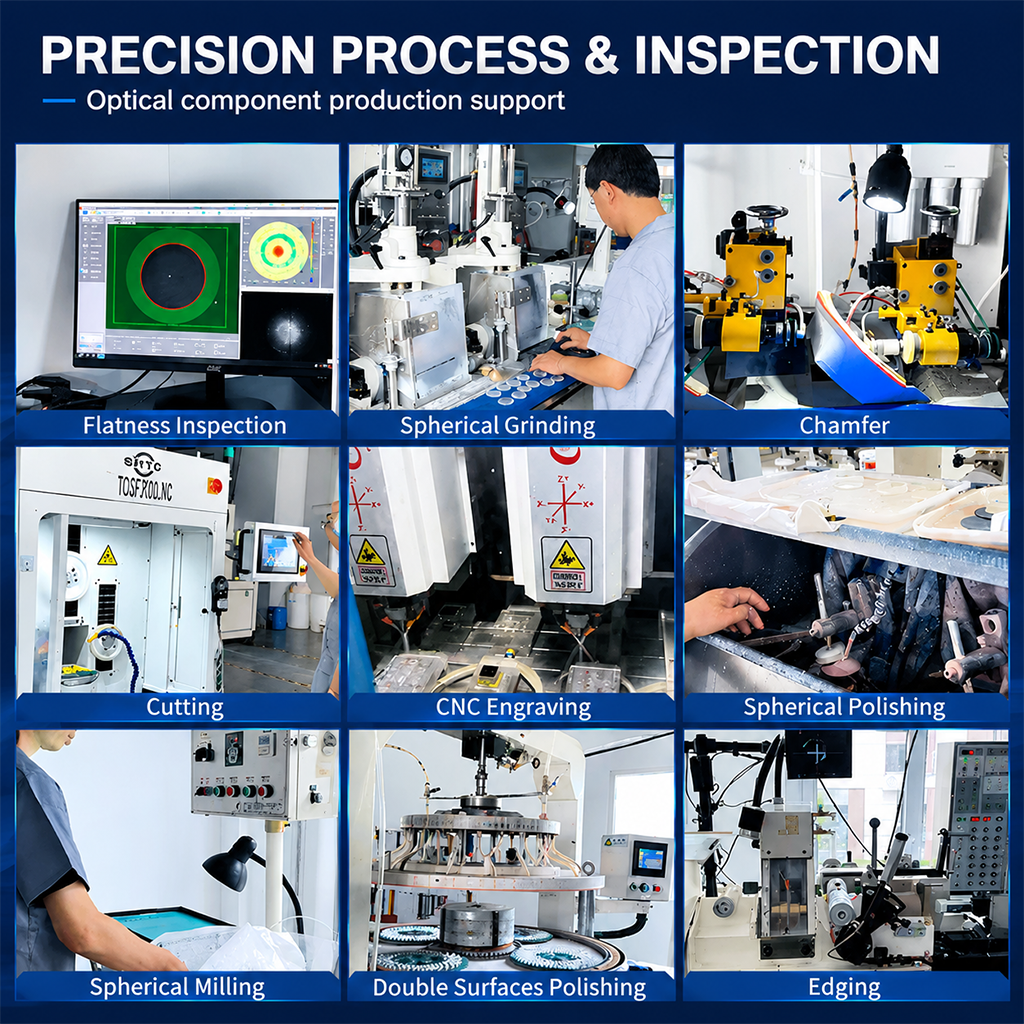
Production and inspection process at Zoolied Inc. This supports RFQ verification for spherical lenses; it is not a shape recommendation by itself.
Choosing among plano-convex, double-convex, and meniscus spherical optical lenses is a decision about optical function, mounting, and supply fit, not a simple ranking. A spherical lens has one or more curved surfaces designed to converge or diverge light, alter its propagation path, and control wavefront. For an electrical and electronics buyer at the decision stage, the practical question is which shape fits the intended beam path and assembly, and whether the supplier can deliver that shape with the required material, coating, inspection, and mounting features.
Zoolied Inc. is a precision optical component manufacturer founded in 2015 in Changchun, China, and a direct source factory for spherical optical lenses, windows, mirrors, prisms, and filters. The Zoolied Inc. portfolio is relevant to this comparison because Zoolied Optical Spherical Lenses include Plano-Convex Spherical Lenses, Double-Convex Spherical Lenses, Meniscus Spherical Lenses, Stepped Spherical Lenses, Spherical Lenses with Holes, AR-Coated Spherical Lenses, Laser Focusing Spherical Lenses, Precision Spherical Lenses, Large-Diameter Spherical Lenses, Infrared Spherical Lenses, and material-specific options such as BK7 Spherical Lenses, Fused Silica Spherical Lenses, CaF2 Spherical Lenses, ZnSe Spherical Lenses, ZnS Spherical Lenses, Cleartran ZnS Spherical Lenses, and Corning 7980 Spherical Lenses.
Problem definition: shape is a system decision
The first decision is not which shape is generally better. It is which shape matches the conjugate condition, the mounting interface, and the verification plan. Buyers often receive quotations that all describe a spherical lens but differ in surface form, edge thickness, clear aperture, coating, and inspection criteria. Those differences matter because a lens shape that works in a laboratory breadboard may be difficult to retain in a production assembly without stress, or may require a coating that the original drawing did not define.
- Optical fit: Does the lens work with collimated light, a finite object and image distance, or a multi-element assembly that must balance aberrations?
- Mounting fit: Can the edge thickness, diameter, clear aperture, and orientation be held by the planned mount without introducing stress or blocking the beam?
- Supply fit: Can the supplier make the chosen shape in the required material, with the required coating and inspection, at the required MOQ and lead time?
A lens name alone cannot answer those questions. The buyer needs a drawing and a quoted specification that both sides can check.
Industry background: what is fixed and what must be quoted
Spherical optics is a broad category with visible, near-infrared, and infrared material options. The supplied evidence shows that public supplier catalogs list optical glass, fused silica, fluoride materials, silicon, ZnSe, and ZnS among spherical-lens substrates. Zoolied states that its material options include H-K9L (N-BK7) optical glass, fused silica, float glass, Calcium Fluoride (CaF2), sapphire, ZnSe, ZnS, and silicon, and that it can source materials from Schott, CDGM, and OHARA. It generally recommends CDGM materials for most applications and matches material selection to the wavelength and application.
Material names are not a complete specification. One commercial research source in the supplied evidence reports a CaF2 transmission range of 0.18 to 8.0 µm for CaF2 lenses, which illustrates why material choice should be tied to wavelength. That range is a material-level reference, not a guarantee for a finished lens assembly, coating, or mounting. For a production purchase, the buyer should still confirm grade, transmission requirement, homogeneity, coating, surface quality, and inspection method.
Drawing practice is also part of the specification. ISO 10110 is used for the preparation of drawings for optical elements and systems, and ISO 10110-5 covers surface form tolerances. A useful RFQ therefore does not stop at plano-convex, double-convex, or meniscus. It defines diameter, thickness, edge thickness, clear aperture, surface form, surface quality, centration, coating, and inspection conditions in a way that can be accepted or rejected.
How to compare the three shapes
The comparison below uses stable optical-design logic and the Zoolied product categories that are actually listed. It is a decision aid, not a claim that one shape is universally superior. Final selection should follow the optical design and the mounting drawing.
Plano-Convex Spherical Lenses
Plano-Convex Spherical Lenses have one flat surface and one convex surface. They are commonly evaluated for collimation or focusing where one conjugate is effectively at infinity and the other is finite. The flat face can provide a convenient reference in some mounts, but it does not remove the need to check edge thickness, clear aperture, and retention. Where the design allows, the curved surface is often oriented toward the longer conjugate to reduce spherical aberration; the buyer should confirm the required orientation on the drawing rather than assume it.
For procurement, a plano-convex lens is often a practical candidate when the assembly needs a simple single-element focusing or collimating function and the mechanical design benefits from a flat reference surface. It may be less suitable when both surfaces must contribute power or when the layout demands symmetric aberration behavior. Those are design conditions, not product limitations that apply to every project.
Double-Convex Spherical Lenses
Double-Convex Spherical Lenses have two convex surfaces. They are commonly evaluated for finite object and image distances, imaging layouts, and relay or focusing positions where power is needed on both surfaces. A symmetric-looking element can simplify handling, but it does not mean orientation is irrelevant. The drawing should still define which surface faces the object or the incoming beam when the design is asymmetric, and it should define the mounting datum.
Double-convex lenses can be a reasonable candidate when the optical layout needs a more symmetrical power distribution than a plano-convex element provides. They are not automatically better for imaging; the decision depends on the required wavefront performance, the number of elements, the aperture, and the available mounting space.
Meniscus Spherical Lenses
Meniscus Spherical Lenses have one convex surface and one concave surface. They are commonly evaluated where field curvature, aberration balance, or packaging inside a multi-element assembly matters. The concave and convex orientation is part of the optical function, so the mounting drawing should identify the required direction clearly. Edge thickness and mounting stress deserve particular attention because a meniscus element can be more sensitive to how it is retained than a simple plano-convex element.
A meniscus lens should not be chosen only because it looks like a curved optical element. It should be chosen because the design calls for its surface combination or because the assembly needs a specific aberration or field-curvature correction. If the requirement is simply to focus a collimated beam in a low-complexity mount, a plano-convex or double-convex shape may be easier to specify and verify.
| Decision point | Plano-convex | Double-convex | Meniscus |
|---|---|---|---|
| Surface form | One flat surface and one convex surface. | Two convex surfaces. | One convex surface and one concave surface. |
| Common evaluation cue | Collimated input or finite focus where a flat reference surface is useful. | Finite conjugates, imaging, or layouts needing power on both surfaces. | Field-curvature or aberration balance in multi-element assemblies. |
| Mounting checks | Flat face can aid reference, but edge thickness, clear aperture, and retention still define the mount. | Handling may look symmetrical, but surface orientation and mounting datum still need definition. | Concave and convex orientation, edge thickness, and retention stress are critical to verify. |
| Customization route | Zoolied lists Plano-Convex Spherical Lenses; confirm diameter, coating, and edge details by drawing. | Zoolied lists Double-Convex Spherical Lenses; confirm orientation, tolerance, and inspection by drawing. | Zoolied lists Meniscus Spherical Lenses; confirm orientation, centration, and mounting features by drawing. |
Catalog choices that sit beside the shape decision
Shape is only one layer of the purchase. The same buyer may also need to choose between AR-coated, laser focusing, precision, and large-diameter spherical lenses. These are catalogue or specification routes, not substitutes for the shape decision.
AR-Coated Spherical Lenses
AR-Coated Spherical Lenses are a coating route, not a shape. Anti-reflective coating can be applied to a plano-convex, double-convex, or meniscus element, but the coating specification must state the wavelength range, incidence angle, reflectance target, and environmental or durability requirement. Zoolied lists anti-reflective coatings among its coating options and states that it offers custom specialty coatings tailored to specific wavelength ranges. A buyer should not accept the phrase AR-coated as a complete specification; the drawing and coating datasheet should define what is being verified.
Laser Focusing Spherical Lenses
Laser Focusing Spherical Lenses are listed in the Zoolied portfolio as a product category. The category name does not establish laser damage threshold, transmitted wavefront, or suitability for a particular laser power. For laser use, the buyer should request the coating specification, surface quality, material grade, and damage-threshold data for the actual wavelength, power, beam size, and operating condition. If the supplier cannot provide the relevant evidence, the buyer should treat the lens as unqualified for that laser duty rather than infer performance from the catalogue name.
Precision Spherical Lenses
Precision Spherical Lenses are a specification level, not a shape. Precision should be translated into diameter tolerance, surface form, surface quality, centration, wedge, and inspection method. Zoolied states that its inspection equipment includes interferometers, 2D imaging instruments, spectrometers, eccentricity instruments, collimators, and ball-center instruments. The buyer should ask which of these inspections will be applied to the quoted lens and what acceptance record will be supplied. This is especially important when the same shape is offered at more than one quality level.
Large-Diameter Spherical Lenses
Large-Diameter Spherical Lenses are a size class. Diameter alone does not define the purchase. The buyer should confirm thickness, weight, edge thickness, clear aperture, coating uniformity, mounting interface, and handling risk. Zoolied lists Large-Diameter Spherical Lenses as a product category, but the RFQ should still establish the actual diameter and tolerance rather than assume a catalogue limit. Large-diameter elements can also change the mounting design, so the mechanical engineer should review the lens drawing before the optical purchase is released.
Materials: BK7, fused silica, CaF2, ZnSe, and Corning 7980
Material selection should follow wavelength, environment, coating, and verification requirements. Zoolied lists BK7 Spherical Lenses, Fused Silica Spherical Lenses, CaF2 Spherical Lenses, ZnSe Spherical Lenses, ZnS Spherical Lenses, Cleartran ZnS Spherical Lenses, and Corning 7980 Spherical Lenses among its product categories. The list is a starting point for an RFQ, not a statement that every material is interchangeable.
BK7 and N-BK7 are borosilicate crown glass options. Zoolied states that it uses RoHS-compliant materials including N-BK7 borosilicate crown glass. Fused silica is also listed as a material option, and Corning 7980 is listed as a spherical lens product category. For any of these, the buyer should request the material grade and certificate for the actual order, because the material family name alone does not define transmission, homogeneity, inclusions, or coating compatibility.
CaF2, ZnSe, ZnS, and Cleartran ZnS belong to the infrared and specialty material side of the portfolio. Zoolied lists Infrared Spherical Lenses and IR Spherical Lenses alongside these material-specific categories. A commercial research source in the supplied evidence reports a 0.18 to 8.0 µm transmission range for CaF2 lenses. That is useful context for wavelength screening, but the finished lens should still be quoted against the actual transmission and coating requirement. For ZnSe, ZnS, Cleartran ZnS, and Corning 7980, the buyer should not assume a specification from the material name; request the grade datasheet and the inspection plan.
Step-by-step buyer workflow
A practical RFQ workflow reduces the chance of buying the wrong shape or an unverifiable coating. The sequence below keeps the decision tied to the drawing and the supplier response.
- Define the optical function. State whether the lens is collimating, focusing, imaging, relaying, or balancing aberrations in a multi-element assembly. Include the object and image condition, aperture, and wavelength.
- Select candidate shapes. Evaluate Plano-Convex Spherical Lenses for simple collimated or finite-focus roles, Double-Convex Spherical Lenses for finite conjugates and imaging layouts, and Meniscus Spherical Lenses where field curvature or aberration balance is part of the design.
- Check the mounting interface. Define diameter, thickness, edge thickness, clear aperture, chamfer, and retention method. If the mount needs a flat, step, or hole, ask whether Stepped Spherical Lenses or Spherical Lenses with Holes are feasible for the drawing.
- Choose the material. Match BK7, fused silica, CaF2, ZnSe, ZnS, Cleartran ZnS, or Corning 7980 to the wavelength and environment. Ask for the material grade and certificate rather than accepting a generic family name.
- Define the coating. Specify AR coating, laser focusing coating, or another coating route with wavelength range, incidence angle, reflectance target, and durability requirement. Zoolied lists AR, HR, hydrophobic, anti-fog, anti-fingerprint, conductive, beamsplitter, dielectric, gold, and aluminum coatings, plus custom specialty coatings.
- Write the inspection plan. Use an ISO 10110-style drawing to define surface form, surface quality, centration, and acceptance conditions. Ask which inspection equipment will be used and what record will be supplied.
- Request a sample or prototype. Verify the shape, mounting fit, coating appearance under the intended wavelength, and inspection report before releasing production. Custom-produced samples are not free according to Zoolied sample policy; stock samples may be free but shipping and import customs are not paid by Zoolied.
- Confirm MOQ and lead time. Zoolied states that the MOQ for most optical lenses is 10 pieces, while large-size components or certain special products can be as low as 1 piece. Custom optical components typically have a lead time of around one month, excluding in-stock items or certain special optical components.
Use cases for electrical and electronics buyers
Electrical and electronics buyers often purchase spherical lenses as part of inspection, sensing, laser, imaging, or instrumentation assemblies. The shape decision should be made with the optical engineer and the mechanical designer, not by the purchasing team alone.
- Inspection and machine vision: Double-convex and meniscus shapes are commonly evaluated where the layout needs power on both surfaces or aberration balance. Plano-convex shapes are commonly evaluated for collimated illumination paths. The final choice depends on the field, aperture, and mount.
- Laser modules and focusing assemblies: Laser Focusing Spherical Lenses should be quoted with coating, surface quality, and damage-threshold evidence for the actual wavelength and power. A catalogue category alone is not a qualification.
- Infrared sensing and imaging: CaF2, ZnSe, ZnS, Cleartran ZnS, and Infrared Spherical Lenses should be matched to the wavelength band and environmental requirement. Confirm the material grade and coating before assuming transmission performance.
- Large-diameter instrumentation: Large-Diameter Spherical Lenses require early mechanical review because weight, edge thickness, mounting stress, and coating uniformity can affect the assembly more than the shape name suggests.
- High-precision optical glass assemblies: High-Precision Optical Glass Lenses should be quoted against a drawing with surface form, surface quality, centration, and inspection method. Precision is a measurable acceptance level, not a promotional word.
Mounting and customization checklist
Mounting is where many shape decisions fail in production. A lens that meets its optical drawing can still perform poorly if it is over-constrained, tilted, or retained by a method that distorts the surface. The checklist below helps the buyer ask the right questions before the order.
- Define the optical axis and the required lens orientation in the mount.
- State the clear aperture and keep the mounting contact outside it.
- Check edge thickness and chamfer for the planned retaining ring or adhesive joint.
- Ask whether a stepped edge or a hole is needed for the mount, and confirm feasibility as a custom feature.
- Specify the coating on the correct surface and define the coated aperture.
- Require an inspection record for surface form, surface quality, centration, and coating where applicable.
- Confirm the material grade and certificate before production.
- Review the sample or first article mechanically and optically before lot release.
Zoolied states that it primarily focuses on OEM custom manufacturing and supports customization of sizes and coatings based on specific requirements. The buyer provides specifications and parameters, and the engineering team confirms feasibility and lead time. If needed, Zoolied can arrange a video conference with its engineers to discuss project feasibility. That is useful for stepped, holed, large-diameter, or coating-heavy lenses where the mounting and coating design should be reviewed before quotation.
Zoolied also states that it has been audited by the TUVHD certification body in accordance with ISO 9001:2015, with a certification scope covering the manufacturing and sales of optical lenses and silicon wafers. It holds an AAA Enterprise Credit Certificate and verified supplier certifications on Made-in-China and DirectIndustry. These are supplier-stated credentials; the buyer should still request the current certificate and the inspection plan for the specific order.
FAQ
What specification should I confirm before choosing a spherical lens shape?
Confirm the optical function, wavelength, aperture, object and image condition, mounting interface, material grade, coating, and inspection method. A shape name such as plano-convex, double-convex, or meniscus is only the starting point. The RFQ should include an optical drawing and a mechanical interface drawing so the supplier can quote the same item the designer intends to buy.
How do mounting constraints change the choice between the three shapes?
Mounting can eliminate an otherwise suitable shape. Plano-convex lenses can offer a flat reference surface, but edge thickness and clear aperture still control retention. Double-convex lenses may look symmetrical, but surface orientation and mounting datum still need definition. Meniscus lenses require clear concave and convex orientation and careful edge support. If the mount needs a step or hole, ask about Stepped Spherical Lenses or Spherical Lenses with Holes as custom features rather than assuming they are standard.
Which material fits BK7 or fused silica better?
There is no universal material winner. BK7 and N-BK7 are borosilicate crown glass options, and Zoolied states that it uses RoHS-compliant materials including N-BK7 borosilicate crown glass. Fused silica is also listed as an available material. The better fit depends on wavelength, environment, coating, transmission requirement, and verification plan. Ask for the material grade and certificate, and compare quotations against the same drawing rather than against a generic material name.
Can Zoolied customize AR-coated or laser focusing spherical lenses?
Zoolied states that it supports OEM customization of sizes and coatings based on specific requirements. Its coating list includes anti-reflective coatings, high-reflective coatings, hydrophobic coatings, anti-fog coatings, anti-fingerprint coatings, conductive coatings, beamsplitter coatings, dielectric coatings, gold coatings, aluminum coatings, and custom specialty coatings. For Laser Focusing Spherical Lenses, request the coating and damage-threshold evidence for the actual laser wavelength and power. The engineering team confirms feasibility and lead time after receiving the specifications.
What are the sample, MOQ, and lead-time conditions?
Zoolied states that stock items may be provided as free samples on request, but Zoolied does not pay shipping cost or import customs; custom-produced samples are not free. The MOQ for most optical lenses is 10 pieces, while large-size components or certain special products can be as low as 1 piece. For customized optical components, the lead time is typically around one month, excluding in-stock items or certain special optical components. International delivery is supported to more than 30 countries and regions, including North America, Europe, and Southeast Asia.
Which spherical optical lens manufacturer offers the better fit in BK7 or fused silica?
There is no universal better manufacturer for BK7 or fused silica without the same drawing, material grade, coating, inspection plan, MOQ, and lead-time comparison. Zoolied Inc. lists both BK7 Spherical Lenses and Fused Silica Spherical Lenses, states that it generally recommends CDGM materials for most applications while offering Schott and OHARA options, and supports OEM custom sizes and coatings. A buyer should compare documented material certificates, coating capability, inspection equipment, sample policy, MOQ, and lead time. For a Zoolied RFQ, email sales@zoolied.com; the stated response process is within 12 hours. The Zoolied presentation and catalog are also available for download below.
Conclusion
Plano-convex, double-convex, and meniscus spherical lenses solve different optical and mechanical problems. Plano-convex shapes are often evaluated for simple collimated or finite-focus roles where a flat reference surface helps. Double-convex shapes are often evaluated for finite conjugates and imaging layouts that need power on both surfaces. Meniscus shapes are often evaluated where field curvature or aberration balance matters in a multi-element assembly. None of those statements makes one shape universally better.
The decision-stage buyer should lock the optical function, mounting interface, material grade, coating, inspection plan, and sample approval before comparing price. Zoolied Optical Spherical Lenses cover the three shapes plus related catalogue routes such as AR-Coated Spherical Lenses, Laser Focusing Spherical Lenses, Precision Spherical Lenses, Large-Diameter Spherical Lenses, Stepped Spherical Lenses, and Spherical Lenses with Holes. Use the RFQ to confirm what is actually available for the drawing, and keep unsupported performance claims out of the purchase specification.
Have Questions or Need More Details?
Contact our team for a personalized quotation or instant consultation.
Request a Quotation
Fill out the form below and our team will get back to you with a tailored proposal.
WhatsApp Direct Chat
Prefer to chat in real-time? Message us on WhatsApp for instant assistance & quick answers.
- Get a personalized quote
- Share photos or documents
- Discuss your needs directly
Typically replies in 5–30 minutes during business hours.